A COMPARATIVE STUDY OF SCHOOL-BASED INTERVENTIONS FOR STUDENTS WITH EMOTIONAL DISABILITIES, SPECIFIC LEARNING DISABILITIES, AND
OTHER HEALTH IMPAIRMENTS
Shannon M. Lewis
A dissertation submitted to the faculty of the University of North Carolina at Chapel Hill in partial fulfillment of the requirements for the degree of Doctor of Philosophy in the School of Education (School Psychology)
Chapel Hill
2013
Approved by:
Chair: Rune J. Simeonsson
Advisor: Barbara H. Wasik
Advisor: Melissa Miller
Advisor: Anita Scarborough
ABSTRACT
SHANNON LEWIS: A comparative study of school-based interventions for students with emotional disabilities, specific learning disabilities, and other health impairments.
(Under the direction of Rune J. Simeonsson, Ph.D.)
The purpose of special education is to provide students with effective interventions in
order to ensure they perform up to their potential while enrolled in school and are prepared
upon exiting school. The current study aimed to examine and compare school-based
interventions, and the behavioral and psychological functioning of students with emotional
disabilities (ED), specific learning disabilities (SLD), and other health impairments (OHI)
category. Using secondary summary data on students served under the ED, SLD, and OHI
categories from the National Longitudinal Transition Study-2 (NLTS2), this study used
multiple significance tests to examine differences in interventions and functioning among
students served under the three special education categories. The results indicated that
students in the ED and OHI categories received significantly more behavioral interventions
than their peers with SLD; students with ED received significantly more mental health
interventions than their peers in the SLD and OHI categories; and students with ED, SLD,
and OHI received similar rates of academic interventions. Findings also indicated that
students with ED and OHI share similar behavioral profiles. Further research is needed to
determine whether distinct behavioral profiles exist among students with ADHD served
ACKNOWLEDGMENTS
First and foremost, I give honor and thanks to Jesus, my Lord and Savior, for the
faith, strength, and wisdom He has provided me throughout the completion of this project.
While completing my dissertation, He has truly shown me that His grace and strength is
sufficient (2 Corinthians 12:9).
I am very grateful for the direction and insight my chair, Dr. Rune Simeonsson, has
provided me throughout my graduate school career and my dissertation. He has always been
a source of encouragement and allowed me to explore my own interests while in the
program. He continues to push beyond the limits of Peabody Hall and provide opportunities
for graduate students to literally explore the world! I hope that one day I will be able to
impact lives the way he has and continues to. Also, I am thankful for my dissertation
committee. Thank you for your knowledge and advise throughout the completion of my
project.
I am incredibly grateful for my family, Dad, Mom, Josh, and Bani, who has always
been a source of motivation in pursuing my education in school psychology. Although I
could not understand it at the time, I truly am fortunate to have been thrown into the “deep
end” because it taught me to swim and grow strong quickly. Without those experiences, I
know I would not be who I am and where I am today. Thank you! I am also grateful for all
of my extended and adopted family. Thank you Uncle Richard and Aunt Rhonda for always
providing me with love, a bed to sleep on, and food in my belly. Graduate school would not
praying for me, pushing me, and showing me what a strong, wise, woman of God looks like.
Last but certainly not least, thank you Keith, my love, for always telling me “you can do it,”
“I’m so proud of you, baby,” and for praying for me and with me. Even though it may have
seemed like I did not want to hear it at the time, those words of encouragement mean the
world to me because the have gotten me to this point. I also thank you for being so
understanding when dissertation took up a huge chunk of my time.
Thank you to both of my church families, Celebration AG and Emerge Church, for
always praying for me and bringing so much joy to my life throughout graduate school and
my dissertation. Thank you to all of my friends, prayer partners, accountability partners, and
fellow interns for always telling me to “get to work,” but also making sure I was taking care
of myself. Also, I am thankful for my internship supervisors, who were incredibly
understanding throughout this process. Lastly, I would like to thank the Linnea Smith
TABLE OF CONTENTS
LIST OF TABLES ... viii
ABBREVIATIONS ... ix!
Chapter I. INTRODUCTION ...1
II. LITERATURE REVIEW ...4
Functional characteristics of students with emotional disturbances ...4
Functional characteristics of students with specific learning disabilities ...9
Functional characteristics of students with other health impairments ...12
Comparing ED, SLD, and OHI ...15
Behavior Interventions ...16
Academic Interventions ...25
Mental Health Interventions ...35
Rationale ...41
III. METHODS ...44
Participants ...44
Instruments ...48
Variables ...49
Research Question 1 ...53
Research Question 2 ...54
Research Question 3 ...55
Research Question 4 ...56
V. DISCUSSION ...59
Explanation of findings ...60
Limitations ...66
Implications and Future Directions ...68
Appendices ...76
LIST OF TABLES
Table
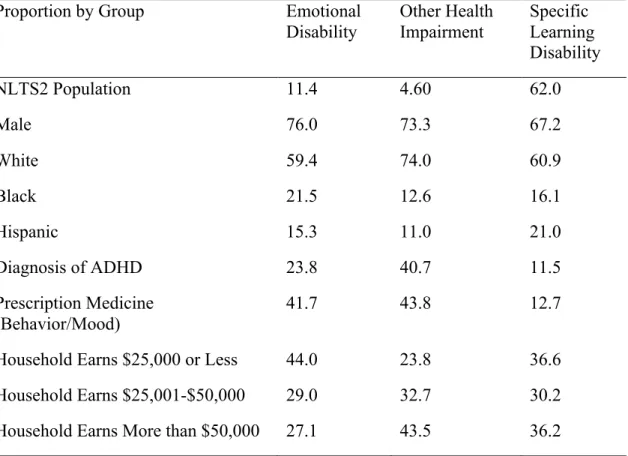
1. Student characteristics ...46
2. Behavior intervention services ...54
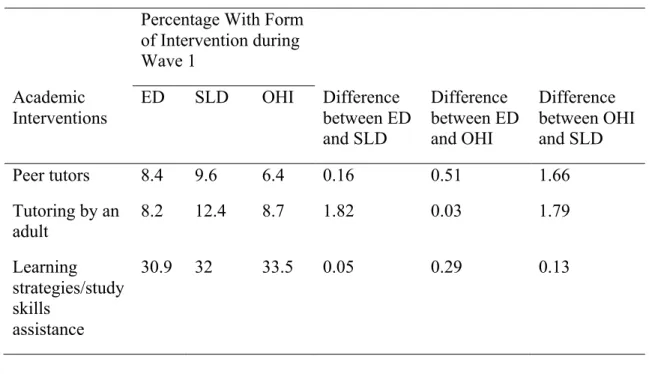
3. Academic intervention services ...55
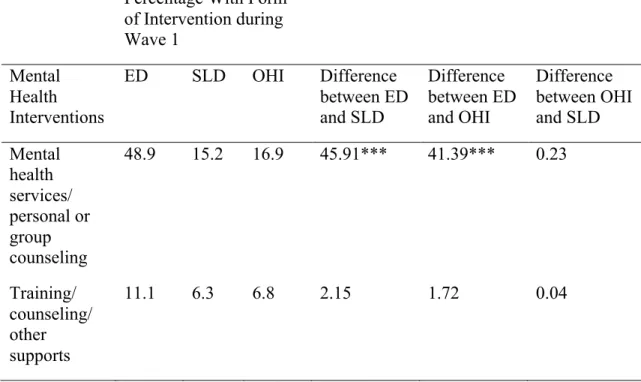
4. Mental health intervention services ...56
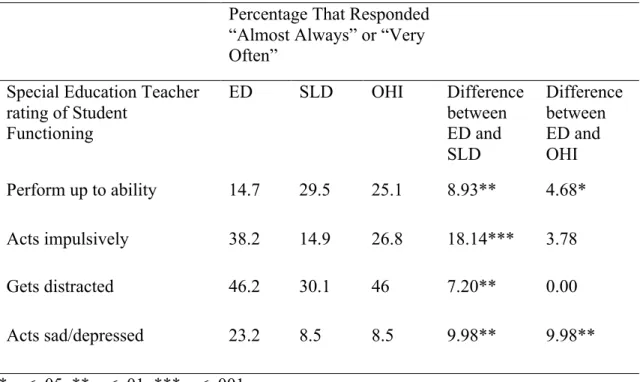
5. Special education teacher’s report of student functioning ...57
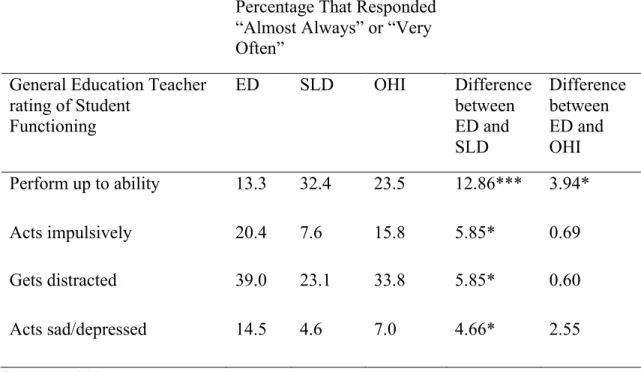
6. General education teacher’s report of student functioning ...58
ABBREVIATIONS
ADHD Attention Deficit Hyperactivity Disorder
CBT Cognitive Behavioral Therapy
ED Emotional Disability
IDEIA Individuals with Disabilities Education Improvement Act of 2004
OHI Other Health Impairment
CHAPTER 1
INTRODUCTION
School-age children with disabilities receive special education services under Part B
of the Individuals with Disabilities Education Improvement Act of 2004 (IDEIA, 2004, Pub.
L. No. 108-446, 118 Stat. 2647). The primary purpose of IDEIA is to ensure (1) all children
with disabilities are provided with a free and appropriate public education with special
services; (2) children’s and parent’s rights are protected; (3) educators and parents have the
tools they need to best support the education of children with disabilities, and; (4) efforts to
educate children with disabilities are effective (IDEIA, 2004, Pub. L. No. 108-446, "!602,
118 Stat. 2647). Students are eligible for special education if they have a disability defined
by meeting criteria for one of the following fourteen categories: autism (AU), deaf-blindness,
deafness, developmental delay (DD; children ages 3-9), emotional disturbance (ED), hearing
impairment (HI), intellectual disability (ID), multiple disabilities (MD), orthopedic
impairment (OI), other health impairment (OHI), specific learning disability (SLD), speech
or language impairment (SLI), traumatic brain injury (TBI), or visual impairment (VI),
including blindness. From 2008-2009 approximately 13.2 percent of students received
special education services (U.S. Department of Education, 2011).
Students in special education are not exempt from the same requirements general
education students must fulfill under the Reauthorization of the Elementary and Secondary
Child Left Behind [NCLB], 2002). Under ESEA, students in special education are mandated
to complete annual assessments and are expected to make yearly progress (Browder and
Cooper-Duffy, 2003). To ensure students in special education satisfy their educational
requirements and goals, conducting an assessment of their overall functioning and providing
appropriate interventions are necessary.
Undeniably, academic interventions are a pertinent part of special education students’
academic program, as their disabilities significantly impact their academic performance and
functioning. However, functioning and interventions related to behavioral and mental health
are equally important, as students in special education have been known to experience more
behavioral difficulties, lower self-esteem and confidence, experience less peer acceptance,
and feel lonelier compared to their general education peers (Daniel and King, 1997; Valas,
1999). Rather than examining students based on special education categories, arguably, it is
more important to understand a student’s strengths and weaknesses in their academic,
behavioral, and mental health functioning as a means of informing their school-based
interventions (Simeonsson, 2009). The ED, SLD, and OHI groups are distinct categories
under IDEIA 2004; however, students identified under the three categories often share
similar academic and behavioral concerns (Bradley et al., 2008; Forness & Kavale, 2001;
Kortering, 2009; Kortering & Christenson, 2009; Schnoes, Reid, Wagner, & Marder, 2006),
making them ideal groups to compare and contrast with regard to functioning and
interventions.
This study compares school-based academic, behavioral, and mental health services,
and the functioning of students in the ED, OHI, and SLD categories. To this end, an
literature describes common issues faced by children and adolescents served under ED, OHI,
and SLD categories, and compares and contrasts the interventions often provided to students
identified with an ED, OHI, and SLD. The literature review concludes with the rationale for
the present study and proposed research questions. Lastly, the methodology to answer the
CHAPTER 2
LITERATURE REVIEW
In this section, an overview of the characteristics of students served under ED, OHI,
and SLD is provided, as well as the prevalent issues facing these three populations. Next,
interventions targeting the academics, behaviors, and mental health of students identified
with an ED, OHI, and SLD are discussed. Concluding this section is the rationale for the
proposed study and the research questions.
Functional Characteristics of Students with Emotional Disturbances
Emotional disturbance (ED) is an eligibility category under the Individuals with
Disabilities Education Improvement Act of 2004 (IDEIA). During the 2008-2009 school
year, approximately 0.9 percent of students out of the total population and 6.5 % of special
education students received services under the ED category (U.S. Department of Education,
2011). A variety of different terms are used to define this category, with individual states
developing the disability definition with guidance from IDEIA 2004. For example, these
terms include, Serious Emotional Disability, Serious Emotional Disturbance, Emotional
Disability, Behavioral Disability, or Emotional/Behavioral Disability, which is considered a
more global term to describe students who fall into the special education category. The
federal definition of ED is as follows:
sensory, or health factors.
(b) An inability to build or maintain satisfactory interpersonal relationships with peers and teachers;
(c) Inappropriate types of behavior or feelings under normal circumstances; (d) A general pervasive mood of unhappiness or depression;
(e) A tendency to develop physical symptoms or fears associated with personal or school problems.
Emotional disturbance includes schizophrenia. The term does not apply to children who are socially maladjusted, unless it is determined that he/she is also seriously emotionally disabled (Assistance to States for the Education of Children with Disabilities and Preschool Grants for Children with Disabilities, 2006, pg. 46756).
Several disabilities and disorders in the Diagnostic and Statistical Manual of Mental
Disorders Fourth Edition, Text Revision (DSM-IV-TR; APA, 2000) meet the ED eligibility
criteria when evidence suggests that a student’s disorder significantly impacts their
educational performance. DSM-IV-TR disorders can include but are not limited to unipolar
depression, bipolar disorder, anxiety disorders, psychosis, and a variety of other psychiatric
disorders (Duncan, Forness, Hartsough, 1995; Mattison et al., 1986). Parents often report
these characteristics as the disabling conditions and problems their child with ED faces
(Wagner, Kutash, Duchnowski, Epstein, and Sumi, 2005).
However, some disorders are not recognized under IDEIA, 2004 in that the ED
category does not include students who are identified as socially maladjusted. Ironically,
there is no federal or state definition of the term socially maladjusted, leaving states to
interpret the meaning of the term on their own. Reference to this term often implies students
characterized by purposeful, deviant behavior, such as gang behavior, truancy, and theft
(Merrell and Walker, 2004). A consequence of the exclusion is to deny special education
services to children who have been diagnosed with conduct disorder and oppositional defiant
disorder. The ‘socially maladjusted’ clause may be viewed as unfortunate because many of
In fact, Costenbader and Buntaine (1999) found students with ED and those who are
identified as ‘socially maladjusted’ generally do not present with distinct behavioral patterns.
Demographic characteristics, such as race and socio-economic status, are
disproportionately represented among students served under the ED category compared to
students in other special education categories and the general population. The majority of
ED students tend to be male, and African Americans constitute a larger percentage compared
to what is represented in the general population and other disability categories (Wagner et al.,
2003; Wagner et al., 2005). In contrast, females and Latino students tend to be
underrepresented (Reddy, 2001; Wagner et al., 2005). There are significantly higher rates of
students with ED living in poverty than students in general education and those with other
disabilities (Wagner et al., 2005). Likewise, there are significantly more students with ED
being raised by a single parent or living with relatives, and who have a parent unemployed
than students with other disabilities and those in general education (Wagner et al., 2003;
Wagner et al., 2005). Students with ED more frequently come from households at greater
risk for poverty (Wagner et al., 2003).
Students who are identified under ED often encounter more severe academic
difficulties compared to children and adolescents being served in other special education
categories (Bradley et al., 2008; Wagner and Cameto, 2004). For instance, students served
under the ED category often have their disability identified at an age later than students with
other disabilities (Wagner et al., 2003; Wagner et al., 2004). Even after they are identified
and receiving services, parents more often report that their child served under ED received
mostly Ds and Fs compared to students identified with OHI or SLD. This discrepancy exists
cognitive assessments (Bradley et al., 2008). Evidence suggests students with ED make
fewer gains in reading than those served under SLD (Anderson, Kutash, and Duchnowski,
2001). Suspension and expulsion rates of students with ED in elementary, middle, and high
school are higher than for other special education categories (Wagner et al., 2005), even
when compared to students served under OHI (Bradley et al., 2008) and SLD (Achilles,
McLaughlin, and Croninger, 2007). Compared to students with OHI and SLD, those with
ED had lower rates of attending any type of postsecondary education institution (Newman,
Wagner, Cameto, and Knokey, 2009) and were more likely to drop out of secondary school
(Bradley et al., 2008). Students identified with ED evidence higher rates of employment than
attending a postsecondary institution; however, rates of employment for students with ED are
still lower than that of students in the SLD and OHI categories (Newman et al., 2009).
Research provides evidence indicating students with ED have deficits in their
language and communication skills. In a systematic literature review of 26 studies, Benner,
Nelson, and Epstein (2002) found about 70 percent of those identified under the ED category
also had expressive, pragmatic, and receptive language difficulties. Further, their review also
showed over half of the children identified with language impairments were also identified as
students with ED. Parents recognize their children’s problems with communication, with
about a third describing their children with ED as having difficulty with both understanding
what others say and expressing themselves (Wagner et al., 2005).
Students categorized under ED also encounter more behavioral and social difficulties
than students in other special education categories. Post-high school, those who received
services under the ED category had significantly higher rates of carrying weapons,
categories (Newman et al., 2009). Problems of students being served under ED include the
highest rates of daily cigarette smoking, alcohol consumption, marijuana, and any other
illegal drug use when compared to those from other special education categories (Yu, Huang,
and Newman, 2008).
The internalizing behaviors and experiences of children and adolescents in the ED
category are equally important. The very nature of the ED definition means there will be
some students in the category experiencing internalizing disorders, that is, a general
pervasive mood of unhappiness or depression (Cullinan and Sabornie, 2004). The literature
suggests students in the ED category who are characterized by more externalizing behaviors
also experience internalizing behaviors, such as depression, especially students who are older
and in self-contained classrooms (Allen-Meares, 1991). Maag and Behrens (1989a) reported
that depression existed in over 20 percent of their ED sample and research also suggests that
levels of depression among students under the ED category are higher than that of the general
education population (Cullinan & Sabornie, 2004; Cullinan, Schloss, and Epstein, 1987;
Stanley, Dai, and Nolan, 1997).
Further, rates of depression in the ED population tend to be similar to the rates in
other special education categories, such as SLD (Maag and Behrens, 1989a; Stanley et al.,
1997), and females tend to endorse more severe levels of depressive symptoms, especially at
the secondary level (Maag and Behrens, 1989a; Maag and Behrens, 1989b). While evidence
suggests students in the ED category will endorse depressive symptoms (Allen-Meares,
1991), especially females (Maag and Behrens, 1989b), recent national findings reveal that
students identified under the ED category rarely report any feelings of depression (Wagner,
how they feel but are unable to recognize or verbalize those experiences as sadness or
depression.
The difficulties students with ED manifest may be organic in nature, related to social
risk, or learned behaviors (Sprague and Walker, 2000). Regardless of etiology, these students
encounter difficulties navigating and accessing their education and social systems (Wagner et
al., 2006). Therefore, the availability of school-based interventions and services for students
with ED is of particular importance.
Functional Characteristics of Students with Specific Learning Disabilities
According the U.S. Department of Education (2011), during the 2008-2009 school
year approximately five percent of the student population and 30 percent of special education
students received services under the SLD category, making it the largest special education
category. Under IDEIA, a Specific Learning Disability (SLD) is defined as:
A disorder in one or more of the basic psychological processes involved in
understanding or in using language, spoken or written, which may manifest itself in the imperfect ability to listen, think, speak, read, write, spell, or do mathematical calculations, including conditions such as perceptual disabilities, brain injury, minimal brain dysfunction, dyslexia, and developmental aphasia.
Specific learning disability does not include learning problems that are primarily the result of visual, hearing, or motor disabilities, or mental retardation, of emotional disturbance, or of environmental, cultural, or economic disadvantage. (Assistance to States for the Education of Children with Disabilities and Preschool Grants for Children with Disabilities, 2006, pg. 46757).
As noted in the definition of SLD, a student can be identified with a learning
disability in many domains (i.e. reading, writing, math, speaking), but a deficit in one of
these areas cannot be better attributed to a disruption in emotional regulations, such as with
ED, economic circumstances, or any other disability. Therefore, a specific learning disability
1996). Similar to students with ED, individuals identified with SLD in schools also may
have a DSM-IV-TR diagnosis, such as a Reading Disorder, Mathematics Disorder, Disorder
of Written Expression, or Learning Disorder Not Otherwise Specified. However, a student
who has one of the DSM-IV-TR diagnoses mentioned above may not qualify for special
education services under SLD if there is no impact on their educational performance, as
defined by the school.
With regard to academic achievement, as expected, students identified under the SLD
category exhibit more academic deficits than their general education peers (Lane, et al.,
2006). These academic deficits leave students identified with SLD more at risk for school
dropout than their general education peers (Morrison & Cosden, 1997). Additionally,
research indicates students with SLD who have graduated from secondary school have lower
rates of attending postsecondary education and graduating from a postsecondary institution
compared to their peers without a disability (Murray, Goldstein, Nourse, & Edgar, 2000;
Fourqurean, Meisgeier, Swank, Williams, 1991). Regarding post-high school employment,
students who were identified with SLD in school have higher rates of employment than
postsecondary education enrollment, but they are more likely to be employed in lower paying
jobs than their general education peers (Fourqurean et al., 1991).
In terms of behavioral characteristics, students identified with SLD typically exhibit
lower levels of behavioral difficulties than their peers identified under the ED category
(Lane, et al., 2006; however, compared to their general education peers, students with SLD
are at a higher risk for behavioral problems (Lyon, 1996; Nowicki, 2003), secondary to their
SLD (Lyon, 1996). The behavioral problems can vary depending on the student, but some
withdrawn behavior (McKinney, 1989). Unfortunately, the behavioral difficulties in students
with SLD can lead to a greater risk for encounters with the juvenile justice system than their
general education peers (Bender & Wall, 1994; Morrison & Cosden, 1997).
While research suggests that students served under the category of SLD exhibit
greater levels of social competence than their peers served under ED (Lane, et al., 2006), a
meta-analysis conducted by Kavale and Forness (1996) indicated that approximately 75% of
students with learning disabilities demonstrated more social skills deficits than their general
education peers. According to teacher, peer, and self-reports, common social deficits
included less interaction with peers, peer rejection, and lower social status (Kavale &
Forness, 1996). Social skill deficits in students with learning disabilities have been widely
studied because it has been observed to significantly impact this group’s interpersonal
relationships and peer acceptance across the lifespan (Bender and Wall, 1994). After leaving
secondary school, adults who were previously served under the SLD category reported more
social difficulties, having more relationship issues, and feeling most comfortable around
others with SLD (Bruck, 1987; Gerber, 2012; Shessel & Reiff, 1999).
With regard to the mental health of students served under the SLD category, research
suggests that they are at greater risk than typical peers for depression and anxiety
(Huntington & Bender, 1993; Maag & Reid, 2006; Morrison & Cosden, 1997). Students
identified with SLD are at a higher risk for reporting low self-efficacy, or confidence (Bender
& Wall, 2004; Klassen & Lynch, 2007), even though many teachers perceive their student
with SLD as seeming overconfident with their schoolwork (Klassen & Lynch, 2007). In
addition to risks of feeling less confident, research suggests that students served under the
levels of anxiety and depression, and are at higher risk of suicide than their general education
peers (Bender & Wall, 1994).
Functional Characteristics of Students with Other Health Impairments
Under IDEIA the category of Other Health Impairment (OHI) is defined as having
limited strength, vitality, or alertness, including a heightened alertness to environmental
stimuli, that results in limited alertness with respect to the educational environment, that—
(a) Is due to chronic or acute health problems such as asthma, attention deficit disorder or attention deficit hyperactivity disorder, diabetes, epilepsy, a heart condition, hemophilia, lead poisoning, leukemia, nephritis, rheumatic fever, sickle cell anemia, and Tourette syndrome; and
(b) Adversely affects a child’s educational performance. (Assistance to States for the Education of Children with Disabilities and Preschool Grants for Children with Disabilities, 2006, pg. 46717).
During the 2008-2009 school year, approximately 1.3% of the total population and 10% of
students with disabilities were served under the OHI category (U.S. Department of
Education, 2011). As stated above, several health conditions fall under the OHI umbrella.
More common medical diagnoses include epilepsy and asthma (Wodrich & Spencer, 2007),
but over half of the students who receive services under the OHI category have a diagnosis of
Attention-Deficit/Hyperactivity Disorder (ADHD; Forness and Kavale, 2001; Schnoes, Reid,
Wagner, and Marder, 2006).
ADHD is a mental disorder (DSM-IV TR) that occurs in approximately 3-7% of
school-age children and is defined as a consistent pattern of difficulties with attention,
hyperactivity, and/or impulsivity that is more frequent and severe than typically seen in
same-aged peers (APA, 2000). This pattern of difficulties must occur in at least two different
settings (e.g. home and school), prior to age seven, and with resulting impairment that
Currently, there are three types of ADHD defined by DSM-IV TR: ADHD,
Predominately Inattentive Type, ADHD Predominately Hyperactive-Impulsive Type, and
Combined Type. The following are some features characteristic of each type. According to
the DSM-IV-TR, individuals with the predominately inattentive type often make careless
mistakes on tasks, fail to give close attention to details, and are distracted by irrelevant
stimuli. They often find it difficult to follow through with requests, struggle with
organization, and have difficulty completing tasks (APA, 2000). Individuals with the
predominately hyperactive-impulsive type often fidget and find it difficult to remain in their
seat. Hyperactive behavior manifests in such a way that a person may seem like they are
always “on the go” or talking excessively. Individuals with impulsive behavior often appear
impatient, frequently interrupt, and blurt out answers before questions have been completed
(APA, 2000). Individuals with ADHD, Combined type manifest both the inattentive and
hyperactive-impulsive behaviors that are mentioned above (APA, 2000). Because there is no
literature specifically focusing on the functioning and interventions for students under the
OHI category, literature focusing on the functioning and school-based services for students
with ADHD will be presented, as they represent the largest percentage of students being
served under OHI.
With regard to racial characteristics, unlike the ED category, research suggests that
African Americans are not overrepresented in the ADHD group. In contrast, Hispanic
students are underrepresented (Reid, Maag, Vasa, and White, 1994; Schnoes, et al., 2006).
Consistent with many special education categories, males are overrepresented in the ADHD
education population, students served under ADHD tend to be from low-income households
(Schnoes, et al., 2006).
In terms of academic achievement, students with ADHD who receive special
education services often demonstrate poor academic performance across all academic areas
during primary and secondary school (Berthiaume, 2006; Bussing, et al., 2012; Loe &
Feldman, 2007; Wu & Gau, 2013; Zentall & Ferkis, 1993). In addition, students with ADHD
tend to do poorer on standardized tests (Bussing, et al., 2012) and have lower IQ scores than
general education students (Loe and Feldman, 2007). Furthermore, students with ADHD
often take longer to complete high school, have increased rates of retention, and have
decreased rates of postsecondary education compared to their general education peers
(Bussing, et al, 2012; Loe and Feldman, 2007). Research suggests that the inattention and
executive functioning deficits associated with ADHD are related to experiences with
academic problems, not the observed hyperactive/impulsive behaviors (Daley and
Birchwood, 2009). In contrast, the hyperactive/impulsive behaviors are prone to result in
aggressive behaviors (Gaub & Carlson, 1997; Paternite, Loney, Salisbury, and Whaley,
1999) that result in significantly more suspensions and expulsions than their general
education peers (LeFever, Villers, Morrow, and Vaughan, 2002). Unfortunately, many of the
externalizing behaviors exhibited by students under ADHD affect post-school experiences,
such as higher rates of employment termination (Barkley, et al., 2002).
Though not as severe as students identified under ED, students with ADHD also
experience negative social difficulties, especially when compared to their general education
peers (DuPaul, 2007; Hoza et al., 2005; Stormon, 2001). For example, Hoza and colleagues
that their disruptive and off-task behaviors are often what lead to the problems experienced
with peers (Stormont, 2001). Furthermore, DuPaul (2007) suggests that the negative social
experiences for students with ADHD are often a result of (a) not following rules of reciprocal
conversation, (b) joining activities abruptly and inappropriately, and (c) problems with
aggressive (verbal or physical) behaviors. For some students with ADHD, issues with peer
relationships may be related to experiences with depression. Research suggests that children
with ADHD and depression tend to have lower self-esteem and more anxiety, especially as it
was related to popularity (Bussing, Zima, and Perwien, 2000).
Comparing ED, SLD, and OHI
Although ED, SLD, and OHI are distinct special education categories as described
under IDEIA, students served under these three categories share a number of characteristics
(Bradley et al., 2008; Forness & Kavale, 2001; Kortering, 2009; Kortering and Christenson,
2009; Schnoes, et al., 2006). For example, studies have found students in both groups
experience low academic achievement (Lane, Carter, Pierson, and Glaeser, 2006) and
students with SLD and student with an ED have no significant differences in their cognitive
abilities (Bradley et al, 2008; Goran and Gage, 2011). The main difference between the two
groups is that the ED population tends to have more behavioral and social difficulties than
students identified with SLD (Goran and Gage, 2011; Lane et al., 2006; McConaughy,
Mattison, and Peterson, 1994). Students identified with an ED may experience more
behavioral and social difficulties but Handwerk and Marshall (1998) found no significant
differences between ED and SLD groups on teacher reports of attention problems. In the
under the ED category were also served under the SLD label (Chandler and Jones, 1983a;
Chandler and Jones, 1983b).
Further, students with ED and ADHD are more likely to be suspended or expelled
compared to other students (Achilles et al, 2007). Lastly, students who meet criteria under
ED, SLD, and OHI experience more difficulty matriculating from high school (Kortering,
2009; Kortering and Christenson, 2009). Based on the literature demonstrating the similar
characteristics shared among the three groups, ED, SLD, and OHI are ideal groups to
compare and contrast.
The research presented above provides evidence of the difficulties students identified
with ED, SLD, and OHI encounter. Fortunately, several interventions have been developed
to address the needs of students in all three categories.
Behavior Interventions
ED: Behavior Interventions. The literature consistently indicates students
categorized with ED have significant academic difficulties across the areas of math, reading,
and writing (Nelson, Benner, Lane, and Smith, 2004; Reid, Gonzalez, Nordness, Trout, and
Epstein, 2004; Trout, Nordness, Pierce, and Epstein, 2003; Wagner et al., 2005). Studies also
show externalizing and internalizing behavior problems are predictive of poorer academic
performance (Lane, Barton-Arwood, Nelson, and Wehby, 2008; Nelson et al., 2004),
however, there is evidence indicating externalizing behavior problems do not account for all
of the deficits observed in the academic performance of student with ED (Nelson, Benner,
Neillm and Stage, 2006). Accordingly, there are interventions seeking to address the
behavioral, academic, and psychological needs of students identified as meeting criteria
As noted above, students who qualify under the category of ED are a diverse group of
students who have a variety of needs. These needs are often of an academic, behavioral, and
mental health nature. A range of intervention approaches exists to meet the needs of students
who are at-risk and/or meet eligibility under ED. Common interventions range from those
targeting specific academic deficits (e.g. math, reading), behaviors common to ED, and
social skills. Many approaches have been effective in improving academic performance and
behaviors during the school years (Reddy, Newman, De Thomas, & Chun, 2009), but little is
known about the long-term benefits. A variety of interventions have been developed striving
to integrate best practices. These interventions focus on fostering relationships, using
academic supports (e.g., tutoring, small-group), using teachers trained to teach students with
ED, incorporating students’ interests and goals, providing access to mental health services,
and implementing early transition planning. The goal of these interventions is to promote
better school experiences for students with ED and a more successful transition to adulthood
(Wagner and Davis, 2006).
Of the various interventions that have been developed to target the behaviors of
students under the ED category, nationally, approximately half of the secondary students
served under ED receive behavioral interventions or are involved in a behavior management
plan (Wagner, et al., 2004). Common interventions to improve behavior in students with ED
involve peer tutoring, instruction or evaluation. Peer tutoring is an instructional strategy that
links students together to practice an academic task. Locke and Fuchs (1995) described
positive findings of on-task behavior and social interaction of fifth and sixth grade boys with
ED following an intervention of peer reading instruction. Similarly, in a program using
student with ED, Kamps, Kravits, Rauch, Kamps, and Chung (2000) found a reduction in
inappropriate and negative behavior and an increase in positive behaviors and academic
engagement. While there is a large body of literature addressing the efficacy of
peer-mediated approaches, there is little research specifically focused on such efficacy with
students with ED .
Research suggests that self-evaluation of personal behavior, a self-management tool,
is an effective intervention to improve the behavior of students with ED and helps provide
students with more responsibility and independence (McQuillan, DuPaul Shapiro, & Cole,
1996). For example, Sutherland and Snyder (2007) engaged middle school students with ED
in an intervention that included self-evaluation of their reading through graphing and
reciprocal peer tutoring. The results indicated a reduction in disruptive behavior and an
increase in active classroom responsiveness.
The development of interventions based on the function of a student’s behavior is an
effective tool for reducing disruptive behaviors in students with ED (Gage, Lewis, &
Stichter, 2012). These interventions are individualized and target the unique function of the
student’s behavior. Kern, Delaney, Clarke, Dunlap, and Childs (2001) examined the effect of
curricular modifications on the classroom behavior of elementary students with ED, which
were based on functional-behavior assessments. After curricular changes were implemented,
the authors observed an increase in academic productivity and task engagement, and a
decrease in disruptive behavior. In a similar study, Lane and colleagues (2007) presented
results of function-based interventions conducted with two middle school children identified
under ED. Both students responded well to the interventions, with increased participation,
Involving parents in school-based interventions is also an effective way of managing
behaviors of students served under ED. Research suggests that Parent-Teacher Action
Research (PTAR) is one such method. This approach includes a team comprised of a parent,
parent liaison, and the student’s teacher. The team plans the student’s specific academic,
behavioral, and social goals at school and home for the school year, and practical ways of
measuring progress. In conjunction with social skills instruction in the areas of
communication, interpersonal skills, personal skills, and response skills, this intervention
resulted in a decrease of aggression and social problems and an increase in on-task
engagement (McConaughy, Kay, & Fitzgerald, 1998). In the second year follow-up of the
PTAR program, McConaughy, Kay, and Fitzgerald (1999) again found improvements in the
PTAR group compared to the control group. They found significantly lower externalizing
and internalizing behaviors among students and improvement on measures of cooperation
and self-control.
Teachers and clinicians recognize the importance of providing all students with praise
and positive reinforcement. It is no different in classrooms with students being served under
ED. Sutherland, Wehby, and Copeland (2000) conducted a unique intervention in which
they sought to increase the number of behavior-specific praise statements (BSPS) the teacher
provided their students with ED as a way to increase the on-task behavior their students.
They conducted the intervention with one teacher who taught nine students with ED. The
teacher was taught to provide the students with specific praise statements, such as “Laura I
like the way you are sitting quietly and looking at me” vs. “Laura, good job today”. The
results revealed a short-term increase in the teacher’s rate of BSPS and a long-term increase
Another widely used and accepted intervention to address deficits in social
competence of students with ED is social skills training. Studies based on this approach,
however, have only shown modest positive results or no results at all (Maag, 2005). Social
skills training is an intervention focused on building social competence in students to help
them in their interactions with and acceptance from peers. Quinn et al. (1999) found
universal social skills instruction was not very effective with ED students in general, but
found it to be more effective when specific social skills deficits, such as cooperating, were
targeted. Other studies seem to suggest social skills interventions are only effective when
delivered in conjunction with other interventions (McConaughy et al., 1998). In a
comprehensive review of studies, Maag (2005) analyzed social skills training with ED
students and identified several issues limiting findings. These were, (1) students with ED
were not able to generalize the skills they learned to other settings and were not taught to do
so, and (2) there were no specific steps followed in social skills training, therefore
implementation of interventions differed with outcomes observed among students. Further
(3) social skills training did not correspond directly to the student’s deficiencies, and (4)
there were no valid treatment outcome measures to track student progress and determine if
the intervention was truly effective.
However, Cook and colleagues (2008) conducted a more recent meta-analysis of
efficacy of social skills interventions in adolescents with ED. Their results suggested social
skills may be an effective treatment for students with ED because improvements in social
competence were noted in over half of students with ED compared to just one third of
behaviors related to social competence it may be an effective tool, but if used to treat
behaviors in general, it may not be useful.
ADHD: Behavior Interventions. There was no literature on interventions explicitly
developed for students served under the OHI group, as the category includes a heterogeneous
group of students. As such, interventions are described that were developed specifically for
students with ADHD, the largest group represented in the OHI category. Several
interventions used with students served under ED are also used to target the behaviors of
students with ADHD. Some of these interventions include self-management strategies and
peer monitoring (Davies and Witte, 2000; Gureasko-Moore, DuPaul, & White, 2006; Mathes
& Bender, 1997). Self-management strategies are ideal tools to use in the schools because
they shift much of the responsibility of the teacher to the student (Cole, 1992). In addition,
when student accuracy training is incorporated, significant increases in positive behavior and
generalization have been noted (Ardoin & Marten, 2004; Hoff & DuPaul, 1998; Mathes &
Bender, 1997). One study exploring the efficacy of a self-management intervention with
three adolescent students diagnosed with ADHD found the intervention helped to increase
their organizational skills (Gureasko-Moore et al., 2006). The students were instructed on
how to manage their behaviors and organization through goal setting, use of a
self-monitoring checklist, and through self-evaluation of their progress toward goals. In addition,
students learned methods to identify problem areas and how to target the areas
(Gureasko-Moore, et al., 2006). Self-management interventions have also been found to positively
impact the performance of students who continued experiencing behavioral difficulties after
receiving pharmacological interventions (Mathes & Bender, 1997). The students were
or off-task whenever they heard a tone from a tape recorder in the classroom. Following
several days of training and independent self-monitoring, both with and without the cueing
tone, the students were found to have an increase in on-task classroom behaviors (i.e.
attending to instruction, completing assignments; Mathes & Bender, 1997).
Research suggests that goal-setting interventions, a component of self-management
strategies, are an effective tool when combined with computer-assisted instruction (CAI;
Mazzotti, Wood, Test, and Fowler, 2012). In general, CAI uses computer software to offer
an alternative, interactive method for students to learn skills, whether they are behavioral or
academic in nature (Clarfield & Stoner, 2005; Mautone, DuPaul, & Jitendra, 2005; Ota &
DuPaul, 2002; Raggi & Chronis, 2006; Mazzotti, et al., 2012). Mazzotti and colleagues
(2012) coupled the Self-Determined Learning Model of Instruction (SDLMI) and CAI to
teach students how to set goals, make a plan to manage the goal, and make changes to meet
the goal. Results suggested as participants learned more about goal-setting methods through
computer-assisted SDLMI, there was a reduction in their disruptive behavior (Mazzotti,
2012).
Similar to self-management interventions, peer-monitoring allows teachers to assign
more responsibility to students for managing their behavior (Davies and Witte, 2000).
Fowler (1986) explains that peer monitoring is a strategy used to encourage students to
monitor each other’s behavior and reinforce positive behavior in one another. Davies and
Witte (2000) completed a study examining the efficacy of an intervention, combining peer
monitoring and self-monitoring, on the talking-out behaviors of four students with a
diagnosis of ADHD. After training and implementing the intervention, the researchers found
maintenance of these behaviors. Therefore, peer monitoring may be a useful intervention in
the classroom and may potentially help students with ADHD experience less difficulty with
their peers.
Functional assessment-based interventions are also another effective approach in
targeting the off-task and disruptive behaviors of students with ADHD (DuPaul, et al., 2013;
Ervin, et al., 2000; Ervin & DuPaul, 1996; Ervin, DuPaul, Kern, & Friman, 1998; Schultz,
Storer, Watabe, Sadler, & Evans, 2011; Stahr, Cushing, Lane, & Fox, 2006). As mentioned
in the behavioral intervention section for students with ED, assessments based on the
function of a student’s behavior allows practitioners to individualize the intervention to the
unique function of a student’s behavior (Gage, et al., 2012). For example, Ervin, et al.,
(2000) implemented function-based interventions with three students with ADHD, and
findings indicated environmental modifications helped decrease undesirable behaviors.
Similarly, Stahr, et al. (2006) collected functional assessment data indicating that his
behaviors were maintained by attention and escape from tasks. After implementing
interventions targeting these areas, a decrease in off-task and disruptive behaviors were
observed.
Another intervention that has been found effective for students with ADHD is that of
contingency management (Loe & Feldman, 2007; Pelham, Wheeler, & Chronis, 1998).
Contingency management is a technique whereby a consequence (usually a reward) is
contingent upon specific behaviors. This can be used individually, or classroom-wide with
additional contingencies tailored specifically to the preferences of certain students. Common
interventions employ token reinforcement or point systems, whereby students earn
tokens/points collected for a reward/prize (Hackenberg, 2009). Contingency interventions
can be implemented in a variety of creative ways. For example, students can use daily report
cards, in which specific behavioral goals are outlined, and when attained, the student receives
a reward at home (Chronis, Jones, & Raggi, 2006; Fabiano, et al., 2010; O’Leary, Pelham,
Rosenbaum, & Price, 1976). Another way contingency management has been found to help
improve the classroom behavior of special education students with ADHD is through the use
of physical activity as a reward/positive reinforce (Azrin, Vinas, & Ehle, 2007).
Similar to the research findings for students with ED, social skills interventions have
not been found effective for students with ADHD (Pelham, et al., 1998). While students with
ADHD often struggle in their peer relationships because of their overly active and impulsive
behaviors, social skills interventions often do not have an impact because training is usually
focused on skill deficits (DuPaul & Weyandt, 2006). One promising use of social skills
interventions in students with ADHD is when it is combined with parent training (Chronis, et
al., 2006). Although parent training is not very feasible in the school setting, when parent
training is combined with social skills training, behavior improvements and generalization of
skills have been noted in school and home (Chronis, et al, 2006).
SLD: Behavior Interventions. While the literature suggests that students served
under the SLD category are at risk for behavioral problems (Lyon, 1996; Nowicki, 2003),
there are no interventions specifically developed to target behavioral problems that students
with SLD may experience. It can be assumed that if behavioral interventions are needed for
a student served under the SLD category, interventions are similar to those provided for
Like students with ED and ADHD, social skills interventions are another type of
intervention often used with the SLD population; however, they have not proven to be an
effective intervention for students identified with SLD (Forness & Kavale, 1996; Kavale &
Mostert, 2004). Social skills interventions seem to be ineffective in treating the social skill
deficits evident in students with SLD for several potential reasons. Forness and Kavale
(1996) and Kavale and Mostert (2004) suggest that social skills interventions do not
adequately serve students with SLD because the interventions are often short-lived and have
not considered the theoretical underpinnings of why social skill deficits exist in students with
SLD.
Behavior interventions summary. Students in the ED and ADHD categories
receive similar behavioral interventions. Interventions commonly provided to students in
both groups include peer-mediated interventions (i.e. peer tutoring, peer monitoring),
functional assessment-based interventions, and self-management strategies (Joseph &
Eveleigh, 2011). In addition, social skills interventions are generally not effective in treating
the behavioral or social difficulties exhibited in social contexts for students with ED, ADHD,
or SLD. Overall, students served under ED and students with ADHD appear to benefit
similar types of behavioral interventions, although the rate at which each groups receives the
interventions are unknown.
Academic Interventions
ED: Academic Interventions. The positive impact of peer-mediated interventions,
such as peer-tutoring, on the problem behaviors of students identified with ED is comparable
to its usefulness in targeting their academics (Miller, 2005). Ryan, Reid, and Epstein (2004)
The interventions involved students who taught their peers on a teacher-selected lesson. They
reviewed studies including peer groups of children and adolescents of the same age and
different ages focusing on a variety of academic subjects, such as math, reading, spelling,
history, English, and science. The results of the review indicated peer-mediated interventions
were generally successful in improving the academic achievement of students with ED across
different academic areas and grade levels.
Self-management is a common intervention used to enhance the academic
achievement of students identified with ED. Self-management interventions mainly include
self-monitoring, self-evaluation, self-instruction, goal-setting, and strategy instruction
(Mooney, Ryan, Uhing Reid, and Epstein, 2005). In a review of self-management
interventions for individuals with ED, Mooney et al., 2005 found the interventions mostly
improved math calculation skills, but were also found effective for writing, reading, and
social studies.
Reading deficits are of particular concern in students with ED, especially since much
of the evidence suggests a relationship between reading difficulties and antisocial behavior in
the ED population. Many interventions have therefore been created to target this academic
area. McLaughlin (1992) investigated the impact of a written feedback intervention on the
reading of 5 male students in a self-contained classroom for students receiving services under
ED. The written feedback intervention provided the students with positive reinforcement on
their performance, such as “Better than yesterday” or “You’ve really improved”. The results
of the intervention indicated an improvement in the student’s reading performance.
Wehby, Falk, Barton-Arwood, Lane, and Cooley (2003) investigated the effect of a
participants were eight students receiving services under ED in a self-contained special
education classroom. The reading interventions included two programs: Open Court Reading
(OCR; Adams et al., 2000), a curriculum for K-1st grade readers focused on blending sounds
into words administered to students 4 days a week for 45 minutes, and Peer-Assisted
Learning Strategy (PALS), a program in which students with ED were paired with higher
performing students to work on activities enhancing fluency, letter-sound associations,
decoding simple words, and recognizing sight words. The interventions resulted in moderate
gains in nonsense word fluency, sound naming, blending, and segmenting achievement areas.
However, there were no gains in the student’s standardized scores or a decrease in problem
behaviors. Similarly, in a reading intervention using Horizons Fast Track program and
Peer-Assisted Learning Strategies, Barton-Arwood, Wehby, and Falk (2005), found
moderate improvement, with inconsistent results across reading skills, such as phoneme
blending and segmentation, nonsense word fluency, word reading and oral reading fluency.
Academic engagement improvements were also found to be directly related to the
intervention. However, a reading intervention using the Corrective Reading program along
with a repeated reading intervention in which students read passages several times resulted in
reading fluency growth (Strong, Wehby, Falk, and Lane, 2004). This suggests that readings
programs should be carefully selected for use in the ED population, with a focus on reading
programs developed or adapted specifically for students with ED.
Another intervention with promising results with the ED population includes
providing choice and preferred rewards when completing academic tasks. Cosden, Gannon,
and Haring (1995) conducted a study examining the effect of student-control on academic
indicated that when some students with ED were provided with choice over academic tasks
and rewards for completion of the tasks, they demonstrated a significant increase in academic
task completion and accuracy. Dunlap et al. (1994) also conducted a study on academic
choice making with students in ED classrooms and found it helped to increase
task-engagement and decrease problem behaviors. Similarly, Sutherland, Alder, and Gunter
(2003) presented evidence indicating that when students with ED are given more
opportunities to respond to academic tasks, the students provided more correct responses,
were more academically engaged, and demonstrated less disruptive behavior.
Though there is minimal research on the long-term impact of school-based
interventions, Sinclair, Christenson, and Thurlow (2005) conducted a four-year follow up of
a study on the effects of an evidence-based intervention, check & connect, for students
classified as ED. The Check and connect intervention consists of seven components: routine
monitoring, individualized intervention, relationship building, academic motivation,
following students from school to school, problem solving, and encouraging affiliation with
school and learning. Compared to the control group, the students with ED who received the
check & connect intervention had a lower percentage of dropout and higher attendance and
enrollment status in school.
All of the academic interventions discussed thus far are school-based but the home
setting is also important because many of the academic difficulties and problem behaviors
manifest in the home. Cancio, West, and Young (2004) developed a homework completion
intervention program for parents to implement at home with their six middle school boys
served under ED. The intervention involved parent training, student homework contracts,
homework completion. Following the intervention, the students increased homework
completion, homework accuracy, and mathematics achievement.
ADHD: Academic Interventions. Interventions developed to target behavioral
difficulties in students with ADHD are similar to academic interventions used for students
with ADHD. For example, some of the more common and effective interventions include
tutoring, task/instruction modifications, self-monitoring, strategy instruction, and
homework-focused interventions (Daley & Birchwood, 2009; DuPaul, 2007; Nowacek & Mamlin,
2007).
The positive impact of peer monitoring on behavior has been found to help improve
the academic performance of students with ADHD. Peer tutoring is an academic intervention
in which a student provides one-to-one instruction and/or assistance to another student
(Daley & Birchwood, 2009). This form of tutoring is often implemented class-wide
(Greenwood, Maheady, & Delquadri, 2002), and therefore would most benefit students who
are receiving special education services under OHI while they are in their general education
classes. For example, in one class-wide tutoring intervention study, they found that students
with ADHD had improved scores in math and spelling, and they demonstrated increased
academic engagement (DuPaul, Ervin, Hook, & McGoey, 1998). In addition, research
indicates an increase in academic performance for students with ADHD who received parent
tutoring, which involves individualized instruction, feedback, and dynamic responding (Hook
& DuPaul, 1999).
Modifications to academic tasks and/or instruction occur in a variety of ways, and are
usually individualized for students with ADHD in special education. For example,
the delivery of instruction (Daley & Birchwood, 2009). One study examining the use of
extended time for students with ADHD found that increased time on tasks resulted in a
greater number of problems being completed; however, students completed more problems
correctly when provided with the standard completion time (Pariseau, Fabiano, Massetti,
Hart, & Pelham, 2010). This finding indicates that extended time should be used with
caution and only if the student with ADHD would truly benefit from the modification. As
mentioned earlier in the behavior section for students with ADHD, teachers also use CAI as
an instructional modification for students with ADHD. With CAI, teachers use computer
software to supplement their own instruction. Case studies on the use of CAI for students
with ADHD have proved to be effective in improving math and reading performance, and
task engagement (Clarfield & Stoner, 2005; Mautone, et al., 2005; Ota & DuPaul, 2002;
Raggi & Chronis, 2006). Finally, students with ADHD may benefit from modifications
made to the group size. For instance, Hart, Massetti, Fabiano, Pariseau, and Pelham (2011)
conducted a study that found students with ADHD were more productive and on-task during
small-group instruction versus whole-group, but whole-group test-taking was more beneficial
when testing.
Self-monitoring interventions, in which students establish goals and monitor their
own progress, also have a positive impact on the academic performance of students with
ADHD (Daley & Birchwood, 2009). In one study, students with ADHD who were taught to
monitor and graph their own reading, writing, and math performance made significant
improvements in their academic performance (Shimabukuro, Prater, Jenkins, &
Edelen-Smith, 1999). While it seems logical that an individual’s academic performance would
with ADHD may have more academic improvements when self-monitoring their behavior
(Harris, Friedlander, Saddler, Frizzelle, & Graham, 2005). Harris and colleagues (2005)
conducted a study on self-monitoring of attention and self-monitoring of performance in
student with ADHD. The students made gains in both conditions but had significantly more
improvement in spelling when the students self-monitored their behaviors.
While there is limited research in this area, strategy instruction is a promising
academic intervention for students with ADHD (Daley & Birchwood, 2009; Nowacek &
Mamlin, 2007). Research indicates that direct strategy instruction helps to enhance the
academic performance of students with ADHD (Raggi & Chronis, 2006). Common
strategies taught include organizing materials, note taking, and the proper use of sticky notes
and highlighters (Stormont, 2008; Boyle & Rivera, 2012). Iseman and Naglieri (2011)
conducted a study on the impact of cognitive strategy instruction on math calculation.
During the intervention students with ADHD participated in discussions to evaluate and
reflect on the strategies they employed when completing math assignments. In addition,
students were encouraged to explore and use other strategies (e.g. checking their work).
Results of the study indicated that students with ADHD who participated in the cognitive
strategy intervention made greater improvements in their math performance and generalized
these skills to other math work (Iseman & Naglieri, 2011).
SLD: Academic Interventions. Research indicates reading interventions utilizing
additional information and explanations, modeling, small group instruction, cues and
reminders, and which encourage direct questions and dialogue amongst teachers and
students, or peers, are most helpful in enhancing the reading comprehension of older students
Fuchs, Williams, & Baker, 2001). For example, Chan, Cole, and Barfett (1987) used a
technique in which they directly instructed and provided explanations to students with and
without learning disabilities on how to identify inconsistencies within a sentence. Directly
teaching the strategies and providing explanations helped improve the reading
comprehension of students with SLD, but not for their non-disabled peers (Chan, et al.,
1987). With regard to the use of questioning and dialogue, Idol-Maestas (1985) studied the
use of providing comprehension questions cueing students with SLD to attend to important
information in text. The use of questions helped to increase their reading comprehension and
oral reading performance. However, once the intervention was removed, the students’
reading performance declined (Idol-Maestas, 1985). Lastly, another study used both direct
strategy instruction and questioning with students with SLD, which proved to be an effective
intervention (Chan & Cole, 1986). In different experimental groups, students identified with
SLD were taught to underline important and interesting text within a passage, or they were
taught to develop questions about the text they were reading (Chan & Cole, 1986).
Effective reading fluency interventions for students with SLD often include models of
reading fluency, such as the teacher or peer, and repeated reading with feedback (Chard,
Vaughn, & Tyler, 2002). For example, Simmons, Fuchs, Fuchs, Mathes, and Hodge (1995)
conducted a study incorporating peer tutoring and repeated reading, which implicitly
provided students in the study with a model. The students with SLD who received the
intervention performed significantly better than the control group on a reading fluency
measure (Simmons et al., 1995). Another study encompassed modeling by a teacher,
repeated reading with the teacher and a tutor, and peer reading (Sutton, 1991). The study
In terms of the most effective math interventions, students with SLD tend to benefit
most from interventions incorporating teacher-directed instructions, strategy instruction, and
self-monitoring (Kroesbergen & Van Luit, 2003; Maccini & Hughes, 1997; Maccini,
Mulcahy, & Wilson, 2007). For example, in 1989, Hastings, Raymond, and McLaughlin
conducted an intervention to improve the money counting skills in students with SLD. The
intervention involved directly teaching students how to count and teaching them strategies to
keep counted money and uncounted money separated. In addition, rewards were provided
for student who met the criteria set for them. The results of the study indicated that students
with SLD significantly improved in their money counting skills (Hastings, et al., 1989). In
2002, Scarlato and Burr provided teacher-directed instruction on fraction and decimal skills
to students with SLD. The instruction included teaching the skills, modeling the skills,
guided practice, independent practice, and corrective feedback; findings indicated that the
intervention helped improve their skills (Scarlato and Burr, 2002).
Regarding the use of self-monitoring procedures for math, Hutchinson (1993)
provided students with cue cards of self-questions for self-monitoring, a worksheet to help
students remember the goal, teacher modeling of the strategies, and corrective feedback. The
students with SLD who received the intervention demonstrated improvements on their math
problem-solving skills (Hutchinson, 1993). Similarly, teaching students self-instruction
skills for math problems involving multiplication and division proved to be an effective
intervention (Laird & Winton, 1993). Another intervention that expanded the use of
self-monitoring procedures included an intervention in which students with SLD learn to plan for
a task, attend to the material, simultaneously use various information to solve a problem, and
resulted in greater gains on math worksheets for students with SLD who had the lowest
scores during baseline (Naglieri & Johnson, 2000).
The most salient components of writing interventions for students with SLD, which
are similar to reading, involve teaching steps of a writing process, teaching and explaining
different types of writing, and feedback on writing from teacher or peers (Gersten & Baker,
2001). Once instruction is complete and students are taught to self-monitor their writing,
students with SLD are shown to make significant improvements (Shimabukuro, et al., 1999).
For example, students with SLD were taught how to self-monitor their writing, which helped
to increase their writing performance and accuracy (Shimabukuro, et al., 1999).
In general, Swanson & Hoskyn (2001) suggest that there are eight main instructional
strategies that comprise the most successful interventions for adolescents identified with
SLD. The eight strategies include: (1) verbal questioning and dialogue, whereby students
and teachers are developing questions and discussing the topics of focus; (2) sequencing and
segmentation of skills, which includes sequencing material with increasing difficulty; (3)
skill modeling and strategy cues, where teachers or peers are modeling the skills and
strategies students have learned; (4) proving organizing strategies and explicit practice; (5)
small-group setting for learning and practicing skills; (6) indirect teacher activities, such as
homework and parent help; (7) use of technology and computers for practicing skills such as
computer-assisted instruction; and (8) scaffolding of students (Swanson, 1999a; Swanson &
Deshler, 2003; Swanson & Hoskyn, 2001).
Academic intervention summary. The academic interventions provided to students
in the ED, ADHD, and SLD categories share some similar features but are substantially