"! ! ! ! !
Dissecting Transnational Rebels: The Dispossessed Peoples Effect
By Troy C. Homesley
A Thesis submitted to the faculty of the University of North Carolina in partial fulfillment of the require- ments of a degree with Honors in
Political Science.
Adviser: Dr. Navin Bapat
April 10, 2014
Approved By:
_________________________________
_________________________________
#!
Dissecting Transnational Rebels:
The Dispossessed Peoples Effect
Abstract
This paper examines the intricate relationship between dispossessed peoples and the occurrence of international crises. I contend that the existence of dispossessed peoples - ethno-political groups who reside in border areas and have been systematically denied crucial political, cultural and economic rights afforded to more incorporated individuals within their state - increase the likelihood of international crises. This contention arises from previous research that has shown territorial claims and rebel groups to be two of the primary accelerants of international conflict. Dispossessed peoples stand at the intersection of these two accelerants, placing them in a precarious sphere of international relations. Dispossessed peoples may threaten secession, co-optation by bordering states who might hold kindred groups, or cooperation with aggressor states. Additionally, dispossessed peoples are at a high risk of morphing into transnational rebel groups as they attempt to recover power through informal means when formal political power is denied or unachievable. To test this theory, I have compiled data from the Minorities at Risk database and the Correlates of War Dyadic Militarized Interstate Disputes database for the years 1940-2003. A series of empirical tests reveal that, globally, the effect of dispossessed peoples on international crises is statistically insignificant. However, in specific regions, the results vary. In the Middle East,
$! Introduction
A well known catalyst of international conflict is the existence of non-state actors,
and more specifically transnational rebels, in the border regions of states (Salehyan 2009).
Salehyan defines transnational rebel groups as "armed opposition groups whose
operations are not confined to the geographic territory of the nation-state(s) that they
challenge" (Salehyan 2009, 15). His research finds that where external rebel bases in
neighboring territories and militarized interstate disputes coincided, rebels were cited as a
major factor leading to conflict 83 percent of the time (Salehyan 2009, 110). Salehyan
also found that the existence of external rebel bases alone increases the probability of
conflict in any given year by 8 percent. This finding illustrates the impact that
transnational rebels have on conflict.
A crucial subset of non-state actors that has received little scholarly attention is
that of dispossessed peoples. I define dispossessed peoples as ethno-political groups
residing in border areas who have been systematically denied economic equality and
political rights that are afforded to more deeply incorporated individuals and groups
within the state. Dispossessed peoples are unincorporated—politically, economically and
sometimes culturally—into the center of the state. In this way, their ability to exercise
political power is limited. This lack of power is what makes their case especially
interesting. I test whether the existence of a non-state actor in the form of a group of
dispossessed peoples in the border region of a state affects the likelihood of militarized
interstate disputes of any kind. This question arises from an interest in whether a group
%!
discernable effect on the choices of the larger state, and sometimes, global region, in
which it resides.
Solving this puzzle requires unpacking terms such as non-state actors and
transnational rebel groups. I choose to focus on dispossessed peoples as a group that
stands at the cross-section of territorial claims and a group of people are especially
susceptible to morphing into rebel groups, colluding with other extra-state organizations
such as terrorist groups, or joining kindred ethnic brethren in nearby states to launch
secessionist movements. Because dispossessed peoples lack access to the rights and
privileges of those more fully incorporated into the state, I contend that they occupy a
precarious position that states are especially sensitive towards. This position is made all
the more precarious because dispossessed peoples are also ethnic groups.
James D. Fearon (1998) discusses the choices that ethnic groups face in detail.
Fearon uses the example of Croats in Serbia following the fall of Soviet Russia. Using
this example, he points to a commitment problem as the underlying cause of ethnic
conflicts. When a minority is created within a newly created state, the minority can
choose to launch a secessionist movement early on while the state is consolidating
resources, or hope that the majority is willing to share benefits fairly upon consolidation
of the state. However, Fearon points out that majorities within these states often face a
credible commitment problem, they cannot credibly commit to the protection of minority
rights because their bargaining power is automatically increased with the consolidation of
the state. Thus, Fearon argues that minorities often take the opportunity to push for
secession before a constitution is drawn up and states consolidate their power. This
&!
brethren in nearby countries. Examples include Armenians in Nagorno-Karabakh in
Azerbaijan, Serbs in Croatia and Tamils in Sri Lanka.
Moore and Davis (1998) go into further detail about the choices available to
ethnic groups. They find that ethnic groups create transnational alliances that behave
similarly to international alliances. Additionally, they agree with prior literature that
suggests that interstate conflicts originating from ethnic tensions are different from other
types of interstate conflict because they result in higher levels of violence and "involve
higher perceived threats to basic values" (Moore and Davis 1998, 91). Ethnic alliances
are also attractive for brethren states and ethnic minorities. When an ethnic group holds a
majority in one state and a brethren minority in a neighboring state, the potential
oppression of the minority group provides an opportunity for political elites in the
majority country to whip up political support by championing the grievances of the
neighboring brethren minority group. Meanwhile, the minority group has a real interest
in forging a strong alliance with the majority brethren state in order to credibly threaten
the potential for secession or collusion with the neighboring state. In these ways,
ethnicity matters because it increases the likelihood of conflict and creates conflict that is
highly salient for each party involved.
To provide a concrete example of these political choices and motivations, one
might consider the case of Kurdistan. Kurds, one of the largest nations without a state,
live in an area that spans from Western Iran to Northern Iraq to Northern Syria to
Southeastern Turkey. Kurds also stand as a model example of a dispossessed group
because they occupy the border region in each state that they inhabit and have been
'!
Over the years, and especially since the founding of the Turkish state under Kemal
Ataturk, Kurdish groups throughout the region have found themselves at the center of
international conflict, most prominently the Iran-Iraq war.
Kurds have also been at the center of more subdued and ongoing conflicts,
including regular Turkish air raids on the semi-autonomous Northern region of Iraq
known as Iraqi Kurdistan. More recently, Kurds have found themselves grasping for
various partnerships in an extremely divided Syria, hoping to support a contender for
power who will ultimately respect and protect Kurdish rights, or even hoping to carve out
a region of their own (Solomon, 2014).
I use the Kurdish example because it exemplifies the niche area that dispossessed
groups occupy. Unlike more incorporated groups and individuals, dispossessed peoples
cannot necessarily rely on the over-arching state to protect and cultivate their rights,
political power and economic stability because of the credibility problem proposed by
Fearon (1998). Instead, dispossessed groups must make a concerted effort to develop a
range of options through connections with bordering states, extra-state organizations such
as transnational rebel groups (TNRs) and the international community. This calculus
often looks different for dispossessed peoples depending on their political outlook.
For instance, Kurds in Northern Iraq chose to assist and complement American
forces during the 2003 invasion of Iraq, and continue to assist the United States in Iraq to
this day. In that case, Kurds strategically identified the United States as the best potential
option for support. Today in Northern Syria, the calculus for Kurds is much different,
and its various permutations have not yet fully materialized. But, in contrast to Iraq in
(!
this example, we find that it is possible for dispossessed peoples to access a range of
options. Furthermore, the option that is ultimately chosen can be, and often is, different
or even contradictory depending on the political landscape during the time in question.
Further fragmentation of decision-making can be seen on a regional basis, with
dispossessed peoples in one country making different choices than dispossessed peoples
in a nearby country, even if they are descendants of the same ethno-political group.
Dispossessed peoples assert their power through an internationalized range of choices, as
opposed to more incorporated groups, whose political choices within the domestic system
might be broad, but whose patron-client and cooperation decisions are rather limited.
This reality is what states perceive as a threat when considering dispossessed peoples.
This research is important for international relations scholars because it might
provide a better understanding of why conflict originates in some border areas and point
towards the causal mechanisms that bring about such conflict. Understanding these
mechanisms and recognizing the dispossessed peoples effect as a contributing factor to
conflict will allow scholars in the field to better understand the likelihood of conflict
arising and the possibilities for avoiding such conflict when the conditions provided in
this question apply. Additionally, I hope that the method of discerning clearly between
various types of non-state actors is a choice that other scholars recognize as a useful and
productive means of interpreting the effect of non-state actors on international conflict.
In order to test this theory, I rely primarily on quantitative evidence gathered from
the Correlates of War (COW) Dyadic Militarized Interstate Disputes data and the
Minorities at Risk (MAR) database. Additionally, I create an indicator for dispossessed
)!
political differentials when the group is compared to other, more incorporated groups
within the state. This indicator takes into account systemic and societal attempts to
oppress or dispossess the group in question.
Below, I provide an overview of existing research on transnational rebel groups,
the role of territory in international crises and the role that nationalism plays for
dispossessed peoples. The next section provides a description of the theory and causal
mechanisms that explain the dispossessed peoples effect. This section details the logical
progression of the theoretical framework that explains why this theory is likely to hold.
The following section explains my research design, including the creation of my dataset
and the reasoning behind the coding of new variables. The final section provides analysis
of the data and an evaluation of the findings.
Literature Review
It is well known that the presence of non-state actors in the form of transnational
rebel groups increases the likelihood of international conflict (Salehyan 2009). It is also
known that territorial claims are a key trigger of international crises (Senese 2005, 773).
Separately, these two factors are known to impact the likelihood of international crises.
Dispossessed peoples inhabit both of these spheres, often vying for some sort of power
by exercising threats of secession, co-optation by bordering states or cohesion with and
sometimes transition into transnational rebel groups. In this way, dispossessed peoples
are at the intersection of two of the leading factors in the rise of international crises.
Territorial Claims, Borders, Contiguity and Conflict
Research on territorial conflicts among contiguous states is abundant. Senese
*!
mere contiguity and that territorial claims are strongest at the onset of war. Reed and
Chiba (2010) agree that territory is an important factor in conflicts and disputes amongst
states. They attribute this to the highly salient nature of territorial claims for peoples and
governments of both states involved. Territorial claims make states more willing to
engage in conflict because they are likely to pay closer attention to events that are in
close proximity to their territorial front, since these events may seem more threatening or
urgent.
A large amount of evidence has also shown that territorial disputes are the most
dangerous type of dispute in international conflict. Work by Vasquez and Henehan
(Cashman 2014, 245) reveals that territorial disputes, of all dispute types, are the most
likely to escalate from the dispute level to the war level. Paul Huth (Cashman 2014, 246)
follows up on this finding in an attempt to explain why territorial disputes were more
likely to escalate to war. Huth's findings show that ethnic irredentist issues and national
unification issues, and to a lesser degree strategic issues, motivates states to escalate
conflict from disputes to wars in conflicts involving territory.
It is important to note that the findings reviewed above, as well as the findings of
John Vasquez (Cashman 2014, 240), reveal that proximity is not nearly as robust as
territorial disputes in explaining international conflict between states. What, then, makes
territorial disputes so salient for states? There are competing theories on this point.
According to Gregory Cashman, "three types of answers appear relevant: (1) human
territoriality, (2) characteristics inherent in the nature of the territory itself, and (3)
domestic and international political considerations" (Cashman 2014, 241). Each of these
"+!
leaders and citizens. The second explanation is perhaps most germane to my discussion.
This answer includes strategic resources, geographic strategic importance, and more
intangible factors such as ethnic homelands or important cultural and religious sites. One
of the key inherent features of a territory is the people who occupy that territory. This
brings up another compounding factor in the rise of international crises: rebel groups,
ethnic groups and nationalism. The existence of such groups is certain to increase the
salience of territorial disputes.
Rebels, Ethnic Groups and Nationalism
Salehyan (2008, 787) and Lee (2001, 77), among other scholars, have detailed the
effects of refugees on interstate conflict. Salehyan finds that an influx of refugees
increases the likelihood of militarized interstate disputes. Lee outlines various reasons for
this increase, including increased conflict between the host and source countries. But
dispossessed peoples often occupy territory that they hope to one day make their own,
unlike most refugees. Additionally, dispossessed peoples often hold common ethnic
heritage, some dispossessed peoples may even be classified as rebels; unlike most
refugees. Thus, it is important to look at more than refugees alone when considering the
example of dispossessed peoples.
Salehyan (2009) completed a detailed study on the effects of Transnational Rebel
Groups (TNRs) on international conflicts. His results show that TNRs increase the odds
of militarized interstate disputes (MIDs), especially when TNRs are provided with
external sanctuaries in a neighboring state and when TNRs receive transfers of arms and
finances. Again, dispossessed peoples are not just TNRs, but they are also ethnic groups,
""!
nations - ethno-religious communities that do not have a state of their own, but live (as
minorities) within the boundaries of a state dominated by other national groups"
(Cashman 2014, 224). Van Evera views nationalism narrowly, requiring that a
community seek its own independent state in order for it to act in a nationalistic fashion.
Van Evera identifies two paths to inter-state conflict instigated by nationalism: 1.)
attempts at creating an independent state lead to secession, which could lead to
international conflict or 2.) a state attempts to annex a national diaspora or oppress
domestic minority groups, causing external states to intervene (Cashman 2014, 225).
Benjamin Miller provides an extension of Van Evera's hypotheses using the
state-to-nation imbalance theory. The most important portion of Miller's findings for my
research involves his identification of three dyad types: majority-majority dyads,
majority-minority dyads and minority-minority dyads. Woodwell's (2004, 220) research
reveals that those dyads most likely to experience international conflict are
majority-majority and majority-majority-minority dyads. Miller's analysis takes into account important
factors such as proximity and territory as well:
"Miller argues that territorial issues are much more likely to escalate to war if they involve state-to-nation imbalances. This is because those territorial issues tied to nationalism and ethnicity tend to be less divisible. Nationalist aspirations raise strong passions, making deterrence by stronger states problematic, as less powerful states might initiate violence regardless of their weakness" (Cashman 2014, 229).
In this portion of analysis, we find that Miller makes the important step of considering
not only territory or contiguity, but goes further to explore the linkage between the
territory and the people who occupy or hope to occupy such territory. This is also a
crucial concept in my theoretical framework, for it provides the important connector
"#!
Ethnic associations play yet another role in international conflict when a
neighboring state is experiencing internal conflict. Internal conflict can lead to
international conflict through outside intervention by a neighboring (or non-neighboring)
state in favor of either the state or rebel groups. Cashman (2014, 218) notes that the most
important factor that can affect the willingness of a state to intervene on behalf of or
against another state experiencing internal conflict is usually based on
ethno-cultural-linguistic associations between the intervening state and either the majority in the other
state or a minority within that state.
The importance of rebels, ethnic groups and nationalistic aspirations, whether
they be in the form of demands for a state of their own or more political and cultural
freedom, cannot be understated. This factor is amplified when combined with the
existence of a border area, as the chances for territorial disputes are elevated. Thus, I
predict that countries that have dispossessed peoples are more likely to experience
international crises.
I define a dispossessed group as an ethno-political group that has experienced
systemic political and economic oppression and discrimination through the denial of
specific political rights and economic freedoms. Additionally, dispossessed peoples are
primarily located in the border region of the state that they inhabit, and view this territory
as their regional base. Dispossessed peoples stand at the intersection of two of the
leading accelerants of international conflict: territory and rebel groups who are unified by
ethno-political commonality and nationalism. These dual characteristics, embodied
"$!
the likelihood of international crises. This is the primary reason I predict the existence of
dispossessed peoples in border regions to increase the likelihood of international crises.
Theory
Previous literature establishes that the frequency of conflicts between nations that
do not share borders is lower. From this, I investigate the frequency of conflicts between
states with dispossessed peoples versus those with groups that have been more fully
co-opted, accepted and incorporated into their various states. In other words, I investigate
whether there is a significant difference in the frequency of MIDs between contiguous
dyads that have at least one dispossessed group within the dyad and those that have no
dispossessed groups in the dyad:
Hypothesis 1: Dyads that have a dispossessed group within at least one country in the dyad are more likely to experience MIDs than are dyads with no dispossessed groups in either border area.
There are several intermediary links that create the overarching theoretical
framework for this theory. In addition to the combination of two primary accelerants of
conflict (territory and rebellious tendencies), I contend that areas inhabited by a
dispossessed group are more likely to be inherently destabilized regions with several
groups vying for political, cultural or governmental recognition and benefits. In some
cases, these groups may even vie for a state of their own through secession. These
regions are less likely to be stable because there is less attachment to the state, decreased
governmental funding for common infrastructure, and higher rates of poverty and
unemployment. In these areas, voting rates, citizenship rates and access to political
power are likely to be lower for the dispossessed group, thus decreasing the importance
"%!
neutralizes the contested institutions problem proposed by Kurt Dassel (Cashman 2014,
211) in the region examined.
Additionally, dispossessed groups have several options regarding which entity
they may wish to represent them in the future in the form of various states, rebel groups
or otherwise. When these dispossessed groups are located in border areas, they are better
able to leverage the possibility of allowing a foreign state to co-opt them or to threaten
secession, thus threatening the territorial property on which they reside. In this manner,
dispossessed peoples can grasp for otherwise absent political power by utilizing the
territory they inhabit as a political bargaining chip. This increased possibility of
co-optation by bordering states threatens the territorial holdings of the home state and thus
increases the possibility for confrontation. Importantly, the draw towards conflict is not
in support of the dispossessed peoples, but rather to ensure that the territory upon which
they reside remains intact.
Further, as a result of the inherent destabilization and low political participation of
dispossessed groups in border areas, national governments are less likely to be held
accountable for human, economic or social losses incurred by the possibility of conflict
with bordering nations in these areas. As a result, the overarching national government
will be more willing to initiate or participate in conflict when dispossessed groups occupy
the border areas that inevitably become the frontlines of international conflict with
adjacent states.
This theory is also bolstered by a mechanism I term the buffer zone effect. I
contend that border areas occupied by dispossessed peoples act as buffer zones that
"&!
the territory from the violence of international conflict. In addition, when border areas
occupied by dispossessed peoples become the frontlines of international conflict, the
national government is able to avoid heavy economic and political costs involved when
conflicts affect groups important to the economic success of the state and the political
success of the dominant groups.
The buffer zone effect also explains why states would be willing to participate in
conflict in order to maintain territory. As reviewed above, territorial disputes are the
most common cause of international conflict for various reasons. The buffer zone effect
is yet another explanatory tool for why territorial conflict is so salient for states. States
will be unwilling to relinquish buffer zones because of the added protection that the
buffer territory provides for future conflicts. In this way, buffer zone areas provide
strategic geographic protection, exponentially so when they are inhabited by dispossessed
peoples because audience costs are minimized while the "rally 'round the flag" effect can
still be utilized with more incorporated groups in the state. Importantly, the buffer zone
effect applies not only when the militarized international conflict is characterized by war,
but also when it is characterized by threats or other forms international crises.
Because of the buffer zone effect, national governments may even have an
incentive, or at least tendency, to enter into conflict when dispossessed peoples in border
areas may be disproportionately affected. This follows from the notion that destabilizing
these areas will make it less likely that dispossessed peoples will be able to mount a
meaningful political or military campaign and challenge the authority of the political
status quo. Groups in border areas affected by conflict are less able to organize
"'!
conflict. In addition, economic investment is discouraged when a border area has a
history or high possibility of experiencing conflict. Conflict or crises also provide a
compelling excuse for the home state to participate in a full military intervention in areas
populated by the dispossessed, which allows the state to assert dominance and increase
intelligence and control in the region.
This point is important, especially considering the work of Salehyan (2009).
States understand that dispossessed peoples, much like rebel groups, have options
regarding who they select as their patrons. International conflict and crises provide an
opportunity for host states to signal their authority and strength to these groups to ensure
that they are not co-opted by bordering states. Additionally, such conflict can limit the
ability of nearby states or extra-state groups to provide finances, weapons and other
resources to the dispossessed group. Work by Christopher Gelpi and Graeme Davies
(Cashman 2014, 206) also reveals that when there is internal strife, the chances of MIDs
increase as part of a diversionary war tactic, especially when that internal strife is violent.
Because internal strife often originates from those unincorporated into the state, it is
likely that dispossessed groups could be a cause of such strife.
Each of these links culminate in a theoretical chain that bolsters the claim that
dispossessed peoples are likely to increase the occurrence of militarized international
disputes ranging from threats to all out war. These international crises are accelerated
when dispossessed groups exist because of the dual conflict accelerants that they fulfill:
territorial disputes and rebellious tendencies. Further, the buffer zone effect helps to
eliminate audience costs that are commonly associated with other types of conflicts that
"(!
arouse nationalistic support that is especially salient when territorial disputes are involved.
Additionally, conflict surrounding border areas where dispossessed peoples live allow the
state to justify regional intervention and assert dominance, increase control and
intelligence, and signal strength to groups who might otherwise attempt secession,
co-optation by neighboring states, or transformation into rebel or terrorist groups. Below, I
provide a detailed outline of the research design used to test this theory and the data
collected to discern the effects of dispossessed peoples on international crises.
Research Design and Description of Data Set
Because of the inherent nature of dispossessed peoples, acquiring detailed and
consistent data on crucial indicators regarding their existence has presented a challenge.
However, combining data from the Minorities at Risk (MAR) database and the Correlates
of War (COW) Dyadic Militarized Interstate Disputes (MIDs) database, I used a portfolio
of variables in order to create a measurement of dispossession.
The MAR database was created to document minorities at risk around the world,
including indicators regarding conflict and cultural, political and economic situations for
these groups. The database classifies a minority at risk as:
"An ethnopolitical group (non-state communal group) that:
- collectively suffers, or benefits from, systematic discriminatory treatment vis-á-vis other group in a society; and/or
- collectively mobilizes in defense or promotion of its self-defined interests" (Minorities at Risk Project 2009).
Additionally, in order to be included in the MAR data, the country in which the MAR
resides must have a population of greater than 500,000 or the group itself must have a
population larger than 100,000 or 1 percent of the total country population. I first
")!
Data from the 2003-2006 period used different indicators and variables, and was not fully
compatible with the older dataset and thus was left out of the analysis.
In addition to collecting the MAR data, I collected data from the COW database
for all militarized interstate disputes (MIDs) between contiguous states from 1940-2003,
including all available variables for that data (Ghosn, Faten, and Scott Bennett 2003).
Importantly, MIDs include a variety of hostility levels ranging from threats to war. Thus,
the analysis considers international crises rather than international conflict per se,
although MIDs may or may not include actual conflict. This data outputs in the form of
dyad-years. If two states had borders within 400 miles of each other (over sea) they were
considered contiguous.
Next, the MAR dataset and the COW Dyadic MID dataset were combined so that
observations could be made. Because the COW data is presented in the form of
dyad-years, only one MAR group could be chosen for each side of the dyad in each MID. In
order to select one MAR group from each country, I coded the MAR data in order to
identify the primary MAR of interest within each country, using a new variable called
"Primary Minority". If the group was not the primary MAR in the country, I coded it
with a 0. If the group was the primary MAR within that country, I coded it with a 1.
I classified the primary MAR for each country using a two-step process. First, I
checked the transnational dispersion of each MAR within each country1. If the group was
coded as a 0 (no regional base), a 1 (the regional base does not adjoin an international
border), or a 99 (no basis for judging), I coded it as a 0 under the new variable, unless
there were no MAR groups left within a country after this initial threshold. In such cases,
!!!!!!!!!!!!!!!!!!!!!!!!!!!!!!!!!!!!!!!!!!!!!!!!!!!!!!!!
"*!
when countries had no MAR groups with a homeland adjoining an international border, I
used solely population levels to determine the Primary Minority group. I did this to avoid
a selection bias that left out non-dispossessed groups from the analysis. If the group was
a Primary Minority of a given country, it was coded as a 1. If more than one group still
remained within any one country after this initial threshold, I then went on to the next
step. The second step took population levels into consideration2. Out of the remaining
MAR groups within a given country, I chose the group with the highest average
population level as the Primary Minority group and coded it with a 1 under the new
variable.
In countries where only one MAR group existed in a border region, the selection
process for the primary MAR was valid because it sought out groups who existed within
border regions only. This selection method constituted the majority of primary MAR
selections. However, the choice to use population levels to identify the primary MAR in
countries with multiple MAR groups in border regions (or none at all) arose more out of
necessity than choice. This metric can certainly be improved, especially as geographic
indicators in MAR become more detailed. Because more detailed geographic
information was not provided in the dataset, I chose to use the next best indicator:
population. Larger groups within border areas are more likely to have brethren across an
international border and are also more likely to pose a true challenge to the state, thus
making them more pertinent to the study at hand. A better selection criterion, if and
when a variable of this sort becomes available, would have chosen the MAR group
whose regional base was closest in distance to an international border.
!!!!!!!!!!!!!!!!!!!!!!!!!!!!!!!!!!!!!!!!!!!!!!!!!!!!!!!!
#+!
After coding for the primary MARs within each country, I imported the variables
for each MAR group into the COW Dyadic MID dataset using Stata. I first imported all
variables for Country A in each dyad and recoded the MAR variables by adding an "A"
onto the end of each MAR variable. I then imported all variables for Country B in each
dyad and recoded the MAR variables by adding a "B" onto the end of each MAR variable.
At this point, each country in each dyad was paired with the primary MAR within
that country. Any MAR that was not a Primary Minority was dropped from the dataset.
The next step in the process involved identifying whether the MAR groups selected for
each country were dispossessed or not. In order to do this, I operationalized
"dispossessed" using the available MAR variables. To be classified as dispossessed, the
group had to meet at least two of the following criteria in any given year under the
following variables (Minorities at Risk Project 2009):
-AGDIFFX: The Aggregate Differentials Index Score must be greater than or equal to 9. If the Aggregate Differentials Index Score is 15 or greater, the MAR is automatically classified as dispossessed, other factors need not be considered. If the Aggregate Differentials Index Score is negative, the group is automatically classified as not dispossessed. The maximum possible score under this index is 18.
-POLDIS: The Political Discrimination Index must be either a 3 (Social Exclusion/Neutral Policy) or a 4 (Exclusion/Repressive Policy).
-ECDIS: The Economic Discrimination Index must be either a 3 (Social Exclusion/Neutral Policy) or a 4 (Restrictive Policies).
If the group satisfied at least two of the above criteria and resided in the border region of
their home state, the group was coded as dispossessed using a new variable called
"Dispossession"3.
When this variable was imported into the COW Dyadic MID database, it was
divided it into two separate variables: dispossessiona1 and dispossessionb1, where !!!!!!!!!!!!!!!!!!!!!!!!!!!!!!!!!!!!!!!!!!!!!!!!!!!!!!!!
3 The groups were coded as 0 if they were not dispossessed and 1 if they were dispossessed under
#"!
dispossessiona1 signals whether the Primary Minority within the first country in the dyad
is dispossessed and dispossessionb1 signals whether the Primary Minority in the second
country in the dyad is dispossessed. Finally, I combined these two variables into a
primary independent variable that indicated whether either country within the dyad had a
dispossessed group4.
For some of the indicators used above, data was only provided in 5-year intervals.
In other cases, data points were provided only sporadically. In these cases, I used the last
available data point and extrapolated that data until the next available data point.
Fortunately, there was not an extreme fluctuation in indicators from year to year due to
the generally constant nature of the indicators used. Future research might hone these
data points by using other forms of interpolation such as multiple regression or omission
of years with missing data points. Notably, some groups do shift from dispossessed to
not dispossessed from year to year.
I chose to use the above criteria to measure dispossession because these factors
are crucial in discerning a wide variety of causes that can result in a group losing political,
economic and cultural freedom. These indicators also hint at the existence of systemic
and societal attempts to dispossess or, in some cases such as the Alevis in Syria, privilege
certain groups. Additionally, the indexes used provide useful insight regarding the
limitations that MAR groups face when attempting to build political strength and
implement the policies that are important to them. The aggregate differentials index
takes into account a broad range of limitations including cultural, political and economic
differentials. These differentials account for indicators such as a differences in language,
!!!!!!!!!!!!!!!!!!!!!!!!!!!!!!!!!!!!!!!!!!!!!!!!!!!!!!!!
4 This new variable is called "dispossessedtotal" and is coded as a 0 if neither country has a
##!
religion, ethnicity, voting rights, equal protection under the law, access to education and
property holdings. The economic and political discrimination indexes reveal a systematic
governmental or societal attempt to exclude these groups from participation in activities
that are easily accessed by other groups who are better incorporated into the overarching
regime. This exclusion ensures that the dispossessed remain unincorporated into the state,
which can eventually lead to an increased chance of international crises.
There has been some debate amongst scholars regarding the validity of dyad-year
analyses. S.E. Croco and T. K Teo (Palmer 2008, 150) propose various negative effects
of using dyad-years as a form of analysis. They note that dyad-year analyses may miss
important nuances in multilateral and bilateral action and behavior amongst states.
However, their argument refers mostly to studies of alliances, alliance formation and
alliance cooperation. Additionally, Croco and Teo note that a major problem with
dyad-year analyses is that this analysis misses the occurrence of events that happen more than
once in a given year.
Croco and Teo go on to agree with the research done by the heralded political
scientist Stuart Bremer, who contends that conflict initiation should be viewed as a
process rather than one event. This process, according to Bremer, involves various
contributing events whose sequence and frequency must be considered holistically. My
research cannot possibly account for all the various events that ultimately bring a state
into conflict. However, I attempt to test one part of this overall process and use control
variables to ensure that other common causes of conflict are accounted for. Although this
#$!
my findings may help to uncover one contributing factor that might be accounted for by
other scholars in the future.
Testing the Hypothesis
To test hypothesis 1, I use the dyadic dispossession variable5 as the independent
variable and the occurrence of any type of MID6 as the dependent variable. If the
existence of a dispossessed group increases the chances of international conflict above
the expected average, this shows a positive correlation between the existence of a
dispossessed group and MIDs. Because the dependent variable is binary, coded as a 1 or
a 0, I used a logistical regression in order to understand the effect of dispossession on
MIDs.
Control Variables
Identifying control variables for international conflict is a much-debated topic
amongst scholars. Such factors as a contiguous border, mutual territorial disputes,
rivalries, power parity and the absence of a joint democracy are all factors that have been
shown to increase the likelihood of international conflict (Cashman 2014, 277). Selecting
control variables from such a list can be challenging, and deserves much consideration.
For my analysis, I choose to use a combination of the control variables proposed
by Salehyan (2009, 104) and those proposed by Gleditsch, Salehyan and Schultz (2009).
Saleyhan proposes the use of power ratios, alliance information and the existence of
dyadic democracy. The relative power within a dyad has been shown to affect the
likelihood of conflict amongst two countries within the dyad. Alliances have also been
shown to affect the likelihood of conflict amongst dyads, as alliance portfolio similarities
!!!!!!!!!!!!!!!!!!!!!!!!!!!!!!!!!!!!!!!!!!!!!!!!!!!!!!!!
#%!
are certain to make conflict amongst members of a dyad less likely. Finally, countries
whose regimes are characterized by democratic processes have been generally proven to
face conflict with one another much less often than states that do not have democracies
(Russett and Oneal, 2001).
In order to control for power ratios, the COW National Material Capability scores
are used. Higher scores signal a greater advantage for the stronger side of the dyad7. In
order to control for alliances, the global weighted S-score for the dyad is used, which
measures the alliance portfolio compatibility of the two countries in the dyad (Signorino
and Ritter 1999)8. To control for dyadic democracy, the method proposed by Gleditsch,
Salehyan and Schultz (2009) is used. The Polity IV dataset (Center for Systemic Peace,
2012) is used to measure the polity scores of each country within the dyad. If either
country in the dyad has a polity score of 5 or lower, dyadic democracy does not exist. If
both states in the dyad have a polity score of 6 or higher, the control variable indicates the
existence of dyadic democracy9.
Additionally, the existence of civil wars is used as a control variable. A study
conducted by Gleditsch, Salehyan, and Schultz (2009) found that the existence of a civil
war in a country makes international conflict involving that country 50 to 80 percent
more likely when compared to the baseline. They argue that this increase is not a result
of opportunism or diversionary tactics, but rather a result of external states attempting to
influence, one way or another, the outcome of the civil war itself (Cashman 2014, 220).
!!!!!!!!!!!!!!!!!!!!!!!!!!!!!!!!!!!!!!!!!!!!!!!!!!!!!!!!
7 This data was retrieved using EUGene (Bennett and Stam 2000). The power ratio is computed
using the equation CINC1/(CINC1+CINC2) where CINC1 and CINC2 stand for National
Material Capability scores of the first and second country in the dyad, respectively. In the dataset, this is denoted by the control variable BOP1
#&!
Because the existence of civil wars increases the likelihood of international conflict, it
should be controlled for. In order to do this, the Polity IV dataset (Center for Systemic
Peace, 2012) is used to create a variable that indicates whether or not either state in the
dyad was experiencing a period of interregnum or transition during the year in question10.
Yet another important control variable included in the analysis is the distance, in
kilometers, between the capitol cities of both countries in the dyad (Gleditsch). This
variable helps to control for proximity issues, which have been shown to affect the
likelihood of international conflict, mostly due to increased exposure and interaction
between dyads whose states are in close geographic proximity to one another11.
Finally, a temporal control variable that controls for duration dependence of MIDs
is included. The importance of controlling for duration dependence when considering
cross-section data with a binary dependent variable was first proposed by Beck, Katz and
Tucker (1998). This method, in short, utilizes a counter that compounds each year since
the occurrence of a MID within each dyad, restarting whenever a new MID occurs12.
Analysis
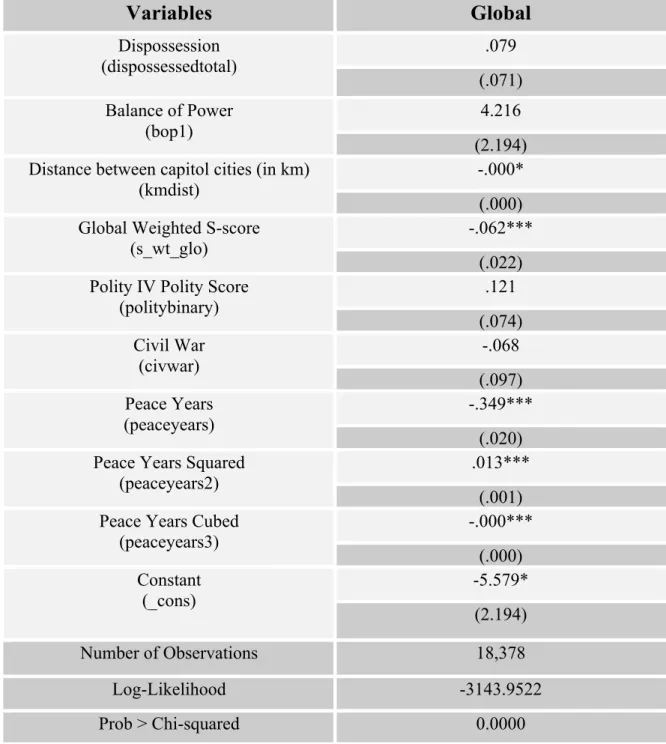
As mentioned, in order to test hypothesis 1, a logistical regression was used, with
dispossession as the input variable to observe the effect of dispossession on the outcome
variable, the occurrence of militarized interstate disputes13. There were a total of 18,378
observations rendered through this logistical regression. The test revealed that, globally,
!!!!!!!!!!!!!!!!!!!!!!!!!!!!!!!!!!!!!!!!!!!!!!!!!!!!!!!!
10 This control variable is denoted by civwar in the data set. A 1 indicates that at least one state in
the dyad was experiencing a transition or interregnum period (indicated by a polity score of -77 and -88, respectively). A 0 indicates that neither state in the dyad was experiencing such a period.
11 This control variable is denoted by kmdist in the data set.
12 This control variable is denoted by peaceyears, peaceyears2 and peaceyears3 in the data set.
Peaceyears2 and peaceyears3 are the squared and cubed results of peaceyears, respectively. These variables were created using a Stata program created by Tucker (1999).
#'!
dispossession was a statistically insignificant factor in the occurrence of MIDs. Thus, the
hypothesis was shown to be incorrect. There are various potential reasons for this
outcome. First, it is possible that the method of operationalizing dispossession was too
expansive or too limited. A different operationalization of dispossession might lead to
very different results. It is also possible that the likelihood of international crises are
accounted for by the control variables included, which include a range of indicators
commonly associated with conflict. Although it is possible that the theory proposed is
entirely incorrect, this is unlikely since dispossessed peoples fulfill two key areas that
have been proven to accelerate international conflict.
[See Table 1]
The most likely explanation of this outcome is the reality that dispossessed
peoples likely have very different effects on international crises depending on which
region of the world is considered. For instance, dispossessed peoples in a region of the
world such as the Americas may be less likely to cause international crises because the
existence of a major world power, the United States of America, creates a calming effect
that is difficult to illuminate when considering contiguous dyads only. In contrast, a
dispossessed group in Africa might be more likely to affect international crises because
of increased instability in the region and the absence of a significant superpower in the
region. In order to explore this possibility, I ran a series of subsequent logistic
regressions for each of the five regions of the world included in the COW database.
These regions are numbered 1-5 and include 12345.6!7-.!89::;.!1<=76!>?39@<6!>=9<6! A437-!>B.39@<!<C:!D427-!America, respectively.
#(!
The results of these tests reveal that, in fact, dispossessed peoples do exert a
statistically significant effect on the likelihood of international crises in certain regions
around the world. In both Europe and Africa, dispossessed peoples exert a positive
influence on the likelihood of international crises at a statistical significance level of
greater than .005. In North America and South America, dispossessed peoples were
shown to increase the likelihood of international crises at a statistically significant level
of .05. Interestingly, in the Middle East, dispossessed peoples were shown to exert a net
negative effect on the occurrence of international crises, at a statistically significant level
of greater than .005. In Asia, the effect of dispossessed peoples on international crises
was ambiguous and statistically insignificant.
These findings are especially interesting because they reveal significant regional
variations in the manner in which dispossesses peoples influence the likelihood of
international conflict. The reasons for this regional variation are difficult to uncover, but
there are a multitude of potential reasons for these variations that might be explored
further by scholars in the future. In a general sense, one reason for this variation might
be that in some regions of the world, territorial claims and the threat of rebels may be
more salient causes for international conflict than in other areas of the world. More
specific regional differences in conflict resolution patterns and methods of dealing with
dispossessed peoples might also cause this variation. A more specific regional
breakdown of potential reasons for variations is detailed below.
Europe and Africa were shown to be the regions in which international crises
were most significantly increased by the existence of dispossessed peoples. This can be
#)!
1940-2003, a time period that covers a series of inter-war and transitional periods in both
of these regions. Additionally, Africa was characterized by a lack of a world superpower
to exert control over conflicts during a time in which various ethno-political groups were
struggling to found states from nations. Meanwhile, Europe (which includes Russia and
Eastern European countries), was characterized by the existence of several world
superpowers vying for power and myriad national transitions spurred by ethno-political
struggles, especially in Eastern Europe in the years leading up to the Cold War until the
end of the Cold War. Thus, these regions were struggling with two of the major
characteristic indicators of dispossessed peoples: territorial claims and opportunities for
rebellion in the form of secession or co-optation by neighboring states.
The statistically significant negative influence of dispossessed peoples on
international crises in the Middle East remains a puzzle, one that might be especially
interesting for scholars who study this topic in the future. Interestingly, the first time I
considered the possibility that dispossessed peoples might influence the occurrence of
international crises was through extensive field research in the Middle East, specifically
southeastern Turkey and Iraqi Kurdistan. Ironically, dispossessed peoples in this region
are actually shown to decrease the likelihood of international crises. I suspect that one
reason for this result is the fact that during the period from 1940-2003, Middle Eastern
countries were often preoccupied with internal strife. Additionally, other than the
Iraq-Iran War and the Iraqi invasion of Kuwait, international crises amongst Middle Eastern
countries were rather limited during this time period (excluding ongoing conflicts
between various Middle Eastern states and Israel). Another explanation harkens back to
#*!
range of destabilizing forces in the Middle East, thus creating the illusion that their effect
on conflict is negative. Yet, these explanations are certainly not expansive enough to
explain the negative effect on international crises exerted by dispossessed peoples in the
region, making this puzzle all the more intriguing for future study.
Essentially, these results reveal that dispossessed peoples have varying effects on
international crises dependent upon the global regions in which they reside. At the core
of this finding is the reality that dispossessed peoples are more limited in their ability to
genuinely threaten secession and co-optation in certain regions of the world, and are more
free to threaten such actions in other regions. In the case of dispossessed peoples then,
context matters. The geopolitical landscape of the region and regional balances of power
might limit dispossessed peoples' effect on conflict in some cases, and spur it onwards in
other cases.
Conclusion
Globally, dispossessed peoples do not exert a statistically significant influence on
the occurrence of international crises. However, within specific regions, their effects are
statistically significant, confirming the theory that dispossessed peoples do have a
discernable effect on the likelihood of international conflict. In regions where methods of
controlling and co-opting dispossessed peoples are lacking, their effect is likely increased.
This explains regional variations in the influence of dispossessed peoples. These results
answer some questions about dispossessed peoples, but the results also create various
puzzles that demand further study by scholars.
Future research might clarify and standardize the requirements for a group to be
$+!
dispossessed is one of the first of its kind. Because dispossessed peoples, as I define
them, have rarely been studied in the past, the indicators that I selected were somewhat
arbitrary and could use further clarification. Additionally, it might be useful for scholars
to consider the effect that a technically dispossessed group exerts on conflict when it is
located closer to the geographical center of the state. Further, scholars would do well to
study how Diaspora communities affect dispossessed peoples, especially when those
Diaspora communities are not located in an adjacent state. The existence of Diaspora
communities worldwide might make dispossessed peoples more willing and able to gain
international attention and develop more expansive coalitions. Finally, future scholars
will undoubtedly benefit from a broader range of data, data that will be more accessible,
detailed and accurate as time progresses.
One further area of study includes the buffer zone effect. Although only a
theoretical link within this study, if true, the buffer zone effect might hold important
insights for groups who seek to limit human rights abuses and support marginalized
communities. If the buffer zone effect holds up to scrutiny, it reveals an extremely
disproportionate burden of force that is primarily borne by dispossessed peoples and
other marginalized groups who inhabit border areas. These groups are at a high risk of
human rights abuses and long-term destruction of economic, political and cultural
resources. By identifying dispossessed peoples as the kernel of this inequality, rights
activists and international organizations such as the United Nations might better target
their efforts to combat such negative effects. Furthermore, international organizations
$"!
quest to exercise formal political and economic power through legitimate, non-violent
means, thus curbing rights abuses and conflict simultaneously.
As noted, this study found that, generally, dispossessed peoples do not increase
the likelihood of international crises. However, future scholars might add further texture
to this study by considering the effect of Diaspora communities or kindred groups across
an adjacent international border. Previous research by scholars such as Woodwell reveals
that international conflict is increased when a majority-minority dyad exists. That is, if
country A holds a majority of a specific ethnic group and an adjacent county, country B,
holds a minority of that same group, international conflict is likely to increase. Future
scholars might test this theorem in regard to dispossessed peoples as well. Perhaps if a
dispossessed group that is a minority in country A is more likely to incite international
crises if a kindred group holds a majority in country B of the dyad. This could be studied
empirically using the MAR and COW databases.
It is also my hope that future scholars might continue the effort to understand
dispossessed peoples as entities separate and distinct from transnational rebel groups,
refugees and terrorist organizations. Because of the range of options accessible to
dispossessed peoples, they are in a position that is unique when compared to more
commonly studied groups. Dispossessed peoples are also unique because they stand as
groups whose ties are predicated on shared ethno-political backgrounds, political rights
struggles and demands for economic freedom and mobility. While their formal political
and economic power appears weak, they remain an important force in the rise of
international crises. To understand how they influence international crises requires study
$#!
political games and choices available to dispossessed peoples might allow political
scientists to better predict their ultimate decisions. Further, this might allow the
international community to pursue means of avoiding conflict that originates in the
existence of dispossessed peoples.
Finally, this study reveals crucial political lessons for policymakers in states in
which dispossessed peoples are found. Although dispossessed peoples are often viewed
by leaders within a state as a nuisance that should be minimized through dominance,
militarization of border regions and perpetual limitations on political and economic rights,
this study shows this notion to be fraught with the risk of international conflict. Instead,
states should focus on incorporating dispossessed peoples into the overarching state by
providing them with access to equal political rights and the opportunity for economic
mobility. Otherwise, the theory proposed above implies that dispossessed peoples will be
co-opted by nearby states, or even vie for a country of their own; two pathways that are
certain to draw states into a range of international crises. Importantly, there are certain
regions where this outcome was not necessarily true, which points to the potential that
states within these regions have discovered the importance of co-opting dispossessed
peoples rather than attempting to marginalize them further. Dispossessed peoples stand
at the crossroads of some of the most important international issues of this era, and
$$!
Appendix
Table 1: Global Militarized Interstate Disputes (1940-2003)
Variables
Global
.079 Dispossession
(dispossessedtotal)
(.071) 4.216 Balance of Power
(bop1)
(2.194) -.000* Distance between capitol cities (in km)
(kmdist)
(.000) -.062*** Global Weighted S-score
(s_wt_glo)
(.022) .121 Polity IV Polity Score
(politybinary) (.074) -.068 Civil War (civwar) (.097) -.349*** Peace Years (peaceyears) (.020) .013*** Peace Years Squared
(peaceyears2)
(.001) -.000*** Peace Years Cubed
(peaceyears3) (.000) -5.579* Constant (_cons) (2.194)
Number of Observations 18,378
Log-Likelihood -3143.9522
$%!
Table 2: Regional Militarized Interstate Disputes (1940-2003)
Region
14Variables
1
2
3
4
5
.610*** -.594*** .485*** -.275 .561* Dispossession
(dispossessedtotal)
(.172) .186 (.164) (.165) (.226)
1.611 70.879* 52.043 6.952 58.191*** Balance of Power
(bop1)
(3.609) (28.594) (38.418) (3.686) (19.613) .000 -.000*** -.000* -.000*** -.000** Distance between capitol
cities (in km)
(kmdist) (.000) (.000) (.000) (.000) (.000)
-.245 .071 -.080 -.069 -.010
Regional Weighted S-score (s_wt_re1)
(.918) (.079) (.042) (.043) (.072)
-.145 .565*** .122 .288 .709***
Polity IV Polity Score (politybinary)
(.189) (.180) (.200) (.158) (.210)
.051 -.425* -.134 -.541* .697*
Civil War (civwar)
(.257) (.170) (.231) (.220) (.346) -.426*** -.343*** -.256*** -.311*** -.284*** Peace Years
(peaceyears)
(.050) (.047) (.050) (.042) (.046) .018*** .014*** .010* .011*** .010*** Peace Years Squared
(peaceyears2)
(.003) (.003) (.004) (.003) (.003) -.000*** -.000*** -.000 -.000** -.000*** Peace Years Cubed
(peaceyears3)
(.000) (.000) (.000) (.000) (.000) 3.589 -71.628* -53.855 -7.449* 60.444*** Constant
(_cons)
(3.642) (28.608) (38.463) (3.691) (19.586)
Number of Observations 5,631 2,739 4,168 2,509 3,331
Log-Likelihood 583.2543 643.7898 669.0099 669.3512 450.9915
Prob > Chi-squared 0.0000 0.0000 0.0000 0.0000 0.0000
***Significant at .005 level; **Significant at .001 level; *Significant at .05 level
!!!!!!!!!!!!!!!!!!!!!!!!!!!!!!!!!!!!!!!!!!!!!!!!!!!!!!!!
14 Region 1 is Europe, Region 2 is the Middle East, Region 3 is Africa, Region 4 is Asia, Region
$&! Works Cited
1. Beck, Nathaniel; Katz, Jonathan and Tucker, Richard. 1998. "Taking Time Seriously:
Time-Series-Cross-Section Analysis with a Binary Dependent Variable."
American Journal of Political Science 42 (October): 1260-1288.
2. Bennett, D. Scott, and Allan Stam. 2000. EUGene: A Conceptual Manual.
International Interactions 26:179-204. Website: http://eugenesoftware.org.
3. Cashman, G. (2014). What causes war? an introduction to theories of international
conflict. (2nd ed. ed.). Plymouth, United Kingdom: Rowman and Littlefield.
4. Center for Systemic Peace. 2012. "Polity IV: Regime Authority Characteristics and
Transitions Datasets." June 10, 2013.
http://www.systemicpeace.org/polity/polity4.htm (March 10, 2014)
5. Fearon, James D. 1998. "Commitment Problems and the Spread of Ethnic Conflict." In
The International Spread of Ethnic Conflict: Fear, Diffusion and Escalation, eds.
David A. Lake and Donald Rothchild. Princeton: Princeton University Press, 107-
126.
6. Ghosn, Faten, and Scott Bennett. 2003. Codebook for the Dyadic Militarized
$'!
7. Gleditsch, Kristian Skrede. "Distance Between Capital Cities."
http://privatewww.essex.ac.uk/~ksg/data-5.html (March 10th, 2014).
8. Gleditsch, Kristian Skrede; Idean Salehyan & Kenneth Schultz (2009) Fighting at
home, fighting abroad: How civil wars lead to interstate disputes. Journal of
Conflict Resolution 52(4): 479-506.
9. Gleditsch, K. S. , 2008-08-28 "Two Sides of the Same Coin? Exploring the
Endogeneity of Civil War and Interstate Disputes" Paper presented at the annual
meeting of the APSA 2008 Annual Meeting, Hynes Convention Center, Boston,
MassachusettsOnline. 2014-03-04 from
http://citation.allacademic.com/meta/p279050_index.html
10. Lee S. Emerging threats to international security: Environment, refugees, and
conflict. Journal of International and Area Studies. 2001; 8(1): 73-90.
11. Minorities at Risk Project. (2009) "Minorities at Risk Dataset." College Park, MD:
Center for International Development and Conflict Management. Retrieved
from http://www.cidcm.umd.edu/mar/ on: [10/10/13]
12. Moore, Will H. and Davis, David R. 1998. "Transnational Ethnic Ties and Foreign
$(!
Escalation, eds. David A. Lake and Donald Rothchild. Princeton: Princeton
University Press, 89-103
13. Oakes, A. (2012). Diversionary war: Domestic unrest and international conflict.
Stanford, California: Stanford University Press.
14. Palmer, G. (2008). Causes and consequences of international conflict: Data, methods
and theory. New York, NY: Routledge Publishing Company.
15. Reed W, Chiba D. Decomposing the relationship between contiguity and
militarized conflict. American Journal of Political Science. 2010; 54(1): 61-73.
16. Rod JK. International borders and conflict revisited. Conflict Management and
Peace Science. 2012; 29(2): 170-194.
17. Russett, Bruce, and John Oneal. 2001. Triangulating Peace. New York: W. W.
Norton and Co.
18. Salehyan I. The externalities of civil strife: Refugees as a source of international
conflict. American Journal of Political Science. 2008; 52(4): 787-801.
19. Senese PD. Territory, contiguity, and international conflict: Assessing a new joint
$)!
20. Signorino, C. S. and Ritter, J. M. (1999), Tau-b or Not Tau-b: Measuring the
Similarity of Foreign Policy Positions. International Studies Quarterly, 43: 115–
144. doi: 10.1111/0020-8833.00113
21. Solomon, E. (2014, January 22). Special report: Amid syria's violence, kurds carve
out autonomy. Retrieved from
http://www.reuters.com/article/2014/01/22/us-syria-kurdistan-specialreport-idUSBREA0L17320140122
22. Tucker, Richard (1999). BTSCS: A Binary Time-Series–Cross-Section Data Analysis
Utility. Version 4.0.4. Cambridge, MA: Harvard University.
http://www.fas.harvard.edu/ !rtucker/programs/btscs/btscs.html
23. Woodwell D. Unwelcome neighbors: Shared ethnicity and international conflict
during the cold war. International Studies Quarterly. 2004; 48(1): 197-223.
$*!
!"#$%&'()&*+&,&-( !
1. Atzili B. When good fences make bad neighbors fixed borders, state weaknesses,
and international conflict. International Security. 2006; 31(3): 139-173.
2. Choi S, Salehyan I. No good deed goes unpunished: Refugees, humanitarian aid,
and terrorism. Conflict Management and Peace Science. 2013;30(1): 53-75.
3. Flint C, Diehl P, Scheffran J, Vazquez J, Chi S. Conceptualizing Conflict Space:
Toward a geography of relational power and embeddedness in the analysis
of interstate conflict. Annals of the Association of American Geographers. 2009;
99(5): 827-835.
4. Furlong K. The boundary dataset. Conflict Management and Peace Science. 2003;
20(1): 93-117.
!
5. Hegre H. Gravitating toward war: Preponderance may pacify, but power kills. The
Journal of Conflict Resolution. 2008; 52(4): 566-589.
!
6. Ross. Will oil drown the arab spring? Foreign Affairs. 2011; 90(5).
!
7. Sarkees, Meredith Reid and Frank Wayman (2010). Resort to War: 1816 - 2007.
%+!
8. Starr H. Opportunity, willingness, and geographic information systems (GIS):
Reconceptualizing borders in international relations. Political Georgraphy.
2002; 21(2): 243-261.
9. Stein J. Detection and defection: Security 'regimes' and management of international
conflict. International Journal. 1985; 40(4): 599-627.
10. Zacher M. The territorial integrity norm: International boundaries and the use of
force. International Organization. 2001; 55(2): 215-250.