ORIGINAL RESEARCH
Acute Trauma Factor Associations With Suicidality
Across the First 5 Years After Traumatic Brain Injury
Matthew R. Kesinger, BA,
aShannon B. Juengst, PhD,
bHillary Bertisch, PhD,
cJanet P. Niemeier, PhD,
d,eJason W. Krellman, PhD,
fMary Jo Pugh, PhD,
g,hRaj G. Kumar, MPH,
bJason L. Sperry, MD,
iPatricia M. Arenth, PhD,
bJesse R. Fann, MD,
jAmy K. Wagner, MD
b,k,l,mFrom theaUniversity of Pittsburgh, School of Medicine, Pittsburgh, PA;bDepartment of Physical Medicine and Rehabilitation, University of Pittsburgh, School of Medicine, Pittsburgh, PA;cDepartment of Rehabilitation Medicine, New York University School of Medicine, New York NY; d
Department of Physical Medicine and Rehabilitation, Carolinas Medical Center, Charlotte, NC;eUniversity of North Carolina, Chapel Hill, Chapel Hill, NC;fDepartment of Rehabilitation Medicine, Icahn School of Medicine at Mount Sinai, New York, NY;gSouth Texas Veterans Health Care System, San Antonio, TX;hUniversity of Texas Health Science Center, San Antonio, TX;iDepartment of Surgery, University of Pittsburgh, School of Medicine, Pittsburgh, PA;jDepartment of Psychiatry and Behavioral Sciences, University of Washington, Seattle, WA;kDepartment of Neuroscience,lCenter for Neuroscience, andmSafar Center for Resuscitation Research, University of Pittsburgh, Pittsburgh, PA.
Abstract
Objective: To determine whether severity of head and extracranial injuries (ECI) is associated with suicidal ideation (SI) or suicide attempt (SA) after traumatic brain injury (TBI).
Design: Factors associated with SI and SA were assessed in this inception cohort study using data collected 1, 2, and 5 years post-TBI from the National Trauma Data Bank and Traumatic Brain Injury Model Systems (TBIMS) databases.
Setting: Level I trauma centers, inpatient rehabilitation centers, and the community.
Participants: Participants with TBI from 15 TBIMS Centers with linked National Trauma Data Bank trauma data (NZ3575).
Interventions: Not applicable.
Main Outcome Measures: SI was measured via the Patient Health Questionnaire 9 (question 9). SA in the last year was assessed via interview. ECI was measured by the Injury Severity Scale (nonhead) and categorized as none, mild, moderate, or severe.
Results: There were 293 (8.2%) participants who had SI without SA and 109 (3.0%) who had SA at least once in the first 5 years postinjury. Random effects logit modeling showed a higher likelihood of SI when ECI was severe (odds ratioZ2.73; 95% confidence interval, 1.55e4.82;PZ.001). Drug use at time of injury was also associated with SI (odds ratioZ1.69; 95% confidence interval, 1.11e2.86;PZ.015). Severity of ECI was not associated with SA.
Conclusions: Severe ECI carried a nearly 3-fold increase in the odds of SI after TBI, but it was not related to SA. Head injury severity and less severe ECI were not associated with SI or SA. These findings warrant additional work to identify factors associated with severe ECI that make individuals more susceptible to SI after TBI.
Archives of Physical Medicine and Rehabilitation 2016;97:1301-8
ª2016 by the American Congress of Rehabilitation Medicine
Support for the collection of the original data was by the National Institute on Disability, Independent Living, and Rehabilitation Research (NIDILRR) (grant no. 90DP0041); and the National Trauma Data Bank. Support for the content of this article was by the NIDILRR (grant nos. 90DP0038 and 90DP0047); the National Institutes of Health (grant no. NIH K23GM093032); the National Institute of Mental Health Medical Student Research Fellowship (fellowship no. TL1TR000005) administered by the University of Pittsburgh (grant no. R25 MH054318); a Rusk Advanced Rehabilitation Research Training Postdoctoral Fellowship (grant no. NIDILRR 90AR5014-01-00); and the Polytrauma Rehabilitation Center Traumatic Brain Injury Model System.
The Polytrauma Rehabilitation Center Traumatic Brain Injury Model System is a funded collaboration between the Department of Veterans Affairs (VA) and the National Institute on Disability, Independent Living, and Rehabilitation Research (NIDILRR). The NIDILRR is a center within the Administration for Community Living (ACL), Department of Health and Human Services (HHS). The contents of this article do not necessarily represent the policy of the VA, NIDILRR, ACL, NIH, or HHS, and endorsement of this content by the Federal Government should not be assumed.
Disclosures: none.
An audio podcast accompanies this article. Listen at www.archives-pmr.org.
0003-9993/16/$36 - see front matterª2016 by the American Congress of Rehabilitation Medicine
http://dx.doi.org/10.1016/j.apmr.2016.02.017
journal homepage:www.archives-pmr.org
Individuals with traumatic brain injury (TBI) are 3 to 4 times more likely to die as a result of suicide compared with the general
pop-ulation.1TBI survivors also have a high rate of suicidal ideation (SI),
which is known to carry a 5-fold increase in the risk of suicide
attempt (SA), and these risks persist for up to 15 years after TBI.2,3
Many of the risk factors for suicidality (a broader term used to incorporate both SI and SA) in noninjured populations overlap with chronic sequelae of TBI, including aggression, poor cognitive inhibition, poor problem-solving, reduced ability to benefit from predominantly verbal counseling interventions, impulsive behavior,
substance abuse, and psychiatric disorders (eg, major depression).3-7
Veterans with the polytrauma clinical triad of posttraumatic stress disorder, TBI, and chronic pain have significantly increased odds of
suicidality, particularly in the setting of substance abuse.8Although
chronic pain is common after TBI, its role in both SI and SA seems to be related more to an individual’s perception or acceptance of pain,
rather than pain severity,9which is in turn associated with disability,10
an additional known risk factor for suicidality.11,12Severity of TBI
has not been linked consistently to depression or risk of
suici-dality,7,13,14but other injury-related factors (eg, severity of
extra-cranial injury [ECI]) that may lead to both increased distress and greater disability have not been assessed in previous studies.
March et al15reported that adults with unintentional major
trau-matic injuries, indicated by total Injury Severity Scores (ISSs)>12
(combined head and extracranial ISS), have>4 times the risk of SA or
completed suicide compared with the general population, even after adjusting for psychiatric conditions (anxiety/mood disorders and substance abuse), physical comorbidities, and other psychosocial factors (income and residence). Similarly, those with life-threatening physical illness (eg, TBI, stroke, myocardial infarction, spinal cord injury [SCI]) have higher rates of SI (11.3%) developing up to 2 years
after illness onset, compared with the general population.16 Ryb
et al12suggest that higher suicide rates among individuals who are
traumatically injured compared with the general population may be caused primarily by a higher prevalence of alcohol abuse in those with traumatic injuries.
The goal of the study was to determine whether severity of head and ECIs were associated with SI or SA after TBI. We hypothesized that (1) severity of head injury would not have a significant association with SI or SA; (2) severity of ECI would be associated with and predictive of SI and SA; and (3) physical disability and substance abuse would be associated with an increased risk of SI and SA.
Methods
Participants and measures
Participants were recruited as part of the 20-site Traumatic Brain Injury Model Systems (TBIMS) National Database longitudinal study, the longest standing longitudinal database of TBI outcomes
(currently with>25 years of data collected). This database has the
following inclusion criteria:16 years old and evidence of a
mod-erate to severe TBI (defined as any one of the following: Glasgow
Coma Scale score <13, loss of consciousness >30min,
post-traumatic amnesia>24h, and/or trauma-related intracranial
abnor-mality). Informed consent was provided by either participant or proxy as necessary, and all procedures were approved by each cen-ter’s institutional review board. Information on data collection has
been described previously17and can be found online (https://www.
tbindsc.org/). Acute care data obtained from the National Trau-matic Data Base, the largest aggregation of trauma registry data (https://www.ntdbdatacenter.com/), were linked to the TBIMS National Database (data from 15 TBIMS Centers) through a proba-bilistic linkage based on common data elements across the TBIMS and National Trauma Data Bank databases using methods described
previously.18Demographic, premorbid, clinical, mood, suicidality,
functional impairment, and other outcome data collected acutely (National Trauma Data Bank and TBIMS National Database) and at 1, 2, and 5 years postinjury (TBIMS National Database) were used for analyses. The specific measures collected and their sources (TBIMS National Database vs National Trauma Data Bank) are
summarized intable 1.
For the primary variables of interest, question 9 on the Patient Health Questionnaire-9 was used as a measurement of SI because this item is a direct scale question regarding how frequently respondents have had thoughts of hurting themselves or that they would be better off dead. This specific item captures suicidal thoughts and has been found to be associated with increased risk
for SA.19Those endorsing a score1 were categorized as positive
for SI. SA in the last year was assessed via interview conducted as part of regular follow-up evaluation per the TBIMS protocol. Head injury severity was measured with the maximum Abbrevi-ated Injury Scale head score. Injuries are ranked on the Abbre-viated Injury Scale from 1 to 6, with increasing severity. The ISS is derived from the sum of the square of the Abbreviated Injury
Scale in the 3 most severely injured body regions.20,21ECI was
measured by the ISS (3 most severely injured body regions,
excluding the head) and categorized as none (0), mild (1e8),
moderate (9e15), or severe (>15).
Data analysis
We conducted an initial analysis comparing baseline demographic and injury characteristics of participants who reported no SI at all follow-up time points with participants with SI, but no SA, at any follow-up time point (1, 2, and/or 5y postinjury) and with those participants reporting SA at any follow-up time point. We used random effects models to identify predictors and associated fac-tors of SI and SA across the first 5 years post-TBI, including both head and ECI severity, motor and cognitive disability, and sub-stance abuse measures. This analytical approach controls for intrasubject correlation associated with repeated measures, while allowing for inclusion of multiple time points for covariates and outcomes. Coefficients can be exponentiated, allowing calculation of odds ratios for individual covariates across time. We first developed base models that included relevant demographic, acute trauma, and follow-up variables. We then added head and ECI severity to the base models, allowing us to conduct a likelihood ratio test to determine if the addition of these acute injury char-acteristics significantly improved model fit. Analysis was
con-ducted with Stata version 13.aThe
Pvalues.05 were considered
statistically significant.
List of abbreviations:
ECI extracranial injury ISS Injury Severity Score
SA suicide attempt SCI spinal cord injury
SI suicidal ideation TBI traumatic brain injury
Results
Of the 3575 participants in the final linked dataset, 293 (8.2%) endorsed suicidal thoughts in the 2 weeks prior to scheduled
follow-up interviews but did not attempt suicide in the previous year, and 109 (3.0%) attempted suicide at some point during the year prior to the follow-up interview. Baseline and follow-up
characteristics are shown intable 2. Those with SI only, and those
Table 1 Description of measures
Measures Construct Summary of Measure
NTDB measures
AIS/ISS Head injury severity
Nonhead injury severity
➢ An anatomic trauma severity scale that quantifies overall severity of injury across multiple body regions.22
➢ Injuries are ranked on a scale of 1e6, with 1 being minor and 6 being an unsurvivable injury.
➢ ISS scores are derived from the AIS, calculated as the sum of the square of the 3 most severely injured body regions.23
➢ The most severe head injury was taken as maximum AIS head score.
➢ Extracranial ISS was calculated as the sum of the square of the 3 most severely injured extracranial body regions.
GCS Head injury severity ➢ Most commonly used tool of acute neurologic injury severity.
➢ Focuses on verbal response, eye opening, and motor response.24
➢ Scores range from 3e15, with 3 being most severe and 15 being most mild.
Infectious complications Infectious burden ➢ Coded based on presence of deep wound infection, urinary tract infection, or pneumonia during acute hospital stay.
Alcohol blood level Alcohol use at time of injury ➢ Blood alcohol level was measured through blood draw at the acute facility and is expressed as a concentration of grams per deciliter.
Drug use at time of injury Drug use at time of injury ➢ Drug use at time of injury was determined with blood draw at the acute facility.
Mechanism of injury Intent ➢ Mechanism of injury caused by accident, assault, or self-inflicted.
TBIMS measures
Years of education Education ➢ Education level at the time of injury.
➢ Coded binary with high school education or greater or less than high school level education.
Race Race ➢ Race was categorized as white, black, Asian, Native American, and other.
Payor source Health care resources ➢ Payor was dichotomized as Medicare and Medicaid vs all others.
FIM Motor disability
Cognitive disability
➢ The FIM is the most widely accepted and used measure of functional recovery during inpatient rehabilitation and after community integration.25 ➢ An 18-item ordinal scale assessing level of physical, motor, and cognitive
disability.
➢ The cognitive and motor subscores at follow-up were used in this study.
PHQ-9 Depressive symptoms ➢ A 9-item ordinal screening questionnaire based on the Diagnostic and
Statistical Manual of Mental Disorders, 4th editioncriteria for major depressive disorder.
➢ Has been validated for use in populations with TBI.26
➢ The PHQ-8 scoring (questions 1e8 only) was used in this study as a measure of depressive symptoms to predict suicidality.
Time to follow commands (d) Injury severity ➢ Refers to the date after injury that a patient is able to follow motor commands.
➢ The individual must either follow simple motor commands accurately at least 2 out of 2 times within a 24-hour period or have a score of 6 on the motor component of the Glasgow Coma Scale.
Substance abuse at time of follow-up
Substance abuse at follow-up ➢ Participant is asked the following question at the time of follow-up: During the last 12mo, did you use any illicit or nonprescription drugs?
Preinjury SA Preinjury SA ➢ Participant is asked the following question at the time of enrollment into the study: Have you ever attempted suicide?
Outcome measures
PHQ-9, question 9 SI ➢ PHQ-9 question 9 assesses SI and asks, over the last 2wk, how often have
they been bothered by thoughts that you would be better off dead or of hurting yourself in some way?
➢ Use of single items from large depressive symptom inventories has been validated for assessing SI.27
➢ SI was defined as a score of1 and no SA in the last year.
SA in the last year SA ➢ This was determined in follow-up interview with either the participant or
proxy. The question specified SA in the previous year.
who attempted suicide, were more likely to have been using drugs
at injury (41.3% vs 33.2%, PZ.012 and 46.2% vs 33.2%,
PZ.117, respectively) and were generally younger (mean, 37 vs
42y; P<.001 and mean, 33 vs 42y; P<.001, respectively) than
those with no SI or SA. Additionally, a larger percentage of ide-ators and attempters reported problems with alcohol or drugs at follow-up (all years), and these participants also reported higher depressive symptoms at follow-up (all years) compared with nonideators and nonattempters. There were statistically significant differences in FIM of motor-based activities of daily living be-tween those with and without SI and SA at time of discharge and follow-up and in FIM cognitive disability at follow-up. However, these differences did not represent a meaningful effect size (FIM
motor differences<17 points and FIM cognitive differences<3
points28). Ideators and attempters differed significantly at 1 and 2
years postinjury (20.8% vs 31.2% and 26.0% vs 32.4%,
respec-tively;P<.001) with regard to problem substance use.
SI models
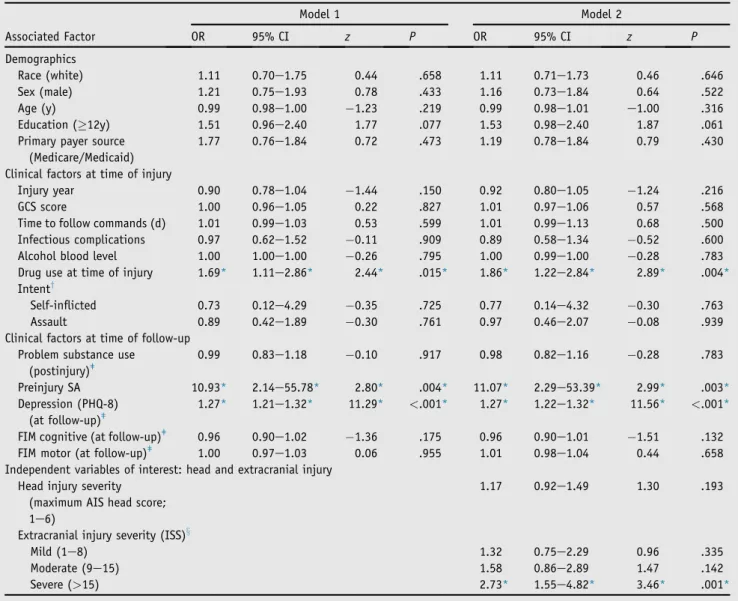
The initial multivariate model for SI included demographics, clinical factors at time of injury, and clinical factors at time of follow-up known or suspected to contribute to SI after TBI (table 3). History of a preinjury SA was associated with an 11-fold
increase in the probability of postinjury SI (odds ratioZ10.93;
95% confidence interval, 2.14e55.78; PZ.004). Depression
severity, as measured by the Patient Health Questionnaire-8 (see table 1) at follow-up, also carried an increased odds of SI (odds
ratio: 1.27; 95% confidence interval: 1.21e1.32; P<.001),
indi-cating that for a single point increase in the Patient Health Table 2 Descriptive characteristics
Characteristic No SI or SA (nZ3173) SI (No Attempt) (nZ293) P* SA (nZ109) Py
Race (white) 68.1 67.2 .768 72.5 .332
Sex (male) 73.6 74.4 .754 66.1 .082
Age 24 (39e56)z 24 (36e48)z .001z 20 (38e44)z <.001z
Education (12y) 67.7 64.9 .314 55.1z .006z
GCS scorex 8 (3e14) 7 (3e14) .256 6 (3e14) .060
Days to follow commandsk 2 (0e11) 3 (1e10) .237 3 (0e12) .386
Primary payer source (Medicare/Medicaid)
34.5 32.4 .472 43.1 .064
FIM cognitive D/C 24 (19e28) 25 (20e29) .051 24 (19e28) .904
FIM motor D/C 68 (56e79)z 70 (60e81)z .015z 66 (58e74) .379
Blood alcohol level{ 0 (0e0.138) 0 (0e0.122) .831 0 (0e0.129) .936
Drug use at time of injury# 33.2 41.3z .012z 46.2z .017z
Infectious complications 36.6 41.6 .089 32.1 .336
Maximum AIS head score 4 (4e5) 4 (4e5) .113 3 (3e5) .909
Extracranial head injury 5 (0e13)z 5 (0e15)z .030z 5 (1e13) .554
Assault 7.1 7.6 .615 9.2 .399
Self-inflicted injury 0.8 1.4 .335 2.8z .034z
Problem substance use
1y 12.5z 20.8z <.001z 31.2z <.001z
2y 14.0z 26.0z <.001z 32.4z <.001z
5y 15.8z 22.7z .013z 24.0z .059
PHQ-8 total
1y 3 (0e6)z 11 (6e15)z <.001z 10 (6e17)z <.001z
2y 3 (0e6)z 10 (6e15)z <.001z 11 (4e15)z <.001z
5y 2 (0e6)z 9 (5e16)z <.001z 6 (1e10)z .003z
FIM cognitive
1y 32 (29e34)z 31 (29e33)z <.001z 30 (26e32)z <.001z
2y 33 (30e34)z 32 (29e33)z <.001z 30 (26e33)z <.001z
5y 33 (30e35)z 32 (30e34)z <.001z 31 (28e33)z <.001z
FIM motor
1y 89 (82e91)z 88 (81e91)z .003z 88 (80e91)z .025z
2y 90 (84e91) 89 (84e91) .066 86 (79e91)z .019z
5y 91 (85e91) 90 (86e91) .635 82 (89e91)z .033z
NOTE. Values are percentage, median (interquartile range), or as otherwise indicated.
Abbreviations: AIS, Abbreviated Injury Scale; D/C, acute rehabilitation discharge; GCS, Glasgow Coma Scale; PHQ-8, Patient Health Questionnaire-8. * ThePvalue is for comparison of no suicidal endorsement or attempt with suicidal endorsement (no attempt).
y ThePvalue is for comparison of no suicidal endorsement or attempt with SA. z Statistical significance ofP<.05.
x Sample size differences for baseline characteristics: nZ3036, nZ284, and nZ104, respectively. k Sample size differences for baseline characteristics: nZ3081, nZ320, and nZ108 respectively. { Sample size differences for baseline characteristics: nZ2301, nZ266, and nZ88, respectively.
Questionnaire-8 score, there was a 1.27 times greater odds for SI, which translates to 3.3 times greater odds for SI with a 5-point
increase in the Patient Health Questionnaire-8 score (1.275).
Drug use at time of injury was associated with an increased odds
of SI (odds ratioZ1.69; 95% confidence interval, 1.11e2.86;
PZ.015). There were no other significant variables associated
with SI, including FIM scores at follow-up.
The second model included head injury (maximum Abbrevi-ated Injury Scale head score) and ECI (ISS categories) severity
variables (see table 3). ECI, measured through ISSs, carried a
higher likelihood of SI, but only when the ECI was severe
(ISS>15). With a severe ECI, participants were nearly 3 times
more likely to have SI (odds ratioZ2.73; 95% confidence interval,
1.55e4.82; PZ.001) compared with those with no ECI. The
likelihood ratio test showed that head injury severity (maximum Abbreviated Injury Scale head score) and ECI (ISS) significantly
contributed to the variance explained by the model
(c2
4Z13.74,PZ.008).
SA models
The only covariate that was significantly associated with SA in either the base or full model was Patient Health Questionnaire-8
(odds ratioZ1.14; 95% confidence interval, 1.06e1.23;P<.001).
Exploratory analysis
We also explored whether ECI predicted depression, to assess whether the relation between ECI and SI might be explained (mediated) by depression. However, ECI was not significantly associated with depression severity and it did not interact with depression to predict SI (data not shown). Further, both ECI and depression severity remained significant in the SI model, indi-cating that depression severity does not explain the relation be-tween ECI and SI. We also explored whether drug use at injury interacted with ECI to predict SI; this was not statisti-cally significant.
Table 3 Factors associated with SI with no SA in the first 5 years after TBI
Associated Factor
Model 1 Model 2
OR 95% CI z P OR 95% CI z P
Demographics
Race (white) 1.11 0.70e1.75 0.44 .658 1.11 0.71e1.73 0.46 .646
Sex (male) 1.21 0.75e1.93 0.78 .433 1.16 0.73e1.84 0.64 .522
Age (y) 0.99 0.98e1.00 1.23 .219 0.99 0.98e1.01 e1.00 .316
Education (12y) 1.51 0.96e2.40 1.77 .077 1.53 0.98e2.40 1.87 .061
Primary payer source (Medicare/Medicaid)
1.77 0.76e1.84 0.72 .473 1.19 0.78e1.84 0.79 .430
Clinical factors at time of injury
Injury year 0.90 0.78e1.04 1.44 .150 0.92 0.80e1.05 1.24 .216
GCS score 1.00 0.96e1.05 0.22 .827 1.01 0.97e1.06 0.57 .568
Time to follow commands (d) 1.01 0.99e1.03 0.53 .599 1.01 0.99e1.13 0.68 .500
Infectious complications 0.97 0.62e1.52 0.11 .909 0.89 0.58e1.34 0.52 .600
Alcohol blood level 1.00 1.00e1.00 0.26 .795 1.00 0.99e1.00 0.28 .783
Drug use at time of injury 1.69* 1.11e2.86* 2.44* .015* 1.86* 1.22e2.84* 2.89* .004*
Intenty
Self-inflicted 0.73 0.12e4.29 0.35 .725 0.77 0.14e4.32 0.30 .763
Assault 0.89 0.42e1.89 0.30 .761 0.97 0.46e2.07 0.08 .939
Clinical factors at time of follow-up Problem substance use
(postinjury)ǂ
0.99 0.83e1.18 0.10 .917 0.98 0.82e1.16 0.28 .783
Preinjury SA 10.93* 2.14e55.78* 2.80* .004* 11.07* 2.29e53.39* 2.99* .003*
Depression (PHQ-8) (at follow-up)ǂ
1.27* 1.21e1.32* 11.29* <.001* 1.27* 1.22e1.32* 11.56* <.001*
FIM cognitive (at follow-up)ǂ 0.96 0.90e1.02 1.36 .175 0.96 0.90e1.01 1.51 .132
FIM motor (at follow-up)ǂ 1.00 0.97e1.03 0.06 .955 1.01 0.98e1.04 0.44 .658
Independent variables of interest: head and extracranial injury Head injury severity
(maximum AIS head score; 1e6)
1.17 0.92e1.49 1.30 .193
Extracranial injury severity (ISS)x
Mild (1e8) 1.32 0.75e2.29 0.96 .335
Moderate (9e15) 1.58 0.86e2.89 1.47 .142
Severe (>15) 2.73* 1.55e4.82* 3.46* .001*
Abbreviations: AIS, Abbreviated Injury Scale; CI, confidence interval; OR, odds ratio; PHQ-8, Patient Health Questionnaire-8. * Statistical significance ofP<.05.
y Referent group is accident.
Discussion
Recent work suggests that self-injury is the eighth leading cause
of death in the United States,29and understanding the underlying
reasons for suicide remains a significant public health problem. To our knowledge, this is the first study to link acute trauma factors to suicidality across the first 5 years post-TBI, and the analysis revealed a novel finding that those with severe ECI may be at the greatest risk for SI even many years after TBI. Although psy-chological factors (eg, higher prevalence of depression after
TBI)30are strong contributors to the elevated risk of suicidality
after TBI, there is also evidence that neurobiologic factors (eg, TBI-induced tissue loss, neuroinflammation) may contribute to
suicidality after TBI.31-33 Consistent with previous
research,13,34,35 we did not find significant associations between
SI/SA and multiple indicators of TBI severity (maximum Abbreviated Injury Scale head score, Glasgow Coma Scale, and time to follow commands). However, we did find that drug use at the time of injury and substance abuse at follow-up, severe ECI, and depressive symptoms were associated with SI after TBI. It was surprising to discover that motor disability over time (FIM motor) was not meaningfully associated with SI, contrary to our hypothesis, suggesting that the relation between ECI and SI was not the result of greater motor disability or less functional inde-pendence with basic activities of daily living. Additionally, ECI was not predictive of depression, suggesting a more direct or alternatively mediated (eg, through other psychosocial factors over time) relation between ECI and SI. Perhaps individuals’ overall adjustment to disability, a construct likely determined by a constellation of physical, psychological, and social factors, and not adequately captured by discrete measures of mood or basic functional ability, is a major determinant of postinjury suicidality. Future research is needed to better define and measure adjustment to disability after traumatic injury.
Within the general literature on suicidality, most research focuses on suicidal gestures or attempts, rather than SI in particular. Differ-ences in the significant predictors and associated factors between SI and SA in this study suggest that SI and SA are different, although related, outcomes. Other latent factors not measured in this study may explain more of the variance in SA. A literature review of studies investigating SI after TBI found SI among those with a range of time
postinjury was reported in 3% to 33% of individuals with TBI.2
Those reporting SI have>5 times the risk of SA.2In our sample,
participants with SI and participants with SA shared similar baseline and follow-up characteristics on all factors measured, with the one exception being that attempters were more likely to have substance abuse problems than ideators only. This finding is consistent with recent work suggesting that substance abuse problems contribute
significantly to suicide rates nationally.29,36
Recent studies with non-TBI cohorts report that substance use
disorders, second only to depression in some clinical samples,37
are highly correlated with both SI and SA.38-41These data are
also consistent with our findings because both substance use at injury and postinjury problematic substance use distinguish be-tween those with and without SI in our sample. Interestingly, some studies examining the relation between substance use and SI or SA in the non-TBI literature suggest that these relations are bidirec-tional and that suicidality may either precede or follow the onset
of substance use.42,43 If drug use at injury in our sample is
reflective of premorbid patterns of use, this behavior could be associated with underlying SI prior to the injury, which then persisted through the follow-up period. This idea is consistent with
our finding that preinjury SAs are also associated with long-term SI. These findings reflect the fact that preinjury psychological and behavioral challenges, including mental health conditions and substance use disorders, can persist postinjury and often
compli-cate recovery,44-46 highlighting the importance of assessing and
accounting for these factors in rehabilitation.
Although not often studied, full injury severity measured by ISSs has been informative for some TBI outcomes (eg, discharge
dispo-sition,20community integration47). Our study demonstrates a nearly
3-fold increased likelihood of SI among participants with severe ECI
(ISS>15), representing major polytrauma, compared with those with
isolated head injuries. However, the likelihood among those with mild to moderate ECI was not significantly higher. Although the association between TBI and suicidality has been well studied in both
civilian and military populations,1,48,49 there are few studies
reporting on the association between ECI severity and SI. March15
reported significantly higher odds of suicide completion or SA among those with severe traumatic injuries compared with partici-pants without traumatic injuries. That study, however, did not sepa-rate cranial and ECI, examine mild to modesepa-rate traumatic injuries, or assess SI risk. Individuals sustaining polytraumatic injuries, including TBI, have poorer recovery over time than those with TBI
alone or ECI alone.50,51Therefore, this is the first study specifically
examining ECI severity after TBI as it relates to both SI and SA. Our results may have parallel implications for ECI in the military setting, a population at high risk for polytrauma.
Contrary to our hypothesis, we did not find motor disability to
differ to a clinically meaningful degree (eg,17 points) for those
with SI or SA. Extrapolating from the SCI literature, SI/SAwas most often associated with control of one’s community activities,
spiri-tual well-being, younger age at injury, and severity of injury.52This
literature suggests that restrictions in community-based participa-tion (rather than just basic activities of daily living, as measured with the FIM) or differences in age at injury may be factors explaining the association between severity of ECI and SI after TBI. However, these factors require further exploration.
Study limitations
to the follow-up visit, whereas SA is assessed any time within the last year.
We also do not have complete data on completed suicides, and although extrapolations could be made with regard to the per-centage of those with SI or SA who go on to complete suicide, there are also cases of completed suicide in the absence of either SI or SA. Despite a robust sample size overall for a TBI cohort, the incidence of SA was relatively low (approximately 3%)
compared with other studies (1%e18%)2reporting postinjury SA.
Therefore, this study may be underpowered to identify significant factors associated with SA that may have smaller effect sizes. This low incidence may be caused by a number of factors, including differences in study samples (evaluating a general TBI cohort vs a cohort specifically screened for depressive symptoms/SA), differences in how SA was measured (in the year prior to injury vs any postinjury SA), and differences in services received that may reduce post-TBI risk factors for SA (eg, all participants in the TBIMS National Database participated in inpatient rehabilitation). Although a strength of this study is its robust longitudinal modeling, this research design does not allow for differentiation of temporal relations between associated factors and SI or SA.
Conclusions
Suicidality may develop through multiple pathways, whether related to the injury itself, to individual differences in adjustment to disability and in coping, or to other personal, biologic, and environmental factors unaccounted for or obscured when data are aggregated. Developing proactive strategies to monitor at-risk individuals and provide early intervention for SI may have a positive public health effect by decreasing the incidence of suicide after TBI.
Supplier
a. Stata version 13; StataCorp.
Keywords
Brain injuries; Injury Severity Score; Multiple trauma;
Rehabilitation; Suicidal ideation; Suicide, attempted
Corresponding author
Shannon B. Juengst, PhD, Department of Physical Medicine and Rehabilitation, University of Pittsburgh, School of Medicine, 3471
Fifth Ave, Pittsburgh, PA 15213.E-mail address:[email protected].
References
1. Harrison-Felix CL, Whiteneck GG, Jha A, DeVivo MJ, Hammond FM, Hart DM. Mortality over four decades after traumatic brain injury rehabilitation: a retrospective cohort study. Arch Phys Med Rehabil 2009;90:1506-13.
2. Simpson G, Tate R. Suicidality in people surviving a traumatic brain injury: prevalence, risk factors and implications for clinical man-agement. Brain Inj 2007;21:1335-51.
3.Reeves RR, Laizer JT. Traumatic brain injury and suicide. J Psy-chosoc Nurs Ment Health Serv 2012;50:32-8.
4.Brown AW, Moessner AM, Mandrekar J, Diehl NN, Leibson CL, Malec JF. A survey of very-long-term outcomes after traumatic brain injury among members of a population-based incident cohort. J Neurotrauma 2011;28:167-76.
5.Fountoulakis KN, Iacovides A, Fotiou F, et al. Neurobiological and psychological correlates of suicidal attempts and thoughts of death in patients with major depression. Neuropsychobiology 2004;49:42-52. 6.Giegling I, Olgiati P, Hartmann AM, et al. Personality and attempted suicide. Analysis of anger, aggression and impulsivity. J Psychiatr Res 2009;43:1262-71.
7.Homaifar BY, Brenner LA, Forster JE, Nagamoto H. Traumatic brain injury, executive functioning, and suicidal behavior: a brief report. Rehabil Psychol 2012;57:337-41.
8.Finley EP, Bollinger M, Noe¨l PH, et al. A national cohort study of the association between the polytrauma clinical triad and suicide-related behavior among US veterans who served in Iraq and Afghanistan. Am J Public Health 2015;105:380-7.
9.Campbell G, Bruno R, Darke S, et al. Prevalence and Correlates of Suicidal Thoughts and Suicide Attempts in People Prescribed Phar-maceutical Opioids for Chronic Pain. Clin J Pain 2016;32:292-301. 10.Cook AJ, Meyer EC, Evans LD, et al. Chronic pain acceptance incrementally predicts disability in polytrauma-exposed veterans at baseline and 1-year follow-up. Behav Res Ther 2015;73:25-32. 11.McConnell D, Hahn L, Savage A, Dube´ C, Park E. Suicidal ideation
among adults with disability in Western Canada: a brief report. Community Ment Health J 2015 Jul 23 [Epub ahead of print]. 12.Ryb GE, Soderstrom CA, Kufera JA, Dischinger P. Longitudinal
study of suicide after traumatic injury. J Trauma 2006;61:799-804. 13.Simpson G, Tate R. Suicidality after traumatic brain injury: demographic,
injury and clinical correlates. Psychol Med 2002;32:687-97.
14.Bryan CJ, Clemans TA. Repetitive traumatic brain injury, psycho-logical symptoms, and suicide risk in a clinical sample of deployed military personnel. JAMA Psychiatry 2013;70:686-91.
15.March J, Sareen J, Gawaziuk JP, et al. Increased suicidal activity following major trauma: a population-based study. J Trauma Acute Care Surg 2014;76:180-4.
16.Kishi Y, Robinson RG, Kosier JT. Suicidal ideation among patients with acute life-threatening physical illness: patients with stroke, traumatic brain injury, myocardial infarction, and spinal cord injury. Psychosomatics 2001;42:382-90.
17.Dijkers MP, Harrison-Felix C, Marwitz JH. The Traumatic Brain Injury Model Systems: history and contributions to clinical service and research. J Head Trauma Rehabil 2010;25:81-91.
18.Kesinger MR, Kumar RG, Ritter AC, Sperry JL, Wagner AK. A probabilistic matching approach to link de-identified data from a trauma registry and a traumatic brain injury model system center. Am J Phys Med Rehabil 2016 Apr 15 [Epub ahead of print].
19.Simon GE, Rutter CM, Peterson D, et al. Does response on the PHQ-9 Depression Questionnaire predict subsequent suicide attempt or suicide death? Psychiatr Serv 2013;64:1195-202.
20.Wagner AK, Hammond FM, Grigsby JH, Norton HJ. The value of trauma scores: predicting discharge after traumatic brain injury. Am J Phys Med Rehabil 2000;79:235-42.
21.Wagner AK, Hammond FM, Sasser HC, Wiercisiewski D, Norton HJ. Use of injury severity variables in determining disability and community integration after traumatic brain injury. J Trauma 2000;49:411-9. 22.Copes WS, Champion HR, Sacco WJ, et al. Progress in
character-izing anatomic injury. J Trauma 1990;30:1200-7.
23.Baker SP, O’Neill B, Haddon W, Long WB. The injury severity score: a method for describing patients with multiple injuries and evaluating emergency care. J Trauma 1974;14:187-96.
24.Teasdale G, Jennett B. Assessment of coma and impaired con-sciousness. A practical scale. Lancet 1974;2:81-4.
26. Fann JR, Bombardier CH, Dikmen S, et al. Validity of the Patient Health Questionnaire-9 in assessing depression following traumatic brain injury. J Head Trauma Rehabil 2005;20:501-11.
27. Desseilles M, Perroud N, Guillaume S, et al. Is it valid to measure suicidal ideation by depression rating scales? J Affect Disord 2012; 136:398-404.
28. Beninato M, Gill-Body KM, Salles S, Stark PC, Black-Schaffer RM, Stein J. Determination of the minimal clinically important difference in the FIM instrument in patients with stroke. Arch Phys Med Rehabil 2006;87:32-9.
29. Rockett IH, Caine ED. Self-injury is the eighth leading cause of death in the United States: it is time to pay attention. JAMA Psy-chiatry 2015;72:1069-70.
30. Bombardier CH, Fann JR, Temkin NR, Esselman PC, Barber J, Dikmen SS. Rates of major depressive disorder and clinical outcomes following traumatic brain injury. JAMA 2010;303:1938-45. 31. Juengst SB, Kumar RG, Arenth PM, Wagner AK. Exploratory
associ-ations with Tumor Necrosis Factor-a, disinhibition and suicidal endorsement after traumatic brain injury. Brain Behav Immun 2014;41: 134-43.
32. Serafini G, Pompili M, Elena Seretti M, et al. The role of inflam-matory cytokines in suicidal behavior: a systematic review. Eur Neuropsychopharmacol 2013;23:1672-86.
33. Lopez-Larson M, King JB, McGlade E, et al. Enlarged thalamic volumes and increased fractional anisotropy in the thalamic radia-tions in veterans with suicide behaviors. Front Psychiatry 2013;4:83. 34. Dikmen SS, Bombardier CH, Machamer JE, Fann JR, Temkin NR. Natural history of depression in traumatic brain injury. Arch Phys Med Rehabil 2004;85:1457-64.
35. Tsaousides T, Cantor JB, Gordon WA. Suicidal ideation following traumatic brain injury: prevalence rates and correlates in adults living in the community. J Head Trauma Rehabil 2011;26:265-75. 36. Case A, Deaton A. Rising morbidity and mortality in midlife among
white non-Hispanic Americans in the 21st century. Proc Natl Acad Sci U S A 2015;112:15078-83.
37. Randall JR, Walld R, Finlayson G, Sareen J, Martens PJ, Bolton JM. Acute risk of suicide and suicide attempts associated with recent diagnosis of mental disorders: a population-based, propensity score-matched analysis. Can J Psychiatry 2014;59:531-8.
38. Tupler LA, Hong JY, Gibori R, Blitchington TF, Krishnan KR. Suicidal ideation and sex differences in relation to 18 major psy-chiatric disorders in college and university students: anonymous web-based assessment. J Nerv Ment Dis 2015;203:269-78.
39. Artenie AA, Bruneau J, Roy E´ , et al. Licit and illicit substance use among people who inject drugs and the association with subsequent suicidal attempt. Addiction 2015;110:1636-43.
40. Darke S, Ross J, Marel C, et al. Patterns and correlates of attempted suicide amongst heroin users: 11-year follow-up of the Australian treatment outcome study cohort. Psychiatry Res 2015; 227:166-70.
41. Nowrangi MA, Kortte KB, Rao VA. A perspectives approach to suicide after traumatic brain injury: case and review. Psychosomatics 2014;55:430-7.
42. Zhang X, Wu LT. Suicidal ideation and substance use among ado-lescents and young adults: a bidirectional relation? Drug Alcohol Depend 2014;142:63-73.
43. Ortı´z-Go´mez LD, Lo´pez-Canul B, Arankowsky-Sandoval G. Factors associated with depression and suicide attempts in patients under-going rehabilitation for substance abuse. J Affect Disord 2014;169: 10-4.
44. Corrigan JD, Deutschle JJ Jr. The presence and impact of traumatic brain injury among clients in treatment for co-occurring mental illness and substance abuse. Brain Inj 2008;22:223-31.
45. Taylor LA, Kreutzer JS, Demm SR, Meade MA. Traumatic brain injury and substance abuse: a review and analysis of the literature. Neuropsychol Rehabil 2003;13:165-88.
46. Bogner JA, Corrigan JD, Mysiw WJ, Clinchot D, Fugate L. A comparison of substance abuse and violence in the prediction of long-term rehabilitation outcomes after traumatic brain injury. Arch Phys Med Rehabil 2001;82:571-7.
47. Wagner AK, Saaser H. Gender associations with disability and community integration after TBI. Arch Phys Med Rehabil 2000;81: 1267-8.
48. Teasdale TW, Engberg AW. Suicide after traumatic brain injury: a population study. J Neurol Neurosurg Psychiatry 2001;71: 436-40.
49. Bryan CJ, Clemans TA, Hernandez AM, Rudd MD. Loss of con-sciousness, depression, posttraumatic stress disorder, and suicide risk among deployed military personnel with mild traumatic brain injury. J Head Trauma Rehabil 2013;28:13-20.
50. Gross T, Schu¨epp M, Attenberger C, Pargger H, Amsler F. Outcome in polytraumatized patients with and without brain injury. Acta Anaesthesiol Scand 2012;56:1163-74.
51. Andruszkow H, Probst C, Gru¨n O, Krettek C, Hildebrand F. Does additional head trauma affect the long-term outcome after upper extremity trauma in multiple traumatized patients: is there an addi-tional effect of traumatic brain injury? Clin Orthop Relat Res 2013; 471:2899-905.