THE INCLUSION AND NEGOTIATION OF THE APPROPRIATE FEMALE PRESENCE IN PUBLIC: THAMUGADI AND CUICUL
Katelin McCullough
A thesis submitted to the faculty at the University of North Carolina at Chapel Hill in partial fulfillment of the requirements for the degree of Master of Arts in the Department of
Classics.
Chapel Hill 2015
Approved by:
Jennifer Gates-Foster
Kenneth Sams
Donald Haggis
iii ABSTRACT
Katelin McCullough: The Inclusion and Negotiation of the Appropriate Female Presence in Public: Thamugadi and Cuicul
(Under the direction of Jennifer Gates-Foster)
This treatment begins to re-contextualize some of the epigraphic material from the
Roman African cities of Thamugadi and Cuicul by taking into account associated statuary
and probable locations for these monuments within the town centers. In order to go beyond
simply noting that women were part of the urban fabric of Roman communities in the West,
this discussion considers the specific economic context of the North African region and its
impact on how women chose to present themselves both as a part of the public fabric of the
community and in a manner that would have been acceptable in a male-dominated, Roman
society. Evidence from North Africa demonstrates that Roman influence did not translate
into consistent honorific practices and that the ways in which women were included in public
space display distinct local patterns even within the same province or across cities with
iv
TABLE OF CONTENTS
LIST OF FIGURES………...v
LIST OF ABBREVIATIONS……….………..vi
CHAPTER 1: INTRODUCTION………..1
Overview of Previous Scholarship……….3
CHAPTER 2: PATRONAGE AND THE ECONOMY IN NORTH AFRICA ...……….7
CHAPTER 3: BACKGROUND AND OVERVIEW OF THAMUGADI AND CUICUL….14 Thamugadi: Civic Monuments………17
Cuicul: Civic Monuments...……….26
CHAPTER 4: STATUARY……….31
CHAPTER 5: CONCLUSIONS………..36
APPENDIX 1: SHORT EPIGRAPHIC CATALOGUE FOR THAMUGADI...………38
FIGURES…….………46
v
LIST OF FIGURES
Figure 1: Map showing locations of Cuicul and Thamugadi………...46
Figure 2: Thamugadi: plan showing the original colonia...……….47
Figure 3: Cuicul: plan of the forum and its associated structures………48
Figure 4: Inscription recording Annia Tranquilla and Annia Cara at Thamugadi…………...49
Figure 5: Cornelia Valentina Tucciana s. Sertia..………50
Figure 6: Faustina Maior from the theater at Thamugadi………51
Figure 7: Faustina Minor from the theater at Thamugadi………52
vi
LIST OF ABBREVIATIONS
AE L'Année Epigraphique (Paris, 1888- ).
ANRW Aufstieg und Niedergang der römischen Welt, ed. H. Temporini and W. Haase (Berlin, 1972-).
CIL Corpus Inscriptionum Latinarum I-XVI (Berlin, 1863-).
ILAlg S. Gsell, E. Albertini, J. Zeiller, H.-G. Pflaum, and L. Leschi (ed.) Inscriptions latines de l’Algérie I-III (Paris, 1922-2003).
ILS Inscriptiones Latinae Selectae, ed. H. Dessau I-III (2nd ed.) (Berlin, 1954).
PIR2 Prosopographia Imperii Romani, ed. E. Groag, A. Stein, and L. Peterson. I-VI
1
CHAPTER 1: INTRODUCTION
This paper examines the monumental presence of women in the public spaces of
Thamugadi (Timgad) and Cuicul (Djémila) in the Roman province of Numidia. The presence
of women is evaluated through an analysis of their representation in inscriptions and portrait
statues and with consideration of where those monuments were located within the town
centers of these colonies. In order to move beyond simply noting that women were part of the
urban fabric of Roman communities in the West, this discussion considers the specific
economic context of North Africa and its impact on the “interesting problem of why and how
it became acceptable and even important to include women as an integral part of a city’s
public identity.”1 This paper explores evidence from North Africa to demonstrate that Roman influence did not translate into uniform honorific practices and that the ways in which
women were included in public space display distinct local patterns even in cities in the same
region or province with similar social structures.
In particular, this investigation hopes to demonstrate that there was a phenomenon
during the 3rd century CE in North Africa whereby women were increasingly brought into the
cycle of euergetism when the financial need was strong enough. This inclusion in the public
life of the town of Thamugadi resulted in those women with a connection to a specific civic
and religious role – that of flaminica – being honored in the urban center of the community. This local method of including women in this reciprocal relationship with the community
2
will then briefly be compared with that of the Numidian town of Cuicul (Djemila). This town
reacted to third century financial stress by also including women in their public spaces but
while some were flaminicae, Cuicul supplies less evidence for the pattern of honoring women for their financial contributions through that specific office. Instead, in Cuicul
women were occasionally honored for their connection to a wealthy family but were more
often able to contribute to the urban equipment of the public places of their town (and
simultaneously to demonstrate their own access to financial resources) by dedicating
monuments for others. For city notables and benefactors, these public monuments were the
“highest denomination in the currency of euergetic politics.”2 However, they were also complex and articulate images that embody and express the social ideals of similar but
distinct North African cities under the control of the Roman Empire.
Furthermore, this paper addresses the problem of how these civic monuments were
designed in order to make them appropriate for communal viewing in a society that had long
hesitated to accept the appearance of women in public.3 The phrasing of the inscriptions that mention such women, the appearance of a few extant portrait statues, and their original
location (when known) are discussed. While many of the inscriptions and the few statues that
survive from these towns might fit well in relation to an overarching narrative of Roman
honorific methods, they should also be seen as appropriate to the specific time and place in
which they were erected.4 Therefore, this treatment looks at broader regional influences and,
2Smith 1998, 63.
3This will be expanded upon below, but see Davies (2008 and 2013) for comprehensive discussions of this
concept when considering the statue body and Dillon (2010) for a discussion of how this affects the statue head.
3
in keeping with R.R.R Smith’s belief that the “local aspect is important,” on their specific
manifestation within Thamugadi and Cuicul.5
Overview of Previous Scholarship
Past investigations in the former province of Numidia have examined the epigraphy
associated with honorific monuments found within the two cities of Thamugadi (Timgad)
and Cuicul (Djémila). Gerhard Zimmer’s analysis of the honorific monuments in the fora of these two cities provided local and regional evidence for what he claimed were distinctly
masculine spaces.6 However, Christian Witschel has more recently argued for the
prominence of civic inscriptions set up for or by women in these communities, although
extant statues of women securely connected to these towns remain rare.7 His work has
provided some insight into the number of women active in public life and has provided a
foundation for understanding their familial connections.8 Witschel focused a great deal of attention on the fact that most monuments honoring elite women in these towns also mention
their male relatives and generally dismissed local factors that might also have had a hand in
their inclusion on the public commemoration of women.
While familial connections are certainly important for understanding the overall
context in which these inscriptions were erected, Witschel’s readings of the inscriptions from
these sites rely heavily on explanations similar to those of Riet van Bremen’s interpretation
5See Smith 2006, 4.
6See Zimmer (1989) and Trimble’s (2011, 216 and 271) comments on Zimmer’s work.
7Witschel 2013.
8Witschel (2013) is in the form of a prosopographical catalogue. He examines the totality of the epigraphic
4
of honorific monuments for women in the Roman East.9 Riet van Bremen has argued that the prominence of women, such as priestesses, was tied to that of male counterparts and was a
form of entrapment that limited the participation of women to “the role of the virtuous wife”
in emulation of the public role performed by the empress.10 In following van Bremen’s argument for the Roman East in these two North African cities, Witschel excludes the
possibility of regional or local variation in patterns for including women in public space
within the Roman Empire. In contrast to Witschel, this paper will examine these monuments
with the intent of contextualizing them within a regional framework. This perspective allows
for more localized factors, such as economic developments that are particular to one time and
place and the societal changes that may have accompanied them, to come into focus.
Regional studies for women in North Africa have been done but have focused on
women of specific roles and titles and have not taken into consideration their situation within
a specific town.11 For example, Sarah Bond has persuasively argued that one of the primary
factors behind the phenomenon of awarding honors through inscriptions and statues to
women – specifically civic patronae – in the region of North Africa as a whole was
economic.12 However, while she gives an overview of all eighteen recorded female patrons in the Roman world, she does not examine them within the corpus of inscriptions for other
9Witschel 2013, 104.
10Van Bremen 1996, 115-20, 298-302; Friesen (2003, 145) summarizes these claims. See Pomeroy (1998, 491)
for a critique of van Bremen’s argument. See Friesen (2003, 146-147) for an overview of her evidence and critique of it that finds only 52% of her evidence, at least for priestesses, supports her claim.
11Ladjimi Sebaï 1990.
5
women within the towns where they were located.13 Nevertheless, while no civic patronae
are recorded at Thamugadi or Cuicul, her overall approach of examining the financial role of
women in civic life matches well with some of the evidence that appears in these two
Numidian towns. While this paper will expand upon her approach of looking at economic
factors as a major motivation in the process of awarding and recording public honors for
women, it does not select a single woman, a patrona, in one city and hope to compare each such honorand to other very temporally and spatially scattered individuals with the same
titulature. Instead, this paper examines several women in both towns and considers
individuals as part of a larger assemblage of women who were honored in these two cities
with the hope that this may demonstrate intra and inter-city patterns concerning which
females were honored and how they were represented.
In Thamugadi, the city that is the main focus of this treatment, women reacted to the
specific economic, social, and political context within which they found themselves. Here, I
argue that economic stagnation led to a rather sudden inclusion of women in spaces
traditionally considered to be a part of a male-gendered landscape. In the early third century
CE, monuments were erected to publicly commemorate a specific demographic within
Thamugadi’s female population: the priestesses of the imperial cult (flaminicae). These women were suitable benefactors because, as part of the flaminate, they paid higher summa honoraria than other civic offices. A sudden increase in civic monuments recording these women within the most prestigious area of Thamugadi, suggests that their wealth may have
been an apt solution to the problem of how to fund a city during a difficult economic
situation. While this phenomenon can easily be seen in Thamugadi, in Cuicul the change
13
6
from a more fruitful economic situation to a less desirable one results in a different pattern.
Here, a tradition of women being honored as part of family groups, especially for those of
senatorial families, began in the 2nd century CE.14 However, as that century was coming to a close and the 3rd century was beginning, women began to promote their own economic status by providing statuary honors for others while their own names were featured prominently in
the dedicatory inscription. While a few of these women were connected to the flaminate, they
were not honored in Cuicul with the same exclusivity as is visible in the evidence from
Thamugadi.
The benefit of comparing the town of Cuicul to Thamugadi is that it allows for a
consideration of how different local traditions (a pre-existing tradition of honoring women in
public spaces, but under different circumstances) can result in distinct patterns of civic
participation even under similar regional influences. In order to examine women’s inclusion
within the public space of these two towns, the next section briefly discusses the overall
economic situation within North Africa during the second and third centuries and how
females with access to monetary resources could participate in local benefactions.
7
CHAPTER 2: PATRONAGE AND THE ECONOMY IN NORTH AFRICA
This chapter considers first what the financial situation in North Africa may have
been during the transition from the second to the third centuries CE and second what access
women had to wealth and what evidence there is to demonstrate female financial assistance
in exchange for commemoration within the communities of Roman North Africa. Bond cites
economic stagnation and an increased burden on municipal decurions in the late second and third centuries as the impetus for local councils to seek out women for economic support in
North Africa.15 This may explain the sudden appearance of monuments for women in this time period in Thamugadi and Cuicul.
The economic stagnation cited by Bond is often seen as the result of a combination of
factors, including, but not limited to: warfare, uprisings, plague, the debasement of coinage,
and political instability.16 Debates based on a variety of sources (archaeological, literary, and epigraphic) over the last 50 years of scholarship in particular have weighed the possibility of
a significant economic recession in the region of North Africa.17 The steep decline in building activities, accompanied by a decrease in inscriptions that commemorate such
projects, in North Africa as a whole during the third century CE is frequently seen as a sign
15Warmington (1954, 51) comments that “prosperity was damaged by the financial disorders which
accompanied the civil wars;” for economic stagnation and corruption in North Africa in the third century, see Macmullen (1988, 28-35).
16See Alföldy (1974) for a summary of the various aspects of this crisis; see De Blois (2002) for an expansion of
his summary and a discussion of more recent scholarship on the topic.
8
of economic troubles as cities struggled to replicate the spending of earlier times.18 While assessing the state of the discussion about the ‘Third Century Crisis,’ Lukas de Blois notes
that while for the most part towns continued to be lived in, their most expensive acts, like
constructing new buildings and erecting inscriptions, were becoming increasingly rare and
that this trend increased dramatically under the reign of Alexander Severus.19
However, not all cities were effected in the same way.20 In light of the poor excavation methods which were used at Thamugadi, the types of evidence that are
understood well enough to discuss this issue may, at this time, be limited to a consideration
of the architectural remains and the epigraphic sources. During the second century, many
new projects had been undertaken in Thamugadi, especially towards the improvement of the
city’s infrastructure, and as a result, the municipal area was nearly doubled and building
inscriptions were regularly put up to commemorate those who contributed.21 These building projects, described below, had largely been financed by public money.22
Beginning in the third century, while public buildings were still repaired and restored
across North Africa as a whole, new constructions were rare.23 For example, Gareth Sears
notes that Sabratha’s economy began to struggle during this time.24 He cites a lack of new
18Gilhaus 2013, 21; De Blois 2002, 215.
19De Blois, 2002, 215; also discussed in Sears (2011, 98-114), who notes that there were reductions to the
amount of building and restoration work that was being undertaken during the third century compared to the Severan period and a decline in new building inscriptions in North Africa.
20Sears 2011, 110.
21Gilhaus 2013, 25.
22Gilhaus 2013, 25.
23Gilhaus 2013, 21.
9
building work in the later second and third centuries and the abandonment of building work
that had already begun in the city’s East Forum Temple as evidence for a reduction in the
size of the community’s economy.25 Sabratha’s inability to continue building new, large public buildings from the later second century onwards leads Sears to hypothesize that the
city had a small agricultural base and that this small financial base had been unable to sustain
the city after its second century building campaigns.26
In contrast with the decrease in new construction projects in much of North Africa,
there were still new building projects in Thamugadi. In this city, where a macellum and possibly a capitolium were built at this time (see below), the number of buildings funded by private money exceeded those paid for at public expense for the first time.27 Furthermore, as
will be discussed, it may be significant that the most prominent buildings constructed at the
beginning of the third century in Thamugadi, the macellum and the capitolium, were dedicated partially by a woman. This switch to largely private funding for building projects
may signal a certain degree of financial instability in the city or, at the very least, a
significant change in the way in which the community handled its funds. While parts of
North Africa were unable to persist in an expansion of their urban fabric, Thamugadi endured
during the beginning of the third century, possibly because they were able to tap previously
unutilized or under-utilized sources of funds: those belonging to women.
In regards to what material resources women may have been able to muster, it is
thought that, especially by the 2nd century CE, the Roman practice of partible inheritance, in
which male and female children inherit a portion of the father’s wealth, left many elite
25Sears (2011, 113) follows Dore (1988, 74, 84) in this.
26Sears 2011, 113.
10
women with “large fortunes and the discretion to dispose of them as they pleased.”28 The practice of tutelage, which had placed guardians over un-married women and their assets,
was restricted due to laws such as the Lex Iulia Papia-Poppaea.29 By allowing women with more than 5 children (3 in Rome) to be excused from requiring the services of a tutor or a
curator, women who could meet this requirement had increased control over their own
wealth.30 Päivi Setälä has argued that the combination of a woman’s inherited property and dowry made it possible for some women to act independently, and her work shows
increasing economic activity by women throughout the Imperial period.31 Women who controlled their own property were able to exert influence, not only in the private, but also in
the public sphere.32 As some women were able to command their own material resources,
Thamugadi and Cuicul incorporated them into their cycles of benefactions and honorific
monuments.
As is discussed below, at the beginning of the 3rd century the women in Thamugadi who were recorded on these monuments were, by and large, priestesses of the imperial cult
known as the flaminicae. Emily Hemelrijk argues that such priestesses must have been persons of a high degree of wealth based on the number and amount of fees they had to pay
upon assuming the religious office.33 In other areas of North Africa, flaminicae seem to have
28Saller 1996, 883.
29Ulp. 11.1, 18, 25, 27; Suet. Aug. 34-5; Additionally, Claudius’ extension of the ius quattuor liberorum
whereby he extended this right to encourage female grain importers to increase commercial trade reflects women’s increased involvement in economic affairs both in Rome and in the provinces (Suet. Claud. 19).
30Inst. 1 25; Dig.27 1.
31See Setälä (1999) for an overview of her work. In particular, her studies of brick stamps have demonstrated
that the economic activity of women, particularly of the senatorial and equestrian classes, lasted at the very least from the first century BCE until sometime in the third century CE.
32Setälä 1999, vii-xi.
11
been expected to enrich their cities with benefactions and to have paid a summa honoraria, just as decurions paid the summa honoraria for their civic offices.34 For example, in Thugga, also a city in the Roman province of Numidia, Botria Fortunata, a flaminica perpetua (a priestess for life), gifted a temple sua pecunia (with her own money) for Tellus in 261 CE to her city ob summam honoris flaminatus (on account of the sum of the flaminate honor).35
Additionally, priestesses had to pay a fixed summa honoraria, the amount of which, in the African provinces, was usually higher than the summa honoraria for most civic magistrates, such as the duumvirate or the aedileship, within a single town.36 For Hemelrijk, this indicates the high level of prestige associated with the religious post.
Dedications to these women often establish a connection between euergetism and the
honorary offices they received. Women were recognized sources of money and benefaction
within North African municipalities, and they paid for priesthoods that were largely tied to
their socio-economic position. In the late third century, Annia Aelia Restituta received five
statues for a theater she had promised (costing 400,000 sesterces) to Calama in Numidia after
becoming a flaminica perpetua. Two dedications comment on her actions. The first dedication notes that the statues were on account of the liberalitas of her promise, the
34Duncan-Jones (1974, 86) notes that in African cities, the summae honoriae appear to have been originally
intended as direct cash-payments to the city, but that they were sometimes put towards monuments built by the magistrate for the adornment of the city.
35CIL 8, 26558: Pro salute Imp(eratoris) Caes(aris) P(ubli) Licini Egnati Gallieni Germanici Pii Fel(icis)
Aug(usti) pont(ificis) max(imi) Germanici [maximi tribunicia po]te`st(ate) X co(n)s(ulis) IIII p(atris) p(atriae) proco(n)s(ulis) et Corneliae Salo[ninae Aug(ustae)] totiusque divinae domus eorum Botria Fortunata Victoris filia flam[inica perpetua templum Tellu]ris ob summam honoris flaminatus sua pecunia a s[ol]o extruxit excoluit et [d]edicavit sport[ulis] d[atis decurionibus et e]puli[s universo popul]o; Summary: She built a temple of Tellus for the well-being of the emperor Gallienus, his wife Salonina and the entire domus divina; to celebrate the dedications she offered sportulae to the decurions and epula to the people.
36Hemelrijk 2006, 88. R. Duncan-Jones (1974, 82-88) describes payments varying from HS 5,000 to 10,000 for
12
erection of the theater, and her merita; the second emphasizes that the benefactions were from her own money, for the adorning of her homeland (pecunia sua exornanda[e
pat]riae).37 These inscriptions exemplify the expectation of benefaction in return for public office.
North African cities counted on the summae honorariae derived from decurions and the benefactions of wealthy equestrians to sustain the city, and avoidance of the summa honoraria and the traditional civic munera undermined the economic base of cities.38 The large personal wealth of North African elite women helped municipalities to establish a
wider economic base that could then be perpetuated among a wider group of individuals than
before. Perhaps due in part to the willingness of North African communities to honor elite
women, Thamugadi continued to expand its urban fabric well into the third century.39 North African sources of benefaction for such generosity may have been affected by economic
stagnation, but the strong African focus on civic benefaction allowed cities such as
Thamugadi to make it acceptable for women to become new benefactors. 40 However, as we shall see, the monuments that they received in return may have been qualified in certain ways
that made it more acceptable to display them on a more frequent basis than before.
37(1) CIL VIII 5365 = CIL VIII 17495 = ILAlg. I 286: Anniae Aeliae Restitutae / flam(inicae) perp(etuae) ob
in/signem liberalita/tem pollicitatio/nis eius HS CCCC(milium) n(ummum) /at theatrum faci/endum cui cum or/do ob eam causam sta/tuas quinque de pu/blico pon[i]censuis/set etiam ob merita / L(uci) Anni Aeli
Clemen/tis flam(inis) Aug(usti) p(er)p(etui) patris / eius cui aere conla/to universi cives sta/tuam posuissent / [---] unive[rsus(?)--[---] / [--- ] d(ecreto) d(ecurionum); (2) CIL VIII 5366 = ILAlg 1.287: Anniae Aeli/ae L(uci) fil(iae) Restit[u]/[t]ae flam(inicae) Augg(ustorum) [p(er)]/p(etuae) ob egregiam in / [s]uos cives libera/[l]itatem theatro / pecunia sua exor/nanda[e pat]riae / s[p]onte p[rom]isso / ad referendam gr[a]/tiam ordo univer/sus statua[s] n(umero) quinq(ue) de pu[bl(ico)] faciend[as] / decrevit.
38See Duncan-Jones (1985, 29) concerning the use of summa honorariae for public buildings.
39Bond 2007, 52.
40Lepelley (2001, 89) comments that the focus on building and the financial data involved “is evidence too of a
13
Despite the need to honor women with a statue for their contributions to the city, a
longstanding unease with their display in public (a male dominated space) that seems to have
been present in contemporary literature meant that certain characteristics were emphasized
and others downplayed on monuments that dealt with women.41 The public image of women as represented in these portrait statues and portrait heads was shaped by this interplay
between the conflicting needs of feminine modesty and conspicuous (generally) elite
visibility. So while women were technically able to participate in the practice of providing a
service to the community in exchange for a statue in their honor, a woman needed to appear
to be acting within the range of “proper” female behavior. In these situations, the sculptor
and engraver identified the gestures and characteristics which those walking around the
public spaces of Thamugadi and Cuicul would recognize as being appropriately feminine and
imitated them to create an image and text suitable for displaying a woman in public.42 In many ways similar to the purpose of wearing the veil in public or using a generic female
portrait face, defensive and subordinate gestures found in female statue body types were a
visual strategy designed to mitigate the cultural offense of appearing in public and, as is
discussed below, phrasing civic inscriptions in specific ways may have been part of this
overall design.43
41Davies 2008, 210-220.
42Davies 1997, 103.
43See Dillon (2010, 133) for a discussion of the idealized portrait face and see Davies (1997, 2008 and 2013) for
14
CHAPTER 3: BACKGROUND AND OVERVIEW OF THAMUGADI AND CUICUL
This broader North African economic context influenced the practices of erecting
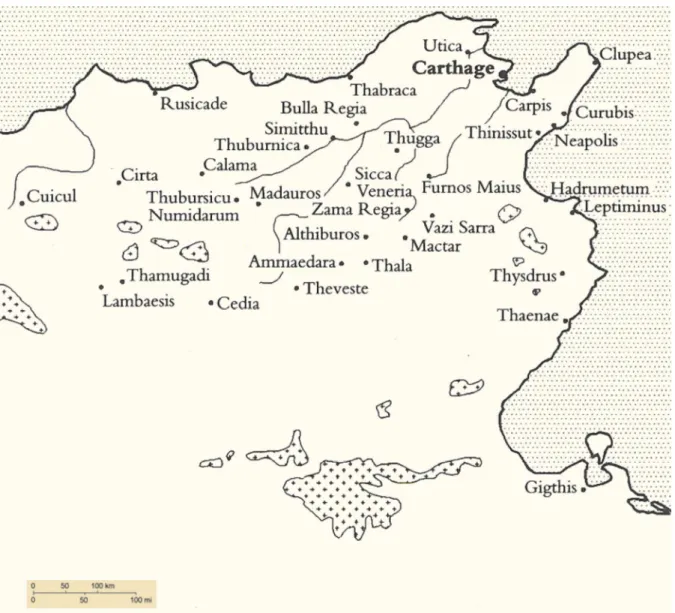
civic dedications at Thamugadi and Cuicul (see Fig. 1 for a map showing these sites). These
sites are advantageous in that they both have extensive epigraphic material and are also
thought to have similar historical origins.44 Thamugadi was founded as a veteran colony in 100 CE, and Cuicul, although its date has occasionally been disputed, was also established as
a colonial community most likely during the late first century CE.45 In addition, while both sites were rather roughly “excavated” by French archaeologists in the late 19th and early 20th centuries, there remains good evidence for the city plans and, thus, for how the epigraphic
evidence was connected to the public spaces within those layouts.46
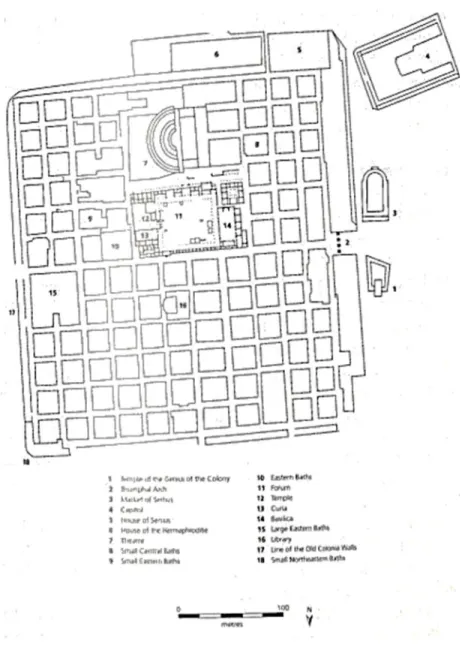
The principal focus of this paper is on Thamugadi (Fig. 2), and it is worth taking a
moment to orient the discussion within the town’s forum – one of the primary locations
chosen for the display of honorific monuments within the community. A rigid street plan,
44Witschel (2013, 85) notes that each town can be associated with about 600 inscriptions; Witschel (1992)
brought together most of the epigraphic material of Thamugadi in his MA thesis, but there is no modern holistic collection of the inscriptions. The inscriptions of Cuicul have fared much better in this respect as they were completely re-edited only a few years ago in ILAlg 2.3.
45Thamugadi is given an exact date by two founding inscriptions which were once attached to the gates of the
town: CIL 8, 2355 = 17842 = ILS 6841 and CIL 8, 17843; Cuicul lacks such confident sources, but Kleinwächter (2001, 65-72) finds this date most likely.
15
probably conceived originally by military architects, lacked most of the important civic
structures during the first few years of the colonia’s history. However, despite the non-stratigraphic excavation of this architecturally complicated city center, the development of
the town’s urban fabric can be traced through the building dedications which testify that
these projects were financed, at least partially, by money connected to the assumption of
municipal magistracies.47 The forum was constructed during the life of Trajan and enlarged during the reigns of his successors Hadrian and Antoninus Pius.48 On the western edge stood municipal structures, which included a curia. During the second century this side of the forum in particular was subjected to a series of developments that disrupted thecourtyard and
portico.49 A rostrum for public speaking was constructed in front of the portico. Behind this
rostrum, and connected to it by a flight of stairs, was a small, tetrastyle temple (cella of 4.3 x
6.8 m.) that has usually been thought of as the ‘Temple of Victory.’50 Probably in the reign of Hadrian or Antoninus Pius an aedicule (small shrine) of Fortuna Augusta, which was set up by one two of the women discussed below, was established next to the temple.51 The few large construction projects of the third century, a macellum and a capitolium, were built by a husband and wife, a flaminica perpetua.52 The forum of Thamugadi was primarily a location
47See Saastamoinen (2010) for a full catalog of known building inscriptions.
48Laurence et al. 2011, 190. Ballu (1897, 129-132) describes the initial complex as having been constructed
with a paved area of around 50x42 m. and having been surrounded by porticoes. To north and south a series of spaces, some sealed with metal grilles, may have been used as shops or meeting-places.
49Laurence et al. (2011, 190) describes the eastern side of the forum as where the basilica and its dependent
buildings were located.
50Ballu 1897, 147-8; Jouffroy 1986, 215.
51Laurence et al. 2011, 191.
16
for public business associated with the curia and the basilica as well as being a place for the display of loyalty to Rome and for honoring the city’s rich and powerful.53
As another city provided with large monuments and expansions over the course of the
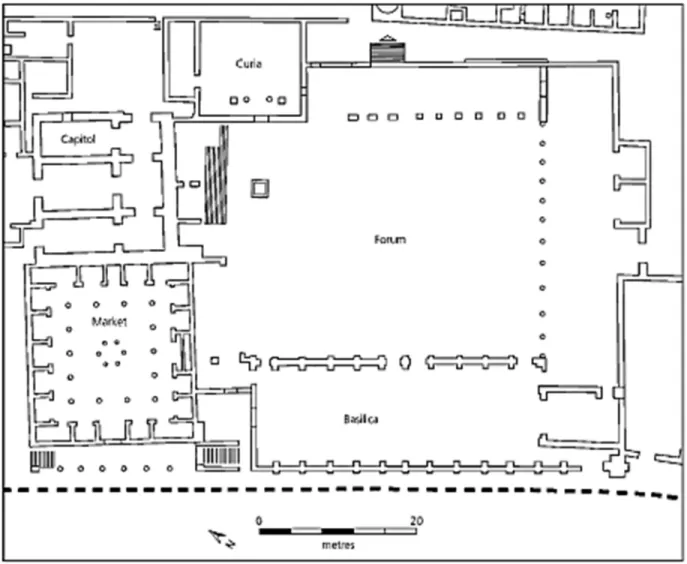
second century, Cuicul is often held in comparison with Thamugadi.54 This town had a forum by the reign of Hadrian (Fig. 3).55 It gained a capitolium by the middle of the second century,
a market under Antoninus Pius, a basilica sometime after 169 CE and a curia under the Antonines.56 However, this forum may have been unable to provide for all of the population’s needs. During the late years of the second century CE, a new, but irregular
porticoed space was created immediately outside the city walls (known as the Severan Forum
or South Forum even though it is unknown whether it was officially conceived of as a
forum).57 This space did not appropriate all the functions of the old forum, but considerable work was done here that included the addition of paving and the erection of porticoes. In
effect this became a transitional space between the old, walled, town and the expanding
urban area along the city’s spur to the south and the area of the theatre to the east.58
Increasingly it also became an area for the display of the elite and the provision of facilities
for the city’s population.
Into all of these spaces were placed the statues of magistrates, the elite, and the
benefactors of the city who had held office, managed its affairs and even enhanced its urban
53Laurence et al. 2011, 192.
54Sears 2011, 68-70; Zimmer 1989.
55Février 1982, 353.
56Février 1982, 353; Février 1968, 40.
57Février 1964, 10-11.
17
life by holding banquets and games or constructing new buildings.59 Additionally, these public spaces acted as venues for showcasing Thamugadi and Cuicul’s connection to the
Roman emperor and through his imagery, the state. Statues of the emperors comprised up to
60% of all those known from the fora at Cuicul and 39% of the statuary from the forum at
Thamugadi.60 It is within these settings, where Roman civic identity was displayed, that
most discussions of the honorific monuments take place.
Thamugadi: Civic Monuments
During the early years of Thamugadi’s existence, the population is thought to have
consisted primarily of veterans of the legio III Augusta and their families, although this is difficult to prove definitively since epigraphic sources cannot be securely dated to this early
period.61 However, during the second century, the social structure of the town became more hierarchical and a more stable municipal aristocracy was established.62 Leading figures of the town seem to have been incorporated into the ranks of the Roman equestrians and even the
senatorial order. Office holding and euergetism, commemorated through inscriptions and
honorific statuary, became very competitive as members of this new elite tried to increase
their prestige.63 These honorific monuments were among the most important ways in which benefactors and notable members of the community could be recognized for their
contributions to the community.
59Laurence et al. 2011, 192.
60See Zimmer’s (1989) appendix for a full breakdown.
61Witchel 2013, 86.
62See Witchel 1992, 1995, 2009 and Briand-Ponsart 2003 and Gilhaus 2013 for more thorough discussions of
the social history of Thamugadi.
18
Witschel’s prosopographical catalogue contains twelve instances in which civic
inscriptions were set up for or by women in the public spaces of Thamugadi.64 These twelve women, whose inscriptions are in the Appendix of this paper, represent a very small portion
of the already small attested population for the city, but are among the municipal elite and
two are even clarissimae feminae.65These women are studied as a group as they were the
only women to be commemorated in public inscriptions which were important for the
“communication and commemoration of social values and prestige.”66 Despite this small sample size, some revealing patterns can be noted. For example, all but four of these women
are mentioned on monuments dating to the early 3rd century or later. These four women were commemorated publically at a time – during the second century – when, as we saw above,
major additions to Thamugadi’s forum and public spaces took place. As Zimmer has noted,
these spaces were full of dedicatory and honorific monuments set up for and by men.67 Elite men had contributed to the cycle of euergetism in the city and supported its continual growth
during the first century of its existence.68 This vanguard of women during the second century represents a significant numeric minority in these communal spaces.69 This small group
shares some striking characteristics that may represent how women were incorporated into
64See my short Appendix below containing the main inscriptions for each of these 12 individuals. Witschel
(2013, 89) states that among the 622 total persons who are known as citizens of Thamugadi, 182 (29%) are known as women. These women represent a small number of these women. This Appendix only includes the inscriptions mentioned from Thamugadi and not the ones from Cuicul which are available in the ILAlg 2003.
65Witschel 2013, 89.
66Witschel 2013, 89.
67Zimmer 1989, 38-48.
68Witschel 2013, 88-89.
69Witschel (2013) notes that these twelve women were named in honorific inscriptions (18 times) and in
19
the Roman practice of civic commemoration as it occurred at Thamugadi. This early
tendency provided a pattern to follow once it became desirable for women who had access to
financial assets, ample enough to supplement the city’s economic resources, to be
incorporated into public life during the third century CE.
Two of these women, Annia Cara and Annia Traquilla, were sisters, and the former
was recorded as a flaminica (Fig. 4).70 These women were not honored with statues but assisted in the erection of a statue of Fortuna Augusta on the forum, the most prestigious
public place for a civic inscription, which had been bequeathed as an act of munificentia
(munificence) by a collibertus (a fellow freedman) of their father who himself had given money for this purpose (Figure 4). The two sisters added an aedicula (small structure or shrine) worth HS 4400 and also sponsored an epulum (public feast) with their own money. Notably, Cara and Tranquilla were the daughters of a libertus (freedman). Witschel notes that it is unusual and unclear how Cara, the daughter of a libertus, could reach the “prestigious position” of a flaminica and theorizes that she may have been married to a flamen
perpetuus.71 Witschel views this as closely aligning with van Bremen’s view of female
priestesses in the Roman East in which women acquired the title of flaminica by virtue of their husband holding the male priesthood of that type.72 However, there is no evidence to support this for Cara, and it is quite possible that she managed to have been chosen for this
role on her own as the daughter of a freedman who nonetheless possessed enough wealth to
pay the summa honoraria, as Hemelrijk has noted.73 In Thamugadi, therefore, it appears that
70See Appendix below, T6 and T7; both are on the monument identified as CIL 8, 17831. Figure 4.
71Witschel 2013, 92.
72Van Bremen 1996, 115-20, 298-302.
20
Cara was able to reach the position of flaminica despite her lack of high status, suggesting that one of the determining factors in being selected for such a role was wealth.
The other two women recorded in public space during the second century CE were
also connected to the imperial cult and, like Cara and Tranquilla, were related. Flavia
Procilla, flaminica perpetua, and her daughter, Marcia Caelia Procilla, were both commemorated in a public place.74 Flavia was honored with a statue by her brother,
Monimus. Since it was reused in the Byzantine fortress, the inscription recording this act has
an unknown original location. However, the formula d(ecreto) d(ecurionum) finishes this inscription and indicates that it was originally erected in a place sanctioned by the local
ordo.75 Flavia is also known to have dedicated a statue for her brother in the forum, and the
two may have originally been located near each other.76 Flavia’s presence, not only in the inscriptions, but also in her non-extant portrait statue, demonstrates that the overall messages
for these monuments could be complex. While the monument celebrated her presence in
public, it also included the man who dedicated the monument to her, her brother, and thus
framed her honor in a very public space within the acceptable realm of women – the family.
Furthermore, not only was it a male relative that dedicated the statue for her, but Flavia’s
brother was a man of high rank (an eques Romanus or Equestrian) and a flamen perpetuus in addition. This addition of high social status by virtue of her family may have legitimized
Flavia’s claim to displaying her image and name in a very male dominated public space.
74See Appendix below, T4 (AE 1941, 45) and T8 (CIL 8, 2404).
75Decreto decurionum = “by decree of the decurions,” indicates that the monument had their permission to be
set up in a public place.
21
Flavia’s daughter, Marcia, was also honored with a statue by the liberti of the family, most likely in the forum as is deduced from the formula used to end the inscription: d(ecreto)
d(ecurionum).77 The fact that she is the daughter of a flaminica perpetua is explicitly mentioned (flaminis perpetui filiae). In contrast with her mother, Marcia is not named in relation to a male member of her family but in relation to her mother, who was recorded not
by name but by her religious role. This suggests, perhaps, that Marcia did not feel the need to
shore up her claim to public honors through the link to a male relative and, instead, that her
mother’s position and previous honors were enough to make her daughter’s in a public arena
appropriate by association.
To summarize, before the third century begins, women were recorded in civic
inscriptions when they dedicated monuments for (male) family members or when they were
being honored by family members or their own freedmen. Interestingly, the status of
flaminica is given prominence even when the person being honored does not possess that title themselves, suggesting that even before the third century, the socially acceptable role of
priestess was something that may have made the presentation of women more suitable for
public viewing. If this were thought insufficient, for example, for a first generation flaminica
like Flavia, additional levels of propriety came through association with male members of
society. Annia Cara and Annia Tranquilla’s dedication from their own money suggests that
the right to be recorded in such public places (although not necessarily to be honored with a
public statue) or even to become a flaminica was associated with wealth. The wealth of these
22
women allowed them to be able to contribute to the adornment of the city despite lacking
traditional access to elevated status by birth.
While gaps in the epigraphic and statuary record for the second century for females
commemorated in public may contribute to this small corpus, it still seems significant that in
the third century there is a sudden increase in the number of women being recorded in civic
inscriptions. Witschel has collected evidence of eight women from the third century who
were commemorated in a bath complex, in the theater, in a macellum, and even in the
forum.78 One woman was even honored by the whole community of Thamugadi.79 Such an increase requires some examination. Most of these women were members of families which
belonged to the highest strata of society. Important connections to the religious post of a
flaminica continue to be highlighted, as well as connections to family members, but the variety of places in which these women were commemorated and their increased inclusion in
“public places” – often possibly the forum – suggest that it was more acceptable to
commemorate women in monumental ways. One such flaminica perpetua, Virria Flavia Sevreiana Petroniana, was honored with a statue by two amici (friends) of her father during the third century CE.80 While the exact, original location of the base is unknown, the statue was set up l(ocus) d(atus) d(ecreto) d(ecurionum) or at a place having been given by the decree of the decurions, most likely the forum.
Witschel is certainly correct in noting that these women became much more visually
present in the public arenas of Thamugadi, but this leaves the problem of why these women
78See Appendix below, T1-3, T5, T9-12.
79CIL 8, 17905, Tucciana, discussed below.
23
were increasingly being included in such inscriptions in the first place and what made it
acceptable for statues of women to be included in higher numbers than before.
It is possible that the same economic stress that Bond associates with the rise of the
awarding of the title of civic patrona for female benefactors who were incorporated into the cycle of civic euergetism is also causing this increase in women recorded in such a public
manner. The funds under their control would have supplemented those that could be
mustered from the decurions in order to continue to build the urban fabric of Thamugadi’s community.81 No civic patronae are attested for either Thamugadi or Cuicul, and at
Thamugadi this may have been due to this small but pre-existing tradition of sanctioning the
commemoration of women associated with the flaminate (with or without the legitimizing
role of a male relative) in public places from the second century CE, as is discussed above.
The high amount of money associated with assuming that office in North African cities may
have made them the more logical choice for towns experiencing financial stress. As
supplements to regular male benefactors, female flaminicae would have expected the money paid as part of their summa honoraria to have been reciprocally honored in a way similar to how the men had been honored – with a statue.82
Of the women commemorated in the third century epigraphic record of Thamugadi,
Cornelia Valentina Tucciana s. Sertia, is possibly the most impressive.83 Tucciana was a
flaminica perpetua and had perhaps gained her title earlier than (and thus independently from) her husband, the wealthy eques Romanus and flamen perpetuus, M. Plotius Faustus s.
81Sears, 2011.
82Bond 2007, 60.
24
Sertius.84 She is mentioned on more epigraphic documents than all the other women at Thamugadi; there are nine inscriptions in which Tucciana is named. Three of them relate to
building projects in which Tucciana was involved including a macellum donated with her husband. Two of which are listed in the Appendix below.85 Furthermore, it seems that the Sertii family was also responsible for the construction or restoration of another important
building – perhaps even the capitolium of the town – and that they commemorated this act in a monumental building inscription.86
Tucciana was honored with five statues (known only by their bases) in the public
sphere. Four of these were erected by relatives and clients in the macellum which the Sertii had built.87 Two statues were put up by her husband Faustus, who explicitly mentioned their
relationship in the inscriptions engraved on the statue bases.88 Another statue was given by the foster-son of the couple, M. Pompeius Quintianus s. Optantius, himself an eques Romanus and flamen perpetuus.89 The fourth statue of Tucciana in the macellum was dedicated by two alumni (foster children) of the family, calling her a patrona benignissima
84This is claimed by Bassignano (2005, 427) who argues that in some inscriptions (e.g. in CIL 8, 2396 = 17823)
that Tucciana is mentioned as flaminica perpetua whereas Faustus lacks this title. Fig. 5.
85For the inscription commemorating the construction of the macellum, see BCTH 1893, 159. No. 57 = BCTH
1894, 361 no. 74 = ILS 5579: Sertii/ macullum/ et aream / eius / patriae / suae / fecerunt; for the location of the statue bases mentioned in the following footnotes see Zimmer (1992, 312 fig. 207), see Appendix below T3.1.
86AE 1980, 956: [M(arcus)] Plotius [Fa]ustus sa[cer]dos ur[bis---] et Cornelia Valen[tina] Tucciana [---uxor]
eius flamines p(er)p(etui) [---] patriae suae fecerunt. Some of the panels on which this inscription was written were reused in the courtyard of the capitolium during a restoration of the building in the 4th century. Bassignano (2005, 417) believes that the inscription originally also belonged to this monument, see Appendix below T3.2.
87See Appendix below, T3.
88See CIL 8, 2397 = ILS 2752 is on a statue base; found in the inner courtyard of the macellum; and CIL 8, 2398
is on a statue base found at the main entrance of the macellum on the inner side: …Faustae maritus posuit.
89CIL 8, 17905 is on a statue base found in the inner courtyard of the macellum. In this inscription, Tucciana is
called a honestae memoriae femina, but it is also explicitly stated that she was coniux M(arci) Ploti Fausti a
25
(kindest patron).90 Most importantly, Tucciana, by decree of the local council, had a statue dedicated to her by the whole city.91 This is followed by a statement which gives the
motivation for the erection of the statue: ob merita in civis patriamque et munificentiam eius
(on account of her merit toward the citizens and her homeland and her munificence). The
wording seems to indicate that not only did Tucciana have an elevated position within local
society, but it seems likely that this was based to a large degree on her own merits.92 Tucciana was certainly one of the wealthiest women of her time at Thamugadi and was
highly visible in the public sphere of the town through the inscribed monuments referring to
her. However, in most cases this was combined with an explicit reference to the career and
deeds of her husband. 93
This example is given not with the intention of claiming that references to male
relatives or a husbands within the honorary inscriptions are detrimental to the honor being
received by the person being given deference, since referencing one’s place within a familial
structure was often important for male honorands, too.94 Nor is this inclusion of male relatives in any way out of the ordinary for female honorands who were often listed
alongside a husband or other male relative in the context of the wider Mediterranean.
However, I would argue that in certain situations, such as the one presented at Thamugadi
90CIL 8, 2396 = 17823 (Statue base found at the main entrance of the macellum on the outside): [Se]r[tiae] /
[Cor]neliae Vale[n] / [ti]nae Tuccianae / fl(aminicae) p(er)p(etuae) et Plotius / Thallus pater / eius alumni / patronae / benignissimae.
91AE 1987, 1072 = AE 1992, 1833: The statue base was found at Oued Taga about 14 km east of Timgad, but it
seems most likely that it was brought there from one of the public places of the urban center in later times.
92See BCTH 1896, 285 no. 251.
93Bassignano (2005 418, 428) even assumes that Tucciana may have been richer than her husband, but there is
not proof for that.
26
(known for the predominantly male character of its public spaces), that using such a
technique may have acted as one way in which the offense of a woman appearing and being
honored in public could be mitigated.95 By associating the woman receiving an honor with a male figure, usually a relative or husband, the impact of her public presence is not
overshadowed, but merely deflected slightly. Despite the fact that most of these inscriptions
were dedicated by male family members, they were sanctioned for erection in a public place
by the local ordo, an act suggesting that these women were clearly deserving enough of honor that they were allowed a monument in public. However, the continued reliance on, in
all but Tucciana’s special case, a male relative or friend to act as dedicator could hint at a
continued belief that even though it was now acceptable for women to be honored in public,
they still had to behave in ways considered proper for Roman matrons.
Cuicul: Civic Monuments
Witschel notes that Cuicul’s social structures seem to have developed along more or
less the same lines as at Thamugadi, however there are some stark differences in how this
town reacted to the less desirable economic situation brought about by the third century CE.96
In Cuicul, during the second century women were occasionally honored for their connection
to a wealthy family or were honored for an unknown reason, without an associated position
like that of the flaminica to suggest a financial motive on the behalf of the dedicant.97 However, with the beginning of the third century CE, women were more often able to
95See Berg (2002) for a discussion of how women balanced this need to balance the conspicuous consumption
of wealth with the demand to remain invisible in public in the context of their personal appearances.
96Witschel 2013, 97. For the society of Cuicul, see the remarks by Jacques 1984, 549-553 and Briand-Ponsart
2008.
27
contribute to the urban equipment of the public places of their town (and simultaneously to
promote their own access to financial resources) by dedicating monuments for others.
In Cuicul, I will briefly examine those monuments connected with women that were
erected in the two main public places of the town: the “North Forum” (Figure 3) in the old
city center and the “South” or “Severan Forum” located south of the original town center (see
above for a more thorough description).98 A large number of statue bases and other inscribed monuments are known from both places, and this enables us to have a fairly clear picture of
who would have normally received an honorific portrait in one of these places and what the
role of women was within that context, both as persons that were honored with a statue and
as dedicators of such monuments. Women were named in the inscriptions on the bases of the
statues, making their commitment to the town and its inhabitants highly visible in the public
sphere. However, they do not seem to have made this contribution simply through the summa honoraria associated with assuming the office of flaminica. Instead, women began to
promote their own economic status by providing statuary honors (sometimes explicitly with
their own money) for others while their own names were featured prominently in the
dedicatory inscription.99 While some of these women were connected to the flaminate, they were not honored in Cuicul with the same selectivity as is visible in the evidence from
Thamugadi.
When compared with the Roman honorific practices at Thamugadi, trends in Cuicul
demonstrate both striking differences and some interesting similarities. For example, during
the late 2nd CE, at least nine women were honored with statues by the city or in the name of
98Zimmer 1989, 17-37; Kleinwächter 2001, Beilagen 6-8.
99Additional examples not discussed below of women recorded as dedicants: ILAlg 2.3 7689, ILAlg 2.3 7956,
28
the local ordo.100 In comparison, only one woman is known to have received an honorific monument from the community at Thamugadi.101 For many of these women, no specific reason is given for why honors were awarded, and there seems to have been less direct
connection to the position of flaminica other than through marriage or relation to a male with that title when the women who received honorific monuments are examined.102 However,
during the early years of the third century, there were a fair number of women, often
flaminicae, who are recorded as having acted quite independently in using their financial resources to dedicate monuments for other individuals. In Cuicul’s North Forum, four
women are recorded as dedicators of statues for other individuals (out of fifteen total) and
five women are recorded as dedicators of statues for gods out of 26 such statues.103 In
Cuicul’s South Forum, out of 26 total statue bases with inscriptions, 2 were dedicated by
women.104
There do not seem to have been any women like Annia Cara (see above) in Cuicul. In
contrast the financial resources associated with those who could afford the position of a
flaminate were accompanied by high social status. For example, Didia Cornelia Ingenua, a
flaminica perpetua, and her sister Didia Cornelia, a clarissima femina, both belonged to one of the leading families of Cuicul and they and the inscriptions which mention them are
thought to have been dated to the end of the second century or the beginning of the 3rd
100Iulia Pisonina ILAlg 2.3 7909; Tiberia Claudia Sabatiana Aquilina and Tiberia Claudia Digna Subatia
Saturnina ILAlg 2.3 7898; Claudia Saturna and Titinia Clodia Satura ILAlg 2.3 7899; Gargilia Marciana ILAlg 2.3 7944.
101AE 1987, 1072 = AE 1992, 1833.
102ILAlg 2.3 7689, ILAlg 2.3 7956, ILAlg 2.3 7678.
103Witschel 2013, 101.
29
century.105 However, they are not remarkable for the honors they received; instead, they initiated the installation of three statuary monuments: two for their father and one for their
brother (both of them equites Romani) in the North Forum.106 Nonetheless, it appears that these women were able to command significant amounts of capital and were willing to use it
to dedicate monuments (with their own name featured on the accompanying inscription) that
added to the urban landscape of the community. This is perhaps best exemplified by one
woman not included in Witschel’s catalog: Claudia. 107 As a flaminica, she consecrated a statue to an unknown deity, probably to the genius of the city, from her own money (sua pecunia) in an inscription dating to the 3rd century CE.108 The inscription is made on a simple, oblong stone, but she is listed as the sole dedicator, without the help of a male family
member or liberti.
Furthermore, those in the role of flaminica could be called on to complete religious dedications, demonstrating not only their ability to command monetary resources but also
their assumed willingness to participate in projects that would benefit the community as a
whole. For example, an inscription on the base for a statue of Mars Augustus Genius
Coloniae found on the “South Forum” declares that a member of the local aristocracy, Q.
Gargilius Quietus (who was omnibus honoribus functus – performing all honors –and flamen
105Witschel 2013, 101-102.
106Statue bases for the father: ILAlg 2.3 7948 = AE 1923, 21 = Kleinwächter 2001, 126 no. 23; ILAlg 2.3 7947 =
AE 1920, 115 = Kleinwächter 2001, 126-127 no. 24 Statue base for the brother: ILAlg 2.3 7942 = AE 1916, 13 = Kleinwächter 2001, no. 25.
107BCTH 1915, 134, n.27: [Mar(?)]ti A[ug(usto) (?)] / Sac(rum) / Claudia Ti(beri) fil(ia) / flaminica / s(ua)
p(ecunia) p(osuit). Name of the deity in the dative case, defined by the epithet Augustus also sacrum is common. Dedication to the gods and to the emperor.
30
perpetuus), had ordered in his testament that the statue should be put up by his wife (uxor), who was also a flaminica perpetua.109
While flaminicae in particular were not honored with the same exclusivity as those in Thamugadi during the 3rd century CE, in Cuicul the few flaminicae recorded in civic
inscriptions are invested in directly contributing to the urban fabric through dedications of
statuary for others. In Cuicul, honoring women from families of high social status during the
second century seems to have established clarissimae feminae as the main group for whom honors were awarded, and it is this factor that seems to make them appropriate for public
display. However, a second group of women – those making dedications for others – while
still often of high status, did not necessarily merit honors, but instead their status often
revolved around their position as flaminicae – suggesting that this title sanctioned an
appropriate appearance in a this type of civic inscription. It seems that the earlier dependence
on social status carried over into the 3rd century. Flaminicae were not the only women honored and even those who were, were often of a very high status. This brief look at Cuicul
shows similarities, but also striking differences with the practices of establishing honorific
monuments in Thamugadi despite the two places having similar regional and historical
backgrounds. Both cities’ civic inscriptions seem to attest to very distinct and specific
tendencies with regard to incorporating women into public life in ways considered
appropriate for each town.
109ILAlg 2.3 7678: Marti Aug(usto) / Genio col(oniae) / sacr(um) / statuam quam / Q(uintus) Gargilius Q(uinti)
31
CHAPTER 4: STATUARY
The honorific statuary displays in the fora of Timgad suggest that these spaces were
treated as predominantly male, more so than was the case in the Roman east.110 Trimble uses this as a possible explanation for the lower number of North African versions of the Large
Herculaneum statue type in comparison to the number found in the Roman east and Italy.
Another factor that Trimble notes is regional preferences for different forms. She cites a
preference for the “Ceres” statue type for female portraits in North Africa. 111 In the two towns examined in this paper, it is difficult to discuss a “preference” for one type of statuary
body and how that correlates to evidence provided in the inscriptions due to a lack of statues
in general, much less ones paired with an accompanying base.112 In fact, there are only four
known female statues with a provenance in the city of Thamugadi that survive and only one
from the town of Cuicul.113
110Trimble 2011, 233.
111Trimble 2011, 233.
112See Alexandridis (2004) App. 1 and 2 for her collection of imperial and non-imperial female statues from the
Roman Empire. Other North African towns have more extensive evidence for this, and to truly examine the relationship between text, location, statue body format, and portrait head, different locations (such as Bulla Regia) would be better choices for such an investigation. In the case of Thamugadi, the construction of the Byzantine Fortress at the site is perhaps one of the largest contributors to the survival of statues.
113This information comes from the comprehensive Appendix 2 of Alexandridis’ (2004) catalogue of female
32
From Thamugadi, two of these are depictions of imperial women, both in the Ceres
type pose.114 The arms of this statue, while they stay close to the sides of the body, do not cross the chest. Statues of this type lift a fold of their mantle on their forward left thigh,
emphasizing the strong forward motion of the legs. The Ceres type was not used during the
late Republic or early Augustan periods, when public statues were only beginning to become
a popular way to honor women. Once the practice of honoring women with a statue in civic
areas became more frequent, there were more contexts in which the more open and active
pose of this statue type would be appropriate. Both statues, one representing Faustina Minor
(Fig. 6) and the other representing Faustina Major (Fig. 7) were discovered in the theater at
Timgad, a very prominent area, and were thought to have been displayed in the scaenae frons
there.115 The body formats of these statues had long been associated with public display, and this does match the context with which they are thought to belong.116
Two non-imperial statues from Thamugadi have also been identified: one as a
modified Hip-swathe body format (Fig. 8) and the other as a Large Heruclaneum woman.117 The Hip-swathe statue type is an “open” pose where the arms are held away from the body,
and strong diagonal lines that begin around the right knee or foot call attention to the motion
present in this type. The type known as the Large Herculaneum Woman uses a closed pose,
with the arms and drapery forming a barrier between the woman and the viewer. This statue
composition appears to be wearing a thin tunic under a light wool mantle that is draped so as
114Alexandridis 2004, Kat.-Nr. 209 and Kat.-Nr. 197.
115Alexandridis 2004, Kat.-Nr. 209 and Kat.-Nr. 197.
116Davies 2013, 185.
117Alexandridis 2004, App. 2.2.14 Bb
33
to completely cover the upper half of the body.118 While the two imperial statues that are mentioned above might fit with Trimble’s observation of a preference for the Ceres type in
North Africa, despite the extremely small sample size of extant statues, the ones chosen to
represent private women at Thamugadi present a much more varied picture at the local level.
Interestingly, the statue of a woman presented in the Hip-swathe format was found in the
Frigidarium of the large South-Bath complex at Thamugadi. If there were a larger sample size with which to work, it might be significant that the more open composition type that we
have is found not in the forum, but in the baths. A full exploration of the entire sculptural
assemblage for the bath complex would have to be undertaken, but from preliminary
examinations, it seems that this area was less strictly dominated by representations of male
figures.119 Perhaps, the more assertive, open, Hip-swathe pose could be considered appropriate in such a setting. Unfortunately, no find spot was recorded for the Large
Herculaneum type statue from Thamugadi.
In Cuicul, there is only one portrait statue of a woman that survives and can be
successfully connected to the town.120 This image of a non-imperial woman is also in the
Hip-swathe format. While this once again shows more variation in statue types for North
Africa than Trimble is able to capture with the wide scope of her book, it may be possible to
see a parallel between the choice of a Hip-swathe statue format in both Cuicul and
Thamugadi. While flaminicae were present in the public spaces of both cities, just as the epigraphic material in Cuicul features women as dedicators rather than as honorands (in
contrast with Thamugadi), the statuary accompanying these monuments may also have
118Dillon 2010, 82.
119Manderscheid 1981.
120Alexandridis 2004, App. 2.2.14 A