R E S E A R C H A R T I C L E
Open Access
When a child dies: a systematic review of
well-defined parent-focused bereavement
interventions and their alignment with
grief- and loss theories
Eline M. Kochen
1*, Floor Jenken
2, Paul A. Boelen
3,4, Laura M. A. Deben
1, Jurrianne C. Fahner
1,
Agnes van den Hoogen
2, Saskia C. C. M. Teunissen
1, Karin Geleijns
1and Marijke C. Kars
1Abstract
Background:The availability of interventions for bereaved parents have increased. However, most are practice based. To enhance the implementation of bereavement care for parents, an overview of interventions which are replicable and evidence-based are needed. The aim of this review is to provide an overview of well-defined bereavement interventions, focused on the parents, and delivered by regular health care professionals. Also, we explore the alignment between the interventions identified and the concepts contained in theories on grief in order to determine their theoretical evidence base.
Method:A systematic review was conducted using the methods PALETTE and PRISMA. The search was conducted in MEDLINE, Embase, and CINAHL. We included articles containing well-defined, replicable, paediatric bereavement interventions, focused on the parent, and performed by regular health care professionals. We excluded
interventions on pathological grief, or interventions performed by healthcare professionals specialised in
bereavement care. Quality appraisal was evaluated using the risk of bias, adapted risk of bias, or COREQ. In order to facilitate the evaluation of any theoretical foundation, a synthesis of ten theories about grief and loss was
developed showing five key concepts: anticipatory grief, working models or plans, appraisal processes, coping, and continuing bonds.
Results:Twenty-one articles were included, describing fifteen interventions. Five overarching components of intervention were identified covering the content of all interventions. These were: the acknowledgement of
parenthood and the child’s life; establishing keepsakes; follow-up contact; education and information, and;
remembrance activities. The studies reported mainly on how to conduct, and experiences with, the interventions, but not on their effectiveness. Since most interventions lacked empirical evidence, they were evaluated against the key theoretical concepts which showed that all the components of intervention had a theoretical base.
(Continued on next page)
© The Author(s). 2020Open AccessThis article is licensed under a Creative Commons Attribution 4.0 International License, which permits use, sharing, adaptation, distribution and reproduction in any medium or format, as long as you give appropriate credit to the original author(s) and the source, provide a link to the Creative Commons licence, and indicate if changes were made. The images or other third party material in this article are included in the article's Creative Commons licence, unless indicated otherwise in a credit line to the material. If material is not included in the article's Creative Commons licence and your intended use is not permitted by statutory regulation or exceeds the permitted use, you will need to obtain permission directly from the copyright holder. To view a copy of this licence, visithttp://creativecommons.org/licenses/by/4.0/. The Creative Commons Public Domain Dedication waiver (http://creativecommons.org/publicdomain/zero/1.0/) applies to the data made available in this article, unless otherwise stated in a credit line to the data.
* Correspondence:[email protected]
1Julius Center for Health Sciences and Primary Care, University Medical
(Continued from previous page)
Conclusions:In the absence of empirical evidence supporting the effectiveness of most interventions, their
alignment with theoretical components shows support for most interventions on a conceptual level. Parents should be presented with a range of interventions, covered by a variety of theoretical components, and aimed at
supporting different needs. Bereavement interventions should focus more on the continuous process of the transition parents experience in readjusting to a new reality.
Trial registration:This systematic review was registered in Prospero (registration number:CRD42019119241).
Keywords:Bereavement, Parents, Paediatrics, Systematic review, Models theoretical, Interventions
Background
After the death of an infant, or child, parents are left
with an intense and overwhelming sense of grief [1–3].
Parents experience an accumulation of feelings of loss
from the child’s initial diagnosis, through the progressive
deterioration in the child’s condition, and eventually, to
the death of the child [4]. In addition to their own
feel-ings of grief, parents also experience the burden of grief
from the dying child and their siblings [3]. Grief is a
nor-mal reaction to the loss of a child. For most parents, moderate support from regular health care professionals (HCPs), and relatives, is sufficient in helping to cope
with feelings of grief [5]. However, around 10 to 25% of
parents experience a serious disruption in emotional sta-bility, which may result in poor psychosocial outcomes
and adverse mental and physical health effects [6,7].
A growing body of literature demonstrates that HCPs
recognise parents’need for support in handling feelings of
loss and grief [8–10]. This has resulted in an increasing
number of interventions in practice aimed at all bereaved
parents and provided by regular HCPs [10]. Although care
standards state that providing bereavement care to parents is an important aspect of end-of-life care, such care is not
yet routinely implemented in most hospitals [7,11]. This
might be due to the fact that HCPs often feel ill equipped
to provide bereavement care [12]. Another explanation
might be that bereavement interventions based in practice do not contain clear guidelines or protocols, making them
difficult to standardise [13]. The assumption is that clear
protocols and guidelines make interventions replicable for other HCPs. An overview of, clear, replicable interven-tions, containing guidelines and instrucinterven-tions, could lead to improved implementation and appropriate care delivery to all bereaved parents. This is because the availability of evidence-based practice guidelines could enable HCPs to
feel more equipped [12]. However, such an overview is
currently missing.
Another characteristic of this practice-based nature of the interventions is that theoretical and empirical
sup-port are often unclear or not provided at all [10,14,15].
Theoretical understanding is an essential ingredient in developing, evaluating, and implementing behavioural
interventions and best clinical practices [16]. A social
theory can be seen as a set of statements that explain as-pects of social life, and which demonstrate how people
conduct and find meaning in daily life [17]. However,
the theoretical field of loss and grief is still evolving. Nevertheless, several theories have been put forward to provide a supporting structure to the theoretical
under-standing of the process of grief [18–30]. Understanding
how different elements of interventions might relate to, or rely on, such theories, could improve our understand-ing of the underlyunderstand-ing mechanisms of these interventions and provide an indication of their effectiveness.
This review will provide an overview of well-defined be-reavement interventions performed by regular HCPs, and aimed at supporting parents in coping with loss, during
both the end of their child’s life and after their child’s
death. Furthermore, we will provide an overview of their effectiveness and whether the bereavement interventions currently practiced are substantiated by theory about loss and grief, and, as such, provide a theoretical basis for the effective elements of bereavement interventions.
Methods Design
The field of paediatric palliative care is relatively young and so clear terminology is yet to be established. There-fore, we used an iterative method for constructing a search strategy: Palliative cAre Literature rEview
iTera-Tive mEthod (PALETTE) [31]. In addition, our method
complied with the Preferred Reporting Items for
System-atic Reviews and Meta-Analyses (PRISMA) [32]. This
systematic review was registered in Prospero (registra-tion number: CRD42019119241).
Databases and searches
The first articles were identified through a preliminary search in PubMed and via expert advice from senior re-searchers in the field of paediatric palliative care and be-reavement. From these articles, different synonyms were gathered and terminology became clearer, a process
known as‘pearl growing’. As a result, articles were
met all inclusion criteria and thus should be included in the review. These processes resulted in additional searches. The process of pearl growing, identifying such new articles and adjusting the search string conducted in collaboration with an information specialist, was repeated until the
search was validated [31]. That is, when all golden bullets
were identified in the results of the search. Subsequently the information specialist involved conducted the final structured literature search in the following databases:
MEDLINE, Embase, and CINAHL. See Additional file 1
for the full search strings.
Study selection
The studies that were published in peer reviewed English language journals between January 1, 1998 and November 15, 2018, were included when they contained a well-defined bereavement intervention, offered by regular HCPs, to par-ents of deceased children or children with a life limiting condition at the end-of-life phase. This period of time was chosen because palliative care was formalised in a definition by the World Health Organization (WHO) in 1998,
provid-ing a consensus around the term‘palliative care’.
Interven-tions were defined as an intentional act performed for, with, or on behalf of, a parent or parents. An intervention must consist of well-defined, concrete proceedings. This means it can be replicated by other HCPs and is supported by instructions, a manual, training, a program or other sup-porting documents. We defined regular HCPs as profes-sionals working in neonatal, or paediatric, care, where in their daily tasks, they are confronted with palliative care and care for loss and bereavement, without having neces-sarily received specialist training in these domains. Further-more, interventions aimed at complex grief were excluded, since most parents do not require specialised services and such interventions are mostly performed by specialists on bereavement care. Full inclusion, and exclusion, criteria are
listed in Table1. When the full text was not available
on-line, or when it was unclear whether the practices described were supported by a protocol or supporting documents, the first author of the article was contacted by email and re-quested to send additional information or a copy of the art-icle. Both the title and abstract, and full text screenings, were performed by two researchers independently (EK, FJ), supported by the web-based screening program Rayyan (https://rayyan.qcri.org/welcome). Disagreements were re-solved in dialogue with the research team. All the articles included were reference checked for additional relevant studies.
Data extraction and quality assessment
Data on baseline characteristics, participants, interven-tions, and outcomes were extracted by three researchers
(EK, KG, FJ) using a predesigned form based on Schulz’s
intervention taxonomy [34].
The quality assessment was performed by two re-searchers independently. The trials were assessed using
the Cochrane risk of bias tool (KG, AvdH) [35],
observa-tional studies with an adapted risk of bias tool based on the Cochrane risk of bias assessment tool (KG, AvdH)
[36], and qualitative studies were assessed with the
COn-solidated criteria for REporting Qualitative research
(COREQ) (FJ, EK) [37], recommended by Cochrane
Netherlands. The total scores ranged from 0 to 7 in the trials and observational studies, and from 0 to 32 in the qualitative studies. The quality appraisals did not affect inclusion in the review due to the explorative nature of this systematic review, and also due to the fact that arti-cles containing low appraisal scores could still contain valuable interventions and thus be relevant for the study
aim [38].
Synthesis of grief theories
The interventions were compared with a theoretical syn-thesis, in order to compensate for the expected lack of evi-dence for most interventions, and to evaluate the possible effectiveness. Since there is not a singular dominant theory
on grief [16], leading theoretical models have been
identi-fied using a pragmatic approach. At first, experts in the
Table 1Inclusion and exclusion criteria
Inclusion criteria:
•Articles containing well-defined bereavement interventions offered by regular HCPs to parents of children who have died or those chil-dren in the phase of receiving palliative care.
•Interventions aimed at consoling intense feelings of grief during the end-of-life phase or after the loss of a child. Bereavement care may also occur before the death of the child, for example from the mo-ment the condition of the child is deteriorating and death is imminent.
•Studies must address interventions defined as: Intentional acts performed for, with, or on behalf of, a parent or parents. An intervention must consist of well-defined, concrete proceedings. This means it can be replicated by other HCPs and is supported by in-structions, a manual, training, a program or other supporting docu-ments. Our definition is based upon the definition of interventions used by the World Health Organization [33].
•Studies must address regular HCPs defined as: All types of health care professionals who primarily provide care and/or treatment and, therefore, do not specialise in bereavement care.
•Research in the field of paediatrics and neonatology. •Articles published in a peer reviewed journal. •Studies published in English.
Exclusion criteria: •Review articles.
•Articles published before 1998.
•Articles containing interventions that focus on complex grief and complex bereavement care.
field of bereavement (PB, MK, EK) and palliative care (MK) were consulted, preliminary searches were conducted in Google scholar and Medline, and; a compendium on
be-reavement was consulted [39]. Secondly, a pragmatic
search was conducted in Medline using keywords such as grief, loss, bereavement, theory and equivalents (EK). Thirdly, the theories identified were validated by experts (PB, MK). They aimed for articles that showed the vari-ation in bereavement theories and were a reflection of the most accepted theories from several different domains
[18–30]. By doing so an overview of the leading theoretical
concepts available was developed, which were extracted from the theoretical articles, clustered into communal the-oretical concepts, and labelled accordingly. Most theories on grief emphasise that bereaved families need to adjust
from the‘old world’to the‘new reality’[18–21,23,26–30],
where the deceased is no longer physically present. This re-adjustment can be seen as a continuous process that takes months to years to complete, while the grief, itself, may never be resolved. The theories propose different ap-proaches to how this adjustment is achieved. However, when comparing the leading theories we found that most theories have several key concepts at their core. This of-fered the opportunity to synthesize the theories on a con-ceptual level and, as such, capture the core mechanisms of
most theories. These core mechanisms create the‘how’in
which the theories explain the process of readjustment to the new reality. The synthesis of theories resulted in five concepts: anticipatory grief; an attachment to working models and plans; appraisal processes; coping behaviours, and; continuing bonds. These five concepts will be dis-cussed in the following section. Importantly, these con-cepts do not represent elements of a sequential process, but rather elements of adjustment that may be
re-addressed over time. The Additional file2displays how the
theoretical concepts are formed, based on different theoret-ical articles.
Anticipatory grief refers to feelings of loss and grief
before an imminent loss [30]. It involves forms of
cop-ing and reorganisation prior to loss and death,
man-aging conflicting demands, facilitating a ‘good’ death,
and preparedness. Preparedness comprises several dif-ferent dimensions such as medical, psychosocial,
spirit-ual, and practical dimensions [25]. Preparedness may
help informal caregivers in coping with grief at a later stage.
Concepts concerning attachment working models and plans enhance multiple types of plans, namely: internal plans such as personal plans which may help a person
understand their environment [27, 28]; relational plans
such as how the self relates to others [26, 28, 30], and;
attachment plans such as those created in early child-hood and which guide a person in forming attachment
bonds with others [19, 23]. Such plans make the world
understandable, recognisable, and predictable. However, sometimes they do not match reality, for example when a child dies. This causes a severe stress reaction. This new reality must be incorporated into the existing plans
to establish a new stable situation [18,20].
Appraisal systems are set up when a new situation needs to be evaluated. In the situation of the loss of a child, the appraisal systems conclude the fact that
the reality does not match the existing plans [19, 20,
23, 24, 26]. Appraisal systems will then be active until
new plans are developed [26], or the old plans are
re-vised [26, 30]. The loss is then incorporated into the
autobiographical memory and a revision of
self-identity can take place [18, 27].
Stressful situations are managed by employing helpful
coping behaviours [18, 20]. Different coping styles exist,
such as those focusing on the problem or the emotion
[24]. Some coping styles may be orientated towards loss
or restoration [21,30], while some strategies may seek to
make meaning out of the experience [28]. The reaction
and coping behaviours differ between individuals and de-pend upon several factors including context and
personal-ity [26]. Effective coping includes the ability to shift,
flexibly, between different coping strategies [20,21,27].
Finally, the concept of continuing bonds refers to an ongoing relationship between the individual and the
de-ceased [21,22,26].
Results
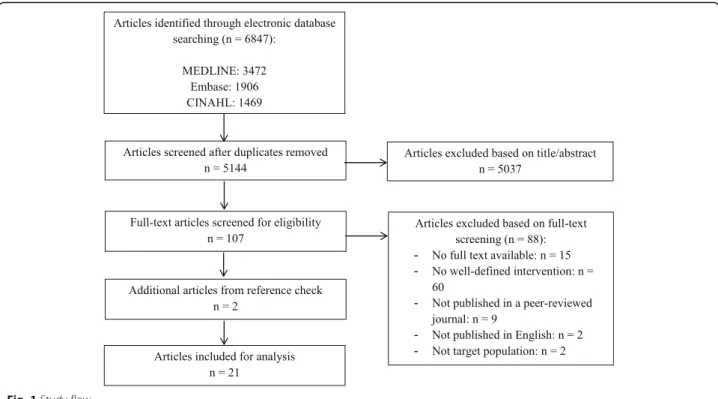
The search yielded 5144 unique articles, of which
nineteen met the inclusion criteria [40–58] and two
were added following an additional reference check
(Fig. 1) [59, 60]. Twelve articles represented empirical
data drawn from the interventions of bereavement care programmes. Of these, four represented
quantita-tive studies [40–43], six represented qualitative studies
[44–49], and two represented studies which included
both quantitative and qualitative outcomes [50, 51].
Nine articles were descriptive in nature [52–60].
These articles contained well-defined bereavement in-terventions, yet the interventions were not tested em-pirically and, therefore, the outcomes could not be provided. An overview of all the articles included is
provided in Table 2. Quality appraisals ranged
be-tween 2 and 5 for trials and observational studies, and between 8 and 21 for qualitative studies. Quality
scores on all studies can be found in Table 2.
Quali-tative studies received higher appraisal scores.
The twenty-one articles included fifteen unique be-reavement interventions, identified with the letters of the alphabet A through to O. Two interventions were described in multiple articles (A and G). The
The characteristics of bereavement care interventions The bereavement care programmes were predominantly initiated by hospital staff (A-N). They took place in the
field of neonatology (n= 5) (F,H,I,M,O), paediatrics (n=
9) (B,C,D,E,G,J,K,L,N), or both neonatology and
paediat-rics (n= 1) (A). Some interventions were aimed at
chil-dren with a certain diagnosis: Sudden Infant Death
Syndrome (SIDS) (n = 1) (O), and cancer (n= 4) (B,E,G,
N). Three studies presented a bereavement care programme, while focussing on the impact on HCPs of losing a patient (A,G,J).
With regard to the timing, we found that eleven
inter-ventions started after the child’s death (A,B,C,D,E,G,I,K,
L,M,O), one intervention started during the end-of-life phase (J), and three interventions covered both before, and after, death (F,H,N).
In most interventions, the person intervening was ei-ther a nurse, appointed as the primary carer and operat-ing individually or as part of a team (A,C,E,H,I,K,M), or a physician (A,C,D,G,I). Other people intervening in-cluded clinical social workers (B,H,K), chaplains (A,L) or peer supporters - parents who have previously lost a child too - (A), photographers (J), trained counsellors (D), public health nurses (O), team members who had the most contact with parents or experienced the light-est workload (F) or, bereavement care team members not otherwise specified (N).
We identified five overarching components of in-terventions which encompass the variety of practices described in the interventions. These are: (i) the
acknowledgement of parenthood and the child’s life;
(ii) establishing keepsakes; (iii) follow-up contact; (iv) education and information, and; (v) remembrance activities.
(i) The acknowledgement of parenthood and the child’s life consisted of washing, holding, or dressing the child (H,I), giving parents privacy in the moments surrounding the death of the child, for instance in a family room (H), providing the child with a certificate of life (I), or a blessing ceremony (F,H).
(ii) Establishing keepsakes consisted of safeguarding a lock of hair (H,I), hand, foot, or face print (H,I), pictures (F,H,I,J), or items that belonged to the child, such as toys, a blanket (H), ornaments (H), a memory stone (I), clothes (I), a baby ring or bracelet (H,I), memory books (F), poems (A,H), or other belongings (F,H). The created items were often provided to the parents in the form of a comfort basket or memory box (B,H). Keepsakes, especially for siblings, could also be provided (I). (iii) Follow-up contact consisted of follow-up calls
(A,B,E,F,G,H,I,K,O), cards (B,E,G,H,I,N), visits (A,F,L,O), flowers (F), condolence letters (K), and appointments (A,C,D,G,M). Follow-up contact also included facilitating contact with peers (A,K,N). (iv) Education and information on coping, grief, and practical information concerning the death of the child, consists of folders and booklets with
Table
2
Baseline
characteristics
(Co
ntinued)
Cook
et
al.
(2002
)
[
53
],
UK
Descriptiv
e
artic
le
To
review
loc
al
be
reavements
suppo
rt
prac
tices
ov
er
the
last
5
years
Regi
onal
hospi
tal,
PICU
Parent
s
of
children
who
have
died
unexpe
ctedly
in
the
PICU
N.A.
N.A.
N.A.
Edi-Os
agie
et
al.
(2005
)
[
59
],
UK
Descriptiv
e
artic
le
To
desc
ribe
a
temp
late
for
a
be
reavem
ent
service
Tert
iary
care
cen
tre,
NICU
Parent
s
of
children
who
have
died
in
the
NICU
N.A.
N.A.
N.A.
Gibson
et
al.
(2011
)
[
60
],
USA
Descriptiv
e
artic
le
To
desc
ribe
the
de
velopm
ent
of
a
NICU
be
reavem
ent
progr
am
Unive
rsity
hospi
tal,
NICU
Parent
s
of
children
who
have
died
in
the
NICU
N.A.
N.A.
N.A.
Levic
k
et
al.
(2017
)
[
54
],
USA
Descriptiv
e
artic
le
To
summ
arize
and
evaluate
a
com
preh
ensive
app
roach
of
be
reavem
ent
services
to
NICU
families
an
d
ed
ucation
/suppo
rt
to
NICU
staf
f
Regi
onal
children
’
s
hospi
tal,
NI
CU
Parent
s
of
children
who
have
died
in
the
NICU
N.A.
N.A.
N.A.
Morris
et
al.
(2016
)
[
55
],
USA
Descriptiv
e
artic
le
To
disc
uss
the
go
als
of
bereaveme
nt
car
e
an
d
the
nee
d
to
standardize
be
reavem
ent
care
in
the
pae
diatric
se
tting
,
and
describ
e
their
hospital
wid
e
be
reavem
ent
mod
el
Hosp
ital,
pae
diatric
setting
Familie
s
of
chi
ldren
who
have
died
in
a
paediatric
setting
N.A.
N.A.
N.A.
Reilly
-Smorawski et
al.
(2010
)
[
56
],
USA
Descriptiv
e
artic
le
To
eva
luate
exper
iences
of
bot
h
indi
viduals
an
d
couples
with
a
be
reavem
ent
support
group
Tert
iary
Centre,
NICU
Parent
s
of
new-born
s
or
infan
ts
wh
o
have
died
in
the
NICU.
N.A.
N.A.
N.A.
Snaman
et
al.
(2017
)
[
57
],
USA
Descriptiv
e
artic
le
To
review
the
thre
e
primary
pil
lars
of
a
pare
nt-in
spired
and
parent-derived
be
reavem
ent
progr
am
Unive
rsity
children
’
s
hospi
tal,
onco
logy
and
palliative
car
e
unit
Parent
s
of
children
who
have
died
of
cance
r
N.A.
N.A.
N.A.
Stastny
et
al.
(2016
)
[
58
],
USA
Descriptiv
e
artic
le
To
provi
de
a
prac
tical
guideline
for
public
heal
th
nurs
es
(PHN
)
in
performing
home
vis
its
to
bereaved
paren
ts
Home
vis
its
Parent
s
of
children
who
have
died
of
sudde
n
inf
ant
de
ath
syn
drome
N.A.
N.A.
Table
3
Intervention
characteristics
Autho
r/yea
r/
coun
try
Interv
entioni
st
In
terventi
on
Outcom
es
Develop
me
nt
Imp
leme
ntation
Theo
retical
suppo
rt
Out
line
Comp
onen
ts
A.
Aho
et
al.
(2010
)
[
52
],
Aho
et
al.
(2011
a)
[
40
],
Aho
et
al.
(2011
b)
[
44
],
Nikkola
e
t
al.
(2013
)
[
42
],
Raiti
o
et
al.
(2015
)
[
43
],
Fin
land
Peer
suppo
rters
and
H
CPs
-Support
pack
age
at
disc
harge
afte
r
the
chi
ld
’
s
de
ath
-Peer
sup
port
one
week
afte
r
the
chi
ld
’
s
de
ath
-Follow-u
p
cont
act
by
HCP
after
2
–
6
we
eks
-Su
pport
package
-Pe
er
contac
t
-HCP
contac
t
Outcom
es
fathe
rs
(Ah
o
et
al.
2011a)
:
-Experie
nced
most
affe
ct
and
emotio
nal
sup
port,
more
from
pe
er
support
ers
than
from
HCP
s.
-Most
fathe
rs
res
ponded
that
the
follow
up
contac
t
helpe
d
them
in
coping,
ti
ming
of
cont
act
was
app
recia
ted
-Lower
values
in
all
dime
nsions
of
grief
exce
pt
for
personal
growth
in
the
interve
ntion
group
Outcom
es
moth
ers:
-No
sign
ificant
diff
erences
in
grief
reactions
betw
een
interve
ntion
-and
control
group
(Raitio
et
al.
2015)
-Mother
s
rece
ived
most
affect,
mod
erate
affirmation,
and
little
aid
from
HCP
s
and
peer
support
ers
(Nikkola
et
al.
2013)
-Follow-u
p
cont
act
help
ed
moth
ers
in
cop
ing
(Nikko
la
et
al.
2013).
Outcom
es
HCPs
(Aho
et
al.
2011b) -Follow-u
p
cont
act
import
ant
el
ement
of
care,
but
also
stres
sful
and
difficult
-Implem
entat
ion
possible
due
to
posi
tive
attitud
e
HCP
s,
res
ources
inadequate
-Interven
tion
increased
coop
eration
betw
een
HCP
s
and
peer
sup
porters
-Bas
eline
study
o
n
curre
nt
bereavemen
t
support
systems
-Syst
ematic
review
-Exp
ert
pane
l
-Cli
nical
exp
erience
and
patient
perspective
-Tra
ining
for
im
plem
enters
-Tra
ining
to
use
the
interve
ntion
was
provi
de
d
for
pe
er
sup
porters
and
HCP
Not
me
Table
3
Intervention
characteristics
(Continued)
Autho
r/yea
r/
coun
try
Interv
entioni
st
In
terventi
on
Outcom
es
Develop
me
nt
Imp
leme
ntation
Theo
retical
suppo
rt
Out
line
Comp
onen
ts
bereaved
parent
mentors
QO
L
team
and
be
reavement
coordinat
or
to
start
support
ive
relationshi
p.
Famil
ies
rece
ive
a
bo
oklet,
opt
ion
for
pe
er
support
.
-Mem
orial
even
t;
tw
o
day
gat
hering
for
bereaved
pare
nts
whose
chi
ld
died
6
mon
ths
to
thre
e
years
pre
viously.
Part
2:
Pare
nt-Created
Mate
rials:
-Condol
ence
card,
several
we
eks
to
child
’
s
de
ath.
-Berea
veme
nt
reso
urces
guide
is
mailed
within
tw
o
weeks
of
a
chi
ld
’
s
de
ath.
-Seasons
bookle
t
&
Reme
mbran
ce
mai
lings
-Addit
ional
res
ources:
boo
ks
for
siblings,
pare
nts
vid
eos.
Part
3:
Be
reaved
pare
nt
cou
ld
be
involved
in
ed
ucation
for
staff
and
part
icipate
in
research.
-Vide
o
’
s
for
parents
-Con
tact
by
cards/
emails
the
Qualit
y
of
Life
(QOL
)
steering
cou
ncil
under
the
guidance
of
an
exper
t
bereaveme
nt
coord
inator.
O.
Stast
ny
et
al.
(201
6)
[
58
],
USA
Public
heal
th
nurs
e
Af
ter
pub
lic
heal
th
nurs
e
ha
s
rece
ived
inf
ormation
of
coron
er
’
s
inve
stigator
families
are
contac
ted
by
pho
ne/
to
schedule
a
home
vis
it(s).
Friend
s
and
family
may
be
invite
d.
Duri
ng
the
home
vis
it(s)
the
mai
n
focus
is
to
provi
de
support
,
ed
ucation,
SID
Ss
referrals,
resources
an
d
conne
ct
with
other
SID
S
bereaved
families
-Phon
e
cont
act
-H
o
m
e
visit
(Educate,
support,
provide
resources,
conne
ct
with
peers,
referral)
Not
app
licable
Authors
exper
ience
(PHN
SIDS
coord
inato
r)
Not
mentio
ned
Not
me
information (A,B,E,F,G,H,I,K,L,N), financial advice (F), videos containing information (L), educational support meetings for peers and relatives (L), seminars or workshops on coping and grief (K), and information sessions (A,C,D,G,M) during which HCPs provided information about the treatment and autopsy (I), or answered questions (I). (v) Remembrance activities included ceremonies or
services (F,H,K,N), and HCPs attending the funeral (E,L).
The empirical basis of the interventions and the outcomes of the studies
Most interventions identified consisted of a descrip-tion of practices, sometimes based on years of experi-ence, but did not include an empirical or theoretical basis. Several studies did provide substantiation for their interventions such as a previous, non-specified, literature search (A,E), interviews and focus groups (B,E,G), or expert knowledge and special education (A,B,D,F,J,O). Only two interventions were developed using a clear theoretical basis. One intervention was based on principles of stress and social support the-ory (B), and the other contained a psycho-educational bereavement guide based on the principles of cogni-tive behavioural theory (K).
The studies that evaluated an intervention, showed that parents reported a positive experience with bereavement photography and follow-up contact (A,B,C,E,G,J,L). Par-ents were grateful to receive photos of their child, and helped HCPs feel better about their role (J). The outcomes of most of the empirical studies focused on how the par-ents had experienced the follow-up contact with the HCPs who had taken care of their child. Follow-up contact was generally valued. It helped parents cope with their grief, provided closure, and gave parents a secure feeling of the ongoing bond with the hospital and their child (A,B,C,E,G, L). Parents found follow-up meetings with HCPs and/or peers helpful in learning to tolerate and understand grief better. Moreover, it stimulated further thinking and
discussion between the parents about the topics addressed in the meeting and helped parents to express their ideas and feelings concerning grief to each other and to their family and friends (L,M).
The alignment between intervention components and theoretical key concepts
Given the lack of knowledge concerning the effective-ness of the interventions, the potential worth of the components of intervention is evaluated by aligning the five intervention components identified (i-v) to the key
theoretical concepts as described in theMethodssection.
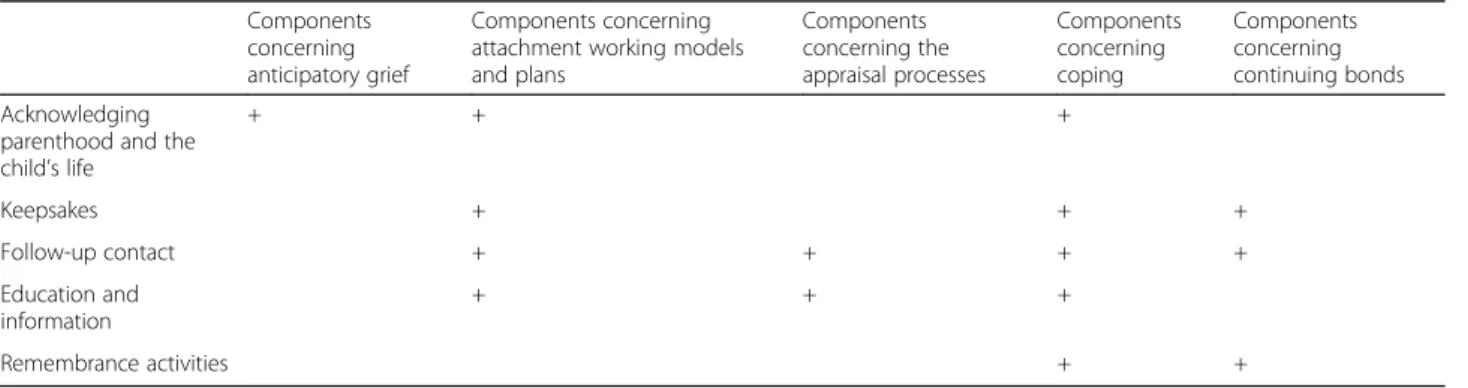
These are: anticipatory grief; attachment to working models and plans; appraisal processes; coping, and; con-tinuing bonds. Hereafter, all the components will be dis-cussed and hypothesised, considering how they align
with the theoretical concepts identified (Table4).
The acknowledgement of parenthood and the child’s life
This component includes facilitating parents to fulfil their role as a parent, and to acknowledge the identity of their child. Facilitating parents in their parental role is a compo-nent HCPs provide before and after death. The main strat-egy in these interventions is to enable parents to nurture
their child and to acknowledge their child’s uniqueness
[54]. Parents are facilitated to experience the bond with
the child, create memories, have a blessing ceremony, and
say their farewells [59, 60]. It allows parents to begin to
contemplate the idea that their child is dying, while
ensur-ing that their child is as comfortable as possible [60].
These practices support anticipatory grief, since they fos-ter emotional preparedness, allow parents to adjust slowly to the fact that their child is dying, and help to create
last-ing memories for parents to cherish after death [54]. A
certificate of life empowers parents to recognise the iden-tity of their child. In letting parents participate in the last care for their child, this also enables them to adjust, grad-ually, to the fact that their child is dying, and makes the transition between the internal plans less abrupt.
Table 4The alignment of theoretical key concepts and intervention components Components
concerning anticipatory grief
Components concerning attachment working models and plans
Components concerning the appraisal processes
Components concerning coping
Components concerning continuing bonds
Acknowledging parenthood and the child’s life
+ + +
Keepsakes + + +
Follow-up contact + + + +
Education and information
+ + +
Remembrance activities + +
Establishing keepsakes
HCPs take the initiative in creating keepsakes together with, or in accordance with, the parents. These keepsakes provide the parents with a tangible memory of the child. Especially in neonatology, where parents will not have been outside the hospital with their child, keepsakes provide par-ents with a way to cherish a part of their child, when the child is no longer present. Establishing keepsakes can help parents feel attached and close to their child and to provide
comfort [54]. Over time, the keepsakes can help the parents
in remembering the child, and help parents with process-ing, conceptually, the loss, while they revise the autobio-graphical memories and the memories of the child in order to adjust to the new reality. Over time, when the parents have adjusted to the new reality, the tangible memories of the child serve as a form for expressing the continuation of the bond between the parents and their child.
Follow-up contact
Follow-up contact with the hospital may take various forms. Parents value ongoing contact with the hospital staff, since the hospital staff know the child and many
parents developed a bond with them over time [45–47].
When parents feel that the HCPs remember their child,
this is felt as an acknowledgement of the child’s identity,
and a validation that their child has made an impact and
mattered [45,46]. This acknowledgement results in
posi-tive reappraisal processes and adds posiposi-tive meaning to the past events. These positive reappraisals could also foster adaptive coping behaviours, for example the shar-ing of the story of the loss with friends and family. The continuous reappraisal and coping behaviours in turn re-sult in altering the working models and plans because the loss is processed conceptually. This helps parents to find a place for, and to define a new bond with, the
de-ceased child in the new reality [47]. Follow-up contact
with HCPs and peer supporters, simply their presence
and conversations, help parents to cope with loss [40,
43]. During follow-up contacts, HCPs can offer parents
an explanation of the course of treatment and the ra-tionale for certain decisions that were made. This is im-portant as parents often describe being in a haze during
the end-of-life period of their child [44, 46].
Further-more, autopsy results are often shared in order to clarify
the physical illness [53, 54]. HCPs also have the
oppor-tunity to reassure parents that there is nothing that they
could have done differently [58]. This helps parents to
make sense of the preceding events and to clarify the
memories surrounding the death of their child [46, 53].
This clarification, in turn, aids reappraisal of the situ-ation and past events, and provides parents with a form of closure. It also allows parents to readjust their mem-ories of the situation, address doubts about themselves, and treasure memories of their child, which results in
readjustment to new memories and thus creates new plans about themselves, their child, and the past events.
Education and information
Information folders, booklets, workshops, and seminars can help parents in regaining some control over the many different challenges they face in a new, unknown, and in-secure, situation. It makes parents feel more prepared in practical terms such as with financial aid, funeral arrange-ments, and in finding extra emotional assistance when
needed [59]. An example of practical assistance might be
how to provide explanations to, and support for, the sib-lings, reassuring parents that what they are feeling is nor-mal, actions which can be termed preparation and which
offer a sense of validation [55,59]. But practical assistance
could also include providing information about when and
who to turn to for extra support [55]. These forms of
as-sistance support parents in coping with the new situation because it makes the new demands slightly more manage-able. The information provided, and the validation of the emotions they experience, also assist parents in creating new knowledge structures and plans with regard to their grief and the future they face. It helps the appraisal pro-cesses and offers new working models.
Remembrance activities
The remembrance activities provide an opportunity to feel close to the child again and to recollect memories
about their life [60]. It is also a means of feeling
sup-ported by friends, family, hospital staff, and the
commu-nity, that may help parents to cope with the loss [51].
These remembrance occasions provide a secure environ-ment where parents feel connected to the child and feel the bond that they had, and that still exists. Remem-brance activities help parents in finding a way to con-tinue their bond with the child in the new reality. Religious or spiritual aspects of the events can also help parents to make sense of, and find meaning in, the
child’s death. Such “meaning making” after the death is
a helpful coping mechanism for parents, in which they can revise their memories and plans surrounding the death of their child in a positive and helpful manner.
Discussion
This review identified fifteen well-defined bereavement in-terventions provided by regular HCPs to support parents
of seriously ill children both at the end of their child’s life
and after death. All interventions were clustered into five overarching components of the intervention. These are:
the acknowledgement of parenthood and the child’s life;
physician. Most of the empirical studies included in this review evaluated how to conduct the intervention and ex-periences with the interventions, but not their effective-ness. To compensate for this lack of evidence, the components of intervention were assessed against a theor-etical synthesis on loss and grief, which revealed that all the components from which the interventions were built were covered by theories on a conceptual level. The theor-etical synthesis did uncover that bereavement is charac-terised by the continuous process of adjusting to a new
reality [18–21, 23, 26–30]. Five key theoretical concepts
clarify this process: anticipatory grief; attachment working models and plans; the appraisal processes; coping behav-iours, and; continuing bonds. The theoretical synthesis shows the need for bereavement interventions to focus on the continuous nature of grief, and thus, starting before the death and guiding parents through the grieving process. Most interventions we identified relied on a com-bination of multiple components or time points. However, few interventions reviewed here showed such a continu-ous process in supporting the parents.
In our comparison of the components of intervention, and the theoretical synthesis, we found HCPs pursued sev-eral underlying aims for providing bereavement care to parents. The interventions were offered by HCPs to
en-hance the parents’ feeling of preparedness towards the
death of their child. These comprise providing parents with information, nurturing the child, and experiencing support from HCPs or their peer supporters. Those de-signed to enhance their ability to create memories of, and with, their child include nurturing the child, treasuring keepsakes, and recollecting memories at the subsequent remembrance ceremony. Finally, the interventions to pro-vide parents with comfort and reassurance involve making memories and keepsakes, answering questions and provid-ing comfort in follow-up, providprovid-ing information in gen-eral, and remembering and acknowledging the child. These elements are not captured in a single moment, but require support at different moments and in a continuous
nature [61]. A difference we noticed is that the importance
of supporting parents in their parental role, and acknow-ledging the identity of the child, may have a different
meaning in neonatology compared to paediatrics [54,62].
The time in the hospital is often the only time these par-ents can make memories with their child and to nurture them. The HCPs are often the only people, apart from the family, to have seen the child alive.
Bereavement theories emphasise that dealing with loss
takes form in a transition towards a new reality [18–21,23,
26–30]. However, only four interventions included in this
review commenced before the death of the child [50,57,59,
60]. Yet, conversations between HCPs and parents about
the condition of their child, and their preparedness for the death of their child, can contribute positively to the
bereavement process after their child has died [25,63]. The
possible explanations for this are, firstly, that there is a deli-cate balance between preserving hope and letting go of the child during the end-of-life phase. Most, but not all, parents
are able to make this transition [4,64]. Most parents are
in-tellectually aware that their child’s death is imminent,
how-ever, emotional awareness usually follows at a later stage, or
not until after the death [65]. For the HCPs these
phenom-ena, and the parental diversity, make it difficult to assess when parents are receptive to bereavement support during the end-of-life phase. Furthermore, this diversity tends to provoke insecurity among HCPs. However, HCPs should
be able to influence parents’ awareness and openness
to-wards bereavement support, for example by informing par-ents about the finality of curative options by sharing information honestly and considering whether to stop
on-going curative treatment [65]. Secondly, given the diversity
both in parental responses to letting go of their child, and in their emotional awareness, it is difficult to create a stan-dardised intervention, including a protocol, for bereavement care for parents during the end-of-life phase. Since our in-clusion criteria consisted of interventions that needed to be replicable, and supported by a protocol or documents, these kind of interventions could have been excluded. This could mean that there is, in fact, attention for feelings of loss and grief, prior to the death of the child, by HCPs in their current daily practice. However, these practices are not standardised and thus were not covered in this review.
The comparison of key theoretical concepts and compo-nents of intervention showed that interventions all ac-count for small fragmented pieces in the grieving process. But, also, that there are no interventions that emphasise the continuous parental adjustment process as a whole.
The regular HCPs who had been involved in the child’s
care since diagnosis could be a significant factor in this continuous care. Studies have shown that parents require at least one meaningful follow-up contact with the HCPs
who cared for their child [14, 66]. We propose that
be-reavement care, including follow-up conversations, are
important parts of the regular HCPs’activities. There are
three main reasons for the integration of follow-up care into the HCPs activities. Firstly, parents often have
out-standing questions about their child’s care, illness, and
their role in the period of the illness [67]. The regular
HCPs are able to answer these questions since they have been part of the care prior to death. Secondly, the trust-worthiness and bonds that already exist between the HCPs
and parents are very important [54]. Thirdly, parents seek
proximity to their child - an acknowledgement of his or her life, and the impact the life has made; it helps parents in the grieving process when the HCPs speak of their memories of the child, reflect on his or her unique
iden-tity, and are effected by the child’s death [14,45]. Another
and parents could be psycho-education [68, 69]. Psycho-education encompasses information about what parents are experiencing while preparing them for what they could encounter during their journey through the grieving process. It has been shown to have positive effects on the self-efficacy of informal caregivers. Psycho-education could strengthen parents in their transition to a new real-ity where the child is no longer physically present, if they understand which challenges they are going to face, and
prepare them with helpful coping strategies [68].
Psycho-education might too have a positive effect on mental ap-praisals when a setback in the grieving process occurs and in validating the feelings parents experience as normal
[70].
Once a child dies, their parents are left with an over-whelming sense of grief. They describe the time passing as
a blur [44,54]. Parents are not aware, during that period,
of all the interventions and assistance HCPs could offer them. However, options could be presented to parents, and the most appropriate could be chosen. Therefore, it is important that HCPs offer parents a broad range of
inter-ventions [71]. This is also important because the key
the-oretical concepts are not sequential. Instead they form a continuum and the most dominant of these key concepts
alter according to the demands at a given time [18,20,21,
27]. Also, effective coping is defined by a process of
alter-nating between two or more different coping strategies,
depending on the demands at a specific time [72]. If HCPs
could determine, in what stage parents were at a given time, or with which processes they experience difficulties, the appropriate components of intervention to aid that process could be selected.
Strengths and limitations
The search was constructed using a recently developed method, PALETTE, in addition to PRISMA. This was helpful in identifying all the relevant articles in relatively young domains where terminology is still diffuse. To our knowledge, given the difficulty of measuring outcomes in the field of paediatric palliative care, this is the first systematic review to give insight into the theoretical ef-fectiveness of bereavement interventions. In particular, the inclusion of replicable interventions provides HCPs with opportunities to implement them in their practice. A limitation of this systematic review concerns the in-clusion and exin-clusion criteria. These eliminated less de-veloped practices and potentially helpful professional attitudes and behaviours out of sight. It is possible that these contain strategies that can be considered support-ive in parental grief. Also, we included replicable inter-ventions which could be implemented in practice since these interventions are supported by a protocol or clear guidelines. However, most interventions are not tested and offer little evidence in their support. This is required
before implementing an intervention. Testing these in-terventions might then be difficult due to the setting of paediatric palliative care. Therefore, the theoretical syn-thesis and alignment could only provide a form of theor-etical support for the interventions we reviewed.
Conclusion
This review provides an overview of well-defined, replic-able, bereavement interventions. The theoretical synthesis in this review provides a basis for the effectiveness of the components of intervention. All five of these cover mul-tiple key concepts derived from theory. HCPs can choose multiple interventions for different components to provide parents with a continuous form of bereavement care, aid-ing the transition that parents have to go through follow-ing their loss. Future research is needed on how this continuous support can be established, which time points are crucial for providing bereavement care, and how new interventions can be developed that align with this transi-tion, and thus, ultimately, help parents in adjusting to their new reality.
Supplementary information
Supplementary informationaccompanies this paper athttps://doi.org/10.
1186/s12904-020-0529-z.
Additional file 1.Search strategy.
Additional file 2.Synthesis of theories on grief and loss.
Abbreviations
COREQ:COnsolidated criteria for REporting Qualitative research; HCP(s): Health Care Professional(s); NICU: Neonatal Intensive Care Unit; PALETTE: Palliative cAre Literature rEview iTeraTive; PICU: Paediatric Intensive Care Unit; PRISMA: Preferred Reporting Items for Systematic Reviews and Meta-Analyses; SIDS: Sudden Infant Death Syndrome
Acknowledgements
We thank René Spijker for sharing his expertise in constructing the search string and for performing the electronic literature search. We thank Paulien Wiersma for sharing her expertise in helping to conduct the preliminary searches.
Authors’contributions
EK, FJ, PB, JF, AH, ST, KG, and MK were involved in the development of the conception and design of this work. EK, FJ, KG, AH were involved in article selection, data extraction, and quality appraisal. EK, MK, PB performed the theoretical synthesis on grief theories. EK, FJ, PB, LD, JF, AH, ST, KG, and MK were involved in the interpretation of data and in drafting or substantially revising the manuscript for intellectual content. All authors reviewed and approved the final manuscript.
Funding
The authors disclosed receipt of the following financial support for the research, authorship, and/or publication of this article. This review is part of a larger project: the emBRACE study (embedded bereavement care in paediatrics). This work was supported by ZonMw [grant number 844001506]. The funding party did not take part in the design of the systematic review, interpretation of the results, and in writing or revising the manuscript.
Ethics approval and consent to participate Not applicable.
Consent for publication Not applicable.
Competing interests
The authors declare that they have no competing interests.
Author details
1Julius Center for Health Sciences and Primary Care, University Medical
Center Utrecht, Universiteitsweg 100, 3584 CG Utrecht, The Netherlands.
2Department Woman and Baby, Wilhelmina Childrens Hospital, Lundlaan 6,
3584 EA Utrecht, The Netherlands.3Department of clinical psychology, Utrecht University, Heidelberglaan 1, 3584 CS Utrecht, The Netherlands.4Arq
Psychotrauma Expert Group, Nienoord 5, 1112 XE Diemen, The Netherlands.
Received: 7 November 2019 Accepted: 19 February 2020
References
1. Cox SA. Pediatric bereavement: supporting the family and each other. J
Trauma Nurs. 2004;11:117–21.
2. Decinque N, Monterosso L, Dadd G, et al. Bereavement support for families
following the death of a child from cancer. J Psychosoc Oncol. 2006;24:65–
83.
3. Wender E. Supporting the family after the death of a child. Pediatrics. 2012;
130:1164–9.
4. Kars MC, Grypdonck MHF, De Korte-Verhoef MC, et al. Parental experience
at the end-of-life in children with cancer:‘preservation’and‘letting go’in
relation to loss. Support Care Cancer. 2011;19:27–35.
5. Boelen PA, Smid GE. Disturbed grief: prolonged grief disorder and persistent
complex bereavement disorder. BMJ. 2017;357:1–10.
6. October T, Dryden-Palmer K, Copnell B, et al. Caring for parents after the
death of a child. Pediatr Crit Care Med. 2018;19:S61–8.
7. Wiener L, Rosenberg AR, Lichtenthal WG. Personalized and yet standardized
: an informed approach to the integration of bereavement care in pediatric
oncology settings. Palliat Support Care. 2018;16:706–11.
8. Jensen J, Weng C, Spraker-Perlman HL. A provider-based survey to assess
bereavement care knowledge, attitudes, and practices in pediatric
oncologists. J Palliat Med. 2017;20:266–72.
9. Borasino S, Morrison W, Silberman J, et al. Physicians’contact with families
after the death of pediatric patients: a survey of pediatric critical care
practitioners’beliefs and self-reported practices. Pediatrics. 2008;122:e1174–
8.
10. Donovan LA, Wakefield CE, Russell V, et al. Hospital-based bereavement
services following the death of a child: a mixed study review. Palliat Med.
2015;29:193–210.
11. Currin-Mcculloch J, Pelletier W, Jones B, et al. Psychosocial standards of care
for children with cancer and their families: a national survey of pediatric
oncology social workers. Soc Work Health Care. 2018;57:221–49.
12. Lisle-Porter DM, Podruchny AM. The dying neonate: Family-centered end of
life care. Neonatal Netw. 2009;28:75–83.
13. Granek L, Barrera M, Scheinemann K, et al. When a child dies: pediatric
oncologists’follow-up practices with families after the death of their child.
Psychooncology. 2015;24:1626–31.
14. Lichtenthal WG, Sweeney CR, Roberts KE, et al. Bereavement follow-up after
the death of a child as a standard of care in pediatric oncology. Pediatr
Blood Cancer. 2015;62:S834–69.
15. Endo K, Yonemoto N, Yamada M. Interventions for bereaved parents
following a child’s death: a systematic review. Palliat Med. 2015;29:590–604.
16. Supiano KP. The role of theory in understanding grief. Death Stud.
2018;0:1–4.
17. Rubin A, Babbie ER. Research methods for social work. 8th ed. Belmont:
Brooks/Cole Cengage Learning; 2014.
18. Boelen PA, Van Den Hout MA, Van Den Bout J, et al. A cognitive-behavioral
conceptualization of complicated grief. Clin Psychol Sci Pract. 2006;13:109–
28.
19. Bowlby J. Attachment and los, Volume 1: Attachment. New York: Basic
Books; 1969.
20. Shear K, Shair H. Attachment, loss, and complicated grief. Dev Psychobiol.
2005;47:253–67.
21. Stroebe M, Schut H. The dual process model of coping with bereavement:
rationale and description. Death Stud. 1999;23:197–224.
22. Stroebe M, Schut H, Stroebe W. Attachment in coping with bereavement: a
theoretical integration. Rev Gen Psychol. 2005;9:48–66.
23. Bowlby J. Attachment and loss: volume 3, loss: sadness and depression.
New York: Basic Books; 1980.
24. Folkman S, Lazarus RS. An analysis of coping in a middle-aged community
sample. J Heal Soc Behavriour. 1980;21:219–39.
25. Hebert RS, Prigerson HG, Schulz R, et al. Preparing caregivers for the death
of a loved one: a theoretical framework and suggestions for future research.
J Palliat Med. 2006;9:1164–71.
26. Horowitz MJ, Bonanno GA, Holen ARE. Pathological grief: diagnosis and
explanation. Psychosom Med. 1993;55:260–73.
27. Maccallum F, Bryant RA. A cognitive attachment model of prolonged grief:
integrating attachments, memory, and identity. Clin Psychol Rev. 2013;33:
713–27.
28. Neimeyer RA. Searching for the meaning of meaning: grief therapy and the
process of reconstruction. Death Stud. 2000;24:541–58.
29. Neimeyer RA. Reconstructing meaning in bereavement: summary of a
research program. Estud Psicol. 2011;28:421–6.
30. Rando TA. Clinical Dimensions of Anticipatory Mourning. Champaign Ill:
Research press; 2000.
31. Zwakman M, Verberne LM, Kars MC, et al. Introducing PALETTE: an iterative
method for conducting a literature search for a review in palliative care.
BMC Palliat Care. 2018;17:1–9.
32. David Moher, Alessandro Liberati, Jennifer Tetzlaff, Douglas G. Altman TPG.
Preferred reporting items for systematic reviews and meta-analyses: The
PRISMA statement. PLoS Med; 6. Epub ahead of print 2009. doi:https://doi.
org/10.1371/journal.pmed.1000097.
33. World Health Organization. International Classification of Health
Interventions (ICHI), (2019).https://www.who.int/classifications/ichi/en/.
34. Schulz R, Czaja SJ, McKay JR, et al. Intervention taxonomy (ITAX): describing
essential features of interventions. Am J Health Behav. 2010;34:811–21.
35. Higgins J, Green S. Cochrane Handbook for Systematic Reviews of
Interventions.5th ed. London: The Cochrane Collaboration,http://
handbook.cochrane.org(2011).
36. Fahner JC, Beunders AJM, van der Heide A, et al. Interventions guiding advance
care planning conversations: A systematic review. J Am Med Dir Assoc. Epub
ahead of print 2018. DOI:https://doi.org/10.1016/j.jamda.2018.09.014.
37. Allison T, Peter S, Jonathan C. Consolidated criteria for reporting qualitative
research (COREQ): a 32-item checklist for interviews and focus groups. Int J Qual Heal Care. 2007;19:349.
38. Dixon-Woods M, Cavers D, Agarwal S, et al. Conducting a critical
interpretive synthesis of the literature on access to healthcare by vulnerable
groups. BMC Med Res Methodol; 6. Epub ahead of print 2006. doi:https://
doi.org/10.1186/1471-2288-6-35.
39. Maes J, Modderman H. Handboek rouw, rouwbegeleiding, rouwtherapie:
Tussen presentie en interventie 1st edit. S.I.: Witsand; 2014.
40. Aho AL, Tarkka M-T, Åstedt-Kurki P, et al. Evaluating a bereavement
follow-up intervention for grieving fathers and their experiences of sfollow-upport after
the death of a child—a pilot study. Death Stud. 2011;35:879–904.
41. Meert KL, Eggly S, Berg RA, et al. Feasibility and perceived benefits of a
framework for physician-parent follow-up meetings after a child’s death in
the PICU. Crit Care Med. 2014;42:148–57.
42. Nikkola I, Kaunonen M, Aho AL. Mother’s experience of the support from a
bereavement follow-up intervention after the death of a child. J Clin Nurs.
2013;22:1151–62.
43. Raitio K, Kaunonen M, Aho AL. Evaluating a bereavement follow-up
intervention for grieving mothers after the death of a child. Scand J Caring
Sci. 2015;29:510–20.
44. Aho AL, Tarkka M-T, Åstedt-Kurki P, et al. Health care personnel’s
experiences of a bereavement follow-up intervention for grieving parents.
Scand J Caring Sci. 2011;25:373–82.
45. Berrett-Abebe J, Levin-Russman E, Gioiella ME, et al. Parental experiences
with a hospital-based bereavement program following the loss of a child to
cancer. Palliat Support Care. 2017;15:348–58.
46. Brink HL, Thomsen AK, Laerkner E. Parents’experience of a follow-up
meeting after a child’s death in the paediatric intensive care unit. Intensive
47. Darbyshire P, Cleghorn A, Downes M, et al. Supporting bereaved parents: a phenomenological study of a telephone intervention programme in a
paediatric oncology unit. J Clin Nurs. 2013;22:540–9.
48. Eggly S, Meert KL, Berger J, et al. A framework for conducting follow-up
meetings with parents after a child’s death in the pediatric intensive care
unit. Pediatr Crit Care Med. 2011;12:147–52.
49. Meert KL, Eggly S, Berger J, et al. Physiciansʼexperiences and perspectives
regarding follow-up meetings with parents after a childʼs death in the
pediatric intensive care unit. Pediatr Crit Care Med. 2011;12:e64–8.
50. Michelson KN, Blehart K, Hochberg T, et al. Bereavement photography for
children: program development and health care professionals’response.
Death Stud. 2013;37:513–28.
51. Oliver RC, Sturtevant JP, Scheetz JP, et al. Beneficial effects of a hospital
bereavement intervention program after traumatic childhood death. J
Trauma. 2001;50:440–8.
52. Aho AL, Åstedt-Kurki P, Tarkka MT, et al. Development and implementation
of a bereavement follow-up intervention for grieving fathers: an action
research. J Clin Nurs. 2010;20:408–19.
53. Cook P, White DK, Ross-Russell RI. Bereavement support following sudden
and unexpected death: guidelines for care. Arch Dis Child. 2002;87:36–8.
54. Levick J, Fannon J, Bodemann J, et al. NICU bereavement care and
follow-up sfollow-upport for families and staff. Adv Neonatal Care. 2017;17:451–60.
55. Morris SE, Dole OR, Joselow M, et al. The development of a hospital-wide
bereavement program: ensuring bereavement care for all families of
pediatric patients. J Pediatr Heal Care. 2016;31:88–95.
56. Reilly-Smorawski B, Armstrong AV, Catlin EA. Bereavement support for
couples following death of a baby: program development and 14-year exit
analysis. Death Stud. 2002;26:21–37.
57. Snaman JM, Kaye EC, Levine DR, et al. Empowering bereaved parents
through the development of a comprehensive bereavement program. J
Pain Symptom Manag. 2017;53:767–75.
58. Stastny PF, Keens TG, Alkon A. Supporting SIDS families: the public health
nurse SIDS home visit. Public Health Nurs. 2016;33:242–8.
59. Edi-Osagie NE, Evans V. Bereavement support in neonatal intensive care.
Infant. 2005;1:203–6.
60. Gibson J, Finney S, Boilanger M. Developing a bereavement program in the
newborn intensive care unit. J Perinat Neonatal Nurs. 2011;25:331–41.
61. Milstein J. A paradigm of integrative care: healing with curing throughout
life,‘being with’and‘doing to’. J Perinatol. 2005;25:563–8.
62. Bloomer MJ, Endacott R, Copnell B, et al.‘Something normal in a very, very
abnormal environment’- nursing work to honour the life of dying infants
and children in neonatal and paediatric intensive care in Australia. Intensive
Crit Care Nurs. 2016;33:5–11.
63. Kreicbergs UC, Lannen P, Onelov E, et al. Parental grief after losing a child
to cancer: impact of professional and social support on long-term
outcomes. J Clin Oncol. 2007;25:3307–12.
64. Lockwood B, Humphrey L. Supporting children and families at a Child’s end
of life: pediatric palliative care pearls of anticipatory guidance for families.
Child Adolesc Psychiatr Clin N Am. 2018;27:527–37.
65. Valdimarsdóttir U, Kreicbergs U, Hauksdóttir A, et al. Parents’intellectual and
emotional awareness of their child’s impending death to cancer: a
population-based long-term follow-up study. Lancet Oncol. 2007;8:706–14.
66. Gijzen S, L’Hoir MP, Boere-Boonekamp MM, et al. How do parents
experience support after the death of their child? BMC Pediatr. 2016;16:
1–10.
67. Laurent S, Samuel J, Dowling T. Fifteen-minute consultation: supporting
bereaved parents at the time of a child’s death. Arch Dis Child. 2016;101:
292–4.
68. Alves S, Teixeira L, Azevedo MJ, et al. Effectiveness of a psychoeducational
programme for informal caregivers of older adults. Scand J Caring Sci. 2016;
30:65–73.
69. Thompson AL, Young-Saleme TK. Anticipatory guidance and
psychoeducation as a standard of care in pediatric oncology. Pediatr Blood
Cancer. 2015;62:S684–93.
70. Durepos P, Kaasalainen S, Carroll S, et al. Perceptions of a psychoeducation
program for caregivers of persons with dementia at end of life : a qualitative study at end of life : a qualitative study. Aging Ment Health.
2019;0:1–9.
71. Shelkowitz E, Vessella SL, O’Reilly P, et al. Counseling for personal care
options at neonatal end of life: a quantitative and qualitative parent survey
psychosocial. BMC Palliat Care. 2015;14:1–11.
72. Darlington ASE, Korones DN, Norton SA. Parental coping in the context of
having a child who is facing death: a theoretical framework. Palliat Support
Care. 2018;16:432–41.
Publisher’s Note