Abstract ⎯ Nowadays, decision support plays an important role in making, errors in decision-making is able to lose the competition. Decision-decision-making is very complicated especially when the problem is in multiobjective problem. To learn decision making through play a game is an interesting thing. Player plays a game but actually, he or she learns about how to make a decision. In this research, the objective is to make Non-Player Character (NPC) for serious game for electrical power production. This NPC is developed with 2 stages, the first stage is multiobjective optimization problem that uses NSGA2 method. This stage results some optimal solutions. The second stage is clustering that uses FCM method and FLVQ method to decrease number of solutions. In this stage, we compare these methods.
Keywords ⎯
Optimization, Multi Objective, NPC, Serious Game, Fuzzy Clustering.
I.INTRODUCTION
n this competitive era, problems that faced by company have high complexity, such as to reduce lead-time and costs, to increase customer service level, and to increase product quality. Some companies that keep on using conventional manner, their unit such as: procurement, production, distribution and marketing work for their own objective. Although every unit of organization looks like to work together to achieve an objective, but they have a different objective. As examples: marketing wants to increase customer service level as high as volume of selling. In other side, this objective will conflict with the objective of production unit or distribution unit. Other conflict is between production unit and distribution unit, where production unit objective is only to maximize volume of product and minimize production cost without consider inventory level of distribution unit.
Therefore, problem in the company is not only single objective problem but also multiobjective problem. These problems have multi criteria or multiobjective that must be fulfilled simultaneously. These problems become complex because each objective will conflict each other. As a result, it is needed a way to solve this
1I.G.P. Astobuditjahjanto is with the Department of Electrical
Engineering, Faculty of Industrial Technology, Universitas Negeri Surabaya, Surabaya, Indonesia. E-mail: [email protected].
2Mochamad Hariadi and Mauridhi Hery P. are with the Department
of Electrical Engineering, Faculty of Industrial Technology, Institut Teknologi Sepuluh Nopember, Surabaya, 60111, Indonesia.
problem by using best search solution. This best search solution will achieve objective that compete under different trade off scenario.
Multiobjective Optimization Problems (MOP) may not have one best solution (minimum or maximum global) on all objectives, but group of solution that superior at end of solution from search space when all objectives are considered. But inferior at other solutions on search space on one objective or more. This solution is known as Pareto Optimal Solution or No dominated solution [2].
Recently, there are some methods of MOP such as : Multi-Objective Linear Programming, Multi-Objective Genetic Algorithm (MOGA), Strength Pareto Evolutionary Algorithm (SPEA), Pareto Archived Evolution Strategy (PAES), No dominated Sorting Genetic Algorithm (NSGA), Multi-Objective Simulated Annealing (MOSA). Each method has capability to solve multi objective problem based on its characteristic. Although some MOP methods have been developed and learned but few of them need evaluation results from MOP. This is because of choosing a solution for system implementation from the Pareto-optimal set can be a difficult task, generally because Pareto-optimal sets can be extremely large or even contain an infinite number of solutions. A practical approach is used to help in the analysis of the solution of multi-objective optimization and provides the decision-maker a workable sized set of solutions to analyze. This method is based on clustering methods, in which the solutions in the Pareto optimal set are clustered so that the Pareto optimal front is reduced to a set of clusters [6].
Power plant companies also have MOP in their production unit. These MOP are known as Economic and Emission Dispatch (EED) problems. The EED problems are to minimize production cost and emission level. Some studies about EED that use MOP are: [1] used Non-dominated Sorting Genetic Algorithm II (NSGA2) that compared with other method such as NSGA, NPGA and SPEA. [17] Used multiobjective particle swarm optimization (MOPSO) method and compared with Multiobjective Evolutionary Algorithm (MOEA) method. The studies that mentioned before do not evaluate deeply results from Pareto optimal set. Therefore, it needs next step to explore the Pareto optimal set. We use fuzzy clustering method to explore and analyze Pareto optimal set to become a small
Intelligent Decision Support Based on
Integration of Fuzzy Clustering and Multi
objective Optimization Problem for Non
Player Character in Serious Game
I.G.P. Asto Buditjahjanto1, Mochamad Hariadi2, Mauridhi Hery Purnomo25number of solutions for decision makers, in order they can choose a good solution.
This research constructs a NPC (Non Player Character) module on a serious game in electrical power production on power plant. This module gives some solutions for player. These solutions are derived from MOP that used NSGA2 method. After that, fuzzy clustering is used to reduce the number of solutions based on their cluster center. Learning decision through playing game is more interesting than learning through decision tool. By playing game, players or decision makers can learn their decision that they have decided. This is called with learning by doing [3, 5, 13]. They can learn result of their decision on game.
II.FORMULATION OF ECONOMIC AND EMISSION DISPATCH PROBLEM
Emission and Economic Dispatch Problems are multi-objective problems. This multi-multi-objective problems are to minimize fuel cost and to minimize emission that produced by power plant
A. Minimization of fuel cost
Fuel cost of system can be connected as an important criterion for economic feasibility. Curve of fuel cost is assumed for prediction with quadratic function from real power output generator as :
∑ + +
=
= N
i i i Gi i Gi
G a bP cP
P F
1
2
1( ) ( ) (1)
where, PGi is real power output from i-th generator; N is sum of total generator; ai, bi, ci, are coefficients of fuel cost curve from i-th generator simultaneously.
B. Minimization of emission
Emission that produces from this generator is Nitrogen Oxide (Nox) emission type. This emission is given as a function from generator output that is sum of quadratic and function of exponential as shown below:
exp ) (
10 ) (
1
2 2
2 P P P (λP )
F i Gi
N
i i i Gi i Gi i
G =∑ + + +
=
− α β γ ξ (2)
where αi, βi, γi are coefficients from i-th generator that show us as emission characteristics
C. Constrains
• Constrain of Power Capacity
For stable operation, real power output from each generator is limited by upper bound and lower bound, as shown below:
PGimin ≤ PGi ≤ PGimax (3) • Constrain of Power Stability
Total of electric power must meet with total of electric demand power PD as a result:
0
1
= −
∑
=
D N
i
Gi P
P (4)
D. Mathematic Formulation
Problem of EED can be formulated mathematically as multiobjective optimization problem as follows:
Minimize [F1(PGi),F2(PGi)] s.t : g(PGi) = 0
h(PGi) ≤ 0 (5)
Where g is equality constrain to represent power balance, and h is inequality constrain to represent generator capacity.
III.PRINCIPLES OF MULTIOBJECTIVE OPTIMIZATION
PROBLEM
A Multiobjective Optimization Problem (MOP) is consisted of k competing objectives and m constraints that defined as functions of decision variable set x. A MOP is written in the role of a way to find vector X =
[x1,x2,…,xk] and to optimize vector of objective function
as follow :
Max/Min : F(x) = (f1(x), f2(x), . . . , fk(x)) (6)
that fulfill m inequality :
gi(X) ≥ 0, i =1,2,3,……..m. (7)
with l equality constrains :
hi(X) = 0, i =1,2,3………l. (8)
The purpose of solving and arranging from MOP is to find a solution for each objective that has been optimized and quantized, how superior its solution if compare with other solution [6].
A. Pareto Optimal Solution
Some problems in real life need optimization simultaneously from many things that cannot be measure and usually on conflicting objectives each other. Usually, there is no single optimal solution, but some alternative of solutions. This alternative of solutions will optimal if there are no other solutions in space search and there are dominant on other solutions, when all objectives are considered. These solutions are known as Pareto Optimal Solution. To define, it can be shown on minimizing problem of two decision vectors such as x1, x2 ∈ X. where x1 , to said dominated x2 if :
{
}
{
1,2,...}
: ( 1) ( 2) and , ) 2 ( ) 1 ( : ,... 2 , 1x j f x j f N j
x i f x i f N i
< =
∃
≤ =
∀
(9)
If one of condition does not achieved, solution x1 will not dominate solution x2. And if solution x1 dominates solution x2, x1 is called non dominated solution with group {x1, x2}. Solution in non-dominated with all search space is known as Pareto optimal and form Pareto Optimal Set or Pareto Optimal Front. When some objectives are related and compared with a pair of non-dominated solution, it will be found that each solution is superior, at least at one objective.
B. Non-dominated 2nd Sorting Genetic Algorithm
To maintain diversity of population, this classified individual is divided by their dummy fitness value. Then this group of classified individual is ignored and other layers from non-dominated individual are considered. The process continues until all individuals on population are classified. Since individuals on first front have maximum fitness value, they always have duplication that better than remain population. It gives permission to a better searching on Pareto Front and results convergence from population to its domain.
NSGA2 builds a population from competed individual, ranks and selects each individual based on non-domination level. NSGA2 also applies Evolutionary Operations to create new pool from offspring and to combine parents and offspring before separation new combination into front. Then NSGA 2 goes to niche with adding a pooling distance for each member. NSGA2 uses a pooling distance on its selection operator to maintain a diversity of front by made each member leave separate on a pooling distance.
IV.FUZZY CLUSTERING
Clustering is a fundamental method in data mining and pattern recognition area. Fuzzy clustering allows natural grouping of data in large data set and provides a basis for constructing rule-based fuzzy model.
A. Fuzzy C Means
The well known of fuzzy clustering algorithm is Fuzzy C-Means (FCM) that introduced by Bezdek [14]. If X={x1,x2,…,xn} where xi∈Rn is group of data features and objective of FCM algorithm is to minimize FCM cost function in order that the formulate of FCM cost function is as follow:
∑ ∑ − = = = C j N
i i j
m
ij x v
V U J 1 1 2 ) ( ) , ( μ (10) V={v1,v2,…,vc} is center of cluster. U = (µij) NxC is a fuzzy partition matrix where each of member µij shows degree of membership between vector data xi and cluster j. The value of U matrix must fulfill this condition:
C j N i
ij ∈[0,1] ∀ =1,..., ∀ =1,...,
μ (11)
FCM Clustering involves two processes namely calculation of cluster center and assignment of points to cluster center by used Euclidean distance dij = || xi – vj||. This process is iterated until cluster center is stable. FCM executes constrain directly from function fuzzy membership that connected with each point as follow:
N i
C
j1 ij 1, ∀ =1,...,
∑ =
=μ (12)
The objective of FCM algorithm is to assign data point into cluster with varied degree of membership. Exponent m ∈ [1, ∞] is weight factor that determine fuzzyfication of cluster. Minimization of cost function J(U,V) is non-linear optimization problem that can be minimize with iterative algorithm as follow:
1. Initialization of U matrix membership with random value in order to (11) and (12) condition is fulfilled and choose m exponent and stop criterion.
2. Calculate center of cluster V with expression:
C j x v
N i ij m
i N i ij m
j , 1,...,
) (
) ( 1
1 ∀ =
∑ ∑ = = = μ μ (13)
3. Calculate new distance
C j N i v x
dij = i− j ,∀ =1,..., ;∀ =1,..., (14)
4. Improve fuzzy partition matrix U if dij > 0 (shows that xi≠ vj)
∑ ⎟⎟ ⎠ ⎞ ⎜ ⎜ ⎝ ⎛ = = − C k m kj ij ij d d 1 ) 1 /( 2 1 μ (15)
5. If stop criterion is fulfilled, stop and if else back to step 2.
The accurate choosing of stop criterion able to evaluate cost function (10) and to know if it is still below certain tolerance of error or if its improvement is compared with prior iteration is below certain boundary; moreover, maximum number of iteration can be used as stopping criterion.
B. Fuzzy LVQ
Fuzzy Learning Vector Quantization (FLVQ) is an integration method of Learning Vector Quantization (LVQ) and Fuzzy C- Means (FCM). Karayiannis [12] introduces this method. LVQ is a learning method from neural network with objective to cluster training data vector M to become C groups. In addition, FCM is a clustering method from fuzzy. FLVQ is an improvement of FCM on calculating center of cluster. FLVQ Algorithm is as follow:
1. To determine
a. Number of cluster = C
b. Weight of exponent = mi and mf c. Maximum of iteration = N d. Tolerance of error = ξ
e. k = 0
2. To determine initial value of cluster center V0 = {v1,0, v2,0,.... ,vc,0}
3. k=k+1 4. Calculate a. ⎟ ⎠ ⎞ ⎜ ⎝ ⎛ − + = N mi mf k mi
m (16)
b.
m m C
i i i j i k ij v x v x − − = ⎥ ⎥ ⎥ ⎥ ⎦ ⎤ ⎢ ⎢ ⎢ ⎢ ⎣ ⎡ ∑ ⎟ ⎟ ⎟ ⎠ ⎞ ⎜ ⎜ ⎜ ⎝ ⎛ − − = ) 1 ( 1 1 2 2 ,
α (17)
where 1≤ i ≤ m; 1 ≤ j ≤ C
c. 1 1 , , − = ⎟⎠ ⎞ ⎜ ⎝ ⎛∑ = M
i ijk k
j α
η where 1 ≤ j ≤ C (18)
d. = + ∑ −
= −
−
M
i ijk i jk
k j k j k
j v x v
v
1 , , 1
, 1 ,
, η α ( )
where 1 ≤ j ≤ C (19)
e.
2
1 , , 1
∑ −
=
− −
C
j jk jk
k v v
E (20)
Fig.1. Next step from design of serious game on electrical power production Player
Scanario Selection
Government regulation to reduce level of
pollution
Lower cost for production Fluctuation of
Fuel Cost
Demand of Electrical Power
Higher profit for Electrical Power
Power Plant Selection (1,2,3,4,5,6) Higher profit for
Electrical Power
Capacity of Power Plant Production
Power Plant Emission
Player choose some/all Power Plants
Multiobjective Optimization Problem on Economic and Emission Dispatch
Clustering from Optimization of Economic and Emission Dispatch
Offering some alternative optimal solutions
Solution 3 Solution 4 Solution 5 Solution 2
Solution
Player Choose a solution for a decision
Total of Cost and Total of Emission
Player Choose a solution for
a decision
Total Cost
Decision
Player Score Ranking
‐ Penalty of Pollution
‐ Fulfillment of Capacity
‐ Production
‐ Cost of Production
‐ Profitability
‐ Cost HRD Operational
‐ InitialCost of Generation Power Plant
‐ Cost of spin reserve
V.RESULT AND DISCUSSION
This serious game is built in order to offer players knowledge for choosing a good decision on production of electrical power. At first time, player must choose scenario that player wants to play or to learn. Scenario of this serious game consists of some factors such as fluctuation of fuel cost, number of electrical power demand, higher profit for company, lower cost production, and government regulation to reduce level of pollution. Then, player should determine number of power plants, followed by their characteristics and their constraints of power plant.
This serious game, player asks information from NPC of serious game by entering parameters from power plant. Then NPC gives some solutions to player. Player must choose one of solutions that NPC gives to win this game. Player’s solution will be counted with other costs. Decision scoring of player is considered with other factors such as: penalty of pollution, fulfillment of capacity production, production cost, and profitability level. These factors become determination of winning. If these factors do not meet, player’s score is reduced. Win or loss of playing this game is based on rank of players score in play this game. Fig. 1 shows design of serious game on electrical power production.
This research conducts NPC of serious game. Simulation of this research uses 6 power plants as seen on Table 1 for their characteristics and Table 2 for their emission data. This research uses data from standard test system of IEEE 6 generator s 30 buses [1, 10, 17].
This MOP is built with NSGA2 method. It is done 3 simulations, first simulation, we use population at 25 and
TABLE 1.
POWER PLANT CHARACTERISTICS
Generator
F = a + b PGi + c PGi2 PGimin PGimax
No. (MW) (MW)
a b c
1 100 200 10 0.05 0.5
2 120 150 10 0.05 0.6
3 40 180 20 0.05 1
4 60 100 10 0.05 1.2
5 40 180 20 0.05 1
6 100 150 10 0.05 0.6
TABLE 2.
POWER PLANT EMISSION
Generator E 102( P P2) exp( P )(ton/h) G G
G γ ξ λ
β
α+ + + = −
No. α Β γ ξ λ
1 4.091 -5.554 6.49 2.00E-04 2.857
2 2.543 -6.047 5.638 5.00E-04 3.333
3 4.258 -5.094 4.586 1.00E-06 8
4 5.326 -3.55 3.38 2.00E-03 2
5 4.258 -5.094 4.586 1.00E-06 8
6 6.131 -5.555 5.151 1.00E-05 6.667
generation at 200, second simulation, we use population at 50 and generation at 200, and third simulation, we use population at 100 and generation at 200. The objective to simulate different population of NSGA2 is to know the effect on clustering selection.
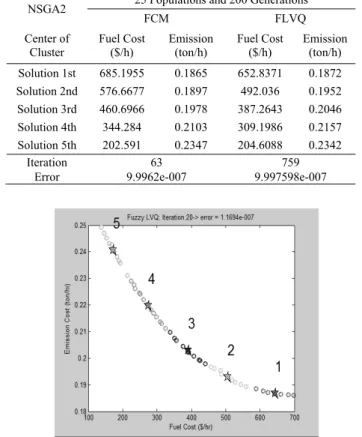
It is shown; there are some solutions for simulation such as at 25 solutions, 50 solutions and 100 solutions. Therefore, we need a clustering method to reduce the number of solution based on their cluster. We compare two methods of clustering such as FCM and FLVQ. For parameter setting, we use 5 clusters, 1000 maximum iterations and 1e-7 for maximum tolerance of error.
Simulation results show that 50 populations give better result than others (25 or 100 populations) do. From table 4 shows that FCM error at 8.7972e-006 and FLVQ error at 1.169373e-007. It means that FLVQ better than FCM. Therefore, this research chooses FLVQ methods as clustering method for simulation for optimal solution selection.
Table 4 shows the best center value of cluster for FLVQ method. In NPC module, this center value of cluster is used as alternative solutions to choose a decision for determine fuel cost and emission. Player can learn his decision while playing this serious game.
As an example, we use center value of FLVQ method, If player wants low fuel cost (only concern with profit), player choose fifth solution at 173.1168 $/h but with consequent, player has emission at 0.2407 ton/h, the number of this emission can get penalty for playing this serious game. In the other side, if player concerns with environment, player chooses first solution with emission at 0.1869 ton/h while fuel cost at 643.7024 $/h. Otherwise, player wants to play safely by choosing third solution with fuel cost at 390.4146 $/h and emission at 0.2030 ton/h. Selection of a solution for a decision is a problem for player to choose a good solution to win this serious game.
TABLE 3.
CLUSTERING OF NSGA2 ON 25POPULATIONS AND 200GENERATIONS
NSGA2 25 Populations and 200 Generations
FCM FLVQ Center of
Cluster
Fuel Cost ($/h)
Emission (ton/h)
Fuel Cost ($/h)
Emission (ton/h) Solution 1st 685.1955 0.1865 652.8371 0.1872 Solution 2nd 576.6677 0.1897 492.036 0.1952 Solution 3rd 460.6966 0.1978 387.2643 0.2046
Solution 4th 344.284 0.2103 309.1986 0.2157
Solution 5th 202.591 0.2347 204.6088 0.2342
Iteration 63 759
Error 9.9962e-007 9.997598e-007
VI.CONCLUSION
Clustering for MOP can be used as decision support on playing serious games that act as a NPC. Research results show that solutions from NSGA2 at 25, 50 and 100 solutions are too large for player to choose his decision. Therefore, clustering method such as FCM and FLVQ can help player to choose his decision by reduce solution to be only 5 solutions. Simulation results show that FLVQ is better than FCM in clustering solutions.
This research only simulates a NPC on serious game. For next development research, this simulation will be a serious game. Therefore, this serious game can be used for learning of decision. Player acts as an electrical power production manager in determine electrical capacity production and its consequence in choose a solution.
TABLE 4.
CLUSTERING OF NSGA2 ON 50POPULATIONS AND 200GENERATIONS
NSGA2 50 Populations and 200 Generations
FCM FLVQ
Center Fuel Cost
($/h)
Emission (ton/h)
Fuel Cost ($/h)
Emission (ton/h)
Of Cluster
Solution 1st 656.8695 0.1868 643.7024 0.1869 Solution 2nd 530.4855 0.1912 506.0973 0.1931 Solution 3rd 397.7678 0.2028 390.4146 0.203 Solution 4th 261.2999 0.2224 274.4069 0.2199 Solution 5th 158.5826 0.2444 173.1168 0.2407
Iteration 58 20
Error 8.71E-07 1.17E-07
REFERENCES
[1] Abido. M. A, 2006, “Multiobjective Evolutionary Algorithms for Electric Power Dispatch Problem”, IEEE Transaction on Evolutionary Computation, Vol.10, No 3, June.
[2] Branke Jürgen, Kalyanmoy Deb,Kaisa Miettinen, Roman Słowi´nski, 2008, “Multiobjective Optimization Interactive and Evolutionary Approaches”, Berlin Heidelberg, Springer-Verlag. [3] Buditjahjanto I.G.P. Asto, Fressy N, Mochammad Hariadi,
Mauridhi Hery Purnomo, 2008, “Using Business Games to Offer Life Skills for The Vocational High School Students”, VTE Research and Networking 2008, An International Conference of Senior Administrators, Policymakers, Researchers and other Practitioners ,“Nurturing Local VTE Research Efforts: A Response to Global Challenges”, Bali, Indonesia, 7-8 July. [4] Buditjahjanto I.G.P. Asto, Mochammad Hariadi, Mauridhi Hery
Purnomo, 2008, “Using Simulated Annealing for Simulation Based Optimization on Power Plant Scheduling”, The 4th International Congress on Logistics and SCM Systems, Effective Supply Chain & Logistic Management for Sustainable Development,Bangkok, THAILAND 26-28 November.
[5] Clark Aldrich, 2005, “Learning by Doing: A Comprehensive Guide to Simulations, Computer Games, and Pedagogy in e-Learning and Other Educational Experiences”, John Wiley & Sons.
[6] Coello Coello. C.A., Gary B. L, David A. , 2007, “Evolutionary Algorithms for Solving Multi-Objective Problems”, second edition, Springer Science + Business Media.
[7] Deb Kalyanmoy, Tushar Goel, “A Hybrid Multi-Objective Evolutionary Approach to Engineering Shape Design”.
[8] Deb, K. Agarwal, S. Pratap, Meriyan. T, 2000, “A Fast Elitist Non-Dominated Sorting Genetic Algorithm for Multi-objective Optimisation: NSGA-II”, KanGal Report Number 200001, Indian Institute of Technology, Kanpur, India.
[9] Hideyuki Mizuta, Yoshiki Yamagata, 2002, “Transaction Cycle of Agents and Web-Based Gaming Simulation for International Emissions Trading”, Proceedings of the 2002 Winter Simulation Conference, pp. 801-806.
[10] King Robert T.F. Ah, Harry C.S. Rughooputh, Kalyanmoy Deb, “Evolutionary Multi-Objective Environmental/Economic Dispatch: Stocastic vs Deterministic Approaches”. http://www.iitk.ac.id/kangal/papers/k200419.pdf.
TABLE 5.
CLUSTERING OF NSGA2 ON 100POPULATIONS AND 200GENERATIONS
NSGA2 100 Populations and 200 Generations
FCM FLVQ Center Fuel Cost
($/h) Emission (ton/h) Fuel Cost ($/h) Emission (ton/h) Of Cluster
Solution 1st 623.9845 0.1873 617.781 0.1875
Solution 2nd 488.8198 0.1936 483.3144 0.194
Solution 3rd 372.083 0.205 363.691 0.2061
Solution 4th 256.567 0.2225 255.1838 0.2228
Solution 5th 162.5709 0.2427 163.8492 0.2424
Iteration 110 69
Error 8.97E-07 9.97E-07
[11] Konak Abdullah, David W. Coit, Alice E. Smith, 2006, “Multi-Objective Optimization using Genetic Algorithm: A Tutorial”,
International Journal of Reliability Engineering and System Safety Vol. 91, pp 992-1007.
[12] Karayiannis, Nicolaos, B., Bezdek, James, C., 1997, An Integrated Approach to Fuzzy Learning Vector Quantization and Fuzzy c-Means Clustering, IEEE Transactions on Neural Networks Vol 5 no 4.
[13] Maja Pivec, 2004, “Game-Based Learning in Universities and Lifelong Learning: UniGame: Social Skills and Knowledge Training Game Concept “, Journal of Universal Computer Science, vol. 10, no. 1, pp. 14-26.
[14] Munakata Toshinori, 2008, “Fundamental of the New Artificial Intelligence-Neural, Evolutionary, Fuzzy and more”, second edition, Springer-Verlag London Limited.
[15] Stapleton A., 2004, “Serious Games: Serious Opportunities”.
Paper presented at the Australian Game Developers’ Conference,
Academic Summit, Melbourne, VIC.
[16] Woods. Allen J. and Bruce F. Wollenberg, 1996, “Power Generation, Operation, and Control “, John Willy and Son Inc, [17] Zhao Bo, Cao Yi-jian, 2005, “Multiple-objective Particle Swarm