New Distributed Algorithm for Connected
Dominating Set in Wireless Ad Hoc Networks
Khaled M. Alzoubi
Peng-Jun Wan
Ophir Frieder
Department of Computer Science
Illinois Institute of Technology
Chicago, IL 60616
Email:
falzoubi, wan, ophir
g@cs.iit.edu
Abstract—Connected dominating set (CDS) has been proposed as virtual backbone or spine of wireless ad hoc networks. Three distributed approxi-mation algorithms have been proposed in the literature for minimum CDS. In this paper, we first reinvestigate their performances. None of these al-gorithms have constant approximation factors. Thus these alal-gorithms can not guarantee to generate a CDS of small size. Their message complexities can be as high asO
; n
2
, and their time complexities may also be as large asO
; n
2
andO ;
n 3
. We then present our own distributed algorithm that outperforms the existing algorithms. This algorithm has an approxi-mation factor of at most 8,O( n)time complexity andO(nlogn)message
complexity. By establishing the(nlogn)lower bound on the message
complexity of any distributed algorithm for nontrivial CDS, our algorithm is thus message-optimal.
Keywords: wireless ad hoc networks, distributed algorithm, connected dominating set, independent set, leader election, spanning tree.
I. INTRODUCTION
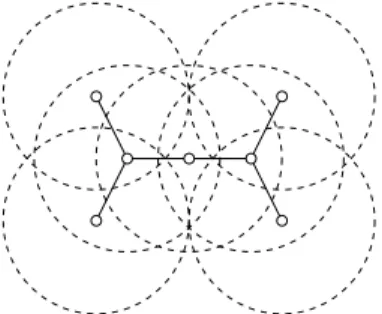
Wireless ad hoc networks can be flexibly and quickly de-ployed for many applications such as automated battlefield, search and rescue, and disaster relief. Unlike wired networks or cellular networks, no physical backbone infrastructure is in-stalled in wireless ad hoc networks. A communication session is achieved either through a single-hop radio transmission if the communication parties are close enough, or through relaying by intermediate nodes otherwise. In this paper, we assume that all nodes in a wireless ad hoc network are distributed in a two-dimensional plane and have an equal maximum transmission range of one unit. The topology of such wireless ad hoc net-work can be modeled as aunit-disk graph[6], a geometric graph in which there is an edge between two nodes if and only if their distance is at most one (see Figure 1).
Fig. 1. Model the topology of wireless ad hoc networks by unit-disk graphs.
Although a wireless ad hoc network has nophysicalbackbone infrastructure, avirtualbackbone can be formed by nodes in a
connected dominating set of the corresponding unit-disk graph [1][7][10]. Such virtual backbone, also referred to as spine, plays a very important role in routing, broadcasting and con-nectivity management in wireless ad hoc networks [1][11]. In general, adominating set(DS) of a graph
G
=(V;E
)is asub-set
V
0V
such that each node inV
;V
0is adjacent to some node in
V
0, and aconnected dominating set(CDS) is a dominat-ing set which also induces a connected subgraph. A (connected) dominating set of a wireless ad hoc network is a (connected) dominating set of the corresponding unit-disk graph. To sim-plify the connectivity management, it is desirable to find a mini-mum connected dominating set (MCDS) of a given set of nodes. However, finding an MCDS in unit-disk graphs is NP-hard [6], and thus only distributed approximation algorithms in polyno-mial time are practical for wireless ad hoc networks. In this paper, we further show that any distributed algorithm for non-trivialCDS requires at least
O
(n
logn
)messages, wheren
isthe number of nodes and the message length has the same order of the number of bits representing the node IDs.
Since the networking nodes in wireless ad hoc networks are very limited in resources, a virtual backbone should not only be “thinner”, but should also be constructed with low communi-cation and computation costs. In addition, the communicommuni-cation and computation costs should be scalable as the wireless ad hoc networks are typically deployed with large network size. In this paper, we first reinvestigate the performance of the three known distributed approximation algorithms for MCDS, proposed by Das et al in [1][7][10], by Wu and Li in [12] and by Stojmen-ovic et al in [11], respectively. After that we propose a new distributed algorithm. We show that our algorithm outperforms significantly the existing algorithms. A remark is that this paper focuses on the generation of a CDS. The maintenance of CDS is not discussed in this paper.
II. LOWERBOUND ONMESSAGECOMPLEXITY
In this section, we establish the(
n
logn
)lower bound onthe message complexity for distributed algorithms for leader election, spanning tree and nontrivial CDS in wireless ad hoc networks. The reduction is made from the following well-known bound on the message complexity of distributed leader election in asynchronous ring networks with point-to-point transmission.
Theorem 1: [2] In asynchronous rings with point-to-point transmission, any distributed algorithm for leader election in sends at least(
n
logn
)messages.Theorem 2: In asynchronous wireless ad hoc networks whose unit-disk graph is a ring, any distributed algorithm for leader election sends at least(
n
logn
)messages.Proof: LetAbe any distributed algorithm for leader
elec-tion in wireless ad hoc networks whose unit-disk graph is a ring. LetA
be the algorithm by replacing each wireless transmission by two point-to-point transmissions. ThenA
is a distributed algorithm for leader election in asynchronous rings with point-to-point transmission. Note that the algorithmA
sends twice messages of that sent byA. Thus from Theorem 1,Amust also
send at least(
n
logn
)messages.Theorem 3: In asynchronous wireless ad hoc networks whose unit-disk graph is a ring, any distributed algorithm for spanning tree sends at least(
n
logn
)messages.Proof: LetAbe any distributed algorithm for spanning
tree in wireless ad hoc networks whose unit-disk graph is a ring. Note that any spanning tree of a ring consists of all edges in the ring except one. Thus it has exactly two leaves which are also neighbors. Thus after an spanning tree is completed, the two leaves can exchange a message to select the leader between them according to some symmetry-breaking criterion, for example by their IDs. After the leader is identified, it then notifies all other nodes in linear number of message. Thus from algorithm A,
we can derive a distributed algorithm for leader election whose message complexity is(
n
)more than the number of messagessent byA. From Theorem 2, the message complexity ofAis at
least(
n
logn
):
A distributed algorithm for leader election in wireless ad hoc networks has been proposed in [5]. This algorithm has message complexity
O
(n
logn
)and therefore is message-efficient. Itsactual implementation also constructs a spanning tree rooted at the leader.
Theorem 4: In asynchronous wireless ad hoc networks whose unit-disk graph is a ring, any distributed algorithm for nontrivial CDS sends at least(
n
logn
)messages.Proof: Let A be any distributed algorithm for CDS in
wireless ad hoc networks whose unit-disk graph is a ring. Note that for any nontrivial CDS of a ring consists of all nodes except either a unique node or two neighboring nodes. So after an non-trivial CDS is completed, the leader can be elected as follows. A dominatee declares itself as the leader if both its neighbors are dominators, or one of its neighbor is a dominatee but has larger ID. The leader then notifies all other nodes in linear number of message. Thus from algorithmA, we can derive a distributed
al-gorithm for leader election whose message complexity is(
n
)more than the number of messages sent byA. From Theorem 2,
the message complexity ofAis at least(
n
logn
):
III. DAS ET AL’SALGORITHM
The centralized version of the distributed algorithm proposed by Das et al consists of two stages. The first stage finds an approximation to Minimum Dominating Set, which is essen-tially the well-studied Set Cover problem. Not surprisingly, the heuristic proposed by das et al in [1][7][10] is a translation of Chvatal’s greedy algorithm [4] for Set Cover, and thus guaran-tees an approximation factor of
H
(), where is themaxi-mum degree and
H
is the harmonic function. The dominating set is initially empty. The greedy algorithm iteratively adds toU
a node adjacent to the maximum number of nodes not yet dominated byU
, and terminates whenU
become a dominat-ing set. The second stage assigns each edge in the unit-disk graphG
with a weight equal to the number of endpoints not inU
, and then finds a minimum spanning treeT
in the resultant weighted graph. All internal nodes ofT
then form a CDS. It is easy to show that the CDS generated in this way contains at most3jU
jnodes, and therefore is a3H
()-approximation ofMCDS. Note that the weighted graph described here is slightly different from the one defined in [1][7][10]. The weighted graph defined in [1][7][10] excludes all edges whose endpoints are both in
U
. Such weighted graph may not be connected and thus does not have a spanning tree. Such bug is fixed in the weighted graph described here. Next, we show that the approximation factor of the above greedy algorithm is(H
( )).2
u
u
2v
2v
kv
11
k-1
2
02
12
02
12
k-1# of nodes
# of nodes
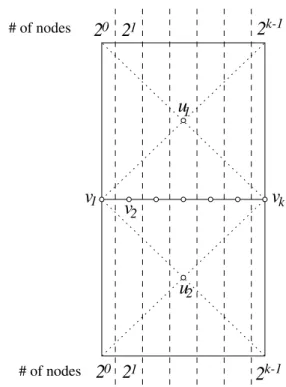
Fig. 2. Instance for which the size of the solution computed by the greedy al-gorithm,f v
1 ;v
2 ;;v
k
g, is larger than the optimum solution,fu 1
;u 2
g,
by a logarithm factor.
Figure 2 shows a family of instances for which the size of the solution computed by the above greedy algorithm is larger than the optimum solution by a logarithm factor. All points lie in a
rectangle whose horizontal side has length one and whose ver-tical side has length2
r 1; 1 2(k ;1) 2
. The two nodes
v
1andv
kare the centers of the left and right vertical sides respectively.The
k
;2nodesv
2;v
3;
;v
k ;1are evenly distributed within
the line segment between
v
1andv
kfrom left to right. The twonodes
u
1andu
2are the centers of the two sub-rectangles aboveand below the segment between
v
1andv
k respectively. The restpoints lie in the two horizontal sides. In each horizontal side,
2 0
=1node lies to the left of (and excluding) the perpendicular
bisector of
v
1v
2, 2k ;1
nodes lie to the right of (and excluding) the perpendicular bisector of
v
k ;1v
k, and2 i;1
nodes lie be-tween (and excluding) the perpendicular bisector of
v
i;1v
iandthe perpendicular bisector of
v
iv
i+1. Thus, the total number ofnodes is
n
=k
+2+2 k Xi=1 2
i;1
=
k
+2k +1
:
Note that
u
1 is adjacent to all nodes lying in the topsub-rectangle,
u
2 is adjacent to all nodes lying in the bottomsub-rectangle, and they are adjacent to each other. Thus, f
u
1;u
2g
forms an MCDS. On the other hand, the above greedy algorithm would add
v
k;v
k ;1;
;v
1sequentially to the dominating set
in the first stage and output the setf
v
1;v
2;
;v
k
gas the CDS
at the end of the second stage. This can be proven by induction as follows.
Initially, the degree of node
v
iis 22i;1
+(
k
;1)+2=2 i+
k
+1;the degrees of the node
u
1andu
2are both kX
i=1 2
i;1
+
k
+1=2k +
k
;and the degree of any other node is
k X
i=1 2
i;1
;1+1+1=2 k
:
So
v
k is the first node to be selected. Now we assume that thenodes
v
k;v
k ;1;
;v
jhave been added to the dominating set.
For any node
v
i withi < j
, the number of its neighbors thathave not been dominated yet is22 i;1
=2
i
; for the node
u
1or
u
2, the number of its neighbors that have not been dominatedyet is j;1 X i=1 2 i;1 =2 j;1 ;1;
and for any other rest node, the number of its neighbors that have not been dominated yet is
j;1 X
i=1 2
i;1
;1=2
j;1 ;2
:
So the node
v
j;1is then added to the dominating set. Therefore,by induction, the nodes
v
k;v
k ;1;
;v
1are added sequentially
to the dominating set. Note thatf
v
1;v
2;
;v
k
gis a CDS. The
first stage will stop after
v
1is added, and the second stage wouldadd no more nodes. Since
n
=k
+2k +1
and = 2
k
+
k
+1, we havek >
logn
;2andk >
log;1. Therefore, the instance shown inFigure 2 implies the lower bounds logn 2
;1and
log 2 ; 1 2 on the approximation factor of the greed algorithm.
The distributed implementation of the above greedy algorithm proposed in [1][7][10] has very high time complexity and mes-sage complexity. Indeed, both time complexity and mesmes-sage complexity can be as high as
;
n
2. We also notice that such distributed implementation is technically incomplete. For exam-ple, the distributed implementation consists of multiple stages, but the implementation lacks lack mechanisms to bridge two consecutive stages. Thus, individual nodes have no way to tell when the next stage should begin. While these technical incom-pleteness are possibly to be fixed, we will not take such effort here as the approximation factor of the greedy algorithm is in-trinsically poor.
In summary, we have the following performance results of the distributed algorithm in [10].
Theorem 5: The approximation factor of the distributed al-gorithm proposed by Das et al in [10][1][7][10] is between
log 2
; 1 2
and3
H
(). Both its message complexity and timecomplexity are
O
;
n
2.
IV. WU ANDLI’SALGORITHM
While the algorithm proposed by Das et al first finds a DS and then grow this DS into a CDS, the algorithm proposed by Wu and Li in [12] takes an opposite approach. The algorithm in [12] first finds a CDS and then remove certain redundant nodes from the CDS. The initial CDS
U
consists of all nodes which have at least two non-adjacent neighbors. A nodeu
inU
is con-sidered aslocally redundantif it has either a neighbor inU
with larger ID which dominates all other neighbors ofu
, or two ad-jacent neighbors with larger IDs which together dominates all other neighbors ofu
. The algorithm then removes all locally re-dundant nodes fromU
. This algorithm applies only to wireless ad hoc networks whose unit-disk graph is not a complete graph. As indicated in [12], the approximation factor of this algorithm remains unspecified. Obviously, the MCDS of any wireless ad hoc network whose unit-disk graph is not complete graph con-sists of at least two nodes. On the other hand, any CDS contains at mostn
nodes. Thus, the approximation factor of the above algorithm is at most n2
where
n
is the number of nodes. Next, we show that the approximation factor of the above algorithm is exactlyn2
:
This means that the above algorithm does perform extremely poorly over certain instances.
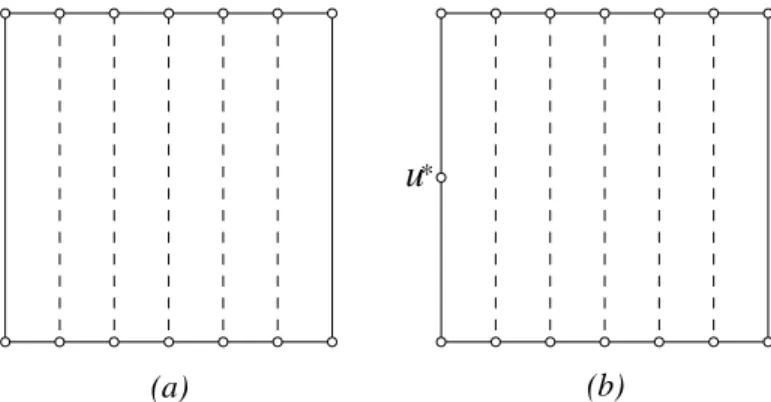
When
n
is even, we consider the instance illustrated in Figure 3(a). These nodes are evenly distributed over the two horizon-tal sides of a unit-square. Each node has exactlym
neighbors, one in the opposite horizontal side and the rest in the same hor-izontal side. Any MCDS consists of a pair of nodes lying in a vertical segment. However, the CDS output by the algorithm in [12] consists of all nodes. Indeed, for each nodeu
, the unique neighbor lying in the opposite horizontal side is not adjacent to all other neighbors ofu
. Thus, the initial CDSU
consists of all nodes. In addition, no single neighbor of a nodeu
can dominate all other neighbors ofu
. Furthermore, if a pair of neighbors ofu
are adjacent, they must lie in the same horizontal side asu;
and therefore neither of them is adjacent to the unique neigh-bor ofu
lying in the opposite horizontal side. So no node is locally redundant. Consequently the output CDS still consists of all nodes.*
(b) (a)
u
Fig. 3. Instance for which the CDS computed by Wu and Li’s algorithm consists of all nodes but the MCDS consists of only two nodes.
When
n
is odd, we consider the instance illustrated in Figure 3(b). The node with the largest ID, denoted byu
, is the center of the left vertical side of a unit-square, and all other
n
;1nodes are evenly distributed over the two horizontal sides of the square. The two nodes at the left two corners of the unit-square forms an MCDS. On the other hand, the CDS output by the algorithm in [12] also consists of all nodes. In fact, following the same argument as in the even case, all nodes other than
u
are in the initial CDS
U
. The nodeu
is also in the initial CDS
U
as well. Sinceu
is not adjacent to the two nodes at the right corners of the unit-square, all nodes other than
u
are not locally redundant. The
u
itself is also not locally redundant as it has the maximum ID. Therefore, the output CDS still consists of all nodes.
The distributed implementation of the above algorithm given in [12] runs in two phases. In the first phase, each node first broadcasts to its neighbors theentire set of its neighbors, and after receiving this adjacency information from all neighbors it declares itself as dominator if and only if it has two nonadjacent neighbors. These dominators form the initial CDS. In the second phase, a dominator declares itself as a dominatee if it is locally redundant. Note a dominator can find whether it is locally re-dundant from the adjacency information of all its neighbors. It is claimed in [12] that the total message complexity is
O
(n
)andthe time complexity at each node is
O
;
2
. A more accurate message complexity is(
m
)wherem
is the number of edgesin the unit-disk graph, as each edge contributes two messages in the first phase. The
O
;
2
time complexity, however, is not correct. In fact, in order to decide whether it is locally redun-dant in the second phase, a node
u
in the initial CDS may have to examine as many asO
;
2
pairs of neighbors, and for each pair of neighbors, as much as
O
()time may be taken to findout whether such pair of neighbors together dominates all other neighbors of
u
. Therefore, the time complexity at each node may be as high asO
;
3
, instead of
O
;
2
. Note that
m
andcan be as many as
O
;n
2and
O
(n
)respectively. Thus, themessage complexity and the time complexity of the distributed algorithm in [12] are
O
;
n
2and
O
;
n
3respectively. The in-stances shown in Figure 3 do require such complexities.
In summary, we have the following performance results of the distributed algorithm in [12].
Theorem 6: The approximation factor of the distributed algo-rithm proposed by Wu and Li in [12] is exactlyn
2
. Its message complexity is(
n
)and its time complexity isO
;
3
.
V. STOJMENOVIC ET AL’SALGORITHM
In the context of clustering and broadcasting, Stojmenovic et al [11] presented a distributed construction of CDS. The CDS consists of two types of nodes: the cluster-heads and the border-nodes. The cluster-heads form a maximal independent set (MIS), i.e., a dominating set in which any pair nodes are non-adjacent. Several algorithms for MIS were described in [11], which can be generalized to the following framework:
Each node has a uniquerankparameter such as the ID only
[8][9], an ordered pair of degree and ID [3], an order pair of degree and location [11]. The ranks of all nodes give rise to a total ordering of all nodes.
Initially, each node which has the lowest rank among all
neighbors broadcasts a message declaring itself as a cluster-head. Note that such node does exist.
Whenever a node receives a message for thefirsttime from a
cluster-head, it broadcasts a message giving up the opportunity as a cluster-head.
Whenever a node has received the giving-up messages from
all of its neighbors with lower ranks, if there is any, it broadcasts a message declaring itself as a cluster-head.
After a node learns the status of all neighbors, it joins the cluster centered at the neighboring cluster-head with the lowest rank by broadcasting the rank of such cluster head. The border-nodes are those which are adjacent to some node from a different cluster.
The implementation cost of these algorithms given in [11] de-pends on the choice of the rank. If the rank is ID only, which remains unchanged throughout the process, both the time com-plexity and the message comcom-plexity of this algorithm are(
n
).CDS. If the rank involves the degree, which would change dy-namically throughout the process, a significant amount of time and messages have to be devoted to rank updating and synchro-nization. The algorithms in [11] didn’t provide these implemen-tation details. But we believe that
O
;
n
2messages and time may be required for rank updating and synchronization.
Regardless of the choice of the rank, all algorithms in [11] have an(
n
)approximation factor. In fact, the instances shownin Figure 3 imply that their approximation factors are at least n 2
. If the rank is ID only, it is easy to construct an instance to show that the approximation factor is exactly
n
, the worst possible. Such inefficiency stems from the non-selective inclusion of all border-nodes.VI. OURALGORITHM
Our distributed algorithm for CDS consists of two phases. These two phases construct an maximal independent set (MIS), and a dominating tree, respectively. They are described and an-alyzed in the next three subsections.
A. MIS Construction
By definition, any pair of nodes in an MIS are separated by at least at two hops. However, a subset of nodes in an MIS may be three hops away from the subset of the rest nodes in this MIS. The MIS constructed in this section guarantees that the distance between any pair of complementary subsets isexactly
two hops. Our construction also follows the general framework described in the previous section, but with a carefully chosen rank definition.
To define the rank, we first apply the distributed leader elec-tion algorithm in [5],
O
(n
)time complexity andO
(n
logn
)message complexity, to construct a rooted spanning tree
T
rooted at a nodev
. After such construction is completed, each node identifies its tree level with respect toT
(i.e., its graph dis-tance inT
from the root) as follows: The root first announces its level0. Each other node, upon receiving the levelannounce-ment message from its parent in
T
, obtains its own level by increasing the level of its parent by one, and then announce this level. Each node also records the levels of its neighbors in the unit-disk graph. If we need to report the completion of the tree, a report process has to be performed upwards along theT
. When a leaf node has determined its level, it transmits a LEVEL-COMPLETE message to its parent. Each internal node will wait till it receives this LEVEL-COMPLETE message from each of its children and then forward it up the tree toward the root.When the root receives the LEVEL-COMPLETE message from all its children, each node knows the levels and IDs of its own and its neighbors. The rank of each node is then given by the ordered pair of level and ID of a node. The ranks of all nodes are sorted in the lexicographic order. Thus the root, which is at
level 0, has the lowest rank. An MIS can then be constructed in the following simple way:
Initially, each node which has the lowest rank among all
neighbors marks itself black and declares itself as a dominator by broadcasting a DOMINATOR message.
Whenever a node receives a DOMINATOR message for the
firsttime, it marks itself gray and declares itself as a dominatee by broadcasting a DOMINATEE message.
Whenever a node has received the DOMINATEE messages
from all of its neighbors with lower ranks, if there is any, it marks itself black and declares itself as a dominator by broad-casting a DOMINATOR message.
When a leaf node is marked, it transmits a MIS-COMPLETE
message to its parent. Each internal node will wait till it receives this MIS-COMPLETE message from each of its children and then forward it up the tree toward the root.
Let
U
be the set of black nodes. We show that it has the following property.Theorem 7: The distance between any pair of complementary subsets of
U
is exactly two hops.Proof: Let
U
=fu
i:1
i
k
gwhereu
iis thei
th
node which is marked black. For any1
j
k
, letH
jbe the graph
overf
u
i:1
i
j
gin which a pair of nodes is connected byan edge if and only if their graph distance in
G
is two. We prove by induction onj
that inH
jis connected. SinceH
1consists ofa single vertex, it is connected trivially. Assume that
H
j;1 isconnected for some
j
2. When the nodeu
jis marked black,
its parent in
T
must be already marked gray. Thus, there is some nodeu
i with1
i < j
which is adjacent tou
j’s parent in
T
.So(
u
i;u
j)is an edge in
H
j. As
H
j;1 is connected, so mustbe
H
j. Therefore,H
j is connected for any1
j
k
. Theconnectedness of
H
k then implies that the bipartite separationof
U
is exactly two.Obviously, this phase has
O
(n
) time complexity andO
(n
logn
)message complexity. Next, we bound the numberof black nodes in terms of the size of an MCDS, denoted by
opt
. Intuitively, the nodes in an independent set are “sparsely” distributed with certain distance between any pair of nodes. In-deed, it is well-known that in a unit-disk graph each node is adjacent to at most five independent nodes. This immediately implies that the size of any independent set is at most5opt
.Next, we show a stronger bound on the size of any independent set.
Lemma 8: The size of any independent set in a unit-disk graph
G
=(V;E
)is at most4opt
+1.Proof: Let
U
be any independent set ofV
, and letT
be any spanning tree of an MCDS. Consider an arbitrary preorder traversal of
T
given by
v
1;v
2;
;v
opt. Let
U
1 be the set ofnodes in
U
that are adjacent tov
1. For any2
i
opt
, letU
i be the set of nodes inU
that are adjacent tov
i but none ofv
1;v
2;
;v
i;1. Then
U
1;U
2;
;U
optform a partition of
U
.As
v
1can be adjacent to at most five independent nodes, jU
1
5. For any2
i
opt
, at least one node inv
1;v
2;
;v
i;1
is adjacent to
v
i. ThusU
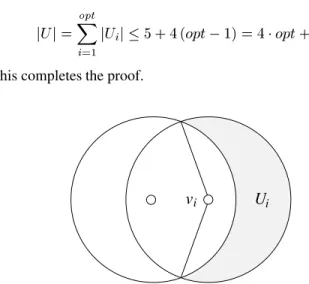
i lie in a sector of at most240degree
within the coverage range of node
v
i(see Figure 4). This impliesthatj
U
ij4. Therefore,
j
U
j= opt Xi=1 j
U
i
j5+4(
opt
;1)=4opt
+1:
This completes the proof.
Ui i
v
Fig. 4. Uilie in a sector of at most240degree within the coverage range of
nodev i.
B. Dominating Tree Construction
The second phase constructs a tree spanning all the black nodes, referred to asdominating tree. All nodes in this domi-nating tree form a CDS. The domidomi-nating tree is initially empty . The root joins the dominating tree first. When each black node joins the dominating tree, it sends an invitation to all black nodes that are two hops away and outside the current dominating tree to join the dominating tree. This invitation will be relayed through the gray nodes. Each black node will join the tree when it receives the invitation for the first time together with the gray node which relays the invitation to itself. This process should be repeated until all black nodes are in the tree. The next is the implementation detail:
The root sends an INVITE message.
When a gray node receives for thefirsttime an INVITE
mes-sage from a black neighbor, it stores the ID of this black neigh-bor in its local variable
inviter
, and then relays such INVITE message.When a black node receives for thefirsttime an INVITE
mes-sage from a gray neighbor, it puts this gray neighbor as its parent in the dominating tree, then sends back a JOIN message towards this gray neighbor and finally initiated an INVITE message.
Whenever a gray node receives a JOIN message towards
it-self from a black neighbor, it puts this black neighbor as its child. In addition, upon the receiving of thefirst JOIN mes-sage towards itself, it sends a JOIN mesmes-sage towards the black neighbor whose ID is stored in the local variable
inviter
.Whenever a black node receives a JOIN message towards
it-self from a gray neighbor, it puts this gray neighbor as its child. Theorem 7 guarantees that whenever there is any black node outside the current dominating tree, at least one black node
would join the dominating tree. Thus eventually all black nodes will join the dominating tree. A reporting process described as follows, if necessary, can be performed along the spanning tree
T
to notify the root of the completion. A gray node re-ports a COMPLETE message to its parent in the spanning tree if all has received a COMPLETE message from each child in the spanning tree. A black node reports a COMPLETE message to its parent in the spanning tree if all has received a COM-PLETE message from each child in the spanning tree and itself has joined the dominating tree.Note that each black node initiates one INVITE message and one JOIN message (except the root); each gray node relays one INVITE message and at most one JOIN message. So the con-struction of the dominating tree requires
O
(n
) messages andO
(n
)time. The same is true for the optional reporting process.Therefore, the total message complexity and time complexity of our algorithm are
O
(n
logn
)andO
(n
)respectively.Finally, we bound the size of the dominating tree. Since each gray node appearing in the dominating tree is the parent of at least one black node, the total number of gray nodes in the dom-inating tree is at most one less than the number of black nodes. From Lemma 8, the total number of nodes in the dominating tree is at most
2(4
opt
+1);1=8opt
+1:
In summary, we have the following performance results of the distributed algorithm in [12].
Theorem 9: Our distributed algorithm has an approximation factor of at most8,
O
(n
)time complexity, andO
(n
logn
)mes-sage complexity.
VII. CONCLUSION
In this paper, we have established a(
n
logn
)lower boundon message complexity of any distributed algorithm for non-trivial CDS. We then reinvestigated three known distributed ap-proximation algorithms for MCDS. After that we presented our own algorithm. The performance comparison of these four al-gorithms is listed in Table I. From this table, we can conclude that our algorithm outperforms the existing algorithms.
[1][7][10] [12] [11] This paper Approx. factor O(logn) O(n) O(n) 8
Msg. complexity O ;
n 2
O
; n
2
O( n)–O ;
n 2
O(nlogn)
Time complexity O ;
n 2
O
;
3
O( n)–O ;
n 2
O( n)
Ngh. knowledge two-hop two-hop single-hop single-hop
TABLE I
PERFORMANCECOMPARISON.
Finally, we appreciate the valuable comments from the re-viewers.
REFERENCES
[1] V. Bharghavan and B. Das, “Routing in Ad Hoc Networks Using Mini-mum Connected Dominating Sets”,International Conference on Commu-nications’97, Montreal, Canada. June 1997.
[2] J. Burns, “A Formal Model for Message Passing Systems”,Technical Re-port TR-91, Computer Sceince Department, Indiana University, May 1980. [3] G. Chen and I. Stojmenovic, “Clustering and routing in wireless ad hoc networks”,Technical Report TR-99-05, Computer Science, SITE, Univer-sity of Ottawa, June 1999.
[4] V. Chv´atal. A greedy heuristic for the set-covering problem.Mathematics of Operation Research, 4(3):233–235, 1979.
[5] I. Cidon and O. Mokryn, “Propagation and Leader Election in Multihop Broadcast Environment”,12th International Symposium on DIStributed Computing (DISC98), September 1998, Greece. pp.104–119.
[6] B. N. Clark, C. J. Colbourn, and D. S. Johnson, “Unit Disk Graphs”, Dis-crete Mathematics, 86:165–177, 1990.
[7] B. Das, R. Sivakumar, and V. Bhargavan, “Routing in Ad-Hoc Networks Using a Spine”,International Conference on Computers and Communica-tions Networks ’97, Las Vegas, NV. September 1997.
[8] M. Gerla, and J. Tsai, “Multicluster, mobile, multimedia radio net-work”,ACM-Baltzer Journal of Wireless Networks, Vol.1, No.3, pp.255-265(1995).
[9] C.R. Lin and M. Gerla, “Adaptive Clustering for Mobile Wireless Net-works”,IEEE Journal on Selected Areas in Communications, Vol. 15, No. 7, Sept. 1997, pp. 1265-1275
[10] R. Sivakumar, B. Das, and V. Bharghavan, “An Improved Spine-based In-frastructure for Routing in Ad Hoc Networks”,IEEE Symposium on Com-puters and Communications ’98, Athens, Greece. June 1998.
[11] I. Stojmenovic, M. Seddigh, J. Zunic, “Dominating sets and neighbor elimination based broadcasting algorithms in wireless networks”,Proc. IEEE Hawaii Int. Conf. on System Sciences, January 2001.
[12] J. Wu and H.L. Li, “On calculating connected dominating set for efficient routing in ad hoc wireless networks”,Proceedings of the 3rd ACM inter-national workshop on Discrete algorithms and methods for mobile com-puting and communications, 1999, Pages 7–14.