International Journal of Emerging Technology and Advanced Engineering
Website: www.ijetae.com (ISSN 2250-2459, Volume 2, Issue 2, February 2012)76
Cognitive Radio Implementation Issues in Channel
Sensing
Garima Mahendru
Electronics & Communication Engineering Department, Amity University
1
Abstract—Cognition means state and contextual awareness, reasoning and conclusion formulation, and a method by which application can be re-configured. Cognitive Radio (CR) is one such Intelligent Wireless Communication system that is built on Software Defined Radio which collects information from the surrounding environment and uses this learning to adapt itself to the variation in the input stimuli [7]. The major objective of a Cognition based Radio is to deliver highly reliable communication as well as highly efficient utilization of the most precious natural resource of wireless communication, the frequency spectrum. Usually spectrum access is a significant problem than the physical scarcity of the spectrum. This is due to the command and control regulations that limit the access to potential spectrum. Cognitive Radio is a measure proposed to support the efficient utilization of the frequency spectrum by making the most of the spectral gaps or unused spectrum holes. Various cognitive methods are being investigated to reuse the locally unused spectrum to increase the total system capacity. Identifying the free unused spectrum is the first step in cognition that provides opportunistic access of the spectrum by the secondary (unlicensed) users [14]. Channel sensing forms an integral part of Cognition that selects the channel, utilizes it and finally implements it. The initial sensing of the channels and the final implementation and application of end user raises many issues in Cognitive Radio Systems. Liberating the spectrum would materialize better and optimized connectivity and would enable new opportunities.
Keywords
—
Software Defined Radio, Cognition, Spectrum Holes, Primary (licensed) Users, Secondary (un-licensed) Users, Spectrum Analysis, Channel Sensing.I. INTRODUCTION
Wireless Communication era is now moving towards
mutually conscious intelligent devices that leverage awareness of the environmental conditions and user needs to enable the method of communication on the fly via dynamic spectrum access to improve connectivity and capacity. Globally the wireless communication devices are facing a bandwidth crisis.
This problem can be sufficed with the dynamic spectrum usage via intelligent devices [2]. Due to strict spectrum allocation rules the wireless frequencies are getting overloaded and crowded. For faster service and better connectivity far more bandwidth is required than the current availability [1]. Cognitive Radios make themselves aware of the surroundings and frequency availability and use the spectrum dynamically based on location, nearby radios, transmission power, time of the day and other factors. With the implementation of the cognitive intelligent radios varied devices would be able to detect other radios around them and work together for
spectrum optimization, resource allocation and
communication with their peers [15]. By the term radio we mean any device that can communicate wirelessly. Presently all the radios can communicate with the radios of the same kind, but cognitive radios would allow interaction and interoperability between various kinds of wireless radios. Cognitive radios quickly adapt itself to the altered situation and ensure proper operation of the network.
II. COGNITIVE CYCLE
International Journal of Emerging Technology and Advanced Engineering
Website: www.ijetae.com (ISSN 2250-2459, Volume 2, Issue 2, February 2012) [image:2.595.90.264.139.344.2]77
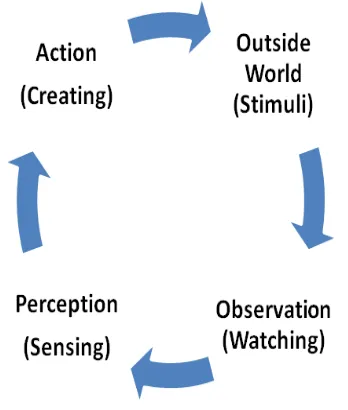
Figure 1: Human Cognition Cycle
[image:2.595.334.553.210.389.2]As discussed above Cognitive radio networks are smart networks that continuously analyses the radio environment and detects the free white spaces in the spectrum in an oppurtunistic manner [7]. The Cognitive Radio continuously take input from the radio environment, analyses the spectrum, senses the channel and then finally allocates the vacant channels to the secondary users (as Shown in Figure 2) [7].
Figure 2: Cognitive Radio Cycle
Once the frequency spectrum is found vacant, it is filled in by the secondary users [2], [8]. Wherever the primary user is not present a appropriate communication link is established and information is transmitted by the secondary user.
However, the presence of the secondary user should not effect and interfere with the primary user transmission. This means that the network design and infrastructure of the primary user cannot and must not be altered.
Figure 3: Cognitive Radio Acquiring free “White Spaces”
The Cognitive radio should be intelligent enough to
sense the channel independently and setup a
communication link for the secondary user(s) whenever the spectrum is available or idle As shown in Figure 3, the frequency gaps between primary users (shaded as grey) are the white spaces occupied opportunistically by the secondary users [17].
III.CHANNEL/SPECTRUM SENSING
Spectrum sensing can be regarded as detecting holes in the given spectrum band. Sometimes the interference caused by the primary users may be high and sometimes
low or nil. Depending on the type of
modulation/transmission, power and frequency
parameters of the primary users, the appropriate spectrum sensing requirements are decided. Some critical aspects should be taken care of while sensing the spectrum for the secondary users. Firstly, the process of spectrum analysis should be continuous. Secondly, a backup plan or an alternative spectrum should be reserved so that the secondary user information is not lost when the primary user returns.
Frequency
Time
Secondary User
Primary User
[image:2.595.83.286.461.661.2]International Journal of Emerging Technology and Advanced Engineering
Website: www.ijetae.com (ISSN 2250-2459, Volume 2, Issue 2, February 2012)78
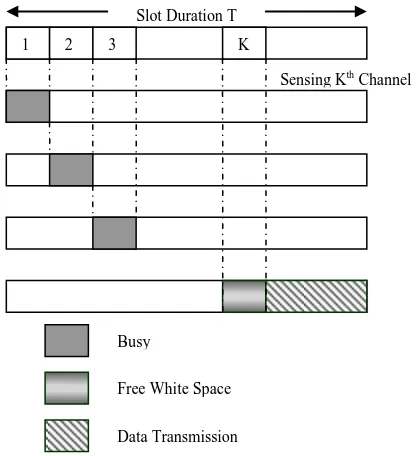
Figure 4: Channel Sensing Process for secondary users
Figure 4 depicts the spectrum sensing process where the transmission is done in fixed time slots (T) and each slot is divided further into several channels (1,2,3…K) [12]. Each channel from 1 to K is sensed by the
secondary user and its status is tested. When found busy,
the secondary user senses the next channel for
availability. Once the channel is found free a white space
is declared by the secondary user and data is transmitted. There exists numerous ways of spectrum sensing in a Cognitive Radio Network. Few of those techniques are discussed below:
A. Matched Filter
One of the most commonly used method for spectrum
sensing is Matched Filtering followed by a threshold test.
Matched filter is supposed to be an optimal technique for spectrum sensing because it maximizes the signal-to-noise ratio [13]. It is a coherent detection method that requires demodulation of the primary user signal. The various parameters like type of modulation, format of packet information is stored within the Cognitive Radio memory and then demodulation of the primary user signal is performed. But this method poses various limitations for systems that consist of a number of primary users [10]. As the number of primary users increase the circuitry and implementations cost of this method increases so as to attain synchronization with each primary user for coherent detection.
B. Energy Detector
[image:3.595.72.280.156.384.2]Energy detector involves simple detection of the primary signal in presence of noise. In this spectrum sensing method first of all a threshold value is set for specific observation duration and then the energy on the primary band is compared with the set threshold value to declare the presence of a white space (shown in Figure 5) [11]. The observation interval is also termed as the sensing period during which the comparison is done [10] [13]. If the measured energy level is less than the threshold value a white space is declared and a secondary user transmission is allowed. If the measured energy level is more than the threshold value the channel is declared busy.
Figure 5: Comparison of energy level of primary signal with a given threshold
A typical Energy detector (Figure 6) consists of a Low pass filter followed by an Analog to Digital Converter (A/D). The digital output is then passed through a Square Law device and finally integrated which gives the test statistics (T) as output [11]. The decision test statistic in energy detection is given by:
[image:3.595.323.570.313.406.2]T =
Σ
(Y[n])2 ….Eq 1Figure 6: Conventional Energy Detector
The limitation of the energy detection spectrum sensing method is its inability to distinguish between the source of energy (Primary user or noise) [10]. This drawback makes it prone to uncertainties and incorrect status declaration of the primary user band. If the modulation type, carrier frequency or some other feature of the primary user signal is known is known more sophisticated feature detectors may be implemented.
y (t) Low Pass Filter
A/D
Square Law Device
Integr ator Y[n]
P1
P2
Frequency Threshold
Primary Signal 1 Primary Signal 2
1 2 3 K
Slot Duration T
Busy
Free White Space
Data Transmission
[image:3.595.330.564.534.635.2]International Journal of Emerging Technology and Advanced Engineering
Website: www.ijetae.com (ISSN 2250-2459, Volume 2, Issue 2, February 2012)79
This method involves longer sensing time for desired performance. The low cost and implementation simplicity makes this method a favourable spectrum sensing technique. However, there are several drawbacks of this method that lessens its implementation simplicity. Firstly, the threshold value selection becomes critical since it is highly susceptible to frequent changing noise levels. Secondly, energy detection method is not able to differentiate between primary user signal, noise and interference. Furthermore, energy detection spectrum sensing method is not applicable to spread spectrum signals. To increase the robustness of this method prior knowledge of few features like modulation type, carrier frequency or data rate should be known
C. Cyclostationary Feature Detector
The Cyclostationary Feature Detector extracts signal features in the background of noise. In cases where energy detection scheme is not effective, Cyclostationary feature detector is a suitable method [10], [13]. This method utilizes the built-in periodicity features of the communication signals like carrier frequency, bit rate,
modulation type, hopping sequences etc. The
communication signals that exhibit periodicity are termed as Cyclostationary. Common analysis of the stationary signals is based on the autocorrelation function and power spectral density. Unlike the noise which remains
stationary, the spectral correlation of different
communication signals gives unique values. The distinct characteristic of spectral redundancy makes signal selectivity feasible. These unique spectral properties allow a Cognitive Radio to detect a specific primary user signal obscured in noise and interference. Different modulation techniques like BPSK, QPSK have identical power spectral density (PSD) functions but exhibit distinct spectral correlation function that allows the Cognitive Radio to detect a feature (modulation type) of the primary signal.
Cyclostationary feature detector can be regarded as expansion of the energy detector with a correlator. In practice, a combination of the above said methods could
be employed. The possibly free primary bands among a
wide range of frequencies could be identified using Energy detection method. The required white spaces
could be then detected from the possibly free primary
bands with more advanced Feature detection method. However, the limitation of such a method would be very long spectrum sensing time.
IV.IMPLEMENTATION ISSUES
Implementation of Cognitive Radio Network poses several challenges and issues. The sources of uncertainty ranges from channel randomness to device-level and network level architecture uncertainties. Some of the performance issues faced by the Cognitive Radio Networks are discussed below.
A. Sensing Periodicity
Once a white space is detected by a Cognitive Radio, the secondary system should continuously sense the channel and check the status of the primary user so that it does not interrupts the primary communication [10]. The sensing and status updating is done after a fixed interval
of time. This periodic interval is termed as sensing period
(Tp) and decides the Quality of Service (QoS) as well as
the delay. Generally Tp will depend on type of primary
user service and will be set for each user band by the regulator.
It is not feasible to transmit data by the secondary user and sense the channel simultaneously, that is why it is clubbed with data transmission [11]. To improve the system performance and maximize the time available for data transmission the sensing period should be set below Tp.
B. Detection Sensitivity
If the interference generated by the Cognitive Radio causes the Signal-to-Interference (SIR) ratio to fall below the threshold value, the entire system performance is degraded potentially [10], [13]. This interference is dependent on the characteristic of the transmitted signal as well as the type of primary service. To optimise the system performance a specific interference range must be decided for the secondary transmitter. This interference range can be regarded as the maximum distance from a primary user at which the acquired interference is still harmful. It is dependent on the secondary user’s transmitted power and primary user’s interference tolerance.
Let Pp be the transmitted power of the primary user, R
be the maximum distance between the primary user and its corresponding receiver, L be the path loss factor, D be the interference range for secondary user and N be the noise power [10]. Taking these parameters into account
the detection sensitivity,
γ
min can be defined asγmin = Pp L (D+R)/N ….. Eq 2
Therefore, detection sensitivity can be defined as the minimum SNR at which the primary signal may still be accurately identified by a cognitive radio
C. Channel Uncertainty
International Journal of Emerging Technology and Advanced Engineering
Website: www.ijetae.com (ISSN 2250-2459, Volume 2, Issue 2, February 2012)80
This implies that low received signal strength will not always denote a free primary band but actually mean that the primary user signal is deeply faded or heavily shadowed by obstacles.
Thus spectrum sensing is challenged by channel uncertainties that compel the Cognitive Radio to be more sensitive to differentiate between a faded/shadowed signal and a white space. This constraint urges for a higher detection sensitivity requirement. However, this problem can be alleviated by taking a group of Cognitive Radios that share their measurements and then jointly decide on available frequency band.
D. Noise Uncertainty
As observed in the Eq 2, the noise power N should be known but it is has to be actually estimated by the receiver. Thermal noise variations due to temperature deviation and calibration errors pose limitations on accuracy of the estimated noise power [10]. Due to underestimation of the noise power the cognitive radio might disobey the sensitivity requirement. Further, in case of energy detection method, a very low primary user signal will not be easily distinguished from noise if it SNR value falls below a certain threshold value [11], [13]. However, this is not an issue in case of feature detection method where differentiating between noise and primary user signal is easier.
V. CONCLUSIONS
In this paper, the benefits of opportunistic access of the spectrum by the unlicensed secondary users in a Cognitive Radio Network to resolve the problem of spectrum scarcity is discussed and studied. It is observed that the Cognitive Radio offers efficient usage of the available spectrum. The various spectrum sensing techniques are analyzed that propose to enhance the performance of a Cognitive Radio. Further, in this article the issues faced by a Cognitive Radio in spectrum sensing are described and studied. Research on spectrum sensing so far emphasize on regulatory constraints for trustworthy sensing. For further enhancement of the Cognitive Radio Network and to achieve better QoS interplay of spectrum sensing and higher layer functionalities will have to be proposed.
References
[1] D. Tse and P. Viswanath, Fundamentals of Wireless Communication. Cambridge University Press, 2005., 1996. [2] J. Mitola and G. Q. Maguire, ―Cognitive Radio: Making
Software Radios More Personal,‖ IEEE Pers. Commun., vol. 6, no. 4, Aug. 1999, pp. 13–18.
[3] FCC, Spectrum Policy Task Force Report, ET Docket No. 02-155, Nov 02, 2002
[4] A. Sahai, N. Hoven, R. Tandra, ―Some Fundamental Limits on Cognitive Radio‖, Proc. of Allerton Conference, Monticello, Oct 2004.
[5] R.W. Brodersen, A.Wolisz, D.Cabric, S.M.Mishra, D. Willkomm, 2004 White Paper: ―CORVUS-A Cognitive Radio Approach for Usage ofVirtual Unlicensed Spectrum‖
[6] G. Staple and K. Werbach, ―The end of spectrum scarcity,‖ IEEE Spectrum, vol. 41, no. 3, pp. 48–52, 2004.
[7] S. Haykins, ― Cognitive Radio: Brain Empowered Wireless Communications‖, IEEE Journal, VOL 23, No. 2, Feb 2005 [8] Y Yuan, P Bahl, R. Chandra, P. A Chou, ―KNOWS: Cognitive
Radio Networks over White Spaces‖ IEEE, 2007
[9] D. Niyato and E. Hossain, ―Medium access control protocols for dynamic spectrum access in cognitive radio networks: A survey,‖ CognitiveRadio Networks, pp. 179–214, Editors Y. Xiao and F. Hu, Auerbach Publications, CRC Press, Dec. 2008. [10] A. Ghasemi, E S Sousa, ―Spectrum Sensing in Cogntive Radio
Networks: Requirements, Challenges and Trade-offs‖, IEEE Communication Magazine, April 2008.
[11] D. Cabric, A. Takchencko, R.W Broderson ―Experimental study of spectrum sensing based on energy detection and network cooperation‖
[12] H.T Cheng, W Zhaung, ―Simple Channel Sensing Order in Cogntive Radio Networks‖, IEEE Journal, Vol. 29, No. 4, April 2011.
[13] D. Cabric, S. M Mishra, R.W Broderson ―Implementation Issues in Spectrum Sensing for Cognitive Radios.‖
[14] A. M Hayar, R Pacalet, R. Knoop, ―Cognitive Radio Research and Implementation Challenges‖.
[15] Frederic Pujol, ―Regulatory and Policy Implications of Emerging Technologies to Spectrum Management‖ ITU Workshop on market mechanisms for spectrum management, Geneva, 22-23 Jan 2007
[16] D. Cabric, S. M Mishra, R.W Broderson , D Willkomm, A Wolisz, ―A Cognitive Radio Approach for Usage of Virtual Unlicensed Spectrum‖ 14th IST Mobile Wireless
Communication Summit 2005