The Development of a Model for Geodesic Learning:
The Geodesic Information Processing Model
Caroline M. Leaf, Brenda Louw and Isabel Uys
Department of Communication Pathology and Audiology
University of Pretoria
ABSTRACT
the perception of ^arnin^n order* copew learning how to learn and self-directed inquiry as essential life-skills
for the speech-language therapist are discussed. OPSOMMING
Hierdie artikel voer aan dat alternatiewe benaderings tot die huidige tradisionele leermetodesessensieel
isindier^nderrig-inhgtingsontplotting te Han rnnteen self-gerigte navraag as essensiele lewensvaardigheid wat sisteme,
* bewerkstellig in respons op veranderende situasies
m P Z Z P me t S ^ M ^ p ^ Z alternatiewe diensleweringsmodel, naamlik die geodetiese
inligtingsproses-^ r ^ ^ w ^ ^ J Z van geodetiese filosofie val. Die implikasies van hierdie alternatiewe benadermg vir die spraak-taalterapeut word ten slotte bespreek.
KEY WORDS: geodesic learning, mind mapping approach
INTRODUCTION j
Humans are biologically" designed to survive and the single greatest competitive advantage is the ability to learn (Jensen, 1995: iv).
TRADITIONAL PERCEPTIONS OF LEARNING
The ability to learn, individually, in groups, in organi-sations and as a country, is a critical factor in the progress and development of society as a whole. Traditionally, def-initions of learning have been based on behaviouristic, mechanistic and cognitive theories (Glasser, 1986; Knowles, 1990). This has led to the assumption that learning is the internalisation of external knowledge, and is under the control of a single internal source of self-reg-ulation, namely executive self-regulation (Iran-Nejad, 1990). This viewpoint defines learning as a growth process dependent on internalising events into a "storage"
system that corresponds to the environment (Knowles, 1990). Therefore, most traditional learning theorists view learning as a process by which behaviour is changed, shaped or controlled, with an emphasis on growth and cognitive development (Knowles, 1990; Glasser, 1986). However, these assumptions undermine the creative and multimodal nature of learning, limiting learning to the simple incremental learning of facts and definitions, which in turn is responsible for the achievement and motivational problems many students experience (Glasser, 1986; Iran-Nejad, 1990; Gardner, 1985; Knowles, 1990; Jensen, 1995). It appears that behav-iouristic and cognitive theories are too narrow to explain the complexity of the learning process as their primary focus is on concept attainment to the exclusion of concept formation or invention (Glasser, 1986; Jones, 1968, in Knowles, 1990). Furthermore, it needs to be acknowl-edged that that everyone learns in different ways, and that it is consequently necessary to explore alternative
Die Suid-Afrikaanse Tydskrif vir Kommunikasieafwykings, Vol. 44, 1997
by
S
ab
in
et
G
at
ew
ay
u
nd
er
li
ce
nc
e
gr
an
te
d
by
th
e
Pu
bl
is
he
r (
da
te
d
20
12
ways of facilitating learning that will allow individuals to realise their natural potential. Current traditional learn-ing systems that propose to stimulate learnlearn-ing in the "whole" child, tend to favour predominantly linguistic and mathematical intelligences as opposed to a more pluralis-tic approach (Jensen, 1995). This is a consequence of the prevailing philosophy of current traditional educational systems and therapeutic institutions which indicates that "intelligence" or "potential" is a single general capacity that enables the individual to achieve in all situations. Research has, however, indicated that the traditional type of approach to developing learning potential , which is based on the I.Q., Piagetian and Information Processing movements, is product versus process oriented and does not develop the whole person in their full capacity (Iran-Nejad, 1990; Gardner, 1985; Jensen, 1995). Many educa-tors and philosophers concur that the most important goal of therapy and education is to facilitate thinking. Hence an approach to learning is needed that moves away from viewing learning as a process of controlling, chang-ing or shapchang-ing behaviour, to one that views learnchang-ing as competency development. Consequently, an alternative approach that focuses on the dynamics of the thought processes and the pluralistic nature of the intelligences of the human mind has arisen, and which is termed the geo-desic movement (Leaf, 1997; Gardner, 1985; Iran-Nejad, 1990).
THE PARADIGM SHIFT IN SPEECH-LANGUAGE THERAPY AND AUDIOLOGY
The paradigm shift that is occurring in the perception of learning is parallelled in the field of Speech-Language Therapy and Audiology, and has resulted in a paradigm shift in the professional self-concept and role played by the speech-language therapist. This paradigm shift has emerged in response to the increasing awareness of the inefficiency of traditional approaches in meeting needs of clients, with alternative service delivery models proposed to provide a more accountable service to clients (Paul-Brown, 1992; Simon, 1987; Leaf, Uys & Louw, 1990; Lewis 1994). One of the communication needs stressed in the alternative service delivery literature is the need to integrate communication skills with academic material with the emphasis on the learning process (Paul-Brown, 1992). This is due to the academic environment requiring competent communication skills both oral and written -as prerequisites for school success (Johnson, 1987). A stu-dent's successes and failures are bound up in the way they share and create meaning through language. Speech-lan-guage therapists therefore need to broaden their role to promote overall learning success, and in this way, provide a more accountable service to clients. Speech-language therapists need to become more involved in facilitating the language and communication skills needed in the learning process in the classroom. This change therefore implies an evolution. According to Johnson (1987:225), "the evolution from "speech-language therapist" to "com-munication and learning instructor" has been the result of adopting an educational versus a medical model, through integrating communication instruction into the students natural learning environment, and through col-laborating with other educators". This entails the use of classroom and curriculum based service delivery models where the basis for the content of treatment would be the
The South
concepts and vocabulary from the academic curriculum. This implies a consultative role for the speech-language therapists allowing for their background and abilities to be utilised to a greater extent. Not only can speech-lan-guage therapists provide direct therapy, but they can also provide input on the communication and social difficulties exhibited by the pupils as observed in the naturalistic learning environments, as well as about the process of language and learning in general (Thurman & Wider-strom, 1990).
HUMANISM VERSUS BEHAVIOURISM
The development of Humanistic Psychology (founded in 1963) carries this trend of thought further in that the image of man is recast from a passive, reactive recipient to an active, seeking, autonomous and reflective being (Rogers, 1969, in Knowles, 1990). According to Rogers (1969, in Knowles), learning is seen as having a quality of personal involvement; as being self-initiated; as pervasive; as evaluated by the learner; and finally, as having mean-ing as its essence. This view is expanded by Maslow (1970, in Knowles, 1990) who identifies the goal of learning to be self-actualisation. Jourard argues that "the learner has the need and the capacity to assume responsibility for his own continuing learning" (1972, in Knowles, 1990). This humanistic view of learning has been formulated into a theory by Glasser (1986) which he calls "learning control theory". Learning control theory is a biological theory of how humans function as living creatures. It has as its basic premise the contention that all behaviour is an attempt to satisfy needs that are built into the genetic structure of the brain, and thus all motivation is internal, as opposed to external - as claimed by behaviourists and cognitists. Control theory contends that it is impossible to force or bribe a person into doing quality work. That is, learning is not a process of shaping change in behaviour, rather it is an internally motivated creation of meaning (Glasser, 1986). Iran-Nejad (1990) elaborates on this idea by defining learning as the creative reconceptualisation of internal knowledge. He further proposes that there are two different sources of internal self-regulation; one that controls the sequential conscious aspect of learning,! and another that controls the simultaneous non-conscious aspect. Furthermore, to extend the domain of learning beyond simple incremental memorisation, both sources of self-regulation have to be activated. ' !
Both the behaviouristic and cognitive theories, wliich utilise computers and mechanistic processes as analogies, define learning as a change in behaviour that is largely controlled by an external source, and that will result in an accrual of knowledge facts. By contrast, humanistic theo-ries, which have the functioning of the human brain as their analogy, define learning as an internally motivated and controlled process that results in the recreation of conceptual knowledge with the emphasis on meaning. Behaviouristic and cognitive theories emphasise the edu-cator, the agent of change who presents stimuli, and rein-forcement for learning and designs activities to induce change. A humanistic approach, by contrast, emphasises the person in whom the change occurs, and learning as the act or process by which behavioural change, knowl-edge skills and attitude are reconceptualised. In this, a humanistic approach to learning appears to be a more accurate description of human functioning than a
behav-y
ab
in
et
G
at
ew
ay
u
nd
er
li
ce
nc
e
gr
an
te
d
by
th
e
Pu
bl
is
he
r (
da
te
d
20
12
iouristic and cognitive approach. Extensive research has been conducted in the fields of contemporary neuroscience and neuropsychology and has led to the identification of the brain's preferred way to learn, confirming the latter statement (Glasser, 1986; Gardner, 1985; Iran-Nejad, 1990; Jensen, 1995; Knowles, 1990; 1986; Lozanov, 1978; Dhority, 1991; Springer & Deutsch, 1989; Diamond, 1988). However, behaviouristic and cognitive theories tend to dominate the philosophy of learning institutions with what are believed to be negative effects on the learn-ing abilities of students and clients and the realisation of their potential. The adoption of predominantly behav-iouristic and cognitive philosophies is possibly due to a lack of integration between research on the brain and standard education practices.
In addition, the behaviouristic and cognitive theories provide neat ways of "measuring" and "packaging" stu-dents and clients into controlled environments, and are thus convenient to educationalists and learning institu-tions. The humanistic approach recognises the complexi-ty and individualicomplexi-ty of human nature, and consequently the complex and involved task of facilitating learning. This approach is not as convenient or controllable.
Cremin (1981, in Knowles, 1990) indicates that the revolution in learning that began in the twentieth centu-ry and is continuing into the twenty-first centucentu-ry may be as fundamental as the original invention of formalised learning institutions. A strong case for the adoption of alternative approaches to learning is made by Capra (1982, in Knowles, 1990). He argues that "we are trying to apply the concepts of an outdated world view - the mech-anistic world view of Cartesian-Newtonian science - to a reality that can no longer be understood in these terms. We live in a globally interconnected world, in which bio-logical, psychobio-logical, and environmental phenomena are all interdependent. To describe this world appropriately, an ecological perspective is needed that the Cartesian world view cannot offer" (Capra, 1982, in Knowles, 1990: 19). Capra further argues that a fundamental change is needed in thoughts, perceptions and values, and thus, attitudes. The beginnings of this change are visible in
x most areas and are likeljj to result "in a transformation of
unprecedented dimensions, a turning point for our planet as a whole" (Capra, 1982-, in Knowles: 19).
Thus, a paradigm shift is needed in order to create new learning systems that focus on the development of poten-tial which is achieved through teaching how to learn and not what to learn. There are many reasons for a paradigm shift in learning, not the least of which is that in the USA more than 40% of school-going children are diagnosed as having some kind of learning problem (Jensen, 1995; Thornburg, 1991, in Jensen, 1995; Simon, 1987). However, it is felt that this percentage is in fact higher, closer to 90% than 40%, and that the reason for this high percentage is the system within which pupils are being "educated". The current educational system is producing "educational casualties" (Simon, 1987), rather than inno-vative lifelong learners. This constitutes a major problem because learning is an ongoing process that crosses all walks of life, and the application of traditional behav-iouristic and cognitive learning systems is not preparing children for life (Knowles, 1990). According to Mitchell (1986, in Buzan & Dixon, 1976), society needs a more extended view of what normal human potential is, imply-ing that high achievers are the norm and not the
excep-tion. This involves a totally new and broader approach to the perception of learning, and, therefore, of educating and remediating.
In summary, it appears that traditional approaches to education and therapy are based on the I.Q., Piagetian and classical information processing theories of learning. These approaches all focus on a certain kind of logical or' linguis-tic problem-solving; ignore neurobiology; do not deal with higher levels of creativity; and finally do not consider the ethnography of learning. The result of such approaches is less than optimal as, according to research, 70- 90% of stu-dents are underachieving , many of whom require addi-tional support in the form of therapy (Iran-Nejad, 1990; Bloom, 1984). Bloom (1984, in Iran-Nejad, 1990) states that for more than thirty years students have been memo-rising facts and definitions without understanding them. Sizer (1984:84) indicates that "students are all too often docile, compliant and without initiative, painting a picture of considerable passivity towards academic learning and school". A non-intelligent learning culture of not thinking has thus resulted, producing students who do not take responsibility for their learning, and who are reliant on external sources to do their thinking for them.
THE GEODESIC MOVEMENT
The geodesic movement by contrast, focuses on the symbolic vehicles of thought, namely the activities and products of the human mind such as language, mathe-matics, visual arts and gestures (Gardner, 1985; Iran-Nejad, 1990: Allport, 1980; Hinton & Anderson, 1981). The geodesic movement moves away from the search for general problem-solving devices and horizontal struc-tures such as memory, attention and perception, and focuses more on vertical components, hence providing a more molar and molecular analysis of the nervous system (Allport, 1980). This approach is not entirely new, as facets of the mind were already recognised in ancient Greek philosophy, and it can thus be seen as a type of rejuvenated faculty psychology. The geodesic movement does not merely focus on the linguistic, logical and numer-ical symbols of Piagetian, I.Q., and information process-ing theories , but also focuses on a full range of symbol systems encompassing musical, bodily, spatial and per-sonal symbol systems, and is consequently multimodal (Gardner, 1985: Leaf, 1997). Each symbol system can be viewed as an independent functioning cluster of intelli-gences making up that particular symbolic domain, and, although separate, the domains do interact in the think-ing process (Gardner, 1985). The geodesic is biologically oriented and is based on brain organisation and matura-tional capacity. Thinking is perceived to consist of a num-ber of special purpose devices, or clusters of abilities pre-sumably dependent on neural "hard-wiring" in the brain (Allport, 1980). Furthermore, cognitive accomplishments may occur in a range of domains some of which are uni-versal, such as the logical-mathematical domain which forms the basis of experimentation in the I.Q., Piagetian and Information Processing movements (Feldman, 1980). Some are culturally specific such as reading which is important in some cultures and not in others. Within each domain there are steps ranging from novice to expert, making the movement developmental. However, there are great inter-individual differences in the speed at which an individual passes through the stages from novice to
mas-Die Suid-Afrikaanse Tydskrif vir Kommunikasieafwykings, Vol. 44, 1997
by
S
ab
in
et
G
at
ew
ay
u
nd
er
li
ce
nc
e
gr
an
te
d
by
th
e
Pu
bl
is
he
r (
da
te
d
20
12
tery in the different domains. In contrast to Piaget's the-ory, success at negotiating one domain does not invoke the other domains (Feldman, 1980). The development of domains is dependent on internal genetic factors as well as on external cultural factors (Gardner, 1985).
Therefore the geodesic movement represents a shift from cognitive theories of knowledge to cognitive theories of how the nervous system functions. (Iran-Nejad, 1990; Hinton & Anderson, 1981). This development suggests that simultaneous learning in diverse local sites and sub-systems of the nervous sub-systems is the rule for learning, as opposed to one-thing-at-a-time rule of traditional approaches. According to Iran-Nejad (1990), if previously unrelated local sites in the brain, representing domains, are stimulated simultaneously in a brain-compatible way, they will combine in configurations previously not experi-enced and result in higher levels of functioning. This simultaneous learning hypothesis, which is central to the geodesic movement, suggests that more than active con-scious control is needed to think, learn and release poten-tial. It implies that another kind of control must be oper-ating on the non-conscious level, and both types of control are needed in effective learning. This control is called dynamic self-regulation, and is simultaneous, implying that simultaneous functioning is a prerequisite for learn-ing as opposed to the other way around as in traditional approaches. Furthermore, dynamic self-regulation oper-ates on the non-conscious level, yet will impact the con-scious level through a process of attention delegation, which is the power to contribute to the learning process even though not conscious (Iran-Nejad, 1990).
This simultaneous, non-conscious process permits individuals to engage in multimodal encoding, unencum-bered by potential interference from one-modality-at-a-time executive encoding which is characteristic of many learners exposed to traditional approaches, and results in a cautious literal attitude to learning. Learning in the tra-ditional mode becomes increasingly analytical, intention-al and potentiintention-ally very sequentiintention-al because the learner is using the rehearsal-memorisation strategy of allocating immediate attention to every physical item of the task over and over again, without regard for the powerful con-tributions of spontaneous, tacit and explicit attention-del-egation processes of dynamic internal self-regulation. The geodesic approach represents a way of creating a more thinking-orientated approach to learning. A fundamental tenet underlying geodesic learning is that a mediator cannot cause learning in an individual, learning must be created by the learner. Thus the mediator should struc-ture the environment to facilitate the learning process (Feuerstein, 1980).
Within the alternative geodesic approach, with the altered perception of learning, is the implication of an expanded role for the speech-language therapist working in educational settings. Traditionally the speech-lan-guage therapist has employed a clinical model of inter-vention focusing on the oral linguistic aspects of language * (Simon, 1987; Paul-Brown, 1992). This latter approach
has led to a focus on deficits and remediating deficits - a symptomatic approach. For example, viewing syntax, semantics, pragmatics and auditory processing as sepa-rate variables while ignoring the reading and writing aspects of communication leads to fragmented services that drill splinter skills (Simon, 1987; Paul-Brown, 1992). In the field of education, specifically Simon (1987)
postu-lates that well-meaning traditional speech-language approaches have actually ended up creating "educational casualties" as a consequence of segregating and labelling students, leading them to become addicted to 1:1 atten-tion. This has led to the development of passive attitudes towards learning by falling into patterns of "learned help-lessness" due to believing their "disabled" labels (Johnson, 1987). Alternative service delivery approaches have consequently emerged in response to the increasing awareness of the inefficiency of traditional approaches to communication, with immediate impact on the role of the speech-language therapist.
Thus, the most significant implication arising out of the literature related to the development of lifelong inno-vative learners with proficient communication skills, con-cerns the need to move from teaching and facilitating spe-cific skills to the teaching of strategies to enable students to attain mature language repertoires and communica-tion competence with adequate problem-solving skills (Thornburg, 1991, in Jensen, 1995; Derry, 1990). The speech-language therapist, with a background in lan-guage, communication, psychology, speech and hearing science, linguistics, and learning theory, is eminently qualified to become involved in the integration of a geo-desic approach to the process of learning and intellectual development, which indicates the expanded role for the speech-language therapist working with learning prob-lems (Paul-Brown, 1992). As discussed, speech-language therapists should view themselves as language specialists concerned with the prevention and remediation of com-munication difficulties by focusing on the process of learn-ing and intellectual development (Thornburg, 1991, in Jensen, 1995). The speech-language therapist is seen to play an important role academically in assisting with adapting the child's academic instruction so that he can achieve to the best of his ability (Committee on Language, Speech and Hearing Services in Schools, 1983, in Johnson, 1987). This implies that a complex relationship exists between language used for learning and intellectu-al development and language used for communication, highlighting the need for a paradigm shift in the percep-tion of learning. In view of the foregoing, research high-lighting and emphasising the necessity of a learning par-adigm change is needed if educational institutions are to facilitate the development of innovative lifelong learners that can make a contribution to society. ι
The overall objective of the research on the geodesic information processing model, and its application, the Mind-Mapping Approach (MMA) (Leaf, 1990; 1997), is therefore to create and explore an alternative system to the traditional learning system. The Mind-Mapping Approach (MMA), is believed to provide a better way to assist learners - teachers, therapists, pupils and clients alike - in becoming innovative lifelong learners. This is because the theoretical base of the MMA incorporates the principles inherent in the philosophy of geodesic learning, which is the suggested alternative philosophy upon which the perception of learning should be based,, and which falls within the realms of a humanistic approach. The MMA framework provides a basis for bridging the gap between the unique individual learner and the design and delivery of the learning experience. The latter is in con-trast to traditional educational and institutional systems of facilitating learning and communication, which are based on unnatural behaviouristic, mechanistic and
cog-ab
in
et
G
at
ew
ay
u
nd
er
li
ce
nc
e
gr
an
te
d
by
th
e
Pu
bl
is
he
r (
da
te
d
20
12
nitive philosophies which undermine the complexity and hence the potential of human nature.
In view of the complex nature of learning, intellectual potential and communication, approaches of a more geo-desic nature need to be adopted by educationalists and
speech-language therapists in learning institutions in
order to increase the efficacy of service delivery (Simon, 1987). This implies a paradigm shift from traditional behaviouristic and cognitive approaches to geodesic approaches to learning and communication (Gardner, 1985; Dhority, 1991; Jensen, 1995). This paradigm shift can be facilitated by practical frameworks incorporating geodesic principles. The MMAis viewed as a framework of
this nature. _ This theoretical model also serves as a foundation lor
the expansion of the concept of the Mind-Map (Leaf, 1990; Leaf, Uys & Louw, 1993). The expanded view of Mind-Mapping views the Mind-Map as the key which accesses the non-conscious levels of the brain. The Mind-Map is seen to directly access and influence the thought process-es serving to unlock the potential of the brain. Hence the Mind-Map will be shown to be the creative symbolic visu-alisation of the raw material of consciousness, that is, the synchronised electrical-chemical reactions of the neurons. It is the purpose of this paper to explain the develop-ment of the theoretical model, the geodesic information processing model in terms of its operation and theoretical assumptions. The importance of a theoretical base in the development and application of an alternative approach to facilitating a creative learning process in students and clients is stressed. The concepts inherent in the geodesic information processing model are general geodesic princi-ples and can therefore be extrapolated and used in thera-py and education . The MMA and the expanded concep-tion of the Mind-Map do, however, provide a framework that incorporates all geodesic principles in a practical way, and will be discussed in ensuing papers.
EXPLANATION OF THE GEODESIC INFORMA-TION PROCESSING MODEL
I
In this section, the components of the geodesic infor-mation processing model and their operation will be described.
ORIENTATION
I
1
The geodesic information processing model was devel-oped to explain the thinking process invoked by using the geodesic techniques of the MMA. The emphasis of the MMAis to capitalise on the natural multimodal function-ing of the brain in order to reconceptualise useful knowl-edge and develop potential.
The four components of a geodesic approach, namely metacognition, cognition, neuropsychology and symbol-ism, are incorporated into the geodesic model. The theo-retical underpinnings of the development of the model have been derived from contemporary brain research: the work of Iran-Nejad (1990) on the two-source theory of self-regulation; Lozanov's (1975, 1978) development of Suggestopeadia; Gardner's (1980, 1985) research on sym-bolic systems and the multiple intelligence theory; con-temporary metacognitive and cognitive research, specifi-cally on the role of the non-conscious (Flavell, 1978); and
finally symbolic system1 approaches to information
pro-cessing which use the brain as the analogy for the mind (Hinton & Anderson, 1981).
The geodesic information processing model is present-ed in schematic form in Figure 1. This is accompanipresent-ed by a gestalt overview of its operation followed by an in-depth explanation and discussion of its components and their operation.
AN OVERVIEW OF THE OPERATION OF THE GEO-DESIC INFORMATION PROCESSING MODEL
The geodesic information processing model (Figure 1) is a hypothetical model that traces the information pro-cessing pathway from the input - which can be internal, external or both - to the output whilst using a geodesic framework such as the MMA. It is, however, postulated that this model can be extrapolated to explain any approach that strives to facilitate the processing of infor-mation within an environment that follows the natural laws of functioning of the brain.
As the result of an internal or external input, or both, information begins to be processed (see figure 1). If the geodesic framework, the MMA is utilised, specific metacognitive module(s) will be activated by a pattern-matching process. This will result in the activation of the processing systems of the specific metacognitive mod-ule^) to be involved in the task.
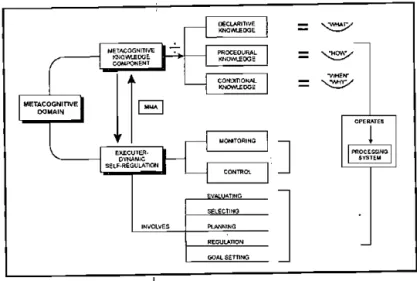
In order for the processing system to operate, metacog-nitive action (see Figure 1), needs to be instituted, that is, the interaction of declarative, procedural and conditional knowledge executed by dynamic self-regulation. This will lead to the selection of the function to be carried out, facil-itated by the activation of existing descriptive systems to assist in the reconceptualisation of the new knowledge, and the cognitive process will begin. At this point, active and dynamic self-regulation interact. The quality of this interaction is controlled by the geodesic nature of the MMA.
The cognitive domain (see Figure 1), has to match the processing system already selected, and therefore the cog-nitive requirements of content, form and use will need to be met before quality processing can continue. If the cog-nitive requirements are fulfilled, then the cogcog-nitive func-tion^) will be selected to carry out the cognitive task to completion. In order to operationalise the cognitive func-tion^), cognitive action begins. Finally, the result of the information processing will be expressed through a sym-bolic format which is known as the output. The evidence of the newly reconceptualised knowledge is visually avail-able on the Mind-Map, and represents the overt evidence that thought has taken place.
The geodesic information processing model (Figure 1) is divided into four components, namely the metacogni-tive, cognimetacogni-tive, symbolic and neuropsychological compo-nents. The operation and interaction of each of these com-ponents is now discussed.
THE METACOGNITIVE COMPONENT Description
The metacognitive component comprises seven metacognitive module's (see figure 1), each of which can be broken down into processing systems. Each processing system is made up of functions that realise the potential
Die Suid-Afrikaanse Tydskrif vir Kommunikasieafwykings, Vol. 44, 1997
by
S
ab
in
et
G
at
ew
ay
u
nd
er
li
ce
nc
e
gr
an
te
d
by
th
e
Pu
bl
is
he
r (
da
te
d
20
12
The SouthAfrican Journal of Communication Disorders, Vol. 44, 1997
ab
in
et
G
at
ew
ay
u
nd
er
li
ce
nc
e
gr
an
te
d
by
th
e
Pu
bl
is
he
r (
da
te
d
20
12
knowledge. of that processing system. This realisation of the potential
of a processing system is made possible by its computa-tional capacity, the activation of the metacognitive domain.
The seven metacognitive modules
The metacognitive modules represent the knowledge base of the mind, categorised into seven groups based on the multiple intelligence theory (Gardner, 1981, 1985). These seven are not exhaustive but are seen to be repre-sentative of the range of human knowledge and intellec-tual potentials (Gardner, 1985; Kline, 1990).
The seven modules are the linguistic, logical /mathe-matical, visual/spatial, musical, inter- and intrapersonal, and kinaesthetic domains of knowledge. According to Gardner (1985), owing to heredity, early training or both, some individuals will experience greater development within some domains of knowledge than others, but every normal individual should develop each domain to some extent.
In life, these domains of knowledge (called metacogni-tive modules in the current model because of the metacog-nitive and information processing perspective) work in harmony, and so their autonomy may be invisible. However, Gazzaniga (1977, in Gardner, 1985) argues that they function as independent units each with their own cognitive characteristics. It is therefore proposed that the integrative cognitive nature of the MMA facilitates the interaction of these modules. When these modules inter-act, higher order thinking is produced because the net result of the interaction between modules improves the quality of interaction within modules. Strength in the sum of the parts is the fundamental principle of this mod-ular perspective. The quality of higher cortical functions is influenced by the harmonious interaction of modules which is facilitated by creating environments that tap the abilities of all the modules, as opposed to just one or two, as is the case with traditional approaches. Synchronised interaction is facilitated within multimodal frameworks such as the MMA. i
It should be noted that in Figure 1 (the geodesic infor-mation processing model), the expansion from the metacognitive level to the cognitive level, to the symbolic level is shown only in the linguistic metacognitive ule. However, it is proposed that each metacognitive mod-ule follows this selfsame expansion within its domain of
METACOGNITIVE KNOWLEDGE COMPONENT
| MMA |
EXECUTER-DYNAMIC SELF-REGULATION
MONITORING
]
OPER ATES
i
PROCE SYS SSIN3 TEM
REGULATION GOAL SETTING
FIGURE 2: The Metacognitive Domain
The processing systems and their functions
A metacognitive module is further subdivided into pro-cessing systems which (see figure 1) are the result of a whole system of functions. These are represented neuro-logically by interrelations of different parts of the brain, based on Luria's (1980) conception of functional systems. Each metacognitive module has its own specific pro-cessing systems, which are represented across both hemi-spheres in the brain. The processing systems are made up of functions which are locally represented in specific areas of either the left or right hemisphere of the brain. For example, the linguistic metacognitive module has various different processing systems such as reading, writing, communicating and listening. Each of these, in turn, can be divided into their functions. Thus, for the processing system of reading, the function could be reading to find the key concept, or reading a complex technical manual, or reading a novel for pleasure. Each of these functions requires different cognitive approaches and is made up of various different steps - termed cognitive actions - which will operationalise the cognitive task.
The metacognitive domain - the computational capacity
A computational capacity exists at the core of each metacognitive module which is unique to that particular metacognitive module, and on which its complex realisa-tions are based. From the repeated use of, interaction among, and elaboration of the various computational devices, forms of knowledge will eventually flow that could be termed useful, thus contributing to intelligence. These forms of knowledge have the potential to be involved in symbol systems, and will ultimately be expressed on the symbolic level.
More specifically, these computational capacities, which are unique to each of the metacognitive modules, are termed the metacognitive domains. A metacognitive domain comprises declarative, procedural and conditional knowledge with its executor being dynamic self-regula-tion. Each processing system operates under the direction of the metacognitive domain for that particular metacog-nitive module. Figure 2 illustrates this relationship schematically.
An example of the interplay in the metacognitive domain
A hypothetical example of the dynamic interplay
between the declarative, procedural and conditional knowledge components, and their executor - dynamic
self-regulation as invoked by the MMA - would involve
the following. Initially an externally- or self-imposed goal is established (the equivalent of internal or exter-nal input). The existing metacognitive knowledge con-cerning this particular objective leads to the conscious metacognitive experience (interaction between active and dynamic self-regulation) that the objective may be difficult to achieve. This metacognitive self-regulation, combined with additional metacognitive knowledge, results in the selection and use of the cognitive strate-gy (termed cognitive act on the schema) of asking
ques-Die Suid-Afrikaanse Tydskrif vir Kommunikasieafwykings, Vol. 44, 1997
by
S
ab
in
et
G
at
ew
ay
u
nd
er
li
ce
nc
e
gr
an
te
d
by
th
e
Pu
bl
is
he
r (
da
te
d
20
12
tions of oneself or knowledgeable other people. The answers arising from this exercise stimulate additional metacognitive experiences about the success of the task, which represents the interaction between active and dynamic self-regulation. These experiences, guided by rel-evant metacognitive knowledge (declarative, procedural and conditional), investigate the cognitive strategy (cog-nitive act) of surveying, to establish whether it forms a coherent whole which provides a solution to the problem. This overview may result in the identification of difficul-ties with consequent activation by metacognitive knowl-edge and experience (active and dynamic self-regulation) of the same or different cognitive strategies. This inter-play continues until the symbolic representation is achieved, which is the final creation of the Mind-Map.
The activation of the metacognitive module -metacognitive action
In order to activate a metacognitive module, the com-ponents of the metacognitive domain (declarative, proce-dural and conditional knowledge) need to interact. This interaction results in metacognitive action, and is orches-trated by dynamic self-regulation. The quality of the interaction of the metacognitive domain determines the eventual output.
In the creation of the Mind-Map, all three types of knowledge need to be considered when selecting the con-cepts, as well as when representing these in an associat-ed way. The process of creating the Mind-Map enhances the interaction of declarative, procedural and conditional knowledge, resulting in metacognitive action.
When metacognitive action occurs, the process of cog-nition begins. As mentioned earlier, 90 per cent of learn-ing takes place on the non-conscious level (Gardner, 1985; Iran-Nejad, 1990). The rationale for this is that "intelli-gent" learning is creative and multisource, and hence takes place on the non-conscious level (Iran-Nejad, 1990). Traditional approaches assume that learning occurs under active conscious executive control, namely from a single source termed metacognition (Iran-Nejad, 1990; Dhority, 1991). As a result effortful attention (Iran-Nejad, 1990) is viewed as the single most important regulator of learning (Bereiter, 1985). This limits the domain of learn-ing. In the current study, based on a literature review on the non-conscious and self-regulation, metacognition is redefined as occurring on the non-conscious level (Iran-Nejad, 1990; Dhority, 1991; Lozanov, 1978; Flavell, 1978). These authors postulate the notion that external and internal stimuli are far too complex to manage or hold with only the mechanisms of our conscious attention. Hence the non-conscious level is not viewed as simply con-taining the unattended or unimportant percepts, but as the level where the complex mental activity occurs. A structure for the non-conscious level is postulated, thus providing a broader definition of metacognition. By impli-cation, 90 p.er cent of learning is taking place when metacognitive action is in process, and hence this is the level that should be targeted in intervention and media-tion.
The activation of the non-conscious stores triggers metacognitive action. The MMA can be seen as this trig-ger. By implication, the MMA focuses at the root level of the learning process, and therefore predominantly on the non-conscious. Conversely, the cognitive functions that
have been activated by metacognitive action, and that are orchestrated by active and dynamic self-regulation, only represent approximately 10 per cent of the learning and reconceptualisation of knowledge process (Reddy, 1979, in Iran-Nejad, 1990; Lozanov, 1975).
The neurobiological level of metacognitive action
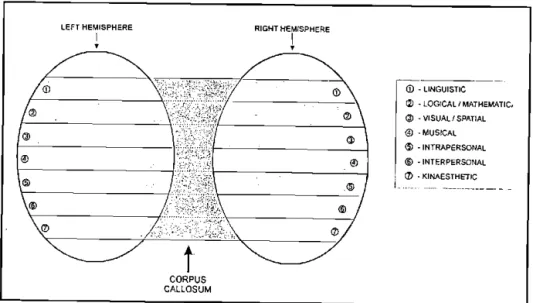
On a biological level, modular columns of neuronal cells ascending from the cortex to the subcortex to the lim-bic system across the left and right hemispheres, repre-sent the metacognitive modules and functional systems (See figure 1) (Feldman, 1980). Metacognitive action is represented as the distributed parallel activation of den-dritic interconnections from the cortex to the limbic sys-tem across both hemispheres.
The neuropsychological level of metacognitive action - pattern recognition
On a neuropsychological level, metacognitive action can be perceived as the activation of the descriptive sys-tems (Goldberg & Costa, 1981), or organisational codes. The number of descriptive systems activated is dependent on the complexity of the cognitive task. These will be used to reconceptualise new descriptive systems based on pat-tern recognition. The Mind-Map's patpat-tern structure facil-itates the pattern recognition process, as well as making it available to introspection, and in this way more effi-cient use of the descriptive systems can be made.
The interaction of active and dynamic self-regula-tion
Active self-regulation occurs on a conscious level, which implies that conscious introspection can occur. This is the result of the interaction of dynamic and active self-regulation (see hypothetical example above). According to Iran-Nejad (1990), this interaction has important impli-cations for learning because the quality of this interaction distinguishes between effective and ineffective approach-es to learning. Therefore, active and dynamic self-regiila-tion have to interact in order to produce cogniself-regiila-tion. Once the cognitive process is instituted, active and dynamic self-regulation should continue to interact, and the non-conscious will impact on the non-conscious level through attention delegation. This will lead to "quality learning". However, if active self-regulation starts to operate at the expense of dynamic self-regulation, which can occur if the facilitation is brain-antagonistic (Jensen, 1995), as in tra-ditional approaches, then the quality of learning lessens and learning becomes more rote-like.
A single-source theory of self-regulation implies that the central executive must monitor constructive change by directly allocating attention to the source of change (Reddy, 1979, in Iran-Nejad, 1990). The two-source alter-native (Iran-Nejad, 1990) implies that active allocation of attention is neither sufficient nor always necessary. An activated descriptive system (the result of metacognitive action) can influence a cognitive task, even though it may be outside conscious awareness. Therefore the activated descriptive system will still influence higher mental func-tions or cognitive tasks and strategies being used to com-plete a goal - be it of a communicative or academic nature. This is known as attention-delegation power, which is the
The SouthAfrican Journal of Communication Disorders, Vol. 44, 1997
ab
in
et
G
at
ew
ay
u
nd
er
li
ce
nc
e
gr
an
te
d
by
th
e
Pu
bl
is
he
r (
da
te
d
20
12
power to continue an ongoing contribution to internal
r e c o n s t r u c t i o n even after t h e executive spotlight moves
on to another site (Iran-Nejad, 1990).
The most direct source of interaction between active and dynamic self-regulation occurs when specific atten-tion is allocated to the components (Iran-Nejad, 1990). These are the declarative, procedural and conditional knowledge components of the metacognitive domain in the information process model. It is postulated that this interaction is enhanced by the MMA due to its metacog-nitive nature. This process is evidenced during the act of creating a Mind-Map, where essentially declarative, pro-cedural and conditional knowledge is stored. In the selec-tion of a concept, metacognitive acselec-tion sequences are established which indicate the associative relationships in a deductive and inductive way, therefore analogically. Thinking on this level is considered to be deep processing as the metacognitive level is actively involved.
If the incorrect concept is selected due to lack of com-prehension or the attempt to learn in a rote fashion, incor-rect action sequences will be stored, which will affect recall. This is easily rectified by reviewing the networked patterned nature of the Mind-Map. In this way the metacognitive components (which have become conscious by their visual symbolic expression on the Mind-Map, and therefore regulated by active self-regulation) will be acti-vated.
However, the metacognitive action sequences are gov-erned by the non-conscious level (Anderson, 1986, in Springer & Deutsch, 1989), and therefore dynamic self-regulation, and will be activated on a non-conscious level. Hence, in order to rectify the incorrect action sequences, active and dynamic self-regulation have to meet and interact. It is this interaction that becomes a primary focus of the MMA because, as already stipulated, the quality of interaction will distinguish between effective and ineffective approaches to learning. It is hypothesised that the MMA improves' the quality of the interaction because it accesses the cognitive and metacognitive levels in its construction. Figure 3 illustrates the relationship between active and dynamic self-regulation and metacog-nition and cogmetacog-nition. Therefore, the metacognitive non-conscious is the highest level of thought, where qualita-tive, intelligent and useful knowledge is reconceptualised. Traditional forms of stimulation will result in only partial activation of this level, arid hence the lack of activation of potential. j
THE COGNITIVE COMPONENT Description
The cognitive component of the geodesic information processing model represents what is traditionally assumed to be metacognition, that is, "thinking about thinking" (Flavell, 1978). In the model (see figure 1), this level represents the level on which slow, conscious control of the thought process occurs. It is under the control of the central executive and is inherently sequential. The cogni-tive process begins after metacognicogni-tive action is institut-ed, when dynamic and active self-regulation interact.
The cognitive process
When metacognitive action is instituted, cognition (see figure 1), orchestrated by active and dynamic self-regula-tion, begins, the interaction between the two being of paramount importance. On the cognitive level, the metacognitive action is carried out to completion. This completive action is constantly enhanced by the use of the MMA framework. In order to complete the metacognitive action, the cognitive process will be instituted on the product of the metacognitive action. This is the process that is instituted as the Mind-Map is being made. These action sequence steps include the following:
• Attention allocation and delegation;
• Perception through all the sensory modalities;
• The decoding (analysis) of the incoming information (this involves the analysis of existing appropriate descriptive systems already called up when metacogni-tive action began) in preparation of the new reconcep-tualisation of knowledge;
• The process of problem-solving, which includes reason-ing, both deductive and inductive, resulting in infer-ences and judgements being made, and cause-effect relationships being established;
• The organisation of the resultant reconceptualisations into appropriately associated and categorised net-works; and finally
• The synthesising (encoding) of information that will be effectively stored in memory
(Flavell, 1978; Gardner, 1985; Iran-Nejad, 1990; Jensen, 1995; Dhority, 1991; Hart, 1983; Hand, 1986).
These cognitive pro-cesses occur within each of the cognitive domains which delineate the pro-cessing systems already activated on the metacog-nitive level, namely listen-ing, speaklisten-ing, reading and writing, in the case of the linguistic module. Each cognitive domain has vari-ous requirements that have to be fulfilled in order to create useful knowledge. These requirements
(Bloom & Lahey, 1978, in Leaf, 1997) include:
some-METACOGNITION (NON-CONSCIOUS)
POINT AT WHICH ACTIVE • DYNAMIC vSELF-REGULATIOri
COGNITION (CONSCIOUS)
rtWE •
FIGURE 3: The Interaction between Active and Dynamic Self-Regulation Die Suid-Afrikaanse Tydskrif vir Kommunikasieafwykings, Vol. 44, 1997
by
S
ab
in
et
G
at
ew
ay
u
nd
er
li
ce
nc
e
gr
an
te
d
by
th
e
Pu
bl
is
he
r (
da
te
d
20
12
thing to communicate (content); a structure for the com-munication (form); and, finally, a communicative intent (use).
The next phase of the MMA information processing model proposes that the cognitive process operates within each cognitive domain selected for the specific task at hand, if the cognitive requirements of useful knowledge have been fulfilled. Each cognitive domain is divided into cognitive functions, corresponding to the functions on the metacognitive level, which are further subdivided into cognitive actions. In this way the cognitive act opera-tionalises the cognitive task.
An example of cognition in action
level is therefore the evidence that thinking and process-ing of information has occurred. This is expressed through a symbolic vehicle that is representative of the metacognitive module. For example, the linguistic metacognitive module can be expressed symbolically as oral expression, reception, written expression or reading, or all of these (see Figure 2.1). The Mind-Map facilitates and represents all four forms of expression. From the symbolic level, judgements of a person's thinking, learn-ing, intellectual potential and communication skills are made. This implies judgements as to the effectiveness of cognitive and metacognitive skills. This occurs because metacognition influences cognition which in turn influ-ences the symbolic output.
In selecting the cognitive domain (see figure 1) (process-ing system) of writ(process-ing, the cognitive function may be to write down a selected concept onto the Mind-Map. This is CF1 (cognitive function 1) in Figure 1. CF1 would then be made up of various cognitive acts (CA1, CA2 etc) which are the steps involved in carrying out CF1.
Thus, CA1 in this case would be the analysis of the phonemes that would afterwards have to be written. This involves the posterior parts of the left temporal zone (Luria, 1978). CA2 would involve the motoric expression of the lingual sound (Luria, 1980) in order to make the contents of the sound clear. This involves the inferior por-tion of the left post-central gyrus (Luria, in Leaf, 1990). CA3 is the transferring of phonemes into letters involving the spatial arrangement of the graphemes, which involves the parietal-occipital part of the cortex (Luria, 1980). CA4 involves the sequencing of phonemes and graphemes while writing, which involves the pre-motor zone (Luria, 1980).
Finally, CA5 will involve the positioning of the word on the Mind-Map to fit into the associative network. Thus CA5, in this case, moves onto the symbolic level - namely level three on the information processing model.
THE SYMBOLIC COMPONENT
The symbolic component comprises the expressive level of the cognitive action, which is in turn influenced by the metacognitive component. Functioning on the symbolic
FIGURE 4: A Schematic Representation of the Neurobiological Arrange-ments of the Metacognitive Modules
THE NEUROPSYCHOLOGICAL COMPONENT
The last component of the geodesic information pro-cessing model is the neuropsychological component, which deals with the relationship between brain function and behaviour (see figure 1) (Tollman, 1988, in Leaf, 1990). This component is the link between the biological and cognitive levels. In order to fall within the realms of being geodesic, the brain-function-behaviour relationship cannot be overlooked (Dhority, 1991).
According to the model, the metacognitive modules are represented biologically as modular columns of neuronal cells ascending from the cortex to the limbic system across both left and right hemispheres. It is postulated that there are seven neuronal columns representing the seven metacognitive domains, as illustrated in Figure 4. As the result of input, electrical activity will flow across the columns. The more synergistic the input, the more synchronised the flow between the two hemispheres. It is postulated that when this occurs, larger areas of the brain will be utilised more efficiently. It is believed that this synchronised synergistic flow will result in the metacog-nitive action being activated. Thus, the reserve capacities will be mobilised. In contrast, input from traditional approaches will result in reduced unsynchronised flow between the hemispheres resulting in only active self-reg-ulation and effortful cognition occurring.
The metacognitive domain is represented biologically as the distributed parallel activation of dendritic
inter-connections and synapses within the neuronal columns of the modules across both hemispheres (Cook, 1984, in Springer & Deutsch, 1989). Neuropsychological^, this results in pattern detection (Pribram, 1971, in Leaf,1997; Hart, 1983, in Leaf, 1997), which is the calling up of existing descriptive systems to facilitate reconceptualisation of knowledge.
The cognitive component is repre-sented as localised activation of neur-al connections in either the left or right hemisphere, because the pro-cessing systems at this'' stage are more specific (Springer & Deutsch, 1989). Finally the symbolic compo-nent is represented as parallel activa-tion of the modules involved across both hemispheres because the sym-bolic expression is the result of
syner-y
The SouthAfrican Journal of Communication Disorders, Vol. 44, 1997
ab
in
et
G
at
ew
ay
u
nd
er
li
ce
nc
e
gr
an
te
d
by
th
e
Pu
bl
is
he
r (
da
te
d
20
12
eristic action. „ , ,
Therefore the geodesic information processing model
rovides speculation as to the type of thinking that is
induced when working within a geodesic framework. It
traces the processing of information from the metacog-nitive level through to the symbolic output. There are
various assumptions upon which this model is based. A n
e x a m i n a t i o n of these assumptions and their theoretical
underpinnings is of relevance, as they lead to a
redefin-ition of the non-conscious level, metacognredefin-ition, cognredefin-ition and learning. These redefinitions are pivotal in the
explanation of the effectiveness of a geodesic approach
to intervention and education. In the ensuing discus-sion, an overview of the eight assumptions of the model is presented. This is followed by a more detailed expla-nation.
THE EIGHT ASSUMPTIONS OF THE GEODESIC MODEL: AN OVERVIEW
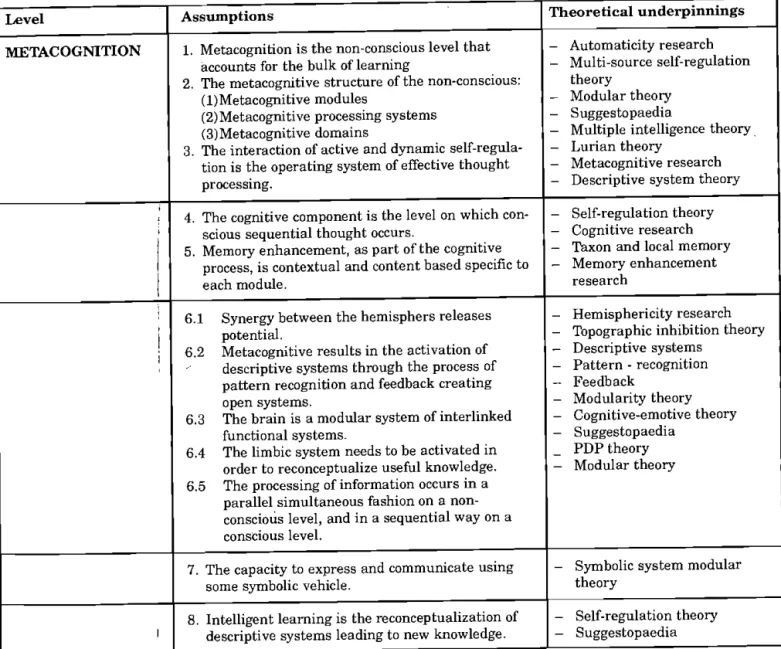
There are eight assumptions underlying the geodesic information processing model (see Figure 1 and Table 1).
The first of these assumptions deals with the
metacogni-tive component of the model. It is assumed that
metacog-nition is the root of the thought process controlling the cognitive process and ultimately the symbolic output. Furthermore, the key to unlocking intellectual potential occurs when the metacognitive level is activated effec-tively. It is postulated that traditional approaches, which are not geodesic, do not take full advantage of the metacognitive potential of the brain, and that the full spectrum of metacognition is thus overlooked. Within a geodesic approach such as the MMA, it is assumed that the metacognitive level is more adequately activated.
The second assumption postulates that metacognition is the non-conscious level. This implies that the majority of complex higher cortical functioning and learning occurs outside conscious awareness (Reddy, 1979, in Iran-Nejad, 1990; Derry, 1990). The way that metacognition is con-ceptualised within the geodesic information processing model provides a structure for understanding and analysing the non-conscious level.
The third assumption deals with the concept of self-regulation and relates to the metacognitive and cognitive components of the geodesic information processing model. Traditionally, this is the conscious executive control of thought which forms part of the definition of metacogni-tion (Costa, 1984). According to Slife, Weiss and Bell
TABLE 1: The assumptions and theoretical underpinnings of the Geodesic Information Processing Model
Level Assumptions Theoretical underpinnings
METACOGNITION 1. Metacognition is the non-conscious level that accounts for the bulk of learning
2. The metacognitive structure of the non-conscious: (1)Metacognitive modules
(2) Metacognitive processing systems (3) Metacognitive domains
3. The interaction of active and dynamic self-regula-tion is the operating system of effective thought processing.
- Automaticity research - Multi-source self-regulation
theory
- Modular theory - Suggestopaedia
- Multiple intelligence theory - Lurian theory
- Metacognitive research - Descriptive system theory 4. The cognitive component is the level on which
con-scious sequential thought occurs.
5. Memory enhancement, as part of the cognitive process, is contextual and content based specific to each module.
- Self-regulation theory - Cognitive research - Taxon and local memory - Memory enhancement
research !
i
6.1 Synergy between the hemisphers releases potential.
6.2 Metacognitive results in the activation of descriptive systems through the process of pattern recognition and feedback creating open systems.
6.3 The brain is a modular system of interlinked functional systems.
6.4 The limbic system needs to be activated in order to reconceptualize useful knowledge. 6.5 The processing of information occurs in a
parallel simultaneous fashion on a non-conscious level, and in a sequential way on a conscious level.
- Hemisphericity research - Topographic inhibition theory - Descriptive systems
- Pattern - recognition - Feedback
- Modularity theory - Cognitive-emotive theory - Suggestopaedia
PDP theory - Modular theory
7. The capacity to express and communicate using some symbolic vehicle.
- Symbolic system modular theory
1 8. Intelligent learning is the reconceptualization of descriptive systems leading to new knowledge.
- Self-regulation theory - Suggestopaedia
Die Suid-Afrikaanse Tydskrif vir Kommunikasieafwykings, Vol. 44, 1997