Fifteen
Steps
to
Effective
Code
Enforcement
Raymond
J.Burby
and
Peter
J.May
A
ew
would
argue withthe assertionthaturban crimeis out ofcontrol in cities across the United States.
The
less-told story is the crisis in another type ofcrime: violationsofbuilding,environmentaland
land-use regulations.
Yet
here the evidence of systemfailure is equally stark. In
North
Carolina, recentreviews
of
compliance
with
erosionand
sedimentationcontrol permits
(Burby
et al. 1990)andcoastalpermits
(Brower
and Ballenger1991)revealedrates ofviolation in excess
of
50 percent. Reportsfrom
other states are equally distressing and theconsequences
especially tragic. In south Florida following HurricaneAndrew,
fully a quarter of themore
than$20billion inproperty losseswas
attributed toshoddy
construction not in compliance with the building code (BuildingPerformance Assessment
Team
1992). InKansasCityin 1980, 113peoplewere
killed and
200
others injuredwhen
the skywalk inthe Hyatt
Regency
Hotel collapsed, due to design faults,accordingtosome
reports, thatwerenotcaughtby the code enforcement
system
(Waugh
andHy
1995).
Twenty-three years ago, Jeffrey Pressman and
Aaron Wildavsky
wrote
in their classic book,Implementation
(famous
for its subtitle:How
GreatExpectations in
Washington
Are
Dashed
inOakland
Or
Why
It sAmazing
FederalPrograms
Work
atAllThis
Being a
Saga
of
theEconomic
Development
Administration
asTold
by
Two
Sympathetic
Observers
Who
Seek
toBuild
Morals
on
theRaymond
J.Burby
isDeBlois
Chair ofUrban
and
Public Affairsand
Professorof
Planning in theCollege of
Urban
and
PublicAffairsatthe Universityof
New
Orleans.PeterJ.May
isProfessorofPoliticalScienceinthe
Department
ofPoliticalScienceattheUniversityof Washington.
Foundations of
Dashed
Hopes) that even themost
carefully thought out
programs
often failed toaccomplishtheirends becauseofglitches inthe
way
they were carried out. Planners,
who
spend untoldhourscrafting
new
land-useregulationsandevermore
detailed developmentpermitconditions,haveyet to
learnthislesson,sincetheyspendlittletimethinking aboutwhetherpermitconditions willeverbefulfilled. In part, thisneglect
may
stemfromignorance ofwhat
to
do
tomake
enforcementmore
effective.Some
attention has been given to the use
of
financialperformance guaranteestoassure compliance (e.g.,
Feidenetal. 1989),butkeytextssuchas ThePractice
ofLocal
Government
Planning (Soand Getzels 1988),Urban
Land
Use Planning
(Kaiser et al. 1995),Managing Community
Growth
(Kelly 1993),and
Growth
Management
Principlesand
Practice (Nelsonand
Duncan
1995)make
nomentionofenforcement, andonlyonePlanningAdvisoryService(PAS)
Memo
hasbeenpreparedon thissubject (seeKelly 1988).
This article has
two
purposes.One
is to urge plannerstopaymore
attention to code enforcement.The
other is tosuggest
concrete steps localgovernments can take to improve the chances that
building
and development
regulations will be followed by developers and building contractors.These
suggestions are basedon
the results of anational
survey of
cityand
county
building departments andananalysisof thecodeenforcementpractices
of
thirty-threeNorth Carolina
localgovernments.
About
theData
In 1995
we
surveyed a national sample of 995city and county building departments to identify
methods
they were usingto enforce building codesThere
are
no
quick
fixes
that
are
likely
to
produce
large
improvements
in
compliance
with
codes.
.local
governments
can
bring
about a
marked
improvement
in
code
compliance
by
implementing
sets
of
related
actions.
experienced. In addition,
the
survey
probed
for information on anumber
of
governmental
char-acteristics and situational
factors that might affect
code enforcement
prac-ticesand
outcomes.
Responses
were
receivedfrom
819
localgov-ernments (an 83 percent responserate).
The
survey datawere
analyzed
usingmulti-variate statistical
tech-niques to isolate factors associated with higherand lowerrates of compliance
by
the privatesector.Basedon
the multiple regressionresults,
an
"effects " ~~analysis"
was
performed to seehow
compliance
would
likely change ifalocalgovernment changed
the value
of
each of the significant predictors ofcompliance fromthelevelofthelowestquartile(25th
percentile) in thesample to the level ofthe highest
quartile(75thpercentile), while holding constant all
of
theother factors that affectcompliance(seeBurby
et al. 1996). This analysis produced a listoffifteen
key
factors,orderedby
the strengthofthelikelyeffecta change in their value
would
have on improving compliance.To
make
these datamore
relevant toNorth
Carolina planners
and code
administrators,we
calculatedthe
mean
valuesofthekeyeffectsvariablesforNorthCarolinalocalgovernments and
compared
them
to themean
values for local governments inother states that
have
attained the highest rates ofcompliance. This
comparison
helped
isolateenforcement practices in North Carolina that fall
farthest short of the
most
successful enforcementprograms.
The
North Carolina localgovernments
studiedare listed in theappendix.
Fifteen
Steps
toEffectiveEnforcement
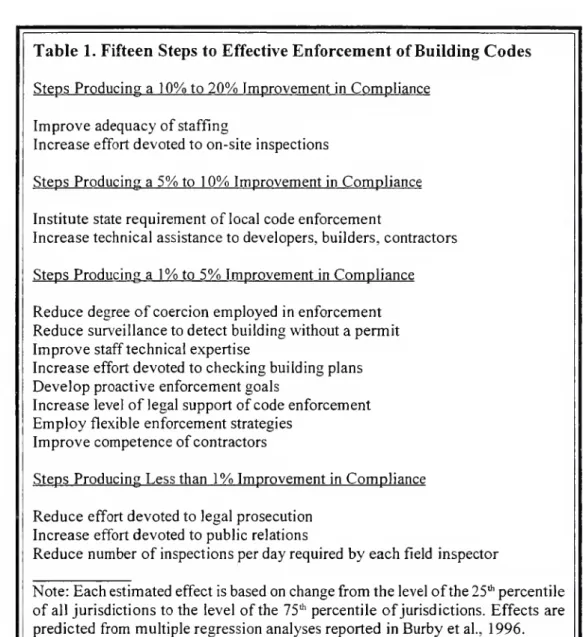
Table 1 listsfifteen
ways
toimprove compliance with building codes and indicates the approximatepercentage
improvement
incompliancethatcouldbeaccomplished
when
a localgovernment
implementsone
ofthestepslisted inthetable.Becausethe effectsmeasuresarebasedonstatisticalanalysisofsubjective
indicators(suchasunitsof estimated staff adequacy on a five-pointscale), the
steps axe less precisethan
those one
would
find inacookbook, and
plannersand
code
administratorswill
have
to experimentwith exact
amounts
of
each
ingredient inconcocting
theirown
"Effective
Enforcement
Stew."
A
quick
glance atTable 1
shows
therearenoquick fixesthatare likely
toproducelarge improve-ments incompliance with
codes. Instead,moststeps
will result in incremental
_ _
progress
and
will be used in combinationwith other similar steps.As we
note below, local governments canbring aboutamarked
improvement
in code complianceby
implementingsets ofrelated actions. Staffing
A
number
ofreviews ofcode
enforcementhavesingled out shortfalls in staffing as the single
most
important barrier to effective
enforcement
(e.g., NationalCommission
on
Urban
Problems
1968; Southern BuildingCode
Congress
International1992).
Our
analysis reinforces this conclusion.By
improvingtheadequacy ofstaffing
from
the levelofthelowestquartile tothe levelofthehighestquartile
inthesample oflocalitiesstudied,compliance could improve
by
15 percent. Furthergains incompliancecouldoccurifotheraspectsofcapacity areenhanced
similarly:
improved
stafftechnical expertise couldraisecompliancelevels
by
3 percent;improved
legalsupportcouldproducea1 percent gain;andreducing
theworkload offieldinspectorscouldresultinabout
a 0.5 percent improvement. In combination, these
enhancementsincapacitymightleadtoas
much
asa20
percent
gain incompliance
with
code
requirements.
EfforttoEnforce
Having
adequatestaffon boardisimportant, butVOLUME
22
NUMBER
137
Table
1.Fifteen Steps to EffectiveEnforcement
ofBuilding
Codes
Steps Producinga
10%
to20%
Improvement
inCompliance
Improve
adequacyofstaffingIncreaseeffortdevotedtoon-site inspections
Steps Producinga
5%
to 10%
Improvement
inCompliance
Institutestaterequirementoflocal codeenforcement
Increasetechnical assistancetodevelopers, builders,contractors
Steps Producinga
1%
to5%
Improvement
inCompliance
Reduce
degree ofcoercionemployed
inenforcementReduce
surveillance todetectbuildingwithoutapermitImprove
stafftechnical expertiseIncreaseeffortdevoted tocheckingbuilding plans
Develop
proactive enforcementgoalsIncrease leveloflegalsupport ofcodeenforcement
Employ
flexibleenforcementstrategiesImprove
competenceof contractorsSteps Producing Less than
1%
Improvement
inCompliance
Reduce
effortdevotedto legal prosecutionIncreaseeffortdevotedtopublicrelations
Reduce number
ofinspectionsperdayrequiredby eachfield inspectorNote:
Each
estimatedeffectisbasedonchangefromthelevelof
the25thpercentile
ofalljurisdictions tothe level ofthe 75th
percentile ofjurisdictions. Effects are
predicted from multiple regression analyses reportedin
Burby
et al., 1996.mount
a strong, proactiveenforcement effort, codeviolations are likely tocontinuetobeexcessive.Like capacityshortfalls,thelackof aggressiveenforcement isthoughtby
many
expertstounderminegovernmentregulatory
programs
(e.g.,seeKagan
1994).Our
datalend support to this conclusion.
By
taking steps to increase the levelof
enforcement effort from thelowest to the highestquartile oflocal governments, compliance rates could be improved significantly.
Specifically,an increaseintheeffortdevotedto field inspections could raise compliance levels by just
under
10 percent; increasing effortdevoted
totechnicalassistance couldraisecompliancelevelsby
over 5 percent; increasingthe effortdevoted toplan
checking could result in a 3 percent increase in
compliance; andthe formulation andactive pursuit
of
enforcement
goals could lead to a 1 percentincrease.
Together,
theseenhancements
inenforcement effort might lead to as
much
as a 20percent
improvement
incompliancelevels.Styleof Enforcement
Increasingthe effortdevotedtoenforcement does
not
mean
that localgovernments
should bemore
coercive intheirdealings with theprivate sector. In
fact,contrarytoconventional
wisdom
(forexample,seeBressi 1988), just the opposite istrue.
Our
datashow
thatwhat
regulatorytheoriststerma "flexible" or "cooperative" style ofenforcement
willpay
dividends in enhanced compliance, while coercion will actually reduce compliance (forevidence ofa
similar effect for other types of regulation, see
Braithwaite 1982; andScholz 1984). Stepstotakein
enhancingcooperation withthe private sector include:
reducing the
degree
ofcoercion
employed
inenforcement (that is,
making
less use ofstopwork
orders
and
fineswhen
violations are detected); reducingtheeffortexpendedinprosecutingviolators;andreducingsurveillancetodetectbuildingswithout
a permit.
At
thesame
time, enforcement agencies shouldtake positive stepstobuildgood workingrelationships
withcontractors.Theseinclude:spending
more
efforton publicrelations; instituting flexibleenforcement
procedures (explanation of provisionsviolated,advice
on
how
tofixthem, bargaining to agreeonascheduleto correct infractions, and relaxation ofstandards
when
costs of complianceexceed
benefits to thepublic); and incentives such as relaxed inspection
schedulesand leniency
when
violations are detected torewardthosewho
make
asincereefforttocomply.In
combination,
thesemeasures
canenhance
compliancebyas
much
as5 percent.Moreover,sincecooperation will not be successful unless staff capacity and
competence
also are adequate, if a cooperativestrategyisundertakeninconjunctionwithenhancements inenforcement capacity, compliance
levelscould be increasedbyover 25 percent.
Role oftheState
NorthCarolinaisoneoftwenty-sevenstatesthat
have adopted statewide building code requirements
and
mandated
local enforcement(May
et al. 1995).Eightstateshave legislation
which
enables butdoesnot require local building
code
enforcement,and
fifteen states leave code enforcement solely to the
discretion oflocal governments.
Our
data indicatethatstatemandates such as
North
Carolina'shave amarked
effectinpromotingcompliancewith building regulations.We
think this occurs because statemandates
cause
local officials togive
code
enforcement
more
priorityinbudgetallocationsanddeter
them
from
undermining
compliance
by
meddlingexcessivelyinenforcementcases in order toreward keyconstituents.
Improving
Code Enforcement
inNorth
Carolina
NorthCarolina localgovernments haveattained
ratesofcompliancewiththe statebuildingcodethat aresimilar tothoseofcitiesandcountiesnationwide.
On
a scale of 1 (low)to 10 (high), themean
NorthCarolina local
government
has a compliance scoreof 8.2; the national average is 7.9. Nationwide, 8
percent ofthe
governments
we
surveyed reportedcompliancelevelsof5orbelow onthe 10-pointscale, indicative of a serious failure ofthe enforcement
system.InNorthCarolina,6percent reportedsimilar
difficulty inattainingcompliance.
Two
North Carolinalocalitieswe
surveyed and45 others nationally
were
much
more
successful thanaverage ingainingcompliance (theyscored a 10 on
the 10-pointscale).
Comparison
ofthe enforcementpracticesof high-complianceplaces withthe practices
of otherlocal
governments
provides away
toisolateenforcement practicesthatare lagging and mightbe
focused
upon
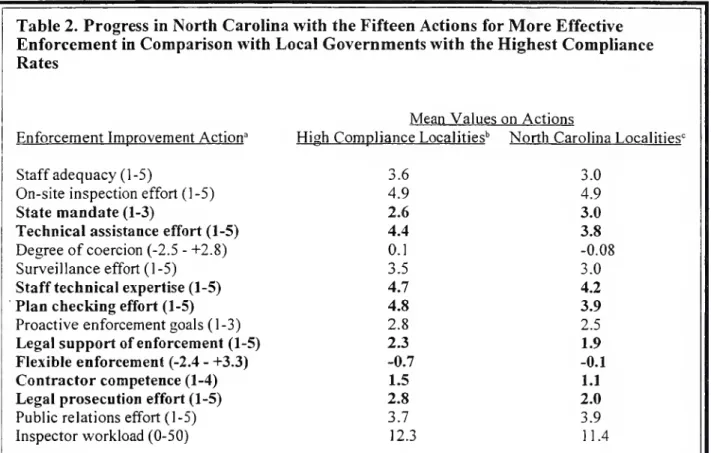
firsttoimprove performance(seeTable2).
North Carolina localitiesfall short oflocalities
inotherstatesthat
have
attained thehighestrates ofcode complianceinfiveofthefifteensteps to effective
enforcement: staff technical expertise, technical assistanceeffort,plancheckingeffort,legal support,
and contractor competence.
These
deficiencies areinterrelated. For example, a technically competent
staffis needed to offer technical assistance and to
check building and site plans for compliance with
code
requirements.
Low
ratesof
contractorcompetence
probably
reflects, in part, lack oftechnical assistance
from
local buildingcode
agencies. Legal support also tends to be far less
adequate in North Carolina localities, as does staff
adequacy
in general, although this latterdifferenceisnot statistically significantatthe.05 level.
These
data suggest that enforcement results inNorth Carolina
would
be enhanced significantly iflocal
governments
allocatedmore
resources forthecode enforcementfunction, particularly for additional
staff, stafftraining,
and
legal support.With
addedstaff, it
would
be possible for agencies to reviewbuildingplans
more
carefully, offertechnical aidto the private sector,and
towork
in otherways
toimprove
thecompetence
of buildingcontractors.NorthCarolinalocalitiesare
more
likelythanhighranking localities in other states to use flexible
enforcementstrategies,andtheydevotelesseffortto
legalprosecution.
With
adequatestaff resources,thisrelativelycooperativestancetowardthe private sector
would
enhance compliance. Without adequate staffresources, however, flexibility is likely to simply
result in lax
enforcement
and
aweak
level ofcommitment
tocomply
among
developers, buildersand contractors. Thus,
by
enhancingthe capacityofVOLUME
22,
NUMBER
139
Table
2.Progress
inNorth
Carolina
with
the FifteenActions
forMore
EffectiveEnforcement
inComparison
with
Local
Governments
with
theHighest
Compliance
Rates
Mean
Values on ActionsEnforcement
Improvement Action"Staff
adequacy
(1-5)On-site inspectioneffort(1-5)
State
mandate
(1-3)Technical assistanceeffort (1-5)
Degree
ofcoercion(-2.5- +2.8) Surveillanceeffort(1-5)Stafftechnical expertise(1-5)
Plan
checking
effort (1-5)Proactiveenforcementgoals(1-3)
Legal
support
ofenforcement
(1-5)Flexible
enforcement
(-2.4-+3.3)Contractor competence
(1-4)Legal prosecutioneffort (1-5)
Public relationseffort(1-5)
Inspectorworkload(0-50)
High
Compliance
Localities6North
CarolinaLocalities3.6 3.0
4.9 4.9
2.6 3.0
4.4 3.8
0.1 -0.08
3.5 3.0
4.7 4.2
4.8 3.9
2.8 2.5
2.3 1.9
-0.7 -0.1
1.5 1.1
2.8 2.0
3.7 3.9
12.3 11.4
Table
entriesshow
mean
values for scoreson
different enforcement actions.The
range ofpossible scoresforeachitem isshown
inparentheses. Actionsinboldfacetypeindicatethedifferencebetween
North Carolinalocalgovernmentsand local
governments
inother states thathave
attainedthehighestcompliance with buildingcoderegulations isstatisticallysignificantatthep
<
.05 level. bLocalgovernmentsinstatesotherthanNorthCarolina
where
compliance with buildingcodesisrated10
on
a scale of (low)to 10(high).N
=
45c
North Carolinalocal governments.
N
=
33 (includes 2 governments whichscored 10 onthe 10-pointcompliancescale)
compliance both directly and,
by
making
flexiblewe
have
identified willproduce only
asmall
enforcement strategies
more
effective, indirectly as increment of improvement. Ifused in combinationwell. with each other, however, significant gains can
be
made.
In particular, our research points to theConclusion
importanceof
improving staff capacity to enforceregulationscoupled with an aggressive efforttouse
Catastrophicfailuresof buildingsarea hard
way
available capacity inworking
with, not against, theto learn that the specification ofrules governing private sector.
With
a cooperativeapproach
tobuildingand development
mean
littleifcorresponding enforcement that includes adequate inspectionand
steps are not taken to ensure that rules are plan checking undertaken
by
competent personnelsubsequently followed in the urban
development
withsufficientlegalsupportininterpretingregulatoryprocess. In this article,
we
have
shown
that requirements, technical assistance, and the useof
breakdowns
in enforcement have occurred in local incentivesand flexibility in addressingenforcement governmentsinNorthCarolinaandotherstates.But, issues, compliance can be assured. Planners,we
we
alsohave
demonstrated that there are clearly believe, cando
much
topromote
effectivecode
marked
steps to achieving high ratesofcompliance enforcementinNorthCarolinaandelsewhere. Inthisimportant
task.®
Acknowledgments
This article is
based
on data developed withsupportfromNational Science FoundationResearch
Grant
Number
BCS-9331
1857to the University ofNew
Orleans.We
are grateful for the assistance ofJose Cabral ofthe University of
New
Orleans,who
supervisedthelocalgovernmentdatacollectioneffort, and
Dan
Hansen
andMark
Donovan
oftheUniversity of Washington,who
collected the state-level data.RobertPaterson ofthe University ofTexas assisted
with the formulation ofdatacollection instruments.
The
findingsreportedinthispaperare notnecessarilyendorsed
by
theNational Science Foundation.References
Ahlbrandt,Roger S„ Jr. 1976. Flexible CodeEnforcement:
A Key
Ingredient in NeighborhoodPreservation Programming. Washington, DC: National Association ofHousing andRedevelopmentOfficials.Bardach, Eugene, and Robert Kagan. 1982. Going by the
Book: The Problem ofRegulatory Unreasonableness.
Philadelphia:Temple University Press.
Braithwaite, John. 1982. "The Limits of Economicism in
Controlling Harmful Corporate Conduct,"
Law
andSociety Review, 16,3:481-504.
Bressi, Thomas W. 1988. "Throwing the Book at Zoning Violators,"Planning54, 12 (December):4-8.
Brower, David J. and Laurie G. Ballenger. 1991. Permit
Compliance Assessment. Prepared for the Division of
Coastal Management, North Carolina Department of
Environment, HealthandNaturalResources.ChapelHill:
Center for Urban and Regional Studies, University of
NorthCarolinaatChapel Hill,September.
Burby,
Raymond
J.,Peter J. May, and Robert C. Paterson. 1996. "SolvingtheCode
EnforcementPuzzle: LessonsfromBuilding Regulation."
New
Orleans,LA: College ofUrban and Public Affairs, UniversityofNew
Orleans, July 1996.Burby,
Raymond
J., Edward J. Kaiser. Michael I. Luger.Robert G.Paterson, H. Rooney Malcom, and Alicia C.
Beard. 1990. "A Report Card on Urban Erosion and
Sedimentation Control in North Carolina," Carolina
Planning16,2(Fall):28-36.
Feiden,
Wayne
M,Raymond
J.Burby.andEdwardJ.Kaiser.1989."FinancialPerformanceGuarantees:TheStateof
Practice,"JournaloftheAmericanPlanning Association
55,4(Autumn): 482-489.
Kagan, Robert A. 1994. "Regulatory Law,"in Handbookof
Regulation andAdministrative Law. ed. David H.
Rosenbloom and Richard D. Schwartz.
New
York: Marcel Dekker,Inc.:383-422.Kaiser,EdwardJ.,DavidR.Godschalk,andF.StuartChapin,
Jr. 1995. Urban Land Use Planning. Fourth Edition
Urbana: University ofIllinoisPress.
Kelly,EricDamian. 1988.EnforcingZoningand Land-Use
Codes. Planning Advisory Service Report No. 409.
Chicago:AmericanPlanningAssociation,August.
Kelly, Eric Damian. 1993. Managing Community Growth. Westport,CT:Praeger Publishers.
May,PeterJ.,
Dan
HansenandMarkDonovan. 1995. "StateBuilding and Energy Code Administration: Reportto
Respondentsto
A
NationalSurveyofState Agencies."Seattle,
WA:
Department ofPoliticalScience, UniversityofWashington, September.
National Commission on Urban Problems. 1968. Building
theAmerican City.Washington,DC: U.S.Government Printing Office.
So,FrankS.andJudith Getzels. 1988. ThePracticeof Local
Government Planning. Second Edition. Washington,
DC:International City ManagementAssociation.
SouthernBuilding CodeCongress International, Inc. 1992.
CoastalBuildingDepartmentSurvey. Chicago:Natural
Disaster Loss Reduction Committee, National
Committeeon Property Insurance.
Waugh, William L. and Ronald J. Hy. 1995. "The Hyatt
SkywalkDisaster andOthersLessonsintheRegulation of Building."WorkingPaper #91.Boulder,CO:Natural
Hazard Information and ApplicationCenter,University
of Colorado.
Appendix:
North
Carolina
Local
Governments
Included
intheStudy
Albemarle,
Alexander County,
Anson
County,
Asheville,
Black Mountain, Boone,
Buncombe
County,
Catawba
County, Chapel Hill, Concord,Durham,
Elizabeth City, Forest, Gaston County,Gastonia, Greensboro,