Asylum Policies in Southeast Asia:
A Comparative Perspective
By Madelyn Usher
A Thesis submitted to the faculty of the University of North Carolina in partial fulfillment of the require-‐ ments of a degree with Honors in
Political Science.
2015
Acknowledgments
This paper is the product of months of work and invaluable assistance offered by a number of individuals and organizations. I would like to extend my deepest thanks to those of you that contributed to this project, I am eternally grateful for your (possibly misguided) faith in me.
I would like to give special thanks to the Burmese refugee population for serving as the subjects and inspiration for this work, as well as Refugee Community Partnership for connecting me to this issue. I would like to specifically thank Mary Mawi for her friendship and inspiration, Andrea Eisen and Khai for going above and beyond in searching for participants, and Paw Ray and Tay Nay for their insightful contributions. I would also like to extend my utmost gratitude to my tireless and adaptable interpreters, Rosy and April, and to the remarkable families we
interviewed—I hope this paper does justice to their bravery and resilience.
I would also like to thank my committee, Dr. Niklaus Steiner and Dr. Rahsaan Maxwell, for reading through this paper and for offering instrumental feedback and support during the writing process. I would like to especially thank Dr. Frank Baumgartner for serving as my advisor—despite having never met me before—and guiding me through this process. I am also eternally grateful for Dr. Michael Tsin and Dr. Benjamin Meier, who have served as trusted mentors and offered invaluable advice throughout this process. The generosity and dedication to fostering academic curiosity demonstrated by these professors has been the highlight of my
undergraduate experience.
The D’Amico Fund and the Carolina SEAS Alumni Research Fellowship provided funding for this project—without their generous support, this research would not have been possible. This project was also made possible by the
remarkable degree of cooperation from the UNHCR Malaysia and Bangkok offices. I would like to particularly thank UNHCR Malaysia representatives for giving me several hours out of their day and for supplying such candid and well-‐informed answers to my (many) questions.
Finally, I would like to thank my family and friends for their consistent support and encouragement. I am especially grateful to Emiko Morimoto for all of the tough love and Mariam Diallo for printing and caring for multiple copies of my drafts. Last but not least, I would like to thank my parents for their unending patience, I am sorry I love Asia so much, but I promise I still love you more.
Table of Contents
I. Introduction . . . 5
A. The Refugee Crisis in Southeast Asia . . . . 7
II. Background . . . 9
A. Terminology . . . 9
B. International Law and the UNHCR . . . . 11
III. Literature Review . . . 14
IV. Theory . . . 18
V. Methodology . . . 22
A. Challenges . . . 24
VI. Asylum Policy in Thailand . . . 27
A. Background . . . 27
B. Asylum Policy . . . 28
i. History . . . 30
ii. UNHCR . . . 33
iii. Factors Influencing Policy Development . . 36
iv. Durable Solutions . . . 39
a. Repatriation . . . 40
b. Resettlement . . . 44
C. Effect of Refugee Population on Thailand . . . 48
D. Conclusion . . . 50
VII. Policy Outcomes in Thailand . . . 52
A. Conditions within the Camps . . . 52
i. Work . . . 53
ii. Health . . . 56
iii. Education . . . 58
B. Refugees Outside of the Camps . . . 61
i. Family-‐Splitting Arrangements . . . . 63
C. Documented Abuses . . . 66
i. Deportations . . . 68
ii. Immigrant Detention Centers . . . . 70
iii. Minority Groups . . . 71
VIII. Asylum Policy in Malaysia . . . 74
A. Background . . . 74
B. Asylum Policy . . . 75
i. History . . . 76
iii. Factors Influencing Policy Development . . 81
iv. Conclusion . . . 85
IX. Policy Outcomes in Malaysia . . . 86
A. Living Conditions . . . 86
i. Work . . . 89
ii. Health . . . 90
iii. Education . . . 91
B. Documented Abuses . . . 93
X. Conclusion . . . 97
Appendix I: Figures . . . 102
Appendix II: Interview Questions . . . 104
References . . . 106
I. Introduction
Estimates place 80% of the 45.2 million forcibly displaced persons globally
as being hosted by developing countries. Traditionally, these nations serve as a
transit point for asylum-‐seekers waiting to either return to their home country or be
resettled to a third country. However, the root causes of displacement can stretch on
for years (if not decades) and developed countries do not have the capacity to
accommodate hundreds of thousands of asylum applicants. While both the UN High
Commissioner for Refugees (UNHCR) and UN Convention Relating to the Status of
Refugees1 are dedicated to the protection of refugees, many refugee-‐hosting
countries have still not signed the Convention, and limit the ability of the UNHCR to
fulfill its mandate. As a result, asylum-‐seekers and refugees are left in limbo,
languishing in the absence of a comprehensive legal framework to guarantee their
right to protection. This not only comprises a concerning violation of human rights,
but can also impede the success of more permanent arrangements. Access to basic
rights and services can vary widely between countries, and this access can
dramatically impact the wellbeing of a displaced population. Variability between
lived experiences and outcomes for refugees is not always attributable to different
national policies or cultural contexts, but can be observed in situations that should,
theoretically, yield similar results. An important question is then how and why the
lived experiences of refugees are different in countries with seemingly similar
formal policy responses and national contexts.
Furthermore, there is a well defined and rigorous international standard
established regarding the treatment of refugees rooted in human rights norms. On a
theoretical level, determining why asylum policy decisions are made and how policy
differences impact outcomes is crucial in the protection of refugees’ human rights.
Functionally, this knowledge can also aid countries in making policy choices that
will minimize the impact of an undesirable—but often unavoidable—situation. As
protracted refugee crises continue to develop across the world and permanent
solution options remain limited, determining best practices becomes critical to
mitigating human rights violations.
This paper seeks to explore the creation of asylum policies in the absence of
the Refugee Convention and gauge the outcomes of these policies on the refugee
population and argue for the value of utilizing local integration during protracted
refugee situations. To do so, I will examine the case of Burmese refugees in
Southeast Asia, with Thailand and Malaysia as case studies. I will demonstrate that,
despite similar formal policy responses, a few key differences exist between
Thailand and Malaysia in their handling of asylum-‐seekers, and that these
differences result in vastly different lived realities for refugees. I attribute these
discrepancies to differences in informal policy implementation and argue that
certain of these informal approaches are more in keeping with international human
rights standards—and thus more favorable—than others. These informal
mechanisms have helped contribute to better outcomes for refugees living in
A. The Refugee Crisis in Southeast Asia
The protracted refugee situation occurring in this region is one of the longest
standing in the world, stemming from persistent political and ethnic-‐related
violence. Burma ranked sixth among the top ten source countries of refugees in the
world, with approximately 479,600 Burmese people living as refugees or in refugee-‐
like situations by the end of 2013 (UNHCR). This figure excludes hundreds of
thousands of stateless persons, internally displaced persons, unregistered asylum
seekers, and Burmese individuals fleeing persecution that are now living in
neighboring states as undocumented migrant workers. These individuals are fleeing
the Burmese government’s aggressive use of “forced labor, extortion, land
confiscation, and forced agricultural practices” (Burma Human Rights Yearbook
2008). Religious and ethnic minorities are especially vulnerable to persecution at
the hands of the government, as the nation has been rife with internal conflict and
civil war since its independence in 1948. Burma was ruled by a military dictatorship
under the State Peace and Development Council (SPDC) from 1962 to 2011, and the
military retains an enormous amount of influence in the country’s current
presidential republic system. Poor living conditions and ethnic conflict have been
exacerbated by a low level of economic development, partially due to extensive
economic sanctions levied against the SPDC by Western nations. Although these
sanctions have since been lifted, Burma is the poorest member of the Association of
Southeast Asian Nations (ASEAN), and ranked 150th out of 187 countries on the
Although the international community has heralded recent governmental
reforms as promising steps towards democracy, human rights organizations
continue to document abuses, and ethnic minorities and political dissenters
continue to stream across the border into the neighboring states of Bangladesh,
India, China, Thailand, and Malaysia. These nations have been forced to
accommodate the majority of the more than 1 million Burmese that fled since 1988.
Of these, only about 255,000 have applied for asylum in the last decade. Despite
efforts by nations like the US and Australia to prioritize Burmese refugees in
resettlement schemes, hundreds of thousands of asylum-‐seekers (many
undocumented) remain in Southeast Asia, primarily in Thailand and Malaysia.
Although these nations have similar formal policy responses for handling asylum-‐
seekers, their reputations within refugee social networks are vastly different.
Qualifying how and why these reputations came about and gauging the impact of
any actual differences on resettlement outcomes is an important step in
understanding refugee flows and developing a proactive international response.
Substantively, this is a massive humanitarian crisis that stands to drive
demographic, economic, and policy changes within the region; and the value of
understanding the success of different approaches cannot be understated. As the US
plans to drastically reduce the number of Burmese refugees admitted for
resettlement each year and Australia espouses increasingly restrictive immigration
policies, it has become clear that the focus on finding durable solutions must shift
II. Background
A. Terminology
States can be classified in a number of ways in relating to their role in
asylum-‐seeker flows. “Origin” or “home countries” are the source of refugee flows,
“asylum” or “transit countries” serve as the first destination for an asylum-‐seeker
after fleeing his or her country, and a “resettlement” or “third country” serves as the
final destination. Southeast Asia is primarily home to origin and asylum countries,
with the majority of refugees in recent years leaving Burma and fleeing to
neighboring nations.
There are three recognized durable solutions for displaced persons—
repatriation, integration, and resettlement. Repatriation, according to the
stipulations of the Convention, must be voluntary and involve no significant risk to
the life or wellbeing of the persons returning to their country of origin. Integration
involves allowing refugees to legally integrate into the country of first asylum.
Finally, resettlement to a third country can be utilized if the first two options prove
to be unfeasible. Of these, the UNHCR and other international humanitarian
organizations advocate primarily for repatriation.
The legal status and motivation behind migrating determine which term is
appropriate to identify different populations and identities. “Migrant” is a broad,
catchall term for any person that has left his or her home. Migrants are further
distinguished by whether or not they left their home voluntarily, with “migrant
worker” and “economic migrant” used generally to denote the latter. The term
further broken down into “refugees” and “asylum seekers.” A refugee is someone
that has undergone a status determination process to ensure they meet the criteria
to be legally considered a refugee. An asylum seeker is someone that has fled
persecution and is outside of his or her home country, but has not received formal
recognition as a refugee.
“Protracted displacement situations” refer to “those which have moved
beyond the initial emergency phase but for which solutions do not exist in the
foreseeable future.” These situations “are the combined result of the prevailing
situations in the country of origin, the policy responses of the country of asylum, and
the lack of sufficient engagement in these situations by a range of other actors.”
(Loescher and Milner 9)
Increasingly restrictive migration policies have led to the proliferation of
human smuggling operations—which are often critical tools of escape for refugees
in Southeast Asia (Palmgren 2011). “Human smuggling” refers to an operation
whereby migrants knowingly enter into an illegal agreement in which they pay to be
illegally snuck across a border. This is distinct from “human trafficking,” in which
victims are deceived for the purpose of exploitation in the destination country
(Gallagher 2002). Within the context of Southeast Asia the distinction between these
two processes is often blurred.
Finally, I use the name Burma in this paper, rather than the official name
Myanmar. I use the name Burma in keeping with the preferences of many Burmese
opposition leaders, the refugee families I work with, and my friends from Burma to
the standards of the Forced Migration Review, and use “the term ‘Burmese’ is used
for any person originally coming from Burma, while the term ‘Burman’ is used for
people from the ethnic majority group.”
B. International Law and the UNHCR
The right to seek asylum from persecution is established in the 14th Article of
the Universal Declaration of Human Rights. Although this declaration is non-‐
binding, it establishes the standard of states’ conduct in international law, and is an
integral source of authority for the human rights regime. To protect this right, the
United Nations High Commissioner for Refugees (UNHCR) was established. The
organization’s main objective is to ensure that all persons can exercise the right to
seek asylum, and is the primary authority in determining who qualifies as a refugee
and which practices are respectful of this right. Although a number of relevant
international and regional instruments for protection have been developed, the
UNHCR derives its authority primarily from the 1951 UN Convention Relating to the
Status of Refugees (the Refugee Convention).
The Refugee Convention established the criteria for receiving refugee status
under international law. The Convention states that a refugee is a person who:
owing to a well-‐founded fear of being persecuted for reasons of race, religion,
nationality, membership of a particular social group or political opinion, is outside
the country of his nationality, and is unable to or, owing to such fear, is unwilling to
avail himself of the protection of that country or return there because there is a fear
To be considered a refugee, a person must be officially granted refugee status. The
status determination process is conducted either by states themselves or the UN
High Commissioner for Refugees (the UN Refugee Agency), and is based upon the
extent to which a candidate meets the above conditions. Reasons for persecution
outside of those specifically delineated within the Convention are not considered
valid, and applicants are screened to determine if their migration was economically
motivated.
States are not obligated to provide asylum, and are only bound to the terms
of the Convention if they are signatories. Within Southeast Asia, only Cambodia and
the Philippines are parties to the Refugee Convention. In non-‐signatory countries
there are no guidelines for the treatment of asylum-‐seekers, and they are
accordingly often lumped in with undocumented migrants. This approach not only
denies asylum-‐seekers access to the rights guaranteed to them by the Refugee
Convention, but also criminalizes them under harsh immigration laws.
Criminalization under the law and in public discourse by government officials leaves
asylum-‐seekers vulnerable to arrest, detention, and expulsion; regardless of the
validity of their claims (Palmgren 2011). Globally, there has been a marked shift
towards policies focusing on immigration law enforcement and security, at the cost
of protecting the rights of asylum-‐seekers (Frelick 2001).
Although neither Malaysia nor Thailand have ratified the Refugee
Convention, both have signed the Convention on the Elimination of Discrimination
against Women (CEDAW) and the Convention on the Rights of the Child (CRC).
these countries, but also establish the illegality of refoulement. The principle of
non-‐refoulement is defined within the 1951 Refugee Convention, which states that:
“No Contracting State shall expel or return (“refouler”) a refugee in any manner
whatsoever to the frontiers of territories where his life or freedom would be
threatened on account of his or her race, religion, nationality, membership of a
particular social group or political opinion.”2
The principle of non-‐refoulement is also considered customary international law,
and both Malaysia and Thailand are thus obligated to follow its basic tenets.
III. Literature Review
A comparative analysis of refugee policy in Southeast Asia through the
lens of outcomes for asylum-‐seekers has not yet been undertaken. This is mainly
due to the absence of reliable data and measurement issues inherent to working
with populations operating in the extralegal realm. However, there is a great deal of
work that has been done to address human rights violations and poor living
conditions for asylum-‐seekers in the region, analyze potential economic benefits of
refugee flows, and explain current policy responses.
In analyzing the policy responses of my case study countries, it is important
to understand how these policies came into being and how they fit into global
migration policy trends. Frelick (2001) explores some of the breakdown between
the ideals delineated by international law and the Refugee Convention and states’
actual policies. He argues that the international human rights regime has not yet
developed any instruments to effectively compel states to respect the rights of
refugees. Frelick critiques the Refugee Convention as establishing the principle of
non-‐refoulement to bar states from forcibly returning refugees, but not developing a
corollary right to asylum so asylum-‐seekers would be guaranteed somewhere to go.
This perspective is helpful in contextualizing the policy responses of many
Southeast Asian nations, which seem to waiver between violating and protecting
human rights in their implementation of migration policy. Furthermore, Frelick’s
work helps to locate these policy responses within a global context, and argues that
there is an international trend towards emphasizing enforcement and security at
Frelick’s framework, which helps to explain their use of restrictive policies and the
consequences of these policies on refugee flows.
While Frelick’s work is useful in understanding why Thailand and Malaysia
have failed to ratify the Refugee Convention and utilize human rights in the creation
of their asylum policies, it does not speak to the absence of national frameworks
addressing refugees. Stern (2014) explores the formation of a national migration
policy addressing refugees and asylum-‐seekers, and some of the conventional
factors taken into account during this process. The comparative importance of legal
obligations, economic and political concerns, and ethical/moral considerations is
emphasized. Stern expands this model to evaluate the importance of a state’s self-‐
image, particularly within liberal democracies. She documents the value that these
governments place on principles of asylum, humanitarianism, and human rights;
and the consequences of practice failing to align with theory. Although this study
was done in the context of a very liberal democracy (Sweden), I believe that the
basic principles also apply to Thailand and Malaysia, as both have democratic
elements of governance and rhetorically support human rights.
Some work has also been done to explore the negative impacts of restrictive
asylum policies. Koser (2000) is key to understanding links between restrictive
asylum policies and increased instances of human trafficking. Koser argues that
different asylum policies, utilization of trafficking, and refugee vulnerability are all
intertwined, and that blame for increasing vulnerability lies more with asylum
In terms of the beneficial impacts of less-‐restrictive policies, one of the most
important works on this topic done in Southeast Asia argues that irregular
migration in the context of labor is so pervasive that states need to start regulating it
rather than blocking it entirely (Battistella and Asis 2002). The study went on to
show that irregular migration provides the cheap labor necessary for economies to
be flexible and sustain continued growth. The authors argue that the duration and
scope of the phenomenon demonstrate its worth to recipient countries—if the
migration were detrimental, countries would have seen widespread economic
consequences long ago.
Another study conducted by Porter and Haslam performed a meta-‐analysis of
mental health surveys addressing issues specific to refugees worldwide. They
compiled the findings to identify the factors that lead to improved mental health
outcomes for displaced persons. Porter and Haslam established clear causal linkages
between factors like permanent, private accommodation; economic opportunity
(right to work); and being granted greater cultural freedom to better mental health.
The three factors listed are all key components of my definition of a liberal policy
approach. These findings demonstrate that liberal policies not only economically
benefit host countries and carry inherent short-‐term benefits for refugees—they
also contribute to the long-‐term wellbeing and health of asylum-‐seekers.
A great deal of work has been done assessing the merits and shortcomings of
different specific asylum approaches. Loescher and Milner’s work on refugee crises
and responses found that camps have “serious implications for the human rights
the violation of a number of basic human rights, and that as a result refugees
become dependent on aid and “lead lives characterized by poverty, frustration, and
unrealized potential” (10). However, Loescher and Milner also raise concerns about
undocumented urban refugees living in fear of arrest and without access to proper
housing, employment, or social services (10).
An even fuller body of work exists documenting the successes and failures of
different durable solutions. However, the bulk of this work has been focused on
resettlement and repatriation, mirroring the attention of states and the UNHCR. To
put integration back on the table, Fielden and Crisp show that it has been used
successfully in a number of contexts. They demonstrated that, even in protracted
refugee situations with countries prioritizing repatriation, policy reversal has led to
highly successful integration efforts (78). These findings are pertinent for the
current situations in both Thailand and Malaysia.
IV. Theory
The ideal policy approach for protecting the rights of refugees is one that is
rooted in the tenets of the Refugee Convention and international human rights law.
This could be deemed a liberal policy approach (as opposed to a restrictive
approach) as it allows refugees free access to asylum countries and guarantees a
number of rights. I will utilize the liberal approach prescribed by the Refugee
Convention as an ideal that countries should strive towards in both developing and
implementing migration policies.
According to the Refugee Convention, the most important right for a refugee
is protection from refoulement, or forced return to the country of origin (Article 33).
The refoulement of refugees is a serious violation of human rights, and will
accordingly be addressed as the most important indicator of the liberalness of a
state’s policy approach. A second critical tenet of the Convention states that refugees
should not be penalized for entering a country illegally if they are fleeing
persecution (Article 31). A state that has liberal asylum policies intuitively cannot
detain or arrest refugees for reasons relating to illegal immigration. Finally, asylum-‐
seekers must have access to the UNHCR or some other body that conducts status
determination. Without this infrastructure in place it is impossible to determine
legitimate refugees. These three core tenets will serve as the basis of my evaluation
of the liberalness of states’ asylum policies.
Once a refugee has been certified as per the requirements of the Convention,
he or she is entitled to further rights within the asylum country. States must
documentation necessary to travel within or outside of the country. Outside of this,
it is generally expected that refugees receive the same treatment as nationals of the
asylum country. The Convention goes on to list a number of rights associated with
this principle, some of which are not always feasible—particularly within the
context of a developing nation. Thailand and Malaysia have both expressed concerns
over adopting policies that could be seen as condoning local integration, a durable
solution that both have ruled out of the question.
This paper asserts that a liberal asylum policy approach—defined as one in
which asylum seekers are granted the basic rights enshrined in the Refugee
Convention—both makes a country a more attractive place to seek asylum and
generates comparatively better outcomes for refugees. I have dubbed an approach
meeting these standards to be semi-‐integrative, as it allows refugees and asylum
seekers to access local services and participate in the economy, but does not grant
them full legal status, require the ratification of the Refugee Convention, or
guarantee all of the rights delineated within the Refugee Convention (such as the
right to housing or public assistance). While a semi-‐integrative approach is far from
ideal due to its inability to guarantee refugees access to all of their rights, it is
superior to the policies of restriction and confinement currently utilized by many
states. Semi-‐integration will also likely appeal more to developing countries that are
wary of ratifying the Refugee Convention, and can be seen as a set of general
guidelines for these countries as they formulate their asylum policies through
balancing the needs of the refugee population against state concerns about
integration and burden sharing.
A semi-‐integrative approach, despite its shortcomings, offers many benefits
to asylum seekers and host countries alike. It better prepares refugees for other
permanent solutions because it provides greater access to education and job
opportunities, which increase autonomy and help refugees build the skills necessary
to be successful. This approach also allows host countries to benefit from refugee
labor and reduce enforcement costs for crackdowns on undocumented workers.
This approach further benefits host countries by allowing them to improve their
international standing and reputation for respecting human rights. However, while
ad hoc administrative responses can work when guided by international law or
organizations, a coherent national policy would do more to streamline the asylum
seeking process, ensure the adequate protection of refugees, and benefit transit
countries. Adopting a semi-‐integrative approach can be an important first step
towards achieving this goal.
An important distinction exists between formal policy and its
implementation, and the impact of this distinction on the lived outcomes for
refugees in each country is pronounced. I argue that the differences in
implementation between Malaysia, and Thailand contribute to significant disparities
in outcomes for refugees, with more liberal policies yielding overall better
outcomes.
Intuitively, it makes sense that asylum-‐seekers would gravitate towards
much of refugee migration, better living conditions in one country can quickly
translate into a redirection of migration flows. It follows logically that the same
liberal approaches that draw refugees to a certain country then produce
comparatively better outcomes than countries with more restrictive approaches.
Aside from the inherent benefits of some of the indicators I will use to gauge
liberalness (e.g. education, gainful employment), I argue that these factor also lead
to improved outcomes for host countries themselves. The argument for linking
liberal policies to overall better outcomes also finds support in a meta-‐analysis of
studies done on refugee mental health post-‐displacement. Multiple studies found
better mental health among refugees positively correlated with residing in private,
permanent accommodations, having the right to work, and being granted greater
cultural freedom (Porter and Haslam 2005).
I also explore the historical, social, and political contexts that led to each
state’s current policy approach in dealing with asylum seekers. While a variety of
domestic and international factors contribute to these approaches, I find that the
government’s relationship with the UNHCR and susceptibility to international
pressures serve as the most accurate predictors for a liberal asylum policy.
Hypothesis 1: A history of cooperation with the UNHCR and concerns about international image contribute to more liberal asylum policy approaches.
V. Methodology
I selected Thailand, and Malaysia as my case studies because both of these
nations are geographically proximate to Burma, and are therefore often the first
(and sometimes final) stop on a Burmese refugee’s journey. These countries have
espoused similar formal policy responses to the protracted refugee crisis; have
similar cultural and economic backgrounds, governmental structure, and obstacles
to development. Thailand and Malaysia also hosted about the same number of
refugees and asylum-‐seekers in 2012. Neither country has ratified the Convention
and both have working partnerships with the UNHCR, although the structure of
these partnerships differs. Furthermore, neither of these countries have legal
asylum frameworks, thereby establishing a policy context in which refugees cannot
legally work nor attend school. However, both of the chosen countries have different
approaches for temporarily settling refugees and enforcing migration law, which
highlights the differences I am most interested in identifying.
To measure outcomes, I utilize NGO reports and other works documenting
living conditions in Thailand and Malaysia. To bolster this information, I
interviewed 8 local Burmese refugee families in Orange County. Five of these
families lived in Thailand, and the other 3 lived in Malaysia before being resettled to
the US. I conducted one-‐on-‐one interviews with these families during which I asked
a number of in-‐depth questions regarding their experiences while in transit. The
interview questions are included in Appendix III. These interviews were conducted
in the interviewees’ native tongue through the use of two local interpreters. I
community. Interviewees were contacted initially by a community leader to see if
they would be interested in participating, before being referred to me, contacted by
an interpreter to go over the basic details of the study, and then finally interviewed
after providing their verbal consent to participate in their native tongue.
To get a sense of both outcomes and policy dynamics, I conducted one-‐on-‐
one interviews with officials from the UNHCR in both Thailand and Malaysia this
summer. My time with a protection office at UNHCR Bangkok was rather brief, and
so I supplement my narrative in that chapter with a more thorough literature
review. I was fortunate enough to have a rather in-‐depth interview at UNHCR
Malaysia, which was the source of much of Malaysia Part I. Both officials requested
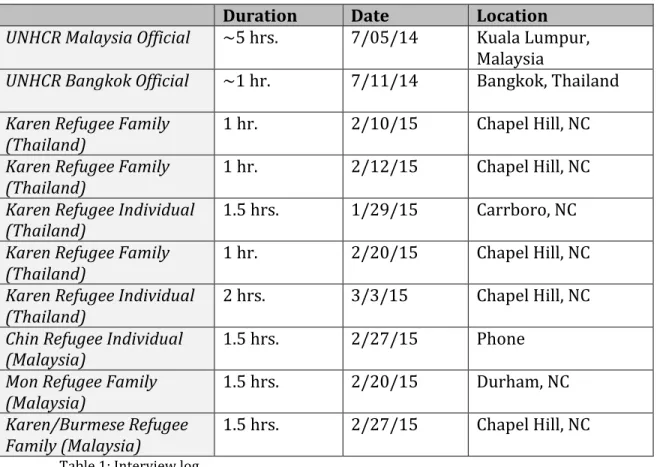
anonymity. The table below represents all interviews conducted for this project:
Duration Date Location
UNHCR Malaysia Official ~5 hrs. 7/05/14 Kuala Lumpur,
Malaysia UNHCR Bangkok Official
~1 hr. 7/11/14 Bangkok, Thailand
Karen Refugee Family
(Thailand) 1 hr. 2/10/15 Chapel Hill, NC
Karen Refugee Family (Thailand)
1 hr. 2/12/15 Chapel Hill, NC
Karen Refugee Individual
(Thailand) 1.5 hrs. 1/29/15 Carrboro, NC
Karen Refugee Family (Thailand)
1 hr. 2/20/15 Chapel Hill, NC
Karen Refugee Individual (Thailand)
2 hrs. 3/3/15 Chapel Hill, NC
Chin Refugee Individual
(Malaysia) 1.5 hrs. 2/27/15 Phone
Mon Refugee Family (Malaysia)
1.5 hrs. 2/20/15 Durham, NC
Karen/Burmese Refugee
Family (Malaysia) 1.5 hrs. 2/27/15 Chapel Hill, NC
A. Challenges
There are a number of challenges associated with attempting to quantify
refugee flows, living conditions, and policy effects. Particularly within the context of
Southeast Asia, many asylum-‐seekers remain deliberately undocumented (and
uncountable) out of necessity. As a result, data on irregular migrants often
underestimates the “degree and volume” of actual numbers (Koser 2009).
Furthermore, it is also impossible to know how many may have a valid claim to
asylum and how many are economic migrants. Even making this distinction on a
case-‐by-‐case basis is difficult in the current context of mixed migration, in which
people move for a number of varied and intertwined reasons (Klaauw 2010). Even
migrants who are registered in some way are difficult to track statistically as
legal/illegal status can change quickly. Finally, and perhaps most detrimental to the
study of this phenomenon, is the lack of comparable data over time and between
different locations. Although the refugee situation in Southeast Asia is one of the
most protracted in the world, it has not been adequately tracked statistically until
the last few years. Even now, a clear and universally accepted methodology is absent
amongst researchers, resulting in widely varying estimates of the same measure.
Aside from the general data collection issues endemic to the study of this
topic, I ran into a few specific issues within my analysis. One of my objectives is
linking liberal policy approaches with increased “popularity” among asylum-‐seekers
and improved outcomes for refugees. As mentioned previously, knowing the actual
number of asylum-‐seekers in a country at a given time is nearly impossible. Beyond
influence refugee flows. Secondly, statistics and case study comparisons do little to
indicate agency. Asylum-‐seekers traditionally have very little say in the direction
their flight from persecution takes, and therefore they may not have the opportunity
to consciously choose between Thailand and Malaysia.
Another key objective of this study deals with the outcomes for refugees
associated with liberal asylum approaches. I tried to use some third-‐party reports to
keep these sections somewhat objective, but also relied heavily on interview data.
The interviews proved to be extremely difficult to schedule, and many of the refugee
families I spoke with were reticent to discuss their experience. Compared to the
experiences detailed in reports I’d read, I found that interviewees were surprisingly
positive about their experiences on the whole. One of my interpreters explained that
interviewees were unlikely to open up to me due to a cultural stigma against
complaining as well as, for refugees from Thailand, a learned shyness around
foreigners. It was rare for foreigners to be allowed in the camps, she explained, and
residents were instructed not to speak to journalists. For whatever reason, I did find
the refugees from Thailand to be overall more taciturn than their counterparts from
Malaysia, and they seemed less willing to critique living conditions or the RTG’s role
in handling refugees.
Finally, the possibility of any true quantitative comparison between Thailand
and Malaysia is nonexistent. Not only is much of the data widely inaccurate and
present only in very small sample sizes, it is based primarily on anecdotal evidence
and NGO reporting. Rigorous studies of how many refugee students receive an
seekers are unjustly detained or deported are nonexistent. While firsthand accounts
and NGO reporting were valuable tools in constructing this paper, this information
is often sensationalized to serve humanitarian or political goals, and cannot be
counted as wholly representative. Furthermore, there is a huge disparity in the
amount that has been written about Burmese refugees in Thailand compared to
what has been written about Malaysia. Because Thailand has been dealing with the
crisis for longer, and relies on extensive humanitarian assistance from international
NGOs and donor countries, a number of reports gauging the impact of different
strategies and their results on the population have been published. Malaysia,
however, has yet to establish a network of interrelated organizations that even
remotely resembles the scale and scope of the operation in Thailand. Further, the
fact that refugees are living both amongst the local community and a much larger
migrant community in Malaysia makes it harder to single them out for analysis.
VI. Asylum Policy in Thailand
A. Background
Thailand has served as the primary transit and destination country for
displaced persons from Burma since 1984. Thailand is a popular destination for
asylum seekers due to its geographic proximity and predominantly Buddhist
population, as the majority of Burmese asylum seekers are Buddhist.3 Thailand also
attracts a large number of Burmese migrating for economic reasons due to its strong
economy, enjoying a low unemployment rate of 0.7% and only 13% of the
population living below the poverty line.
Of Thailand’s 67 million residents, approximately 90% are Thai, 1.3% are
Burmese, and 8% hold other nationalities (CIA World Factbook 2014). However,
this total excludes the roughly 500,000 stateless people living within Thailand—a
population that includes displaced Rohingya from Burma and the children of
Burmese refugees born within Thailand. This total also excludes undocumented
migrant workers and asylum seekers currently residing in Thailand—a population
estimated to be between 2 and 3 million people, predominantly of Burmese origin
(US TiP Report 2014, 372). Thailand is urbanizing, with approximately 34% of the
population currently residing in urban locales, a figure that is increasing by about
2% annually (CIA World Factbook 2014). Outside of border towns, many
undocumented Burmese seek out these growing urban centers as a source of work
and cheap housing.
The annual Trafficking in Persons Report produced by the US government
downgraded Thailand to Tier 3 status in 2014 due to its status as a regional hub for
forced labor and sex trafficking, primarily of Burmese migrants (TiP Report 2014).
Subgroups of the Burmese population affected by trafficking include economic
migrants and refugees detained for being caught outside of the camps without
proper documentation.
B. Asylum Policy
Thailand has neither ratified the Refugee Convention nor developed a
national framework for handling asylum-‐seekers. Refugees and asylum seekers are
thus subject to the regulations of the Thai Immigration Act of 1979, with one key
exception: Section 17 of the Immigration Act gives the Ministry of the Interior (MOI)
authority to grant exemptions to standard immigration customs in special
circumstances. This authority was used to establish camps especially designated for
Burmese “persons fleeing fighting” (Burma Human Rights Yearbook 2008).4 The
Royal Thai Government (RTG) uses this term in lieu of refugee or asylum-‐seeker to
further underscore its eschewing of international standards regarding the treatment
of refugees. The exemption to the Immigration Act only holds as long as Burmese
remain within the confines of 9 officially designated refugee camps along the Thai-‐
Burma border. All those found outside of the camps are considered “illegal
immigrants” and are subject to deportation, regardless of whether or not they are in
need of asylum (Green et. al 31).
The RTG’s primary objective is to provide temporary shelter until the
political situation in Burma has stabilized (Lang). From the beginning of the crisis,
the RTG continually underscored the temporariness of the camp-‐based
arrangement, and currently views repatriation and resettlement as the only two
viable durable solutions. In 2011, following a series of discussions with the Burmese
government, the chief of Thailand’s National Security Council announced, “I cannot
say when we will close down the camps but we intend to do it” (Chitradon).
As a result of the reluctance to allow local integration, Thailand is currently
utilizing a camp-‐based approach to deal with the influx of Burmese seeking asylum
within its borders. As of June 2014, there were approximately 140,000 individuals
residing within the 9 official refugee camps along the Thai-‐Burma border (The
Border Consortium). Approximately 50% of this population is unregistered, due to a
government-‐imposed moratorium on the registration process intended to stem the
tide of new arrivals. To facilitate this encampment approach, the RTG relies on the
international community in donors to engage in responsibility sharing by providing
the bulk of humanitarian relief received by camp residents (Chantavanich 121). The
resulting framework is one of interdependency between NGOs, Community-‐Based
Organizations, the UNHCR, and the RTG and is seen at all levels of administration—
camp, provincial and national. This network of organizations is responsible for
everything from “coordination of services, child protection, resettlement, donor
interests, and general information updates” (Thompson 27).
A sophisticated network of international and domestic actors is necessary to
refugees’ freedom of movement, which “prohibit residents from leaving the camps,
or earning income” (Human Rights Watch 2). Camp access is also restricted for
foreigners, including aid workers and journalists, who are not allowed to visit the
camps without first registering with Ministry of Interior (MOI). The imposition of
these restrictions has not only resulted in increased confinement and deteriorating
conditions within the camps, but has also led to a near complete dependence on aid.
Refugees are reliant on aid organizations to supply them with food rations, clothing,
shelter, medicine, and basic education. The increasing dependence on aid coupled
with the protracted nature of the crisis has led to donor fatigue and has limited the
potential for future durable solutions to be implemented successfully.
Outside of the camps, Thailand frequently arrests, detains, and deports
asylum seekers and UNHCR recognized refugees, imposing hefty fines and
demanding bribes from these at risk individuals (Human Rights Watch 120). De
facto refugees living outside of the camps have no access to legal documentation or
protection. This treatment of displaced persons Thailand is at odds with
international human rights standards and has created an unnecessary burden for
both the refugee population and the RTG itself.
i. History
Thailand’s development of its asylum policy could be broadly described as
one that is responsive, rather than proactive, with clear purpose, and formulated
through the use of increasingly restrictive ad hoc mechanisms (Vungsiriphisal et. al.
conflict in Burma. Past refugee situations in Southeast Asia were fairly temporary,
and refugee populations typically repatriated to their home country once the initial
conflict was resolved. Throughout the Indochinese refugee crisis of the 1970s and
1980s, Thailand received a great number of refugees from neighboring countries,
but similarly recognized these people on a “humanitarian and not legal basis”
(Chantavanich 121). An Asylum Act was proposed in Parliament during this time,
but it did not pass, and no similar legislature has been proposed since
(Vungsiriphisal et. al. 42). Thailand has thus modeled its response to and
expectations of the Burmese population around the assumption that they will
eventually be returning to Burma. As such, when the first refugees began crossing
the border in 1984, the RTG did not develop a comprehensive strategy to respond to
these initial refugee flows. The RTG instead opted to allow refugees to organize and
manage themselves along the border during the initial years of the conflict. Basic
services were provided to the refugee population by NGOs during this time, and the
Committee for Coordination of Services to Displaced Persons in Thailand (CCSDPT)
managed these efforts.
During the initial period of Burmese seeking asylum in Thailand the refugee
population operated autonomously, without screening policies or admissions
protocol—refugees simply moved across the border and created small settlements.
The RTG was forced to rework this hands-‐off approach as the Burmese military
began gaining control of the borderlands and conducting raids in Thailand. Finally,
following the attack and burning of 12 settlements between 1995 and 1998, the RTG