Advisor: Javed Mostafa
Abstract: This study addresses the notion of information silos as it applies to the health
informatics community. It asks the question: do authors, who have published on EHR usability testing in the health informatics literature, participate in the greater discourse of scientific communities that have a long history of usability and human factors engineering? Publications associated with the Association of Computing Machinery (ACM) and the Institute of Electrical and Electronic Engineers (IEEE) are known for their rigorous standards based testing
methodologies.
Headings:
Medical Care
Health Care Reform
by
Vincent N. Carrasco, MD
A Master’s paper submitted to the faculty
of the School of Information and Library Science
of the University of North Carolina at Chapel Hill
in partial fulfillment of the requirements
for the degree of Master of Science in
Information Science.
Chapel Hill, North Carolina
July 2016
Approved by
_______________________________________
TABLE OF CONTENTS
Table of Contents ... 1
INTRODUCTION ... 2
Background and Literature Review ... 4
Methodology ... 6
Results ... 7
Discussion and Analysis ... 9
Conclusion ... 15
Bibliography ... 16
INTRODUCTION
This study addresses the notion of information silos as it applies to the health informatics community. It asks the question: do authors, who study and have published work on usability testing of electronic health records (EHRs) in the health informatics literature, participate in the greater discourse of scientific communities, that have a long history of usability and human factors engineering? Publications associated with the Association of Computing Machinery (ACM) and the Institute of Electrical and Electronic Engineers (IEEE) are known for their rigorous standards based testing methodologies (Gainer, 2008)(HL7, 2016)(IEEE, 2016).
The Health and Medicine Division (HMD) – formerly the Institutes of Medicine (IOM) are private, non-profit organizations that provide the federal government and American people policy direction based on observation and analysis of technology and health care in the United states (HMD, 2016). The IOM was chartered in 1863 by the US and signed into law by President Lincoln . IOM was changed to the HMD on March 15, 2016 to reflect the institutes societal importance and broaden its scope (HMD, 2016).
The Institute of Medicine’s (IOM)1 published a report, To Err is Human: Building a Safer Health System, in 1999 that shook the foundation of American health care. It focused on patient safety in America by starkly pointing out that not only were US health care costs accelerating at an unsustainable rate, but it was fragmented, and lacked uniformity and
accountability. The report revealed that as many as 98,000 people died per year as the result of medical errors (IOM, 1999). A 2nd report Crossing the Quality Chasm: a New Health System for
the 21st Century followed in 2001 that suggested a series of changes they believed could not only improve delivery health care in the U.S. but promote innovation (IOM, 2001).
The core of the IOM’s recommendations involved HIT; essential to quality improvement and cost control for the US health care system was the adoption of EHRs as the standard of care(Leichner, 2014). Despite the startling realizations brought forth by the IOM reports it was not until the Health Information Technology for Economic and Clinical Health ACT of 2009 (HITECH ACT 2009) and the Patient Protection and Affordable Care Act of 2010 (ACA), that electronic health records (EHRs) became mandatory for the documentation of patient care in the American health care system (HITECH, 2009) (ACA, 2010). As an enforcement measure, the federal government mandated a timeline of complex rules supported by incentives and penalties. The initial regulations defined rules for:
EHR development and deployment, system interoperability
2,
Medical ontologies including taxonomies for diseases, treatment processes
and medications (such as ICD, LOINC, SNOMED etc.)
The regulations also required that health care entities demonstrate “meaningful use” (HITECH, 2009). Meaningful use consists of a series of tangible goals that document an institutions ability to use HIT to benefit their patients. The ultimate goal, of meaningful use, is to improve patient outcomes. Systems that were included in the meaningful use guidelines included: CPOE-
computerized physician order entry systems, CDS -clinical decision support systems, and Patient Portals- systems that gave patients access to their personal medical record.
The IOM reports in the 1990’s and early 2000’s started a revolution in American health care. The institution of advanced health information systems facilitated better financial
management, provided a means for measuring and improving quality of service, and focused the delivery of health care to the patients. A multi-billion dollar industry devoted to the development
and implementation of EHR software was spawned. However, the regulations specified the content and format of these systems but provided no guidance on usability.
A recent systematic review of the health information literature identified forty-three articles that studied EHR usability using quantitative and qualitative methods . The objective of this review was to evaluate the literature and provide methodologic guidance for future authors (Kim, Yu, Mostafa, 2016).
The impetus for this author’s research stemmed from the observation that much of the work done on EHR usability, by the authors selected by Kim, Yu & Mostafa for their systematic review, appears confined within the medical information silo (PubMed). The following
hypothesis are proposed:
Hypothesis #1:
The Institute of Electrical and Electronics Engineers (IEEE) and Association for Computing
Machinery (ACM), as scientific communities, have long studied “usability” and related fields.
Hypothesis #2:
EHR usability researchers, within clinical informatics and information science, present their
work, most frequently, within a community of scientists defined by PubMed (“silo”).
Hypothesis #3:
Few of the first and last authors found in PubMed would be found within ACM & IEEE digital libraries.
BACKGROUND AND LITERATURE REVIEW
should be true for EHRs, raising the question : is the medical community fully benefiting from the knowledge and expertise readily available within the infosphere (Holden, 2010)? The Institute of Electrical and Electronic Engineers (IEEE) and the Association of Computing Machinery (ACM) have enormous experience with usability, HFE, HCI and ergonomics (Akamatsu, Green, & Bengler, 2013). This is discussed at length in the following pages.
Human tools are numerous and complex. The moment humans conceived their first tools, the need to improve the tool or “improve” the human prevailed (Franco, Franco, 2001). Tools may be physical, abstract, man-made or a product of the environment; natural or synthetic. They work in series, in parallel, simultaneously or over time. Tools are developed singly or in groups, eventually aggregating into machines, assembly lines, manufacturing plants and fabrication facilities. They also begin as single doctor offices, becoming medical groups - single or
multispecialty; clinics and hospitals - academic or private; and eventually aggregating into health systems - university or private. No matter how large, interrelated or complex they become, they remain tools; things “ used in performing an operation or necessary in the practice of a vocation or profession” (Merriam-Webster, n.d.).
Health care is a tool, a complex system, of which the EHR, a system of hardware, software and services, is an integral part. People are essential components of this system
interacting with the tools that comprise the EHR; executing the processes required of monitoring and maintaining health. They interact with the most intimate aspects of other people, and record the information resulting from that interaction.
through his alliance with Henry Ford and others, significant improvements in operations and manufacturing. Taylor believed that scientific management was such a fundamental principle that it could be applied to all aspects of social discourse (Taylor, 1913).
Usability refers to the “utility” of an object or product; its ease of use. It is a term that gained popularity as our society transitioned from an analog paper based society to a digital society; one that is dependent upon information and communication technology (ICT).
As mentioned earlier, the definitions of the terms HFE, HCI, UCD, and usability vary by discipline and therefore are believed to have many origins. Industrialists trace the origins, or their equivalent, back to ergonomics (Pheasant, 1991)
. Ergonomics was a philosophical framework defined by W.B. Jastrzebowski in a paper published in 1857. He referred to ergonomics as the study of work (Jastrzebowski, 1857 & 1997)(Karowowski, 2005) . At the time, ergonomics was defined conceptually and therefore quite broadly.
Human factors engineering (HFE) evolved from this framework. It is defined as the scientific discipline devoted to human-artefact interactions; the engineering, design, management of technology and processes for either natural or artificial systems (Karowowski, 2005). This would include measurements for human-system compatibility.
Closer to health care is ergonomics and occupational medicine. Occupational medicine traces the origin of ergonomics to the 17th century where it was defined as “the scientific study of
human work” (Pheasant, 1991)(Gainer, 2008).
METHODOLOGY
data derived from each article were tagged with their PubMed ID (PMID) and a unique identifier used for tracking within the systematic review. The data was sorted numerically from smallest to largest using the unique identifiers with the authors separated into positions (1st, 2nd, 3rd , etc.),
journal and date of publication3. Data necessary to reduce author ambiguity, encountered when
searching, such as associated institutions, full names and common abbreviations was stored separately for later reference.
There were a total of 43 papers and 263 authors. Paper authorship varied from one to 13. The original intent was to search the ACM and the IEEE digital libraries for each author and asses their contribution to each knowledgebase. Unfortunately, there was no practical way to access the author databases in such a manner to automate a search using modern query tools.
Subsequently, searches for 1st and last authors were performed manually using IEEE Xplore and
ACM DL web search tools. For each author, the number of publications appearing in each database was recorded in the subset of publications related to; usability, usability testing, HCI, and human factors.
RESULTS
Depth of first author publication in the ACM and IEE Literature
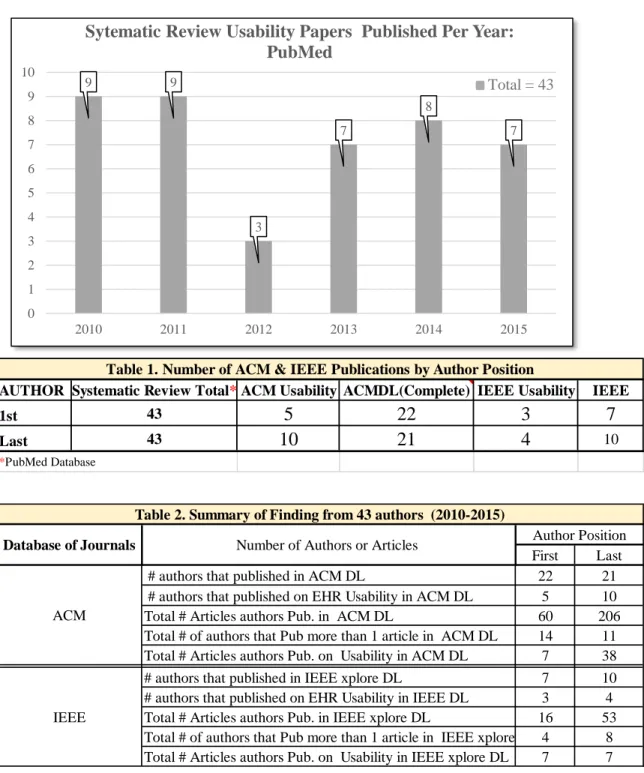
In the systematic review (Kim, Yu, Mostafa, 2016), 22 out of 43 first authorswere found to have published within the ACM DL, 5 authors had a history of publishing articles related to EHR usability. There were a total of 60 articles published within the ACM DL infosphere with a total of 7 articles related to usability of EHR. Fourteen 1st authors published
more than 1 article within the ACM DL infosphere (table1).
3 Articles for systematic review determined by Kim, Yu, Mostafa et al 2016
Seven of the 43 first authors used in the systematic review were found to have published within the IEEE Xplore Digital Library. Three of the 1st authors had a history of publishing
articles related to EHR usability. There were a total of 16 articles published within the IEEE Xplore Digital Library infosphere with a total of 7 articles related to EHR usability. Four 1st
authors published more than 1 article within the IEEE Xplore Digital Library infosphere (table1).
Depth of last author publication in the ACM and IEE Literature
Twenty-one of the 43 last authors used in the systematic review were found to have
published4 within the ACM DL and 10 of those also had a history of publishing articles related to
EHR usability. There were a total of 206 articles published within the ACM DL infosphere with a total of 38 articles related to usability of EHR. Eleven last authors published more than 1 article within the ACM DL infosphere (table 2).
Ten of the 43 last authors, used in the systematic review,were found to have published within the IEEE Xplore Digital Library. Eight of the last authors published more than 1 article. A total of 53 articles were produced, 7 of which were related to EHR usability (table 2).
4 The database was searched using usability or HCI or human factors
AUTHOR Systematic Review Total*ACM Usability ACMDL(Complete) IEEE Usability IEEE
1st 43
5
22
3
7
Last 43
10
21
4
10*PubMed Database
Table 1. Number of ACM & IEEE Publications by Author Position
First Last
# authors that published in ACM DL 22 21
# authors that published on EHR Usability in ACM DL 5 10 Total # Articles authors Pub. in ACM DL 60 206 Total # of authors that Pub more than 1 article in ACM DL 14 11 Total # Articles authors Pub. on Usability in ACM DL 7 38
# authors that published in IEEE xplore DL 7 10 # authors that published on EHR Usability in IEEE DL 3 4 Total # Articles authors Pub. in IEEE xplore DL 16 53 Total # of authors that Pub more than 1 article in IEEE xplore DL 4 8 Total # Articles authors Pub. on Usability in IEEE xplore DL 7 7 Table 2. Summary of Finding from 43 authors (2010-2015)
Database of Journals Number of Authors or Articles Author Position
ACM
Depth of ACM and IEEE Literature
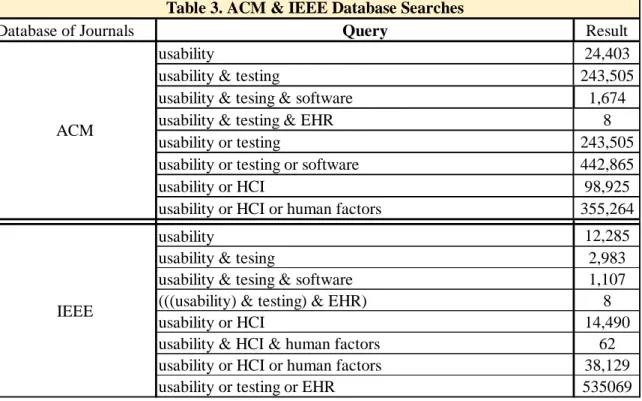
A search of ACM DL for “usability5” in titles and abstracts yielded 24,403 articles. The same
search for “usability or HCI or human factors” yielded 355,264 articles. A search of IEEE Xplore DL for “usability6” yielded 12,285 articles. A search for “usability or HCI or human
factors7” yielded 38,129 articles (table 3).
DISCUSSION AND ANALYSIS
Health care in the US is experiencing a crisis of quality and cost containment
(IOM,1999)(IOM,2001). This crisis triggered federal mandates forcing transition from a paper based health care system to a digital health care system motivated by significant rewards, and severe penalties (HITECH ACT 2009). The transition, nevertheless is well underway.
5 The database was searched using “usability” 6 The database was searched using “usability”
7 The database was searched using usability or HCI or human factors
Database of Journals Query Result
usability 24,403
usability & testing 243,505
usability & tesing & software 1,674
usability & testing & EHR 8
usability or testing 243,505
usability or testing or software 442,865
usability or HCI 98,925
usability or HCI or human factors 355,264
usability 12,285
usability & tesing 2,983
usability & tesing & software 1,107
(((usability) & testing) & EHR) 8
usability or HCI 14,490
usability & HCI & human factors 62
usability or HCI or human factors 38,129
usability or testing or EHR 535069
Table 3. ACM & IEEE Database Searches
ACM
As with all major transitions, there are unintended consequences. The greatest casualty is the physician-patient relationship. These new systems demand full attention, requiring high levels of interaction and disrupt the physicians’ ability to consistently attend to their patients. Despite many flaws, paper charts supported the unstructured nature of most patient information. It
supported the unfolding of patients’ health over time, a discourse between consultants using signs and symptoms, arriving at a consensus of experience regarding the etiology and pathophysiology of patients’ problems. The presumptive diagnosis was tested over time by repeated examinations and supported by laboratory examination, imaging and invasive examination.
The health care market is highly competitive with manufacturers securely guarding their intellectual property (IP). The federal mandates outlined a general guideline of minimal
functional requirements for the design of these systems. However, standards for usability were not included (HITECH ACT 2009). As a result, there are virtually no studies on the design or use of these products, nor are there studies that compare usability of competing systems.
Health care providers are presented with a set of proprietary products of unknown usability and design quality (Dolan, 2016). Adding to the inconvenience, these products are non-interoperative. Keeping this setting in mind, the resistance to new HIT becomes less of a mystery.
Usability and the concepts behind them, are definitely not new. A rich science of invention, and innovation exists behind our modern understanding of human interaction with “tools” - especially computers. Almost every industry (complex system) in our society, directly benefits by creating its own science of human interaction with tools or applies the experience of others. The exception, as illustrated above, is health care (Declerck & Aimé, 2014).
industry are experiencing an easier transition to the introduction of HIT, most likely because of their functional similarities to other well established industries.
The development of HIT for the clinical aspects of health care delivery are another thing altogether. There are many unique aspects to clinical medicine as follows; the nature and
sensitivity of the data (structured and unstructured personal information), the unique setting and clinical cognition. These processes are underappreciated by developers.
Software development for clinicians requires an understanding of clinical cognition in addition to basic principles of HCI (Patel, Arocha, Kaufman, 2001)(Patel, Arocha, & Zhang, 2005). Research involving clinical cognition, for both medical education and information systems, represents a mature knowledgebase unrecognized by many software engineers, and exists within another untapped silo (Holden, 2010)(Holden, Karsh, 2010). Further discussion of clinical cognition, is beyond the scope of this paper. However, expertly applied principles of standardized methodologies for design and testing, in addition to improved understanding of clinical cognition, would go a long way towards the development of intuitive - easy to use - EHRs. Examining this aspect of development of EHRs is within the scope of this paper.
The proprietary nature of many vendor products, restrictions imposed by the Health Insurance Portability and Accountability Act (HIPAA), and the complexity of health care data, present formidable barriers to the development and testing of EHRs. However, one of the greatest barriers to the development of intuitive EHRs exists within the health care community itself.
EHRs, represent a level of complexity that differs from many traditional medical problems. Diseases, for example, may be infectious, genetic, or metabolic and are solved by reductionist approaches. Frequently, collaboration only with closely related fields.
Diseases are puzzles, solved by assembly of complex components. These components are discovered by progressive identification of things – signs, symptoms, proteins, chemicals,
The problems, defined by the IOM, were systemic and operational in nature, very different problems from the traditional problems mentioned earlier. These problems involve finance, human resources, security and process improvement. The solutions to these problems depend upon a broader knowledgebase than traditionally found within the medical community; a realization that came very slowly. This is the central tenant of this research: few researchers, within the health care community studying the usability of EHRs, take advantage of more
experienced research communities, found, for example, within the ACM and the IEEE by
publication and conference participation.
A community as sophisticated as the medical community should better understand that all individuals and information are inevitably linked within the same infosphere (Floridi, 2013). Ergonomics, human factors engineering, user centered design, usability, and human computer interaction have the same root goal; to produce something that is useful.
These fields have standards that guide the study and measurement of human interaction with tools that guide designers. The results are interfaces that enable users to accomplish their tasks efficiently and in an intuitive way.
Standards are important, because without them, products that are too complex, confusing and dangerous result. A case in point involves a computerized radiation delivery tool designed in 1985 that caused significant harm. The device was the Therac-25, a state-of-the-art commercial radiation delivery tool; that used accelerated electrons to treat cancer (Leveson, Turner, 1993) (Leveson, 1995). The Therac-25 was one of the first radiation machines to use a linear accelerator (linac). It could generate particles of varying energies giving radiation oncologists control over the dose and penetration of the radiation given to cancer patients (Leveson,1995). Prior treatment methods used timed exposures of radioactive isotopes such as radium or cobalt stored in lead containers.
incidents revealed that the user interface was to blame. It was ambiguous and failed to provide the user (treatment technician) with the information required to maintain safe treatment levels for the patients. The investigating commission determined that the harm resulted from poor software design (Leveson, Turner, 1993).
So why did this happen? Admittedly, during the 1980’s, there was less experience with computerized interfaces for medical devices compared to today. However, there was enough evidence to determine that standards for safe design were not met (Leveson, Turner, 1993) (Leveson, 1995). Was this from incompetence, lack of knowledge or poor testing on the part of the developers? The answer to that question is not completely clear.
Tools, such as medical devices and software, including EHRs, should enable users to accomplish their tasks efficiently and safely in an intuitive way. EHRs are ubiquitous and are now essential for the modern delivery of health care. Unfortunately, despite only a few products dominating the market place, there is little literature on the usability of these products.
In an effort to better understand usability testing on EHRs and disseminate methodologies for doing such, Kim, Yu, and Mostafa (2016) recently performed a systematic review. They studied the medical literature (PubMed) on usability testing of EHRs. A search, for publications studying usability of EHRs of the PubMed database, from the last 5 years, yielded over 800 papers. Only 43 papers, met the inclusion requirement of methodical usability testing (Kim, Yu, & Mostafa, 2016).
Considering the Therac-25 incidents, and the results of the above systematic review, a pattern is suggested. A pattern of knowledge isolation exemplified by a lack of broad
literature, participate in the greater discourse of scientific communities with a long history of
usability and human factors engineering? As mentioned earlier, from this question, the 3
hypotheses proposed earlier were derived. The results of this study address each hypothesis in the following paragraphs.
An idea fundamental to this study (Hypothesis #1), is that the engineering and computer science disciplines have significant scientific knowledgebases on usability and related fields such as human factors engineering (HFE), human computer interaction (HCI), ergonomics, and user centered design (UCD), (Akamatsu, Green, & Bengler, 2013)(Gainer, 2008)(Jastrzebowski, 1857 & 1997)(Norman, Miller, & Henderson, 1995). As a consequence, these fields have vetted research methodologies and quality standards (i.e. ISO) with sophisticated readership and experienced bodies of peer reviewers (HL7, 2016)(IEEE, 2016)(Karowowski, 2005). Hypothesis #1 is supported by the literature presented and the search results from simple word queries of the ACM and IEEE databases. Tens of thousands and hundreds of thousands of relevant articles were found – see table 3.
The data addresses Hypothesis #2 and #3 by further analyzing the author search results. Five 1st and 10 last authors, of the included 43 publications in the systematic review by Kim, Yu,
and Mostafa (2016), appeared as authors the in ACM EHR usability literature (table 2) representing only 11.6% and 23.3%, respectively, of the total group of authors studied in this paper (table 4). These same authors appeared, as authors in the IEEE EHR usability literature only 7% and 9.3%, respectively, of the total group of authors studied in this paper (table 4).
Data Base
% 1st Au.
Appeared
% Last Au.
Appeared
% 1st Au appeared
EHR Usability
% Last Au appeared
EHR Usability
ACM
51.16%
48.84%
11.63%
23.26%
IEEE
16.28%
23.26%
6.98%
9.30%
Conclusion
Goes (2013), in an editorial in the MIS Quarterly regarding the evolution of information systems research, discussed divisions of ideas and research which have developed as a natural organization of training programs. Each division represented a different aspect or paradigm within the field. The programs all differ in strengths and emphasis of ideas with no single program having equal depth or strength in all areas (Goes, 2013). These divisions appear as silos of seemingly unrelated work having only information systems in common and populate an environment of limited exposure to a variety of disciplines for students or developing researchers. The divisions, now silos, have ideas or research “streams” within the seemingly different or conflicting disciplines that may indeed be studying the same things. “Within each stream, camps and sub-camps abound in the IS [sic: information systems] academic world with their own
workshops, preferred conferences, and editorial appointments in the journals” (Goes, 2013, p. iii).
These concepts are seminal and common in all areas of research and education. Goes (2013) offers insight into this lack of true interdisciplinary cooperation with researchers. In general they are not trained to work this way, and institutions have traditionally provided little guidance or incentive to do so.
Mixed methods research, widely discussed in information science – combines
quantitative and qualitative research methods – while an excellent step towards more in-depth collaboration, it just scratches the surface of the cross-pollination of ideas and methodologies needed to study the complex systems required within the health care ecology.
BIBLIOGRAPHY
Akamatsu, M., Green, P., & Bengler, K. (2013). Automotive Technology and Human Factors Research: Past, Present, and Future. International Journal of Vehicular Technology, 2013, 1–27. http://doi.org/10.1155/2013/526180 (Akamatsu, Green, & Bengler, 2013)
Congress, 111th. HITECH ACT 2009 : TITLE XIII of the American Recovery and Reinvestment Act 2009 —§ TITLE XIII—HEALTH INFORMATION TCHNOLOGY ,Pub. L. No. 111-5—G Feb. 17, 2009 pg. 123 STAT 227 (2009). Retrieved from http://www.gpo.gov/fdsys/pkg/PLAW-111publ5/pdf/PLAW-111publ5.pdf (HITECH ACT 2009)
Declerck, G., & Aimé, X. (2014). Reasons (not) to Spend a Few Billions More on EHRs: How Human Factors Research Can Help. Yearbook of Medical Informatics, 9(1), 90–6. http://doi.org/10.15265/IY-2014-0033 (Declerck & Aimé, 2014)
Dolan, P. (2016). EMR Vendors Stress Usability to Attract Physicians [Medical Practice Trends - BLOG]. Retrieved June 22, 2016, from http://69.16.221.200/~emedikon/emr-vendors-stress-usability-to-attract-physicians/ (Dolan, 2016)
Floridi, L. (2013). The Ethics of Information (1st ed.). NY: Oxford Press. ISBN: 978-0-19-964132-1 (Floridi, 2013)
Franco, G., & Franco, F. (2001). De morbis artificum diatriba [diseases of workers]. 1713. American Journal of Public Health, 91(9), 1382–1382.
http://doi.org/10.2105/AJPH.91.9.1382 (Franco, Franco, 2001)
Gainer, R. D. (2008). History of ergonomics and occupational therapy. Work (Reading, Mass.),
Goes, P. B. (2013). Editor’s comments: Commonalities across IS silos and Intradisciplinary information systems research. MIS Quarterly: Management Information Systems, 37(2), iii–vii. (Goes, 2013)
HL7 Standards Referenced in US Regulations. (2016, March 18). [Not-for-profit]. Retrieved March 18, 2016, from http://www.hl7.org/implement/standards/hhsifr.cfm?ref=nav (HL7, 2016)
Holden, R. J. (2010). Physicians’ beliefs about using EMR and CPOE: In pursuit of a
contextualized understanding of health IT use behavior. International Journal of Medical Informatics, 79(2), 71–80. http://doi.org/10.1016/j.ijmedinf.2009.12.003 (Holden, 2010)
Holden, R. J., & Karsh, B.-T. (2010). The Technology Acceptance Model: Its past and its future in health care. Journal of Biomedical Informatics, 43(1), 159–172.
http://doi.org/10.1016/j.jbi.2009.07.002 (Holden, Karsh, 2010)
IEEE. (2016). IEEE Xplore - Browse Standards Dictionary [A not-for-profit organization]. Retrieved July 21, 2016, from:
http://ieeexplore.ieee.org.libproxy.lib.unc.edu/xpls/dictionary.jsp?stdDict=match_keyword&def_term=usability (IEEE, 2016)
Institute of Medicine (IOM) National Academies of Science. (1999). To Err is Human: Building A Safer Health System (Consensus report)Washington, D.C. Retrieved from
http://iom.nationalacademies.org/hmd/Reports/1999/To-Err-is-Human-Building-A-Safer-Health-System.aspx . (IOM,
1999)
Institute of Medicine (IOM) National Academies of Science. (2001). Crossing the Quality Chasm: A New Health System for the 21st Century (Consensus report). Washington, D.C. Retrieved from http://www.nap.edu/catalog/10027 . (IOM, 2001)
published in 1997. (Warsaw: Central Institute for Labour Protection). (Jastrzebowski, 1857 & 1997)
Karwowski, W. (2005). Ergonomics and human factors: the paradigms for science, engineering, design, technology and management of human-compatible systems. Ergonomics, 48(5), 436–463. http://doi.org/10.1080/00140130400029167 (Karowowski, 2005)
Kim, Heejun, Yu, Fei , Mostafa, Javed. (2016). A systematic review of usability testing of EHR systems for future practice. Publication in progress. (Kim, Yu, Mostafa, 2016)
Leichner, David. (2014) Gartner lead Analyst David discusses Health IT Trends and Forecast at the mHealth Israel conference, Dec 15, 2014 in Tel Aviv. (Leichner, 2014)
Leveson, N. (1995). Medical Devices: The Therac-25*. http://doi.org/10.1002/lsm.22009 (Leveson, 1995)
Leveson, Nancy G.; Turner, Clark S. (July 1993). "An Investigation of the Therac-25 Accidents" (PDF). IEEE Computer 26 (7): 18–41. (Leveson, Turner, 1993)
National Academies of Medicine. (July 2016)HMD : Health and Medicine Division [Government educational research]. Retrieved July 12, 2016, from
http://www.nationalacademies.org/hmd/About-HMD.aspx (HMD, 2016)
Norman, D., Miller, J., & Henderson, A. (1995). What you see, some of what’s in the future, and how we go about doing it: HI at Apple Computer. In Conference on Human Factors in Computing Systems - Proceedings (Vol. 2, p. 155). Denver, Colorado: ACM Press. http://doi.org/10.1145/223355.223477 (Norman, Miller, & Henderson, 1995)
Patel, V. L., Arocha, J. F., & Zhang, J. (2005). Thinking and reasoning in medicine. In: Keith Holyoak: Cambridge Handbook of Thinking and Reasoning. Cambridge, UK: Cambridge University Press. (Patel, Arocha, & Zhang, 2005)
S.T. Pheasant, Ergonomics, Work, & Health, Gaithersburg, MD: Aspen Publishers, 1991. (Pheasant, 1991)
Taylor, F. W. (1913). The Principles of Scientific Management (1st ed.). Harper & Brothers Publishers. Retrieved from https://books.google.com/books?id=HoJMAAAAYAAJ&pg=PA3#v=onepage&q&f=false (Taylor, 1913)
AUTHOR Systematic Review Total*ACM Usability ACMDL(Complete) IEEE Usability IEEE
1st 43
5
22
3
7
Last 43
10
21
4
10*PubMed Database
Table 1. Number of ACM & IEEE Publications by Author Position
First Last
# authors that published in ACM DL 22 21
# authors that published on EHR Usability in ACM DL 5 10 Total # Articles authors Pub. in ACM DL 60 206 Total # of authors that Pub more than 1 article in ACM DL 14 11 Total # Articles authors Pub. on Usability in ACM DL 7 38
# authors that published in IEEE xplore DL 7 10 # authors that published on EHR Usability in IEEE DL 3 4 Total # Articles authors Pub. in IEEE xplore DL 16 53 Total # of authors that Pub more than 1 article in IEEE xplore DL 4 8 Total # Articles authors Pub. on Usability in IEEE xplore DL 7 7 Table 2. Summary of Finding from 43 authors (2010-2015)
Database of Journals Number of Authors or Articles Author Position
ACM IEEE 9 9 3 7 8 7 0 1 2 3 4 5 6 7 8 9 10
2010 2011 2012 2013 2014 2015
Sytematic Review Usability Papers Published Per Year:
PubMed
Database of Journals Query Result
usability 24,403
usability & testing 243,505
usability & tesing & software 1,674
usability & testing & EHR 8
usability or testing 243,505
usability or testing or software 442,865
usability or HCI 98,925
usability or HCI or human factors 355,264
usability 12,285
usability & tesing 2,983
usability & tesing & software 1,107
(((usability) & testing) & EHR) 8
usability or HCI 14,490
usability & HCI & human factors 62
usability or HCI or human factors 38,129
usability or testing or EHR 535069
Table 3. ACM & IEEE Database Searches
ACM
IEEE
Data Base
% 1st Au.
Appeared
% Last Au.
Appeared
% 1st Au appeared
EHR Usability
% Last Au appeared
EHR Usability
ACM
51.16%
48.84%
11.63%
23.26%
IEEE
16.28%
23.26%
6.98%
9.30%
Database of Journals
Query
Result
usability
24,403
usability & testing
243,505
usability & tesing & software
1,674
usability & testing & EHR
8
usability or testing
243,505
usability or testing or software
442,865
usability or HCI
98,925
usability or HCI or human factors
355,264
usability
12,285
usability & tesing
2,983
usability & tesing & software
1,107
(((usability) & testing) & EHR)
8
usability or HCI