Developing an education and evaluation plan for teaching global health to primary care residents at the University of North Carolina
By
Bethany Hodge, MD
A Master’s Paper submitted to the faculty of the University of North Carolina at Chapel Hill in partial fulfillment of the requirements for the degree of
Master of Public Health in the Public Health Leadership Program
Chapel Hill 2012
(signature)____________________________________ Advisor (printed name)_____________________(date)______________
2
Table of Contents:
Abstract ...3
Introduction ...4
Review of the existing models ...8
Developing the Program Plan ...16
Program Setting ...16
Program Theory ...21
Goals and Objectives ...24
Figure 1: Logic Model ...30
Program Implementation ...31
Evaluation Plan ...38
Rationale and approach to the evaluation ...38
Evaluation study design ...41
Table 1: Evaluation methods by objective, evaluation question, and participant population ....43
Evaluation study methods ...49
Dissemination of information ...52
Discussion...54
Acknowledgements ...56
References ...57 Appendix A: Review of existing programs by name and type (table format)
Appendix B: Descriptions of existing programs by taxonomic category Appendix C: GLBE 401 course description
Appendix D: UNC travel policy
3 Abstract:
4 Introduction:
Modern life is increasingly global. Increased travel, immigration, and international trade change how medicine is practiced as well. Both health care issues and the delivery of health care are affected by globalization.1,2 Physicians in the United States are expected to have knowledge of infectious diseases once thought to occur only in developing countries. Doctors also must function as culturally sensitive providers for patients from a multiplicity of ethnicities and cultural backgrounds.3,4 Global health education has been defined as “learning about health issues that transcend geographic borders and commonly present a greater burden to
disadvantaged populations.”3
Furthermore, “global health”, integrates not only tropical health and hygiene but aspects of public health, community health and practice adaptation for clinical work in low-resource and multicultural settings. Competence as a physician in today’s world requires recognition of the added complexity brought to clinical encounters due to
globalization.1,3,5,6
Doctors-in-training are actively seeking ways to prepare themselves for this reality of global medicine. Over 30% of medical students participate in international electives during medical school.7 Rising numbers of residents in primary care specialties are participating in global health electives as part of their graduate medical training as well.8 However, in contrast to well-organized global health education experiences available in medical schools, residents often work independently to learn about global health and design their international fieldwork
experiences.9
At the University of North Carolina, residents are encouraged to seek out opportunities to diversify their health care training through global health experiences; however, no formal
5
residents enter the UNC graduate medical education programs in the primary care fields of internal medicine, pediatrics, and family medicine. Developing academic and technical support for primary care residents participating in international electives is a practical step the university can take to endorse global health education as an important aspect of training. Additionally, it may be easier to start a new international initiative in primary care than in surgery or
subspecialty care because primary care is generally less technology dependent. Therefore, starting global health programming in primary care residencies is easier first step when building a global health education program at an institution. Furthermore, as availability and quality of global health curriculum are increasingly important selection factors for prospective residents, it is advantageous for residency programs that value international experiences to facilitate these opportunities.8,10-12
6
ethical decision making can be enhanced by diversifying the contexts in which residents contemplate their roles in medicine.3
Additionally, while resident interest in international activities is common, little data exists to describe residents’ changes in knowledge, skills, or attitudes attributable to participation in global health education.14 By developing evaluation mechanisms that are built in to program participation, program leaders at UNC will be better able to determine the educational effects of global health curriculum and expand generalizable knowledge in this area. Program evaluation will also be important for tailoring the curriculum to fit UNC residents and maximize the use of locally available resources.
7
8 Review of existing models of global health education in graduate medical education:
Before designing the global health education program for UNC, I reviewed existing models of global health education in graduate medical education. However, I found that performing a truly “systematic” review of existing programs in global health education in the United States is difficult for several reasons. First, without a universally accepted definition for global health or standard of practice for global health education, there is no standardize language available to categorize programs.3,5,6 Second, global health education programs appear to be developing at many institutions rapidly and organically, responding to resident desires and faculty member interests.15,16 This makes any published review of programs likely to be out-of-date by the time it is printed. Third, because of the pace of change and specific tailoring of each program’s components in response to local interest, available resources, and resident needs, few programs have published details about their curricula in the literature. Several authors with experience in global health have published sets of ideas or recommendations for the formulation of a global health curriculum, but most lack sufficiently detailed information about their
programs to allow replication.3,17-21
Methods for systematic review of the literature and additional searches:
9
search was further limited to articles in the English language and dating from 2007-2012. A five year search limit was chosen because descriptions of programs prior to this time frame would not take into account recent work-hour and competency guidelines recently put into place by the ACGME. The result was 172 abstracts (118 from Medline and 54 from ERIC) that were evaluated for inclusion.
I then evaluated the articles for relevance. Articles were included only if 1) participants were part of a medicine, pediatrics, or family medicine residency program, 2) the residency program was based in the United States, 3) the article described in some detail the coursework and travel components of a global health curriculum. Articles were limited by residency type because the RRC requirements and general curricular structure of other residencies, such as surgery, could be too different from primary care residency programs to be comparable. I limited the programs to those based in the United States because programs outside the country would not necessarily be compliant with ACGME recommendations. Additionally, though some articles described personal anecdotes or opinions about global health education experiences, articles were excluded unless they related information about the program components pertaining to four pedagogical domains: curriculum/didactics, practice experience, mentorship, and evaluation.21 Last, I performed hand searches of relevant bibliographies to find articles not found by my search terms.
The literature and hand searches yielded six articles that met these criteria. However, in my search, I also discovered a previously performed summary of exemplary global health programs that is part of the document “Developing residency training in global health: a guidebook,” that was published by GHEC in 2008.15
10
programs than was available in the literature. Therefore, I included the information from this document that pertained to primary care residency programs. Furthermore, most programs highlight their global health curriculum and international clinical work on their program websites. Accordingly, in addition to reviewing the published literature and transferring
information from the GHEC guidebook, I visited programs’ websites to ascertain the most up-to-date information regarding their global health education offerings. Last, I included two more programs (Duke University and Indiana University) based on my personal familiarity with the curricula and similarities to UNC in a particular demographic characteristic such as location or size of the program (See Appendix A).
However, even by these extensive search measures, this summary likely only represents a fraction of the global health education programs in American primary care residency programs. In spite of this, I believe some conclusions about trends within global health education can be drawn from understanding how programs fit on a continuum of curricular complexity.
Specifically because of the differences I noted when each program was described in terms of the aforementioned pedagogical domains, I found there is a need for a more robust vocabulary with which to discuss the various types of programs currently in use. Therefore, I stratified the spectrum of models into groupings based on the level of programmatic support given to global health education and labeled the newly defined groups in this novel taxonomic framework as “permissive,” “supported rotation,” “formal track,” “additional certification,” and “layered” programs.
11
supporting global health while still allowing residents to arrange their own international experiences to count as electives in residency. In a supported rotation program, the institution helps the resident in some way (e.g. funding or guidance to approved sites and rotations) but didactics, mentorship, and evaluation are generally minimal. Formal track programs, however, are characterized by intense didactics that may overlap several years of residency and higher expectations for continuing mentorship and production of scholarly work. Additional
certification programs have all the rigor of the formal track programs and are further characterized by an expectation that participation in didactics will culminate in the resident earning an additional degree (such as a Masters in Public Health) or certification by a national body. Layered programs are defined by the presence of multiple entry points into global health education activities—typically an intense formal track or additional certification program for residents who are pursuing global health as a major part of their future careers paired with a supported rotation pathway for residents whose chief goal is to add an international elective to their personal learning programs in residency. (See Appendix B for further discussion and analysis of existing programs reviewed using this framework.)
Trends seen reviewing existing models:
Several interesting observations can be made from the diversity of programs
12
specifically for the graduate medical students in a particular specialty, while some larger programs have formulated coursework in global health that is available to residents from many specialties.
Different programs also employed various didactic methods. Most incorporated special global health lectures; however, some programs integrated these lectures into existing education activities for the whole residency program, while others required residents to attend sessions outside of the normal work day or take a concentrated elective in global health. Curricula often incorporated web-based learning activities, though some programs developed their own modules while others utilized modules created by global health experts such as USAID or the American Society of Tropical Medicine and Hygiene. Last, programs that require extensive coursework in global health may result in extra degrees earned by the participants and longer time spent in residency.
The global health practice experience varied in duration and focus. The shortest trips, usually two weeks, typically had a clinical focus. Longer rotations were more likely to have research or scholarly projects as part of the work to be completed. Many programs maintained long-standing partnerships with designated foreign sites. Programs that expected scholarly work were more likely to require residents to rotate only at designated sites, possibly in order to maintain continuity with ongoing projects. If greater than two months were allowed away from the residency home, special arrangements were made to fulfill ACGME requirements for continuity clinic participation (such as maintaining a secondary continuity clinic site).
13
financially tie the US-based program to its partner site. Last, in some instances a rotation in an underserved population within the US, such a Native American group, could qualify as a global health experience.
Mentorship was mentioned, but not well described in many of the program plans. This particular pedagogical domain, while emphasized in the literature as a necessary part of creating sustainable programs that adequately support learners, appears to receive little formal attention in many global health education programs.3,17,18,22 It appears that many programs may have a few faculty with leadership in global health as a part of their job descriptions, but for the most part, mentoring takes place in informal relationships between learners and faculty with some global health experience. While this organic approach is less restrictive, it may also be difficult to ascertain the effectiveness of these important relationships when no clear objectives or structure exists.
Interestingly, “evaluation” of a global health program can mean very different things in different settings. In some programs, evaluation appears to pertain to measuring performance of the learners—how well the resident fulfilled predetermined academic criteria or ACGME competencies. In other programs evaluation seems to mean only that the participants and faculty are periodically surveyed to determine if the global health program is meeting their personal desires for education. The academically based evaluation measures of the learners were more often concrete, such as satisfactorily completing a scholarly project or passing a quiz.
14
assessing participants’ desires and the overall likelihood that future residents will want to participate in the program.
Strengths and weaknesses of this review:
Using a combination of search methods has strengths and weaknesses when addressing a broad topic such as global health education. As I have shown, using only a strict literature to find published articles about global health curriculum plans would have excluded many programs and resulted in inclusion of outdated information. Because the practices of global health education in residency are fluid and dynamic at each institution, inclusion of web searches gives a more accurate picture of current activities. However, the reliability and truthfulness of things found in web searches should always be questioned because it is altogether too easy to publish things on the internet. In this case, the process of peer review for journal publication would likely result in more detailed and verified information. Last, even using a multiplicity of search methods, it would be impossible to complete a truly systematic review of all the global health education programs available to residents without the input of every primary care residency program— which is beyond the scope of this review. This summary, therefore, represents examples of programs, but is surely not inclusive and may be influenced by publication or familiarity biases.
15
evidence regarding resident outcomes related to participation in global health education programs would be informative for stakeholders.
Overall, this summary of global health education programs for primary care residents indicates that there may not be one “right” answer when developing curriculum. Institutions appear to be tailoring their programs to fit the needs and desires of participants, while keeping in compliance with basic ACGME requirements. Within that framework, there are many
possibilities for how the teaching, learning, and service components are shaped. As more
16 Developing the program plan:
After reflecting on the existing models for global health education in graduate medical education, I next sought to understand the specific context for a program at UNC. By exploring the macro- and microenvironments within which a global health education program would function, I came to better understand the needs that exist at UNC, the resources available to program planners, and the potential obstacles to implementation and this institution. I will next discuss the political setting of the program, its likelihood of being accepted by residents, financial resources available, technical feasibility issues, and potential interests of other stakeholders.
Political setting:
17
The political environment surrounding residency education is influenced by several factors, including emerging content recommendations, restricted work hours, and limited funding. Several bodies exist that make “best practice” recommendations based on available evidence to guide the development of graduate medical education. When discussing global health education in residency, the recommendations for various competing interests must be considered.
First, it is important to understand how the basic requirements for residency education have emerged. Within the Accreditation Council of Graduate Medical Education (ACGME) Residency Review Committees (RRCs) are assembled to guide educational policy regarding training. All educational activities, no matter the specialty, are competency based.13 The competencies outlined by the ACGME include: medical knowledge, professionalism, patient care, interpersonal and communication skills, practice-based learning and improvement, and systems-based practice.27 An emerging challenge is how to evaluate residents’ performance in the areas, such as professionalism, where outcomes are more subjective than in concrete, highly-testable areas like medical knowledge.28 Furthermore, while global health experts have proposed several models for how global health activities can fulfill competency requirements (such as increasing communication skills through interactions with multi-lingual populations), global health activities are not formally recognized by the RRCs as mechanisms to teach
competencies.29-32
18
available for educational activities.34 Thus, the political environment of graduate medical
education in the United States is complicated by the need to balance teaching content and respect for time.
Furthermore, much of the funding for residency education is through government-sponsored programs, such as Medicare.35 As tax dollars are then used to pay for the salaries of residents who are in training, programs have a certain level of responsibility to make sure that people living in the United States benefit from the care residents provide. So, though the argument can be made that learning about global health strengthens residents’ abilities to take care of travelers, immigrants, and international adoptees, the first priority in residency education and work generally pertains to domestic health care issues and training the next generation of physicians to run the American health care system.
Presently, two organizations are making specific recommendations for how global health can be taught in academic settings. The Global Health Education Consortium (GHEC) and Consortium of Universities for Global Health (CUGH) have each worked to formalize the definition of global health education and develop the structure for comprehensive
19
Acceptability to residents:
Currently, a survey to assess resident interest in global health education is planned for June 2012. Supplementary global health education has generally been met with enthusiasm by medical students and residents at other universities.2,12,19 However, in most cases, supplementary activities have been voluntary and, therefore, limited to those who have intrinsic interest in this subject matter. Participation in auxiliary instruction could be made more palatable if it can be shown that global health education, while not required by any RRCs within the ACGME, helps residents score better on licensing exams or increases board exam pass rates. Unfortunately, research on the impact of global health education on measurable outcomes is quite limited at this time.
Financial resources:
At the university level, allocation of funds for global health instruction may be decided according to the strategic goals of the institution. Because UNC is a state-funded college, taking care of the citizens of North Carolina is a fundamental part of the mission. However, as a major institution for learning and research in medicine, expansion into global health could support educational objectives in all the areas listed in the previous paragraphs. Funding global health education for residents working in the system would have to be determined to be complementary to the established goals of university. Additionally, offering global health education may be strategic for recruitment and diversifying the residency programs applicant pools.
20
Currently, a self-regenerating pool of funds has been created by the OIA coordinating international medical students’ electives visiting UNC (for which there is a fee). The money generated as fees is then used to fund global health education activities for medical students and could be extended to residents as well.
Outside funding from other parties interested in global health is obtainable through specific grants and programs. UNC currently has connections with several organizations that fund medical students’ international activities, but none that specifically serve residents. Seeking funding through specific grants or alumni allocations may become more important as the
program develops and expands.
Technical feasibility:
The technical feasibility of a global health education program in residency will depend on the types of instruction attempted. Maintenance of a supplementary readings library, instruction via online modules, and accountability through quizzes can all easily be accommodated by existing internet-based education packages such as Sakai. A site manager would need to be appointed to format and upload the materials and manage end-user issues that might arise.
21
if planned ahead. Additionally, residents participate in ongoing journal clubs, and articles on global health topics could be incorporated into this schedule.
To expand a global health curriculum beyond modifying existing educational activities, several limiting factors may arise. For example, supplementary evening lectures are difficult to coordinate with resident call schedules. Furthermore, the ACGME carefully monitors resident work hours, and supplementary educational activities (even when voluntary) could cause residents to violate work hour restrictions.
Additional stakeholders:
The other main stakeholders in the process of creating and delivering supplemental global health education to residents in internal medicine, pediatrics, and family medicine are the
residency programs themselves. Residency program leadership and clinical faculty members who are interested in global health would make natural leaders in a global health education program. However, changing current educational patterns and expectations would require buy-in from all clinical faculty members. Global health education would need to be promoted as a university priority and an extension of the existing teaching mission.
Program Theory:
22
applicability of tenets of service-learning. Last, because incorporation of this new curriculum into the existing graduate medical education for internal medicine, pediatrics, and family medicine residents represents a system-wide change, organization change theory may be useful to determine how to fully integrate global health curriculum at this institution.
According to curriculum theory, global health education currently resides in the “null curriculum” at UNC. Curriculum theory asserts that learners are affected not only by what they are formally taught, but also by what material is absent in a set of courses.37 Therefore, by leaving out global health from the educational experience of residents, programs make
statements about the relative importance of global health education compared to the instruction they do provide (e.g. clinical rotations, research methods education, or business practice seminars).
Furthermore, curriculum theory also posits that learners are taught through both overt and hidden curriculum.37 Overt curriculum teaches testable knowledge, and a program in global health should evaluate learners’ absorption of that testable knowledge to assess the curriculum’s efficacy and usefulness. Conversely, the idea of “hidden curriculum” refers to the subconscious changes that occur in the mentality and decision-making processes of learner as a result of being exposed to instruction on particular topics. In the area of global health, this has often meant that learners have developed skills such as greater sensitivity to disparities in health care or become more willing working with poor populations.15 While changes in these areas may not be
attributable to any particular lecture, module, or experience, the presence of the curriculum has a cumulative effect on the learners that is greater than the sum of the individual parts.
23
programs clearly fit into service-learning models as overseas experiences where the learners implement knowledge to help others in real-world settings are usually a part of the curriculum. Service-learning is, however, different from medical volunteerism.38 While the learning that occurs in a medical volunteer setting may be rich, it can be haphazard. Conversely, service-learning takes places in a structured environment, is grounded in coursework, and
post-experience reflection is facilitated by instructors.39 Furthermore, when designing a true service-learning partnership, the goals and objectives of the partner organization are recognized to be equally as important as the learners’ educational needs. 40
Implementing global health curriculum as a service-learning experience in residency programs would require several things on an institutional level. Program planners need to build a foundation of appropriate coursework. Program directors must foster partnerships with specific organizations in the international community. Agreement over the roles of residents in these foreign settings must be reached such that the residents are set up for beneficial learning experiences while the community partners are having needs met. Course leaders must be identified and be prepared to lead residents through structured reflection exercises and facilitate learners’ processing of this new kind of educational experience. Last, a mechanism for feedback should be put in place so that the program can adapt as learners’ and partners’ needs change.40
24
of finding funding within the university, reallocating faculty to maintain the program, incorporating promotion of the program into advertising, or a variety of other changes.
Institutionalization of a program is the last step in organizational change theory and represents the full acceptance of a new idea into the mindset and workings of an organization. As these systematic changes occur in the university establishing global health education within residency curriculum, the program becomes a lasting part of the university.
Goals and objectives:
1) Increase UNC medicine, pediatrics, and family medicine residents’ exposure to global health, population health, and community health in diverse settings.
Within the next 12 months, clinical faculty and the OIA will design or coordinate 6
lectures to be given monthly at resident noon conferences (1 hour each). Proposed topics:
Proposed topics:
Global health and development basics Social determinants of health
Malnutrition and health
Tropical medicine case studies
Professionalism in multicultural settings
Immigrant and traveler health for the practicing physician
Within the next 12 months, the clinical faculty and the OIA will design and facilitate
25
Adapting practice to low-resource settings
Chronic disease management in developing countries Health and human rights in a global environment Careers in global health
Personal safety and dealing with “culture shock” while working abroad Ethics and scope of practice during international clinical rotations
Over the next 6 months, clinical faculty and OIA will coordinate the development of
online modules appropriate for graduate medical education:
Existing modules include: Causes and treatment of childhood diarrhea; Culture, ethics and professionalism; Maternal health; Travel health and safety; HIV; and Global health research. New modules are continuously being developed for the medical school. Many modules and statement papers are available online through global health collaborators at other universities, NGOs, and government offices such as the United States Global Health Initiative and CDC.
1) Support residents’ learning relevant to established ACGME competencies through participation in global health education.
Increase participating residents’ capabilities to work in multicultural and
low-resource settings (systems-based learning, communication skills, professionalism, and practice-based learning and improvement).
After 12 months of participation, follow up surveys will show residents report increased efficacy when working with patients from other cultures.
26 After 12 months of participation, residents will be able to articulate principles
of global health including the role of the physician in population health, identification of social determinants of health, and methods of adapting medical practice to multicultural and low-resource settings.
Increase participating residents’ knowledge of conditions and presentations of
tropical diseases (medical knowledge and patient care).
After 12 months of participating in global health education, residents will show measurable increases and retention of information by showing improvement in identifying tropical diseases on module quizzes.
After 12 months of participating in global health education, residents will show improvement in knowledge of appropriate treatments for tropical diseases and malnutrition on module quizzes.
After 12 months of participating in global health education activities, residents will be able to identify local and international resources for information and treatment guidelines when working with international populations.
2) Enhance programmatic support for residents participating in international clinical experiences.
Mentoring:
Over the next 12 months, the OIA will connect residents planning
27 Over the next 2 years, the OIA will work to develop faculty-resident
relationships with a goal of 10 or more interdisciplinary faculty willing to meet with residents before and after their travels in a mentoring capacity. Technical support
Over the next 12 months, the OIA will enhance residents’ access to pre-trip planning information, provide help with paperwork, and direct internationally bound residents toward country-specific resources to help them with the technical aspects of travel and assure compliance with the UNC Travel Policies.
Funding
Starting in 2012, the OIA will start biannual disbursement of travel
scholarships to chosen applicants who apply for funding through the OIA. 3) Grow and formalize education pathways in Global Health for residents at UNC.
Global health pathway:
Over the next 4 years, work with the university to formalize a set pathway of educational and practical experiences in global health that will qualify as a Global Health Certificate for residents in UNC GME programs.
Over the next 4 years, explore options for a university-accredited the Global Health Certificate Pathway for any interested residents.
28
weeks duration, and a post-trip scholarly project for dissemination of information.
Development of bilateral international relationships:
Over the next 5-7 years, identify 3 or more sites that are strong participators in hosting UNC residents and work to develop bilateral working relationships based on service-learning models to maximize the benefits and stability of the relationship for both parties.
Continuous program improvement:
Starting pre-intervention and recurring annually, the OIA will survey medicine and pediatric residents to determine their interests in global health and improve upon methods for education and support for international electives.
Starting with the intern cohort of 2012, track all residents’ international clinical activities during medicine or pediatric residency at UNC and build a repository of participant information. This will, in the future, serve as a framework for the collection post-trip scholarly projects.
Starting now, the OIA will maintain a database of locations and institutions that have hosted residents along with residents’ evaluations of the educational experiences in each place. Information from the database can help direct residents toward experiences that will appropriately fit their needs and expectations.
29 Over the next 4 years, residents will add to global health education within
their programs via the scholarly projects created while reflecting on their experiences in international clinical settings.
In the world:
31
Program implementation:
The three main components in implementing a global health curriculum in residency programs at UNC are: development of appropriate educational activities, programmatic support for residents’ international activities, and formalization of global health as an academic area in residencies at UNC.
Implementation resources:
The Office of International Activities (OIA) will serve as the hub for information and coordinate the resources to build and maintain these components. The OIA fits, institutionally, as both a division of UNC Global and a branch of the UNC School of Medicine Department of Medical Education. Additionally, the OIA collaborates with other groups on campus that coordinate students’ international activities (UNC Global Health and Infectious Disease Department, the Center for Global Initiatives, and the Office of Global Health at the Gillings School of Global Public Health). Last, in the specific venture of developing global health education for primary care residents, the residency programs themselves will be active
participants in developing the components of the curriculum. These collaborations are important because of the interdisciplinary nature of global health and uniquely position the OIA to connect residents with the resources for global engagement at UNC.
Funding for the OIA is currently through a single, creative revenue stream. The OIA, in another capacity, also coordinates electives for students visiting from medical schools overseas. The fees collected from these students make up the source money for projects housed in the OIA. Fortunately, this revenue stream has been fairly consistent in recent years. The OIA staff
32
Many other faculty members who are passionate about global health volunteer their time and skills to global health education activities as well. Some activities and products sourced from the OIA will overlap with their existing programs to support medical students, but this program plan expands upon these to craft coursework and support structures to meet the needs of resident physicians.
Global health educational activities:
Two of the main goals of the program pertain to development of resources that will help residents prepare for international clinical activities and increase medical knowledge. These educational activities will affect residents to different degrees, depending on their voluntary involvement with the program and depth of interests.
Objective 1: Increase UNC medicine, pediatrics, and family medicine residents’ exposure to global health, population health, and community health in diverse settings
The main ways that this objective will be reached is through didactic lectures and online modules. Residency programs already maintain a regular schedule of morning reports, noon conferences, and grand rounds lectures. We propose that six lectures over the next twelve months be dedicated to global health topics. Many faculty members on campus have expertise in various areas of global health who may be available to give these lectures. Eventually, residents
33
the lecture series plans every year with topics rotating every three years, so that by the end of residency, most trainees would have had multiple chances for exposure to global health topics.
For residents who have specific interest in global health, the OIA proposes expanding education through online modules. Six online modules currently exist as part of the GLBE 401 class (Appendix C). The modules consist of a video lecture, quiz, and written feedback
assignment. The website also has links to relevant articles and documents. The Sakai site for the class is maintained by the OIA and several faculty members have contributed presentations and content. Currently, the target audience of the modules is undergraduate medical students. Therefore, some modules may need to be refined or added to specifically address the needs of residents. The OIA will coordinate the creation of new modules and the technical parts of getting them available online. In the future, completion of modules will be a part of required pre-trip didactics for residents wishing to participate in international clinical activities or complete a Global Health Certificate.
Objective 2: Support residents’ learning relevant to established ACGME competencies through participation in global health education.
34
clinical information taught in the modules. Last, residents who participate in global health educational activities, including international clinical experiences, will be surveyed by the OIA after their experiences to assess their self-reported changes in efficacy when working with patients from other cultures.
International electives:
Objective 3: Enhance programmatic support for residents participating in international clinical experiences.
The international clinical experience is a key part of global health education and links the didactics to residents’ real-world experiences. Arranging and preparing for time away from work can be difficult due to the constraints of residency training. The OIA will facilitate residents’ participation in overseas electives through practical assistance and mentorship.
Residents who wish to go on international clinical electives will be directed to the OIA from their residency programs for assistance. The OIA will make sure that necessary paperwork is properly filled out and that the residents’ travel plans are compliant with UNC Travel Policies (Appendix D). The OIA is also currently implementing an application and selection process through which to disburse $2000 travel scholarships to up to ten residents per year (Appendix E).
35
they return home. Mentors will also serve as guides for residents who are seeking careers in global health.
Last, the OIA will serve as a clearinghouse of information to help residents select their international experience locations. By tracking previous students’ and residents’ experiences, staff in the OIA can guide residents to locations and projects that fit their interests. Tracking the quality of student and resident experiences will also allow program leaders to identify strong institutions with which to foster deeper relationships that may result in bilateral exchange efforts in the future.
Global health as a formal academic program:
Objective 4: Grow and formalize education pathways in global health for residents at UNC. As a long term goal, the OIA will work towards codifying a set of global health activities that will qualify the resident to obtain a Global Health Certificate. Through completing
educational activities, international clinical work, and a follow-up scholarly presentation based on the resident’s experiences, a resident interested in global health will earn this special
designation. While earning special certificates is not required for completion of residency per the ACGME, it will be a good way for residents to be able to highlight their interest and effort when presenting their resume to prospective employers or fellowships programs. Furthermore,
presence of Global Health Certificate pathway helps prospective applicants to the residency programs understand the depth of the resources available to residents at UNC and more clearly envision how their interests may be fostered while being a resident at UNC.
36
difficult part of the program to plan at this point in time, having a mindset towards establishing bilateral international exchanges in the future may shape how relationships with other institutions are managed now. Bilateral exchange models fit both the service-learning paradigm for global health education as well as supporting the best practices for ethical participation in medical activities in developing countries. 18,38,42
Objective 5: Contribute to general knowledge in the field of global health education.
As UNC formalizes the processes for participation in global health education, the OIA will also be positioned to collect new information generated by residents participating in the program. The scholarly projects required of residents in the Global Health pathway will form a body of new work that will contribute to the richness of the curriculum at UNC. The projects will also be available to scholars looking to study trends in what residents see and experience through international electives. Residents’ participation in online modules will also give feedback as to what are effective teaching measures (according to residents’ scores on module quizzes). Follow-up surveys performed by the OIA to further understand the characteristics of participants and changes in resident outcomes after participation will not only inform additional program
37
Plan for sustainability:
The program to develop global health education activities for primary care residents at UNC will build on existing elements and expand as directed by the needs and desires of the participants. The OIA reported that over 80 foreign students participated in medical elective exchanges last year (bringing funding into the OIA for programs). The exchange program is expected to grow in the coming years, but many factors, including political changes, institutional restrictions, and individual student choices can affect this. Thus, development of program
elements by the OIA may be incremental as funding is generated.
At this point in time, it is also unknown how changes in programmatic support for international electives may influence rates of residents who want to participate in global health activities. A baseline needs and desires survey for understanding the current resident cohort’s attitudes toward participation in global health is underway and exit surveys for participants are planned for the future. It is expected that streamlining and formalizing the Global Health Certificate pathway could increase the number of current residents who choose to go on
38 Rationale and approach to the evaluation:
Reasons for evaluating a global health education curriculum at UNC:
Because this is a new program, thoughtful evaluation measures should be used to
determine the usefulness and efficacy of the global health curriculum. Outcomes of utility occur on several different levels. For example, the residents’ and faculty members’ perspectives on how useful the materials provided are for learning about global health would indicate end user-level utility. Assessing the value of the technical assistance supplied by the OIA to assure compliance with regulations and increase safety of travelers would be a university-level utility outcome. Review of the efficacy of methods to perform these tasks would be a form of
accountability for the use of resources and inform ways to reduce redundancy in service lines. Additionally, as this is a relatively new area of formalized education for residents, it is important to gather data about outcome changes to build a repository of information. Without standardization or concrete consensus guidelines, institutions are implementing global health education with a variety of approaches, as was seen in the “semi-systematic” review of programs in this paper. Gathering outcomes data that documents changes in residents’ knowledge or attitudes attributable to participating in the curriculum is the first step in determining best practices in the field. Using this information, programs wishing to develop global health
education for residents in the future will have an evidence-based framework for designing their curricula. Furthermore, verified outcomes are likely to have more weight with funding and regulatory bodies when decisions must be made about continuation of the program.
39
products that make up the global health curriculum at this university. By understanding the real-world effects of the present program and comparing them to the desired outcomes, planners can adapt the curriculum to better meet the needs and expectations of those involved. Also, the program must maintain awareness of and adapt to any changes from outside the OIA (such another iteration of work hours regulations from the ACGME) that might affect residents’ ability to participate.
Recommendations for who should evaluate the program:
In the earliest years of the program, it may be beneficial to concentrate on internal
evaluation methods. Again, because there are no strict guidelines published by a regulatory body, initial definitions of success will be determined by the values and expectations of those
participating. An internal evaluator is more likely to be in tune with the culture of the
organization and recognize the importance of the acceptance by stakeholders. Additionally, it is likely that there will be a rapid succession of minor changes as the logistics of program
implementation are realized. A locally available, internal evaluator would be able to monitor these changes and redirect when needed to keep the program on the intended path.
40
An internal evaluator will therefore need several key skills. He or she will need to be able to understand the interactions between various stakeholders in the program at UNC.
Additionally, listening skills and the ability to integrate multiple perspectives into succinct recommendations will be important. Last, in this instance, it may be useful for the evaluator to be able to act as a supportive individual within the organization as he or she will be among those best informed about what is working in the program and able to relate this in a compelling way to university administration and potential funders.
Stakeholders involved:
As in most educational initiatives, the main stakeholders in this program can be categorized as learners, teachers, and process facilitators. The learners in this instance are primary care residents at UNC. The teachers are faculty members who participate in global health education either through giving lectures, developing modules, or serving as mentors. Process facilitators include those working directly to implement the program, such as the OIA staff members, as well as residency program directors and university administrators who have vested interests in how resources and residents’ time are used.
Potential challenges to evaluation:
The main challenges to conducting a comprehensive evaluation involve time factors and the need to integrate the perspectives of diverse stakeholders. Time is an important consideration because all the stakeholders have other demands for their attention, including maintaining
41
are only at UNC for a limited time (typically three to four years to complete a primary care residency) and usually cannot take an international health elective until their final year. Therefore the window of time in which evaluators can gather important post-experience feedback before the residents leave the program is relatively short. Last, program coordinators must synchronize the evaluation schedule with the university planning schedule in order to have pertinent outcomes data available when institution-level decisions must be made.
The diversity of stakeholder perspectives presents a challenge to evaluators as well. While residents may be most concerned with improving upon their personal experiences learning global health through the curriculum, residency program directors and university administration must ensure that institutional regulations are followed and resources are used efficiently. At times, these interests may be in direct competition with one another. Evaluation methods must then be chosen carefully to generate the information needed to understand the outcomes
important to the various stakeholders. Round table discussions, interviews, and surveys may be good ways to gauge attitudes and overall satisfaction, but more concrete methods will be needed to show significant changes in knowledge or performance.
Evaluation study design: Study design:
42
subjective, qualitative attributes of a new program (such as user-friendliness and the
enjoyableness of the experience), measuring outcomes data and showing quantitative changes reveal the value of the program by objective methods. These “hard” data are more easily tracked over time and are the foundation for evidence-based practice.43
Additionally, while strictly controlled experimental designs may be the best for generating data, observational methods are often more practical when evaluating education programs.43 Outcome changes attributable in part to educational interventions, such as career choices or practice habits, may not be detectable in the short term. Furthermore, as global health education is not mandatory within graduate medical education, it would be difficult to perform a randomized controlled study where participants might be assigned to go overseas when they do not wish to while others who had an interest in the topic were denied these opportunities.44 Because of these obstacles, most of the previous studies assessing changes in outcomes after participation in global health education programs have been pre-experimental or observational.14
Within the scope of observational study design, longitudinal observation and cross-sectional studies may be the most useful for discerning the effects of a global health education initiative. Longitudinal observation requires careful planning and extensive follow up effort, but it can be useful to detecting changes in participants’ attitudes and knowledge before and after the educational intervention. In this way, the participant is compared to his or her “former self” and the effects of involvement in the educational program are isolated against a backdrop of baseline thoughts and feelings. Conversely, cross-sectional studies look at differences within a population at a certain point in time. A cross-sectional study of a group that included those who had
43
studies, evaluators could learn a lot about not only about how participants differ from non-participants, but evaluate emerging trends and infer cause-and-effect relationships.43
Evaluation Methods:
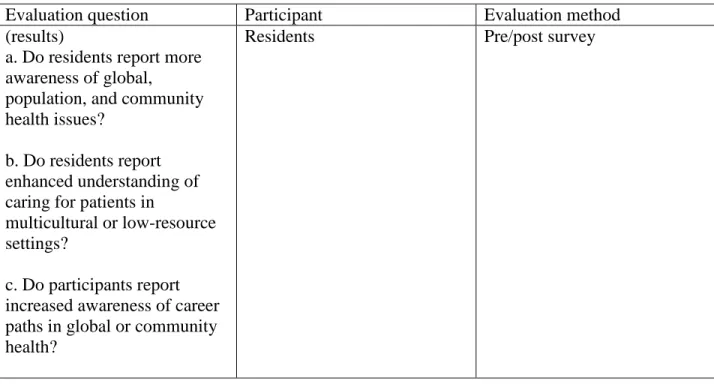
The following table summarizes the evaluation questions, who will need to participate in the evaluations, and proposed methods for accomplishing the evaluations. More detailed
explanations of the evaluation methods and how these may be used in particular study designs are discussed in the subsequent text.
Table 1: Evaluation methods by objective, evaluation question, and participant population. Objective: Increase UNC medicine, pediatrics, and family medicine residents’ exposure to global health, population health, and community health practices in diverse settings.
Evaluation question Participant Evaluation method
(results)
a. Do residents report more awareness of global,
population, and community health issues?
b. Do residents report enhanced understanding of caring for patients in
multicultural or low-resource settings?
c. Do participants report increased awareness of career paths in global or community health?
44
(results)
c. Were 6 noon conferences, 6 evening sessions, and
appropriate online modules created for the global health pathway?
Program managers and OIA-associated faculty
Faculty focus group
(performance)
a. Did residents attend and participate in noon lectures? b. Did residents interested in global health attend evening lectures?
c. Did residents access and satisfactorily complete online modules?
d. Did interested residents experience barriers to attendance or completion of modules? If so, what were the barriers?
Residents Evaluate attendance logs
Evaluate online access records and results of online quizzes and assignments
Pre/post Survey
(learning)
a. Do residents have a different attitude toward the importance or relevance of global health education than prior to engaging the
curriculum?
Residents Pre/post survey
(motivation)
a. Did residents find that the topics presented were relevant to increasing their
understanding of global health?
b. Did interested residents find the additional lectures and online modules significantly added to their understanding of global health? Were any particularly weak or strong?
Residents Post survey
45
(motivation)
c. Were OIA and residency faculty satisfied with the quality and quantity didactics created? If not, what can be improved?
Program managers, OIA-associated faculty, and residency program directors
Faculty focus group
Objective: Support residents’ learning relevant to established ACGME competencies through participation in global health education.
Evaluation question Participant Evaluation method
(results)
a. Do participants score higher on questions pertaining to global health on standardized exams?
b. Do participants show increased skill in working in multicultural or low-resource health care systems?
c. Do participants show enhanced medical knowledge pertaining to proper diagnosis and treatment of tropical diseases?
d. Can participants identify local and international
resources for information and treatment guidelines for caring for international populations?
Residents and program faculty Develop pre- and post- tests for residents at UNC
Monitor in-training exam performance and board scores Monitor residents’ internal evaluation forms (based on performance in ACGME competencies)
Pre/post survey
(performance)
a. Did participants use new knowledge or skills gained through engaging the curriculum during their international electives?
Residents Post survey
46
b. Have participants used knowledge or skills gained during practice domestically? (learning)
a. Do participants believe they acquired new knowledge they would not have learned through other residency activities? If so, what is an example?
b. Do participants believe they acquired new skills they would not have learned through other residency activities? If so, what is an example?
Residents Post survey
Exit interview
(motivation)
a. Did participants enjoy the lectures and modules? Why or why not?
b. Did the participants find the didactics to be a good use of their time? Why or why not? c. Did participants feel didactics were good
preparation for international clinical activities? Which parts were most useful?
Residents Post survey
Exit interview
Objective: Enhance programmatic support (mentoring, technical assistance, travel preparation) for residents participating in international clinical experiences.
Evaluation question Participant Evaluation method
(results)
a. Were all participants
Residents and OIA-associated faculty
47
assigned an appropriate mentor?
b. Were all participants compliant with UNC travel regulations?
c. Were participants able connect with available funding streams for their trips?
(results)
f. Were 10 or more faculty available for taking of the roles of mentors in global health?
OIA and OIA-associated faculty
Faculty focus group
(performance)
a. Did technical support from the OIA meet the logistic needs of traveling
participants? Why or why not? b. Did participation in
mentorship enhance the quality of scholarly work or post-trip presentations? In what ways?
c. Did mentorship enhance participants’ understanding of global health? In what ways?
Residents and OIA-associated faculty
Post survey Exit interview Faculty focus group
(learning)
a. Did participants learn new knowledge or skills from mentors?
b. Did participation in mentorship change
participants’ attitudes toward working in global health or underserved populations? c. Did participants learn about the technical aspects of
Residents Post survey
48
planning international clinical collaborative work?
(motivation)
a. Did participation in mentorship result in more satisfactory experience in the global health pathway? In what ways?
b. Did participants feel the technical support from the OIA was helpful in planning and executing an international elective? Why or why not? c. Did participants feel they received adequate technical support for accomplishing other requirements
(completing modules, creating a post-rotation presentation)? If not, what was lacking?
Residents Post survey
Exit interview
(motivation)
d. Did the OIA staff feel that they had adequate resources to meet the technical needs of participants?
e. Did faculty enjoy the
process of mentoring residents through this process?
f. Did faculty feel adequately prepared and supported to be mentors?
49 Evaluation study methods:
With the goals of generating data for longitudinal and cross-sectional observational studies as well as informing continuous quality improvement of the program in mind, we will use a variety of different evaluation tools (as indicated above in Table 1.). Also, several key
stakeholders will participate in the evaluation process including residents, faculty, and administrators.
Pre/post surveys:
Pre- and post-intervention surveys are useful methods for establishing baseline
characteristics and following longitudinal changes. All residents participating in the global health education program will complete a pre-intervention survey to assess their knowledge of and attitudes toward global health issues and careers. In the post-intervention survey, changes in attitudes and perception can be directly measured in the same population. Additionally, we will be able to measure participant satisfaction with the quality of program components such as the online modules, mentoring framework, and travel advising with specific questions included in the post-intervention survey.
50
Exit interview:
Qualitative information gained through the exit interviews will add to the quantitative data gathered in the surveys. Exit interviews provide opportunities for participants to elaborate on their opinions of the program components and suggest possible improvements for the future. Additionally, as trends in exit interviews may be identified over the years, structured questions may be added to the interview in such a way that responses can be coded and transformed into quantitative information.45-47
Faculty focus groups:
UNC faculty, including the OIA department members, residency program directors, and global health mentors, should meet regularly to discuss the program and the progress of the resident participants. In part, these meetings will provide the setting for discussing logistical matters such as the development of new modules or coordination of mentors and learners. Also, as the nature of the venture is intentionally interdepartmental and interdisciplinary, these
meetings can serve as a hub for collaboration between faculty as we continually seek to expand and improve the program. Last, faculty focus groups will be an important source of feedback to learn about how participation in the global health curriculum is affecting residents’ work in domestic settings.
Attendance logs and online records:
51
residents attend and modules they complete, the program planners can gauge the implementation of the curriculum components. In the future, levels of participation may be useful to track to discern if a minimum threshold of didactics is necessary in order to see statistically significant changes in performance outcomes.
Pre- and post-intervention tests, standardized exam scores, and competency evaluations:
Finding measurable educational outcomes that can be generalized to larger populations is difficult. However, as in most forms of educational assessments, quizzes or exams are generally accepted as a valid method for appraising how well participants have learned new facts. By creating program-specific tests, program planners can determine residents’ baseline knowledge and discern the gains in knowledge due to participation in the global health curriculum didactics. Trends in resident performance on knowledge quizzes are also a form of feedback for program planners to determine the overall efficacy of curricular components in relating important concepts.
52
pass rates on standardized exams, it may be an indicator that participation in this optional curriculum is detracting from residents’ core-topic learning.
Last, residents are continually evaluated by residency faculty members to determine competency achievements. As previously stated, the ACGME has created a list of competencies applicable to all residency types to ensure universal evaluation of “soft” skills such as
professionalism in addition to the medical knowledge that is assessed with exams.13,28 Because each residency program must have systems in place to evaluate all residents in these competency areas, program planners should be able to access data specific to the performance of participants in global health education. Initial research evidence indicates that participation in global health education results in beneficial increases in residents’ professionalism, interpersonal
communication skills, and ability to adapt to work in various health care systems.14,29,46,48 However, these studies are small and very few have evaluated the impact of global health education specifically on ACGME competency achievement. Linking participation in global health to measurable outcome changes in residents’ performance on competency evaluations would likely be the best way to prove the increases in the hard-to-measure “soft” skills commonly noted in anecdotal findings.
Dissemination of information:
53
of residents through universal enforcement of travel policies, and maximize resource use through coordination the international activities taking place on campus.
It is important, therefore, that mechanisms are put into place for the dissemination of the evaluation information to stakeholders on campus. Because the OIA is accountable to several different departments, it would make sense that an internal review document of this program should be included in the routine departmental reports submitted to the administration. This internal report should also be reviewed at global health faculty meetings and made available to program directors who may wish to know how global health education is affecting their residents.
54 Discussion:
The new plan for global health curriculum in graduate medical education at UNC presented here is ambitious. Integration of this curriculum into the existing practices of primary care residencies at UNC will require a fundamental shift in perceptions of the role of global health in graduate medical education. Global health education will no longer be just for the few residents interested in spending a couple of weeks abroad but a fundamental part of the
curriculum used by the university to train culturally competent, community- minded physicians prepared to treat a wide assortment of pathologies in patients from diverse backgrounds.
Developing, maintaining, and evaluating this program will require ongoing institutional investment, but many potential benefits to residents and patients are evident. Furthermore, implementation of rigorous evaluation mechanisms from the outset will ensure good stewardship of resources while also developing UNC as a center of evidence-based practice in this field.
55
concepts in the academically rigorous manner expected by residency programs and governing bodies.
The Office of International Activities is well positioned to lead both program development and evaluation at UNC. Work has already begun in this area, starting with the survey previously described that will be administered to all incoming interns in July 2012. Through this survey, the OIA will develop a repository of information including resident demographics, previous experiences, current attitudes and interests pertaining to global health that can serve a baseline comparator for future outcomes research. Though UNC will be far from the first university to add formal global health curriculum to resident education, we will start the process in an admirably thoughtful manner.
Through the process of writing this paper, I have developed a greater appreciation for the complex process of turning “good ideas” into a usable educational program. The first challenge was to connect academic theory to real-world action strategies. Though I discovered many gaps in the existing literature, I was able to construct foundation for thinking about this topic that was based on educational theory and current knowledge. Then, by contemplating the actual
56 Acknowledgements:
57 References:
1. Bateman C, Baker T, Hoornenborg E, Ericsson U. Bringing global issues to medical teaching.
Lancet. Nov 3 2001;358(9292):1539-1542.
2. Drain PK, Primack A, Hunt DD, Fawzi WW, Holmes KK, Gardner P. Global health in medical education: a call for more training and opportunities. Academic medicine : journal of the Association of American Medical Colleges. Mar 2007;82(3):226-230.
3. Drain PK, Holmes KK, Skeff KM, Hall TL, Gardner P. Global health training and international clinical rotations during residency: current status, needs, and opportunities. Academic medicine : journal of the Association of American Medical Colleges. Mar 2009;84(3):320-325.
4. Grudzen C, Legome E. Loss of international medical experiences: knowledge, attitudes and skills at risk. BMC medical education. 2007;7(1):47.
5. Henderson DA. Defining global medical education needs. Academic medicine : journal of the Association of American Medical Colleges. May 1989;64(5 Suppl):S9-12.
6. Koplan JP, Bond TC, Merson MH, et al. Towards a common definition of global health. Lancet.
Jun 6 2009;373(9679):1993-1995.
7. AAMC. Medical school graduation questionnaire 2011 all schools summary. 2011;
https://www.aamc.org/download/263712/data/gq-2011.pdf. Accessed January 19, 2012. 8. Anspacher M, Frintner MP, Denno D, et al. Global health education for pediatric residents: a
national survey. Pediatrics. Oct 2011;128(4):e959-965.
9. Houpt ER, Pearson RD, Hall TL. Three domains of competency in global health education: recommendations for all medical students. Academic medicine : journal of the Association of American Medical Colleges. Mar 2007;82(3):222-225.
10. Miller WC, Corey GR, Lallinger GJ, Durack DT. International health and internal medicine residency training: the Duke University experience. The American journal of medicine. Sep 1995;99(3):291-297.
11. Ramsey AH, Haq C, Gjerde CL, Rothenberg D. Career influence of an international health experience during medical school. Family medicine. Jun 2004;36(6):412-416.
12. Kerry VB, Ndung'u T, Walensky RP, Lee PT, Kayanja VF, Bangsberg DR. Managing the demand for global health education. PLoS Med. Nov 2011;8(11):e1001118.
13. ACGME. ACGME at a glance. 2012;
http://www.acgme.org/acWebsite/newsRoom/newsRm_acGlance.asp. Accessed February 21, 2012.
14. Thompson MJ, Huntington MK, Hunt DD, Pinsky LE, Brodie JJ. Educational effects of
international health electives on US and Canadian medical students and residents: a literature review. Academic Medicine. 2003;78(3):342.
15. Evert J, Stewart, C., Chan, K., Rosenberg M., Hall, T. et al. Developing residency training in global health: a guidebook. 2008;
http://globalhealtheducation.org/resources/Documents/Both%20Students%20And%20Faculty/ GHEC%20Residency%20Guidebook.pdf.
16. Whitcomb ME. Promoting global health: what role should academic health centers play?
Academic medicine : journal of the Association of American Medical Colleges. Mar 2007;82(3):217-218.
17. Evert J, Bazemore A, Hixon A, Withy K. Going global: considerations for introducing global health into family medicine training programs. Family medicine. Oct 2007;39(9):659-665.