Green Building:
What Is It and Why Should Planners Care?
Christopher Wedding, LEED-Accredited Professional
Green building is on the rise and many planners are paying attention to the potential environmental, fi nancial and economic benefi ts, including reduced energy and water costs, enhanced worker productivity, better health conditions, and reduced liability. This article provides an introduction to green building by defi ning green build-ing and explainbuild-ing the U.S. Green Buildbuild-ing Council’s LEED guidelines, addressbuild-ing the specifi c benefi ts and costs of green building, discussing the various criticisms and weaknesses of LEED, and proposing how LEED and green building may be of interest to those involved in transportation planning, community development, economic development, and environmental planning.
Chris Wedding is a Ph.D. candidate at UNC-Chapel Hill in the Depart-ment of EnvironDepart-mental Science and Engineering and the DepartDepart-ment of City and Regional Planning. His graduate work focuses on performance metrics for urban green developments—sustainable building practices and brownfi eld redevelopment. With experience at the North Carolina Solar Center and the Offi ce of Sustainability at UNC Chapel Hill, he is an accredited professional with the U.S. Green Building Council’s LEED rating system.
S
enior scientist for the Natural Resources Defense Council Rob Watson claims that “buildings are the worst thing that we do to the environment” (Wat-son 2003). The EPA reports that the construction and building industries account for 1/3 of all environmental impacts in the United States (EPA 2001). According to the U.S. Green Building Council (USGBC), buildings in the U.S. account for 65.2 percent of all electricity consumption, 30 percent of greenhouse gas emissions, 12 percent of potable water use, and 136 million tons of construction and demolition waste annually (2.8 pounds/person/day). Globally, buildings account for 40 percent of raw material use (USGBC 2004a). By combining the residential and commercial sectors and including the portion of the industry sector used to op-erate industrial buildings as well as the “embodied en-ergy” of industrial buildings, Ed Mazria, architect and author of the Passive Solar Energy Book, calculates that buildings actually account for 48 percent of total energy use and 46 percent of total carbon dioxide production in the U.S (Hawthorne 2003). With such dramatic envi-ronmental impacts, it seems prudent to considerbuild-ing designs in a discussion of environmental plannbuild-ing and sustainable development.
Defi ning and Rating Green Buildings
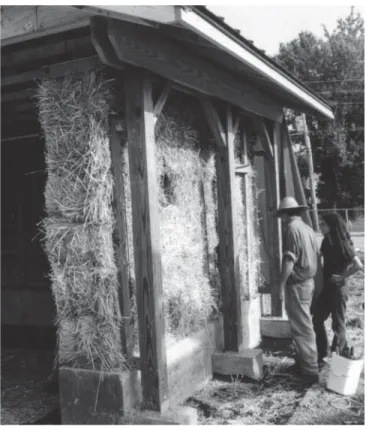
Natural building, on the other hand, refers to designs such as straw-bale construction (see Figure 1), under-ground homes, or cob building.
• use salvaged materials; • use solar water heating;
• install task light and day lighting;
• save water with effi cient plumbing designs and fi x-tures;
• install Energy Star appliances; and
• integrate planning and design so that all profession-als involved in the building can maximize green con-struction (Environmental Building News 2003). The Energy Star Program, a partnership between the U.S. Environmental Protection Agency (EPA) and the U.S. Department of Energy (DOE), and the U.S. Green Building Council’s Leadership in Energy and Environ-mental Design standards (often referred to as the LEED guidelines) are two ways in which these defi nitions are becoming standardized. Energy Star essentially certi-fi es buildings with superior energy performance—typi-cally a 40 percent savings in energy compared to con-ventional buildings. As of January 2004, Energy Star ratings accounted for almost 1400 buildings in the U.S., totaling nearly 325 million square feet. This total in-cludes 791 offi ces, 375 public schools, as well as super-markets, hospitals, and hotels. To earn the label, build-ings must achieve a score of greater than 75 out of 100 on the EPA’s 100-point national energy rating scale as well as conform to industry standards including indoor air quality. Through partnerships with 8000 private and public organizations, Energy Star helps save businesses, consumers, and organizations $8 billion in energy costs per year (EPA 2004).
The LEED guidelines are the most widely accepted defi nition of green buildings. LEED was developed by the USGBC, which is a consortium of 4,600 mem-ber organizations and companies with a stake in green building. These organizations include building prod-uct manufacturers, building owners and managers, in-surance and fi nancial fi rms, design fi rms, contractors, environmental groups, utilities, universities, and gov-ernments. The LEED guidelines, specifi cally LEED-NC (new construction), were developed for the DOE,
Environmental Building News, a leading source of in-formation for architects and builders in this market, par-tially defi nes green buildings as those that:
• renovate old buildings;
• re-develop brownfi elds instead of developing new green space;
• manage storm water with detention ponds and po-rous pavement;
• orient the building to maximize southern exposure to utilize passive solar heating;
• cluster buildings to minimize paved areas; • use native plantings;
• increase effi ciency and insulation in order to mini-mize or eliminate HVAC systems;
• model the energy performance of a building to opti-mize HVAC systems;
Figure 1. Example of straw-bale construction used in the Berea College Eco-village in Berea, Kentucky.
Energy Effi ciency, and Renewable Energy’s Offi ce of Building Technology, State, and Community programs. The intent was that LEED be applied to commercial, institutional, and multi-story (greater than four stories) housing complexes to improve the environmental and economic performance of buildings using “established and/or advanced industry principles, practices, mate-rials, and standards.” LEED committees serve as the third party certifying party (USGBC 2001).
This rating system consists of a much broader scope than simply energy use and indoor air quality like En-ergy Star. The LEED-NC guidelines are focused on a whole-building, life-cycle perspective. These guide-lines serve as an indicator system for rating how well a building creates a healthy indoor environment and re-duces its impact on the environment among other ben-efi ts. LEED-NC is broken down into 6 sections, each with corresponding points. The following sections are listed in order of total points per category, i.e., the list indicates priority:
1) Energy and Atmosphere – 17 points, 2) Indoor Environmental Quality – 15 points, 3) Sustainable Sites – 14 points,
4) Materials and Resources – 13 points, 5) Water Effi ciency – 5 points, and
6) Innovation and Design Process – 5 points. The maxi-mum score is 69, and various levels of certifi cation are possible: 26 points earns a building the status of Certifi ed, 33 qualifi es for Silver, 39 obtains Gold, and 52 or more receives Platinum certifi cation.
For more details on the LEED point system, go to the web site: www.usgbc.org and look for the links to LEED Green Building Rating System documents.
Various Versions of LEED
In addition to LEED-NC, other versions of LEED are being developed, or have been recently completed, to include other sectors of the construction industry.
When completed and marketed, these new versions will cover a much larger percentage of the construction and building industry. These include existing buildings (LEED-EB), commercial interiors projects (LEED-CI), core and shell projects (LEED-CS), homes (LEED-H), and neighborhood development (LEED-ND). While the fi rst of these new systems addresses primarily build-ing methods, the latter are concerned more with site se-lection and the principles of New Urbanism. Currently, the USGBC, the Congress for New Urbanism, and the Natural Resources Defense Council are working to cre-ate a consensus-based rating system in consultation with professionals around the country. LEED-ND will focus on the Smart Growth Network’s ten principles of Smart Growth; the guidelines will promote mixed-used devel-opments and mixed housing types, in addition to other related foci already present in the existing LEED-NC, such as proximity to mass transit, proper site selection, and support for bicycle and carpool travel. The goals of LEED-ND include the following:
• revitalization of urban land; • decrease in land consumption; • decrease in vehicle-miles traveled; • improved air quality;
• decrease in polluted stormwater run-off;
• design of communities with mixed-incomes; and • walkable communities (USGBC 2004c).
Who’s Practicing Green Building?
Carolina has 38 projects in the pipeline. The University of North Carolina at Chapel Hill accounts for two of those projects—the Carrington Nursing School addi-tion, which will include a green roof, and the Botanical Garden Visitor Education Center, shown in Figure 2, which is shooting for the LEED Platinum level of certi-fi cation (USGBC 2004b).
Figure 2. North Carolina Botanical Gardens Visitor Education Center, a proposed LEED-NC Platinum Building.
Image courtesy of Chris Wedding.
There are other signs that green building is gaining mo-mentum. While it is to be expected that progressive cities like Portland, Oregon implement green building policies, the fact that conservative departments, cities, and states are also adopting LEED guidelines shows broad-based approval for this new trend. The following is an abbreviated list of agencies, states, municipalities, and private sector businesses that are using LEED as a guide or mandate on their building projects:
• U.S. General Services Administration; • U.S. Department of Interior;
• U.S. Environmental Protection Agency; • U.S. State Department;
• U.S. Air Force, Army and Navy;
• the states of California, Connecticut, Maryland, Il-linois, Maine, New Jersey, New York, Oregon, Penn-sylvania, and Washington; and
• the cities of Los Angeles, Seattle, Portland, Atlanta, Berkeley, San Francisco, Chicago, Dallas, Arlington, and many more (Templeton 2004).
What are its Costs and Benefi ts?
The benefi ts of green building generally include the fol-lowing:
1) reduction in negative impacts on ecosystems and natural resource bases;
2) reduction in operating and maintenance costs; 3) enhancement of building marketability; 4) increase in worker productivity; and
5) reduction in possible liability for indoor air quality problems (USGBC 2001).
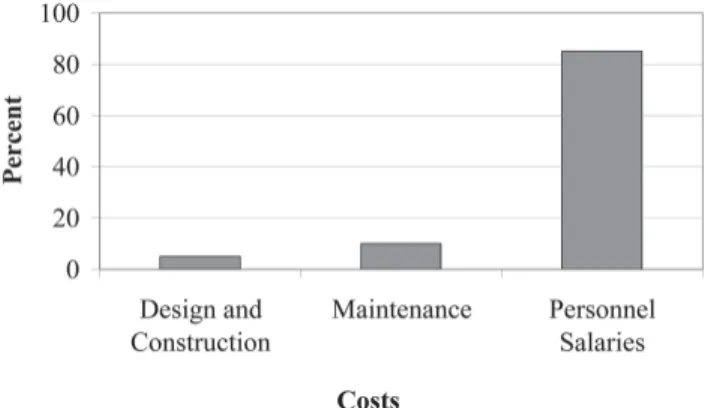
William Browning, Founder of Green Development Ser-vices at the Rocky Mountain Institute, states that green building strategies can increase occupant performance by 6 percent to 16 percent (USGBC 2003). Because offi ce workers’ salaries are by far the largest business expenditure (compared with rent, utilities, repair, etc.), improvements in this domain have far-reaching impacts on profi ts (Hawken, Lovins, and Lovins 1998). Por-tions of the Sustainable Building Technical Manual il-lustrate this relationship well (see Figure 3). A study by the California Energy Commission confi rmed these benefi ts. Call-center workers located in rooms with views to the outside and daylight processed calls 6 per-cent to 12 perper-cent faster and performed 10 perper-cent to 25 percent better on tests of mental function and memory compared to their secluded counterparts. In addition to worker productivity, daylighting has been shown to
crease sales by up to 40 percent compared to tradition-ally lit retail locations (Heschong Mahone Group, Inc 2004).
Water effi ciency is another benefi t of green building methods. Conservation measures can easily reduce water usage by 30 percent compared to the standards set by the 1992 U.S. Energy Policy Act; even greater savings can be achieved when compared to buildings that pre-date this act. According to the USGBC, for a 100,000 square foot offi ce building, low-fl ow fi xtures with automatic controls could save 1,000,000 gallons of water per year, assuming 650 occupants using an aver-age of 20 gallons per day (USGBC 2001).
Additionally, some architects have suggested that a syn-ergy exists between green building and historic preser-vation. That is, both are concerned with conservation (Solomon 2003). One example includes the reuse of the shell and structure of a building, which reduces con-struction and demolition waste while preventing the ex-traction, processing, and transportation of new building materials. However, contention exists in certain areas; for example, the use of historical decorative versus en-ergy effi cient options. These issues are often relevant to abandoned, contaminated properties with standing buildings, as is often the case with brownfi eld proper-ties.
Overall, green buildings are fi nancially attractive. Table 1 shows the total fi nancial benefi ts (per square foot) less the initial premium over a 20-year period. An up-front investment for green techniques of 2 percent of construction costs can generate benefi ts in energy, op-eration and maintenance, and water savings, as well as gains in productivity, equal to a total ten times the initial investment over a 20-year period. This is a conserva-tive estimate because most buildings last much longer than 20 years, although some components, such as me-chanical systems, may need upgrading or replacement (Kats 2003).
The most recent study on the costs of green building indicates that green buildings don’t have to cost more than conventional structures. A study conducted by the Davis Langdon Adamson cost consulting company shows that based on initial budget estimates and fi nal construction costs, the majority of the 61 buildings stud-ied achieved LEED certifi cation without any additional funding. Those that did require additional funds for more expensive items like photovoltaic panels typically only need up to 3 percent of the initial budget. The anal-ysis also indicated that costs per square foot for LEED buildings fell into the existing range of costs for build-ings of similar program type (Davis Langdon 2004). A study by the Brendle Group concluded that the premium for LEED-certifi ed buildings was less than 1 percent, for Silver and Gold certifi cation less than 2.1 percent, and for Platinum the premium approached 6.5 percent (The Brendle Group 2004).
This small premium for a green building is not neces-sarily universal. The Chicago Center for Green Tech-nology, for example, which is more of a demonstration project, exceeded costs for a comparable building by 30 to 40 percent (Trumbull 2004).
The Davis Langdon Adamson study also discusses some of the factors that add to the extra potential costs for a green building. These include:
1) the demographic location—rural versus urban; 2) the bidding climate and culture;
3) the local and regional design standards, codes, and initiatives;
4) the intent and values of the project—the owner’s dedication from the beginning;
5) the climate—heat and humidity, for example, limit passive cooling potentials;
6) the timing of implementation—integrating systems early in programming is cheaper than adding on lat-er;
7) the size of building; and
8) the point of synergies (i.e., can more than one green building goal be achieved with the same building material or method?).
The authors state that the most signifi cant variable is the bidding climate and culture. The bidding pool of knowledgeable contractors may be small and, therefore, limit competition and drive up prices. Additional costs may result from the documentation of steps taken to achieve LEED requirements, the application of indoor air quality construction protocols, scheduling delays to implement post-construction building fl ush-outs, the risk and learning curve of unfamiliar green practices, and responsibility of ensuring that a project earns LEED certifi cation (Davis Langdon 2004).
A fi nal benefi t derives from public image. According to Nigel Howard, USGBC’s vice president and head of the LEED program, companies building green can distinguish themselves as ethical organizations. With so much scrutiny over a company’s environmental ac-tivities, this association may increase the demand for a fi rm’s products or services. Thomas Leppert, chairman and chief executive offi ce of The Turner Corporation, a national general builder that in 2003 completed more than $6 billion worth of construction, claims that “green
is the new corporate color” (Banham 2004). With the rising popularity of green building, many are realiz-ing that the real question is not “What does it cost to build green?” but rather “What does it cost to not build green?”
Criticisms of LEED
The LEED rating system still faces several challenges. Some of the common criticisms are highlighted below:
• All credits essentially receive the same weighting. That is, a building project can earn a point towards certifi cation by redeveloping on a former brownfi eld or by using only low-VOC paint throughout the in-terior of the building. The reader will quickly under-stand that these two credits require vastly different amounts of time, planning, and money to obtain.
• Earning a credit does not always transfer into direct benefi ts to or reduced impact on the environment. For example, a building may achieve Sustainable Site credit 4.3 by installing special refueling stations for alternative fuel vehicles to meet 3 percent of the total parking capacity at a site. This does not neces-sarily mean that users of that building will own or use alternative fuel vehicles, and, therefore, achiev-ing this credit does not translate into real reductions in air pollution related to the use of gasoline-pow-ered vehicles.
• LEED does not give enough attention to the context of a building. Sustainable Sites credit 2 may be a case in point. The goal of this credit is to reward projects that encourage bicycle commuting. How-ever, if a site is located on a highway or bypass where bicycles are not allowed by law, achieving this point has nothing to do with the owner or designer, but perhaps with the state department of transportation.
• LEED is full of trade-offs which can counteract the efforts and goals of a variety of credits. Two ex-amples illustrate this effect. First, a project may aim for incorporating rapidly renewable materials into the design and specify bamboo fl ooring with en-thusiasm. However, doing so contradicts the credit for locally produced materials—since bamboo is produced in China—and adds to negative transpor-tation-related externalities. Another example deals with the credit for giving occupants control over their thermal environment. While this may make them more comfortable and enhance their productiv-ity, certain users will surely use excessive heating or cooling and accordingly negate attempts to achieve the credit for energy effi ciency.
• LEED documentation adds another level of paper-work and bureaucracy to the already complex pro-cess of developing a site and building a new struc-ture. The time, and, therefore, the money spent on documenting that proper actions were taken to achieve the said credits are unappealing to owners and developers.
• LEED offers no credit based on the relative size of a building. While the decision for how much space a building program requires is totally in the hands of the owner/developer, it can be argued that unneces-sarily large buildings (i.e., relative to actual need) consume a great deal more resources in both materi-als and energy. Consequently, these projects should somehow be characterized as more wasteful and en-vironmentally unfriendly.
Why Should Planners Care About Green Building?
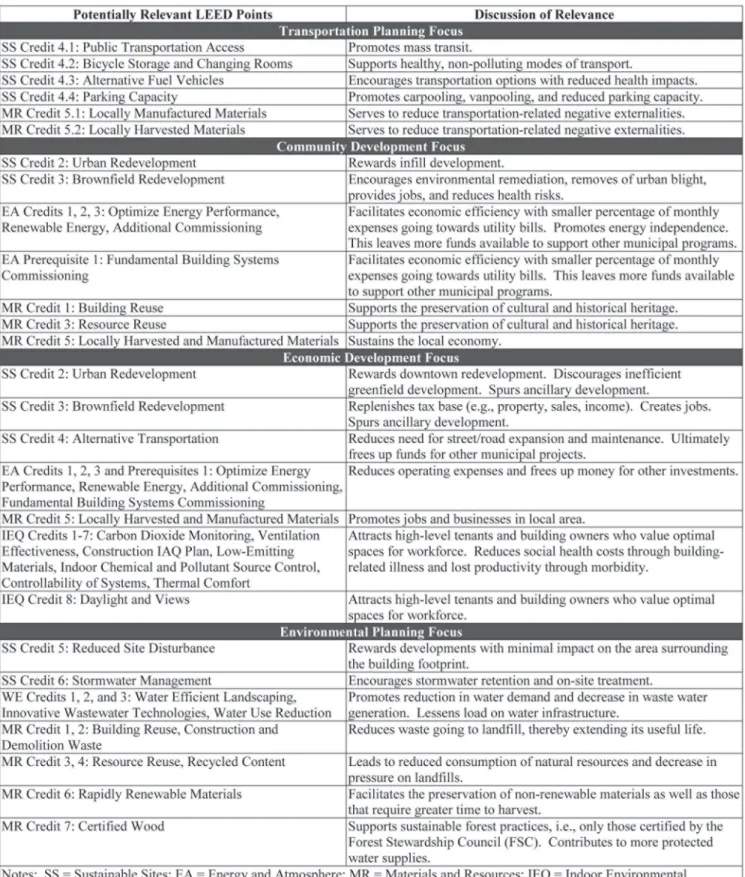
While the upcoming LEED-ND will address a multitude of planning goals, the version of LEED most used today (LEED-NC) addresses many objectives often discussed in the planning community. Table 2 on the following page illustrates a variety of credits relevant to four sub-sections of city and regional planning: 1) transportation planning, 2) community development, 3) economic de-velopment, and 4) environmental planning. The lists are by no means comprehensive and the ability of each credit to reach the goals of each of these subsections listed above is subject to interpretation for each site.
As the table indicates, there are many reasons why plan-ners should be aware of and in support of green build-ing efforts in their communities. Reachbuild-ing for LEED certifi cation has its limitations, but it serves as one way to create public and market awareness for the environ-mental, fi nancial, and social benefi ts inherent in many green building methodologies. As the USGBC’s motto goes: “Build green. Everybody profi ts.” Green build-ing may only account for 5 percent of the buildbuild-ing mar-ket now, but LEED has only been around since 2000. Most agree that not only is it is here to stay, but one day, we won’t need LEED—green building will be the norm. Then we’ll be shooting for some higher stan-dard—buildings that are net exporters of energy, build-ings that change color with the seasons to gain or shed heat, building sites with greater biodiversity than their natural surroundings. LEED is a useful guide, but it’s only a stepping stone.
Works Cited
Brendle Group, The. “Does Sustainable Design Cost More?” USDOE Pollution Prevention Web site. May 2004. Available online at www.eh.doe.gov/oepa/p2/ sustainabledesigncost.pdf, accessed October 20, 2004.
Davis Langdon Adamson. Costing Green: A Compre-hensive Cost Database and Budgeting Methodology.
2004. Available online at www.davislangdon-usa.com/ Attachment%20Files/Research/costinggreen.pdf, ac-cessed January 10, 2004.
Environmental Building News. May 1999. Available online at www.buildinggreen.com/features/lc/low_cost. cfm, accessed September 20, 2003,
EPA. Energy Star Home page. Available online at www. energystar.gov/, accessed September 22, 2004.
EPA. “The Greening Curve: Lessons Learned in the Design of the New EPA in North Carolina.” Offi ce of Administration and Resources Management, 2001.
Hawken, P., A. Lovins, and H. Lovins. Natural Capital-ism. Rocky Mountain Institute: Snowmass, Colorado, 1999.
Hawthorne, C. “Turning Down the Global Thermostat.”
Metropolis Magazine, October 2003.
Heschong Mahone Group, Inc. Daylighting and Productivity - CEC PIER. Available online at www.h-m-g.com/projects/daylighting/summaries %20on%20daylighting.htm, accessed October 1, 2004.
Kats, G. The Costs and Financial Benefi ts of Green Building. 2003. Available online at www.cap-e.com/ ewebeditpro/items/O59F3259.pdf, accessed November 9, 2003.
Solomon, N. B. “Tapping the synergies of green build-ing and historic preservation.” Architectural Record,
Vol. 191, No. 7 (July 2003): 155.
Sustainable Building Technical Manual (1996). The Whole Building Design Guide Web site. 2005. Avail-able online at www.ccb.org/docs/SUSTDGN/SBT.PDF, accessed April 4, 2005.
Templeton, P. LEED User Summary. 2004., Available online at www.hpac.com/microsites/egb/pdfs/LEED_ Users.pdf, accessed January 23, 2005.
Trumbull, W. C., Formerly Deputy Commissioner, De-partment of Planning and Development, City of Chicago and currently Vice President of McShane Corporation. Personal contact. October 2004.
USGBC. LEED Reference Guide, Version 2.0, 2001. USGBC. Making the Business Case for High Perfor-mance Green Buildings. USGBC: Washington, D.C., 2003.
USGBC. (2004a). “Introductory Presentation.” Avail-able online at www.usgbc.org/Docs/1, accessed Octo-ber 22, 2004.
USGBC. (2004b). “LEED New Construction Project Statistics.” Available online at www.usgbc.org, accessed October 25, 2004.
USGBC. (2004c). “LEED – Neighborhood Develop-ment Backgrounder.” Available online at www.usgbc. org, accessed February 1, 2005.