Social Development of Depression under Negative Peer Experiences Brendan J. Yorke
University of North Carolina, Chapel Hill Spring 2013
A thesis presented to the faculty of The University of North Carolina at Chapel Hill in partial fulfillment of the requirements for the Bachelor of Arts degree with
Honors in Psychology
Acknowledgments
Abstract
Social Development of Depression under Negative Peer Experiences
Depression significantly affects the educational outcomes and social development of adolescents, yet its causes remain understudied for young people from ethnic minority
backgrounds. Adolescents’ depression appears to evolve from internal concepts such as identity, in the context of salient negative peer experiences. Negative peer experiences include peer discrimination, broadly defined as bullying due to ethnicity, and bicultural stress, defined as discomfort arising from navigating multiple cultural contexts. Although researchers have
examined the positive impact of ethnic identity, they have not determined whether early negative peer experiences could moderate the relationship. There are many complementary perspectives on how youth react to these factors and develop psychopathology. In this study, I propose a developmental perspective that may provide insight for treatment approaches.
Depression within Ethnic Minorities
Depressive symptoms include a loss of pleasure, thoughts of death or suicide, and loss of energy (APA, 2000). Higher rates of internalizing disorders, such as depression, have been found in ethnic minority members (Dunlop, Song, Lyons, Manheim, & Chang, 2003; Williams, Neighbors, & Jackson, 2008). The diathesis-stress model of depression posits that an individual has a biologically determined threshold of stress before they experience psychological
dysfunction (Hammen, Adrian, & Hiroto, 1988). Once a young person is exposed to this level of stress, they will experience psychopathology, such as depression. A contributing factor to
The Benefits of Ethnic Identity
Phinney (1989) posited that ethnic identity is the feeling of ownership or pride for one’s ethnic group that results from ethnic exploration. Ethnic identity is an important part of a healthy self-concept and general self-esteem for young people from minority backgrounds. In a
longitudinal study, Mandara, Gaylord-Harden, Richards, and Ragsdale (2009) found that high ethnic pride, a component of ethnic identity, from seventh to eighth grade lowered depression and anxiety over the same period. Mandara and colleagues controlled for baseline self-esteem. Additional studies have corroborated the benefit of high ethnic identity in buffering anxiety, depression, and maternal depression (Costigan, Koryzma, Hua, & Chance, 2010; Umaña-Taylor, Updegraff, & Gonzales-Backen 2011; Williams, Chapman, Wong, & Turkheimer, 2012). While high ethnic identity is generally beneficial for a young person from a minority background, variation in this relationship under external influence has not yet been explored longitudinally.
Impact of Peer Discrimination
While ethnic identity is a helpful construct for understanding depression, it is not the full picture. Discrimination based on ethnicity can be categorized by its source – adult or peer. Peer discrimination experiences are negative social relations with age-mates that are linked with differences in ethnic background. Researchers found that ethnic identity was not able to fully buffer the harmful effects of racial discrimination on self-esteem (Dulin-Keita, Hannon, Fernandez, & Cockerham, 2011). However, whereas an attachment to one’s ethnicity causes fewer depressive symptoms indirectly through self-esteem, ethnic identity accounts for only a small degree in the variance in self-esteem. (Phinney, Cantu, & Kurtz, 1997; Umaña-Taylor, Vargas-Chanes, Garcia & Gonzales-Backen, 2008). In order to understand the actual effects of internal constructs, negative peer experiences should be considered as external constructs moderating the relationship between ethnic identity and depression.
Peer discrimination could moderate this relationship between ethnic identity and depression by harming the way a person relates to their peers. Seaton, Yip, and Sellers (2009) found that discrimination caused lower public regard, which, in turn, caused lower self-esteem over time. In their study, Meland and colleagues (2010) also found that bullying was correlated with less confidence in one’s support network of friends over time. Experiences of
discrimination contribute to a polarization between minority youth and the perceived aggressors (Swart, Hewstone, Christ, & Voci, 2011). This isolation could change the way a youth feels about how their ethnic identity affects future social interactions.
Bicultural Stress
Bicultural stress is another negative peer experience that could moderate the relationship between ethnic identity and depression. Bicultural stress occurs when one must navigate multiple cultural environments (quoted in Romero, Martinez, & Carvajal, 2007). Bicultural stress can be caused by a lack of ability to relate to one’s own ethnic group, the cross-group, or both. Families act as an important social support system for ethnic minority members and are the primary source of cultural knowledge for young children. However, peer interactions are also important social experiences; intimate and supportive friendships have been associated with fewer
internalizing symptoms (Schmidt & Bagwell, 2007). Youth are therefore apt to mimic the social cues of their peers; however, they vary in their ability to the values and behaviors of a new group. Those youth with high scores in Hispanic identity and assimilation had higher ratings in peer support and academic achievement (Coatsworth, Maldonado-Molina, Pantin & Szapocznik, 2005).
& Johnson, 2011; Church, Katigbak & del Prado, 2010). Misinterpretations caused by this lack of awareness can limit the intimacy and trust essential for friendship (Laursen, 1993). Regardless of the cause, biculturalism is difficult to develop, and this stress could lead youth to question the value of their family’s ethnic identity.
Differences by Ethnicity
The effect of having a greater frequency of negative peer experiences may be more stressful for African-Americans because they may attribute peer discrimination to an
unchangeable central aspect of themselves. African-Americans and Latino-Americans differ in peer experiences due to historical, demographic, and cultural factors; these factors may cause differences in the proposed pathway.
The comparatively greater number of immigrants within Latino populations could cause the value of peer discrimination to decrease due to positive early exposure to their ethnic group. Immigrants often have experienced a native culture with low peer discrimination because they were likely a majority in these settings. The lack of early negative peer experiences could affect the relationship between ethnic identity and depression later in adolescence (Smokowski, Rose, & Bacallao, 2010). That is, Latino-Americans could attribute the discrimination experiences to a temporary external cause. From this hopeful perspective, the out-group’s ignorance could
improve over time. Additionally, because of the cultural differences and the high in-group versus out-group distinction, bicultural stress could be a more significant external social stressor.
react more negatively to discrimination experiences due to early exposure to mistrust messages (Gaylord-Harden, Burrow & Cunningham, 2012). In this way, African-Americans could attribute the discrimination to internal stable concept, their ethnic identity. From this standpoint, the peer discrimination experienced by the youth would never change. Their attribution of peer
discrimination to their ethnicity would affect their self-concept negatively. This ethnic difference in how youth react to peer discrimination could cause the stress to be more impactful in the relationship between ethnic identity and depression for African-American youth.
Current Study
It was hypothesized that the relationship between ethnic identity and internalizing symptoms would be moderated by negative peer experiences (i.e., peer discrimination and bicultural stress) found in the social environment. Secondly, it was hypothesized that there will be a significant difference between the negative peer experiences of Latino-American and African-American youth. That is, it was hypothesized that African-Americans would be more impacted by negative peer experiences than Latino-American youth. Figure 1 presents the proposed interaction between ethnic identity, negative peer experiences, and depression over time. I will measure the developmental trajectory of depression as a function of ethnic identity and negative peer experiences. For example, an adolescent who is bullied with racial slurs could have a different relationship between their ethnic identity and depression than someone who is not bullied. This investigation will show individual predictors of depression for adolescents from minority backgrounds.
At Time 1, 173 ninth-grade adolescents participated in this study. Participants were classified as having lower socioeconomic status, because 67% of students qualified for free or reduced-price lunch. All students were in regular-education classrooms and could communicate in English. Between baseline and 36-months, 52 participants did not complete questionnaires at all time points. Analysis of the differences between these groups showed a significant difference of ethnicity. Latino American adolescents were less likely to complete the study than adolescents from a non-Latino background. Maximum likelihood methods will be used to account for the missing data.
Procedure
Researchers introduced the study to students (N= 712) in the ninth grade across three high schools by speaking directly to individual classrooms of 20-30 students. Researchers described the study as research on adolescent beliefs and interactions. Students were given a parental consent form to be passed on to their parents, who could grant or deny their child’s participation in the study. To encourage the return of consent forms, students received incentives such as candy, as well as entries into both weekly and grand prize raffles.
time points. Questionnaires were administered every six months starting in the beginning of 9th grade until the end of 12th
grade, for a total of seven time points. This study was approved by the Institutional Review Board at UNC-Chapel Hill.
Measures
Participants completed the measures in a group setting. Students were seated several seats apart from each other to maintain confidentiality.
Depressive symptoms. Depressive symptoms include emotions or cognitions and indicate someone’s negative internal state. The Mood and Feelings Questionnaire (MFQ) is a thirty- three item self-report measure that gauges depression in children and adolescents aged 8-18 years (Costello & Angold, 1988). Respondents indicate their negative thoughts and feelings over the past two weeks prior to the assessment administration. MFQ sample items include statements such as “I felt miserable or unhappy” and “I thought there was nothing good for me in the future.” Each item is scored on a three-point scale: mostly true, sometimes true, or not true. A mean score was calculated from these items at each time point, and then an average was taken across time points. Internal reliability was acceptable for African-Americans (α = .94) and Latino-Americans (α = .94). Higher scores indicate more depressive symptoms.
.86). The mean score from all items was calculated for each participant. Higher scores indicate greater feelings of pride and belonging.
Peer discrimination. Discrimination experiences are negative experiences that a respondent attributes to his/her race or ethnicity. The Way Discrimination Scale (WDS) is a measure of perceived discrimination from other students in the participant’s school (Way, 1997). The measure includes twenty-one questions such as “How often do you feel that other students in school call you names because of your race or ethnicity?” A five-point Likert-type scale from a 1 (never) to 5 (all the time) was used. The mean score from all items was calculated for each participant. Internal reliability was acceptable for African-Americans (α = .96) and Latino-Americans (α = .91).
Bicultural stress. Bicultural stress is the feeling of internal conflict caused by not conforming to the expectations of multiple ethnic groups. The Bicultural Stress Scale was used to measure the everyday stress experienced by respondents as a result of their ethnicity (Romero & Roberts, 2003). Twenty items included questions such as, “I feel that it will be harder to succeed because of my ethnicity.” A four-point Likert-type scale from 1 (not at all stressful) to 4 (very stressful) was used, including a response for “Never had this experience.” The mean score from all items was calculated for each participant. Internal reliability was acceptable for African-Americans (α = .83) and Latino-African-Americans (α = .87).
Data Analysis
The first hypothesis is that negative peer experiences will moderate the relationship between ethnic identity and depressive symptoms. A multigroup (by ethnicity) latent curve analysis was used to model the trajectory of depression over time and the influence of ethnic identity and negative peer experiences on this trajectory. All latent curve analyses were conducted using AMOS 19.0 (Arbuckle, 2006).
First an unconditional model for depression was considered, wherein the intercept and the slope of depression over time were estimated. In these analyses, all path weights between the latent intercept factor and all measures of depression were set to 1, and the path weights from the slope all freely varied except for depression at baseline, which was held constant at 0, and
depression at 36 months, which was held constant at 1. All error variances were fixed over time and ethnicity.
In the conditional model, the predictor variables were included in the model. Five factors were included in the model as uniquely predicting the intercept and slope: ethnic identity, peer discrimination, and bicultural stress were included as the three main predictors. Product terms between Ethnic Identity, Peer Discrimination, and Bicultural Stress were included to examine moderator effects.
In post-hoc probing of significant interaction effects, simple slopes and regions of significance were included in a computation of the 3-way interaction estimated in latent curve analysis (LCA) models (Curran, Bauer, & Willoughby, 2004; Preacher, Curran, & Bauer, 2006).
Results Descriptive Statistics
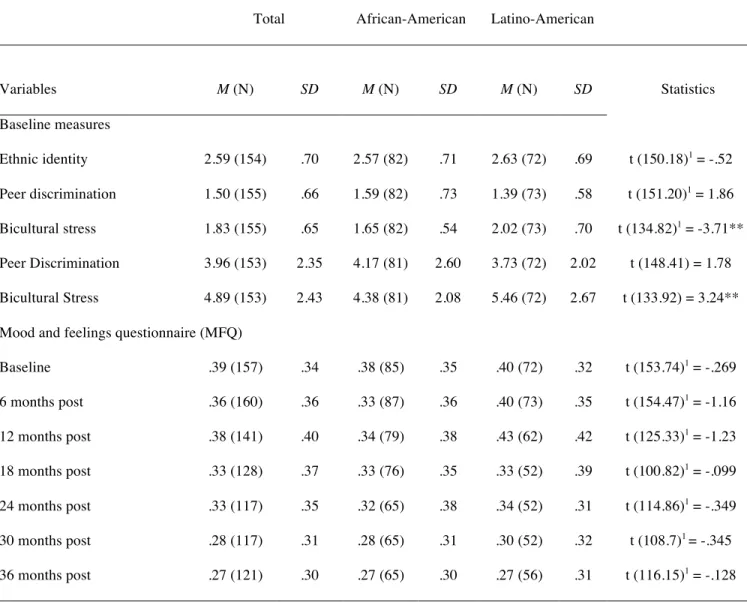
Latino-Americans experienced significantly higher Bicultural Stress than African-Latino-Americans, indicating that they felt more stress when they were forced to navigate different cultural settings. A
difference between peer discrimination between these two ethnicities approached significance (t(151)=1.86, p=.065). African-Americans reported more frequent discrimination experiences, indicating that they may experience higher rates of peer discrimination than their Latino-American peers.
Bivariate associations among all study variables were examined through Pearson correlations, and results are displayed in Table 2. Results are presented for both ethnicities to illustrate differences. For both ethnicities, higher bicultural stress was related to higher discrimination experiences. For both Latino-Americans and African-Americans, the stronger their ethnic identity, the higher their bicultural stress. Likewise, higher bicultural stress was correlated with higher peer discrimination experiences. Bicultural stress also was associated with depression at each time point. For African-Americans, more peer discrimination was moderately correlated with more depression up to 12 months post-baseline, while Latino-Americans’ peer discrimination only correlated with depression at baseline.
Course of Depression over Time
I used a latent curve analyses to model the proposed trajectories for individuals. For the multigroup latent trait analysis, the nature of growth for depression was modeled in an
unconditional growth curve across baseline, 6, 12, 18, 24, 30, and 36 months. Path weights for baseline depression were held constant at 0 and at 36 months were held constant at 1 while all time points in between were allowed to freely vary. Intercepts for Latino-American and African-American were held constant. χ2
(63) = 152.91, p < .001; χ2
/df = 2.43; CFI = .986 RMSEA = .09.The model approached good fit, so analyses were continued (Intercept = .39, SE = .03; Slope = 002, SE = .004).
For the conditional model, five predictor factors were incorporated into the model. Ethnic identity, peer discrimination, bicultural stress, ethnic identity x peer discrimination interaction, and ethnic identity x bicultural stress interaction were all considered as predictors. To examine ethnicity moderation, paths were set to be fixed across ethnicity or allowed to freely vary. Chi-square differences were conducted to examine significant differences in model fit. When
differences did not significantly affect model fit detrimentally, paths were fixed across ethnicity. Results suggest that the following paths were significantly moderated by ethnicity: ethnic identity’s relationship with intercept, peer discrimination and ethnic identity with slope. This conditional model of depression had good model fit, χ2
(122) = 251.45, p < .001; χ2
/df = 2.06; CFI = .93 RMSEA = .08. Table 3 presents the unstandardized path weights for the model. This model is depicted in Figure 2. The moderated predictor variable, peer discrimination x ethnic identity, significantly predicted the intercept and slope of depression.
included only significant variables to reduce errors in multicollinearity. To understand how peer discrimination and ethnic identity interact to predict depression over time, we calculated simple intercept, simple slope, and regions of significance for depression over time. Results of post-hoc probing of the 3-way interaction indicated that under conditions of high peer discrimination, high ethnic identity resulted in less decrease in depression over time. That is, those with high levels of peer discrimination and ethnic identity were at more risk for depressive symptoms. Figure 3 depicts four different trajectories of depression under high and low peer discrimination and ethnic identity. Additionally, under conditions of high peer discrimination, low ethnic identity appeared to lower the amount of depressive symptoms over time.
Discussion
This study contributes an examination of the longitudinal trajectories of depression for youth from ethnic minority backgrounds, an understudied and at-risk population. This study proposed that the strength of ethnic identity was not the only important consideration for the reduction of depression in youth from ethnic minority backgrounds. Bicultural stress and peer discrimination were considered as moderating factors in the relationship between ethnic identity and depression over time.
ethnic identity to become a risk factor for depression. While peer discrimination experiences were a significant moderating factor, bicultural stress was not. Furthermore, the effect of peer discrimination experiences was not moderated by ethnicity. This indicates that both Latino-American and African-Latino-American youth attribute peer discrimination to stable internal traits. Together, these results indicate that having high peer discrimination is an important contextual consideration, and lowering these peer discrimination experiences does not have a negative impact.
There were significant differences between ethnicities for two of the studies’ primary predictor variables, bicultural stress and peer discrimination. Bicultural stress was significantly higher for Latino-Americans than African-Americans indicating, that this measure, which asked questions on marked cultural differences, may be more relevant for Latino-Americans than African-Americans. In other words, due to multiple generations in the USA, African-Americans have fewer surprising cultural contrasts compared to the majority than the more recent Latino-American cultural group. Given the greater number of cross-cultural contrasts, Latino-Latino-Americans would experience more discomfort and conflict than African-Americans. Alternatively, Latino-Americans could be socialized more to close-knit groups than integrated African-American due to fewer generations in this area, which would hinder their assimilation of cultural knowledge. Results indicated African-Americans may experience a higher frequency of peer discrimination experiences. This could be due to intergenerational teaching to mistrust out-group racism or due to more integrated peer groups allowing more exposure to cross-group peers than
of ethnic identity, but in contextual factors that may change the buffering role of ethnic identity on depression.
Interestingly, there was a reduction in depression seen in the group with low ethnic identity and high peer discrimination. This was an unexpected result given the stress caused by high peer discrimination. One interpretation is that these youth are attributing their bullying to a construct under which they place little value. Because they have do not highly value this part of their self-concept, peer bullying may not affect their self-concept or increase depression. This result should be interpreted with caution, considering the amount of research that supports the long-term benefits of ethnic identity into adulthood.
Limitations and Future Research
This study was limited to experiences in high school when ethnic identity is relatively stable (Phinney, 1989; Pahl & Way, 2006); however, earlier experiences could moderate the role of ethnic identity. While not included in this study, immigrant versus non-immigrant and age of immigration would be interesting variables to include in future research. It is possible that early exposure to one’s culture and lack of early ethnic discrimination could create a greater protective factor. Adding to this complexity, later age of immigration for Asian-Americans has been
implicated as a factor for internalizing symptoms due to difficulty acculturating (Yeh, 2003). This past research implies a curvilinear relationship, with a potential ideal age of immigration. If these factors were considered, peer discrimination may have acted as a moderator for certain groups of Latino-Americans, such as second-generation immigrants.
generalizability of these results. Future studies could address a school that has noted need in cross-group relations.
This study measured negative peer experiences through a self-report measure; however, negative emotional disclosure and frequency are both partially culturally determined (Scollon, Koh, & Au, 2011). Williamson and collegues (2003) have shown that objective evaluation of stressful life events is a useful addition to understanding one’s experience of stress. However the application of this technique does require more time than traditional self-report. Based on the current study, perhaps future investigations on minority depression should conduct stressful life events inventories that focus on the frequency, perceived severity and rated severity of peer ethnic-based discrimination. Future research on the precursors to depression in Latino-American youth should investigate bicultural stress, as this group showed higher rates than the African-American sample.
Implications
Considering that one’s concurrent states of high ethnic identity and high peer discrimination appear to be detrimental, it is possible that these variables interact across development.
References
American Psychiatric Association. (2000). Diagnostic and statistical manual of mental disorders (4th ed., text rev.). doi:10.1176/appi.books.9780890423349
Arbuckle, J. L. (2006). Amos (Version 7.0) [Computer Program]. Chicago: SPSS.
Church, A., Katigbak, M. S., & del Prado, A. M. (2010). Cultural similarities and differences in perceived affordances of situations for big five behaviors. Journal of Research in
Personality, 44(1), 78-90. doi:10.1016/j.jrp.2009.11.003
Coatsworth, J., Maldonado-Molina, M., Pantin, H., & Szapocznik, J. (2005). A Person-Centered and Ecological Investigation of Acculturation Strategies in Hispanic Immigrant Youth. Journal Of Community Psychology, 33(2), 157-174. doi:10.1002/jcop.20046
Costigan, C. L., Koryzma, C. M., Hua, J. M., & Chance, L. J. (2010). Ethnic identity,
achievement, and psychological adjustment: Examining risk and resilience among youth from immigrant Chinese families in Canada. Cultural Diversity and Ethnic Minority Psychology, 16(2), 264-273. doi:10.1037/a0017275
Curran, P. J., Bauer, D. J, & Willoughby, M. T. (2004). Testing main effects and interactions in latent curve analysis. Psychological Methods, 9, 220-237.
Dulin-Keita, A., Hannon, L., Fernandez, J. R., & Cockerham, W. C. (2011). The defining
moment: Children's conceptualization of race and experiences with racial discrimination. Ethnic and Racial Studies, 34(4), 662-682. doi:10.1080/01419870.2011.535906
Ellemers, N., Van Knippenberg, A., & Wilke, H. A. (1990). The influence of permeability of group boundaries and stability of group status on strategies of individual mobility and social change. British Journal Of Social Psychology, 29(3), 233-246. doi:10.1111/j.2044-8309.1990.tb00902.x
Gaylord-Harden, N. K., Burrow, A. L., & Cunningham, J. A. (2012). A cultural‐asset framework for investigating successful adaptation to stress in African American youth. Child
Development Perspectives, 6(3), 264-271. doi:10.1111/j.1750-8606.2012.00236.x
Hammen, C., Adrian, C., & Hiroto, D. (1988). A longitudinal test of the attributional vulnerability model in children at risk for depression. British Journal of Clinical Psychology, 27(1), 37-46. doi:10.1111/j.2044-8260.1988.tb00751.x
Kao, G., & Joyner, K. (2006). Do Hispanic and Asian Adolescents Practice Panethnicity in Friendship Choices?. Social Science Quarterly, 87(5), 972-992. doi:10.1111/j.1540-6237.2006.00411.x
Laursen, B. (Ed). (1993). Close Friendships in Adolescence. San Francisco, CA: Jossey-Bass Publishers.
Mandara, J., Gaylord-Harden, N. K., Richards, M. H., & Ragsdale, B. L. (2009). The effects of changes in racial identity and self-esteem on changes in African American adolescents mental health. Child Development, 80(6), 1660-1675.
doi:10.1111/j.1467-8624.2009.01360.x
Pahl, K., & Way, N. (2006). Longitudinal Trajectories of Ethnic Identity Among Urban Black and Latino Adolescents. Child Development, 77(5), 1403-1415. doi:10.1111/j.1467-8624.2006.00943.x
Phinney, J. S. (1989). Stages of ethnic identity development in minority group adolescents. The Journal of Early Adolescence, 9(1-2), 34-49. doi:10.1177/0272431689091004
Phinney, J. S. (1992). The multigroup ethnic identity measure: A new scale for use with diverse groups. Journal of Adolescent Research, 7, 156– 176. doi:10.1177/074355489272003 Phinney, J. S., Cantu, C., & Kurtz, D. A. (1997). Ethnic and American identity as predictors of
self-esteem among African American, Latino, and White adolescents. Journal of Youth and Adolescence, 26(2), 165-185. doi:10.1023/A:1024500514834
Phinney, J. S., & Ong, A. D. (2007). Conceptualization and measurement of ethnic identity: Current status and future directions. Journal Of Counseling Psychology, 54(3), 271-281. doi:10.1037/0022-0167.54.3.271
Preacher, K. J., Curran, P. J., & Bauer, D. J. (2006). Computational tools for probing interaction effects in multiple linear regression, multilevel modeling, and latent curve analysis. Journal of Educational and Behavioral Statistics, 31, 437-448.
Rivas-Drake, D., Hughes, D., & Way, N. (2008). A closer look at peer discrimination, ethnic identity, and psychological well-being among urban Chinese American sixth graders.
Journal Of Youth And Adolescence, 37(1), 12-21. doi:10.1007/s10964-007-9227-x
identity in diverse populations. Cultural Diversity and Ethnic Minority Psychology, 15(2), 106-111. doi:10.1037/a0015510
Romero, A. J., & Roberts, R. E. (2003). The impact of multiple dimensions of ethnic identity on discrimination and adolescents' self-esteem. Journal of Applied Social Psychology, 33(11), 2288-2305. doi:10.1111/j.1559-1816.2003.tb01885.x
Schmidt, M. E., & Bagwell, C. L. (2007). The protective role of friendships in overtly and relationally victimized boys and girls. Merrill-Palmer Quarterly, 53(3), 439-460. doi:10.1353/mpq.2007.0021
Scollon, C., Koh, S., & Au, E. M. (2011). Cultural differences in the subjective experience of emotion: When and why they occur. Social And Personality Psychology Compass, 5(11), 853-864. doi:10.1111/j.1751-9004.2011.00391.x
Seaton, E. K., Yip, T., & Sellers, R. M. (2009). A longitudinal examination of racial identity and racial discrimination among African American adolescents. Child Development, 80(2), 406-417. doi:10.1111/j.1467-8624.2009.01268.x
Seaton, E. K., Yip, T., Morgan-Lopez, A., & Sellers, R. M. (2012). Racial discrimination and racial socialization as predictors of African American adolescents' racial identity
development using latent transition analysis. Developmental Psychology, 48(2), 448-458. doi:10.1037/a0025328
Swart, H., Hewstone, M., Christ, O., & Voci, A. (2011). Affective mediators of intergroup contact: A three-wave longitudinal study in South Africa. Journal of Personality and Social Psychology, 101(6), 1221-1238. doi:10.1037/a0024450
Umaña-Taylor, A. J., Updegraff, K. A., & Gonzales-Backen, M. A. (2011). Mexican-origin adolescent mothers’ stressors and psychosocial functioning: Examining ethnic identity affirmation and familism as moderators. Journal Of Youth And Adolescence, 40(2), 140-157. doi:10.1007/s10964-010-9511-z
Umaña-Taylor, A. J., Vargas-Chanes, D., Garcia, C. D., & Gonzales-Backen, M. (2008). A longitudinal examination of Latino adolescents' ethnic identity, coping with
discrimination, and self-esteem. The Journal Of Early Adolescence, 28(1), 16-50. doi:10.1177/0272431607308666
Verkuyten, M., & Thijs, J. (2006). Ethnic discrimination and global self-worth in early
adolescents: The mediating role ethnic self-esteem. International Journal Of Behavioral
Development, 30(2), 107-116. doi:10.1177/0165025406063573
Williams, C. T., & Johnson, L. R. (2011). Why can’t we be friends?: Multicultural attitudes and friendships with international students. International Journal of Intercultural Relations, 35(1), 41-48. doi:10.1016/j.ijintrel.2010.11.001
Williams, D. R., Neighbors, H. W., & Jackson, J. S. (2008). Racial/ethnic discrimination and health: Findings from community studies. American Journal Of Public Health, 98(Suppl9), S29-S37.
Williamson, D. E., Birmaher, B., Ryan, N. D., Shiffrin, T. P., Lusky, J. A., Protopapa, J., & ... Brent, D. A. (2003). The stressful life events schedule for children and adolescents: Development and validation. Psychiatry Research, 119(3), 225-241. doi:10.1016/S0165-1781(03)00134-3
Yeh, C. J. (2003). Age, acculturation, cultural adjustment, and mental health symptoms of Chinese, Korean, and Japanese immigrant youths. Cultural Diversity And Ethnic
Table 1. Descriptive Statistics for Primary Study Variables and Tests of Ethnic Differences
Total African-American Latino-American
Variables M (N) SD M (N) SD M (N) SD Statistics
Baseline measures
Ethnic identity 2.59 (154) .70 2.57 (82) .71 2.63 (72) .69 t (150.18)1 = -.52
Peer discrimination 1.50 (155) .66 1.59 (82) .73 1.39 (73) .58 t (151.20)1 = 1.86
Bicultural stress 1.83 (155) .65 1.65 (82) .54 2.02 (73) .70 t (134.82)1 = -3.71**
Peer Discrimination 3.96 (153) 2.35 4.17 (81) 2.60 3.73 (72) 2.02 t (148.41) = 1.78
Bicultural Stress 4.89 (153) 2.43 4.38 (81) 2.08 5.46 (72) 2.67 t (133.92) = 3.24**
Mood and feelings questionnaire (MFQ)
Baseline .39 (157) .34 .38 (85) .35 .40 (72) .32 t (153.74)1 = -.269
6 months post .36 (160) .36 .33 (87) .36 .40 (73) .35 t (154.47)1 = -1.16
12 months post .38 (141) .40 .34 (79) .38 .43 (62) .42 t (125.33)1 = -1.23
18 months post .33 (128) .37 .33 (76) .35 .33 (52) .39 t (100.82)1 = -.099
24 months post .33 (117) .35 .32 (65) .38 .34 (52) .31 t (114.86)1 = -.349
30 months post .28 (117) .31 .28 (65) .31 .30 (52) .32 t (108.7)1 = -.345
36 months post .27 (121) .30 .27 (65) .30 .27 (56) .31 t (116.15)1 = -.128
1. Equal variances not assumed.