Double Utility: Operating Public Transportation in Utility Rights-of-Way
by
Walker McGovney Freer
A Masters Project submitted to the faculty of the University of North Carolina at Chapel Hill
in partial fulfillment of the requirements
for the degree of Master of City and Regional Planning in the Department of City and Regional Planning
Chapel Hill
2015
Approved by:
Freer 1
Table of Contents
Executive Summary ... 2
Analysis of Existing Literature ... 4
Research Methodology ... 6
Regulatory Framework and Governmental Oversight ... 7
Transportation Environment ... 7
Federal Energy and Utility Framework ... 8
State-Level Utility Management ... 10
Rights-of-Way Design Guidelines ... 10
Utility and Public Transit Coordination ... 12
Utility Oversight ... 13
Utility Access Concerns ... 13
Interagency Collaboration ... 14
King of Prussia Rail Project ... 16
Existing Conditions ... 16
Previous Studies ... 18
Planning Process ... 18
Stakeholders and Coordination ... 20
York University Busway ... 22
Existing Conditions ... 22
Planning Process ... 23
Operational Upgrades ... 24
Transit Options Amherst-Buffalo ... 25
Existing Conditions ... 25
Planning Process ... 26
Project Status ... 26
Composite Analysis ... 28
Planning Process Variations ... 28
Design Restrictions ... 29
Stakeholder Involvement ... 30
Conclusions ... 31
Appendix I: Interviewees ... 33
Appendix II: High-Voltage Transmission Lines ... 34
Freer 2
Executive Summary
As urbanized regions progressively densify and congested roadways continue to reduce vehicular mobility, identifying and securing funding for dedicated rights-of-way for public transportation projects will become increasingly contentious and costly for local governments and transit agencies, but equally essential. However, in most urban and suburban regions, accessible and unobstructed Greenfield rights-of-way (ROW) corridors are already scarce, especially between heavily populated areas containing the potential for high trip generation. Recognizing these limitations, this research analyzes the feasibility of siting and operating public transportation in active utility rights-of-way.
The Department of Energy (DOE) reports that electricity demand in the United States is forecasted to rise by 30% by 2030. This increased demand, coupled with an aging electrical infrastructure, will place additional strain on the country’s existing transmission line network (DOE 2015). Alternatively, where existing transmission lines must be replaced, transit agencies could use this opportunity to explore the possibility of operating transit concurrently along the corridor. Understanding best planning practices between utility providers, transportation agencies, and federal regulatory bodies is vital. This report also addresses the fundamental differences that exist between utility corporations and public transit agencies concerning the development of land, which is illustrated by the siting of high-voltage transmission lines (HVTL) before adjacent land is developed or even planned (Bond 2013).
In North America, public transportation alignments in utility rights-of-way have been
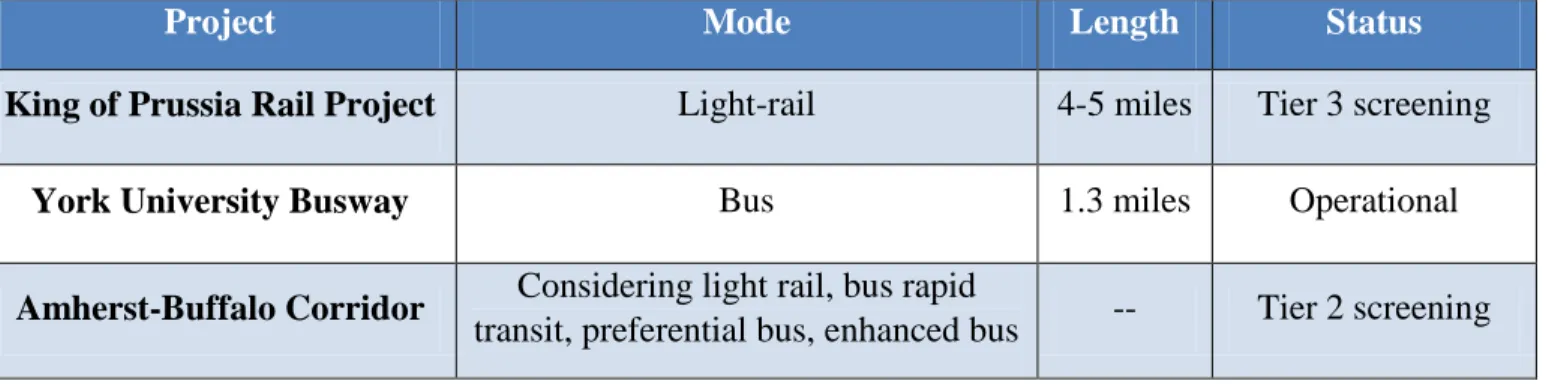
successfully applied in three instances: the York University Busway in Toronto, Ontario, the Southwest Transitway in Winnipeg, Manitoba, and the Central Light Rail System in Baltimore, Maryland. Alignments featuring public transit operating along utility rights-of-way corridors are currently being evaluated in two planning processes in the United States: the Amherst-Buffalo Corridor in upstate New York, and the King of Prussia Rail Project outside Philadelphia, Pennsylvania (Table 1). Despite these successful applications and proposed future operations, myriad locational, policy, and financial challenges encumber the implementation of public transportation in active utility ROW corridors.
Project Mode Length Status
King of Prussia Rail Project Light-rail 4-5 miles Tier 3 screening
York University Busway Bus 1.3 miles Operational
Amherst-Buffalo Corridor Considering light rail, bus rapid
transit, preferential bus, enhanced bus -- Tier 2 screening Table 1: Project Status
Freer 3 or induce hazardous situations. Due to the precarious nature of operating public transit in utility rights-of-way, “pass through” alignments are more commonly applied.1 These efficient
connections can help reduce total trip lengths between separated population centers while still allowing transmission lines to function freely.
Analysis of these case studies accentuate multiple technical engineering and design concerns that inhibit the widespread application of these projects nationally:
High-voltage transmission line clearance: Utility operators must ensure that transit operations within a corridor do not interfere with electric transmissions, or cause service disruptions.
Public health concerns: Although little research suggests that exposure to
electromagnetic frequencies lead to increased health risks, these concerns continue to exist among the general public, and must be considered in the planning process.
Rights-of-way access: Limited access points along utility corridors typically eliminate the option for local transit services.
Rights-of-way dimensions: Not all transmission line corridors feature adequate width to support high-order public transportation.
Because of these challenges securing funding for these projects can also be problematic. Despite these technical limitations, this research suggests that specific alignments and development typologies can support the operation of public transit along utility corridors:
Special generators: Accessible utility rights-of-way serve as ideal potential alignments to connect distinctive, dense, peripheral activity centers lacking dedicated high-capacity transit options.
Express service: Providing express service expedites travel time, reduces the necessary transit infrastructure located within the utility corridor, and limits passenger exposure to hazardous scenarios.
Complementing existing service and enhancing multimodal connections: Transit services operating along utility corridors are often complemented, or enhanced, by connections with existing transit systems.
Expanding the geographic scope of transit services can encourage multimodal interaction (walking and biking to new stations), result in fewer vehicular trips, and reduce vehicular congestion.
This report identifies the common policies and planning practices employed by local, regional, state, and federal planning agencies when designing public transportation projects; examines the federal regulatory environment for energy and utility operators; identifies effective interagency collaborative models; and reviews the corridor typology, design guidelines, and shared-use agreements the promote alignments supporting public transit in rights-of-way corridors hosting active utility operations.
Freer 4
Analysis of Existing Literature
Due to the limited successful application of this concept, there is a notable absence of relevant academic literature. The scarcity of relevant data refined the project’s research goals and identified specific concerns to focus on within these complex planning processes. However, analyzing the existing literature on the individual factors related to the siting and use of utility rights-of-way, including the interaction between transportation and land use, potential health concerns associated with electromagnetic exposure, shared access corridors, and property values, helped inform this research.
The positive correlation between land use and public transportation is extensive, and well
documented. Cervero (2009) advocates for proactive planning that “strike an appropriate balance between transport infrastructure as an economic conduit and broader place-making and
community-building objectives.” Calthorpe (1993) calls for planners to retrofit sprawling suburban developments to promote higher-density and a variety of urban uses. He also supports dedicated rights-of-way to enable “easy movement.”
Residential neighborhoods adjacent to utility rights-of-way are inevitably affected by
infrastructure improvements that occur within these corridors. Literature related to the impact of utility corridors on residential property values is mixed: Chalmers (2009) found that housing values are only negatively impacted when transmission lines are actively blocking view sheds, or encumbering on private property, and thus considered a disamenity to home buyers. Residential properties abutting HVTL rights-of-way benefit from proximity to additional green space, but access may be restricted or limited by the utility operator. The economic impact of public transit in utility ROW on nearby residential properties is unclear, and is likely dependent on the mode selected and the level of permanent infrastructure. As future projects become active, this is an area deserving of future study.
The potential for increased passenger exposure to electromagnetic fields (EMF) in transmission corridors hosting public transit must also be addressed. Fortunately, research concerning the health effects of living near transmission and distribution lines, and exposure to EMF is
encouraging: there is little to no evidence that increased exposure to EMF results in higher rates of leukemia, brain cancer, or breast cancer (the primary afflictions researched). Nor does
exposure to EMF alter normal brain and heart function, disrupt sleep patterns, affect the immune system, or affect hormones (NIEHS 2002). Electromagnetic exposure via electric power
Freer 5 magnetic fields (EPRI 2009).2 The International Agency for Research on Cancer classifies
extremely low-frequency electric fields as “not classifiable as to its carcinogenicity to humans”; extremely low-frequency magnetic fields are considered “possibly carcinogenic to humans” (IARC 2015).3 This research review indicates that passenger exposure to EMF should not be considered a liability for public transit agencies or utility operators when considering alternatives in HVTL rights-of-way.
Deen and Pratt (1992) frame the relationship of public transportation and the identification of available rights-of-way as goals and design objectives being informed by design methods: if the goal of a transit project is to “minimize construction cost or use of existing ROW to avoid under-ground/elevated construction,” then power-line rights-of-way is a design method worthy of consideration; they also note that this is a trade-off, as available ROW is typically located “distant from activity centers.”
Multiple precedents exist for the sharing of power line rights-of-way, for a variety of uses. Pucher et al (1999) noted that in 1999 Toronto featured approximately 75 miles of pedestrian and bicycle trains, with 120 additional miles along utility and rail corridors under study; due to the minimal infrastructure, design standards, and construction costs, bicycle and pedestrian facilities are much easier to accommodate than public transit vehicles, which require significantly wider rights-of-way and dedicated heavy infrastructure.4 Guichon and Blackwell (1986) examined multiple purpose use of rights-of-way in British Columbia, and noted that utility ROW is designed to ensure “minimal interruption” of services. However, they also note that multi-purpose rights-of-way “frequently create higher economic use of land.” Allen (2001) notes two primary limitations associated with constructing public transit projects along existing railroad right of way: proximity of associated industrial land uses and the lack of service for primary travel destinations can limit future real estate development.
Literature concerning the appraisal and valuation of easements primarily focuses on the Highest and Best Use (HBU) for these land parcels. Schmick and Strachota (2006) discuss the railroad valuation model referred to as Across the Fence (ATF). The ATF model theorizes that the assemblage of multiple land parcels into a single corridor creates a “synergism” that raises the overall value and use of the corridor, leading to an increased in perceived value “enhancement factor. While ATF valuation applies specifically to existing railroad rights-of-way, the economic implications can be approximated for utility corridors.
2 The EPRI review cited the World Health Organization, the International Agency for Research on Cancer (IARC),
the California Department of Health Services, the National Radiological Protection Board, the International
Commission on Non-Ionizing Radiation Protection, the National Institute of Environmental Health Sciences, and the National Academy of Sciences/National Research Council.
3 The IARC classifies potentially carcinogenic agents in five categories: Group 1 (Carcinogenic to humans), Group
2A (Probably carcinogenic to humans), Group 2B (Possibly carcinogenic to humans), Group 3 (Not classifiable as to its carcinogenicity to humans), and Group 4 (Probably not carcinogenic to humans).
4
Freer 6
Research Methodology
Few cases of dedicated public transit service operating along active utility rights-of-way exist, which limited the pool of projects to study for this research. These three case studies were selected due to their varied geographic locations, planning procedures, and the mode of transportation considered or ultimately selected. Furthermore, each of these three projects provides an alternate conceptual perspective, and is analyzed from a distinct stage of the planning process: the Amherst-Buffalo Corridor is analyzing Tier 1 and Tier 2 alternatives; the King of Prussia Rail Project has entered the final tier of the alternatives analysis process (Tier 3) and is working towards producing the Draft Environmental Impact Statement (DEIS), as
required by the National Environmental Policy Act (NEPA); the York University Busway opened in 2009, and has been operational for six years.
To gain a better understanding of the planning processes applied to these projects, extensive conversations and interviews were conducted with a range of planning practitioners and stakeholder organizations. This included planning practitioners and project managers from all three primary transit agencies overseeing these projects: the Southeastern Pennsylvania Transportation Authority (SEPTA), the Toronto Transportation Commission (TTC), and the Niagara Frontier Transportation Authority (NFTA). The following organizations were also interviewed: project consultants, invested stakeholders (the King of Prussia Business
Improvement District, officials at York University), project managers from the Federal Transit Administration (FTA) and the Federal Energy Regulatory Commission (FERC), and the Rails-to-Trails Conservancy, a non-profit advocacy organization.
Freer 7
Regulatory Framework and Governmental Oversight
Transportation Environment
The financing approval process for public transportation projects in the United States is governed by multiple federal agencies, including the U.S. Department of Transportation (DOT), the
Federal Transit Administration (FTA), and the Federal Highway Administration (FHWA); the FTA issues detailed regulations overseeing the acquisition or lease of property for transportation projects that benefit from federal assistance. State transportation departments, metropolitan planning organizations (MPOs), local planning agencies, and regional planning commissions are often intimately involved in the planning process for transportation projects; advocacy and stakeholder organizations, such as transportation management associations (TMAs) and business improvement districts (BIDs), also contribute to the planning dialogue.
Long-range transportation plans and transportation improvement plans produced by Metropolitan Planning Organizations (MPOs) direct project selection for local transit agencies. Public
transportation agencies determine specific alignments for transportation projects by undergoing extensive, multiyear public planning processes. A three-tiered process identifies project goals, objectives, purpose and need, determines alternatives, and reaches a design consensus based on the results of conceptual evaluation and comprehensive technical analysis. Public participation is continuously sourced through periodic public meetings, public comment periods, and public surveys. The selected alternative becomes the Locally Preferred Alternative (LPA).
While the Federal Transit Administration contributes financing for transportation infrastructure improvement projects selected through the New Starts/Small Starts program, the FTA is not an active participant in the process to select the LPA. However, a critical understanding of and familiarity with the FTA’s grading criteria for New Starts/Small Starts financing is essential when analyzing potential applications that hope to benefit from FTA funding. Under the Moving Ahead for Progress in the 21st Century Act (MAP-21), overall ratings for New Starts/Small Starts projects are determined through a combined review of “Project Justification” metrics and the “Local Financial Commitment.” The FTA assesses six evaluation criteria to determine Project Justification ratings: mobility improvements, environmental benefits, congestion relief, cost-effectiveness, economic development, and land use; each criterion is weighted equally (16.66%). To assess competitiveness for the Local Financial Commitment component, current conditions (25%), commitment of funds (25%), and reliability/capacity (50%) are considered (FTA 2013). Established in 2009, the U.S. DOT’s Transportation Investment Generating Economic Recovery (TIGER) program is an additional financing mechanism for local road, rail, and transit projects. Characteristically, utility power line corridors are located in alignments that are undesirable for public transit, which limits the optimal maximization of land uses. Accordingly, nearby
Freer 8 transit is directly applicable to an HVTL corridor is determinant on myriad factors. Specific aspects that increase the compatibility of transit in HVTL corridors are preexisting public transit adjacent or connected to the corridor, the presence of trip-generating activity centers along the corridor, and the width necessary to support transportation infrastructure.
Federal Energy and Utility Framework
The energy, utility, and transmission industry and environment in the United States is regulated by a complex thicket of government agencies, transmission organizations, and state-operated commissions. The Federal Energy Regulatory Commission (FERC) regulates gas, oil, electric, and hydropower utility companies and subsidiaries in the United States. FERC maintains oversight of interstate transmission lines, but the commission’s authority is limited at the intrastate and local levels; authorization for transmission line siting widely varies by state. In 1999, prompted by concerns regarding the capacity and management of the national
transmission grid, FERC established a system of Regional Transmission Organizations (RTOs) “to promote efficiency in wholesale electricity markets and to ensure that electricity consumers pay the lowest price possible for reliable service” (FERC 1999). To improve the planning process for grid capacity, transmission planning and expansion is included as one of eight minimum RTO functions: “The Regional Transmission Organization must be responsible for planning, and for directing or arranging, necessary transmission expansions, additions, and upgrades that will enable it to provide efficient, reliable and non-discriminatory transmission service and coordinate such efforts with the appropriate state authorities” (FERC 1999). Moreover, this order elevated transmission planning from the level of individual utility
companies to a regionally focused decision, thereby increasing FERC’s ability to control future transmission siting decisions. As of 2015, FERC administers six RTO/ISO electric power markets in the United States: California, Midcontinent, New England, New York, PJM Interconnection, and the Southwest Power Pool. PECO Energy, the utility operator within the King of Prussia Rail corridor, operates under the authority of the PJM Interconnection, the regional transmission organization (RTO) that coordinates wholesale electricity movements for 13 states and the District of Columbia.
The enactment of the Energy Policy Act of 2005 greatly expanded the federal government’s role in regulating transmission lines, and resulted in numerous regulatory stipulations applied to the Department of Energy (DOE) and FERC. Section 1221, “Siting of Interstate Electric
Transmission Facilities,” requires the Department of Energy to complete a triannual transmission congestion study. Where the DOE identifies “any geographic area experiencing transmission capacity constraints or congestion that adversely affects consumers,” the department is entitled to designate National Interest Electric Transmission Corridors (NIETC) (H.R. 6 2005).5
Released in 2006, the DOE’s inaugural NIETC study identified two “critical congestion areas”: the Mid-Atlantic Area (stretching from metropolitan New York to Northern Virginia) and the Southwest Area (encompassing Southern California and sections of eastern Arizona).
Freer 9 Additionally, the Act authorizes FERC to issues permits for the construction or modification of transmission facilities in a National Interest Electric Transmission Corridor if the facilities or project will be used for interstate electric transmission, is consistent with the public interest, will “significantly reduce interstate congestion and protects or benefits consumers,” is consistent with national energy policy, and that the “proposed modification will maximize, to the extent
reasonable and economical, the transmission capacity of existing towers or structures” (H.R. 6 2005). As the high-voltage transmission lines operating adjacent to King of Prussia lie within the mid-Atlantic critical congestion area, the regulatory oversight and restrictions for these
transmission lines may be more tightly controlled.
Also in 2006, FERC certified the North American Electric Reliability Corporation (NERC) to “assure the reliability of the bulk power system in North America.” As North America’s
designated electric reliability organization (ERO), NERC’s core focuses are ensuring bulk power reliability for all users, owners and operators, and operating a risk-based approach (NERC 2015). FERC’s Order No. 1000 continued the movement to streamline the transmission planning
process between public utility providers. Issued in 2010, and legally affirmed in 2014, Order No. 1000 requires all public utility transmission providers to participate in regional transportation planning processes; 16 transportation planning regions are designated nationwide (only the Electric Reliability Council of Texas is excluded). Collaboration between public utility transmission providers in neighboring transmission planning regions is required to determine potential efficiencies and cost-effective solutions for mutual transmission needs (FERC 2015b). Understanding the scope of the transmission line network in the United States reinforces the potential advantages for operating transit in utility right-of-way. As of 2002, the U.S.
high-voltage transmission line (HVTL) system consisted of 157,810 miles of transmission lines. These lines are split between alternating current (AC), where the electric current can reverse its
direction at given intervals, and direct current (DC), which flow in only one direction through a circuit. AC transmission lines account for 98% of all transmission miles in the United States; only five long-distance DC transmission lines are currently operational (DOE 2002).
Freer 10
State-Level Utility Management
At the state level, primary siting agencies generally regulate the interstate transmission line siting process, and authorize the construction of new transmission line projects. For the majority of states the primary siting agencies are public utility commissions (PUCs), public service
commissions (PSCs), or siting councils; select states are regulated by multiple siting authorities.6 The degree of authority endowed to state siting agencies varies by jurisdiction, and is dependent on multiple state-specific factors and regulatory constraints. This diverse landscape of siting agencies and contrasting state-level policies and regulations results in distinct and highly specialized planning processes.
In Pennsylvania, the Public Utility Commission is the primary siting agency, determining whether the need for a transmission line exists and if the proposed utility route is the best considered alternative. When determining the final siting for transmission lines the PUC considers the impact on public safety, the environment, existing land uses, soil and hydrology, wildlife habitats, and scenic and historic sites (Pa. PUC 2015). The PUC requires approval for transmission lines operating at greater than 100 kilovolts (kV); a full application is required for transmission lines greater than two miles in length; the Pennsylvania Department of
Environmental Protection controls environmental permitting. Within this context, transmission projects must also comply with local zoning ordinances and regulations. In New York, the New York State Public Service Commission maintains authority of transmission line siting. The PSC provides certification for transmission lines operating at greater than 125 kV and longer than one mile in length, and lines operating between 100 – 124 kV and greater than 10 miles in length.
Rights-of-Way Design Guidelines
Design guidelines and required rights-of-way (ROW) clearance and width vary by individual states and utility operators. The standard utility ROW configuration features a center wire zone, buffered by border zones on each side of the transmission corridor. At the utility-level, design decisions are guided by voltage, which determine transmission structure type, height, and rights-of-way width. The Department of Labor’s Occupational Safety & Health Administration
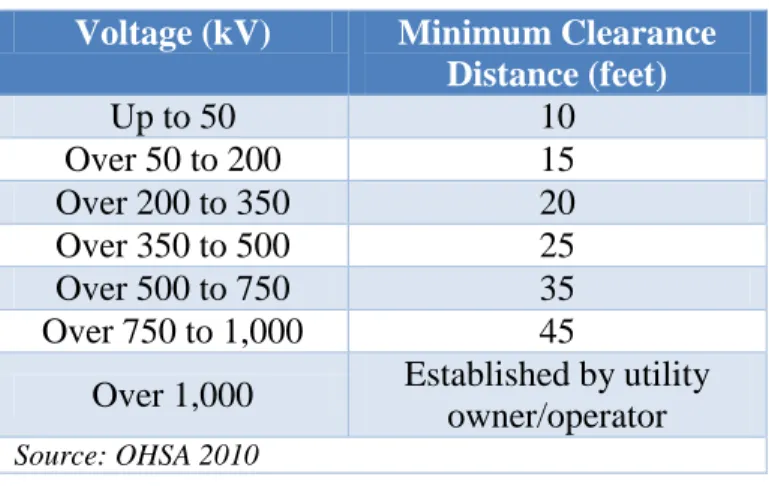
(OSHA) maintains comprehensive safety regulations and standards to protect employees working in proximity to power distribution and transmission lines. Included within these regulations are minimum clearance distances from electric transmission lines (Table 2). For comparison, in North Carolina, Duke Energy maintains the following minimum corridor width requirements: 68-foot corridor for 44- and 100-kV lines; 150-foot corridor for 230-kV lines; 200-foot corridor for 525-kV lines (Duke Energy 2015).
Duke Energy also maintains explicit requirements for shared-use paths and trails operating in utility right-of-way. Guidelines stipulate that trails must not exceed a total of 12 feet in width,
6
Freer 11 and minimum separation of 25 feet is required between easements and utility operations (Duke Energy 2014). These restrictions are designed to both limit the liability of Duke Energy and ensure that energy transmission operates continuously.
Table 2: OSHA Minimum Clearance Distances
As the state regulator, the Pennsylvania PUC also reviews proposed structural designs for transmission line sitings. Statements issued by PPL Electric in a public input hearing in July 2009 for a proposed 500 kV transmission line detail standard siting dimensions in Pennsylvania: average structure height for transmission lines carrying between 69 kV and 138 kV is 85-90 feet, with a right-of-way of 70-100 feet. For 230 kV transmission lines, the modern recommended height is 140 feet, with a 150 foot ROW; statements from the hearing also note that standard ROW for 500 kV transmission lines is 200 feet (Pa. PUC 2009).
Limerick Township, Pennsylvania, is located 16 miles northwest of King of Prussia. The planning process for the township’s “Greenways and Trails Master Plan” provides insight on rights-of-way negotiations with PECO. Completed in 2013, the master plan guides future
development of greenways, trails, and bicycle routes within Limerick Township, with the goal of providing residents with “close-to-home transportation options and recreational and fitness opportunities” (LT 2013). PECO was involved throughout the planning process in 2012 and 2013. In November 2012, township officials and project consultants met with PECO’s External Affairs Manager and Real Estate Specialist to review the feasibility of draft trail alignments, and PECO’s right-of-way requirements; lease agreements with adjacent property owners,
maintenance responsibilities, and trail licensing agreements were also considered.
Notes from the November 2012 meeting provide an overview of PECO’s terms and conditions for leasing right-of-way property. An extensive three-to-four month review process, including an evaluation property review of active leases and future growth prospects for the utility corridor, was performed by PECO prior to an easement agreement and the construction of trail facilities; PECO engineers reviewed all potential trail alignments and construction methods to ensure no conflicts with utility operations occur. Meeting notes indicate that the estimated annual lease fee for the proposed 3.8 mile trail alignment within the PECO-owned ROW along Route 11 is $3,000, with lease terms up to 25 years (LT 2013).
Voltage (kV) Minimum Clearance Distance (feet)
Up to 50 10
Over 50 to 200 15
Over 200 to 350 20
Over 350 to 500 25
Over 500 to 750 35
Over 750 to 1,000 45
Freer 12 Incidentally, PECO helped finance the study through a $7,500 grant award. PECO’s Green Region program provides grants to communities in Southeastern Pennsylvania focusing on public open space preservation, parks and recreation improvements, and environmental conservation (PECO 2014). The Green Region program could be a potential financing
mechanism for a King of Prussia rail project alternative operating in PECO ROW, despite only accounting for a miniscule percentage of total estimated project costs.
The master plan also includes specific clearance distances from PECO transmission lines for contractors operating within the right-of-way. PECO’s recommended clearance standards are slightly more stringent than regulatory distance requirements maintained by OHSA: 34 kV and below (12 feet), 69 kV (15 feet), 138 kV (20 feet), 230 kV (25 feet), and 500 kV (35 feet) (LT 2013).
Utility and Public Transit Coordination
Precedents for interlocal agreements between transportation agencies and utility providers exist on limited scales. In 2007, the Nevada State Legislature passed legislation that enhanced the station selection and improvement capabilities of public transit agencies. Senate Bill 417 (S.B. 417) authorizes transportation commissions in jurisdictions with populations greater than 400,000, specifically the MPO serving Las Vegas, the Regional Transportation Commission of Southern Nevada (RTC), to locate public transit stations within public and utility easements and dedicated rights-of-way; the bill provides for construction of benches, shelters, and transit stops. (NRCB 2007). S.B. 417 also requires the transit commission to execute an interlocal cooperative agreement with the entity operating the easement, which ensures proper maintenance and
upkeep. This legislation, while limited to transit stations, extends and transfers authority of transit agencies to land owned and controlled by utility providers. In 2014, the RTC invested $2.3 million to expand or install 150 bus shelters, along with the installation of 130 benches and trash cans; right-of-way was obtained from three private partners, but not required from utility providers (METRO 2014).
The Implementing Recommendations of the 9/11 Commission Act of 2007 also contains stipulations pertaining to the operation of high-voltage transmission lines, requiring “an assessment of the placement of high-voltage, direct-current, electric transmission lines along active railroad and other transportation rights-of-way.”7 This assessment was completed and released by the General Accountability Office (GAO) in February 2008. The GAO’s review of stakeholders identified three potential benefits of collocating utility functions in transportation rights-of-way: 1) easier and expedited construction and maintenance, via facilitated access to transmission lines, 2) avoiding undisturbed land reduces the environmental and visual impacts, and 3) economic efficiencies can be realized by operating multiple uses on a single ROW, with easement fees benefiting the primary owner. The report also identified potential safety and security risks of collocation. Safety concerns include accidents precipitated by transportation infrastructure users which could inflict damage on transmission lines, electromagnetic
interference between and railroad or highway signaling systems, and the increased risk of injury
Freer 13 to maintenance workers. Disruptive events along the corridor that could lead to interruptions in transit service are the GAO’s principle security apprehensions (GAO 2008).
Utility Oversight
Multiple governmental and not-for-profit regulatory bodies oversee the U.S. and Canadian electrical power grid. While FERC serves as the primary federal regulating body for interstate transmission of electricity, the agency maintains limited authority over the siting of high-voltage transmission lines (FERC 2010). Due to jurisdictional oversight, interstate transmission line projects encounter increased siting, permitting, cost allocation, and cost recovery challenges (EEI 2015). A report from FERC Director J. Mark Robinson reported that from 2000 to 2007, only 14 transmission lines were built that physically crossed state lines (FERC 2007).
The Edison Electric Institute (EEI) represents all investor-owned utility companies in the United States. Released in March 2015, EEI’s annual report analyzes the current infrastructure
improvements member utility companies are applying nationwide, and planned investments through 2025. Transmission projects completed in 2014 represented investments of $3.6 billion. Interstate projects, transmission lines spanning two or more states, represent 42% of current or future transmission sitings, while 58% occurred within a single state; interstate projects are projected to be responsible for 11,800 miles of new transmission line construction, and $19.2 billion of accompanying investments.
The increased focus on renewable energy technologies (wind power, solar power,
hydroelectricity, geothermal, biomass, and biofuels), which are typically required to travel further distances between generation and load, has resulted in a greater emphasis on high-voltage transmission projects by utility providers. Forty-six percent of projects included in the EEI report are integrating renewable energy resources through the upgrade or construction of approximately 6,400 lines of transmission and associated investment costs of $22.1 billion. Financing for high-voltage projects, 345 kV and higher, represents over $31.5 billion, and approximately 7,700 miles of transmission lines. These investments will finance grid modernization (reinforcing and upgrading infrastructure), upgrades to existing transmission capabilities, and the construction of new transmission lines (EEI 2015).
Utility Access Concerns
Busways are more accessible to the general public than elevated railways, and therefore create additional administrative complications for utility operators. The two primary concerns for utility providers are 1) safeguarding their infrastructure to ensure transmission delivery remains fully operational and 2) preventing unauthorized access by the general public that could result in illegal and hazardous situations (e.g. joy-riding or drag racing). To assuage the utility providers, planners and engineers can implement a number of physical protective measures and signage to deter public use.
Freer 14 protect the utility’s high-voltage transmission lines. While access to the busway is not physically obstructed by barriers or gates, signs at all entrances explicitly prohibit public access or use. The posted speed within the Finch Hydro Corridor is 37 miles per hour, which limits the threat of collisions between transit vehicles and transmission facilities. In Limerick Township, illegal all-terrain vehicle (ATV) activities on PECO’s right-of-way impeded the planning process for new greenway trails; the project expects ATV activities to decrease as people are allowed to access the ROW for recreational purposes, but consultants also recommended designating an additional venue specifically for ATV users (LT 2013).
Interagency Collaboration
Despite the multitudinous nature of federal and state agencies, representative associations, and regulatory commissions, there is evidence that interagency collaboration can be leveraged to create more efficient processes for the siting of high-voltage transmission lines. In 2009, nine Federal agencies, including FERC, executed a joint memorandum of understanding to coordinate review of transmission siting projects. This initiative served as the impetus for the formation of the Rapid Response Team for Transmission (RRTT), created in 2011 by the White House’s Council on Environmental Quality (CEQ). The RRTT’s goals are to increase interagency coordination and reduce delays in the review and permitting process of transmission line siting on federal and non-federal lands. Additionally, the RRTT seeks to “resolve interagency
conflicts” and to ensure that project timelines are met effectively across agencies. The integrated planning success of RRTT demonstrates the potential for government agencies, led by the White House, to collaborate more effectively within the confines of the existing policies and
regulations. The RRTT is currently developing seven pilot project transmission lines in 12 states (WHCEQ 2015). This arrangement proves that institutional changes and streamlining review processes can lead to more efficient and effective outcomes.
The Eastern Interconnection Planning Collaborative (EPIC) serves as an alternate model for interagency utility partnerships. EPIC was established in 2010 through funding from the
Department of Energy. The collaborative is comprised of the 27 utility planning authorities that operate on the Eastern Connection alternating-current electrical grid (including both the PJM Interconnection and the New York ISO). EPIC’s directive is “to prepare analyses of transmission requirements under a broad range of alternative futures and develop long-term interconnection-wide transmission expansion plans in response to the alternative resource scenarios.” This approach involves federal and state officials, independent utility system operators and regional transmission organizations, and non-government organizations in the transmission planning process (EPIC 2010). A critical result of EPIC’s formation is long-term scenario planning (20 years) addressing multiple economic and policy situations that could impact the transmission network (EPA 2011).
Several advocacy organizations provide technical assistance and support for jurisdictions seeking to construct trails within existing railroad rights-of-way. The Rails-to-Trails Conservancy (RTC) is a prominent non-profit organization that advocates for the development of multi-use
Freer 15 acquisition and conversion processes. In this role, RTC interacts and coordinates with all
involved parties: transit agencies, economic development stakeholders, adjacent land owners, social services (schools, churches, and hospitals), community organizations, and state
environmental agencies. RTC suggests several acquisition methods: purchase, option to buy, easements, land donation, land lease, purchase and lease back, bargain sale, eminent domain. RTC maintains a database of trail projects operating in railway or greenway, co-operated by utilities. In 2015, RTC documented 320 multi-use trail projects that share rights-of-way with utility services. These utility providers include electric, natural gas, fiber optic, telephone, cable television, sewer, and water. While 48% of these trails share access with only one utility type, primarily electric, gas, fiber optic, sewer, and water providers, 52% of trails coexist with multiple utility providers along a singular ROW (RTC 2015).
International transportation programming is equally informative and relevant. The Australian Transport Council has developed a Transport System Management process that “focuses on strategic plan delivery and review, strategic alignment of activities, sound justification of
activities, identification of future transportation needs, and definition of activities consistent with future plans.” The consideration of long-term rights-of-way needs and forward-oriented
coordination with property owners, utility companies, and transit agencies are emphasized. The eight-step framework specifically reviews transportation system objectives, policy decisions, and multimodal networks to create more efficient management process informed by iterative
Freer 16
King of Prussia Rail Project
Upper Marion, Pennsylvania
Tier 3 screening is ongoing for the King of Prussia Rail Project, a proposed extension of the Norristown High Speed Line. Two alternatives feature light-rail along the PECO Energy HVTL right-of-way, and will increase access to the King of Prussia and Valley Forge activity centers. The Locally Preferred Alternative is expected to be selected in the fall of 2015 (SEPTA 2014).
Existing Conditions
The King of Prussia (KoP) activity center is located in Upper Marion Township, 20 miles northwest of downtown Philadelphia, Pennsylvania, and is a lynchpin of southeastern
Pennsylvania’s economy. In 2010, Upper Marion Township featured a population of 28,435, and is easily accessible from affluent “Main Line” suburbs such as Bryn Mawr, Lower Marion, Malvern, and Villanova. Anchored by the King of Prussia Mall, the region’s largest employment center outside of Philadelphia, Upper Marion contained 57,100 jobs in 2010, while total
employment is expected to reach 62,100 in 2040. Among existing jobs, 12,500 are located at or
Freer 17 within the vicinity of the King of Prussia Mall, with an additional 19,000 located in nearby office parks (KoPRP 2014). With over 2.4 million square feet of leasable retail space, the King of Prussia Mall is the largest mall in America (KoP 2012). The Mall is a prominent regional destination, attracts 68,000 people daily, and totals 25 million annual visitors (KoRPR 2014). King of Prussia is advantageously located near the junction of several major interstate and regional highways. The Schuylkill Expressway (I-76) provides direct access to downtown Philadelphia, the Pennsylvania Turnpike (I-276) connects the area with New Jersey and New York, and U.S. Routes 202 and 422 allow for greater accessibility to destinations within
southeastern Pennsylvania, including the Philadelphia International Airport. As such, the area is extremely auto-centric; the mall alone features 13,376 parking spaces (VP 2015). The limited geography of the four-to-eight lane Schuylkill Expressway has been the driving factor for rail studies in the corridor. Tightly hemmed to the east by the Schuylkill River and restricted by elevated topography on the western side, expansion of the highway is impractical. To alleviate traffic and reduce travel times, congestion pricing or the construction of an upper deck have been suggested, but not seriously studied.
The Southeastern Pennsylvania Transportation Authority (SEPTA) operates a robust subway, trolley, bus, and regional rail network, but does not provide rail service to King of Prussia. The Norristown High Speed Line (NHSL) is a 13.4 mile, 22-station interurban rail line that primarily serves commuters, with two stations in the eastern end of Upper Marion Township (Gulph Mills and Hughes Park). The NHSL is fully grade separated, powered by a third-rail, and features boarding platforms similar to commuter rail service. Service operates from Norristown, north of the Schuylkill River in Montgomery County, to the 69th Street Transportation Center in Upper Darby (west of Philadelphia); connections to the Market-Frankford Subway-Elevated Line (MFSE) and the 101 Media and 102 Sharon Hill trolley lines are available at the 69th Street Transportation Center. The NHSL offers four levels of service: local (stops at all stations), Norristown express (17 stops), Hughes Park express (16 stops), and Norristown limited (eight stops). In 2014 the NHSL’s average weekday ridership was 10,050, and in fiscal year 2014 the NHSL carried 3,147,209 trips (SEPTA 2014). The NHSL operated 99% on time during the same period.
Route Number/Name Average Weekday Ridership On Time Percentage
Route 123: Express King of Prussia
to 69th Street Transportation Center 1,436 75%
Route 124: Chesterbrook and King
of Prussia to 13th-Market 1,693 65%
Route 125: Valley Forge and King
of Prussia to 13th-Market 1,870 62%
Source: “SEPTA Route Statistics,” 2014
Table 3: SEPTA Route Statistics between downtown Philadelphia and King of Prussia
Freer 18 Montgomery County, and approached 180,000 vehicles per day near Center City (DVRPC 2012). As a result, the on time percentage for the two bus routes operating between Center City and King of Prussia in 2014 were 62% (Route 125) and 65% (Route 124), well below the 80% on time threshold required by SEPTA.
Previous Studies
Extending the Norristown High Speed Line was analyzed within two SEPTA concepts studied in the 1990s, the Cross County Metro and the Schuylkill Valley Metro (SVM) project (FTA 2013). The Cross County Metro, a 60-mile commuter rail route from Downingtown to Trenton, New Jersey, would have connected service to King of Prussia, and theoretically enhanced the east-west connectivity of Philadelphia’s northern suburbs. The proposed Schuylkill Valley Metro would have linked Reading, Pennsylvania with the 30th Street Station in downtown Philadelphia via a 62-mile commuter rail route, incorporating sections of the Norristown High Speed Line and featuring stations in Pottstown, Royersford, and Phoenixville. A feasibility project was jointly funded by SEPTA and the Berks Area Regional Transportation Authority in 1996 for $475,000 (PI 1996). In 2003, the Federal Transit Administration (FTA) rejected SVM, citing disputed ridership projections and “weak cost effectiveness”; SEPTA’s failure to comply with federal financing requirements that limited federal funding to 60% of the entire project also likely influenced the FTA’s ruling (DVARP 2003).
The concept of rail service between Reading and Philadelphia was reintroduced through a 2008 study led by the Montgomery County Planning Commission (MCPC) and the DVRPC. The R6 Norristown Line Service Extension Study (now referred to as the Manayunk/Norristown Line) examined the viability of establishing lower cost passenger rail service along the US 422 corridor. The final report was released in 2009, and concluded that three alternatives should be advanced for final planning and analysis:
Extending electrified service from Norristown to Valley Forge;
Diesel service provided west of Norristown, with a transfer to the Manayunk/Norristown Line at the existing Norristown Transportation Center; and
Electrified service from Wyomissing to Philadelphia.
The fund potential extensions, the study forwarded three tolling options as potential financing mechanisms: Express toll lanes in the existing median of the US 422 Expressway; tolling at the US 422 Schuylkill River Bridge at Valley Forge Toll; and general tolling along the US 422 Expressway. Further feasibility studies of tolling along US 422 are necessary before a final decision on the extension service is made.
Planning Process
Freer 19 Norristown High Speed Line, and is a logical route for the King of Prussia extension. PECO’s service area covers 2,100 square miles of southeastern Pennsylvania, and the utility operates 23,000 miles of transmission power lines (Exelon 2015).
Sixteen alignment alternatives were considered during Tier 1 and Tier 2 screening, operating along three trunk lines: the PECO trunk, the U.S. Route 202 trunk, and the PECO/Pennsylvania Turnpike trunk. As of the spring 2015, four retained alternatives are being analyzed in Tier 3 screening:
PECO Alternative 2: 4.5 miles, five stations
PECO/Turnpike Alternative 1: 5.1 miles, seven stations PECO/Turnpike Alternative 3: 4.2 miles, five stations US 202 Alternative 5: 5.1 miles, eight stations
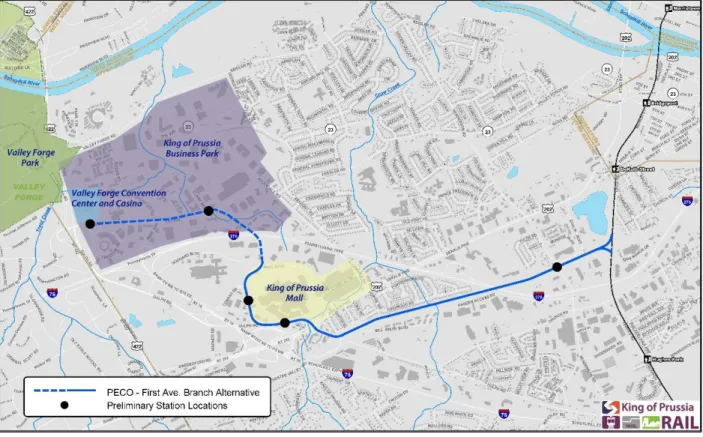
The land use advantages for the alternatives operating on the PECO rights-of-way are clear: the King of Prussia rail extension will provide reliable, high-quality public transit service to an activity center containing more than 30,000 jobs. As presently planned, the PECO Alternative 2 runs to the south of the King of Prussia Mall, while the remaining alternatives connect north of the mall. All four alignments will be fully elevated, with no at-grade sections.
Figure 2: PECO Alternative 2 (Tier 3 Screening)
Freer 20 Locally Preferred Alternative (LPA), PECO has expressed willingness to convert the existing twin high-tension lattice structures, which are approaching the end of their useful life, to monopoles. Monopoles are typically 110-140 feet tall, and feature smaller base footprints that require deeper in-ground anchors. PECO has plans to construct and operate a third set of high-voltage transmission line towers in the corridor’s median, which will preclude rail between the two existing sets of transmission lines. Moreover, PECO has leased a section of the existing ROW to Abrams Run Apartments, which borders the south side of the corridor, enabling the complex to expand its parking.
Figure 3: PECO/PA Turnpike Alternatives (Tier 3 Screening)
As a result of these dimensional restrictions, the preferred alignment for PECO Alternative 2 will run along the north side of the corridor. The chief complication that exists with this scenario is the potential impedance on the residential neighborhood directly north of the corridor. SEPTA will require a 40-foot ROW width to operate the double track. Running the extension on the north side will place the tracks directly adjacent to existing property lines, potentially affecting approximately 55 residential properties in the Valley Forge Homes subdivision.
Stakeholders and Coordination
Freer 21 Greater Valley Forge Transportation Management Association (GVFTMA), and the King of Prussia Business Improvement District (KoP BID). Since 2013, the King of Prussia Business Improvement District (KOP-BID) has privately operated “The Connector,” a fixed-route commuter shuttle service that supplements SEPTA’s local and express bus service. The
Connector’s two shuttle routes provide service between two SEPTA regional rail stations – the Norristown Transit Center and Wayne Station – and multiple destinations within the King of Prussia district. Service only operates during the peak morning and evening commuting periods (KOP-BID 2015). The KOP-BID, supported by the TMA, Upper Marion Township, and local business representatives, has expressed direct opposition to alternatives routing the line adjacent to the mall’s entrance. Theses interests prefer the PECO/PA Turnpike alternative, which utilizes a small section of PECO right-of-way, transitioning to the Pennsylvania Turnpike, runs behind the KoP Mall, and connects with the KoP Business Park and Valley Forge Convention Center and Casino (KOP-BID 2015).
Freer 22
York University Busway
Toronto, Ontario
Figure 4: A VIVA bus (operated by York Region Transit) traverses the York University Busway
Existing Conditions
Opened in 2009, the York University Busway is a four mile series of busways connecting the Downsview subway station with York University. The busway passes through the Finch Hydro Corridor, an active power line right-of-way, for 1.3 miles, via a two-lane, dedicated, bus-only road. The route establishes an east-west connection and significantly reduces travel times between the Downsview Station and York University (Rider 2011).
York University’s Keele campus is located 12 miles northwest of downtown Toronto. With approximately 55,000 enrolled students and employing 7,000 faculty and staff, the campus is a significant regional trip attractor and generator. Due to the university’s peripheral location, the campus is served by four separate transit agencies: Brampton Transit, GO Transit, the Toronto Transit Commission (TTC), and York Region Transit (YRT). Upwards of 2,000 buses operate daily to and from the campus.
York University’s student population is commuter based, and heavily reliant on public
Freer 23 university.8 Moreover, 47% of first-year and senior students commuted for more than 40 minutes in 2006 (York University 2007).
Planning Process
The high percentage of transit-reliant students at York University requires high-quality public transit service. Downsview Station is the western terminus of Toronto’s Yonge-University subway line, and the nearest subway station to York University. In 1999, the TTC commenced service for the York University Rocket (196), providing express bus service between Downsview and York University. In 2000, total daily ridership for the route totaled 8,560 passengers.
The impetus for the York University Busway stemmed from high passenger volume along local bus routes and chronic congestion encountered along the existing route, especially in the winter months. Heavy afternoon on-campus queuing was also a concern of York University officials and TTC planners. In lieu of a higher-order transit option, the TTC and the City of Toronto began the Environmental Assessment for the York University Busway in March of 2003. The project was approved by the Ministry of Environment in the spring of 2006, and construction formally began in the summer of 2008.
Since opening in 2009 the busway has realized multiple efficiencies. Most consequentially, total travel time for the route was reduced from 20 minutes to 13 minutes. In the morning peak period prior to the implementation of the busway, TTC operated 20 buses per hour, with two-minute and 15 second headways. Following the busway’s completion, TTC now operates 16 buses per hour with two-minute headways. Additionally, average bus speeds on the route increased by 41%, from 14.5 miles per hour (mph) to 20 mph (Marshall 2009). In addition to the York University Rocket, five TTC bus routes operate within the York University Busway, along with Wheel-Trans, TTC’s paratransit service. In 2011, York Region Transit began operating the Viva Orange route in the busway. GO Transit and Brampton Transit are also allowed to access the busway.
The route has featured high ridership since 2000, likely due to the transit dependent nature of the college students frequenting the service. Ridership trends for the northbound segment of the route, between Downsview and York University, are irregular, but the heaviest volume currently occurs during the “midday” period (9 a.m. – 3 p.m.). Southbound ridership is highest during the “midday” and “evening rush” periods (3 – 7 p.m.). During a count in March 2014, 21,892 total trips were recorded; 11,400 northbound and 10,492 southbound.
The York University Busway was planned and designed to operate as an interim service during the construction of the subway extension. Following the completion of the Toronto-York
Spadina subway extension in 2017, service on the York University Busway will be discontinued. The Toronto-York Spadina Subway project is a 5.3 mile, six station extension of the existing Yonge-University Line. The extension will expand service into the City of Vaughan, and include a station at the center of York University’s campus.
Freer 24 The busway was completed for $37.8 million (Canadian), with construction cost jointly financed by federal, provincial, and local agencies.9 The Government of Canada and the Province of Ontario each contributed $9.7 million (Canadian) to help fund the busway through the Canada Strategic Infrastructure Fund (CSIF); the City of Toronto financed the remaining $18.4 million (Canadian) (York University 2009).
Operational Upgrades
The planning process for the York University Busway project involved four primary actors: York University, the Toronto Transit Commission (TTC), Hydro One, and Toronto’s
Transportation Services. Toronto’s Transportation Services is responsible for maintaining the city’s public roadways (including repairs, maintenance, street cleaning, and snow removal) and also controls traffic operations (signals, pavement markings, red light cameras, on-street parking permits). Additionally, Transportation Services advises construction planning and policy, and manages pedestrian and cycling programs.
In addition to the dedicated busway along the Finch Hydro Corridor, Transportation Services recommended multiple traffic operations alterations to ensure high-speed and reliable bus service between the Downsview Station and York University. The width of the busway is approximately 24 feet wide. Two traffic signals were installed to regulate new intersections, traffic control signals were optimized to prioritize bus throughput, roadways and lanes were modified to limit right and left hand turns in bus lands, and traffic by-laws were updated along the three existing public roadway segments the busway traverses.
The Finch Hydro Corridor Recreational Trail also operates in the Hydro One right-of-way, on separated facilities. Bike lanes running north-to-south intersect with the trail south of York University, providing dedicated, non-motorized access to the campus. Funding for the trail was received in 2009, provided through the Recreational Infrastructure Canada (RInC) program (Toronto 2015). The establishment of the multi-use trail required the approval of Hydro One, and a license agreement to operate within the corridor. During negotiations to update Toronto’s bicycle network in 2012 Hydro One established a 15-meter setback requirement from tower bases as a condition for new trail construction (Toronto 2012).
9
Freer 25
Transit Options Amherst-Buffalo
Buffalo, New York
Figure 5: The Buffalo Metro Rail in downtown Buffalo
Existing Conditions
The Niagara Frontier Transportation Authority (NFTA) and Metro publicly began the planning process for public transportation options connecting Amherst and Buffalo in upstate New York in the fall of 2013. Buffalo’s Metro Rail is the highest-quality existing public transit service in the region: opened in 1985, the 6.4 mile, 14-station light-rail line runs from downtown Buffalo to the University of Buffalo in the northeastern section of the city. Despite the system’s light-rail designation, 80% of the line operates in a higher-speed underground environment.
The purpose of the Transit Options Amherst-Buffalo (TO Amherst-Buffalo) study is to provide a fast, reliable, safe, and convenient transportation option from Buffalo to Amherst, linking
multiple activity centers, and supporting regional economic growth. The modal alternatives being considered for the corridor are light-rail, bus rapid transit, streetcar, bus preferential treatment, and enhanced bus alternatives (two local routes, two suburban routes, and one
Freer 26
Planning Process
NFTA-Metro hosted two kickoff workshops in November of 2013 to introduce the early-stage planning processes, which consisted of the purpose and need and study methodology and criteria. The study publicly released multiple Tier 1 screening progress reports in September of 2014, including the long-list of multimodal alternatives, existing and future environmental conditions, and a review of possible future Metro station locations. In Tier 1 analysis four corridors were analyzed in the study: Niagara Falls Boulevard, Bailey Avenue, Millersport Highway, and the Tonawanda Corridor.
In total, 30 alternative alignments were considered for light-rail and bus rapid transit service in the Tier 1 analysis, along with three preferential bus alignments and five enhanced bus
alternatives. The long list alternatives were evaluated on the following reasonableness tests: the extent to which the alternative meets the purpose and need; the sufficiency of ROW/land area assessed; and the complex structures, grades, curve radii, and operational flaws. Of the 20 proposed light-rail alignments, only seven received either passing or feasible grades, and advanced to Tier 2 screening; six of the 15 proposed bus-rapid transit alignments passed the reasonableness tests; the enhanced bus and preferential bus alternatives also advanced to Tier 2 screening.
Of particular relevance to this research, included in Tier 1 screening was the “Tonawanda Turnout LRT Alternative.” This proposed alignment featured light-rail operating along significant portions of railroad and utility owned and operated right-of-way. The Tonawanda Turnout alternative extended from the existing LaSalle Station and progressed along abandoned rail right-of-way before entering high-voltage transmission lines owned by National Grid, the utility operator.This ROW alignment would have paralleled Interstate 290 eastward for several miles. Ultimately, the Tonawanda Turnout LRT Alternative was deemed beyond the boundaries of the study area, and was not selected for Tier 2 screening.
The remaining alternative in the TO Amherst-Buffalo study which considers operating transit in utility right-of-way is the “LRT Niagara Falls Boulevard Alternative 7,” which also passes through existing National Grid right-of-way. The alternative meets the purpose and need, was deemed “feasible, but with constraints,” and advanced to Tier 2 screening. Multiple engineering concerns encumber the Niagara Falls #7 alternative, primarily the prospect of crossing National Grid’s right-of-way directly north of Interstate 290.
Project Status
Freer 27 Researching the coordination and planning procedures for the Transit Options Amherst-Buffalo study has been problematic. The preliminary nature of this planning process has complicated detailed or accurate feasibility analysis for operating transit in utility corridors. The majority of ongoing planning is internally regulated between NFTA-Metro and AECOM, the project’s prime consultant.
Coordination and consultation with potentially affected stakeholders (e.g. residents, National Grid, the University of Buffalo, local business owners) will likely not intensify until more finite alignments are selected, following Tier 3 screening. As such, the project team has intentionally limited the official interaction with potential stakeholders, affected landowners, and potential partners. Conversations with NFTA planners indicated that coordination meetings with National Grid are being scheduled, but collaboration has not occurred prior to this stage of the planning process. Lastly, land use interactions will factor significantly into the alternative that is
Freer 28
Composite Analysis
In reviewing these three case studies, multiple differences are evident in the planning processes for transit-utility alternatives, which directly affects the project outcomes. However, common shared approaches toward the development of these projects also exist. Classifying these successful tactics may help inform future projects considering transit-utility alignments. Expectedly, utility providers are concerned foremost with protecting their infrastructure and maintaining their services. Explicit and transparent inter-organizational communication between transit agencies and utility providers can enable productive discourse between organizations and limit resistance issued by utility providers. It’s also necessary to acknowledge that most high-voltage transmission line (HVTL) corridors cannot or should not accommodate transit, due to lack of transit demand, incompatible environmental and landscape features, unsuitable land uses, or infrastructure impediments.
This research does not address the differences in the planning processes for American and Canadian public transportation projects. Variations in the level of coordination between local, regional, and federal agencies, along with the regulatory environment for utility providers, impacts the project development and approval process, and may provide insight on which federal policies are more amenable to the implementation of transit-utility projects. Canada boasts two successful transit segments that operate in HVTL corridors, which suggests a preliminary predisposition towards these project types that does not currently exist in the United States. Planning Process Variations
For transit projects operating in HVTL corridors the relationship between the managing transit agency and the utility provider is the seminal partnership. Close coordination and collaboration between high-level officials, planners, engineers, and real estate specialists, from each
organization is critical to successfully integrating public transit service into HVTL corridors. Without willing cooperation from utility providers, potentially conducive and beneficial projects may be delayed, or rendered entirely infeasible.
Interviews with three transit agency project managers indicates that utility companies are often reticent to participate directly in the planning processes for these projects. The level of
communication and collaboration between transit agencies and utility operators in these case studies varies from frequent and productive (King of Prussia), problematic (York University Busway), to non-existent (Amherst-Buffalo).
Hydro One, the provincial-level utility provider controlling the right-of-way for the York University Busway, was “difficult to deal with,” and raised multiple objections and concerns to the project during the planning phase. In response to Hydro One’s concerns regarding passenger exposure to electromagnetic fields, the Toronto Transit Commission (TTC) performed
Freer 29 For the King of Prussia rail project, the existing relationship between SEPTA and PECO Energy is robust. Project staff from both organizations meet regularly to coordinate the planning process and address potential complications. Upon finalizing project alternatives following Tier 2
screening, SEPTA presented and reviewed the alignments that operate within the PECO HVTL corridor. PECO’s transmission engineering teams are reviewing the proposed alternatives, and preparing technical questions for SEPTA’s project team. PECO’s concession to switch from lattice HVTL structures to monopoles will ultimately create more spaces for alternative uses, including the potential for transit, to operate.
Alternatively, the NFTA has experienced difficulty in approaching National Grid, the utility operator that controls the HVTL corridor potentially affected by the Niagara Falls #7 light-rail or bus rapid transit alternative. Project staff noted that they’ve been unsuccessful in contacting corresponding staffers to discuss the engineering feasibility of passing through the existing National Grid right-of-way.
These reviews suggest that transit agencies interested in utilizing utility corridors for public transit should communicate interest in the concept potential with utility providers well in advance of beginning the formal planning process. Advance planning also allows for the coordination of future infrastructure development, which may prove cost-effective for both organizations.
Design Restrictions
Construction and infrastructure requirements vary widely by project mode, alignment, and surrounding topography. Comparatively, construction costs for rail transit projects are inherently more expensive than busways; the required planning processes, specifically the NEPA
requirements, are also more intensive for rail transit projects.
Where bus service already operates, integrating busways with the adjoining transportation network is relatively uncomplicated, and more flexible, than extending an existing rail line. The biggest logistical complications for at-grade busways is managing access to and through existing intersections. The York University facility required the alteration of four existing intersections; two intersections were upgraded to provide transit vehicles access to the busway, and two new intersections were created with existing north-south roads that allows buses to move
continuously east-west along the busway. Moreover, the universality of busways enables the facility to be used by multiple transit operators and service providers; it’s uncommon for intra-city rail transit lines to share tracks with multiple systems.
Freer 30 Specific design restrictions for the Amherst-Buffalo will be determined once alternatives are narrowed following Tier 2 screening and the mode is selected. However, because the alignment for the Niagara Falls #7 alternative will pass through, and not along, the existing utility right-of-way, engineers are in the preliminary process of considering either elevating or tunneling the line through the ROW to avoid direct conflicts with National Grid’s existing high-voltage
transmission lines.
Stakeholder Involvement
The involvement of local stakeholders can help expand the public conversation, advance the project with business interests, and ensure that project and public goals align. Both reviewed American projects feature robust levels of public engagement, along with active involvement from specified, appointed committees. However, one practitioner interviewed for this research speculated that America’s “bottom-up” planning process may limit the full extent and
implementation of these projects in the United States.
In addition to the full-time King of Prussia rail project staff, four committees – Technical, Steering, Agency Coordination, and Stakeholder – meet regularly, providing multiple perspectives to advise the advancement and evolution of the rail line. The NFTA features a consolidated committee structure, consisting of the Project Steering Committee (key NFTA, state, and federal agency representatives) and the Project Advisory Committee (key local governmental, institutional, business, and employer, and community stakeholders). The York University project also benefited from external stakeholder support. The region’s Rapid
Transit/Public Private Partnership Steering Committee was influential in the development of the busway. The committee provided $100,000 (Canadian) to finance the planning, design,
coordination, and construction of facilities that enable neighboring bus systems to utilize the busway.