Lina Huang. Usability Testing of the HIVE: A System for Dynamic Access to Multiple Controlled Vocabularies for Automatic Metadata Generation. A Master’s Paper for the M.S. in IS degree. November, 2010. 57 pages. Advisor: Jane Greenberg.
This paper reports on a usability study testing the HIVE Vocabulary Server (HIVE). The overall research goal was to identify usability issues needing attention in order to improve the effectiveness the HIVE system. This usability study compared results for two targeted user groups: librarians and scientists. The study employed a formal usability testing approach and formative evaluation. Usability test results for the first build of HIVE were positive. Librarians indicated that HIVE is a useful tool and could assist their work. Scientists responded positively about HIVE’s support for identifying a greater selection of relevant terms describing their data. The main usability problems identified were related to the absence of adequate information via the HIVE interface. These include the absence of descriptive information about individual HIVE-supported vocabularies; lack of evidence about the status of vocabularies during an
interaction (was not clear to users if a vocabulary was, closed or opened during a session); and a lack of information indicating the success (or failure) regarding document upload. Recommendations for addressing these problems are presented in the discussion, and may guide further development of HIVE Vocabulary Server.
Headings:
Controlled Vocabulary
Usability Testing
Usability Evaluation
USABILITY TESTING OF HIVE: A SYSTEM FOR
DYNAMIC ACCESS TO MULTIPLE CONTROLLED VOCABULARIES FOR AUTOMATIC METADATA GENERATION
by Lina Huang
A Master’s paper submitted to the faculty of the School of Information and Library Science of the University of North Carolina at Chapel Hill
in partial fulfillment of the requirements for the degree of Master of Science in
Information Science.
Chapel Hill, North Carolina November 2010
Approved by
Table of Contents
1.Introduction ... 3
2.Literature Review ... 5
2.1 Controlled Vocabulary: A General Overview ... 5
2.2 Vocabulary Access and Service ... 6
2.3 Review of Usability Evaluation Methods ... 11
2.3.1 Iterative Design and Types of Evaluation ... 11
2.3.2 Usability Evaluation Methods ... 13
2.3.3 User Satisfaction Rating ... 14
3.Research Objectives ... 16
4.Research Method ... 16
5.Results. ... 20
5.1 HIVE Development Status ... 20
6.Usability Evaluation Results ... 26
6.1Summary of Participants’ Profile ... 27
6.2Task Performances ... 28
6.2.1 Understanding What is HIVE ... 28
6.2.2 Search a Term ... 28
6.2.3 Automatic Indexing ... 29
6.2.4 Satisfaction Rating ... 30
6.3Qualitative Analysis ... 33
6.3.1 User’s Perception of HIVE ... 33
6.3.2 Usability Problems ... 35
7.Discussion ... 37
7.1 Understand the Satisfaction Rating ... 37
7.2 Differences between librarians and scientists ... 38
8.Conclusions ... 39
9.Acknowledgement ... 41
10. References ... 42
11. Appendices ... 49
11.1 Appendix I Task Scenarios ... 49
11.2 Appendix II: Demographic and Computer Proficiency / Experience with Controlled Vocabulary Questionnaire ... 51
11.3 Appendix III: System Usability Scale ... 54
List of Figures
Figure 1 MeSH Browser interface ... 7
Figure 2 HILT Terminology Server Home Page ... 8
Figure 3 ONKI Ontology Browser with MeSH loaded ... 9
Figure 4 Ontology Lookup Service Initial Look Up Page ... 10
Figure 5 BioPortal Ontology Browser ... 11
Figure 6 BioPortal: Visualization of a Given Concept and its Relationship... 11
Figure 7 The architecture of HIVE Vocabulary Server ... 21
Figure 8 HIVE Home Page ... 24
Figure 9 HIVE Concept Browser ... 25
Figure 10 HIVE Automatic Indexing ... 25
Figure 11 HIVE Indexing after user has ran the extraction process ... 26
Figure 12 SUS Score Rated by Individual Librarian ... 30
Figure 13 SUS Score Rated by Individual Scientist ... 31
Figure 14 Enjoyment and Concentration of Scientists’ Group ... 32
Figure 15 Enjoyment and Concentration of Scientists’ Group ... 32
Figure 16 A comparison of mean System Usability Scale (SUS) scores by quartile, adjective ratings, and the acceptability of the overall SUS score... 38
List of Tables Table 1 Statistics of Task 1 ... 28
Table 2 Statistics of Task 2 ... 29
Table 3 Statistics of Task 3 ... 29
Table 4 Average SUS Score ... 30
1. Introduction
Controlled vocabularies, especially in the form of thesauri, are important
information and knowledge organization tools. A chief purpose of using controlled
vocabularies focused on ensuring consistent analysis of documents during its input to
information retrieval systems (Shiri & Revie, 2001). For example, information
professionals consult authoritative controlled vocabularies such as Library of Congress
Subject Heading during cataloging and indexing practice as part of their routine work. In
addition, the increasing availability of online information retrieval system, along with the
advancement of user-centered design approach, has triggered the needs of utilizing
controlled vocabularies to aid end user searching. Utilities such as search term selection,
query formulation and expansion on users’ search interface are developed to aid end-user
searching and retrieval (Shiri & Revie, 2001).
While controlled vocabularies have been demonstrated to benefit library, museum
and digital initiatives, there remain historical problems limiting the use of controlled
vocabularies in our growing and increasingly interdisciplinary world of digital libraries
(Greenberg et al, 2009). Among chief problems identified for the Helping
Interdisciplinary Vocabulary Engineering (here after referred to as HIVE) project are cost,
interoperability, and usability (Greenberg et al, 2009). Furthermore, as interdisciplinary
collections grow in size and scope, there is growing interest in accessing multiple
knowledge representation. The Helping Interdisciplinary Vocabulary Engineering (HIVE)
project was initiated to address these short comings and specifically to develop a way that
multiple vocabularies could be accessed simultaneously, and via automatic means to aid
the indexing of interdisciplinary resources.
Launched in 2009, HIVE was funded by the Institute of Museum and Library
Services (IMLS) to address the controlled vocabularies limitations described above.
HIVE is a collaboration involving the Metadata Research Center at University of North
Carolina at Chapel Hill and National Evolutionary Synthesis Center co-funded by
University of North Carolina at Chapel Hill, Duke University and North Carolina State
University.
The initial HIVE Vocabulary Server was completed in Fall 2009, and piloting was
conducted in targeted classes at the School of Information and Library Science and in the
SILS Metadata Research Center. Additionally, members of the HIVE advisory board
took place in streamlined pilot to get a view of the server. The HIVE development team
recognized that a formal usability study was needed in order to more concretely get a
sense of current development limitations and better prepare a plan to move forward with
the next phase of HIVE design,
The study reported on in this paper addresses this specific need of HIVE’s
development and evaluated the effectiveness of HIVE Vocabulary Server and gathering
the feedback from targeted users by conducting a thorough and in-depth usability testing
of HIVE Vocabulary Server. Specifically, the purpose of this study was:
(1) To find out what information professionals and scientists thought of the pilot
(2) To find out whether there are significant differences regarding their perception
and use of HIVE Vocabulary Server between information professionals and scientists.
The rest of this paper is organized as follows: section 2 is a literature review on
controlled vocabulary, vocabulary service, and usability evaluation methods; section 3
briefly describes the research objectives; section 4 describes the research method; Section
5 reports the HIVE development status and the usability experiment results; Section 6
provide a discussion about the result; section 7 is conclusion; section 8 is
acknowledgement; section 9 is bibliography references; section 10 attaches a list of
appendices including task scenarios, questionnaire, etc.
2. Literature Review
2.1 Controlled Vocabulary: A General Overview
Controlled vocabularies, especially thesaurus, have played an important role in
modern information storage and retrieval systems. There is a great deal of literature about
creating and using thesauri for the purpose of analyzing and retrieving information.
Generally speaking, thesauri are designed for knowledge workers in the same domain to
talk about the same language and for information professionals to index, manage
information so that information can be easily accessible to various communities.
However, even though the fundamental purpose of controlled vocabulary is to seek an
agreement on terms and concepts over larger communities, controlled vocabularies on the
same domain differ significantly, and there is limited interoperability between tools and
Milstead(1997) stated that thesauri are underused by searchers due to the fact that
database providers do not make them readily available. Some are available only in paper
form while those provided online often have little or no user support in the interface. She
suggested that the provision of effective thesaurus navigation tools within the interface
will improve searcher access and use (Milstead, 1997).
2.2Vocabulary Access and Service
There are different formats and approaches to create and publish thesauri.
Thesauri can be published on paper format as well as published with user-friendly Web
user interfaces with graphical displays as well as browsing and searching capabilities.
Davies suggests that thesauri can be published over the Web in either static or dynamic
form and the choice between the two methods of Web publication influences the format
and organization of the thesaurus (Davies, 1996). Web-based thesauri can be
categorized as (Shiri & Revie, 2000b):
1. Thesauri in simple static text formats.
2. Thesauri HTML format but still static, without effective use of hyperlinks.
3. Thesauri in dynamic HTML format with fully navigable hyperlinks.
4. Thesauri with advanced visual and graphical interfaces.
5. Thesauri in XML format
One way to understand these issues is to review existing systems. The most
advanced thesauri interface on the web is in dynamic HTML format along with navigable,
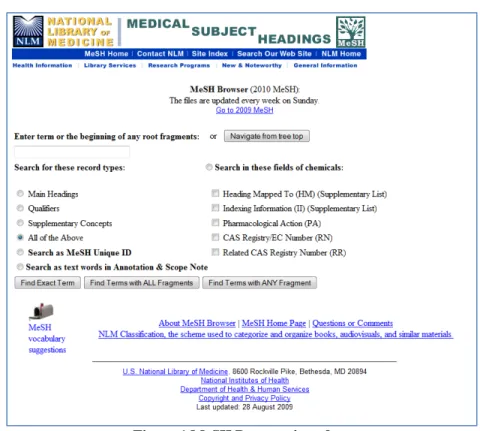
browsable, and searchable features. For example, the MeSH thesaurus is a controlled
vocabulary which consists of more than 19,000 headings. Figure 6 is the MeSH online
between different headings. The user can browse through the MeSH hierarchical tree
structure and choose the headings of interests to display the complete MeSH record
which contains the annotation, scope notes, qualifiers, etc.
Figure 1 MeSH Browser interface
As the number of thesauri is growing, the needs to address thesauri
interoperability and to use multiple and heterogonous thesauri in a unified way are more
evident than before. Several research projects are undergoing to address the need for
multiple thesauri integration through a single interface. One of the recent developments is
the High-Level Thesaurus (HILT) project, which aims to research, investigate, pilot, and
develop solutions for, problems pertaining to cross-searching multi-subject scheme
information environments (Macgregor, McCulloch, & Nicholson, 2007). Figure 7 is the
Fig
ure 2 HILT Terminology Server Home Page
The HILT Homepage consists of a search bar within the selection of thesauri and
links to the browsing interfaces of the thesauri that have been loaded into the terminology
server. One feature
The Unified Medical Language System (UMLS) (http://umlsks.nlm.nih.gov)is a
repository of biomedical vocabularies developed by theUS National Library of Medicine.
Vocabularies integrated in the UMLS Metathesaurusinclude the NCBI taxonomy, Gene
Ontology, the Medical SubjectHeadings (MeSH), OMIM and the Digital Anatomist
Symbolic KnowledgeBase(Bodenreider, 2004). There is not a unified web interface to
search and browse through UMLS Metathesaurus. Instead, the UMLS Metathesaurus is
available via applications program interface (API) from the UMLS Knowledge Source
Server, as well as CD-ROM and FTP.
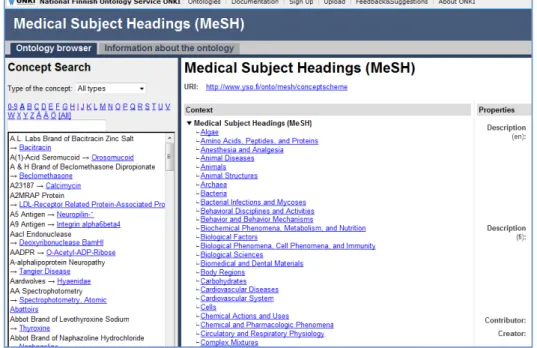
ONKI SKOS Server (Tuominen, J. 2009) allows controlled vocabulary which is
services in a matter of minutes. The services include not only a browser for human usage,
but also Web Service and AJAX interfaces for concept finding, selecting and transporting
resources from the ONKI SKOS Server to connected systems. Figure 8 is the ONKI
browser which MeSH thesaurus is loaded and is ready to be browsed and searched in the
browser. The web page is divided into three major areas. The Concept Search area allows
users to browse or search concept in the loaded ontology. The Context area provides the
path through the selected concept along the ontology hierarchies. The Properties area
displays detailed description about selected concept including Alternative label, scope
note, historical note, broader terms, narrower terms, etc.
Figure 3 ONKI Ontology Browser with MeSH loaded
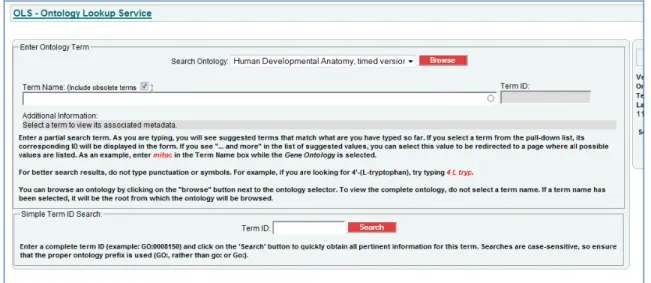
The Ontology Lookup Service (Cote, Jones, Apweiler, & Hermjakob, 2006)
provides interactive and programmatic interfaces to query, browse and navigate
biomedical ontologies and controlled vocabularies. It provides rich browsing experience
the database and displayed to the user. Users can browse full ontologies only with the
click of link. Figure 9 is the screenshot of the OLS initial look up page. Users are able to
choose what ontology they want to search and then type in the term name.
Figure 4 Ontology Lookup Service Initial Look Up Page
Developed by Stanford Center for Biomedical Informatics Research, BioPortal
(Musen et al., 2008) is a Web portal for biomedical ontologies. It enabled a set of tools
for storing, accessing, searching and visualizing ontologies in biological and medical
domain. Researchers can annotate their research data using ontologies, as well as can
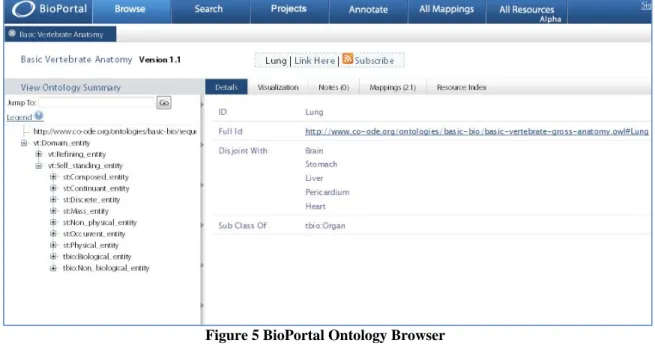
critique ontology content and provide feedback to ontology developers. Figure 10 is the
screenshot of BioPortal’s ontology browser. With the “Basic Verterbrate Anatomy”
ontology loaded, users are able to browse, and search the concepts in the ontology. The
metadata of the concept selected are displayed in the right panel. Visualization, Notes,
Mapping and Resources are separated by different tabs on the right panel. When users
select one of the tabs, an AJAX request is sent and the right panel is updated with the
corresponding responses from the server. Figure 11 shows the graphical visualization of
Figure 5 BioPortal Ontology Browser
Figure 6 BioPortal: Visualization of a Given Concept and its Relationship
2.3Review of Usability Evaluation Methods
2.3.1Iterative Design and Types of Evaluation
Various usability evaluation methodologies can be applied to assess the
Interactive systems are usually designed through an iterative process involving
design, evaluation, and redesign. There are three major iterative stages in iterative design:
initial, prototype, and final design, which are central to the iterative design process
(Hartson, Andre, & Williges, 2003). During initial stage, the goals, guidelines and scopes
are gathered and design specifications are iterated to the construction of the prototype.
Based on the goal of the evaluation, there are two basic types of evaluation (Scriven,
1972). The formative evaluation is conducted after the prototype is delivered and mainly
focuses on usability problems that need to be solved to improve the prototype before final
design can be delivered. The other type of evaluation is the summative evaluation, which
is conducted to assess the final design and the level of usability achieved in the end.
Usability evaluation methods are often formative, aiming at finding usability problems to
fix, hence the results are usually not statistical significant. These results do not contribute
to the science of usability, but are valuable usability engineering methods in a
development project. On the other hand, summative evaluations are often used to
compare design factors and the extent of which different factors will impact the usability.
The results often need to be statistically significant hence can be added to the knowledge
of usability. Usability evaluation methods for development projects are mostly formative,
but sometimes the summative evaluation can also be a component of the evaluation
method. For example, measurement of users’ task completion time and error rates are
viewed to be summative because it is used to assess the level of usability. These
quantitative data are also useful to decide an acceptable level of usability during design
2.3.2Usability Evaluation Methods
There are two major categories of usability evaluation methods: the usability
inspection conducted by usability experts and the usability testing involved with the real
users. Expert-based usability inspection methods are used in the early design stage during
when a working prototype does not exist for users to perform tasks on. One of the most
important expert-based inspection methods is Heuristic Evaluation (Nielsen, 1994). Jakob
Nielsen developed a set of validated usability principles which are used by expert
evaluators to judge whether each element in the user interface follows those principles or
not. Other famous inspection methods include cognitive walkthroughs (Wharton,
Rieman, Lewis, & Polson, 1994), Formal Usability Inspections (Kahn & Prail, 1994) and
Heuristic Walkthroughs (Sears, 1997).
The usability testing methods, on the other hand, are conducted when the working
prototype is available and real users will then get involved. Users are often assigned tasks
to perform on the prototype and their performance will be evaluated to test speed,
completion rate, and errors (Rubin & Chisnell, 2008). The evaluation methods during a
testing session including Think Aloud Method(Fonteyn, Kuipers, & Grobe, 1993) , which
gathers rich verbal data about reasoning during a problem solving task and is useful to
study how information is structured during a problem-solving; Critical Incident Reporting,
which consists of a set of procedures for collecting direct observations of human behavior
during test(Flanagan, 1954); and User Satisfaction Rating (Chin, Diehl, & Norman,
1988)which is used to measure user’s subjective acceptance of the user interface.
The Concurrent Think Aloud method, which requires users to “Think Aloud”
usability evaluations (John & Mashyna, 1997; Nørgaard & Hornbæk, 2006; Van den
Haak, De Jong, & Schellens, 2004). Although it is argued that Concurrent Think Aloud
will create additional cognitive load for users, and it is not always easy to keep users
talking during the evaluation session, the Concurrent Think Aloud method can be used
together with other techniques during usability evaluation which will cover the
shortcomings of Concurrent Think Aloud method. In his study of comparing Concurrent
Think Aloud Method and Retrospective Think Aloud Method, Van Den Haak pointed out
that Concurrent Think Aloud can detect more usability problems by means of observation
compared to retrospective Think Aloud Methodology which will detect more usability
problems by means of verbalization.
2.3.3User Satisfaction Rating
It is argued that usability should be measured in reference to context, which
means that there is no absolute measure of usability. But there is a need for broad general
measures which can be used to compare usability across a range of contexts (Brooke,
1996). In the research field of Human Computer Interaction, several questionnaires have
been developed, used and reported in the literatures for evaluating the subjective
satisfaction of system usage.
QUIS, stands for the Questionnaire for User Interface Satisfaction, was developed
by the Human Computer Interaction Lab at the University of Maryland (Chin et al., 1988).
In the effort of developing QUIS, a definition of computer user satisfaction is also
developed which suggested that satisfaction is the sum of one’s positive and negative
reactions to a set of factors. QUIS then identified a set of 39 factors that can be used to
measurement instrument. The newest version, QUIS 7.0 contains a demographic
questionnaire, a measure of overall system satisfaction along six scales, and
hierarchically organized measures of nine specific interface factors. Each area measures
the users' overall satisfaction with that facet of the interface, as well as the factors that
make up that facet, on a 9-point scale (cite, QUIS 7.0 online).
SUS, stands for the System Usability Scale, is a simple, ten-item scale giving a
global view of subjective assessment of usability (Brooke, 1996). SUS was developed to
address the demands of evaluating usability in the industrial context which requires
usability evaluation to be low cost and has measures which do not require vast amount of
effort and expense to collect and analyze data. SUS was constructed from a pool of 50
potential questionnaire items, and the responses are in 5-point likert scale. The final set of
questions in SUS covered a variety of aspects of system usability including the need for
support, ease of use, ease of learning and complexity.
Other useful evaluation instruments that have been widely used including CSUQ,
stands for the Computer System Usability Questionnaire developed by IBM (Lewis, 1995)
and the Words which is adapted from Microsoft’s Product Reaction Cards (Benedek &
Miner, 2002).
In addition to the satisfaction metrics, Gahni (Ghani & Deshpande, 1994)
developed a set of metrics to evaluate the concentration and enjoyment user has
experienced when working with the system. The metrics are developed based on Flow
theory, which argues that flow was determined by the individual’s sense of being in
3. Research Objectives
The issues outlined above with controlled vocabulary access and the knowledge
that can be gained from usability studies indicate the value in conducting usability studies
for vocabulary servers such as HIVE. The research reported on this study takes this step,
and present a usability study specific to intended HIVE users: both professional librarians
and scientists. Specifically, the purpose of this study is:
(1)To find out what information professionals and resource authors think of the
beta release of HIVE Vocabulary Server and recommend improvements.
(2)To find out whether information professionals and scientists have different
perceptions about the use of HIVE Vocabulary Server between
4. Research Method
The particular interests of this study are the users’ reasoning and motivation, and
their perception of HIVE. In order to have better insight into user and to identify usability
problems, a qualitative approach is better than quantitative approach in this regard. Based
on the literature review on usability evaluation, the formative evaluation along with the
subjective ratings evaluating users’ satisfaction fits the needs of this study. The
interaction between the users and the system needs to be recorded to go through a
thorough analysis. The Concurrent Think Aloud method is used to understand users’
problem solving process using HIVE, and users’ verbalization is recorded. Meanwhile,
the computer screen will also be captured in order to record critical events and system
actions. It can also provide useful reminders for the evaluator of the critical events during
to record the critical observation during the one-to-one experiment session. Specifically,
a usability testing software called Morae (Techsmith, 2009) is used in this study. In
addition to screen recording ability, Morae is able to record the low-level data such as
key stroke, user’s click, etc. It also enables remote testing by creating a unique observer
component to observe user’s interaction and log critical event remotely. Morae also
support the automated calculation of standardized usability metrics from System
Usability Scale. In addition, Morae Manager component glues all the data gathered in a
centralized place for easier data analysis and evaluation report.
The subjective satisfaction metric used in this study is the System Usability Scale
in that it’s an industrial standard for users’ subjective evaluation, and the simplicity of
SUS scales fits the context of this study very well.
Participants
10 participants are recruited from UNC Library System, the biology department at
UNC, and NESCent (National Evolutionary Synthesis Center) at collaboration between
Duke, UNC, and NCState University, which is affiliated with UNC. The participants are
divided into two groups based on their professional profiles and their experiences with
thesaurus and controlled vocabularies. The first group is comprised of professional
librarians who work with Controlled Vocabulary in their professional setting; the second
group is comprised of resource authors who have the potential needs to use formal
controlled vocabularies to assign keywords for their scientific submissions. Six librarians
from UNC Library System and four resource authors from UNC biology department are
Procedures
Each participant engaged in a one-to-one session with the evaluator. Upon arrival
in the experiment setting, the participant will be presented an information sheet and
his/her oral consent will be obtained. The participant will then complete a demographic
questionnaire and computer/controlled vocabulary literacy questionnaire in the beginning
of the experiment. Following the participant will complete three tasks using HIVE. They
were asked to think aloud when they are performing the tasks, and their speeches will be
recorded using an audio recorder. In addition to the audio recording, the screens on the
computer will be recorded when the subjects are performing the tasks. Following each
task, the participant will answer several questions regarding the task they just performed.
The subjective evaluation questionnaire will be presented to participants after they have
finished all three tasks.
Tasks Design
Each participant performed 3 tasks in total. The first task is asking users to
explore HIVE and to evaluate how many time does it take for them to understand what
HIVE is and what HIVE can do as a novice user who visit HIVE for the first time. The
second task is a search task asking users to identify a given concept in given vocabularies.
The third task is asking users to run the automatic concept extraction process for a given
document and then users’ attitude towards the automatic generated result will be asked
Data Analysis
Data analysis for this research included two aspects. First, a background review
was undertaken to assess the development status of HIVE vocabulary server; second
descriptive and qualitative analysis were conducted to serve as the evaluation results of
the usability experiment.
The background assessment of HIVE was important for understanding HIVE
functionalities and the server’s overall capabilities, which were represented in some
means in the interface. The background assessment was reported in section 5.1
Descriptive statistics was calculated from the demographic questionnaire as well
as the computer literacy/controlled vocabularies familiarity items to describe the subjects
and to compare the differences between two groups of subjects. Screen capture videos
for each task and each participant were encoded into following quantitative
measurements to evaluate the effectiveness of the HIVE system: the time to complete the
task and the number of errors happened in each task. The time each participant used to
complete each task will be recorded via the usability testing software and the errors
happened when performing the task will be counted via analyzing the video recording
data as well as the verbal think-aloud protocol.
The qualitative data are gathered from the participants' think-aloud protocol, the
screen capture files and the evaluator’s notes. Those data will be transcribed and analyzed
to reveal usability issues, and to understand users’ perception about HIVE.
A list of tasks and post-task questions used in the evaluation is attached in the
vocabularies familiarity questions are attached in the Appendix II. The post-test
questionnaire, which is comprised of 9 standard questions from the System Usability
Scale, is attached in the Appendix III. Gahni’s usability metrics to evaluate users’
enjoyment and concentration are attached in the Appendix IV.
5. Results.
This section reports results of the two aspects of data analysis: the assessment of
HIVE Development status and the usability evaluation experiment results.
5.1HIVE Development Status
The first year of HIVE effort was dedicated to develop the technical infrastructure
of delivering multidisciplinary controlled vocabularies called HIVE Vocabulary Server.
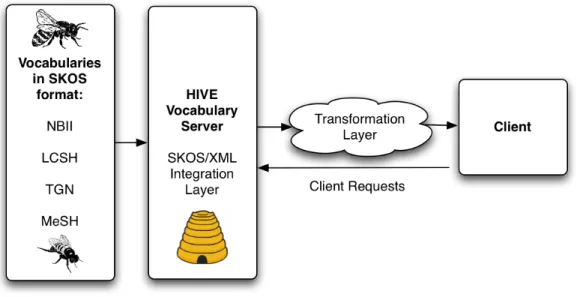
HIVE Vocabulary Server was designed to integrate controlled vocabularies from
heterogonous vocabulary sources into a standard metadata representation called Simple
Knowledge Organization System (SKOS) (Miles & Perez-Aguera, 2007). Multiple
vocabularies written in different metadata standards are mapped into single SKOS
representations to form a unified vocabularies database that can be queried and analyzed.
The SKOS database support vocabularies storage, retrieval and enhancement. An
algorithm that supports the capability to automatically extract keywords drawn from
selected controlled vocabularies sources from a given document was implemented and
linked to the Vocabulary Server. A single web user interface module was developed to
provide user friendly access to multiple vocabularies that have been integrated into HIVE
Vocabulary Server and to demonstrate HIVE automatic metadata extraction approach.
Figure 7 The architecture of HIVE Vocabulary Server
By the end of 2009, HIVE Vocabulary Server has implemented the core
functionalities described above. The technical infrastructures are comprised of two major
components: one component is comprised of a core Java library that provide
functionalities including SKOS mapping and integration, concept retrieval across
multiple controlled vocabularies, and the automatic subject descriptors drawn from
selected controlled vocabularies for a given document; the other component is a
Web-based user interface designed for information professionals and resource authors which
provides easily and user-friendly access to HIVE core functionalities .
At the time of writing, the pilot HIVE Vocabulary Server is accessible on the web
at http://karya.nescent.org:9090. The following is an illustrated description of the HIVE
Vocabulary Server.
Vocabulary schemes
Three authoritative thesauri have been incorporated into the current HIVE
Vocabulary Server and encoded into SKOS. The transformation from various vocabulary
(1) LCSH: Library of Congress Subject Headings from Library of Congress
(2) NBII: National Biological Information Infrastructure’s Biocomplexity
Thesaurus
(3) AGROVOC: AGROVOC Thesaurus which is a multilingual, structured and
controlled vocabulary designed to cover the terminology of all subject fields in
agriculture, forestry, fisheries, food and related domains from the Food and
Agriculture Organizations of the United Nations
SKOS Semantic Databases
The SKOS database containing the concepts and relationships drawn from the
three vocabulary schemes mentioned above was implemented via native RDF database
technologies under Semantic Web Framework. Semantic Web Framework is a collection
of integrated tools that allow programmers to create and work with large RDF data set
(Hebeler, J., 2009, p.243). Specifically, Sesame (Aduna B.V., 2008), an open-source
Semantic Web Framework developed via OpenRDF.org was used in HIVE project to
implement the storage and querying of large amount of terms and association in SKOS.
The database is used within HIVE Vocabulary Server to support concepts and
relationships retrieval across multiple controlled vocabularies scheme, as well as to serve
as a knowledge base for implementing the automatic concepts extraction algorithm.
Automatic Concepts Extraction Algorithm
The most important feature in HIVE Vocabulary Server is the Automatic
Concepts Extraction Algorithm. Concepts are drawn from the SKOS vocabularies
knowledge base and are assigned to describe the given document. The algorithm used in
based on machine learning and works in two main stages: candidate identification, which
identifies thesaurus terms that relate to the document’s content, and filtering, which uses
a learned model to identify the most significant terms based on certain properties or
“features.”
HIVE Web User Interface
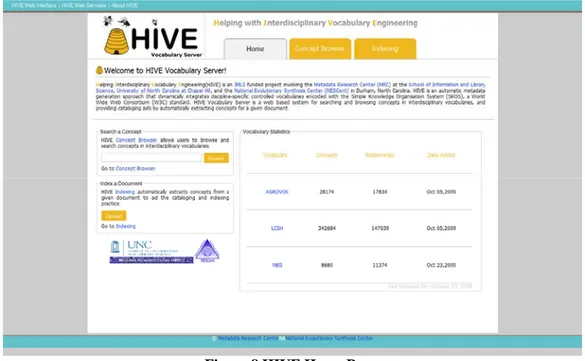
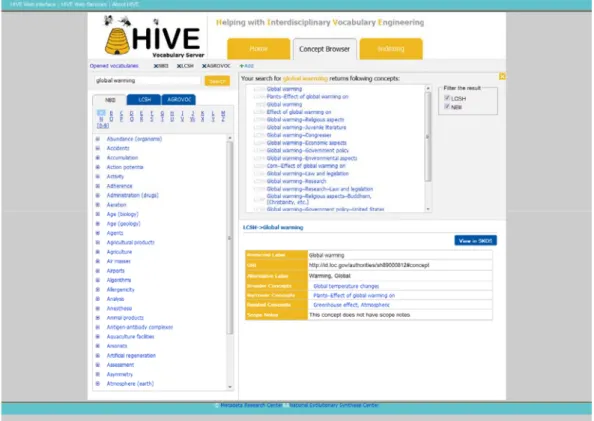
The end-user interface of the HIVE Vocabulary Server is illustrated by Figure 2 –
4, including the Home Page, the Concept Browser Page and the Indexing Page. The
design of the interface was influenced via a review of vocabulary server or
thesaurus/ontology publishing interface described in the literature review part of this
paper.
The targeted end users are divided into two groups: the information professionals
and the resource authors. Users are able to browse and search concepts across multiple
vocabularies, and are able to turn on/turn off vocabularies by selection. Users can also
upload an electronic document and get a list of extracted concepts drawn from selected
controlled vocabularies via running the automatic extraction process located in the
Indexing page.
Figure 8 is the screenshot of current implementation of the Home Page of HIVE
Vocabulary Server. The home page consists of an introduction to the HIVE project, a
search bar to retrieve concepts from given document, a upload component for uploading
given document to generate concepts, and a table of vocabulary statistics to show how
Figure 8 HIVE Home Page
Figure 9 is the screenshot of current implementation of concept retrieval module
called Concept Browser in HIVE Vocabulary Server. In Concept Browser, users are able
to turn on/ turn off vocabularies, to browse and switch back and forth among opened
vocabulary schemes, to search concepts across multiple opened vocabulary schemes, as
well as to comprehend a selected concept via reading the detailed information in a table
Figure 9 HIVE Concept Browser
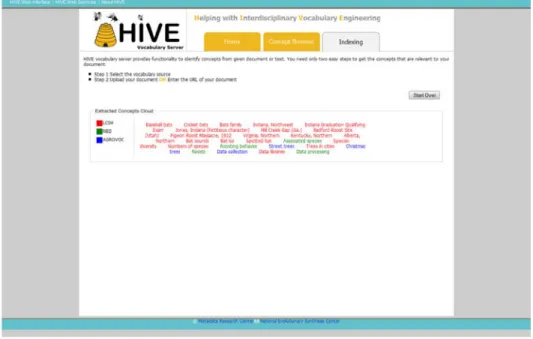
Figure 10 is the screenshot of Indexing Page in HIVE Vocabulary Server. It
contains the implementation of automatic subject descriptor extraction module. Users are
able to upload a document in any machine-readable formats including Pdf, Doc, HTML,
and XML, which means the indexing module, has the ability to process almost any
format of data. The generated concepts are represented via a color-coded Concept Cloud
where different colors are used to distinguish concepts from different vocabulary
schemes. Figure 11 is the screenshot of the generated Concept Cloud after a user
uploaded a document and ran the extraction process.
Figure 11 HIVE Indexing after user has ran the extraction process
6. Usability Evaluation Results
Results for the usability study are presented below. They are organized by the
following sub-topics: summary of participants’ profile, task performance, satisfaction
6.1Summary of Participants’ Profile
Ten participants were recruited to participate in this study, among them six were
librarians/catalogers and four were scientists who have scientific publications. The six
librarians were recruited from UNC Library System, aged from 37-56. Five of them were
female, and only one was male. They all work with controlled vocabularies during their
routine work. Five librarians reported only have experiences with Library of Congress
Subject Headings, and only one reported used more than one controlled vocabularies
including Thesaurus of Graphic Materials (LC), RBMS Thesauri, LCSH, and Getty
(AAT). Their subject of focus varies, including Map, Electronic Thesis and Dissertation,
Monographs and Serial. Two of them didn’t use computer until work, three of them
began to use computer from college, and only one of them used computer since
elementary school. Their most frequent use of computers was at work. All of them did
not have previous experiences with automatic indexing technologies.
The four scientists were recruited from UNC Biology Department, aged from
22-31 and all of them were male. Their research varied from Evolutionary Biology,
Molecular Biology. Each of these participants began using the computer in elementary
school, and all of them were using computer to assist with various activities, including
working, learning, gaming, browsing the internet and chatting with their friends. Their
experiences with formal controlled vocabularies and automatic indexing technologies
were limited. Two of them reported that they have experiences with list of terms
6.2Task Performances
6.2.1Understanding What is HIVE
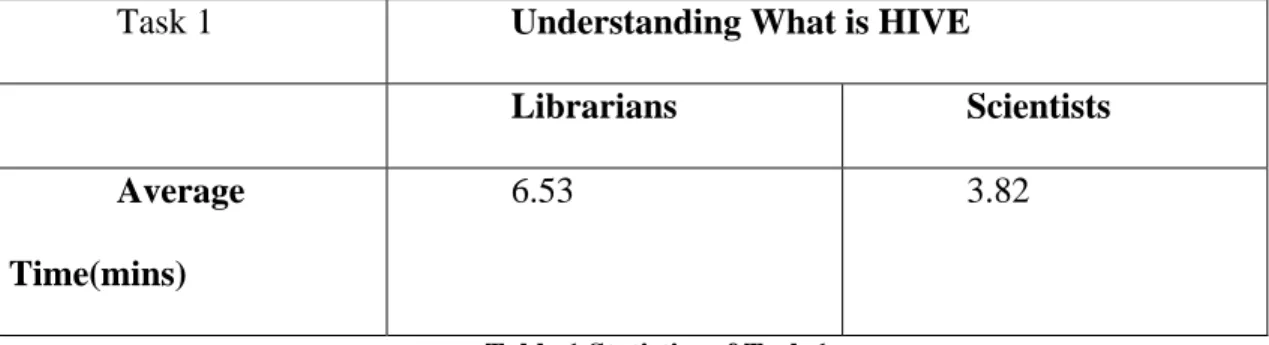
This task asked participants to explore HIVE for gaining a basic understanding
about HIVE Vocabulary Sever. The average time participants took to explore HIVE
Vocabulary Server is reported in Table 1. The librarians’ time was close to double that of
the scientists.
Task 1 Understanding What is HIVE
Librarians Scientists
Average
Time(mins)
6.53 3.82
Table 1 Statistics of Task 1
6.2.2Search a Term
Participants were asked to search a term in a given vocabulary, and then to
identify more specific terms (terms labeled as narrower terms (NT)) for an initially
retrieved term. The evaluator then recorded interface errors, situations where the interface
failed to accommodate the user interaction. For example, errors were detected when the
participants expressed difficulties when they think aloud and then turned to evaluator for
help, or issued a wrong click which can be captured by the screen capture software. The
average time participants took to finish the second task and the numbers of errors
occurred during task completion are reported on Table 2. The average time for librarians
was 4.66 minutes, and the scientists took 3.55 minutes to complete the search task. The
Task 2 Search A Concept
Librarians Scientists
Average Time
(mins)
6.53 3.82
Errors 1.5 1.75
Table 2 Statistics of Task 2
6.2.3Automatic Indexing
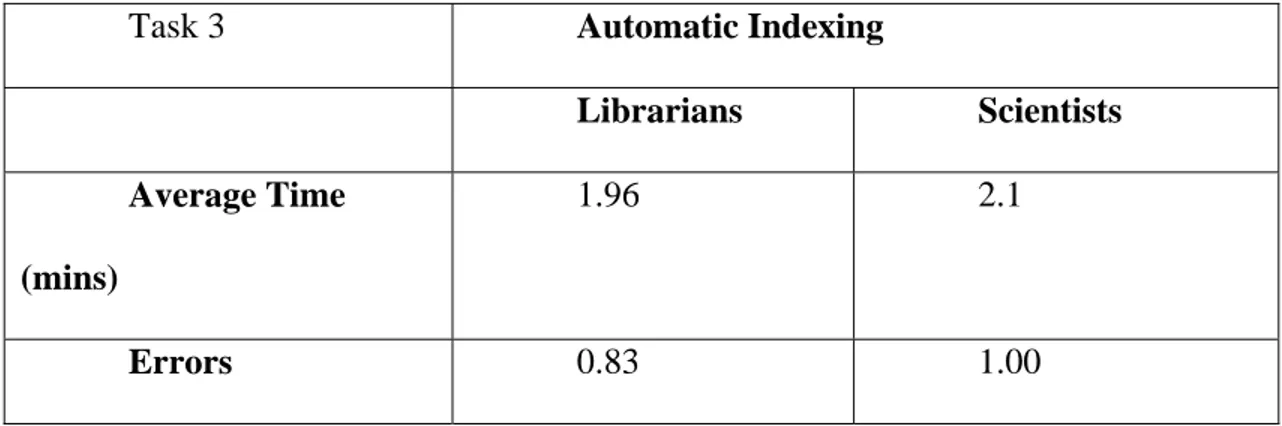
The third task focused on the automatic indexing feature. Participants were given
a document in PDF format to run the automatic term extraction on HIVE. Errors were
detected when the participants expressed difficulties when they think-aloud, turned to
evaluator for help, or issued a wrong click. The evaluator then recorded the number of
errors by analyzing the video data and the think-aloud protocol. The average time
participants took to finish the third task and the numbers of errors occurred during task
completion were reported on Table 3. The average time librarians took to complete this
task was 1.95 minutes and the researchers took 2.1 minutes to complete this task. The
average errors for librarians and scientists were 0.83 and 1.00 respectively.
Task 3 Automatic Indexing
Librarians Scientists
Average Time
(mins)
1.96 2.1
Errors 0.83 1.00
Table 3 Statistics of Task 3
6.2.4Satisfaction Rating
The System Usability Scale (SUS) was used to measure participants’ subjective
satisfaction. A complete list of items in the SUS questionnaire was attached as Appendix
IV. SUS yields a single number representing a composite measure of the overall usability
of the system being studied. The average SUS scores rated by librarians and researchers
were reported in table 4. The average SUS score rated by librarian group was 74.5, and
the average SUS score rated by scientist group was 79.38. Figure 12 and Figure 13 also
reported the SUS score rated by individual librarians and users.
SUS
Librarians Scientists
Average Score 74.5 79.38
Table 4 Average SUS Score
Figure 12 SUS Score Rated by Individual Librarian
Figure 13 SUS Score Rated by Individual Scientist
Participants’ enjoyment and concentration were measured by Ghani’s Flow
metrics, which was attached as Appendix V. The average enjoyment and concentration
scores were reported in Table 5. The average enjoyment score for librarians was 17 and
for researchers was 15.25 (The maximum score meaning fully enjoyable is 20). The
average concentration score for librarians was 15.83 and for scientists was 16.75(again,
the maximum score meaning fully concentrated is 20).
Flow Metrics
Librarians Scientists
Enjoyment 17 15.25
Concentration 15.83 16.75
Table 5 Statistics of Flow Metrics
Figure 14 Enjoyment and Concentration of Librarians’ Group
Figure 15 Enjoyment and Concentration of Scientists’ Group
Figure 14 and Figure 15 also reported the scores rated by individual librarians and
scientists. Librarians have slightly higher score of enjoyment than concentration, while
6.3 Qualitative Analysis
Qualitative data were gathered to assess user’s perception of what HIVE is and to
compare the perceptual differences between librarians and scientists. The critical
usability problems were also identified by analyzing the video recordings and the
think-aloud protocol, and the recommendation to fix each problems were provided followed by
the problems. The results are reported as follow.
6.3.1User’s Perception of HIVE
What is HIVE
In the first task participants were asked to explore HIVE and understand what is
HIVE. According to the task completion time reported in section 4.2.1, the librarians took
more time to explore HIVE than the scientists did. Librarians appeared more concerned
about controlled vocabularies than scientists because of their existing experiences with
controlled vocabularies. Both of them answered the questions “What is HIVE” and
“What are the two major functionalities of HIVE” at the end of the first task. Their
responses showed that both of the groups understood HIVE very well after several
minutes of exploration. Below are 4 sample responses from participants:
User 4(Librarian): “A way of more easily searching controlled subject
headings.”
User 8(Librarian):"A program that allows me to generate definite terms and
headings based upon concepts. Does a great deal of the work for me! A relational
program that pulls from across numerous thesauri."
User 5(Researcher): "A system for collecting vocabulary terms associated with
User 10(Researcher): "A system for searching for topics to assign to research
papers; and a system to automatically index/assign keywords to a document (e.g. a
research paper)."
The response from scientists mentioned controlled vocabularies or thesauri less
than the responses from librarians. Instead, the scientists tended to use keywords, words,
topics rather than use controlled vocabularies.
Positive Feedback
Librarians who participated in this study expressed their excitement towards a
new way of working with controlled vocabularies. They particularly like the Concept
Browser feature, which help them look up subject authority records more easily across
multiple controlled vocabularies. Below are some of the scripts from their Think Aloud
protocol:
User 3: “Okay, so I clicked on Global Warming it gives me the narrower and
broader terms… I like that. It’s cleaner than the authority record. ” (Recording of User 3
at 0:07:52:75)
User 8: “This is a very easy site to use; I like it.” (Recording of User 8 at
0:15:26:45 )
Note that participants were not instructed to specifically talk about what they like
about HIVE, instead, in the beginning of the experiment the evaluator asked the
participants to express their difficulties rather than positive feedback.
Automatic Indexing
All participants provided negative responses to the question “If you are going to
successfully describe the aboutness of the document?” The librarians were very
concerned about the accuracy of the concepts generated. When asked if they are going to
use the automatic approach in terms of aiding the cataloging, User 1 responded: “I think it
has a lot of potential! Well, I mean it’s very cool that you can upload a document and
generate keywords, but…”; and User 2 responded: “I might, in the sense that, you know, I
could come up with some on my own, but I will always be curious to know if the machine
would choose something that’s accurate that I hadn’t thought of.. I would use some of
this… I can see this is a useful way to employ a student assistant actually, to have them
go through upload and generate the list, then they can come to me then I can take
out…. ”
Scientists were less concerned about the accuracy of the terms than librarians did,
one of the scientists reported that “I would use some of them, if I think they are applied”,
or “If I cannot think of some of the common terms for my subsequent papers, I will use it
to look for some common terms”. The scientists appeared to like HIVE’s ability to extract
keywords from the scientific papers, without the knowledge of controlled vocabulary and
professional indexing experiences.
6.3.2Usability Problems
The qualitative analysis presented above help to identify three chief problems.
These problems were discussed below with recommendation to address these problems.
Problem 1: Descriptive information for particular vocabularies is absent
Almost all the participants reported that they don’t understand what
“AGROVOC” or what “NBII” means. The librarians all have previous experiences with
severe for the researchers who don’t have previous experiences with any controlled
vocabulary.
Recommendation: The HIVE homepage might be improved here by containing
textual description for each vocabulary loaded in HIVE, with the explanation of the full
name of the vocabulary, the domain knowledge the vocabulary represent, as well as other
relevant information such as the institute who maintains the vocabulary, etc. It might be
even useful if user is able to retrieve the vocabulary information by mouse over the
abbreviation of the vocabulary in any place.
Problem 2: Close and open indication for vocabulary status is not evident to
users. //JANE STOP HERE! Will re-read this section and still discussion and
conclusion. Let’s briefly talk about the conclusion.]
The close and open vocabularies feature is not evident to users. Only one user
noticed that she can close or open the vocabulary without the reminding from the
evaluator. One librarian reported: “It’s too small to me”. But once they are instructed
they are able to close the vocabulary from HIVE very easily. However, the participants
do not quite understand what will happen if they close or open a vocabulary. The
participants interpret the close/open vocabularies as search criteria rather than as the
vocabulary being loaded into HIVE so that they can browse and search.
In the second task User 1 issued the search in the search box on home page, she
complained that there is no way for her to select which vocabularies to search from. She
than noticed that she can click the Concept Browser tab and then select which
vocabularies to open. After that she was able to search within LCSH and NBII. However,
second task would keep in the system when she went to the third task so she does not
have to select again. There is a lack of understanding how close/open vocabularies would
work on HIVE.
Recommendation: A search criteria selection feature should be implemented
independently of the close/open vocabularies feature. The open/close vocabularies feature
can still persist inside Concept Browser. In addition, under the search box where user can
initiate the search, a selection of vocabularies should be provided for users to express
which vocabularies to select from. Meanwhile, an explanation about open/close
vocabulary should be written on the interface to instruct users. Meanwhile, the icon and
font for close/open vocabularies feature should be larger hence it can be more evident to
users.
Problem 3: Document upload should provide explicit feedback.
More than 4 participants got lost after they selected the document and clicked the
upload button. HIVE does not explicitly tell users that the document has been uploaded.
They asked question like “Has it uploaded already?” and didn’t proceed to next step until
they got the confirmation from the evaluator.
Recommendation: A feedback dialog should be implemented to tell users that
the document has been successfully uploaded.
7. Discussion
7.1Understand the Satisfaction Rating
Bangor et al conducted an empirical evaluation of nearly 10 year's worth of
System Usability Scale (SUS) data collected on numerous products in all phases of the
score and provided details of what constitutes an acceptable SUS score (Bangor, A.,
2008). Figure 16 is excerpted from Bangor’s study, which shows the range of SUS score
and its correlation with adjective ratings and acceptability ranges.
Figure 16 A comparison of mean System Usability Scale (SUS) scores by quartile, adjective
ratings, and the acceptability of the overall SUS score.
Applying the interpretation of SUS scores provided by Bangor et al to HIVE,
where the librarians and the scientists rated HIVE 74.5 and 79.38 respectively as reported
in section 4.2.4, we can conclude that the first build of HIVE Vocabulary Server is an
acceptable system from end users’ subjective point of view.
7.2Differences between librarians and scientists
Average task completion time and error rates for the first tasks showed that
librarians spent more time exploring HIVE than scientists did. The analysis of
think-aloud protocol and video recording would further provide evidences that librarians were
more excited about HIVE than researcher did. They asked thought-provoked questions
when they explored HIVE and started to link their work practice on controlled
vocabularies to the Concept Browser. On the other hand, scientists didn’t appear to be
expected documents indexed by the terms would be displayed when they clicked the term.
All four of them had difficulties to get the narrower terms.
Librarians expressed positive feedback during the experiment. They conceived
HIVE as a useful tool to help them work with controlled vocabularies. Scientists on the
other hand, appeared to be more interested in automatic indexing. The automatic indexing
results generated by HIVE were not well accepted by both groups in terms of describing
the aboutness of the given document. But scientists expressed their interests in the
relevant terms they can get from HIVE if they don’t have an idea about what keywords
they should assign or they suspect there are more relevant keywords than what they have
thought of on their own.
8. Conclusions
The research reported in this paper was aiming at addressing the interface design
and usability problems of utilizing multidisciplinary controlled vocabularies. A literature
review on controlled vocabulary, various vocabulary publishing systems, and usability
evaluation methods was included in this research. HIVE Vocabulary Server was then
introduced and a background assessment of HIVE development status was also reported
in this research for a better understanding of HIVE endeavor to address this problem.
Specifically, the research question reported in this paper has two main focuses:
(1) To find out what information professionals and scientists thought of the pilot
HIVE Vocabulary Server and recommend improvements.
(2) To find out whether there are significant differences regarding their perception
A usability evaluation was then conducted to gather feedback from real users and
to conduct a qualitative analysis on users’ perception of HIVE. The evaluation utilized a
formative methodology, during when participants were asked to complete specific tasks.
Their interaction with HIVE and their think-aloud protocol were recorded for further
analysis. Participants’ tasks performances were calculated to understand the effectiveness
of HIVE. Furthermore, System Usability Scale was employed to measure the users’
satisfaction with HIVE. During the experiment session, six librarians and four scientists
were recruited to participate in the study.
The experiment results proved that the first build of HIVE Vocabulary Server
received positive feedback from librarians and the scientists based on the satisfaction
rating and their task performances. Follow up qualitative analysis revealed that librarians
appeared to be positive about the availability of new tool to help them use
multidisciplinary controlled vocabularies, while scientists like the feature that they can
get the relevant terms about their paper from HIVE automatic indexing. The study also
reported several usability problems which might need to be fixed in the next release of
HIVE Vocabulary Server.
The experiment reported in this research is mainly designed to reveal usability
issues and gain a basic understanding of users’ perception of HIVE system. Future work
should be conducted to recruit more users in a controlled environment to evaluate HIVE,
especially if the goal is to gain a statistical significant understanding of the users and the
9. Acknowledgement
The author thanks the advisor of this paper, Dr. Jane Greenberg as well as her
colleague José Ramón Pérez Agüera, for their consistent help, support and
10.References
Aduna B.V. User Guide for Sesame 2.2. (2008). Retrieved from
http://www.openrdf.org/doc/sesame/users/index.html
Benedek, J., & Miner, T. (2002). Measuring desirability: New methods for evaluating
desirability in a usability lab setting. Proceedings of Usability Professionals
Association, Orlando, USA,
Bangor, A.; Kortum, P.T.; Miller, J.A. (2008). An empirical evaluation of the System
Usability Scale (SUS). International Journal of Human-Computer Interaction 24(6).
http://www.informaworld.com/smpp/section?content=a795414742&fulltext=713240
928
Bergamaschi, S., Castano, S., & Vincini, M. (1999). Semantic integration of
semistructured and structured data sources. ACM Sigmod Record, 28(1), 54-59.
Bodenreider, O. (2004). The unified medical language system (UMLS): Integrating
biomedical terminology. Nucleic Acids Research, 32(Database Issue), D267.
Brooke, J. (1996). SUS-A quick and dirty usability scale. Usability Evaluation in
Industry, , 189-194.
Chin, J. P., Diehl, V. A., & Norman, K. L. (1988). Development of an instrument
Proceedings of the SIGCHI conference on Human factors in computing systems, 213-218.
Cote, R. G., Jones, P., Apweiler, R., & Hermjakob, H. (2006). The ontology lookup
service, a lightweight cross-platform tool for controlled vocabulary queries. BMC
Bioinformatics, 7, 97. doi:10.1186/1471-2105-7-97
Doerr, M. (2001). Semantic problems of thesaurus mapping. Journal of Digital
Information, 1(8)
Drabenstott, K. M., & Weller, M. S. Failure analysis of subject searches in a test of a new
design for subject access to online catalogs. Journal of the American Society for
Information Science and Technology, 47(7), 519-537.
Dube, J., Carrier, S., & Greenberg, J. (2007). DRIADE: a data repository for evolutionary
biology. Paper presented at the Proceedings of the 7th ACM/IEEE-CS joint
conference on Digital libraries, 481.
Davies, R (1996), "Publishing thesauri on the World Wide Web", Advances in
Classification Research Proceedings of the 7th ASIS SIG/CR Classification
ResearchWorkshop Held at the 59th ASIS Annual Meeting, Baltimore, MD, pp.44-54.
Flanagan, J. C. (1954). The critical incident technique. Psychological Bulletin, 51(4),
327-358.
Fonteyn, M. E., Kuipers, B., & Grobe, S. J. (1993). A description of think aloud method
Ghani, J. A., & Deshpande, S. P. (1994). Task characteristics and the experience of
optimal flow in human-computer interaction. JOURNAL OF
PSYCHOLOGY-WORCESTER MASSACHUSETTS-, 128, 381-381.
Greenberg, J. (2006). User comprehension and searching with information retrieval
thesauri. Cataloging & Classification Quarterly, 37(3), 103-120.
Hartson, H. R., Andre, T. S., & Williges, R. C. (2003). Criteria for evaluating usability
evaluation methods. International Journal of Human-Computer Interaction, 15(1),
145-181.
Hebeler, J., Fisher, M., Blace, R., & Perez-Lopez, A. (2009). Semantic web programming.
Oreilly &Associates Inc.
Howarth, J., Smith-Jackson, T., & Hartson, R. (2009). Supporting novice usability
practitioners with usability engineering tools. International Journal of
Human-Computer Studies,
John, B. E., & Mashyna, M. M. (1997). Evaluating a multimedia authoring tool with
cognitive walkthrough and think-aloud user studies. Journal of the American Society
of Information Science, 48(9), 1004-1022.
Kahn, M. J., & Prail, A. (1994). Formal usability inspections. Paper presented at the
Krause, J. (2000). Virtual libraries, library content analysis, metadata and the remaining
heterogeneity. Paper presented at the Proc. ICADL 2000, the 3rd International
Conference of Asian Digital Library,
Lewis, J. R. (1995). IBM computer usability satisfaction questionnaires: Psychometric
evaluation and instructions for use. International Journal of Human-Computer
Interaction, 7(1), 57-78.
Macgregor, G., & McCulloch, E. (2006). Collaborative tagging as a knowledge
organisation and resource discovery tool. Library Review, 55(5), 291-300.
Macgregor, G., McCulloch, E., & Nicholson, D. (2007). Terminology server for
improved resource discovery: analysis of model and functions. Paper presented at the
Proceedings of the Second International Conference on Metadata and Semantics
Research, Corfu, Greece,
Medelyan, O., & Witten, I. H. (2006). Thesaurus based automatic keyphrase indexing.
Paper presented at the Proceedings of the 6th ACM/IEEE-CS joint conference on
Digital libraries, 297.
Miles, A., & Perez-Aguera, J. (2007). SKOS. Cataloging and Classification Quarterly,
43(3), 69-84.
Milstead, J. L. (1997). Use of thesauri in the full-text environment. Paper presented at the
Visualizing Subject Access for 21st Century Information Resources: Proceedings of
Musen, M. A., Shah, N. H., Noy, N. F., Dai, B. Y., Dorf, M., Griffith, N., et al. (2008).
BioPortal: Ontologies and data resources with the click of a mouse. AMIA ...Annual
Symposium Proceedings / AMIA Symposium.AMIA Symposium, , 1223-1224.
Nielsen, J. (1994). Heuristic evaluation. Usability Inspection Methods, , 25-62.
Nikolai, R., Traupe, A., & Kramer, R. (1998). Thesaurus federations: A framework for
the flexible integration of heterogeneous, autonomous thesauri. Paper presented at
the Proceedings of the Advances in Digital Libraries Conference, , 52
Nørgaard, M., & Hornbæk, K. (2006). What do usability evaluators do in practice?: an
explorative study of think-aloud testing. Paper presented at the Proceedings of the 6th
conference on Designing Interactive systems, 209-218.
Rowley, J. (1994). The controlled versus natural indexing languages debate revisited: A
perspective on information retrieval practice and research. Journal of Information
Science, 20(2), 108.
Rubin, J., & Chisnell, D. (2008). Handbook of usability testing: How to plan, design and
conduct effective tests Wiley India Pvt. Ltd.
Scriven, M. (1972). The methodology of evaluation. Evaluating Action
Programs.Readings in Social Action and Education, , 123-136.
Sears, A. (1997). Heuristic walkthroughs: Finding the problems without the noise.
Shiri, A. A., & Revie, C. (2000a). Thesauri on the web: Current developments and trends.
Online Information Review, 24, 273-279.
Shiri, A. A., & Revie, C. (2000b). Thesauri on the web: Current developments and trends.
Online Information Review, 24, 273-279.
Shiri, A. A., & Revie, C. (2001). USER-THESAURUS INTERACTION IN A
WEB-BASED DATABASE: AN EVALUATION OF USERS'TERM SELECTION
BEHAVIOUR. Paper presented at the Proceedings of Infotech Oulu International
Workshop on Information Retrieval. September, 19-21.
Svenonius, E. (1986). Unanswered questions in the design of controlled vocabularies.
Journal of the American Society for Information Science, 37(5), 331-340.
Techsmith, M. Usability Testing for Software and Websites,
Tudhope, D., Alani, H., & Jones, C. (2001). Augmenting thesaurus relationships:
Possibilities for retrieval. Journal of Digital Information, 1(8), 1.
Tuominen, J., Frosterus, M., Viljanen, K., & Hyvönen, E. (2009). ONKI SKOS server for
publishing and utilizing SKOS vocabularies and ontologies as services. Paper
presented at the Proceedings of the ESWC,
Van den Haak, M., De Jong, M., & Schellens, P. (2004). Employing think-aloud
protocols and constructive interaction to test the usability of online library catalogues:
Wharton, C., Rieman, J., Lewis, C., & Polson, P. (1994). The cognitive walkthrough
11.Appendices
11.1Appendix I Task Scenarios
Scenario 1: Understand What is HIVE Vocabulary Server.
Please click the following Link to open HIVE Web User Interface.
http://karya.nescent.org:9090/home.html. Carefully read the information on the screen
and try to grasp what is HIVE and What HIVE can do. Once you are confident to
answer the question regarding your understanding about HIVE, you can begin to
answer the questions.
Answer the questions below; you can skip the questions if you are unable to answer:
(1) Please answer what is HIVE.
_____________________________________
(2) Please write down two major functionalities of HIVE Web User Interface.
______________________________________
Scenario 2: In this task, you will try to identify concepts from the controlled
vocabularies on HIVE. First search for the concept "Global Warming" in "NBII"
and "LCSH" controlled vocabularies. Turn off the “NBII” vocabulary. Then try to
identify the narrower concepts of "Global Warming" ONLY in "LCSH"
vocabulary, read out loud the narrower concepts to the researcher. In the end Look
Scenario 3: Automatic concepts extraction.
In this task you need to use HIVE to automatically generate keywords (subject
descriptors) for a given document. The document for you to run this task is located
on the same computer that you are using. It’s at
Desktop/study_setup/testing_document.pdf. Please use the "LCSH" controlled
vocabulary to run the extraction process. Once you see the generated results, please
click on “End task” to indicate your completion of this task.
Write down the first three concepts that HIVE automatically generates for you:
________________________________________________
If you are going to assign keywords(subject headings) for this paper, do you think the
generated concepts successfully describe the aboutness of the document? (Before answer
this question, please skim the article briefly to gain a basic understanding.)
_Yes. _No.
11.2Appendix II: Demographic and Computer Proficiency / Experience with
Controlled Vocabulary Questionnaire
Background Information 1. Your Age __
2. Your Sex __
3. Your Occupation
___ Librarian/cataloger
___ Academic researcher
4. Your Area of Research/Study or subject focus _______
5. The major materials you are cataloging: (Skip this question if you are an academic
researcher)
___ Print materials: Books, Serials, Journals, etc. ___ Digital resources
Computer Proficiency / Experience with Controlled Vocabulary
1) Since when you start to use computer?
____ Elementary school
____ Junior high/middle school
____ High school
____ College
____ Until work
2) I have used computers to (Check all that apply):
___ do my routine work
___ play games
___ browse the world-wide web
___ send/receive email
___ other uses _______________
Answer following questions if you are a librarian/cataloger:
3) Did you use controlled vocabularies when you are cataloging materials?
___ Yes
___ No (If no, please skip questions 4-5.)
4) Write down the name of the controlled vocabulary you are most familiar with:
_______________________________
5) Do you frequently need to use more than one set of controlled vocabularies when
cataloging materials?
___ Yes
___ Sometimes
___ Not at all, I always use only one controlled vocabulary that matches the area of
materials I need to catalog.
6) Do you use any computer software tool to help you when you are using controlled
vocabulary?
___ Yes. If yes, specify which tool you are using: _________________________
___ No, I look up hard-copy manual.
7) Do you have previous experiences with automatic subject headings assignment
tools and techniques?
___ Yes. Please specify your experience:_______________________________________