Brenna M. Gerhart. Placement of Current Popular Fiction in Academic Library Collections. A Master‟s Paper for the M.S. in L.S. degree. April, 2011. 33 pages. Advisor: Barbara B. Moran
This study looks at the placement of current popular fiction in academic libraries to determine whether popular fiction titles are places within the context of the rest of the collection or separated into browsing or popular collections. While other studies have examined the extent to which academic libraries are collecting popular material, they have not considered what happens to those materials once they have been collected. The study concludes that academic libraries have widely different approaches to both
collecting and placing current popular fiction.
Headings:
Best Sellers
College and university libraries
College and university libraries/Book collections Shelving of books, periodicals, etc.
by
Brenna M. Gerhart
A Master‟s paper submitted to the faculty of the School of Information and Library Science of the University of North Carolina at Chapel Hill
in partial fulfillment of the requirements for the degree of Master of Science in
Library Science.
Chapel Hill, North Carolina April 2011
Approved by
Table of Contents
List of Tables ...2
Introduction ...3
Review of the Literature ...10
Methodology ...12
Results ...17
Discussion ...21
Works Cited ...24
List of Tables
Table 1: Books Used in Search: 2010 ...14
Table 2: Books Used in Search: 2009 ...14
Table 3: Books Used in Search 2008 ...15
Table 4: Universities with All Titles ...17
Table 5: Top 5 Titles in Only Browsing Collections ...18
Table 6: Top 5 Titles in Only General Collections ...18
Academic libraries often find that popular fiction doesn‟t quite fit into their policies and procedures, so they may tend to avoid it. Yet such collections are often the most heavily used in the library, improving circulation statistics and making students feel at home. (Dewan 46)
There seems to be evidence that having popular materials available for
recreational reading is beneficial for college-age students. As Dewan writes, “There has been a renewed interest in promoting reading not just because of its declining popularity among college-age students but also because research is proving its many benefits. A
number of studies have demonstrated a relationship between reading, cognitive
development, verbal skills, and academic achievement” (48). A study by Gallik found
there was a positive correlation between time spent in recreational reading and academic success in undergraduates. He also writes that reading skills are important throughout the lifespan, and recreational reading has been found to improve reading comprehension,
writing style, vocabulary, spelling, and grammatical development (Gallik 481). With results showing more recreational reading leading to better or more successful students, why don‟t all academic libraries promote all types of reading instead of just research?
The first step in promoting recreational reading is collecting titles that users will read for recreational purposes. The materials people enjoy reading recreationally include
fiction and non-fiction titles as well as graphic novels, magazines, blogs, and more. Many academic libraries collect fiction titles for use by a literature department, but this
collections. Browsing collections contain popular fiction and non-fiction titles that have been placed in an area outside the library‟s general collection. But not every academic
library has a browsing collection.
The goal of this study is to determine how academic libraries approach popular
fiction in their collections. Is popular fiction currently being collected? And if so, how is it placed within the context of the rest of the collection? This study will determine if the popular fiction currently in the collections of academic libraries is placed among other
books in the stacks, is pulled out into some type of browsing or popular collection, or is occupying multiple locations.
The best place to start looking at academic libraries‟ collection and placement
habits regarding popular fiction is to look at the popular fiction itself. Popular fiction is generally considered outside the realm of serious literature, although literary fiction can
become popular. Six of the books used for this study are often categorized as literary fiction, yet they spent weeks on the New York Times Bestsellers List. Van Fleet writes
about two types of popular fiction, whose definitions more accurately represent common conceptions of popular lit.
The first is the widely accepted mainstream novel. These works are intended for a popular audience and the emphasis is on characterization, plot, development, thematic relevance, narrative style and, to some extent, originality. They are not, however, held to standards of literary quality such as unique style, social impact, or lasting significance and tend to be less complex, demanding, and
self-conscious than novels categorized as literary works. Genre works, such as mysteries, romances, westerns, science fiction, are also known as “formulaic” or “patterned” fiction. They rely on familiar patterns and predictable outcomes for their appeal, and are more frequently judged on the basis of appeal to the
individual reader than on external literary standards. (Van Fleet 65)
Popular literature is often meant for entertainment or escape rather than moral benefit or
popular literature. Overcash‟s article on the benefits of collecting mystery and detective
fiction in an academic library offers some statistics to back up the claim that educated
individuals read popular fiction. Referring to Gallup polls from the 1980s Overcash writes, “Fifty-four percent of college educated readers buy fiction. Sixty-two percent of
these college-educated fiction buyers purchase mystery/spy/suspense books” (Overcash 76). It is likely the habit of indulging in popular fiction did not start only after college. If academic libraries hope to collect in areas that meet the needs of their users, popular
fiction may become a necessary addition.
Popular fiction is not only useful for recreational reading. Popular fiction also fits
into the category of popular culture, a collecting area which may have merits beyond leisure reading. “Within the realm of popular culture, pop fiction is probably the least
troublesome to libraries since it appears in book or magazine format and can be easily cataloged and shelved” (Sewell 453). Because of its value as popular culture, or perhaps
simply because of its value as leisurely reading material, popular fiction has been
collected intermittently by academic libraries for over a hundred years.
In the 1920s and 30s academic libraries were actively promoting recreational reading, creating large browsing collections and performing reader‟s advisory (Elliott
35). In 1942, Young published the results of a survey of academic libraries regarding their use of popular reading rooms which generally housed popular fiction and other
popular materials and often served as the only student space in the library during a period of closed stacks in academic libraries. The article ends with these recommendations:
as few rules as possible, and with this freedom come respect, graciousness, interest, and a love for the room-the recreational-reading room. (Young 437) These recommendations ring true even today, as academic libraries continue to strive for user satisfaction and value in their services. However as the decades progressed
librarians started to phase out what they saw as less worthy fiction for that of a higher caliber, eventually getting rid of browsing collections altogether in favor of materials
exclusively for research (Elliott 35). Librarians may feel that collecting popular fiction is outside the mission of the academic library and popular fiction collections belong only in public libraries. Van Fleet writes,
Books for the browsing room are often selected from the general collection on a rotating basis and chosen for their ability to provide entertainment, relaxation, or intellectual stimulation for the student through extracurricular reading. Although the browsing rooms of the 1920s and 1930s were compared to the public library reader‟s advisory services with their emphasis on personal guidance, lists, and other features designed for enhanced awareness and use, it is more common for today‟s browsing collections to be offered without additional support services, and many browsing rooms have been marginalized or disappeared altogether. (Van Fleet 66)
Today browsing collections or popular fiction may not be a part of every current
academic library‟s collection. In many only classics or award winning literary fiction are
allowed to stay on libraries‟ shelves. “Best-sellers tend to find their way out of the libraries when they become outdated, but they find their way back in when they are
deemed worthy of being included in the canon. With the rise of popular culture studies at many universities, these rules of inclusion are being questioned” (Crawford & Harris 219).
Rathe and Blankenship believe popular fiction still has a place in academic libraries and write, “While public libraries provide recreational fiction and nonfiction for
libraries promote the value of this activity for their students in a readily accessible manner” (82). Odess-Harnish also believes in the future of the browsing collection in academic libraries and writes in her article on leased popular collections, “The positive
comments made by the survey participants show that if well maintained, a… popular
literature collection can be a useful and popular supplemental collection to any academic library” (68).
Not all academic libraries have excluded browsing collections and popular fiction
from their collections. A recent survey of academic libraries by Elliott found that “slightly more than 70 percent (71.4) of those surveyed noted that their library had a
browsing area,” (37). The collection of popular books appears to be of at least some
importance to a number of academic libraries. Dewan, in his article “Why Your Library Needs a Browsing Collection Now More Than Ever” writes, “Up until now, college and
university libraries have lagged behind other institutions in promoting literacy and
lifelong reading...The next wave of recreational reading promotion strategies will emerge from academic libraries” (53). But he also concedes that space and money are major
issues for libraries and if popular fiction is to be collected, a decision between interfiling popular books with the rest of the collection and creating a browsing collection must be
made (Dewan 55).
The budget, a tricky issue anyway, can be a huge impediment to popular browsing
collections. Hsieh and Runner list possible solutions, writing, “Academic libraries have used several different approaches to offering leisure reading collections, such as
accepting and making available donated collections as well as allocating funds (either
(200). One popular way to implement a browsing collection based on donations is the paperback exchange. In this model, the users themselves, and sometimes outside donors,
provide the collection by bringing books they have already read and borrowing new books. Leasing popular fiction is another cost and space saving option since libraries
only keep books for as long as they are popular, and then ship them back and receive new books. Using this model libraries neither have to pay full-price for each popular fiction title in their collection nor find space for books once they are no longer appropriate for a
browsing collection.
In each of these situations, user access becomes an issue once the browsing
collection has been created. If academic libraries are collecting popular fiction, what is the best way to shelve it in order to create the best user access? There are a surprising number of recommendations on this subject. Smith and Young in their article on
collection promotion discuss the results of an informal survey, “Several librarians who had only recently begun keeping the jackets on noted an increase in circulation; one
respondent remarked that it would make an interesting study to track the circulation of books with jackets versus similar books without” (522). Van Fleet writes, “Enhancing browsing through new book displays and separate genre shelving will increase circulation and cost effectiveness” (80). This suggests that creating a separate browsing collection
would increase user access to the popular fiction in the collection. Sewell also writes
about the value of creating a separate browsing collection,
However, Sewell also cautions against using a browsing collection and the separation of popular fiction from the rest of the collection as an excuse for poor bibliographic control. Cataloging each title in a library‟s collection and creating a way for users to discover and
easily access those titles is important.
Many collections have files (not real catalogs) for series and authors. Where popular culture materials are organized as a separate entity and where good bibliographic control is lacking, popular literature collections are arranged by genre and authors. Librarians contend that this arrangement also provides relatively satisfactory access to the materials. In libraries in which pop fiction is not distinguished from other kinds of literature, full cataloging is the rule. (Sewell 459)
This could be a major issue for user access. If part of a library‟s collection is not
cataloged, or fully cataloged, a user searching for a title may not be made aware of its
Review of the Literature
Previous studies have been done on the existence of popular materials in academic libraries. In the past ten years, a number of studies have been done which
examine the collecting behaviors of academic libraries regarding a number of different popular materials including best-sellers, graphic novels, and science fiction. Generally these studies reveal that academic libraries are not collecting extensively in the area of
popular materials and recommend that more collecting be done to allow researchers in the area of popular culture to have the resources they need.
Crawford and Harris‟s study looked at the holdings of a selection of Pennsylvania
academic libraries to determine the level of collection for past best-sellers. A list of titles compiled from 1940-1990 best-sellers lists, both fiction and non-fiction, was compared against the selected libraries‟ catalogs. Crawford and Harris determined that academic
libraries were more likely to hold older best-sellers than newer best-sellers and more
non-fiction titles were held than non-fiction titles.
A study of science fiction holdings in academic libraries was done by Mulcahy. A search was done on the catalogs of academic libraries that belonged to the Association
of Research Libraries (ARL). Mulcahy used a list of 200 science fiction novels published from 1950-2000 to search the library catalogs and determined that science fiction novels
collection of science fiction novels existed at their institution. The study also found that older and more popular science fiction titles were more likely to be collected.
A similar study was recently done involving graphic novel collections. Wagner searched the catalogs of academic library members of ARL to discover if they are
collecting graphic novels. The list of titles used for the search was created from award winners and “Best-of” lists. The study found that few academic libraries are collecting
graphic novels. Wagner compared the results of his study to those of Mulcahy‟s and
showed that fewer libraries are collecting graphic novels and the collections of titles are smaller than the libraries collecting science fiction and the collections they hold.
Rather than comparing the collections of multiple academic libraries, Odess-Harnish studied the way they populate their browsing collections. Through a survey of 22 libraries that lease their browsing collections instead of purchasing the titles,
Odess-Harnish investigated the reasons academic libraries lease their collections and the
advantages and disadvantages of that decision. The study determined that while leasing a
browsing collection may save space and money, it deprives future scholars of popular materials for their research.
These studies have examined the extent to which academic libraries are collecting
popular materials but have not considered what happens to the materials after they have been collected. This study looks at the placement of current popular fiction in academic
Methodology
To accomplish the research goals of this study, the researcher looked at the collections of the academic Association of Research Libraries (ARL) member libraries.
This particular population of academic libraries has been used by other studies of this type, such as Mulcahy‟s (2006) look at science fiction holdings and Wagner‟s (2010) survey of comic and graphic novel holdings. This population is especially appropriate for
a study such as this since large research libraries are more likely to have the funds and breadth of collecting to include popular fiction in their collections, rather than an
uncataloged paperback exchange functioning as a browsing collection. While paperback exchanges may meet the needs of library users looking for popular fiction, they do not lend themselves to a study documenting the placement of popular fiction in particular
libraries.
The list of ARL libraries used was taken from the “Member Libraries” section of
the ARL website. Libraries that did not serve a primarily academic purpose were
removed, as were two academic libraries whose OPACs (Online Public Access Catalogs) use French rather than English. The websites for each of these libraries was also taken from the ARL “Member Libraries” page, and were used as the access point for catalog
searches of each library‟s OPAC. A search of each library‟s OPAC was done rather than
listed in WorldCat or distinctions between a library‟s collections may not be made. A
full list of the libraries used for this study can be found in Appendix One.
Although recreational reading includes both fiction and non-fiction, this study examines only fiction. Popular fiction was chosen because, as Sanders (2009) writes in
his survey of universities, “The most popular genre of leisure reading among the libraries surveyed was fiction, especially best-seller fiction” (178).
The titles of current popular fiction were taken from the “Hardcover Fiction” lists
of the New York Times Best Sellers over the past three years, 2008, 2009, and 2010. Crawford and Harris used a similar technique for their study of Pennsylvania academic
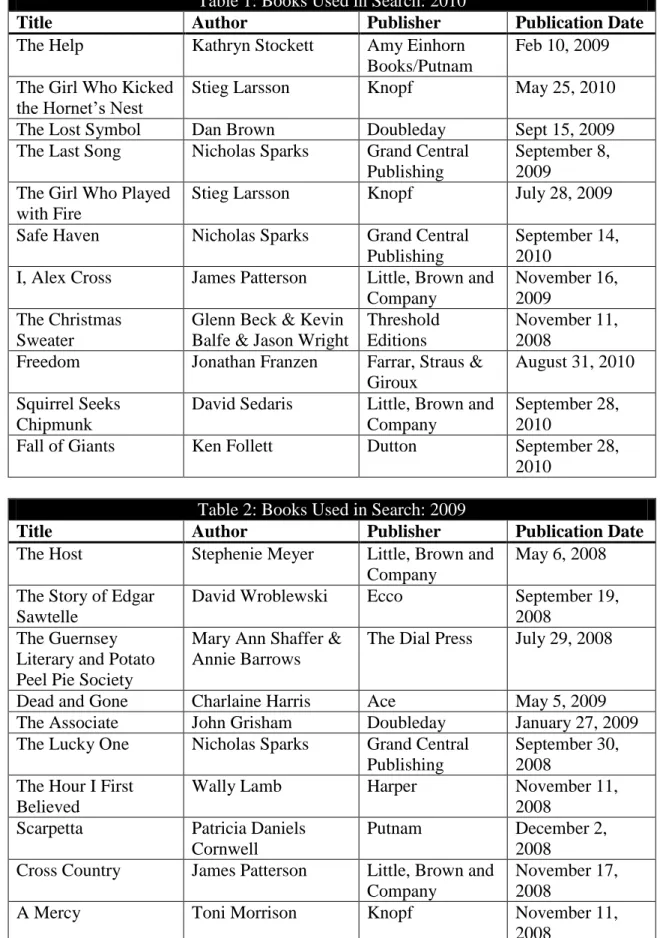
libraries to determine holdings of popular fiction published from 1940-1990. Their study used bestsellers listed in Publishers Weekly. To determine the most popular books for this study, a list of top ten books from each year was compiled based on the number of
weeks a title spent on the list. The number of weeks was counted at the date of last appearance on the list. For those titles which continued appearing on the list into the year
Table 1: Books Used in Search: 2010
Title Author Publisher Publication Date
The Help Kathryn Stockett Amy Einhorn
Books/Putnam
Feb 10, 2009
The Girl Who Kicked the Hornet‟s Nest
Stieg Larsson Knopf May 25, 2010
The Lost Symbol Dan Brown Doubleday Sept 15, 2009
The Last Song Nicholas Sparks Grand Central Publishing
September 8, 2009
The Girl Who Played with Fire
Stieg Larsson Knopf July 28, 2009
Safe Haven Nicholas Sparks Grand Central Publishing
September 14, 2010
I, Alex Cross James Patterson Little, Brown and Company
November 16, 2009
The Christmas Sweater
Glenn Beck & Kevin Balfe & Jason Wright
Threshold Editions
November 11, 2008
Freedom Jonathan Franzen Farrar, Straus & Giroux
August 31, 2010
Squirrel Seeks Chipmunk
David Sedaris Little, Brown and Company
September 28, 2010
Fall of Giants Ken Follett Dutton September 28,
2010
Table 2: Books Used in Search: 2009
Title Author Publisher Publication Date
The Host Stephenie Meyer Little, Brown and Company
May 6, 2008
The Story of Edgar Sawtelle
David Wroblewski Ecco September 19,
2008 The Guernsey
Literary and Potato Peel Pie Society
Mary Ann Shaffer & Annie Barrows
The Dial Press July 29, 2008
Dead and Gone Charlaine Harris Ace May 5, 2009
The Associate John Grisham Doubleday January 27, 2009 The Lucky One Nicholas Sparks Grand Central
Publishing
September 30, 2008
The Hour I First Believed
Wally Lamb Harper November 11,
2008 Scarpetta Patricia Daniels
Cornwell
Putnam December 2,
2008 Cross Country James Patterson Little, Brown and
Company
November 17, 2008
A Mercy Toni Morrison Knopf November 11,
Table 3: Books Used in Search: 2008
Title Author Publisher Publication Date
A Thousand Splendid Suns
Khaled Hosseini Riverhead May 22, 2007
For One More Day Mitch Albom Hyperion September 26, 2006
World Without End Ken Follett Dutton October 9, 2007 The Choice Nicholas Sparks Grand Central
Publishing
September 24, 2007
Playing for Pizza John Grisham Doubleday September 24, 2007
The Appeal John Grisham Doubleday January 29, 2008
Love the One You‟re With
Emily Giffin St. Martin‟s Press May 13, 2008
Double Cross James Patterson Little, Brown and Company
November 13, 2007
Stone Cold David Baldacci Grand Central Publishing
November 6, 2007
Chasing Harry Winston
Lauren Weisberger Simon & Schuster May 27, 2008
Once the libraries and titles were determined, a search of each library‟s OPAC
began. The searches were performed over a period of two weeks in February, 2011, and involved visiting each library‟s website as represented on the ARL “Member Libraries”
page and using a combination of author and title searches. Each title on the list was
searched for in all of the catalogs and if present, its location was noted. Each title was documented as being in one of four collections: “Browsing,” “Stacks,” “Both,” “None.”
For the purposes of this study, a browsing collection was defined as any collection whose purpose is for housing popular titles, or housing particular titles in an area set apart from
the rest of the collection. These collections can have many names including Browsing Collection, Popular Collection, Bestseller Collection, etc. If any location had an ambiguous name a full investigation was done on the library‟s website to determine
and any titles located in the main collection of the library. In the case of libraries with multiple branches or campuses, an effort was made to determine which of the libraries
were part of the larger university library system and which were independent.
There are two main issues for validity in collecting the data for this study. The first is whether or not a given library‟s browsing collection is cataloged. If one of the
libraries studied has an uncataloged browsing collection, it would not appear in the OPAC and there will be no way to know that title actually exists in the library‟s
collection. The second threat is the issue of location naming in library catalogs. If collections have nonsignificant or ambiguous names the location of a book may be
Results
The results of the OPAC searches of the selected popular fiction titles in the selected ARL member library catalogs indicated that popular fiction is handled
differently in different libraries. All of the institutions held at least one of the titles somewhere in their collection, but where popular fiction was held varied greatly. Seven university libraries owned all thirty-one titles in their collection and two of these,
University of Texas and University of Pittsburgh, have no browsing collection (Table 4). Popular fiction is being collected in academic libraries, in both libraries that encourage
recreational reading with browsing collections and libraries which have no browsing collection and collect popular fiction for their general collection.
Table 4: Universities with All Titles Harvard University
University of North Carolina at Chapel Hill University of Pittsburgh*
Temple University Texas A&M University University of Texas*
Washington University in St Louis *No browsing collection
Each of the titles was held by at least one browsing collection. The Girl Who Kicked the Hornet’s Nest by Stieg Larsson was most likely to be included in a browsing
collection with forty-seven inclusions, while The Christmas Sweater by Glenn Beck was
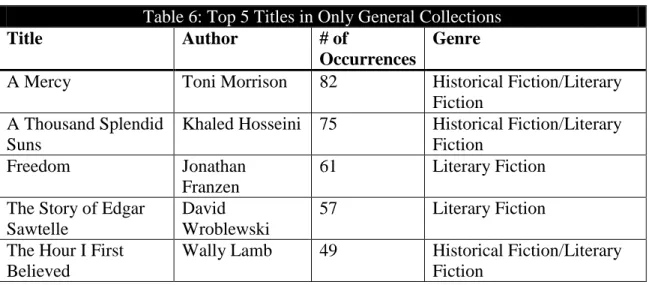
broader collection of a library at much higher rates than its placement within a browsing or popular collection. Table 5 below includes the titles most often shelved only in a library‟s browsing collection while Table 6 includes the titles most often shelved only in a library‟s general collection. The title most often located only in the stacks has that
location in eighty-two libraries, while the title most often only located in a browsing collection has that location in twenty-eight libraries.
Table 5: Top 5 Titles in Only Browsing Collections
Title Author # of
Occurrences
Genre
The Associate John Grisham 28 Mystery/Suspense
Fiction
Dead and Gone Charlaine Harris 27 Science Fiction/Fantasy
The Host Stephenie Meyer 27 Science Fiction/Fantasy
The Lost Symbol Dan Brown 25 Mystery/Suspense
Fiction
The Last Song Nicholas Sparks 25 Romance
Table 6: Top 5 Titles in Only General Collections
Title Author # of
Occurrences
Genre
A Mercy Toni Morrison 82 Historical Fiction/Literary Fiction
A Thousand Splendid Suns
Khaled Hosseini 75 Historical Fiction/Literary Fiction
Freedom Jonathan
Franzen
61 Literary Fiction
The Story of Edgar Sawtelle
David Wroblewski
57 Literary Fiction
The Hour I First Believed
Wally Lamb 49 Historical Fiction/Literary Fiction
Genre classification for each of the titles was based on Library of Congress Subject Headings and categorization on bookselling websites. A look at the genres in
items of literary fiction while those held in browsing collections are classified as genre fiction. A title is more likely to be collected if it can be classified as literary fiction rather
than genre fiction. The titles classified as literary fiction are in more academic library collections than those classified as genre fiction but as Table 7 shows, genre fiction such
as mystery/suspense fiction represents a larger part of best-selling popular fiction titles. Genre fiction may be seen as more appropriate for recreational reading than research and is therefore more often collected in browsing collections than in general collections. If
academic libraries were collecting the popular fiction titles that are truly popular there would be larger numbers of genre fiction in their collections, regardless of where they
place popular fiction.
Table 7: Genre Representation in Searched Titles
Genre # of Titles in Genre
Mystery/Suspense Fiction 10
Romance 6
Literary Fiction* 6 Historical Fiction* 6 Science Fiction/Fantasy 2
Inspirational 2
Humor 1
Sports Fiction 1
*3 titles are classified as both Historical and Literary Fiction, see Table 6
While seven libraries hold all of these titles, thirty-five (30.97%) of the libraries hold ten or fewer of the titles in their collection and 49.56% hold fewer than half the titles. Based on this data, popular fiction is still not a collecting priority of all academic
libraries. Of the libraries searched in this study, 60.2% had a browsing collection of some kind. So although current popular fiction may not be heavily collected by all
practice, as 46.9% of libraries held at least one title in both the general collection and a browsing collection. This could be because a title fits the collecting requirements of both
Discussion
The results seem to indicate that although almost all large academic libraries collect popular fiction, there is no standard model for its placement. The libraries in this
study included examples of libraries with browsing collections and without, those which placed popular fiction in multiple locations and those who maintained a consistent location, those which held every title and those which held very few. Although no
overall model for popular fiction collection or placement can be found, it is possible to identify four models of how libraries deal with popular fiction. The first model is the
library that collects popular fiction and places it in a browsing collection. These libraries contain a large number of the titles on the list in Tables 1,2, and 3 and the majority are located in the browsing collection. The second model is the library that collects popular fiction and places it in the general collection. These libraries don‟t have a browsing
collection but they still have a large number of the titles. The third is the library that collects popular fiction, but doesn‟t have a standard location for popular fiction. These
libraries have a browsing collection as well as a large number of the titles but the titles can be found in the browsing collection, the general collection, or both with equal
frequency. The fourth is the library that does not collect popular fiction, or collects only a very few titles. Each of these library types has at least one representative in the
Why is there no model for popular fiction placement? It may simply be because browsing collections are not a standard feature in every library unlike the reference or
periodical collections. Perhaps it has something to do with the mission of the library and its unwillingness or lack of interest in creating a collection of titles which could be found
in a public library. Although as libraries become more user centered and collections move towards a just in time rather than just in case approach, a browsing collection may become increasingly appropriate. Or it may be seen as a positive thing that libraries seem
to take a number of approaches to popular fiction as each library serves a distinct user population that may have its own particular preferences for the placement of popular
fiction.
Given the results of this study and the great variety of approaches to popular fiction placement, further research into this area may succeed in clearing up the
inconsistencies seen in the libraries and may perhaps result in recommending a successful model for popular fiction placement. One possibility of interest would include studying
circulation statistics to discover what locations allow the best visibility for popular fiction or allow those collections to get the most use possible. Knowing what popular fiction placement receives the most circulation could help libraries determine whether the
popular fiction placement they are currently using is the best or most appropriate for their collection. Another area of future research could include the same type of research done
by this study on other types of academic libraries including community colleges and four year liberal arts institutions. This would provide a more comprehensive picture of the state of popular fiction within academic libraries as a whole instead of just large research
It is clear that there is no common model for popular fiction placement in
academic libraries, and there may never be a single solution that fits all institutions, but it
is important for academic libraries to consider their placement of popular fiction and ensure it fits both their mission and the needs of their students and faculty. Academic
Works Cited
Association of Research Libraries. (2010, November 22). Member Libraries. Retrieved from http://www.arl.org/arl/membership/members.shtml
Crawford, G. A. & Harris, M. (2001). Best-Sellers in academic libraries. College & Research Libraries, 62(3), 216-225.
Dewan, P. (2010). Why your academic library needs a popular reading collection now more than ever. College & Undergraduate Libraries, 17(1), 44-64.
Elliott, J. (2007). Academic libraries and extracurricular reading promotion. Reference & User Services Quarterly, 46(3), 34-43.
Gallik, J. (1999). Do they read for pleasure? Recreational reading habits of college
students. Journal of Adolescent & Adult Literacy, 42(6), 480-488.
Hsieh, C. & Runner, R. (2005). Textbooks, leisure reading, and the academic library.
Library Collections, Acquisitions, & Technical Services, 29, 194-204.
Mulcahy, K. P. (2006). Science fiction collections in ARL academic libraries. College & Research Libraries, 67(1), 15-34.
Odess-Harnish, K. (2003). Making sense of leased popular literature collections. Collection Management, 27(2), 55- 74.
Rathe, B. & Blankenship, L. (2006). Recreational reading collections in academic libraries. Collection Management, 30(2), 73-85.
Sanders, M. (2009). Popular reading collections in public university libraries: A survey of three southeastern states. Public Services Quarterly, 5(3), 174-183.
Sewell, R. G. (1984). Trash or treasure? Pop fiction in academic and research libraries. College & Research Libraries, 45, 450-561.
Smith, R. & Young, N. J. (2008). Giving pleasure its due: Collection promotion and
readers‟ advisory in academic libraries. The Journal of Academic Librarianship, 34(6), 520-526.
Van Fleet, C. (2003) Popular fiction collections in academic and public libraries. In Fazle Kabir, A. M. (Ed.) Acquisition in different and special subject areas (pp. 63-85). New York: Haworth Information Press.
Wagner, C. (2010). Graphic novel collections in academic ARL libraries. College & Research Libraries, 71(1), 42-48.
Appendix: Library OPACs Searched
University of Alabama Libraries University at Albany, SUNY, Libraries
University of Alberta Libraries University of Arizona Libraries
Arizona State University Libraries Auburn University Libraries
Boston College Libraries Boston University Libraries
Brigham Young University Library
University of British Columbia Library Brown University Library
University at Buffalo, SUNY, Libraries
University of Calgary Libraries and Cultural Resources University of California, Berkeley Library
University of California, Davis Library University of California, Irvine Libraries
University of California, Santa Barbara Libraries Case Western Reserve University Libraries
University of Chicago Library University of Cincinnati Libraries
University of Colorado at Boulder Libraries Colorado State University Libraries
Columbia University Libraries
University of Connecticut Libraries Cornell University Library
Dartmouth College Library University of Delaware Library Duke University Libraries
Emory University Libraries University of Florida Libraries
Florida State University Libraries George Washington University Library Georgetown University Library
University of Georgia Libraries
Georgia Tech Library and Information Center
University of Guelph Library Harvard University Libraries
University of Hawaii at Manoa Library
Howard University Libraries
University of Illinois at Chicago Library
University of Illinois at Urbana-Champaign Library Indiana University Libraries Bloomington
University of Iowa Libraries Iowa State University Library Johns Hopkins University Libraries
University of Kansas Libraries Kent State University Libraries
University of Kentucky Libraries Louisiana State University Libraries University of Louisville Libraries
McGill University Library McMaster University Libraries
University of Manitoba Libraries University of Maryland Libraries
University of Massachusetts Amherst Libraries
Massachusetts Institute of Technology Libraries University of Miami Libraries
University of Michigan Library Michigan State University Libraries University of Minnesota Libraries
University of Nebraska–Lincoln Libraries University of New Mexico Libraries
New York University Libraries
University of North Carolina at Chapel Hill Libraries
North Carolina State University Libraries Northwestern University Library
Hesburgh Libraries of Notre Dame
Ohio State University Libraries Ohio University Libraries
University of Oklahoma Libraries Oklahoma State University Library University of Oregon Libraries
University of Ottawa Library
University of Pennsylvania Libraries
Pennsylvania State University Libraries University of Pittsburgh Libraries Princeton University Library
Purdue University Libraries Queen's University Library
Rice University Library
University of Rochester Libraries Rutgers University Libraries
University of South Carolina Libraries University of Southern California Libraries
Southern Illinois University Carbondale Library Stony Brook University, SUNY, Libraries
Syracuse University Library Temple University Libraries
University of Tennessee, Knoxville Libraries
University of Texas Libraries Texas A&M University Libraries
Texas Tech University Libraries University of Toronto Libraries Tulane University Library
University of Utah Library Vanderbilt University Library
University of Virginia Library Virginia Tech Libraries
University of Washington Libraries
Washington State University Libraries Washington University in St. Louis Libraries
University of Waterloo Library Wayne State University Libraries University of Western Ontario Libraries
Yale University Library York University Libraries
The following books were excluded from the search due to non-English catalogs: