THE ROLE OF CORTICOTROPIN-RELEASING FACTOR (CRF) SIGNALING IN THE VENTRAL TEGMENTAL AREA IN THE REGULATION OF BINGE-LIKE ALCOHOL
CONSUMPTION
Varun Gulati
A thesis submitted to the faculty at the University of North Carolina at Chapel Hill in partial fulfillment of the requirements for graduating with Honors in the Department of Biology in the
College of Arts and Sciences.
Chapel Hill
2014
Approved by:
Jennifer A. Rinker, Ph.D. Research Advisor
ABSTRACT
Binge drinking is a pattern of excessive alcohol consumption related to numerous health problems, notably alcohol dependence. Corticotropin-releasing factor (CRF) signaling within the ventral tegmental area (VTA) is known to regulate dependence-induced alcohol consumption. It remains unclear which receptors regulate binge-like consumption. This study utilized the
drinking-in-the-dark design to examine how intra-VTA CRF-1 receptor (CRF-1R) antagonism and CRF-2R agonism influenced binge-like alcohol drinking. Blockade of CRF signaling, by CRF-1R antagonism or CRF-2R autoreceptor activation, reduced binge-alcohol consumption. It was also unknown whether CRF-mediated effects were the result of local VTA interneurons or projection neurons from other brain regions. Transgene expression of eGFP in the VTA of CRF-Cre mice confirmed the presence of local CRF interneurons. By confirming the role of CRF receptors within the VTA in binge-alcohol consumption and establishing the presence of local CRF neurons in the VTA, this study clarifies the CRF-mediated effects on binge-like alcohol consumption and identifies a potential new mechanism mediating alcohol consumption.
INTRODUCTION
Binge drinking refers to a pattern of excessive alcohol consumption that generates a blood alcohol concentration (BEC) of 0.08 grams percent or above in a 2-hr period (National Institute on Alcohol Abuse and Alcoholism, 2004). This pattern of drinking is related to a number of health problems including high blood pressure, liver disease, neurological damage, and often leads to alcohol dependence. Therefore, it is important to examine the neurobiological mechanisms that govern the excessive alcohol consumption.
this peptide family that also includes urotensin, urocortin, and sauvagine. The role of CRF in alcohol intake has recently been established. CRF is a 41-amino acid peptide that is generally released in response to stress. Although mainly produced in the hypothalamus, CRF is also synthesized and secreted by other areas of the brain such as the central amygdala (CeA) and bed nucleus of the stria terminalis (BNST), as well as other peripheral tissues (Society for
Endocrinology 2013). It is important to distinguish between the two CRF receptor subtypes, CRF-1 receptor (CRF-1R) and CRF-2 receptor (CRF-2R). While CRF-1R tends to be a
postsynaptic receptor, CRF-2R is generally referred to as a presynaptic auto- or hetero-receptor regulating presynaptic release (Hoare et al., 2005).
While CRF is most commonly associated with responses to stress and anxiety, it has also been implicated in regulating a number of alcohol related behaviors. For example, it has been shown that long-term alcohol intake and alcohol dependence are correlated with enhanced function of CRF, specifically within the CeA (Funk et al., 2006). In addition, it has been proven that intra-amygdalar administration of CRF receptor antagonists reduces alcohol intake after a period of abstinence in dependent rats (Valdez et al., 2002). It was previously believed that the CRF system did not significantly modulate alcohol intake in nondependent animals, leading to the conjecture that neuroadaptations within the CRF system develop over an extended time period, leading to alcohol dependence (Koob, 2003, 2009). However, recent data suggests that the CRF system is recruited at a much earlier stage, specifically prior to alcohol dependence (Lowery-Gionta et al., 2012). A number of studies have demonstrated this effect. Initially, it was shown that intracerebroventricular (i.c.v.) administration of a variety of CRF receptor
consumption, and infusion of urocortin, a CRF-2 agonist, also reduced binge-like alcohol intake (Lowery et al., 2010).
While these studies have shown that the ability of CRF receptors to modulate binge-drinking behavior, it remains unknown which specific sites in the brain are responsible for modulating this behavior. A recent study performed by Lowery-Gionta et al., (2012)
agonism and its relation to binge-drinking behavior. An additional pilot experiment was
performed to explore the possibility that there are local CRF neurons mediating CRF release and influencing alcohol drinking behavior within the VTA, rather than the purported afferent
projections from other brain regions to the VTA.
MATERIALS AND METHODS
Animals
C57BL/6J mice (Jackson Labs) were used in Experiments 1 & 2, while CRF-Cre transgenic mice (mice who express the exogenous Cre-recombinase selectively only in CRF expressing cells) were used for Experiment 3. All mice were approximately 10-12 weeks old at the beginning of the study. The mice were housed in individual cages with standard rodent chow available at all times. Water was available at all times except when animals were given access to alcohol. The rooms in which the mice were housed were maintained at 22° C and on a 12-hr light/dark cycle (lights off at 0800). All procedures were carried out in accordance with guidelines set by the National Institutes of Health Guide for the Care and Use of Laboratory Animals and were approved by the University of North Carolina Institutional Animal Care and Use Committee.
Drugs/Reagents
AAV8-hSYN-DIO-eGFP, a Cre-dependent adeno-associated virus with a double inverted open reading frame that in the presence of Cre-recombinase in CRF neurons of CRF-Cre mice will cause the transcription and subsequently the expression of the enhanced green fluorescent protein (eGFP) only in CRF neurons of CRF-Cre mice.
Drinking-in-the-Dark Procedure
Alcohol intake was regulated using 4 day drinking-in-the-dark procedure. This procedure is optimized to promote binge drinking and generate BECs greater than 80 mg/dl (Rhodes et al., 2005, 2007; Sparta et al., 2008; Lowery et al., 2010). Three hours into the dark cycle, animals were given access to a 20% alcohol solution in their home-cage. Days 1-3 consisted of a 2-hour drinking session during which water bottles were removed and replaced with 20% alcohol bottles. After 2 hours, alcohol bottles were replaced with water bottles. The same procedure was
followed for Day 4 except that alcohol bottles were available for 4 hours, this was considered the binge test day. All pharmacological manipulations were performed approximately an hour before bottles were placed on the cages. Additionally, approximately 10 microliters of tail blood
samples were collected from each animal immediately after the binge on the test day in order to determine the BECs using the Analox Analyzer (Analox Instruments).
Cannula Placement Verification
Red dye, and visualized on a Nikon-1000 microscope to verify accurate cannulae placement. Any animals with missed placements were removed from analyses.
For Experiment 3, animals were allowed to recover in their homecages for approximately 3 weeks following surgery to allow for sufficient transduction of the viral vector and expression of eGFP. Animals were then injected with an overdose of ketamine/xylazine, and transcardially perfused as described above. Tissue was sliced and mounted, and the expression of Cre-induced eGFP in VTA CRF neurons was visualized on an EVOS FL microscope (Life Technologies).
RESULTS
Experiment 1:
Intra-VTA Antalarmin. An independent samples t-test revealed that intra-VTA antalarmin
Figure 1. The effects of intra-VTA antalarmin (1.0ug/0.5ul) on binge-like alcohol consumption (A), corresponding BECs (B), and sucrose consumption (C). Intra-VTA antalarmin significantly reduced binge-like alcohol consumption on the binge test day (* p < 0.001) and there was a trend toward a reduction in corresponding BECs. Intra-VTA antalarmin did not, however, reduce binge consumption of a 10% sucrose solution, demonstrating this effect was specific to alcohol, not other calorie-rich reinforcers.
Experiment 2:
Intra-VTA Urocortin 3. An independent samples t-test revealed that intra-VTA infusion of 24
pmol Urocortin 3 did not significantly reduce, and in fact appears to cause a small, but
Experiment 3:
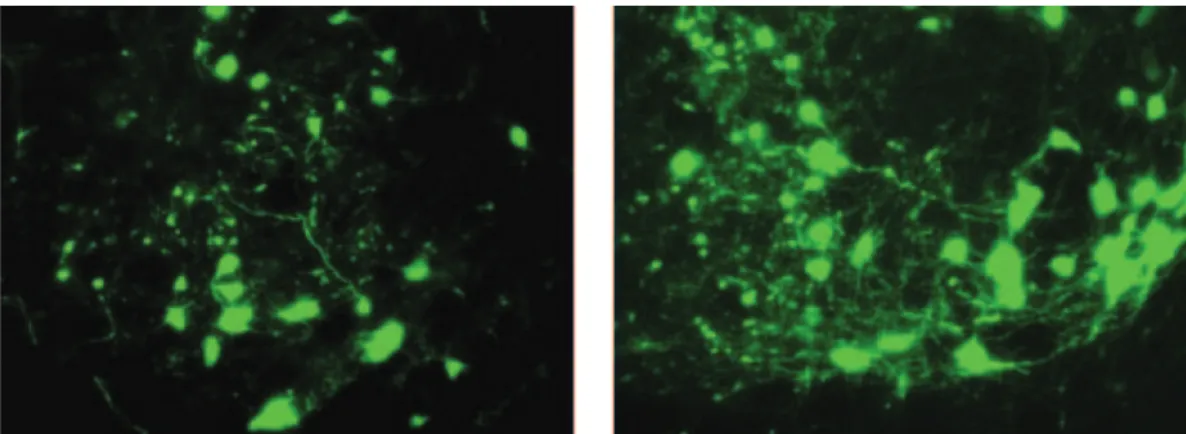
The brain tissues of CRF-Cre animals were visualized using an EVOS FL microscope. Expression of the eGFP protein can only occur in presence of Cre-recombinase, which is localized to CRF neurons, thus if neurons in the VTA express GFP they are CRF expressing neurons localized to the VTA, i.e., not afferent projections into the VTA as the AAV8 serotype is an anterograde viral vector that is taken up by the soma. Photomicrographs at 20x magnification of the VTA revealed a number of eGFP expressing cell bodies within the VTA. This confirms that there are local CRF producing neurons in this region. These neurons may be responsible for regulating CRF-mediated changes in the consumption of alcohol. Figure 3 illustrates these eGFP neurons in the VTA.
Figure 3. These are representative images of Cre-recombinase mediated eGFP expression in CRF neurons of the VTA (20x magnification).
DISCUSSION
CeA (Funk et al., 2006). It has also been shown that intra-amygdalar injection of CRF receptor antagonists reduces alcohol intake after a period of abstinence in dependent rats (Valdez et al., 2002). It was previously hypothesized that the CRF system did not significantly regulate alcohol consumption in nondependent animals, leading to the conjecture that neuroadaptations within the CRF system form over an extended period of time, leading to alcohol dependence (Koob, 2003, 2009). Recent data, however, suggests that the CRF system is recruited at a much earlier stage, specifically prior to alcohol dependence (Lowery-Gionta et al., 2012). Specifically, this group demonstrated that binge-like alcohol consumption increased CRF immunoreactivity in both the CeA and VTA, indicating that CRF signaling might be important in regulating binge-like alcohol consumption (Lowery-Gionta et al., 2012). This group further went on to that CRF signaling via CRF-1 receptors in the CeA modulated binge like alcohol consumption by showing that
blockade of CRF-1 receptors decreases alcohol consumption. The goal of the present set of
studies was to further explore the role of intra-VTA CRF signaling in binge alcohol consumption. The first experiment supports the conjecture that the injection of intra-VTA antalarmin, a CRF-1 receptor antagonist, significantly reduces alcohol intake. Furthermore, since the sucrose consumption remained unaffected, it can be concluded that the antagonist is reinforcer (alcohol) specific. The intra-VTA antalarmin also illustrated a downward trend in the BEC levels of the mice. Infusion of intra-VTA urocortin, a CRF-2 agonist, also reduced alcohol consumption.
receptor mediated reduction in alcohol consumption shown in experiment 1. This demonstration is also particularly exciting because it has previously been thought that the VTA did not contain CRF producing cells and only received CRF via neurons projecting from areas like the CeA and BNST. Thus, we have confirmed that there appear to be local CRF producing neurons in the VTA and further studies will serve to determine if these neurons are responsible for mediating the CRF-related changes in alcohol intake.
In order to fully characterize the role of CRF signaling in the VTA in binge-like alcohol consumption, future studies are planned to investigate CRF-1 agonism and CRF-2 antagonism. This will allow for a complete pharmacological understanding of the CRF system and its relation to binge-like alcohol consumption. Additionally, in order to understand the role of endogenous CRF signaling, we will utilize the designer receptors activated by designer drugs (DREADDs) in CRF-Cre mice so that we can selectively activate and inhibit CRF neurons specifically within the VTA in order to determine whether local CRF interneurons are responsible for the regulation of binge-like drinking behavior. The inability of these neurons to exert an effect on alcohol
REFERENCES
Funk, C. K., O'Dell, L. E., Crawford, E. F., & Koob, G. F. (2006). Corticotropin-releasing factor within the central nucleus of the amygdala mediates enhanced ethanol self-administration in withdrawn, ethanol-dependent rats. J Neurosci, 26(44), 11324-11332.
Hoare, S. R., Sullivan, S. K., Fan, J., Khongsaly, K., & Grigoriadis, D. E. (2005). Peptide ligand binding properties of the corticotropin-releasing factor (CRF) type 2 receptor:
pharmacology of endogenously expressed receptors, G-protein-coupling sensitivity and determinants of CRF2 receptor selectivity. Peptides, 26(3), 457-470.
Koob, G. F. (2003). Neuroadaptive mechanisms of addiction: studies on the extended amygdala. Eur Neuropsychopharmacol, 13(6), 442-452.
Koob, G. F. (2009). Brain stress systems in the amygdala and addiction. Brain Res, 1293, 61-75. Lowery, E. G., Spanos, M., Navarro, M., Lyons, A. M., Hodge, C. W., & Thiele, T. E. (2010).
CRF-1 antagonist and CRF-2 agonist decrease binge-like ethanol drinking in C57BL/6J mice independent of the HPA axis. Neuropsychopharmacology, 35(6), 1241-1252.
Lowery-Gionta, E. G., Navarro, M., Li, C., Pleil, K. E., Rinker, J. A., Cox, B. R., . . . Thiele, T. E. (2012). Corticotropin releasing factor signaling in the central amygdala is recruited
during binge-like ethanol consumption in C57BL/6J mice. J Neurosci, 32(10), 3405-3413. National Institute on Alcohol Abuse and Alcoholism. (2004). NIAAA council approves
definition of binge drinking. NIAAA Newsletter 3:3.
Rhodes, J. S., Best, K., Belknap, J. K., Finn, D. A., & Crabbe, J. C. (2005). Evaluation of a
simple model of ethanol drinking to intoxication in C57BL/6J mice. Physiol Behav, 84(1), 53-63.
Rhodes, J. S., Ford, M. M., Yu, C. H., Brown, L. L., Finn, D. A., Garland, T., Jr., & Crabbe, J. C. (2007). Mouse inbred strain differences in ethanol drinking to intoxication. Genes Brain Behav, 6(1), 1-18.
Sparta, D. R., Hopf, F. W., Gibb, S. L., Cho, S. L., Stuber, G. D., Messing, R. O., . . . Bonci, A. (2013). Binge ethanol-drinking potentiates corticotropin releasing factor R1 receptor activity in the ventral tegmental area. Alcohol Clin Exp Res, 37(10), 1680-1687.
Society for Endocrinology (October 24, 2013). "Corticotropin-Releasing Hormone." Retrieved November 25, 2013, from
http://www.yourhormones.info/hormones/corticotrophinreleasing_hormone.aspx.
drinking associated with drinking in the dark procedures. Alcohol Clin Exp Res, 32(2), 259-265.