
Laura K Dimmit. Building a Community of Practice Around Information Literacy by Design: A Case Study at UNC-Chapel Hill’s Undergraduate Library. A Master’s Paper for the M.S. in Library Science degree. April, 2016. 62 pages. Advisor: Jonathan McMichael
A gap currently exists between the level of instructional training needed for public service librarians to succeed, and the level being provided by employers and LIS
programs. Communities of practice (CoPs), as described by Lave and Wenger, provide a sustainable, practice-centered model for instructors of all experience and skill levels to grow individually while supporting each other. This paper documents the analysis of redesigned instructional training for the instruction team at UNC-Chapel Hill’s
Undergraduate Library (UL), centered around Information Literacy by Design (ILbD). Interviews with instruction team members are coded to track indicators of CoPs, which reveal key trends involving peer relationships, self-efficacy, and ways of learning. The redesigned training is revealed to have influenced the development of a community of practice among the UL instruction team.
Headings:
Academic libraries
Librarians – in-service training
Communities of practice
Communities of practice – case studies
Social learning
BUILDING A COMMUNITY OF PRACTICE AROUND INFORMATION
LITERACY BY DESIGN: A CASE STUDY AT UNC-CHAPEL HILL’S
UNDERGRADUATE LIBRARY
by
Laura K Dimmit
A Master’s paper submitted to the faculty of the School of Information and Library Science of the University of North Carolina at Chapel Hill
in partial fulfillment of the requirements
for the degree of Master of Science in Library Science. Chapel Hill, North Carolina
April 2016
Approved by
Table of Contents
Introduction ...2
Institutional Context ...4
Preview of Results ...8
Literature Review ...9
Mentorship in Academic Libraries ...9
Information Literacy Programs & Training in Academic Libraries...12
Understanding by Design in Libraries ...15
Communities of Practice in Libraries ...16
Methods ...22
Document Analysis ...23
Interviews ...23
Developing Interview Questions ...24
Ethical Considerations ...25
Interview Analysis ...27
Team Relationships ...30
Ways of Learning ...32
Efficacy ...34
Challenges to Community ...35
Conclusion and Recommendations ...41
Current Progress ...42
Future Directions ...42
Broader Use ...44
Bibliography ...46
Appendix 1: Interview Questions ...49
Appendix 2: Original CoP-S Scale ...51
Appendix 3: Adapted CoP-S Scale ...52
Appendix 4: Original ILbD Lesson Plan Template ...54
Appendix 5: Revised ILbD Lesson Plan Template ...56
Introduction
Information literacy (IL) instruction continues to be a key function of academic
libraries, and new professionals working in public service will often be asked not only to
teach, but to innovate in classroom settings (Brecher & Klipfel, 2014). Studies done more
than a decade apart (2001 and 2013) suggest that nearly all reference job postings require
some element of instruction (Davies-Hoffman, Alvarez, Costello, & Emerson; Hall).
While librarians possess the research skills that comprise much of the information
literacy instruction that occurs, not all have received the same level of core educational
training as would classroom teachers. For example, the MSLS curriculum at the
University of North Carolina at Chapel Hill contains a single instructional course: INLS
502—User Education. However, it is not offered every semester, and it is not a required
or core course for any degree.
ACRL has previously recognized the need for strong instructional skills, and the
gap that currently exists between what jobs demand and how the workforce is trained. In
2007, they released a "Standards for Proficiencies for Instruction Librarians and
Coordinators" with a stated goal of "help[ing] instruction librarians define and gain the
skills needed to be excellent teachers in library instruction programs" (ACRL, 2007).
These standards categorize recommended proficiencies into 12 groups; particularly
relevant are information literacy integration skills, curriculum design skills, and teaching
states that the effective instruction librarian "Modifies teaching methods and delivery to
address different learning styles, language abilities, developmental skills, age groups, and
the diverse needs of student learners" (ACRL, 2007). Each of the variables listed—
learning styles, language, age groups--encompasses a hefty background of educational
literature and strategy. Providing a new generation of public service librarians with these
proficiencies will require increased attention to pedagogical training by LIS programs,
and continued focus on training and professional development opportunities for those
already working in an instructional capacity.
This document also recognizes the importance of collaboration in librarianship,
and that gaining skill and expertise as a professional is a social, not solitary, endeavor.
These observations about social learning are best described by Lave and Wegner’s theory
of communities of practice (often abbreviated as CoPs). These CoPs, defined by a shared
goal and common purpose, should promote learning and the opportunity to continue
developing one’s expertise (Lave & Wegner, 1991). For Lave and Wegner, learning is
always an activity influenced by context and culture. The concept of communities of
practice is particularly useful to librarians because it is beneficial for both beginners and
those with more experience. Beginners can gain increasing membership in a community
of practice through legitimate peripheral participation.
Legitimate peripheral participation suggests that engaging new members of a
community immediately with authentic tasks and responsibilities will allow them to learn
necessary vocabulary, norms, and behaviors more quickly than they would by just
observing from the fringes. Becoming participants also enables new members to
gradually increase their responsibilities, and to learn from current experts who are fully
immersed in the work of the community. For those with more experience, participation in
a CoP represents an opportunity for continuous learning, and to sharpen and refine one’s
practice through mentorship and the exchange of ideas.
Communities of practice, as an avenue for social learning and continued
development, represent a solution for our field’s need for increased pedagogical training.
They accommodate members of all skill levels, and can be self-sustaining. To quote
Wenger (1998), communities of practice become “the social fabric” of an organization’s
learning structures. They provide an opportunity to create pedagogical practice that is not
only taught once, but internalized.
Institutional Context
The Undergraduate Library (UL) is the main source of library instruction for early
undergraduates at UNC-Chapel Hill. This instruction is primarily tied to a mandatory
first-year writing course that exposes new college students to writing “across the
disciplines.” By collaborating with first-year writing instructors to develop learning goals
for their courses, UNC Libraries help ensure that information literacy becomes a
In 2014, a UNC MSLS student, Liz McGlynn, along with the Undergraduate
Experience Librarian, Jonathan McMichael, developed a new information literacy
program, Information Literacy by Design (ILbD). This program is based on
Understanding by Design (UbD), the curriculum design strategy authored by Grant
Wiggins and Jay McTighe (McGlynn, 2015). This new ILbD template embraces the same
backwards design principles as UbD, while adding information literacy concepts
embodied in the ACRL Framework. Backwards design suggests that, rather than starting
lesson or unit planning with ideas for specific classroom activities, educators should start
by outlining the desired results that will be achieved through authentic classroom
performance. This strategy enables all instructors to develop lessons that focus on
big-picture understandings and threshold concepts that will be transferable beyond the
boundaries of any specific course (Wiggins & McTighe, 1998).
The ILbD template encouraged the Research and Design staff at the
Undergraduate Library to embark on a redesign of the training and support structures for
library instructors. Two full-time staff teach many of the requested information literacy
sessions, but graduate students from the UNC School of Information and Library Science
(SILS) working at the Undergraduate Library also serve on the instruction team, and
teach 40% of the more than 250 sessions that are requested each academic year. Hiring
and training graduate students allows the UL to meet growing institutional demand for
instruction while also providing valuable experience and training for LIS students.
However, for this to be a sustainable program, it has to work well for all the stakeholders.
engaged and well-trained librarians. Likewise, LIS students don’t just need experience,
but experience that is paired with the support to learn and develop in an authentic setting.
Prior to the Fall 2015 semester, newly-hired graduate students went through a
two-step training process. Prior to the start of the semester, there was an ‘instruction
bootcamp’ designed to introduce both institutionally-specific instruction practices as well
as high-level information literacy concepts. Over the course of a four-hour session, new
instructors were introduced to three major sets of information:
Details about UNC’s first-year writing program: who it serves, what the courses
are like, and what the goals are.
What is information literacy: concepts, terms, the ACRL Framework and
Standards.
Institutional approach: how do the libraries work with the first-year writing
program? What are we teaching? What are the logistics of teaching here?
None of this training was designed with the assumption that students had any previous
teaching experience, in libraries or otherwise.
This bootcamp was followed by an observational period, where new students
would attend three instruction sessions taught by either a second-year student or a
full-time librarian. New students would fill out an observation form, and after completing the
observations, would meet with a full-time librarian assigned as their ‘instruction mentor.’
Some new students would choose to co-plan and execute their first lesson with a partner,
which would supply additional hands-on discussion and guided practice. After executing
Given the opportunity to develop a new training that would have the ILbD
template at its core, UL staff looked to communities of practice as an implementation
model. Previous studies have documented the benefit of conscious mentoring in academic
libraries (Bosch, 2010; Henrich & Attebury 2010; Hallam & Newton-Smith, 2006).
While most current literature focuses on programs for full-time professionals, the
reported positive results suggest that pre-professionals would benefit from similar
programs. The new training model that emerged retains elements of the previous
process—both a ‘bootcamp’ and an observational period remain. However, these
elements are contained within a five-step process (see Appendix 6) that sets students on
the path from being “initiates” to “experts” (though it is not expected that anyone can
become an expert in two years). The training process is also supported by a cohesive set
of documents modeled from the ILbD template, and an Omeka website for sharing lesson
plans and other useful resources. By situating new instructors immediately within a
framework, their progress can consciously mirror the stages of moving from the fringes
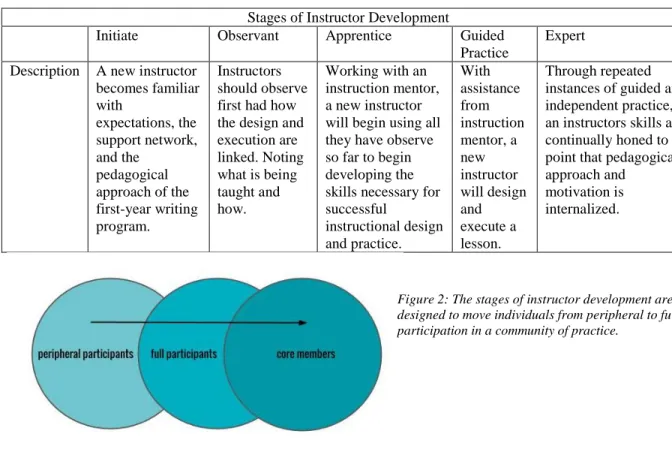
to the core of a CoP (refer to Figure 1, p. 4).
The Fall 2015 semester was the first time the UL’s new training process was used.
Observing the first group of students to receive this training, and soliciting feedback from
them as part of the implementation process, was a valuable way to gauge the impact of a
more immersive introduction to library instruction. It also allows for revision of
processes and supporting documents, both of which will benefit future classes of
incoming graduate assistants. The ultimate goal is to create a training program that is
both scalable and adaptable, one that will be useful for instructional programs involving
training at the Undergraduate Library is new LIS students, a similar training program
should be beneficial for libraries that are adding new instructional staff or expanding the
scope of information literacy programming. Implementing additional opportunities to
come together and focus on instruction can also be beneficial for experienced librarians
who want to explore new possibilities and push back against possible stagnation.
Preview of Results
Through one-on-one interviews with members of the UL instruction team, I was
able to create a fuller picture of individuals’ experiences with the training program, and
of working within this specific community. Coded interview transcripts, when combined
with secondary research, strongly suggest that the instruction team is also a community of
practice with a shared purpose and goals. The interviews also reveal several directions for
Literature Review
Mentorship in Academic Libraries
There is a long tradition of mentorship programs in the workplace, and academic
libraries are no exception. Mentorship, described by Lorenzetti and Powelson as
“facilitating both emotional and behavioral resiliency, and academic and career
advancement,” has been implemented in a variety of ways by academic library teams,
and thus far, no dominant strategy or set of best practices have emerged (2015, p. 186).
Formal mentoring, informal mentoring, and peer mentoring are three variations
represented in the literature.
Formal mentoring generally implies a structured program with mentor/mentee
pairings that are consciously assigned. In a 2010 case study at California State
University, Bosch et al. describe a formal “resource team model”: newly hired librarians
are paired with three established librarians who provide support and guidance in different
professional areas. Moving away from the traditional one-to-one relationships, the
resource team model at CSU was designed to provide a “broader, dynamic network…of
support” (p. 58). For formal mentoring to succeed, the activities and conversations that
surround it must be viewed as professional service, both by individuals and by the
Additionally, mentoring programs of any kind require dedicated time and space
within the work day to enact what Mavrinac calls “transformational change” (2005, p.
400). She also situates mentorship—specifically, peer mentorship—as one way to build
learning cultures within libraries. To build a learning culture, learning should be at the
center of all new developments. Peer mentorship, where relationships are forged between
those on a similar level within organizations (rather than relationships that straddle
different levels of a work hierarchy) can also be more ‘learner-driven,’ as both or all
parties of the relationship are focused on similar problems in their professional lives. Fyn
also discusses the benefit of peer mentorship, especially group peer mentoring. For new
librarians, the narrative element of group discussions can be a powerful way to share not
only formal knowledge about work but cultural and organizational knowledge about their
specific institution (2013).
Broadly, mentorship has a variety of professional and psychosocial benefits for
mentors and mentees. A survey of Canadian library science graduates, librarians, and
library administrators demonstrated a relationship between mentorship and increased
worker satisfaction, worker engagement, and a decrease in institutional turnover
(Harrington & Marshall, 2014). Lacy and Copeland (2013) surveyed current library
science students and their professional mentors after a semester-long program at Indiana
University-Purdue University Indianapolis and found positive results for both parties. For
the students, a formal relationship gave them knowledge about job-seeking and
workplace expectations that were not otherwise included in their LIS degree experience.
practice, as well as a way to stay apprised of current trends and developments that were
being discussed in LIS courses.
Not all student/librarian mentorship relationships are formalized; indeed,
sometimes ‘accidental mentorship,’ as described by Burke and Lawrence, can provide
guidance and feedback at the point of need for student library workers. Accidental
mentorship, like informal mentorship, is not managed by a structured program. However,
unlike informal mentorship, accidental mentors may not even realize they are serving in a
mentorship role until the student has matriculated and/or no longer works for the library
(2011). While Burke and Lawrence’s article specifically describes relationships between
undergraduate library workers and their supervisors, similar opportunities for
point-of-need mentorship should be reasonably expected with graduate student workers and their
supervisors in libraries.
The training program for instruction at the Undergraduate Library provides
opportunities to incorporate both formal and peer mentor relationships. Mentorship
demonstrates the value of a community of practice in action, and strong mentorship can
be evidence of an existing CoP. Because the number of new instructors and graduate
students will always outnumber the number of currently trained instructors, the concept
of peer mentorship is especially important. One of the goals of the UL’s redesign is to
provide a dedicated space for discussion and idea-sharing that is separate from formal
aspects of the training program—to create an environment where organic or ‘accidental’
mentorship is likely. However, being paired with an experienced librarian for discussions
pairings allow mentors to act as resource conduits, and provide a check that new
instructors have access to all the information they need to succeed (Bosch et al., 2010).
Information Literacy Programs & Training in Academic Libraries
To provide effective instructional training for both pre-professionals and current
librarians, we need a vision for what successful information literacy programs look like,
and which skills we should be focused on developing. The ACRL Information Literacy
Best Practices Committee curates the guidelines for “Characteristics of programs of
information literacy that illustrate best practices,” which provide precisely this type of
guidance. The guidelines, last revised in 2012, provide a valuable check for both the
practice of information literacy instruction, and the types of training and development
that should accompany a successful program. Of the 10 guideline categories, category 7
(pedagogy) and category 8 (staffing) are most relevant to the redesign of the training
program at the UL. From category 7, pedagogy for an information literacy program
should:
• support diverse approaches to teaching and learning
• build on existing knowledge, course assignments, and career goals
• prepare students to be lifelong critical thinkers and learners
From category 8, staff of an information literacy program should:
• have the opportunity to receive regular feedback and evaluation
• continue training and professional development
• have the opportunity to develop, coordinate, implement, and revise
These guidelines help create the vision for what the content of information literacy
sessions should be, and also how graduate students and librarians should prepare and be
prepared to teach these sessions. In many ways, the training for instructors should mirror
the content students receive—training should be supportive of various teaching styles; it
should build on what new instructors know, and should support their current or future
careers in librarianship, and it should emphasize fundamental skills.
Key to understanding the current landscape of instructional librarianship is the
discussion surrounding instructional training in LIS education, and how well LIS students
and new librarians are prepared to take on the instructional duties that continue to be a
major component of academic public service careers. Julien (2005) reports that not all
LIS programs offer courses that will provide training in instructional skills or theory.
When these courses are offered, they are overwhelmingly likely to be electives, rather
than a core requirement. Julien concludes the study by asking, “If instruction is now truly
core to the work of academic librarianship, and increasingly important for the work of
librarians in other sectors, why do our LIS school curricula not reflect this reality?” (p.
215). A recent survey by Hall illustrates the relative importance of instructional skills in
new academic library job postings. Supervisors for job postings with instructional duties
were surveyed, and 87% of those rated instruction as being ‘very important’ to their
libraries (p. 28). If instructional skills are increasingly valued, where will the additional
training and development come from: LIS programs? Employers? or somewhere else?
A 2008 content analysis by Sproles, Johnson, and Farison compared the syllabi of
reference and information literacy courses to the 12 ACRL Competencies for Library
information literacy concepts, the number and depth of proficiencies were limited. Their
conclusion was that, while some instructional exposure was possible through coursework,
as it stands, complete instructional training cannot be provided ‘solely in a classroom
setting’ (p. 207).
More recently, Brecher and Klipfel (2014) examined a slightly different
‘disconnect’ between LIS education and the importance of instructional skills in
academic librarianship. As librarians are increasingly asked to collaborate on curricular
issues with faculty as equals, rather than as support staff, pedagogical training is
necessary. It is difficult to help students learn without an understanding of how learning
works (p. 44). Historically, some librarians have supplemented their LIS training with
another advanced degree in education or educational technology, but, the authors asked,
should it be necessary to get a second master’s degree to work in a primarily instructional
position?
For LIS graduate students involved in instruction at the Undergraduate Library,
working while being in school is an opportunity to complement the theory of coursework
with practical application. As the literature suggests that a gap remains between the
instructional training needed for academic public services and the training that librarians
actually receive during their education, both groups can benefit from additional
theoretical and practical instructional training. Communities of practice represent a
practical way to create space for this additional training, while respecting any other
Understanding by Design in Libraries
Searches for “understanding by design” as a keyword in Library and Information
Science Abstracts (LISA), Library & Information Science Source, and ERIC reveal no
articles dealing with Wiggins and McTighe’s curricular design strategies in the context of
academic libraries. Similarly, a search in those same databases for “backwards design” (a
key principle of Understanding by Design) reveals nothing. The core text in this area, and
one with a great deal of significance for this case study in particular, is Elizabeth
McGlynn’s master’s paper from 2015. In this paper, written at UNC while also working
at the Undergraduate Library, she outlines a new vision for the classic Understanding by
Design template, one tailored for information literacy education. This new idea, termed
“Information Literacy by Design” by McGlynn, was the catalyst for a complete
reconceptualization of the UL’s instruction training program. The ILbD template, and
other documents modeled after it, directly support both the training and the larger
instructional program.
Information Literacy by Design is adapted from the same curricular design
principles that form the foundation of Understanding by Design. At the core is backwards
design, the idea that teachers and other educators should reject both “coverage
orientation” and “activity orientation” when designing units or individual lessons.
Coverage orientation speaks to the practice of designing learning plans around how much
material there is to cover—10 chapters in a textbook, for example. Activity orientation
speaks to basing a learning plan around being “hands-on without being minds-on”
In contrast, backwards design asks educators to start with establishing desired
results. What are the big ideas and understandings that a student should have when they
leave the classroom that day/week/semester? After choosing results, educators can then
decide what kind of evidence is necessary to prove that students have achieved the
desired results. What kind of authentic performance tasks can you develop to let them
demonstrate their understanding? Finally, after choosing both desired results and
acceptable evidence, planning of individual lessons and learning experiences can take
place. The goal of backwards design is to let learning motivate classroom strategies, not
the other way around.
McGlynn’s adaptation of the Understanding by Design template tailors the
guiding questions to a specifically library setting, and removes some of the structure that
is designed more to guide unit planning than individual lesson planning (p. 24). The
Information Literacy by Design template also includes some guiding questions that are
tailored for the UNC library instructors teaching sessions for first-year writing courses.
Generally, these library sessions are focused on a particular part of a particular
assignment. To reflect this, and to assist library instructors in breaking down the
requirements of the assignment, the template includes a “Pre-Planning” stage that helps
them establish where students are in the research process, and what the goals of the
lesson should be (McGlynn, p. 25).
Communities of Practice in Libraries
The concept of a ‘community of practice’ shares significant overlap with the
broad concept of mentorship. Like mentorship, communities of practice are centered
communities of practice depend on a larger network of individuals, unlike the traditional
conception of mentorship that is based on a one-to-one or one-to-few relationship. The
idea of a community of practice comes from social learning theory, and was developed in
cognitive anthropologists Lave and Wenger's 1991 book Situated Learning: Legitimate Peripheral Participation. Communities of practice represent learning as a social process. Individuals perform tasks or engage in practices as they are also connected to a larger
‘joint enterprise.’ For the purposes of this study, that joint enterprise is taken to be
‘teaching library instruction for first-year composition students at UNC-Chapel Hill.’ In
this same vein, members of a community of practice share ideas and collaborate, even if
this shared discussion is not formalized. Ultimately, a community of practice becomes a
living resource for each of its members, and the resources will grow as individual
members become more fully participatory (Swieringa, 2009).
Generally, communities of practice provide an alternative to the idea that learning
is a solitary process based on the internalization of knowledge. Instead, Lave and Wegner
present a definition of learning “as increasing participation in communities of practice
concern[ing] the whole person acting in the world” (p. 49). Thinking about learning as
participation rather than as internalization also allows it to be both a mental and physical
activity; learning becomes grounded in specific circumstances.
“Legitimate peripheral participation” (refer to Figure 1, p. 4) is the action
accompanying all communities of practice. While Lave and Wegner are quick to point
out that legitimate peripheral participation as a phrase is meant to be taken as a whole
Lave and Wegner’s use of peripheral is that it does not stand in opposition to some idea
of ‘central’ participation (p. 36). Peripheral participation in a community means that an
individual has the capacity and opportunity to move and develop in practice, and to gain a
richer understanding of the actions and knowledge at hand.
The concept of legitimate peripheral participation is particularly important to the
“Stages of Instructor Development” that are included in the UL’s training redesign. A
chart with each stage is included below, and a full chart with actions and performance
indicator is included as an appendix (Appendix 6). Envisioning new instructor
development as movement through stages is an attempt to create an outline of what
legitimate peripheral participation looks and feels like, and to provide ‘checks’ that allow
new instructors to confirm that they are moving closer to what Lave and Wegner call ‘full
participation’ (p. 37).
Stages of Instructor Development
Initiate Observant Apprentice Guided Practice
Expert
Description A new instructor becomes familiar with expectations, the support network, and the pedagogical approach of the first-year writing program.
Instructors should observe first had how the design and execution are linked. Noting what is being taught and how.
Working with an instruction mentor, a new instructor will begin using all they have observe so far to begin developing the skills necessary for successful instructional design and practice. With assistance from instruction mentor, a new instructor will design and execute a lesson. Through repeated instances of guided and independent practice, an instructors skills are continually honed to a point that pedagogical approach and
motivation is internalized.
Communities of practice are not new in the literature of academic libraries,
though the principles that underpin these communities are often described using different
names. Hensley, for instance, describes a ‘peer learning program’ for new instructional
librarians. In this peer learning model, instructors take progressive levels of responsibility
in the classroom, moving from shadowing to team teaching to solo teaching (p. 182-183).
This progression is accompanied by discussion and reflective questioning. Hensley also
beautifully articulates the mission of such programs and networks of support: “The
question is not, ‘How do you convince a librarian to be a better teacher?’ Rather the
question is ‘How can you spark the motivation of librarians to pursue a medley of
activities surrounding teaching and learning?’” (p. 187).
Regardless of how they are named, libraries as a workplace seem to be a natural
fit for a community of practice. As noted by Henrich and Attebury (2010), the
shared-learning aspect of CoPs blends well with the interpretation of libraries as shared-learning
organizations. The authors also provide a useful summary of the best practices for
communities of practice (while pointing out that so much diversity exists among CoPs
that best practices must be examined on a case-by-case basis). Some successful practices
they identify include identifying a facilitator or some kind of internal leader, using tools
to encourage frequent communication and idea sharing, and the more abstract
development of a “sense of community.”
Wastawy, Uth, and Stewart (2004) discuss communities of practice and other
learner-centered models of learning emerging as a result of the interactive allowances of
technology. Their focus is primarily on libraries adapting to support these learning
more on investigating the needs of emerging types of communities—rings just as true
when the community members are librarians as it does when they are our patrons.
Klein, Connell, and Meyer (2005) propose a classification scheme for
communities of practice that considers both structure and knowledge activities. The
classification categories they propose are: stratified-sharing, egalitarian-sharing,
stratified-nurturing, and egalitarian-nurturing. Stratified CoPs are defined by different
levels of knowledge held by different members, and the fact that members with more
knowledge are sharing what they know with the less advanced members. Egalitarian
CoPs have two-way knowledge sharing, going from those with more knowledge to those
with less knowledge, and vice versa. Knowledge-sharing CoPs, as the name suggests, are
defined by the ways in which knowledge is shared between members.
Knowledge-nurturing CoPs emphasize opportunities for individual members to develop their own
knowledge within the supportive structure of the community (p. 108-109).
At the Undergraduate Library, the goal was to create a training program that
would foster an egalitarian-nurturing community of practice. Though the pool of
instructors is made up of individuals with varying levels of experience, collaboration
between individuals can be more easily fostered if new instructors believe they have just
as much to contribute as someone who has more experience. Since one of the goals
expressed in the Stages of Instructor Development is for new instructors to develop their
own teaching voice, it made sense to emphasize the aspect of nurturing ideas over
sharing, though of course knowledge-sharing should also happen, and arguably must
Together, ILbD and communities of practice provide a sustainable solution to the
challenge of providing more, and more thorough, instructional training. ILbD provides
the language for developing and understanding good library pedagogy, while a CoP
Methods
Communities of practice are grounded in interpersonal relationships, not governed
by strict rules or boundaries, and may not even be intentionally developed. How can
something like this even be studied—if you think a CoP might be developing, how can
you measure it?
In this case study, the primary mode of data collection was one-on-one interviews
with current members of the Undergraduate Library instruction team about their
experiences as developing instructors, including their usage of the new ILbD documents.
The purpose of this study is evaluate the impacts of the redesigned instructional training
on new instructors, and to report on the choices made in the redesign so that they might
be built on and incorporated by other libraries. This does mean that the data collection
will be focused on internal stakeholders—the new instructors and instructors who have
already been teaching—using metrics that will indicate the existence of a community of
practice, or conditions favorable for the development of a CoP. Future research should
also include the impact of training on student learning, but that is beyond the scope of the
Document Analysis
The UL’s previous training program was dependent on a set of documents, and,
while the documents have been redesigned to support the new training program, they
remain important. New instructors first use an instruction observation form, which helps
guide their observations and allows them to reflect not only on what is being presented in
a class, but how it is being presented, and what impact it is having on students. Later in
their first semester of teaching, instructors use a self-assessment form to reflect on their
own teaching. Instruction mentors use a feedback form to structure their comments and
constructive criticism. Of special importance are the templates used by instructors to plan
lessons. These lesson planning templates are included in the appendices (4 and 5) as a
reference, so that readers can better understand the instruction team’s experiences.
Interviews
Individual interviews were conducted with current members of the instruction team,
including new and returning team members. These interviews were designed to collect
more detailed information and opinions about the impact of the new instructional
training. Because this study is interested in the concept of communities of practice, and
examining how one might develop, it was important to have exact phrasing from
instructors about how they felt moving through the training process, and if those feelings were indicative of a community of practice moving them towards full participation.
Interviews were conducted in February 2016, after the first-unit ‘bump’ in
instruction requests. Scheduling interviews after this bump meant that instructors were
entire semester of training and teaching to draw from. Depending on which year
participants started working at the UL, individuals either had 1 ½ years or ½ a year of
experience at the time of their interview.
The researcher interviewed five members of the instruction team, which is
roughly 1/3 of the total group. To protect the privacy of individual team members, all
interviews were anonymized. The questions used in each interview, which focus
primarily on training experiences, support and help-seeking, and self-efficacy, can be
found in Appendix 1.
Developing Interview Questions
The goal for interviews with members of the instruction team was to gather
individual, experiential narratives. That meant that the interview questions being used
needed to guide a conversation while capturing as much information about their time
with the team as possible. These questions were developed after consulting literature on
communities of practice, as well as other library case studies that collected data through
interviews.
Interview Question Sections (see Appendix 1 for complete list of individual questions)
1 History/Background
2 Training Experiences
3 Support
Since some of these questions are tailored to a specific organizational context, they
might need to be adapted by those interested in embarking on a similar study in a
different setting. This is especially true of the second section of questions, which focus on
experiences with the instructional training program used at the UL.
Other sections, about support and self-efficacy, are more broadly applicable. These
sections are more focused on assessing organizational and interpersonal factors that
might indicate a developing community of practice, and developing a fuller picture of
how the team functions.
Ethical Considerations
When interview participants in a research study are both one’s coworkers and
personal acquaintances, the benefits and ethical challenges are wrapped up together. The
advantage of knowing your participants is that you can tap into previously established
knowledge, terminology, and experiences, and the interview questions were developed
with this in mind. It would certainly be possible to use a similar or adapted set of
interview questions to study an outside group of teaching librarians—or librarians with
another type of shared function or goal. In that case, it might be necessary to add some
additional fact-finding questions, to be sure to end up with an accurate and
well-developed picture of the history and development of that group.
However, extra care must also be taken when working with a known population.
This is especially true because many of the interview questions directly involve
participants’ work history, and attitudes about work. It was crucial that interview
said affecting their employment. This made it especially important for all interview data
Interview Analysis
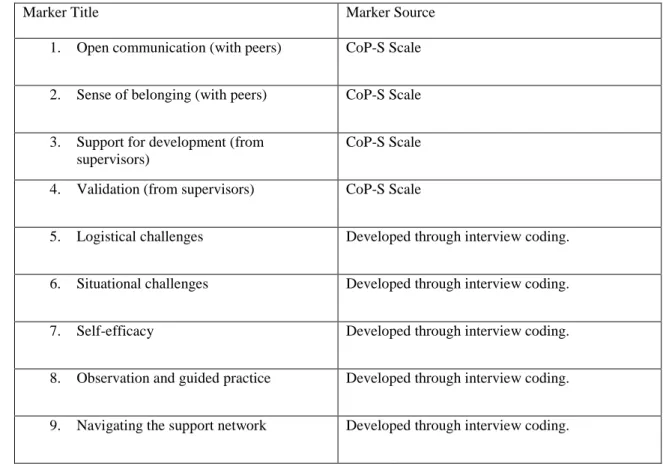
The five interviews were analyzed using nine markers that highlight major
indicators of communities of practice. Using these markers as guides, the next sections
will discuss major themes: relationships among the members of the instruction team,
ways of learning, efficacy, and challenges encountered by the team.
Table 1: Interview coding markers and their original source.
Marker Title Marker Source
1. Open communication (with peers) CoP-S Scale
2. Sense of belonging (with peers) CoP-S Scale
3. Support for development (from supervisors)
CoP-S Scale
4. Validation (from supervisors) CoP-S Scale
5. Logistical challenges Developed through interview coding.
6. Situational challenges Developed through interview coding.
7. Self-efficacy Developed through interview coding.
8. Observation and guided practice Developed through interview coding.
A primary tool in this analysis is the Community of Practice Scale for Schools, or
CoP-S, developed by scholars at George Mason University and Wayne State University
(Gorrell, Kitsantas, and Matthews 2013). This scale, while originally designed for use in
evaluating groups of primary and secondary school teachers, has great utility in
evaluating library instructors. The factors it evaluates—common goals, leadership,
bonding, and discourse—reflect primary identifiers of a community of practice across
institutional settings.
The original scale includes 26 statements to be rated using 5-point Likert
statements (Appendix 2). However, this original scale was adapted for use in coding the
instruction team interviews (Appendix 3). The original 26 statements were compressed
by the researcher into 4 markers: open communication (with peers), sense of belonging
(with peers), support for development (from supervisors), and validation (from
supervisors). This compression makes it easier to track some of the major hallmarks of
developing communities of practice, and the degree to which interviewees feel supported
in their progression towards being full participants in the instruction team.
Supplementing the compressed CoP-S are five other markers that emerged from
the interviews. Two of these, in the "Challenges" section of the adapted scale, enable the
researcher to track both logistical and situational issues that prevented individuals from
participation in the instruction team, or that impacted their pedagogical development. The
three other markers track:
• Discussions of self-efficacy: belief in one's ability and performance;
increasing self-efficacy can be a result of involvement in a community of
• The impact of observation and guided practice: the training received by
the instruction team relies heavily on both observation of other instructors
and the opportunity for guided practice. Tracking the impact (if any) that
these activities had on the experience of individual team members is
useful, especially as they relate to the markers drawn from the CoP-S
scale.
• Navigating the support network: Tracking the decisions involved in team
members' help-seeking behaviors helps create a fuller picture of the
existing community. What peer relationships exist? What
peer-to-supervisor relationships exist?
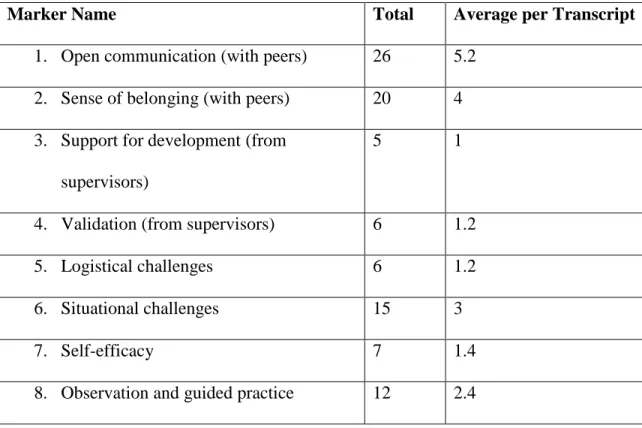
All markers in the adapted scale were coded onto all five interview transcripts,
and counts for each marker are tallied below:
Table 2: Total (across all interviews) count of each coded marker, and average of each marker per interview.
Marker Name Total Average per Transcript
1. Open communication (with peers) 26 5.2
2. Sense of belonging (with peers) 20 4
3. Support for development (from
supervisors)
5 1
4. Validation (from supervisors) 6 1.2
5. Logistical challenges 6 1.2
6. Situational challenges 15 3
7. Self-efficacy 7 1.4
9. Navigating the support network 6 1.2
Team Relationships
Perhaps the most important indicator of a flourishing community of practice is
strong relationships between community members. These relationships enable both
professional communication and emotional support. Without this support, especially
among members on the periphery of the group, the ‘shared purpose and goals’ captured
by the CoP-S scale cannot develop, and forward momentum will wither away. As noted
by Cuddapah and Clayton (2011), a cohort of instructors supports not only professional
development, but the process of meaning-making and identity construction (p. 68-69).
These same processes seemed to occur within the instruction team, especially among
team members with similar amounts of experience.
The counts captured in the table above suggest that the primary relationships
within the instruction team are peer-to-peer, rather than peer-to-supervisor. Both peer
relationship markers (1 and 2) appear nearly 5 times as frequently as both supervisor
relationship markers (3 and 4).
Open communication between peers also seemed to be of equal importance to
both new and returning instructors. For returning instructors, training sessions in their
second semester and beyond represented an opportunity to both increase their knowledge
of teaching strategies and resources and to reaffirm their prior knowledge. Recalling a
group training activity, one participant described that:
and they [the new students] will get here too, and you can connect with them about that.”
Here also, there is a direct intersection between instances of peer-to-peer information
sharing and a growing sense of belonging. While this overlap was not present in every
case, the interviews did make apparent that a “common purpose and goals,” as it is
defined in the original CoP-S scale, is not just one thing but a combination of factors that
enable a community of practice to develop. This particular example, where a returning
instructor experiences that ‘reaffirmation’ of prior knowledge in the context of working
with newer instructors, also represents the remaking of identity that happens when
peripheral participants are transitioning to full participation in their community.
Though they are represented to a lesser degree by the interviews,
peer-to-supervisor relationships are not unimportant to instruction team members. Interview
participants placed similar weight on formalized (i.e. training sessions) and informal
(dropping by the office to chat) interactions, and in both cases emphasized the feeling of
investment. One participant described feeling not just like an employee but also a
‘learner,’ and that “I [got] the sense that they [the supervisors] care about where we’re
going and what we’re doing.” That these supervisory relationships are functional helps
enable the development of an instructional community of practice on multiple levels.
Practically, employees that feel supported by their superiors are more likely to be
invested in the work they do—the instruction team is part of a workplace that works. On
a theoretical level, the supervisors of the instruction team represent those community
members who are full participants—if a community of practice can be sketched out as a
circle with members at varying distances from the center, then the supervisors are going
engagement, they have an almost gravitational ability to bring in more peripheral
members of the group.
Ways of Learning
In a community of practice, learning and practice are both inherently social
activities. The strategies developed by team members for learning more about teaching,
for gathering classroom activities and strategies, and for seeking help with lesson
planning enhance the understanding of the overarching relationships, and our
understanding of how a CoP functions on a daily basis.
For Wenger, social learning has several distinct processes. One of these he
describes as “developing…repertoire, styles, and discourses” (1998, p. 95). This process
involves exploring and revising strategies and routines, creating objects, documents, and
other tools, and determining meaning. Basically, it describes the act of figuring things
out, and creating personalized workflows that fit into an existing community. What
became apparent during the coding process was that instruction team members were each
developing their own nuanced strategies for shared activities, like lesson planning.
Especially when seeking advice about planning a particular lesson, several team
members talked about looking for someone else on the team who had taught a similar
lesson. On its own, this is not a remarkable strategy—it makes sense to seek out someone
with the most specific experience. However, this type of information-seeking requires an
extra step. Generally, a team member will have to consult either the “instruction” channel
on the Undergraduate Library Slack1, or look for similar lessons listed on the previous
instruction requests. It comes down to judgments about time investment. To do this—
to ask, and seek them out—implies that the effort is going to be worth the effort. One of the interview questions indeed asks, “Is it generally worth your time or worth the effort to
seek out help?” (see Appendix 1). In all five interviews, participants answered that
question affirmatively.
In addition to incentivizing help-seeking, it is also important to minimize the
effort needed to actually get that help. By creating a framework of training and activities,
team members had access to a set of organizational norms that guided their help-seeking
and resource-sharing behaviors. These norms make it easier for team members to
navigate the workplace. Early shared experiences, like the required observations, also
expose individuals to different types of instructional feedback that they can rely on later.
Essentially, the instruction team isn’t designed to let people starting teaching in a
vacuum. One participant explained:
“I don’t know how it would be without it…I think if I didn’t have the people to rely on, I would feel must more lost in the dark, like I could be doing something, but who knows if its effective or accurate? Without the feedback, it’s hard to know if you’re on the right track.”
This awareness cannot provide us with a point of comparison for what the team might be
like without this support. However, that any awareness exists does indicate that team
members see value in the communication and feedback structures that exist. If the
support network created by the instruction team was more challenging to navigate, people
would develop external help-seeking strategies that didn’t contribute back into the
Efficacy
Efficacy is a concept that, while not explicitly represented in the original CoP-S
scale, seems to be an important marker of communities of practice overall. As it became
a recurring theme in interviews, it developed into a marker that needed to be tracked.
Self-efficacy, explained by Albert Bandura in 1977, can impact an individual’s likelihood
to attempt otherwise challenging activities, and their levels of perseverance. If an
individual believes that they can succeed, it is more likely that they will—and when they
do, their self-efficacy only increases. It is clear why this concept relates to communities
of practice, especially in the context of integrating novice instructors. Support and
positive teaching experiences should increase an instructor’s self-efficacy, which means
that they will be more likely to move towards full participation in the community.
Most of the notions of efficacy raised by the interviews were in the context of
team members’ willingness to take risks. When talking about their future goals, one
participant said that they hoped to challenge themselves by teaching as many lessons as
they could, “[to] make myself uncomfortable…[and] eventually feel comfortable with the
uncomfortableness.” This is noteworthy because it not only showcases a willingness to
take risks, but also a confidence in the outcome—that the challenge of teaching as much
as possible will be worthwhile, and that temporary discomfort will eventually give way to
something better. This comfort with risk-taking also enables the instruction team to
develop diverse approaches to teaching and learning, which is one of the goals
established by the ACRL guidelines for information literacy programs.
Similarly, another participant talked about the desire to be ‘further along’ as an
happen, but it requires work. And to be really honest, [it’s] not punitive, just that you can
be better than you are now.” This, again, showcases a reasoned balance between
investment and expectations.
In some ways, a feeling of self-efficacy is one of the most important markers of a
community of practice. It indicates that the activities of the community have the potential
to be sustainable, and that members will not be completely derailed by failure.
Self-efficacy doesn’t eliminate challenges, but it makes members more likely to be able to
cope with challenges.
Challenges to Community
While many of the experiences recalled by team members were positive, the
process of joining a new workplace while simultaneously developing several new skill
sets is by no means a smooth and easy process. Tracking challenges in addition to
positive community markers not only provides a fuller and more accurate portrait of team
members’ experiences, it also makes it easier to plan revisions and adjustments to current
training and support processes.
Acclimation and Information Overload
Each interview reflected a similarly challenging experience with that initial
period—basically, the challenge of joining the instruction team, and learning the norms,
necessary information, and expectations. One participant described feeling “completely
overwhelmed” on their first day of training, and went on to say that “I don’t even know if
I could tell you what I learned that day.” New instructors are entering what is in some
structure. Trying to get acclimated to all this at once, while also (in many cases) getting
acclimated to a new graduate program, creates a situation ripe for information overload.
These factors also make it easy for new members of the team to get lost in smaller
details—seeing the trees rather than the forest.
All five interview participants, in fact, reported a similar arc—initial feelings of
confusion or frustration, followed by a period of discomfort that (at varying speeds) gave
way to understanding. Each participant developed their own strategies for coping with the
adjustment period. Some strategies appeared to move individuals farther into the team’s
orbit, while others prevented any engagement with the rest of the team. What emerged in
these strategies was a tension between insecurity and curiosity. For the interviewees,
moving toward full participation in the instruction team was not a completely
comfortable act, but one that was perceived as necessary. To join a new workplace and
get up-to-speed, there may simply have to be a period of discomforting information
overload. However, it is important that this overload never push past the limits of an
individual’s voluntary participation in the workplace community. CoPs can be so
impactful precisely because they are voluntary groups—it is challenging, and perhaps
impossible, to force a sense of belonging.
Generally, participants felt that their challenges could be, or had been, overcome.
“If something goes wrong,” one noted, “it’s not the end of the world because there are
people to talk about it with and figure out why, and learn from it.” This awareness of
available support, especially when faced with a problem, is a key feature that enables the
Scheduling
It is notable that none of the “challenge” markers were in reference to challenges
posed by peers or peer relationships. Rather, one participant referenced the logistical
challenge of busy schedules that prevented the further development of those
relationships: “[I] wish that it was more visible to see what other people were doing in the
classroom.” Some of these challenges, especially time and availability-based challenges,
are especially present in the instruction team because it is primarily composed of
graduate assistants who teach as their work and class schedules allow. This is not to
suggest that full-time librarians do not face scheduling challenges, only to note that teams
primarily composed of full-time librarians may notice an emphasis on different types of
challenges. Many of the session times requested by faculty conflict with team members’
own class schedules. In several interviews, participants expressed frustration at not
always being able to teach as often as they wished. One explained that the uneven
scheduling impacted their feeling of preparedness: “I feel like every time I take a break
from doing it [teaching], I have to start over.” This scheduling challenge also reflects the
natural ebb and flow of instruction requests, which peak during the first few weeks of the
semester, and then drop off sharply. This drop-off may cause team members to drift
farther away from the center of the community, undoing some of the progress they have
made towards full participation. It is possible that extra, maybe voluntary training
sessions could be added during these instructional lulls, to continue creating frequent
Training Documents
Somewhat unexpectedly, the ILbD documents that were designed to aid new
instructors were also a source of confusion, and represented a roadblock to
understanding. The initial ILbD lesson plan template (Appendix 4) was confusing for its
design, for its language, and for a lack of guided practice opportunities. That template
retained much of the formatting of its predecessor, the Understanding by Design
template. So, for someone versed in UbD, this adaptation would be reasonably easy to
follow through the stages (desired results, evidence, and learning plan). However, for
individuals who were not only new to teaching but also new to the vocabulary of
information literacy, this template was complex and more of a distraction than a useful
tool. Several interview participants recalled just bypassing that version of the form and
instead devising their own strategies for organizing lesson ideas and materials.
In response to instructor feedback on this version of the lesson plan template, it
also went through revisions during the Fall 2015 semester. This process (which could
easily be documented in detail in a later study) resulted in an ILbD 2.0 template
(Appendix 5), which sheds some of the complex language and adapts a more streamlined
format. This version, while still may undergo revisions in the future, seems anecdotally to
be more useful for instructors. A prime example of the revisions can be found in the
distinguish between “facts and concepts” and “skills and processes” that students should
use in a session:
This distinction was challenging, especially when combined with a lack of opportunity to
work through the form with others.
Comparatively, the new form asks similar questions about acquisition, but with
more scaffolding about what things instructors should be considering:
Now, rather than “facts and basic concepts,” instructors are being asked to think about
“research concepts,” which is more explanatory and also corresponds to language used
form) for instructors to fill it out by hand. The original form, while fine for digital use,
was not as user-friendly when printed out.
1 Slack is a web-based workplace communication and productivity tool. Members of Slack “teams” create
Conclusion and Recommendations
The interviews conducted with the instruction team strongly indicate the presence
of a developing community of practice. Relationships among peers, as well as with
supervisors, feature prominently in each interview, and those human sources appear to be
a key source of learning more about teaching. This suggests that the group does share a
purpose and goals, as well as an overarching sense of belonging. Members of the
instruction team recognize their peers as valuable, both when seeking information and
when navigating the emotional and social aspects of growing as an instructor.
It is encouraging to see this development, especially among a group of instructors
with varying backgrounds and levels of experience. However, this data collection only
captures the feelings and opinions of instructors at a single point in time. Future research
should focus on longitudinal data collection from the same team, to see if trends
established in these interviews will continue or change. This type of instruction team,
with major yearly turnover from student graduation, provides a unique opportunity to
study not a community of specific individuals, but a culture of community that is passed
down to new members.
As the instructional training for this team continues to evolve, there are
opportunities to create an environment even more conducive to community-building. The
following sections summarize the progress that has already been made, and the ideas and
Current Progress
1. Revised ILbD forms: As mentioned in the Interview Analysis section, the
original set of ILbD forms were complicated and confusing for some new
instructors to use. This type of feedback led to a revision of the lesson plan
template, which is the form that is used most frequently and can have the most
impact on an instructor’s success. The redesign process was focused on removing
as much jargon as possible—rather than relying on the language introduced by the
original UbD template, the underlying concepts needed to be explained in a way
that someone new to libraries, and new to teaching, could begin to internalize.
2. “Instructor Support Group”: A new, informal addition to teaching support
opportunities in Fall 2015, ‘instructor support group’ was designed as a space for
student instructors to get together and talk without supervisory oversight. This
peer-only space allows for a different type of discussion, with instructors free to
express frustration and confusion without fear of repercussions. Of equal
importance, the support group is a space for sharing successes, risks that paid off,
and moments of growth and improvement. Instructor Support Group is also a
unique addition because it’s completely voluntary, student-driven, and scheduled
based on demand. The existence of this extra space for peer-to-peer development
reinforces the value of CoPs in action, and how they can be self-sustaining.
Future Directions
3. Re-envisioning instruction bootcamp: Based on these interviews, instruction
instructor’s experiences. As it stands, bootcamp is extremely information-dense,
with a dual focus on the big picture of information literacy and the
institutionally-specific logistics of teaching for UNC’s first-year writing course. New employees
feel the need to absorb all this knowledge at one time, which seems to result in
individuals not being able to properly understand either aspect. Some level of
confusion, and perhaps even some degree of information overload will be
inevitable for new employees. However, if bootcamp could be reimagined as two
separate sessions, with one focused on information literacy and one focused on
‘how things work at UNC,’ it might reduce the distress that instructors seem to
experience. It might also be possible, perhaps in conjunction with this division of
sessions, to provide more information to new employees prior to meeting
in-person. For some instructors, the ability to read through things ahead of time and
come with questions might be beneficial. It may also be possible to depend more
on the networks within the CoP to distribute knowledge over time. Does all the
information currently introduced by instruction bootcamp have to come in a
one-to-many, formalized setting?
4. More time and space for informal discussion: In every interview, participants
expressed the desire for more unstructured community time. Most formal
trainings are fully scheduled, often months in advance. This does not leave a
much time for instructors to focus on issues that arise unexpectedly, or to share
and collaborate on the spot. The major challenge here is that the instruction team
beneficial from an instructional CoP perspective to set aside more training time, it
may not be logistically feasible
5. More automatic resource-sharing: Instructors also expressed a desire for more
access to each other’s lesson plans, activities, and classroom handouts. Collecting
these documents has been an ongoing challenge for the Undergraduate Library.
Every instructor, though they may use standardized documents like the lesson
plan template, develops an individual strategy for planning lessons and creating
other instructional materials. Some people write everything down; some people
write only an outline; some type everything while others prefer to write by hand.
This variety represents one challenge. The other, perhaps larger challenge, is to
incorporate sharing or depositing these materials as part of the normal instruction
workflow. In the last two years, efforts have been made to collect lesson plans
using the same instruction booking system that instructors use to schedule
sessions. While this has helped, it is still a challenge to collect materials. Some
instructors are also uncomfortable sharing their lesson materials, especially during
their first semesters—this indicates that the community still has room to grow,
and that members of the instruction team may eventually choose to share more of
their materials.
Broader Use
Looking forward, there will be great value in continuing to develop the atmosphere
of community within the UL instruction team. However, this focus on community, and
the relationship between community and instructor development, is much more broadly
instructional program can benefit from a renewed focus on reflective practice. Though
this particular organizational setting is heavy on new, part-time instructors, experienced
instructors can also benefit from the CoP structure. Regardless of the group’s makeup,
maintaining opportunities for legitimate participation is key:
Granting the newcomers legitimacy is important because they are likely to come short of what the community regards as competent engagement. Only with enough legitimacy can all their inevitable stumblings and violations become opportunities for learning rather than cause for dismissal, neglect, or exclusion (Wenger 1998, p. 101).
Through legitimate participation, all instructors can develop and refine their own
pedagogy while contributing to the growth of their peers. Enduring community support
will enable instructors to withstand temporary setbacks and the constantly changing
landscape of librarianship. Pedagogical training alone, even when thoughtfully designed,
will not enable librarians to meet the demand of increased instructional programs and
services Only training that is internalized, and that can be practiced within a community
devoted to improvement and self-reflection, can provide the long-term solution we need.
![When leaseholders are landlords: Edwards v Kumarasamy [2016] UKSC 40; [2016] 3 W.L.R. 310](data:image/gif;base64,R0lGODlhAQABAIAAAP///wAAACH5BAEAAAAALAAAAAABAAEAAAICRAEAOw==)