Impacts of multiple-field irradiation and boron
concentration on the treatment of boron neutron
capture therapy for non-small cell lung cancer
INTRODUCTION
Local non-small cell lung cancer (NSCLC), a
common cause of cancer deaths, presents limited therapeutic options because of tumor
treatment, which have diffused into the lung but not diffused to the whole body. Boron neutron capture therapy (BNCT) combines biological targeting and high linear energy transfer (LET)
radiation. At present, the study on BNCT
H
.
Yu
1, X
.
Tang
1,2*, D
.
Shu
1, C
.
Geng
1,3,
C
.
Gong
1, S
.
Hang
1,
D
.
Chen
1,21
Department of Nuclear Science and Engineering, Nanjing University of Aeronautics and Astronautics, Nanjing 210016, China
2
Collaborative Innovation Center of Radiation Medicine of Jiangsu Higher Education Institutions, Nanjing 210016, China
3
Department of Radiation Oncology, Massachusetts General Hospital, Boston, MA 02114, USA
ABSTRACT
Background: Boron neutron capture therapy (BNCT) is a radiotherapy that combines biological targe ng and high linear energy transfer. A poten al therapeu c approach for non-small cell lung cancer (NSCLC) is considered. However, dose in lung tumor is not homogeneous, and it will reduce the effect of BNCT treatment. In order to improve the dose distribu on of BNCT, the mul -field irradia on strategy and its effects need to be explored.
Materials and Methods: Common NSCLC model was defined in Chinese hybrid reference phantom and the boron concentra on in skin and tumor varied from 6 to 18 ppm and from 30 to 65 ppm, respec vely. Monte Carlo method for dose distribu on calcula on was used. Accelerator-based neutron source called “Neuboron source” was used and mul -field source irradia on plans were designed to op mize the dose distribu on. Results: Under one-field irradia on, it was not feasible to perform BNCT, because the skin dose is unlikely to meet its dose limit. Under two- and three-field irradia on, the uniformity of tumor dose was improved and the maximum dose to organs at risk (OARs) decreased. If boron concentra on in skin was between 6-18 ppm, BNCT was feasible with the boron concentra on in tumor reaching about 57-60 ppm for two-field irradia on and 41-45 ppm for three-field irradia on, respec vely. Conclusion: The mul -field irradia on plan could improve the dose distribu on and the feasibility of BNCT for NSCLC. Theore cal distribu ons of Boron-10 were obtained to meet the treatable requirement of BNCT, which could provide a reference for NSCLC using BNCT in future mul ple-field irradia on.
Keywords: Multiple-field irradiation, BNCT, non-small cell lung cancer, radiation dose, Monte Carlo.
*Corresponding author: Dr. Xiaobin Tang,
Fax: +86 255211290880407 E-mail:
Revised: July 2016
Accepted: Aug. 2016
Int. J. Radiat. Res., January 2016; 15(1): 1-13
► Original Article
DOI: 10.18869/acadpub.ijrr.15.1.1
radiobiological effect, etc. As the exploited
reaction 10B (n, alpha) 7Li is the neutron capture
with 10B, which has a cross section of 3837 b at
thermal energies, and the neutron capture gives rise to high LET radiation, generating an alpha
particle and a 7Li nucleus with ranges in tissues
comparable to a cell diameter. Therefore, dose delivery in BNCT is selective at the cellular level.
The BNCT has been commonly used for treatment of melanoma and malignant glioma.
Recently, some scholars have proposed BNCT for
the NSCLC (5), and the feasibility of applying
BNCT to treat local lung cancer had been
explored (6). This therapy can avoid the
inaccurate treatment caused by the motions of cancerous lung tissues during radiotherapy, as the major effect depends on boron localization. Moreover, the treatment may be delivered in a single-fraction through BNCT.
In BNCT treatment, since the well-known phenomena of self-shielding and neutron 5lux
depression (2), the dose distribution in tumor is
not homogeneous; the dose in the front of the tumor is always higher than that in the tumor
latter part (7). It will reduce the curative effect of
BNCT treatment because the deeply buried cancer cell dose not be killed. Meanwhile, the
skin dose rate often exceeds its dose limitation
and it limits the irradiation time (5). In order to
improve the dose distribution of BNCT, some researchers have made efforts to develop the
boracic drugs to improve its speci5icity and
homogeneous enrichment in tumor (8). While its
usage range is limited to the speci5ic type of tumor, and it will have different responding in different individuals. The other approach was using a skin-shielding layer during the treatment
(9) to improve the dose distribution, for example,
Li2CO3 pad. The use of skin-shielding layer
results in a slight reduction of skin dose, but it also leads to much longer irradiation time, which does not seem to introduce a real bene5it to the
treatment. Meanwhile, both of the above approaches also need a neutron beam with good
beam characteristics to improve dose
distribution. Thus, designing optimized beam
shaping assembly (10) to improve treatment
beam characteristics has been paid much attention to, while it is dif5icult to improve the
dose distribution using mixed energy neutron beam. In 2003, the multi-5ield neutron source irradiation was proposed to improve the dose
distribution of BNCT for brain tumor (11-12).
However, for NSCLC using BNCT, an in-depth study on improving the dose uniformity has not been conducted. Thus, multi-5ield irradiation will be studied in BNCT for NSCLC in this study. Moreover, the overdose problem of the skin may also be solved by multi-5ield irradiation, because
it can reduce the maximum dose to skin by sharing the dose to other areas of skin. Furthermore, different multi-5ield irradiation
plans may require different 10B distributions for
treatment. Thus, in order to improve the dose distribution, the boron distributions that meet the demands of treatment need to be explored in different multi-5ield irradiations.
The impacts of multi-5ield irradiation
condition and the boron distribution on the curative effect were studied. This study aimed to
compare the dose distributions of BNCT under single-, double- and three-5ield irradiations, and determine the theoretical Boron-10 distribution under multi-5ield irradiations in BNCT for lung cancer treatment.
MATERIAL AND METHODS
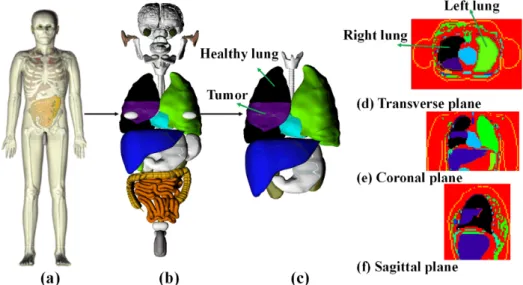
CHRP-M30 Phantom implementation
A dose calculation model was established based on a Chinese hybrid radiation phantom of
30-year-old male (CHRP-Male 30 phantom) (13)
(5igure 1). The high-precision male phantom was
built using Rhinoceros 5.0 (14) and voxelizer
series tools were employed to transform the phantom into a voxel-based model. Considering the geometry construction precision and the calculation speed in the Monte Carlo code used in this study, the phantom was voxelized with a
resolution of 0.4 × 0.4 × 0.4 cm3. Tissue or organ
compositions were from the data in ICRU-46 (15)
and ICRP-89 (16). Details of the construction
procedure for the phantom geometry and materials have been described in a previous
publication (15). Based on CHRP-Male 30
phantom, the tumor (depth of 7 cm) was
2
Int. J. Radiat. Res., Vol. 15 No. 1, January 2017
established (5igure 1) according to the common
NSCLC (1). The gross tumor volume (GTV) was
about 7 × 4 × 3 cm3 and the cancerous lung was
divided into the healthy lungs (black) and the gross tumor volume (GTV) (purple).
The initial concentrations of Boron-10 in
tumor and skin were assumed as 30 ppm and 9
ppm (12), respectively. The ratio of boron in skin
to that in other healthy tissues was 1.5:1. Here,
Boron-10 concentration was considered a
constant.
Figure 1. The implementa on of lung cancer NSCLC model in the CHRP-Male 30 phantom, and the three views of NSCLC model.
Neutron source
Neutron beam is produced from reactions of 2.5-MeV protons and the 93.1-mm-thick lithium
target for accelerator-based boron neutron
capture therapy (AB-BNCT) (17). The total
neutron yield of the 7Li(p, n)7Be reaction is
1.5×10¹² neutrons per millicoulomb of 20-mA,
2.5-MeV protons (standard error of the neutron
yield was < 0.1 %). It is called “Neuboron source”, which is under the construction by Neuboron Medtech Ltd. in China. Neuboron source is in accordance with the recommended criteria by International Atomic Energy Agency
(IAEA) (18), and its neutron and photon energy
spectra were shown in 5igure 2.
(a) (b)
Figure 2. (a) Neutron and (b) photon fluence rate per unit of lethargy as a func on of energy for the Neuboron source based on accelerator-based neutron source (15).
Neuboron source was set as disc non-point source. The diameter of the source was 20 cm. It completely encompassed the tumor volume. In addition, its angel distributing was considered as cosine law distribution (cosine=0.67) after
being collimated. The epithermal neutron
5luence rate of the beam is 1.3×10⁹ n/ (cm2 •s).
The neutron beam quality was evaluated based on a tissue equivalent material cuboid model. Treatable depth (TD) (the depth at which the tumor dose falls below twice the maximum dose of the normal tissue) and advantageous depth (AD) (the depth at which the dose in the tumor equals the maximum dose in healthy tissue) were calculated. In tissue equivalent material,
the maximum dose rate of 4.4 Gy/min was obtained in the depth of 3 cm and the TD and AD
were 7.6 cm and 10 cm, respectively (Figure 3). Therefore, Neuboron source could be applied to treat the NSCLC (depth of 7 cm) as de5ined in part of “CHRP-M30 Phantom implementation”.
Multi- ield irradiation con igurations
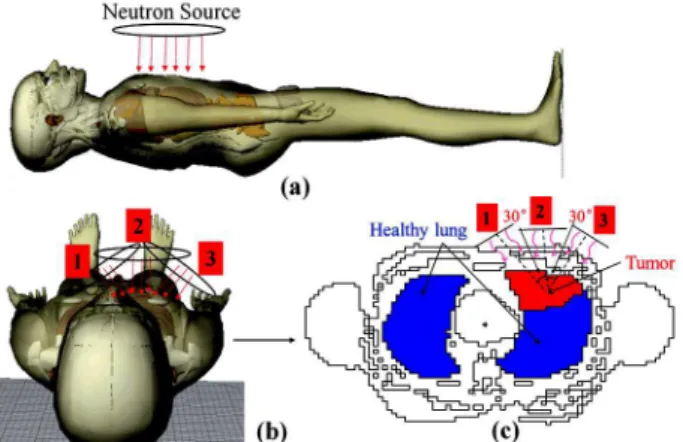
In order to study the in5luence of multi-5ield neutron source on the dose distribution of lung tumor treatment, three irradiation 5ields were set as follows: beam 1 (“1”): 30° left anterior of the tumor; beam 2 (“2”): front of the tumor; beam 3(“3”): 30° right anterior of the tumor (Figure 4). Multiple-5ield irradiation (a b c) was
adopted and “a”, “b”, and “c” represented the ir-radiation time proportions for beam “1”, “2”, and “3”.
First, 1-5ield and 2-5ield radiation plans were compared based on treatment time and dose uniformity of tumor. Best plans of 1-5ield and 2-5ield were chosen. Second, in order to improve the dose distribution, based on the chosen best irradiation plan, three-5ield irradiation plans were optimized by adjusting the irradiation time proportions for each beam. Third, to assess the effect of multi-5ields, the organs at risk (OARs) dose distributions of 1-5ield, 2-5ield and 3-5ield irradiation plans were simulated.
Dose calculations
The dose of BNCT includes boron dose (DB),
thermal neutron dose (Dth), fast neutron dose
(Df), and gamma dose (Dy). The boron dose
stems from the interaction of thermal neutrons
with 10B atoms in the tissue and goes through the
10B (n, alpha) 7Li reaction. The thermal neutron
dose arises primarily from the thermal neutron
capture reaction of 14N (n, p) 14C. The fast
neutron dose comes from fast neutrons with energies above 10 keV delivering the dose through elastic collisions with hydrogen nuclei in the tissue. The gamma dose is generated from an unavoidable gamma contamination of the beam and the induced gamma dose in the tissues.
4
Int. J. Radiat. Res., Vol. 15 No. 1, January 2017 Figure 3. Considering 30/9 ppm of Boron-10 concentra on in
tumor/skin, depth-dose distribu on of tumor and normal ssue in ssue equivalent material.
Figure 4. The neutron irradia on planning, including (a) lat-eral view, (b) ver cal view, and (c) the cross sec on of lung cancer irradia on. Three irradia on fields include beam 1: 30°
le@ anterior of tumor; beam 2: front of tumor; beam 3: 30° right anterior of tumor. Here, healthy lungs (blue) and the GTV
(red) were marked.
Photon-equivalent dose HT (Gy) (19) is the photon equivalent dose of the BNCT dose. It was computed by multiplying each absorbed dose component by the relative biological ness (RBE) or the compound biological effective-ness (CBE) factors listed in table 1. Calculation has been done according to equation 1 as follows:
HT = ωB× DB + ωth × Dth + ωf × Df + Dy (1)
Where ωB is the radiation weighting factor of
dose components (DB, Dth, Df and Dy) in a
particular tissue (table 1).
Monte Carlo con igurations
The general-purpose Monte Carlo particle transport code MCNP5 was used to perform the
dose calculations (20) in this study. The universe/
lattice card was employed in the construction of the human voxel phantom. Each combination of
multi-5ield neutron source and 10B distribution
was modeled separately to calculate the dose values. The SDEF card de5ined disc non-point
source for thermal neutrons and different
concentrations of 10B were added in Material
Cards of tumor and OARs. In addition, the MT card was used to 5ix the thermal reaction cross section.
The doses in the tumor and organs at risk were calculated using MCNP5 tally F4 combined DE/DF cards. For the dose conversion, point
wise KERMA factors and energy mass
absorption coef5icients from the reference (21)
were input with DE and DF cards directly. Tally
FM4 card was adopted to convert the normalized dose (Gy/s) to photon-equivalent
dose (Gy/min). The number of simulated source
particles was set to 1 × 10⁹ in all simulations to
make the statistical uncertainty below 2 % for
the dose results in all the organs of interest.
BNCT dose components Normal ssues Tumor Skin
10B(n, alpha)7
Li (CBE) 1.4 3.8 2.5
Thermal neutron (RBE) 3.2 3.2 3.2
Fast neutron (RBE) 3.2 3.2 3.2
Photon 1 1 1
Table 1. RBE and CBE factors (radia on weigh ng factor ω1) used to convert physical dose (Gy) into photon equivalent dose (Gy)(5).
Treatment assessment
The doses to OARs (including skin and right healthy lung, esophagus, heart, liver, breast, and
trachea) are relative higher than any other tissues or organs. Thus, they were selected to
ef5icacy of BNCT treatment, according to their maximum dose, minimum dose, average dose, and treatment time. In addition, to compare the dose distribution of tumor or OARs, dose volume curves (DVCs) were depicted. Here, in order to Figure 5. Energy-dependent kerma factors based on 1-ppm 10B for neutron reac ons with 10B, thermal neutron, fast ne
utron, and photon (18).
Origin 8.5 were used to process and analyze the dose results based on MCNP calculation.
The minimum dose of GTV should be at least
60 Gy (22). In addition, homogeneity index (HI)
(23) of tumor is de5ined as equation 2:
HI = (HT1 % - HT99 %) / HT50 % (2)
Where, HTa% stands for the photon equivalent
dose level corresponding to the a % volume in the DVCs. A smaller HI value indicates a better dose uniformity.
The dose to OARs should meet the following
two limitations according to the National
Comprehensive Cancer Network (NCCN) (24).
First, more than 1,000 cm3 of the volume of the
healthy lung should receive less than 7.5 Gy to prevent pneumonia. Second, the maximum dose
to the heart, spinal cord, skin, esophagus, trachea, ribs, and breast should be less than 22,
14, 26.0, 15.4, 20.2, 30, and 30 Gy, respectively.
RESULTS
The tumor and OARs doses were calculated to compare the dose distributions of BNCT under one-, two- and three-5ield irradiations. The required boron concentration distributions
were simulated in different irradiation
conditions.
In luence of multi- ield irradiation on tumor dose
One- ield irradiation
One-5ield irradiation (100), (010), and (001)
respectively represent the “1”, “2”, and “3” neutron beam irradiated alone. When it was irradiated by plan (100), the treatment time under the minimum dose in tumor of 60 Gy was 148 min and the dose uniformity of tumor was poor (HI was 1.12). When it was irradiated by plan (010), the dose uniformity in tumor (HI was 0.75) was better than that by the plan (100), and the treatment time was the shortest (70.6 min) (table 2). For the neutron transport of irradiation (010) was directly facing the tumor,
thus, it could deliver the dose to the more volume of tumor than (100) and (001) plans at
the same depth. With the purpose of shorter treatment time and good tumor dose uniformity,
plan (010) was considered as the most advantage plan of the one-5ield irradiation. In
the one-5ield irradiation, the dose uniformity of tumor was unsatisfactory. This problem also
existed in Yen-Wan Hsueh Liu’s (9) research,
when the one-5ield neutron source was used to treat the brain tumor, the HI of tumor only reached 0.75-1.14.
Two- ield irradiation
Multiple-5ield irradiation (a b c) was adopted and “a”, “b”, and “c” represented the irradiation time proportions for beam “1”, “2”, and “3”. Irradiation (011), (110), (101) were used in 2-5ield irradiation. When it was irradiated by
two-5ield plan, the dose uniformity in tumor was improved (table 3). For the neutrons in two-5ield irradiation has a better transport in the tumor than one-5ield irradiation plans. To be speci5ic, the two-5ield irradiation combines two angles of neutron beams to deliver the different depth doses in the tumor, which could increase the dose uniformity in tumor. Although the dose uniformity of plan (101) was better, considering
that in the clinical treatment, too long irradiation time could cause inconvenience and
deviations, the plan (011) was superior for the shorter treatment time, whose irradiation plan: the irradiation times of “2” and “3” beams were 38.2 min and 38.2 min.
Three- ield irradiation
The above results showed that the plan (010) and (011) had the better dose uniformity in tumor and cost shorter treatment time. Therefore, based on plan (010), the irradiation
time ratio of the beam “2” was increased in 3-5ield irradiation, irradiation plans were set as
follows: (132), (142), (152), and (162). Based on plan (011), treatment time proportions of beam “2” and “3” were increased in 3-5ield irradiation, irradiation plans were set as follows: (122), (133), (144), and (155).
The total treatment time and the dose uniformity in tumor of 3-5ield irradiation was
similar with that of two-5ield irradiation (table 4). In addition, the dose uniformity in tumor of 3
-5ield irradiation was better than that of the one-5ield irradiation. The treatment time of plan
6
Int. J. Radiat. Res., Vol. 15 No. 1, January 2017
In luence of multi- ield irradiation on OARs dose
One- ield and two- ield irradiation
According to above results, (010) and (011) irradiation plans were better than other plans of 1-5ield and 2-5ield irradiations. Here, to compare the effect of one-5ield and two-5ield irradiations, OARs doses were calculated under these two
The dose to the healthy lung was evaluated to assess physiological impact to the lung. The irradiation dose of the plan (010) was larger than that of the plan (011), because the (011) irradiation plan could reduce the maximum dose to the healthy lung by sharing the dose to other areas of the lung. The maximum dose in right healthy lung and left lung were 16.5 Gy and 10.1
Source irradia on 1-field irradia on
100 010 001
Max(Gy) 189.93 122.86 136.36
Min(Gy) 60.00 60.00 60.00
H50% (Gy) 114.27 83.29 87.20
Time (min) 148.40 70.60 82.26
HI 1.12 0.75 0.88
Source irradia on 2-field irradia on
011 110 101
Max (Gy) 108.54 115.38 101.73
Min (Gy) 60.00 60.00 60.00
H50% (Gy) 81.55 94.63 74.83
Total me for all fields (min) 76.44 97.04 81.66
HI 0.56 0.58 0.51
Table 2. Considering 30/9 ppm of 10B concentra on in tumor/skin, the tumor dose in one-field irradia on condi on.
Table 3. Considering 30/9 ppm of 10B concentra on in tumor/skin, the tumor dose in 2-field irradia on condi on.
Source irradia-on
3-field irradia on 3-field irradia on
132 142 152 162 122 133 144 155
Max (Gy) 108.10 108.90 109.89 110.77 107.00 107.14 107.28 107.49
Min (Gy) 60.00 60.00 60.00 60.00 60.00 60.00 60.00 60.00
H50% (Gy) 77.78 77.34 77.67 78.21 78.26 79.20 79.90 80.04
Total me for
all fields (min) 72.36 71.06 70.69 70.60 74.35 73.8 73.71 73.32
HI 0.61 0.63 0.64 0.64 0.60 0.59 0.59 0.58
Table 4. Considering 30/9 ppm of 10B concentra on in tumor/skin, the tumor dose in 3-field irradia on condi on. (162) was the shortest among the 3-5ield
irradiation plans, and its tumor dose uniformity
was 14.6 % better than that of plan (010). Besides, the tumor dose uniformity of plan (155)
was the best among the 3-5ield irradiation and the radiation time of it was relatively shorter in 3-5ield irradiation plans. Thus, the (162) and (155) plans were the better irradiation plans among the 3-5ield irradiations.
The optimized irradiation plan (162) cost the shortest treatment time and irradiation times of beam “1”, “2”, and “3” were respectively 7.9 min,
47.0 min, and 15.7 min. The optimized irradiation plan (155) showed the better dose
uniformity in tumor, and irradiation times of beam “1”, “2”, and “3” were respectively 6.7 min, 33.3 min, and 33.3 min.
irradiation plan (011), the maximum dose in right healthy lung and left lung were 15.1 Gy and 6.5 Gy, respectively (5igure 6). In this study, the
volume of lung was 3177 cm3, when was
irradiated by the plan (010), only 22.5 % of the volume of right healthy lung received more than 7.5 Gy, and 2.5 % of the volume of left lung received more than 7.5 Gy, which achieved the
requirement of NCCN guidelines (24). When it
was irradiated by the plan (011), only 3.5 % of the volume of right healthy lung received more than 7.5 Gy, and 0.5 % of the volume of left lung received more than 7.5 Gy. In this way, it fully
met the requirements in NCCN guidelines (24)
when irradiated with both of these irradiation plans.
There were similarities between 1-5ield and 2-5ield irradiation plans. Some OARs (including esophagus, trachea, spinal cord) were far away from the neutron beam, thus their doses were
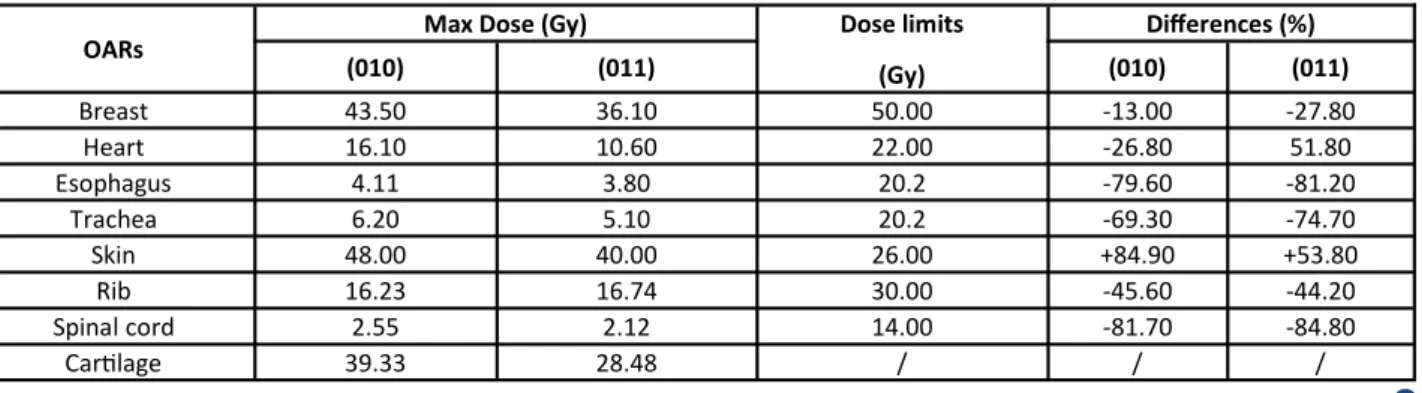
far less than their dose limits. The breast doses were high, but it were still slightly lower than its maximum dose limits (Table 5). However, the skin doses were both higher than its dose limit. There was differences between 1-5ield and 2-5ield irradiation plans. Treatment time of the plan (010) was shorter, but its OARs doses were higher than that of the plan (011), and the breast
dose and skin dose of the plan (010) were respectively 20.5 % and 20 % higher than that of
the plan (011). Therefore, in order to decrease the radiation risk, irradiation plan (011) was better.
In the 1-5ield and 2-5ield irradiations, the skin
overdose problem also existed, and in the previous study of BNCT, the skin dose exceeded
it dose limitation in some conditions (5). Thus,
three-5ield irradiation need to be further study and it probably decreases the skin dose.
8
Int. J. Radiat. Res., Vol. 15 No. 1, January 2017
Figure 6. Considering 30/9 ppm of Boron-10 concentra on in tumor/skin, dose in tumor, le@ lung and right healthy lung irradiated with plan (010) and plan (011).
OARs
Max Dose (Gy) Dose limits
(Gy)
Differences (%)
(010) (011) (010) (011)
Breast 43.50 36.10 50.00 -13.00 -27.80
Heart 16.10 10.60 22.00 -26.80 51.80
Esophagus 4.11 3.80 20.2 -79.60 -81.20
Trachea 6.20 5.10 20.2 -69.30 -74.70
Skin 48.00 40.00 26.00 +84.90 +53.80
Rib 16.23 16.74 30.00 -45.60 -44.20
Spinal cord 2.55 2.12 14.00 -81.70 -84.80
Car lage 39.33 28.48 / / /
Table 5. Considering 30/9ppm of 10B concentra on in tumor/skin, the contrasts of the maximum dose to OARs and their dose limits, in condi on of irradia on (010), (011).
Three- ield irradiation
The OARs doses of the 3-5ield irradiation plans (162) and (155) were obviously lower than that of 2-5ield irradiation plan (011) (Figure 7). As compared with plan (011), when irradiated by plan (162) and plan (155), the maximum dose in skin fell by 5 % and 15.0 %; the maximum dose in breast dropped by 16.9 % and 25.2 %; and the maximum dose in cartilage dropped by 22.8 % and 29.8 %, respectively. In addition, the dose reductions of OARs were more obvious irradiated by plan (155) than that
of plan (162). As a whole, the (155) plan was
more appropriate for the good dose
distributions.
In different cases, the results of multi-5ield irradiation is various. The healthy organs doses were reduced in our multi-5ield irradiation. However, the healthy organs doses increased in multi-5ield irradiation for brain tumor in
Fujimoto’s research (12). In this respect, the multi
-5ield irradiation suggests a better effect on the improvement of dose distribution for this type of NSCLC with BNCT.
In luence of 10B concentration on dose
The skin dose rate is the largest and the skin has the relatively smaller dose limit than the other OARs, if dose to skin is under the dose limitation of 26 Gy, the dose to other healthy organs will not exceed the NCCN dose limitation
(24). Thus, the skin dose was used to assess the
feasibility of the multi-5ield irradiations. Higher
boron concentration will improve the dose deposition. In speci5ic conditions of tumors and
neutron sources, the required boron conditions are different. Here, the relationship between skin/tumor dose and their boron concentration was studied to explore theoretical condition of
boron concentration for the multi-5ield
irradiations.
One- ield irradiation
Boron-10 concentration in tumor/skin
increased from 30/6 to 100/18 ppm, tumor
dose rate increased signi5icantly, and the treatment time was reduced (5igure 8(a)).
When the boron concentration in skin was 18 ppm, skin dose rate was 1.0 Gy/min (Figure 8 (b)); in this case, treatment time should be less than 26 min because of the limit of 26 Gy of skin dose. When treatment time was 26 min, boron concentration in tumor should reach 90 ppm, shown in 5igure 8(a). Therefore, when boron
concentration in skin was 18 ppm, boron concentration in tumor should reach 90 ppm. By
analogy, when boron concentration in skin was 6 ppm, boron concentration in tumor should reach 85 ppm. In conclusion, when the boron concentration in skin was between 6-18 ppm, BNCT could be performed with 85-90 ppm of Figure 7. Considering 30/9 ppm of Boron-10 concentra on in tumor/skin, the healthy organs doses in (162) and (155) irradia on
condi ons.
ensure the dose in OARs all below dose limit of NCCN. However, it was dif5icult to achieve this boron concentration requirement in clinic.
Therefore, BNCT was not feasible under 1-5ield irradiation (010) with Neuboron source.
10
Int. J. Radiat. Res., Vol. 15 No. 1, January 2017
Figure 8. (a) Treatment me of tumor and (b) the maximum dose rates of healthy ssue/organs under 1-field irradia on plan (010) for different boron concentra ons.
Two- ield irradiation
Under 2-5ield irradiation (011), the Boron-10 concentration in tumor/skin increased from 30/6 to 65/18 ppm. Treatment time was less than 40 min when the boron concentration in tumor was 60 ppm (Figure 9(a)).
When the boron concentration in skin was 18 ppm, skin dose rate was 0.658 Gy/min (Figure 9 (b)); in this case, treatment time should be less than 39.87 min because of the limit of 26 Gy skin dose limit. When treatment time was 39.87 min, boron concentration in tumor should reach 60
ppm, as shown in 5igure 9(a). Therefore, when boron concentration in skin was 18 ppm, boron concentration in tumor should reach 60 ppm. By analogy, when boron concentration in skin was 6 ppm, boron concentration in tumor should reach 57 ppm. In conclusion, when the boron concentration in skin was between 6-18 ppm, BNCT could be performed with 57-60 ppm of boron concentration in the tumor, which could ensure the dose in OARs all below dose limit of NCCN.
(a) (b)
(a) (b)
Figure 9. (a) The maximum dose and treatment me of tumor and (b) the maximum dose rates of healthy ssue/organs under 2-field irradia on plan (011) for different boron concentra ons.
Three- ield irradiation
Under 3-5ield irradiation (155), Boron-10 concentration in tumor/skin increased from
30/6 to 65/18 ppm. When the boron concentration in skin was 18 ppm, skin dose rate
was 0.49 Gy/min (Figure 10(b)); in this case, treatment time should be less than 53 min be-cause of the limit of 26 Gy of skin dose. When treatment time was 53 min, boron concentration in tumor should reach 45 ppm, as shown in
5igure 10(a). Therefore, when boron
concentration in skin was 18 ppm, boron concentration in tumor should reach 45 ppm. By
analogy, when boron concentration in skin was 6 ppm, boron concentration in tumor should reach 41 ppm. In conclusion, when the boron concentration in skin was between 6-18 ppm, BNCT could be performed with 41-45 ppm of boron concentration in the tumor, which could ensure the dose in OARs all below dose limit of NCCN. It was easier to achieve the required boron concentration distribution in clinical under (155) irradiation, as compared with 1-5ield and 2-5ield irradiations.
By the above analysis, the boron concentra-tion requirement is high when according as the
tumor reaches the prescribed-dose of 60 Gy. Thus, a more suitable prescription criterion
should be proposed to decrease the skin dose, and the feasibility of BNCT treatment perhaps
could be assessed based on the skin dose
DISCUSSION
The common NSCLC (depth of 7 cm) is treated with BNCT using Neuboron sources. The
impacts of multi-5ield irradiation condition and the boron distribution on the dose distribution were studied. The multi-5ield irradiations could improve the dose distribution and the feasibility of BNCT for NSCLC. The theoretical distributions of Boron-10 were obtained to meet the treatable requirement of BNCT, which could provide a
reference for NSCLC using BNCT with
multiple-5ield irradiation of Neuboron sources in the future.
For one-5ield irradiation, BNCT was not feasible under one-5ield irradiation plan (010)
with Neuboron source. Because it was dif5icult to achieve the boron concentration requirement in clinical treatment. Two-5ield irradiation plan (011), as compared with one-5ield irradiation, needed a longer treatment time and showed a
better tumor dose uniformity. Besides, the maximum dose to OARs decreased obviously.
When the boron concentration in skin was 6-18 ppm, BNCT could be performed with 57-60 ppm of boron concentration in tumor. In order to improve the dose distribution, three-5ield irradiation plans were optimized by adjusting
the irradiation time proportions for three beams. Three-5ield irradiation plan (155) was
proposed, and as compared with two-5ield
(a) (b)
Figure 10. (a) The maximum dose and treatment me of tumor and (b) the maximum dose rates of healthy ssue/organs
boron concentration was required. When the boron concentration in skin was 6-18 ppm, BNCT could be performed with 41-45 ppm of boron concentration in tumor.
As compared with the conventional photon
radiotherapy—the researches of Cyriac (25) and
Qibin (26) on the conformal radiation therapy, the
effect of dose improvement in our multi-5ield irradiation were similar with their effects in conformal radiation therapy, and the healthy organs dose were reduced. In our work, the tumor dose uniformity was improved by multiple-5ield irradiation, and the HI was reduced from the 0.75 to 0.56. Its effect was similar with the effect of multi-5ield source in
BNCT for brain tumor (12) for whose HI was
reduced from the 0.90 to 0.54. Besides, the maximum doses to OARs were decreased under
two- and three-5ield irradiation for NSCLC. Its effect was better than the effect of multi-5ield
BNCT for brain tumor (12), for the OARs dose
increased in multi-5ield for brain tumor. In addition, some advanced neutron beams were
designed to improve the tumor dose (2-3, 10-11).
Here, as compared with the dose improvement effects of multi-5ield irradiation, the neutron beam characteristics improvement suggests a
less effective effect on improving dose
uniformity of tumor, for their mixed energy neutrons made it dif5icult to deliver the dose to
tumor uniformly in a single direction of irradiation. Furthermore, a more suitable prescription criterion needs to be proposed to
decrease the skin dose, and the feasibility of multi-5ield treatment perhaps could be studied
based on the skin dose limitation (9, 12).
Admittedly, some factors including neutron source (for example, beam collimation, beam
attenuator, different beam entry angle) and 10B
concentration dynamics could affect the dose distribution in clinical application, and here these multi-5ield irradiation studies were based on an ideal irradiation condition. To realize the application of multi-5ield irradiation in practice, some factors in5luencing the treatment effect
should be considered. First, multi-5ield
irradiation plans are diverse according to various types of tumors. The implementations of
multi-5ield irradiation need a number of
alternative plans and necessary dose
veri5ications. Second, the boron concentration is patient-speci5ic and changed with time. We will
study the pharmacokinetic model for 10B
concentration, and apply it in our future work to ensure that the treatment planning is coincident with actual condition. In addition, there are some dif5iculties in multi-5ield irradiation operation. It
is worth looking forward to setting up a rotatable device (such as a gantry) to rotate
neutron source for multi-5ield treatment. Furthermore, the switching time of neutron
source should be paid attention to in practice
because it may affect the 10B concentration
distribution.
ACKNOWLEDGMENTS
The National Natural Science Foundation of China [grant number 11475087] supported this work; the Foundation of Graduate Innovation Cen-ter in NUAA [grant number k<jj20150602]; the Priority Academic Program Development of Jiang-su Higher Education Institutions; and the National Science and Technology Support Program [grant number 2015BAI34H00].
Con lict of interest: Declared none.
REFERENCES
1. Park YJ, Yoon WS, Lee JA, et al. (2015) Concurrent chemora-diotherapy in locally advanced non-small cell lung cancer: a retrospec ve analysis of the correla on between radio-therapy-related factors and tumor response. Int J Radiat Res, 13(3): 205-212.
2. Fan dis JG, Sai o E, Bandekas DV, et al. (2013) Op mised BNCT facility based on a compact DD neutron generator.
Int. J Radiat Res, 11: 207-14.
3. Fan dis JG, and Antoniadis A (2015) Op miza on study for BNCT facility based on a DT neutron generator. Int J Radiat Res, 2015: 13-24.
4. Abtahi SM, Aghamiri SMR, Khalafi H, et al. (2014) An inves -ga on into the poten al applicability of gel dosimeters for dosimetry in boron neutron capture therapy. Int J Radiat Res, 12(2): 139-149.
5. Farias RO, Bortolussi S, Menendez PR, Gonzalez SJ (2014) Exploring Boron Neutron Capture Therapy for non-small cell lung cancer. Phys Medica, 30: 888-897.
12
Int. J. Radiat. Res., Vol. 15 No. 1, January 2017
6. Krs c D, Markovic VM, Jovanovic Z, Milenkovic B, Nikezic D, Atanackovic J (2014) Monte Carlo calcula ons of lung dose in ORNL phantom for boron neutron capture thera-py. Radiat Prot Dosim, 161(1-4): 269-273.
7. Miyatake SI, Kawabata S, Yokoyama K, Kuroiwa T, Michiue H, Sakurai, Y, Ono K (2009) Survival benefit of Boron neutron capture therapy for recurrent malignant gliomas. J Neuro-Oncol, 91(2): 199-206.
8. Koganei H, Ueno M, Tachikawa S, Tasaki L, Ban HS, Suzuki M, Shiraishi K, Kawano K, Yokoyama M, Maitani Y, Ono K, and Nakamura H (2013) Development of high boron content liposomes and their promising an tumor effect for neu-tron capture therapy of cancers. Bioconjugate Chem, 24 (1): 124-132.
9. Liu YWH, Chang CT, Yeh LY, Wang LW, Lin TY (2013) BNCT treatment planning for superficial and deep-seated tu-mors: Experience from clinical trial of recurrent head and neck cancer at THOR. Appl Radiat Isotopes, 106: 121-124.
10. Fan dis JG and Antoniadis A (2015) Op miza on study for BNCT facility based on a DT neutron generator. Int J Radiat Res, 2015: 13-24.
11. Savolainen S, Kortesniemi M, Timonen M, Reijonen V, Kuu-sela L, Uusi-Simola J, Valimaki P (2013) Boron neutron capture therapy (BNCT) in Finland: technological and physical prospects a@er 20 years of experiences. Eur J Med Phys, 29(3): 233-248.
12. Fujimoto N, Tanaka H, Sakurai Y, Takata T, Kondo N, Na-rabayashi M, Nakagawa Y, Watanabe T, Kinashi Y, Masuna-ga S, Maruhashi A, Ono K, Suzuki M (2015) Improvement of depth dose distribu on using mul ple-field irradia on in boron neutron capture therapy. Appl Radiat Isotopes, 106: 134-138.
13. Geng CR, Tang XB, Hou XX, Shu DY, Chen D (2014) Develop-ment of Chinese hybrid radia on adult phantoms and their applica on to external dosimetry. Sci China Technol Sc, 57(4): 713-719.
14. GuiRon TG, Kinaci A, Ring D (2013) Diagnos c accuracy of 2- and 3-dimensional computed tomography and solid modeling of coronoid fractures. J Shoulder Elbow Surg, 22: 782-786.
15. Interna onal Commission on Radia on Units and Meas-urements (1992) Photon, Electron, Proton and Neutron Interac on Data for Body Tissues. ICRU Report 46.
16. Interna onal Commission on Radiological Protec on (2002) Basic anatomical and physiological data for use in radiological protec on reference values. ICRP Publica3on 89, Ann ICRP 32.
17. Lee PY, Liu YH, Jiang SH (2014) Dosimetric performance evalua on regarding proton beam incident angles of a lithium-based AB-BNCT design. Radiat Prot Dosim, 161(1-4): 403-409.
18. Rorer D, Wambersie G (2001) Current Status of neutron capture therapy. Interna3onal Atomic Energy Agency (IAEA), 2001 (8): 75-77.
19. Ishiyama S (2014) Determinis c Parsing Model of the Com-pound Biological Effec veness (CBE) Factor for Intracellu-lar 10Boron Distribu on in Boron Neutron Capture Thera-py. Journal of Cancer Therapy, 5(14): 1388.
20. Mesbahi, A, and Dadgar, H (2015) Dose calcula ons accu-racy of TIGRT treatment planning system for small IMRT beamlets in heterogeneous lung phantom. Int J Radiat Res, 13(4): 345-354.
21. Goorley JT, Kiger Iii WS, Zamenhof RG (2002) Reference dosimetry calcula ons for neutron capture therapy with comparison of analy cal and voxel models. Med Phys, 29 (2): 145-156.
22. Suzuki M, Suzuki O, Sakurai Y, Tanaka H, Kondo N, Kinashi Y, Masunaga S, Maruhashi A, Ono K (2012) Reirradia on for locally recurrent lung cancer in the chest wall with boron neutron capture therapy (BNCT). Interna3onal Cancer Conference Journal, 1(4): 235-238.
23. Narayanasamy G, Feddock J, Gleason J, McGarry R, Molloy J (2015) CBCT-based dosimetric verifica on and alternate planning techniques to reduce the normal ssue dose in SBRT of lung pa ents. Interna3onal Journal of Cancer Therapy and Oncology, 3(2).
24. ESnger D S, Akerley W, Borghaei H (2013) Non–small cell lung cancer, version 2. J Natl Compr Canc Netw, 11(6): 645 -653.
25. Cyriac TS, Musthafa MM, Raman RG, et al. (2015) Out-of-field photon dosimetry study between 3-D conformal and intensity modulated radia on therapy in the management of prostate cancer. Int J Radiat Res, 13(2): 127-134. 26. Qibin S (2015). The influence of respiratory mo on on
dose distribu on of 3D-CRT and IMRT-A simula on study.
Int J Radiat Res, 13(1): 39-43.