ISSN: 2252-8938, DOI: 10.11591/ijai.v8i4.pp391-398 r 391
Intelligent credit scoring system using knowledge
management
Bazzi Mehdi1, Chamlal Hasna2, El Kharroubi Ahmed3, Ouaderhman Tayeb4
1,2,3Department of Mathematics and Computer Science, Laboratory of Modeling, Analysis, Control and Statistics, Faculty
of Sciences Aˆın Chock, Hassan II University, Casablanca, Morocco
4
Department of Mathematics and Computer Science, Research Laboratory in Materials Science and Modeling, soultan moulayslimane university, Khouribga, Morocco
Article Info Article history:
Received July 25, 2019 Revised Sep 11, 2019 Accepted Oct 18, 2019
Keywords:
Credit limits Credit scoring Entrepreneurship Knowledge management
ABSTRACT
Promoting entrepreneurship among Moroccan young people has been challenged by a plethora of economic and social problems in the aftermath of the Arab Spring. Several government programs have been set up for young entrepreneurs. Thus, faced with the large number of credit applications solicited by these young entrepreneurs, banks resorted to artificial intelligence techniques. In this respect, this article aims at proposing a decision-making system enabling the bank to automate its credit granting process. It is a tool that allows the bank, in the first instance, to select promising projects through a scoring approach adapted to this segment of entrepreneurs. In the second step, the tool allows the setting of the maximum credit amount to be allocated to the selected project. Finally, based on the knowledge of the bank’s experts, the tool proposes a breakdown of the amount granted by the bank into several products adapted to the needs of the entrepreneur.
Copyrightc 2019 Insitute of Advanced Engineeering and Science. All rights reserved. Corresponding Author:
Bazzi Mehdi,
Department of Mathematics and Computer Science, Laboratory of Modeling, Analysis, Control and Statistics, Faculty of Sciences Aˆın Chock,
Hassan II University, Casablanca, Morocco. Tel: 212 615 10 65 13
Email: [email protected], [email protected]
1. INTRODUCTION
The World Bank classifies Morocco as a lower-middle-income economy [1]. The country is characterized by a great potential for growth thanks to a relatively developed economic diversification compared to other countries in the Middle East and North Africa (MENA) region. Despite the global financial crisis and political unrest in the region stirred by the Arab Spring, the Moroccan economy [2] achieved a growth of 3% in 2018. According to Doing Business 2017, Morocco ranks second in Africa and fourth in the MENA region [3]. In seven years, the country has gained 60 ranks in this ranking moving from 128th position in 2010 to 68th in 2017. In addition, in 2018, the Micro, small (MSEs) and medium-sized enterprises (SMEs) represent 99% of the national economic structure (94% of MSEs and 5% of SMEs). This fact prompted the Moroccan government to adopt several measures to improve the business climate for young micro-entrepreneurs, which is the subject of this study. For the purpose, this paper provides a set of regulatory measures (statutes specific to MSEs, auto-entrepreneurs, company regulations), administrative measures (reduce formalities and processes for the creation of companies), and tax measures (tax exemptions and benefits for newly created companies), without forgetting support before and after the creation and the financing arrangements.
Banks, on their side, provide support for these young entrepreneurs to realize their projects. Thus, faced with the mass of credit requests solicited by these young entrepreneurs, banks are encouraged to put in place tools to fluid the procedures for handling these applications. In this context, we propose a decision-making tool based on the knowledge management [4] of the bank’s experts to select promising projects and propose financing formulas adapted to their needs. At first, we will tackle the concept of Knowledge Management (KM) and its various facets in banking. Secondly, we will present the process followed to acquire the knowledge of the experts used in the selection of promising projects and the formulas used for their finances. Finally, we will apply to a credit application all the knowledge acquired from business experts.
2. KNOWLEDGE MANAGEMENT IN THE BANKING SECTOR
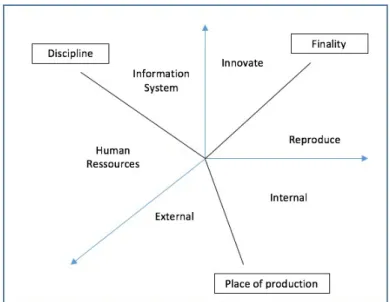
In the face of an ever more stringent regulatory environment combined with strong commercial competition and the renewal of their business, banks are determined to put in place measures to promote the management of their organizational knowledge. Indeed, according to [5] in their article ”Financial risk and the need for superior knowledge management”, the transfer of knowledge to decision makers beforehand, available access to information, or the generation of new knowledge on the evolution of risk management requirements, should lead to more efficient risk management. According to [6], knowledge management is the management of knowledge within an enterprise through specified organizational procedures for the acquisition, organization, maintenance, application, sharing and updating of employees’ knowledge to improve their performance and create value. In their article ”What is knowledge management for banks”, the authors [7] propose three possible readings of knowledge management: its finality, its place of production, and its discipline. Different facets of knowledge management as shown in Figure 1.
Figure 1. Different facets of knowledge management
The first axis deals with the finality of knowledge management. Indeed, two different streams are required. The first, in a logic of creation of the new knowledge to innovate [8]. The second in a replication logic of good practice [9]. Banks that have adopted the knowledge management approach have put in place systems for knowledge sharing (activity reports, procedure manual) based on Lotus notes, intranet and internet, a customer relationship management system [10] or software allowing employees access to the digital library (e learning) to develop their knowledge of the banking profession.
The second axis of analysis is the place of production of knowledge. In fact, two places of conception of knowledge oppose one another. The first is external [11] advocated by the authors who combine customer relationship management with knowledge management. It is a question of knowing the profiles of the bank’s customers in order to offer those customized products and services. The second place is internal [12] and
concerns the knowledge mobilized in organizational practices. It involves initiating a process of exchange and brainstorming between employees to create and transfer knowledge within the bank.
The third axis of analysis identifies the users of the concept of knowledge management within the bank. In fact, two major department have been identified. It is primarily the information systems department [13] whose objective is to put in place a system that allows the process of creation, collection, organization, access and use of knowledge to be automated as much as possible. The second department that uses knowledge management is the human resources. The latter is interested in the management of job forecasts and the creation of a favorable context for learning and knowledge sharing within the bank [14]. In the following, we aim to provide risk management function within a bank with a credit decision support system whose purpose is to replicate good practices in the selection and financing of young entrepreneurs.
3. FUNCTIONAL ANALYSIS OF THE CREDIT DECISION SUPPORT SYSTEM (CDSS)
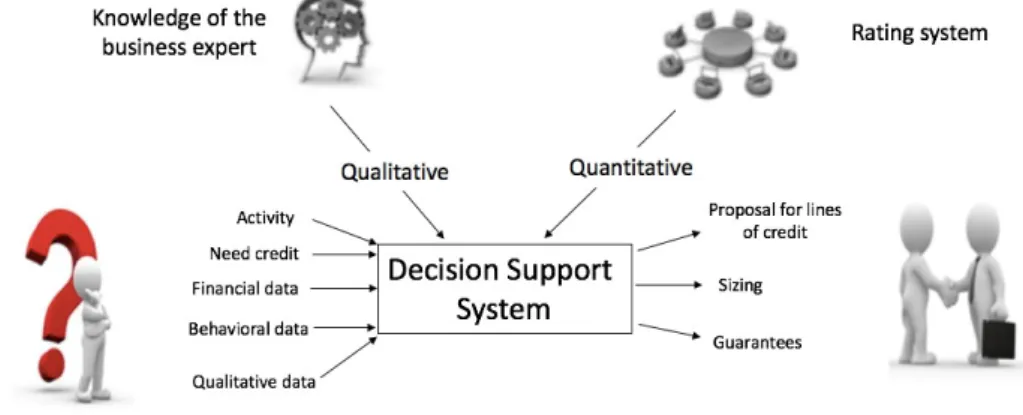
The CDSS system (which we propose) is a decision support system which, following the capitalization of the expert’s reasoning, will allow the selection of the good projects of the young entrepreneurs, generate credit lines, their amounth and the adequate guarantees. The tool, as shown in Figure 2, will be able to combine several quantitative criteria (model for the assignment of scores and calculation of credit limits) and qualitative criteria deduced from the reasoning of business experts following several meetings. The system is a response to several needs from a set of potential users (in bold):
Figure 2. Description of the credit decision support system
a. First, the system will allowthe business entity; In particular, account managers give concise, efficient and reflective guidance to customers by focusing more specifically on credit lines that are appropriate to their needs.
b. The system directly servesthe entrepreneur, who will not have to wait for effective advice but will be served in a very precise and timely manner, which will allow him/her to save time and even stronger confidence in the services of the bank.
c. The error is human, and this is one of the main constraints that the system will avoid to any
risk analyst, since the tool will improve the risk management of any application by being more automatic and following a well-chained process. The entity in charge of the Risks will be able thanks to this tool to retrace all the stages on which it based itself to give its decision concerning the credit limits and the guarantees solicited.
d. The system can also serve the Risk Management entity by avoiding forcing and by facilitating the writing of the appropriate reports to each application thus allowing a facility of risk management. e. Voluntary departures, resignations or retirements can influence the proper approach of the bank’s services
and give rise to a great loss of knowledge and experience. The bank will be forced to trainnew recruits
system, in this case, will be able to capitalize and unite this reasoning to become a pedagogical tool, which will make it possible to identify a well-built reflection and avoid the loss of the experiences of former collaborators.
4. THE ARCHITECTURE OF THE CDSS SYSTEM 4.1. Description
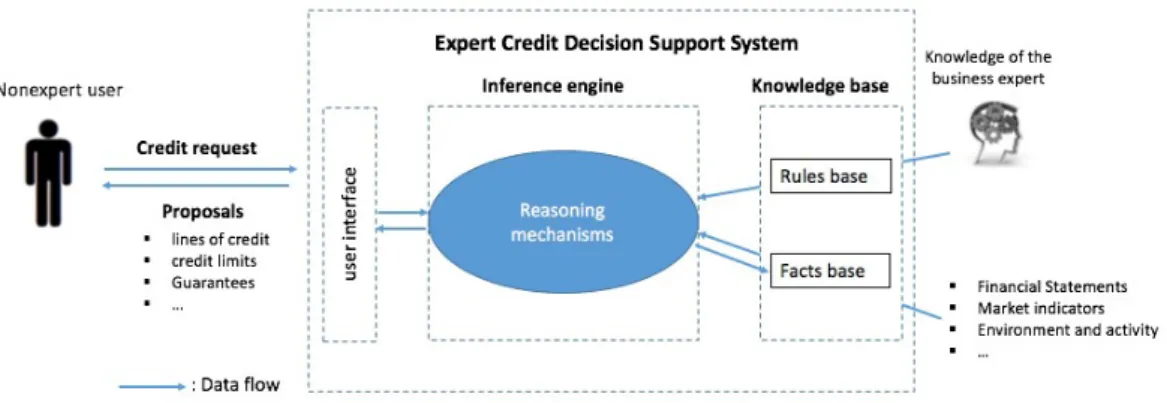
Figure 3 shows the architecture of the credit decision support system (CDSS) allows us to outline the overall design of the system by describing its essential components. The CDSS system will receive in the first place all the inputs in particular, the knowledge of the business expert resulting from the interviews and meetings as well as the data subtracted from the internal system of the bank (Project data, environment, Profile of the project holder...). The data cited will serve as a knowledge base (facts and rules) to an inference engine that serves as a receptacle and allows to map the reasoning mechanism, then to have a graphical interface that the non-expert and expert user will use to display the various proposals for exits to know (lines of credit, their limits and the appropriate guarantees). The system has a twofold meaning since the non-expert user can integrate the credit request at the graphical user interface (GUI) that will be received by the inference engine to feed the system’s fact base.
Figure 3. Description of the credit decision support system
4.2. The CDSS knowledge base
The CDSS system is based on a knowledge base that brings together in a structured way the rules, relationships and problem-solving strategies for the credit application. The content of the CDSS knowledge base was acquired through a series of meetings with business experts, through interviews and structured meetings. The course of these meetings generally consisted of identifying each relevant element and asking the expert to produce the rules used daily. The knowledge base is divided into two components, a fact base, and a rule base.
4.2.1. The fact base
The fact base is a database that records all existing historical data and information in the bank’s internal system, which will exploit the bank to derive a concise structure of quantitative and qualitative data [15]. In our article [16]” we have developed a qualitative model to evaluate the projects of young entrepreneurs. The authors, after hundreds of hours of discussion with several stakeholders (risk management executives, network manager, etc.) and dealing with several evaluation models, have identified 10 to 20 questions from a starting list containing 100 and about 200. The selected questions cover two important aspects of the selection of young entrepreneurs’ projects. This is a questionnaire designed to assess the ability of the young entrepreneur to manage the project and another questionnaire to assess its feasibility. The final evaluation of the project is the combination of the ”Entrepreneur” and ”project” scores. The following equation give the final score:
The authors justify the overweighting of the entrepreneur block by the fact that a good entrepreneur can succeed in an average project, while a less trained (or less supervised) entrepreneur can fail even with a promising project. The rating scale varies between 0 and 100, a score of 100 is given to the best couple (Entrepreneur, project). Finally, the final score is segmented into 7 classes as shown in Table 1.
Table 1. Model MasterScale
Classe Probability of default A 2,10% B 3,90% C 3,93% D 6,70% E 10,00% F 14,40% G 17,70% H 35,10% I 46,20%
The criterion used to split the score into several classes is to group in one class projects with the same risk profile and to disperse those with different risk profiles. Once the projects are selected, the question of their financing arises. In the following, we will present the rules and models used to set the credit limits granted to young entrepreneurs carrying selected projects, as well as the breakdown of this limit by type of product (Cash, discount, consumption, foreign exchange).
4.2.2. The rule base a. Setting the credit limit:
In our article ”Concentration risk: setting credit limits in loan portfolios, case of Morocco” [17], we propose an analytical method which will allow us to decide for a contractor carrying the project selected, the amount of credit limit to be granted to it according to its risk profile and the risk appetite of the bank about this entrepreneur and his project.
The model is as follows:
CCe=PDe×limite+ (V ar(99%)−EL)× limite
E
with:
CCe: The consumption of capital allocated to this entrepreneur; PDe: The probability of default;
Var (99%): Value at risk that presents the maximum loss that the credit institution is likely to incur by financing selected projects with a probability of 1% over a one-year horizon.
EL: Expected loss (to be provisioned) associated with the funded project portfolio. E : Total amount to finance the selected projects.
In what follows, we will present the rules of experts used to allocate the authorized limit to a project leader in a set of products (Consumption, exchange . . . ) adapted to his needs.
b. Breakdown of the global limit:
The knowledge base of the expert and his experience will allow our system thanks to the set of criteria deduced to guide us towards the choice of lines of credit. The business rules and the know-how of the expert will make it possible to set and calibrate these lines of credit to get closer to the authorization or the limit that the credit institution must grant to the customer. In our system, as an illustration after the interviews and the analysis of the data received from the business experts, we have been able to implement some criteria allowing the choice of lines of credit as shown in the Table 2.
Table 2. Extract from the rule base (1/2)
Activity of the entrepreneur Need of the entrepreneur Import: Customs Economic Regime Temporary admission Import: down payment method and deals Aval local supplier Import Export Lines of exchange
Sector Construction and Public Works CProvisional / final security and Advance on Market Discount Payment method: commercial bills Escompte
Seasonal activity Credit companion
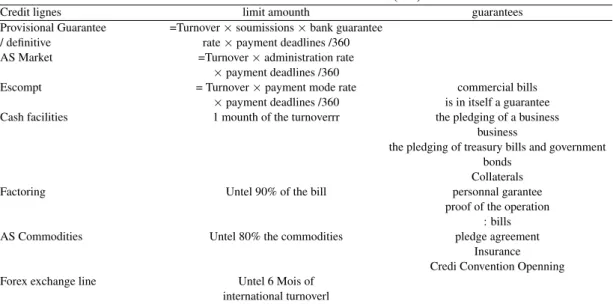
The table above reflects the reasoning of the business expert when choosing or directing a contractor for a line of credit. At the level of this table we apply a schematization of the reasoning of the human brain; (If, then. . . ). These business rules, which we will explain in the Table 3, allow the credit analyst to deduct the amounts that the credit institution should authorize for each product line.
Table 3. Extract from the rule base (2/2)
Credit lignes limit amounth guarantees Provisional Guarantee =Turnover×soumissions×bank guarantee
/ definitive rate×payment deadlines /360 AS Market =Turnover×administration rate
×payment deadlines /360
Escompt = Turnover×payment mode rate commercial bills ×payment deadlines /360 is in itself a guarantee Cash facilities 1 mounth of the turnoverrr the pledging of a business
business
the pledging of treasury bills and government bonds
Collaterals Factoring Untel 90% of the bill personnal garantee
proof of the operation : bills AS Commodities Untel 80% the commodities pledge agreement
Insurance Credi Convention Openning Forex exchange line Untel 6 Mois of
international turnoverl
5. EXPERIMENTATION
5.1. Description of the case
As an illustration of the application of our decision tool, we propose the following case:
a. An entrepreneur operating in the construction sector, who forecasts a turnover of 12 000 000 MAD and who hopes to carry out international operations (Import-Export).
b. The company is paid up to 20% by and over a period of 60 days, up to 50% by transfer and 30% by endorsement.
c. On the other hand, the company pays its clients up to 20%, 30% by effects over a period of 60 days and 50% by effects over a period of 90 days.
d. The company carries out a seasonal activity and follows a customs economic regime and bids in a public market up to 70%, the share of the administration is 3%.
e. The company plans an international turnover of MAD 1,000,000. After integrating the previous data into our system, the results are as follows:
5.2. Choice of lines and credit limits fixed by the expert
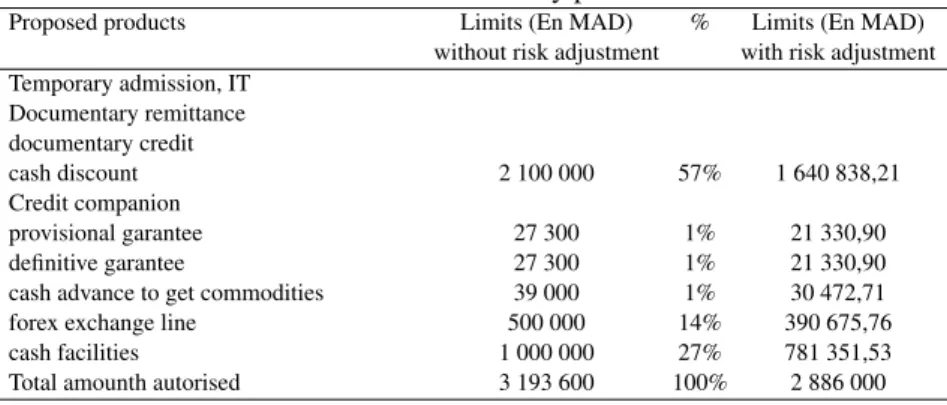
Taking into account the rules specified above, an analysis of the credit application independently on the risk profile (mesured by probability of default [18]) of the client and the risk appetite of the bank towards this client allows the latter the following the set of products, as shown in Table 4.
Table 4. Credit limits by product
Proposed products Limits (En MAD) % Limits (En MAD) without risk adjustment with risk adjustment Temporary admission, IT
Documentary remittance documentary credit
cash discount 2 100 000 57% 1 640 838,21 Credit companion
provisional garantee 27 300 1% 21 330,90 definitive garantee 27 300 1% 21 330,90 cash advance to get commodities 39 000 1% 30 472,71 forex exchange line 500 000 14% 390 675,76 cash facilities 1 000 000 27% 781 351,53 Total amounth autorised 3 193 600 100% 2 886 000
However, the analysis of the risk profile of the client through the credit scoring model [16] and the model of setting the credit limits [17] allows us the following results, as shown in Table 5.
Table 5. Risk profile of the client and its etimated limit
Entreprise classe Autorisation Capital limit estimated Gap (limit estimated, Autorisation) SME C 3 193 600 200 000 2 886 000 -28%
The credit limit calculation model authorizes this client an amount equal to 2.886.000 MAD. Therefore, we need to downgrade the amount allowed by the experts (a decrease of 28%). One way to review this amount is to apply the shares of each product to the risk-adjusted authorized amount. Indeed, the authorized amount for the productcash discountfor example is 2 100 000 MAD, or 57% of the initial amount (without risk adjustment). An application of this percentage to the theoretical limit of 2 886 000 MAD makes it possible to devote to this product an amount of 1.897.733 MAD. For this credit application, the proposed CDSS system slightly lowered the amount allowed to the selected project applicant because of its average risk profile. However, for other profile considered less risky by the system, the limit is revised upwards and the same approach is applied to find the appropriate set of product to the application studied.
6. CONCLUSION
The government’s ambition to promote the business climate has enabled the deployment of several programs to support the economic integration of young entrepreneurs. However, successful program rollout deserves strong bank involvement through the funding of promising projects. Hence the need for these credit institutions to set up systems, based on artificial intelligence, that can deal with the issues of young entrepreneurs in a timely manner and also support these young people. Thus we have established a decision-making tool (SADC) allowing the bank, selection and funding of promising projects based on implicit knowledge including rating models and design of credit lines, and also on expert knowledge of the banking profession.
REFERENCES
[1] World Bank Country and Lending Groups,2017-2018. [2] Central bank of Morocco, financial stability report, 2018. [3] Doing Business 2017: Equal Opportunity for All
[4] Mohamed Bayad, Serge Simen, Le management des connaissances: ´etat des lieux et perspectives, 2003 [5] Marshall, C., Prusak, L. and Shpilberg, D. “Financial risk and the need for superior knowledge
management”, California Management Review (38:3), 1996
[6] Alavi, M. Leidner, D.E. (1998). Knowledge Management and Knowledge Management Systems: Conceptual Foundations and an Agenda for Research.
[7] Val´erie Pallas-saltiel et Rania Labaki, Quel management des connaissances pour les ´etablissements bancaires?, Revue franc¸aise de gestion, 2009, pages 139 `a 151.
[8] NONAKA, I. and TAKEUCHI, H. (1995), The Knowledge-Creating Company, Oxford, Oxford University Press.
[9] Park, H., Ribiere, V., Schulte, W. D., Jr. (2004). Critical attributes of organizational culture that promote knowledge management technology implementation success. Journal of Knowledge Management, 8(3), 106–117.
[10] Saif and al. An Expert System with Neural Network and Decision Tree for Predicting Audit Opinions, International Journal of Artificial Intelligence (IJ-AI), Vol 2, No 4, December 2013.
[11] Chen, M.Y. and Chen, A.P. (2006). Knowledge management performance evaluation: A decade review from 1995 to 2004. Journal of Information Science, 32 (1), 17-38.
[12] Argote, L., McEvily, B., Reagans, R. (2003). Managing knowledge in organizations: An integrative framework and review of emerging themes. Management Science, 49(4), pp 571-583.
[13] Chalmeta, R., Grangel, R. (2008). Methodology for the implementation of knowledge management systems. Journal of the American Society for Information Science and Technology, 59(5), 742-755. [14] Horwitz, F., Heng, C. T., Quazi, H. A. (2003, Vol 13 No 4). Finders, keepers? Attracting, motivating and
retaining knowledge workers. Human Resource Management Journal, pp. 23-44.
[15] Jalil and al. ” Modeling with ontologies design patterns: credit scorecard as a case study”, Indonesian Journal of Electrical Engineering and Computer Science, Vol.17, No.1, January 2020, pp429-439. [16] BAZZI and al., Credit Scoring in the service of entrepreneurship in Morocco: pragmatic Approach for
the selection of promising projects, the Risk Governance and Control Journal, Avril 2016.
[17] BAZZI and al., Risk concentration: Setting credit limits in loan portfolios, Case of Morocco, Risk Governance and Control journal, Juin 2016.
[18] Arup guha, Prediction of Bankruptcy using Big Data Analytics based on Fuzzy c-means Algorithm, International Journal of Artificial Intelligence (IJ-AI), Vol 8, No 2, June 2019.