•Correspondence: Adam Tindale, OCAD University, Toronto, Canada; e-mail: [email protected]
• Received: 24 June 2013; Revised: 20 September 2013; Accepted: 26 September 2013 •Available online: 10 March 2014
• doi: 10.4407/jims.2014.02.001
The E-Drum: A case study for machine learning in new
musical controllers
Adam Tindale1 and George Tzanetakis2
1 Digital Futures Initiative, OCAD University 2 Computer Science Department, University of Victoria
Background in Music Performance. Advances in Music Technology seem to pass percussion by: there is no entry for it in the standard book Percussion Instruments and their Histories (Blades, 1997). Current percussion controllers monitor impact velocity only, dimensionally impoverishing complex musical gestures. Conversely, percussionists select sticks and vary technique to influence the timbre of their performance. Commercial drum synthesizers ignore this, which is inadequate if the device is to be useful for a professional percussionist.
Background in Computer Science. Rebecca Fiebrink has presented several works on integrating machine learning into the live performance context (Fiebrink, 2008, Wang et al., 2008). Fiebrink's system incorporates a machine learning framework with a real-time Open Sound Control interface in order to allow an agnostic approach towards feature extraction.
Roberto Aimi received his Ph.D. from the MIT Media Lab for developing novel percussion interfaces (Aimi, 2007). Aimi's convdrum uses piezo microphones attached to a drum. Convolution of their signals creates a timbre depending on stick, strike position and force.
Aims. The E-Drum primarily uses an acoustically driven physical model permitting acquisition of brushing and scraping gestures eluding existing drum controllers.
Main contribution. The E-Drum has two methods of recognizing gestures: implicit and explicit position tracking. The former uses machine learning to determine the timbre produced by a drum controller and then infer position based on labeled training data. The later is made application-specific by selecting the classification algorithm.
Implications. Acoustic instruments provide a commensurate response to performer's input but only provide a fixed mapping, i.e. the same gesture will always yield the same result. Electronic instruments permit flexible mappings but do not have the input bandwidth to provide a commensurate response. The E-Drum system provides both. During years of performance experience the E-Drum has proven to be a reliable concert instrument.
Keywords: New interfaces for musical expression, musical applications of machine learning, music information retrieval, music technology, timbre recognition based instruments, electronic drumming.
Introduction
This paper discusses the E-Drum, a set of two software tools for electronic drummers. The E-Drum exploits the fact that all commercial electronic drum products use a built-in piezo microphone to capture signals. A traditional electronic drum machine reduces these signals to MIDI notes with an onset and a velocity. All of the subtlety is lost. The E-Drum provides two software suites for utilizing these signals and providing more possibilities of expression to the modern electronic drummer. This paper contains three main sections: a section for the two software tools in the E-Drum package, and a section on the use of this new interface in performance. The explicit position tracking section describes a system of drum gesture acquisition utilizing machine learning concepts. The implicit tracking section describes new and modified DSP algorithms for drum synthesis. The third section provides an informal evaluation of the effectiveness of the system in the form of performance reports of the first author's use of the system.
Drum Sound Implicit Tracking
Explicit Tracking
Sound
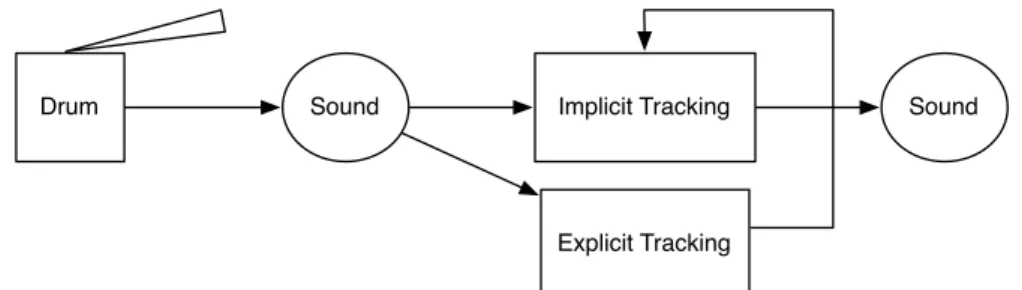
Figure 1. System Diagram of E-Drum software and hardware flow.
The system is made of three parts: the two software components and a hardware component. The hardware is a standard drumpad connected to a computer running the software. The signal is sent into the computer where it is routed to both software components. Whenever an onset is detected, the explicit position tracking analyses the signal and generates a label. The label is fed to the implicit position tracking software to alter a parameter of the synthesis engine. This mapping is determined by the user. All incoming signal is fed to the implicit position tracking software where it is transformed into the resulting sound (see Figure 1).
The explicit position tracking software utilizes machine learning algorithms to classify audio signals into gestures. Since the signals are coming from a known set of input devices, namely electronic drums, then it is inferred that any sound received must have been created by the user as a result of a gesture, a method referred to as indirect gesture acquisition since only the effect of the gesture is measured and not the gesture itself. Thanks to modern hardware, machine learning algorithms are easy and quick to train. The software does not provide any pre-trained algorithms for users. This is by design. Machine learning algorithms deteriorate in accuracy when there are more labels to discern. While one user may wish to have 10 different labels, another
may only wish to tell the difference between a rim hit and a standard strike. The second user will experience a lower classification rate if they use the same algorithm with the same training set.
The mix of these two systems is critical for creating a reliable instrument. At best, explicit position tracking has been able to provide the accurate labeling to 99.8% (Tindale et al., 2004) with the E-Drum software. While this is extremely accurate it is not as reliable as an acoustic instrument. The output sound is achieved entirely through the synthesis layer in the implicit position tracking software, while the explicit tracking is used to create control messages to change the state of the synthesis algorithm. This mapping strategy results in a sound making gesture always creating sound, though in rare cases it will create an unintended sound as a control parameter is changed to an unexpected value due to a misclassification.
Explicit Position Tracking
This section will discuss the results of the indirect acquisition of percussive gestures. Signals are converted to semantic labels by utilizing signal processing and machine learning concepts. A variety of classification scenarios are provided in order to demonstrate the effectiveness and flexibility of the software.
Surrogate Sensors for Detecting Drum Strike Position
There are two main approaches to sensing instrumental gestures. In indirect acquisition, traditional acoustical instruments are extended/modified with a variety of sensors such as force sensing resistors (FSR), and accelerometers. The purpose of these sensors is to measure various aspects of the gestures of the performers interacting with their instruments. A variety of such “hyper-instruments'' have been proposed (Machover, 1992; Kapur et al., 2004; Young and Fujinaga, 2004). However, there are many pitfalls in creating such sensor-based controller systems. Purchasing microcontrollers and certain sensors can be expensive. The massive tangle of wires interconnecting one unit to the next is prone to failures. Things that can go wrong include: simple analog circuitry break down, or sensors wearing out right before a performance forcing musicians to carry a soldering iron along with their tuning fork. However, the biggest problem with hyper-instruments is that there usually is only one version. Therefore only one performer, typically the designer/builder, is the only one that can benefit from the data acquired and utilize the instrument in performances. Finally, musical instruments, especially the ones played by professionals, can be very expensive and therefore any invasive modification to attach sensors is bound to be met with resistance if not absolute horror.
These problems have motivated researchers to work on indirect acquisition in which the musical instrument is not modified in any way. The only input is provided by non-invasive sensors typically one or more microphones. The recorded audio then needs
to be analyzed in order to measure the various desired gestures. Probably the most common and familiar example of indirect acquisition is the use of automatic pitch detectors to turn monophonic acoustic instruments into MIDI instruments. In most cases indirect acquisition doesn't directly capture the intended measurement and the signal needs to be analyzed further to extract the desired information. Frequently this analysis is achieved by using real-time signal processing techniques. More recently an additional stage of supervised machine learning has been utilized in order to “train'' the information extraction algorithm. The disadvantage of indirect acquisition is the significant effort required to develop the signal processing algorithms. In addition, if machine learning is utilized the training of the system can be time consuming and labor intensive.
This approach of using direct sensors to “learn'' indirect acquisition models has some added benefits. Large amounts of training data can be collected with minimum effort just by playing the enhanced instrument with the sensors. Once the system is trained and provided the accuracy and performance of the learned surrogate sensor is satisfactory there is no need for direct sensors or invasive modifications to the instrument (Tindale et al., 2011).
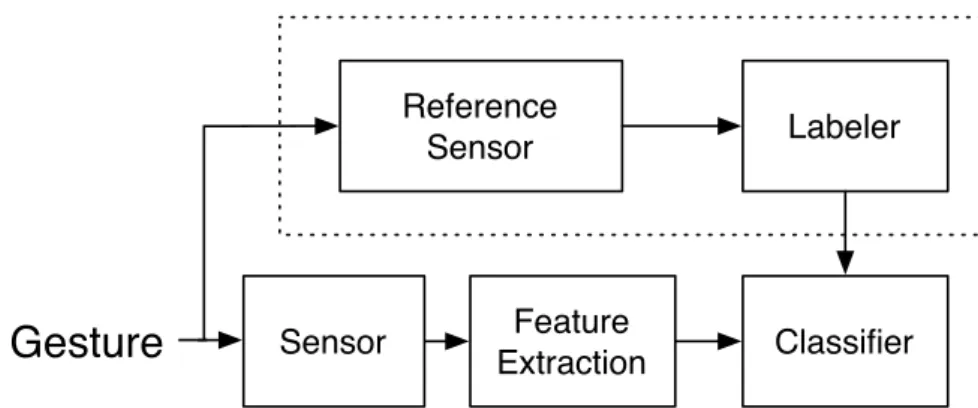
The traditional use of machine learning in audio analysis has been in classification where the output of the system is an ordinal value (for example the instrument name). In this paper a system is described for classifying percussive gestures using indirect acquisition. More specifically the strike position of a stick on a snare drum is automatically inferred from the audio recording. A Radiodrum controller is used as the direct sensor in order to train the indirect acquisition.
Gesture
Reference
Sensor
Sensor
Feature
Extraction
Labeler
Classifier
Figure 2. System Diagram of a Surrogate Sensor Network. Once training is complete the blocks in dotted lines are eliminated.
Radiodrum
The Radiodrum was used as the direct sensor to be removed once training was complete. A drum pad was placed on top of the Radiodrum surface and the sticks of
the Radiodrum were used to capture position data. MIDI data was captured from the Radiodrum.
The Radiodrum is a capacitive spatial controller invented by Max Mathews to control music playback (Mathews, 1991). The Radiodrum is able to track its sticks independently in 3 dimensions by emitting RF signals and receiving them with a capacitive drumpad. Each stick emits a different frequency so that the sticks may be differentiated. The signal strength is measured in 3 dimensions for each stick. A simple thresholding algorithm is used to detect hits on the surface of the drumpad. The controller comes with a converter box that converts the resulting signal into MIDI data representing the spatial position of the sticks and discrete events for drum hits. A newer method for processing these signals involves capturing the direct signals from the device and modulating them into the signal domain to be processed by modern DSP software packages (Neville et al., 2003).
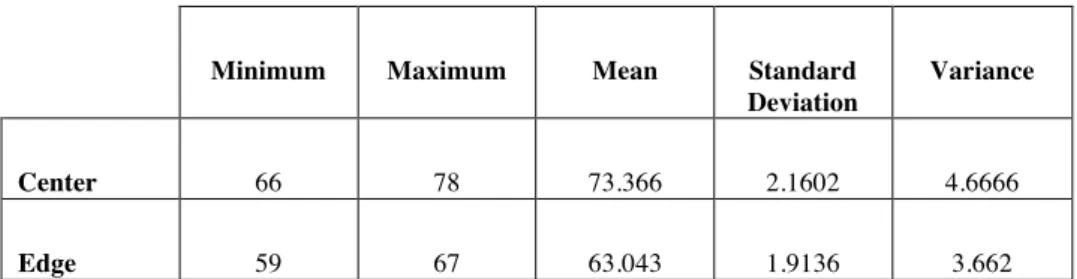
The diameter of the drumpad was 8 inches. The drum was struck at the center and the edge, a distance of 4 inches. The maximum MIDI value was 75 and the minimum MIDI value was 59. When hitting the center of the drum the mean MIDI value was 66 and when hitting the edge the mean MIDI value was 40. The difference between two means is 8 values to quantize 4 inches or one value being roughly equivalent to half an inch. The problem is that there is a standard deviation of approximately 3 MIDI values when using the Radiodrum. With only 8 MIDI values to quantize the examined distance and such a large variance the data acquired by the Radiodrum is not appropriate when a high degree of precision is desired.
Figure 3. Radiodrum with various drums for experimentation.
Another test of the Radiodrum measured the jitter of a stationary stick. A stick was placed at the edge and the center and left for approximately 10 seconds. The data was recorded as a signal in Max/MSP to gain accurate resolution in time. Confirming the standard deviation observed with strikes, the data varied by 3 values when the stick
was left in the same position. The jitter measurements illustrate the effect of ambient noise on the Radiodrum and help to explain the lack of precision.
Table 1. Statistics on Radiodrum Accuracy with 100 hits at each location.
Minimum Maximum Mean Standard Deviation
Variance
Center 66 78 73.366 2.1602 4.6666
Edge 59 67 63.043 1.9136 3.662
The original conclusion from this experiment was that the low correlation was not necessarily bad because the input of label data had so much variance. It was decided to collect data and label the instances with discrete classes and continuous data to determine if the noise of the Radiodrum was a significant factor in the low correlation results. Further investigation into the use of discrete labeling is discussed in the following section.
Gesture Recognition
Previous research (Tindale et al., 2004) has focused on providing discrete symbolic labels for snare drum hits. The snare drum would be struck at different positions with different implements and the resulting sound would be processed with feature extractors and then classified using Wekai.
Classification refers to the prediction of discrete categorical outputs from real-valued inputs. A variety of classifiers have been proposed in the machine learning literature (Mitchell, 1997) with different characteristics in respect to training speed, generalization, accuracy and complexity. The main goal of our experiments was to provide evidence to support the idea of using direct sensors to train surrogate sensors in the context of musical gesture detection. Therefore experimental results are provided using a few representative classification methods.
For the drum experiments the analysis window is 40 milliseconds (no texture window) and the features used were: Spectral Centroid, Rolloff, Kurtosis, and Skewness as well as Mel-frequency Cepstrum Coefficients (MFCCs). A preprocessing step of silence removal and onset detection ensure that features are only calculated once for each drum hit. The analysis window is located so that it captures most of the energy of the hit. The Marsyasii audio analysis and synthesis framework
was used for the feature extraction and direct sensor acquisition and alignment with the audio features (Tzanetakis, and Cook, 2000; Tzanetakis, 2007).
In each experiment, unless explicitly mentioned, the hits were regularly spaced in time. For each hit the radial position was measured and the hit was labeled as either
“edge'' or “center'' using thresholding of the Radiodrum input. Audio features are also extracted in real-time using input from a microphone. The features and sensor measurements are then used for training classifiers. The setup can be viewed in Figure 3.
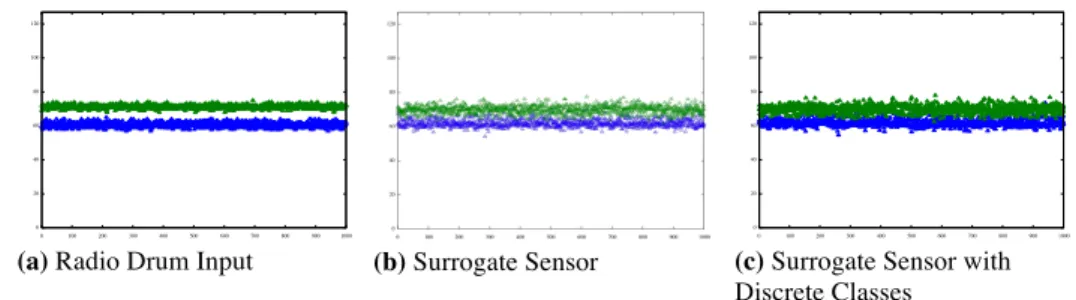
In the first experiment the electronic drum pad was hit in the center and at the edge. 1000 samples of each strike location were captured and used for classification. Figure 4a shows a graph of the MIDI data captured by the Radiodrum for each strike. Figure 4b shows a graph of the predicted output from a PACE regression classifier. The result was a correlation coefficient of 0.8369 with an absolute error of 2.3401 and a mean squared error of 2.9784. The graph clearly shows enough separation between the two classes. The data was then divided into two symbolic classes: Center and Edge.
(a) Radio Drum Input (b) Surrogate Sensor (c) Surrogate Sensor with Discrete Classes
Figure 4. Regression results for predicting drum strike position using a surrogate sensor.
Table 2. Percentages of correctly classified drum pad hits (center, halfway, or edge).
Regression Type Classifier Ordinal
ZeroR 36.5285 NA
SMO 80.3109 76.1658
Naïve Bayes 76.6839 76.1658
J48 86.2694 89.1192
KNN 88.342 88.342
Table 2 shows classification results for predicting whether a mesh electronic drum pad was hit in the center, halfway, or the edge. As can be seen excellent classification results can be obtained using the surrogate sensor approach. A total of 348 drum hits were used for this experiment.
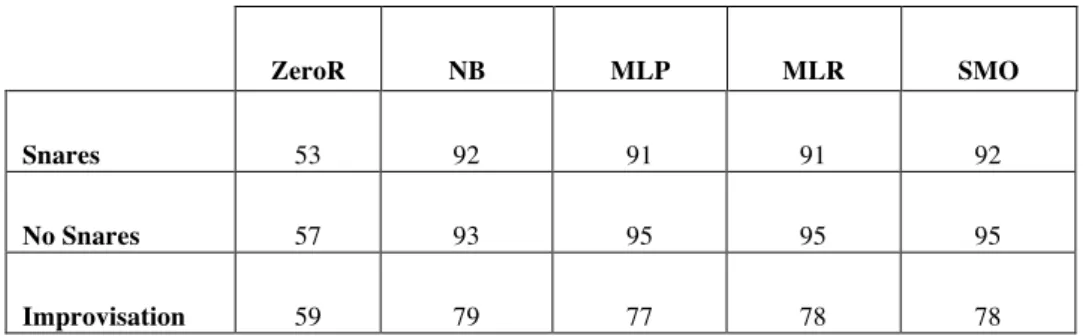
Table 3. Percentages of correctly classified snare drum hits.
ZeroR NB MLP MLR SMO
Snares 53 92 91 91 92
No Snares 57 93 95 95 95
Improvisation 59 79 77 78 78
Table 3 shows classification results for predicting whether an acoustic snare drum was hit in the center or the edge. The Snares, No Snares rows are calculated using approximately 1000 drum hits with the snares engaged/not engaged. All the results are based on 10-fold cross-validation. The trivial {\it ZeroR} classifier is used as a baseline. The following classifiers are used: Naive Bayes (NB), Multi-Layer Perceptron (MPL), Multinomial Logistic Regression (MLR), and Support Vector Machine trained using sequential minimal optimization (SMO).
The results are consistent between different classifier types and show that indirect acquisition using audio-based features trained using direct sensors is feasible. The Improvisation row is calculated using 200 drum hits of an improvisation rather than the more controlled input used in the other cases where the percussionist was asked to alternate regularly between hitting the edge and the center of the drum. Even though the results are not as good as the cleaner previous rows they demonstrate that any performance can potentially be used as training data.
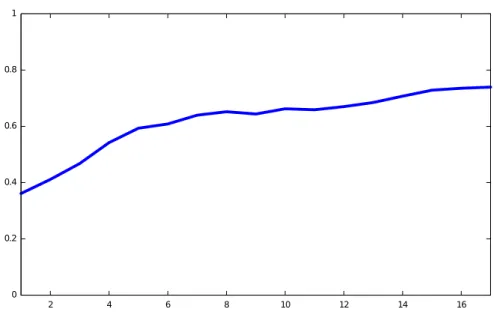
To verify the effectiveness of the features used for classification an experiment was conducted to progressively add features. The feature vector was reduced to 1 element and then increased until all 17 features were included (see Figure 5). The plot shows an increasing line as features are added back into the vector and the correlation coefficient increases.
Figure 5. The effect of more features to the correlation coefficient in drum regression.
Classifying Hands
A test was conducted to determine if a classifier could be trained that would be able to differentiate between the left and right stick of a player. Two hundred and eighty one samples were collected and with a ZeroR classifier 50.8897% instances were classified correctly. A subset of the samples was taken and the ZeroR classifier returned 57%. (see Table 4)
Table 4. Classification results to differentiate right and left sticks.
Regression Type Classification (Full Set) Classification (100)
ZeroR 50.8897 57
Bayesian 68.3274 85
SVM 66.548 80
Neural Network 78.2918 89
In both cases the classifiers were able to classify at least ten percent better than the ZeroR baseline. The Neural Network, though often subject to overfitting, was able to
achieve 27.4021% and 22% excess of the baseline, respectively. Though these results are not high enough for performance, they do provide an interesting result. These results lead one to believe that it is possible that with further research it will be possible to detect a multitude of semantic data from the audio stream.
Implicit Position Tracking
Implicit position tracking is achieved by using the acoustic signal of a drum controller to allow the listener to hear timbral variations that naturally occur when the controller is struck at different locations. By modifying the algorithms to accept audio input, acoustically excited physical models are created. This approach allows for the use of brushes and scraping gestures that standard drum controllers are not able to capture. Any gesture that creates a sound that is captured by the piezo microphone will produce commensurate result, due to the nature of this transformation method.
Modifying Algorithms
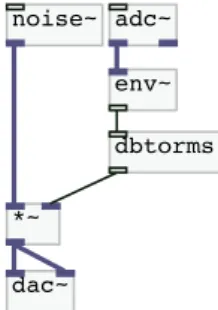
The concept behind the synthesis algorithms utilized in the E-Drum is to modify existing synthesis algorithms by modulating components with audio from the microphone. In some cases this is raw audio and in other it is the envelope of the strike. Figure 6 shows a simple envelope tracking program written in the Pure Dataiii
multimedia programming language. The envelope of the input is used to control the volume of a white noise generator.
adc~
env~ noise~
*~
dac~
dbtorms
Figure 6. Simple Pure Data patch using the amplitude envelope of the input.
Risset Algorithms
In 1963 Jean Claude Risset compiled a library of synthesis algorithms that he had developed in the MUSIC V programming language. A number of percussion algorithms were developed. The bell algorithm and the drum algorithm were ported to the Drum software. Originally, the algorithms were triggered with impulses. The
E-Drum software modifies these algorithms to use an audio input so that a drum pad may be processed through the Risset models. Figures 7 and 8 depict the original Risset algorithms as outlined in his catalog of synthesis (Risset, 1969).
NOISE
LowPass
Ring
Sum
Sine
Sine
FREQ
* 0.17
Figure 7. Signal diagram of Risset drum algorithm.
Sine Sine Sine Sine Sine Sine Sine Sine Sine
Frequency
* .56 * .92 * 1.19 * 1.7 * 2 * 2.74 * 3 * 3.76 * 4.07
Figure 8. Signal diagram of Risset bell algorithm.
Physical Modelling
Physical Modelling synthesis can be done in two main ways: digital waveguides (Smith, 1992) or mass-spring simulations. For this work the digital waveguide method was employed due to the ease of implementation and the efficiency of the algorithm. The low computational requirements allowed for patches with many variations, thus enabling more experimentation. Most simulations utilized one or two dimensional waveguide models.
The classic Karplus-Strong algorithm is a recirculating delay line with a moving average filter (See Figure 9) The noise generator shown in the diagram was replaced with the audio input of a drumpad connected to a computer. This algorithm was one of the first to be implemented in the E-Drum software. The original expectation was that the timbral variance of the output would be minimal due to the filter and that it would sound like any other Karplus-Strong. Timbral variation was noticeable and quite significant considering the limited nature of the algorithm.
Noise
+
Filter
Delay
Output
Figure 9. Signal Diagram of the Karplus-Strong algorithm.
The filter can be replaced by a number of other filters available with modern software. Band-pass filters tuned to the fundamental frequency of the delay lines create a more focused attack to the algorithm. Timbral shaping effects are achieved by tuning the filters to anything other than the fundamental frequency. The attack can be made more noisy by lowering the Q factor of the filters.
Sustain can be modified by controlling the gain of the reflection filter. Alternatively, the filter used may be set to be a ringing filter that will extend the duration of an excitation. Modifying the duration of the event allows for greater variability in the control of sound produced by this algorithm.
The banded waveguides concept is an array of single dimensional waveguides with a summed feedback section. They were developed by Georg Essl and Perry Cook (Essl and Cook, 1999) and have been used for percussion and friction synthesis. See Figure 10 for a system diagram of a banded waveguide network.
Input
Delay
Delay
Delay
Delay
+
Output
Filter
Filter
Filter
Filter
*
...
Figure 10. Signal Diagram of a Banded Waveguides Network.
The length of the delay lines corresponds to the fundamental frequency of the overtone. The filters in each tap of the waveguide control the amplitude and timbral decay for each overtone. The algorithm is a more specialized mutli-dimensional Karplus-Strong algorithm. To allow for audio input into the system the noise generator is substituted for a generic audio input allowing for drum excitation.
Waveshaping
adc~
sin~
dac~
Figure 11. A simple Pure Data patch for sine based waveshaping.
Waveshaping is a classic synthesis operation where a table is stored and the sample value of an audio signal is used to reference a lookup table. Waveshaping may also be performed by processing an audio signal through a function. Simple waveshaping may be performed by using a sine function. Figure 11 shows an implementation of waveshaping in Pure Data.
y[n] = sin( x[n] )
Distortion effects can be achieved by putting arbitrary sound files into the waveshaping lookup table. Since the operation is only a table lookup it is computationally cheap.
Supercollideriv utilizes a distortion function that is direct manipulation utilizing a
hypertangent operation. In practice the hypertangent is stored in a lookup table and the incoming signal is referenced against it.
y[n] = tanh( x[n] )
Spectral Rotation
Spectral rotation is the offsetting of FFT transforms. The latency of the transform depends on the length of the FFT window used. A ChucKv program follows that
rotates the input by 300 positions, nearly half of the frequency resolution in this example.
adc => FFT fft => blackhole;
IFFT ifft => dac; 1024 => fft.size; 300 => int rotation;
fft.size()/2 => int halfFFTlength; // use this to hold contents complex input[halfFFTlength]; complex output[halfFFTlength];
while( true ) { // perform fft fft.upchuck();
// get contents of fft fft.spectrum( input );
for ( 0 => int i; i< halfFFTlength ; i++) input[(i + rotation) % halfFFTlength] => output[i];
// perform ifft
ifft.transform( output ); // advance time
fft.size()::samp => now; }
Morphing
The morphing of sounds into each other or from one to the other was used as away to both generate intermediate sounds and generate new sounds. Modal synthesis algorithms were implemented during the project with an ability to change the frequency of each overtone. Collections of overtone ratios were collected from various articles on synthesis and physics. Morphing was achieved by doing linear interpolation between the overtone ratios. Various “hybrid'' sounds were created by choosing a fundamental frequency for the sound and then determining the ratio of overtones. See Figure 12 for a screenshot of a Pure Data patch that implements modal synthesis morphing.
Figure 12. A Pure Data patch to demonstrate morphing between an ideal membrane and ideal free plate.
Performance Ensembles
This section will discuss the E-Drum in context of the first author's use of the system in two ensembles: the i send data live duo and the Electron Orchestra Widthdrawal band. Both ensembles are improvisation based, giving the opportunity to enter into the situation where the player must react and intuit the response from the E-Drum.
As stated by many others (Schloss, 2003; Zadel and Scavone, 2006) laptop performance suffers from the problem of sound source identification: who is generating which sound. The E-Drum evolved as a solution to this problem where the audience could see the performer and have a clear idea to the sounds being generated by the E-Drum performer. All gestures that create some signal in the drumhead create a response. The nature of this sound is always commensurate with the gesture, given the nature of the signal processing methods discussed in the previous section. Therefore, if the percussionist performs a loud strike, then a loud sound is heard, and the gestural consistency from the image of the percussionist to the sound is preserved.
i send data live
i send data live is an experimental ambient and electroacoustic duo consisting of Adam Tindale and Robin Davies. The name of the ensemble is a anagram of the last names. In the ensemble the first author plays various forms of electronic percussion and Davies plays laptop exclusively. The project served as the main venue of experimentation for the various developmental stages of the E-Drum.
In performance with i send data live, the relationship between the gestures and the sounds of the electronic percussion setup used are very direct: a sound is generated only when the drum is hit. Through the course of a performance the listener is able to identify the relationship between my gestures and the sound then correctly infer that the remaining sounds must be generated by the laptop. This technique has proven to be very successful in illustrating sound sources to audiences and giving them an appreciation for the laptop's contribution to the sound. We measure success by noting that most of the audience members who inquire about the technical production after the show approach Robin to see how he is achieving his results. This indicates that the audience understands the interaction model of the E-Drum and need no further explanation.
Interactive Futures 2006
The first major performance of i send data live was at Interactive Futures 2006 (Tindale and Davies, 2006). The duo set up in the middle of a room and allowed the audience to sit in cafe style seating. Audience members were free to look at the screens of the performers to get an insight into how the performance was being created.
It was this performance that created our colloquial measure of success. After the performance there were no questions about the percussion interface and many questions about the laptop interface.
Alberta College of Art and Design Invited Performance 2007
i send data live was invited to give a performance and lecture at the Alberta College of Art and Design. This performance utilized a combination of the E-Drum and the Alternate Mode Drumkatvi. This performance was designed to be a transition away
from the Drumkat to a full E-Drum setup for the group. The performance began with older material that relied upon the Drumkat and then moved to newer material developed around the E-Drum.
The Drumkat did provide a number of mapping options that became key ideas when developing strategies with the E-Drum. A main feature of the Drumkat was the ability to play sequences or melodies on one pad. Although it is not possible to replicate this on the E-Drum using implicit position tracking, it is instead made possible by adding a mapping layer to the explicit position tracking. For example, a commonly used mapping is to change a whole preset rather than a single synthesis parameter every time a rim hit is detected. The E-Drum allows the percussionist to do this by playing normally on the head of the drum, triggering the change without any additional movements such as pressing a foot pedal or turning momentarily to manipulate keys on a computer and so maintaining the gesture language of performing.
This idea was expanded to work through a sequence of values for labels. For example, a pad can be made to oscillate through a series of fundamental frequencies for a synthesis algorithm. This allows a single pad to play a melody, a feature that became crucial through the evolution of i send data live.
Text, Media and Improvisation 2008
This performance utilized a travelling version of the E-Drum. The setup included a Hart Multipad connected to an Edirol soundcard and an Asus EEEPC running ChucK on Debian Linux. An E-Pedal connected to an Arduino microcontroller was used to capture the hall effect sensor and infrared sensor data.
The Hart Multipad is an array of 6 pads arranged in two rows of three. Each pad contains a piezo microphone but unlike other devices the audio outputs are directly available. Each pad may be connected discretely to a computer or other sound modification device. The only downfall of the device is that since there are so many surfaces so close together there is cross talk between the pads. Usually this results in a slightly layered sound where the sound from a pad struck is heard but small amounts of the sounds from other pads are also audible. This effect is not a problem when the 6 pads have similar sounds but is quite obtrusive with mappings where very disparate sounds are mapped onto each pad. Because of this the mappings used on the multipad are similar sounds, such as bells of different tunings or collections of heavily distorted sounds but mixing these two was not possible to control.
i send data live with Visual Jockeys
For nearly half the performances of i send data live visuals were performed by VJs, or visual jockeys. Love and Olson provided the visuals for many of the shows, integrating the concepts of narrative and ambience into the visual material. The visual aspect of the shows could emphasize the experimental nature of the sound design, further informing the audience as to the intention of the performance.
The Electron Orchestra Withdrawal
Figure 13. Performing with E-Drum and the Electron Orchestra Withdrawal.
The Electron Orchestra Withdrawal is an exploration in expanding the prototypical rock ensemble: guitar, bass, drums, and vocals. The group consists of Clinker (aka Gary James Joynes) on bass and electronics, Les Robot on Guitar, Jackson 2Bears on turntables and electronics, and the first author on E-Drum. The group is able to explore electronic music, rock music, ambient and metered structures through improvisation.
The project was a single night event that brought together four instrument designers and performers. The group consisted of guitar, bass, turntables, and drums - all electronically enhanced. The improvisational nature of the group was designed to test each of the instruments in a large-scale live environment.
Sonic Boom was an event hosted by EMMEDIA artist run centre in Calgary, Alberta. The show featured Clinker and Jackson 2Bears and was the premiere event for the ensemble. During the performance large scale visuals were projected inside of a hemispherical dome, which brought a level of grandeur to the performance (see Figure 13).
The E-Drum software was used on 4 drum pads and a bass drum pad. Rim hits on two drums were set to change presets of the instrument from an ambient long decay instrument to a short decay instrument. This effect had been achieved in the past by using a foot pedal however, the new method described in this particular performance
has since been adopted as a regular mapping for the first author. This was the first performance where the explicit position tracking algorithm was used to detect the difference between a stick and a finger. When a stick was detected the filters in a modal synthesis algorithm would be more resonant and less resonant with fingers. This allowed the use of fingers to stroke the drumhead creating a long tone without performing a drum roll.
Discussion
Currently, the only user of the system is the first author. It is hoped that in the future other performers will find aspects of the software useful in their own practice. While many have expressed interest, there have been no other users.
One issue in finding new users may be that the software is presented as percussion only software. The software works on audio signals and, with the exception of the onset detection algorithm, is not biased towards any particular instrument or mode of playing. Experiments with other instruments will be conducted in order to demonstrate the flexibility and usefulness of the system.
More experiments need to be conceived and carried out with the analysis software. The results of differentiating between left and right hands makes for some interesting potentials. There is definitely a difference in sound between the hands, and the results of the right versus left experiment lead one to the believe that the difference in sound is actually consistent and could potentially be differentiated. What other microcosms of gesture are recognizable? What are the uses? One could conceive of using these as control mechanisms. Capacitance-based percussion trackers are able to track different hands. This possibility on a non-restrictive system allows for the possibility of more extensive mapping strategies. Other micro gestures could be tracked and used for pedagogy. One could track the difference between strokes and aim for the variation to decline over time, demonstrating a more consistent stroke. These results could be recorded to show students their progress over time as encouragement or reinforcement.
There are a number of gestures that have not been explored in the classification section. Flams and dampening are major gestures to be explored in the future. During the study, at no time was there the desire to utilize a flam or a dampening gesture to control sound. If there is no need in performance then there is little need to stress the system by having to classify another gesture. Although these gestures were not used for this study they may be useful to others, therefore warranting study.
Conclusion
Many new electronic music instruments are being invented. However, using an instrument in performance is what makes takes an invention to an instrument. By
using the E-Drum in a multitude of musical settings it moves closer to validation and transitions from a research project to a musical endeavour.
This paper has presented a new electronic musical instrument, the E-Drum, and discussed its technological and performances aspects. Explicit and implicit tracking of percussion gestures were explored and presented. The use of the final instrument in various of live performance ensembles was carried out and two of the main musical projects were discussed.
Even though there are more gestures to classify, the implicit position tracking algorithm provides a commensurate response to any gesture that creates sound, just as an acoustic instrument does. The addition of the explicit position tracking provides the ability to create additional mappings, such as sequences to allow for a different response upon repeated gestures, something that is not possible with an acoustic instrument.
The main goal of the work is generate a performance system for the first author and demonstrate techniques for other performers to leverage in their practice. The combination of explicit tracking with implicit tracking has been shown to be an effective way of generating flexible sound synthesis and mitigating the impact of error in machine learning algorithms. Until such a time that the machine learning algorithms can achieve a 100% classification this combination is effective in achieving a both flexible and reliable system for a performer.
References
Aimi, R. (2007). Hybrid Percussion: Extending Physical Instruments Using Sampled Acoustics. PhD thesis, Massachusetts Institute of Technology.
,Blades, J. (1997). Percussion instruments and their history. Bold Strummer Ltd., Westport, CT. Essl, G. and Cook, P. R. (1999). Banded waveguides: Towards physical modeling of bar
percussion instruments. Proceedings of the International Computer Music Conference, pages 321–324.
Fiebrink, R., Wang, G., and Cook, P. R. (2008). Support for mir prototyping and real-time applications in the chuck programming language. In ISMIR, pages 153–158.
Kapur, A., Davidson, P., Cook, P. R., Driessen, P., and Schloss, A. (2004). Digitizing north indian performance. Proceedings of the International Computer Music Conference. Machover, T. (1992). Hyperinstruments: A progress report 1987-1991. Media lab document,
Massachusetts Institute of Technology.
Mathews, M. (1991). The radio baton and conductor program, or: Pitch, themost important and least expressive part of music. Computer Music Journal, 15(4):37–46.
Mitchell, T. (1997). Machine Learning. McGraw Hill, Columbus, OH.
Neville, B., Driessen, P., and Schloss, W. (2003). A new control paradigm: software-based gesture analysis for music. Proceedings of the IEEE Pacific Rim Conference on Communications, Computers and signal Processing, 1:360 – 363.
Risset, J. C. (1969). An Introductory Catalog of Computer-synthesized Sounds. Bell Laboratories.
Schloss, A. (2003). Using contemporary technology in live performance: The dilemma of the performer. Journal of New Music Research, 32(3).
Smith, J. (1992). Physical modeling using digital waveguides. Computer Music Journal, 16(4):74–91.
Tindale, A. and Davies, R. (2006). i send data live. Interactive Futures.
Tindale, A., Kapur, A., and Tzanetakis, G. (2011). Training surrogate sensors in musical gesture acquisition systems. IEEE Transactions on Multimedia, 13(1).
Tindale, A., Kapur, A., Tzanetakis, G., and Fujinaga, I. (2004). Retrieval of percussion gestures using timbre classification techniques. International Symposium on Music Information Retrieval.
Tzanetakis, G. (2007). Marsyas-0.2: a case study in implementing music information retrieval systems. Intelligent Music Information Systems. IGI Global.
Tzanetakis, G. and Cook, P. (2000). Marsyas: A framework for audio analysis. Organized Sound, 4(3).
Wang, G., Fiebrink, R., and Cook, P. R. (2008). Music information retrieval in chuck; real-time prototyping for mir systems & performance. In ISMIR, page 23.
Young, D. and Fujinaga, I. (2004). Aobachi: A new interface for Japanese drumming.
Proceedings of the Conference on New Musical Interfaces for Musical Expression. Zadel, M. and Scavone, G. (2006). Laptop performance: Techniques, tools, and a new interface
design. Proceedings of the International Computer Music Conference, pages 643–648.
i http://www.cs.waikato.ac.nz/ml/weka/ ii http://marsyas.sourceforge.net iii http://www.puredata.info
iv http://www.supercollider.sourceforge.net v http://www.chuck.cs.princeton.edu vi http://wwww.alternatemode.com
Biographies
Adam Tindale is an electronic drummer and digital instrument designer. He is an Associate Professor of Human-Computer Interaction in the Digital Futures Initiative at OCAD University. Adam performs on his E-Drum: a new electronic instrument that utilizes physical modeling and machine learning with an intuitive physical interface. He completed a Bachelor of Music at Queen's University, a Masters of Music Technology at McGill University, and an Interdisciplinary Ph.D. in Music, Computer Science and Electrical Engineering at the University of Victoria.
George Tzanetakis is an Associate Professor in the Department of Computer Science with cross-listed appointments in ECE and Music at the University of Victoria. He received his PhD in Computer Science at Princeton University in 2002 and was a Post-Doctoral fellow at Carnegie Mellon University in 2002-2003. His research spans all stages of audio content analysis such as feature extraction, segmentation, classification with specific emphasis on music information retrieval. He is also the primary designer and developer of Marsyas an open source framework for audio processing with specific emphasis on music information retrieval applications. His pioneering work on musical genre classification received a IEEE signal processing society young author award and is frequently cited. More recently he has been exploring new interfaces for musical expression, music robotics, computational ethnomusicology, and computer-assisted music instrument tutoring. These interdisciplinary activities combine ideas from signal processing, perception, machine learning, sensors,