ISSN 1479-4403 114 ©ACPIL Reference this paper: Cronje, J. C., 2020. Towards a New Definition of Blended Learning. The Electronic Journal of e-Learning, 18(2), pp. 114-121, available online at www.ejel.org
Towards a New Definition of Blended Learning
Johannes C Cronje
Cape Peninsula University of Technology [email protected]
DOI: 10.34190/EJEL.20.18.2.001
Abstract: Most current definitions of blended learning refer to a blend of online and face-to-face instruction. It seems that few authors notice the irony that the definition of blended learning does not include the concept of learning at all. The problem with these definitions is that they are devoid of theory and thus lead to trial-and-error research. This paper argues that the definition of blended learning should be built around learning theory and should refer to a blend of d irect instruction and learning-by-doing. The paper reports on research conducted to validate a model that puts behavioural and constructivist learning at right angles and considers if the two can occur simultaneously. The model is then placed in the context of a framework of knowledge management and from there a definition is derived that includes context, theory, methodology and technology.
Keywords: Blended learning; constructivism, behaviourism, objectivism, learning theory, context
1.
Introduction
Arguably one of the most common definitions of the term Blended Learning is that of Graham who expresses
-to- (Graham,
2006, p.41). Variations of this definition abound also in papers published in this journal throughout the years (Charbonneau-Gowdy, 2018; Banditvilai, 2016; Soeiro, de Figueiredo and Ferreira, 2012; Onguko, 2014; Tshabalala, Ndeya-Ndereya and van der Merwe, 2014; Gynther, 2016; Nakayama, Mutsuura and Yamamoto, 2016; Kintu and Zhu, 2016; Nortvig, Petersen and Hattesen Balle, 2018; Uziak et al J Š k and G . Very few authors, however, explore any of the other elements that may form part of the blend in blended learning as defined in the earlier definition by Marcy Driscoll, who presents a much more refined definition that includes:
To combine or mix modes of Web-based technology (e.g., live virtual classroom, self-paced instruction, collaborative learning, streaming video, audio, and text) to accomplish an educational goal.
To combine various pedagogical approaches (e.g., constructivism, behaviorism, cognitivism) to produce an optimal learning outcome with or without instructional technology.
To combine any form of instructional technology (e.g., videotape, CD-ROM, Web-based training, film) with face-to-face instructor-led training.
To mix or combine instructional technology with actual job tasks in order to create a harmonious effect of learning and working (Driscoll, 2002, p.54).
This paper seeks to refine the common definition by specifically commenting on those pedagogical approaches that may be connected to learning theory. The problem driving this position paper is that the current definitions of blended learning concentrate on the blend and ignore the learning.
2.
Background and literature survey
The origin of the term blended learning is generally traced back to a 1999 press release by EPIC learning in Atlanta (Friesen, 2012), who points out that, from the outset the term has been plagued by ambiguity, and Blended learning, in other words, is almost any combination of technologies, pedagogies and even job tasks. It includes some of the oldest mechanical media (e.g., film) and theories of learning (e.g., behaviourism), as well as the newest (Friesen, 2012, p.2). In 2006 Graham deplores the ambiguity of the term in that:
encompass virtually all learning systems. One would be hard pressed to find any learning system [or combination of methods] that did not involve multiple instructional methods and multiple delivery
After an extensive analysis of the various definitions of the term Friesen proposes that B
designates the range of possibilities presented by combining Internet and digital media with established
classroom forms that require the physical co (Friesen, 2012, p.1).
2.1 The missing ingredient
T F acknowledge learning, unlike a
T
is derived from two words, blend and learning. The word blend means combining things and learning denotes
an as (Tshabalala, Ndeya-Ndereya and van der Merwe, 2014, pp.102 103).
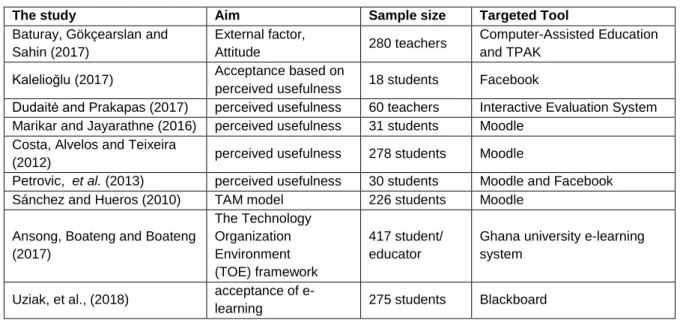
The definitions of blended learning provided in this journal by authors who use the term in the titles of their work are equally diffuse. Table 1 provides an overview of definitions provided by such authors in the period from 2012 to 2018. The table has been arranged in order of pedagogical complexity, from no definition through technology-driven definitions, to pedagogical and strategic definitions.
Table 1 shows that a literature survey conducted in 2018 indicates that there still is very little consensus as to a universal definition of the term Blended learning (Nortvig, Petersen and Hattesen Balle, 2018). Another author (Charbonneau-Gowdy, 2018) simply refers to examples of what she considers to be blended learning. She requires the reader to develop an understanding of how she uses the term from a description of the project discussed in the article. The majority of authors rely on the classic combination of face-to-face and technology to frame their definitions, although there seems to be a taxonomy of complexity ranging from a simple statement of technologies to an acknowledgement of teaching and learning, context, pedagogy and finally value (Uziak et al., 2018; Nakayama, Mutsuura and Yamamoto, 2016; Kintu and Zhu, 2016; Onguko, 2014; Gynther, 2016). Some authors extend the metaphor of the blend to that of a recipe, by referring to ingredients and method(Banditvilai, 2016; Tshabalala, Ndeya-Ndereya and van der Merwe, 2014). Only one article goes as far as seeing blended learning as a strategy, although, ironically these authors do not provide a definition for blended learning at all (Soeiro, de Figueiredo and Ferreira, 2012).
From the analysis of articles in past issues of this journal it can be seen then that there is no clear definition of blended learning that places the focus on learning. What does become clear though is that, in their writing, the authors of these papers are fully aware that the complexities of blended learning go far beyond deciding between face-to-face and technology-mediated contact.
In considering the relationship between the blend and the learning,
(Tshabalala, Ndeya-Ndereya and van der Merwe, 2014, p.102) it is necessary to consider two of the key arguments in our field (1) the so- C -K (Clark, 1994; Kozma, 1994) and (2) the No significant difference phenomenon (Russell, 1999). Richard E Clark (1994) has argued since 1983 that the medium of instruction does not influence the quality of learning. He uses the now famous grocery truck analogy saying that the medium of instruction will no more influence the quality of learning than a delivery truck would influence the nutritional value of the food it delivers. Kozma (1994) however argues that certain affordances of technology may well enable forms of learning that others do not in other words, you cannot drive a grocery truck to the moon. Tom Russell, in support of Clark, presents a bibliography of 355 academic works that indicate no significant differences (NSD) in student outcomes between various modes of delivering education (Russell, 1999).
Along these li despite the failure of some variables to show as significant factors to blended learning outcomes, learners showed a high affinity to engage in blended learning; which accounts
for learner attitudes being contributors to learn (Kintu and Zhu, 2016,
p.192). Others draw specific attention to the affective domain. In a passionate conclusion Soeiro, de Figueiredo F beyond what is often described as the coldness of technology, educators and students can help each other find technology-supported contexts that never existed and where people can
The Electronic Journal of e-Learning Volume 18 Issue 2 2020
www.ejel.org 116 ©ACPIL
Table 1: Definitions of 'Blended learning' in EJEL articles
Category Definition Author Comment
No definition “there has not been complete agreement among researchers about the precise definition or meaning of the term ‘blended learning’”
(Nortvig, Petersen and Hattesen Balle, 2018, p.47)
Authors conducted a literature survey based on a search for “e -learning” OR “online -learning” OR “blended learning” OR “hybrid learning” and concluded that no clear definition existed. Hybrid “Massive Open Online Courseware
(MOOC’s) or their hybrids, so-called Blended Learning Programs”
(Charbonneau-Gowdy, 2018, p.56)
Author uses MOOC as an example of what she means by Blended Learning and provides no formal definition.
Face-to-face and technology
“…platforms are also used for delivery and tracking of blended learning, i.e. a combination of traditional (face-to-face) and on-line resources”
(Uziak et al., 2018, p.1) These two authors use the most basic definition that relies simply on the dimensions of contact and technology to deliver (and track) learning materials. No mention is made of the actual learning that may occur.
“…blended learning, which consists of face-to-face sessions and learning materials that are supported by information communication technologies (ICT)”
(Nakayama, Mutsuura and Yamamoto, 2016, p.43)
“The design in this study involves a transition from traditional face-to-face teaching-learning to blended learning with technology”
(Kintu and Zhu, 2016, p.181)
These authors include the terms teaching and learning.
“In this paper, blended learning is defined as a deliberate combination of self-directed study of offline content deployed on tablets, with occasional face-to-face meetings, moderated through instructor-led sessions. This definition takes into consideration access to offline professional development (PD) content on tablets combined with teachers’ face-to-face interactions with their peers and instructors referred to as professional development tutors (PDTs). JiFUNzeni blended learning approach emphasizes the use of appropriate technologies for each context based on the contextual realities”.
(Onguko, 2014, p.78) In addition to a clear description of what was done this author adds the dimensions of appropriateness and context.
“Blended learning courses integrate online with face-to-face instruction in a planned, pedagogically valuable manner, and do not just combine but trade-off face-to-face with online activity (or vice versa)” (Vignare, 2007, p.38).
(Gynther, 2016, p.21) This author recognises pedagogy and value.
Ingredients “The article underscores the concept that many “ingredients” can comprise a blended learning model, including instructor-delivered content, e-learning, webinars, conference calls, live or online sessions with instructors, and other media and events, for example, Facebook, e-mail, chat rooms, blogs, podcasting, Twitter, YouTube, Skype and web boards”
(Banditvilai, 2016, p.223)
These authors list methods of delivery as well as platforms used for such delivery, much as a recipe would have “ingredients” and a method.
“the mixture of traditional delivery including: lectures, group discussions, apprenticeships and experiential learning, together with e-learning methods, which accommodate various learning needs of a diverse audience in a variety of subjects”
(Tshabalala, Ndeya-Ndereya and van der Merwe, 2014, pp.102– 103)
Strategy “…we were exploring pedagogical participatory strategies, personal and collaborative, in a blended- learning environment supported by Moodle”
(Soeiro, de Figueiredo and Ferreira, 2012, p.339)
Although these authors do not provide a clear definition of blended learning they refer to pedagogy as well as strategy.
More comprehensively though authors argue for a sensitivity to the context in which learning takes place: thus in a context where there is lack of access to electricity, Internet is not guaranteed, and schools lack basic amenities including clean and safe learning spaces, learning materials such as textbooks and facilities such as
desks, blended learning must b (Onguko, 2014,
p.78). In some contexts it could even be argued that technological solutions are better than face-to- on the other hand, it illustrates how deaf students who do not want to expose themselves can benefit from the experience of community learning afforded by pedagogical strategies and tools that could never exist
face-to-(Soeiro, de Figueiredo and Ferreira, 2012, p.347).
If there is to be no significant difference in learner performance, regardless of the mode of delivery then it holds that, in developing blended learning alternatives one should look rather at the theoretical underpinnings of teaching and learning than at the delivery mechanisms. One could therefore argue that a definition of blended learning needs not be too specific in defining exactly what delivery medium is used. It is the context, rather than the meaning, that makes a difference. A definition of blended learning should focus on learning. 2.2 Two dimensions of learning
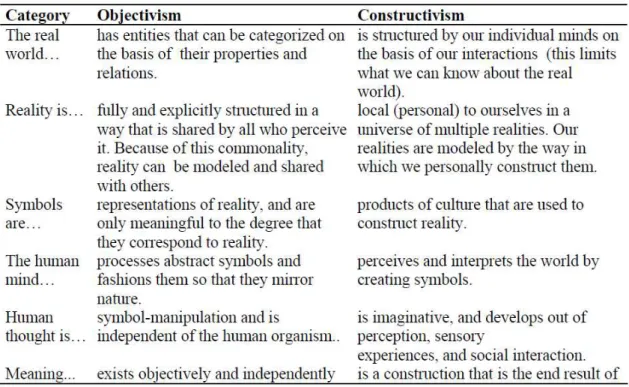
Over time behaviourism and constructivism have evolved as two major, opposing dimensions of learning (Lowrey, 2013). The binary opposing nature of the two paradigms has been outlined by many authors, including Cronje (2006, p.390).
Figure 1: Contrasting views of Objectivism and Constructivism (Cronje, 2006, p.390)
The view of behaviourism/objectivism and constructivism as opposites was particularly strong in the 1990s. There were various calls for a move towards constructivism (Jonassen, 1991; Davis et al., 1993). More recently these two have been researched specifically as they contribute both to face-to-face and online learning (Weegar and Pacis, 2012). It has been shown that, while early computer-based training programmes were primarily behaviourist in their design, the use of technology in online courses has slowly shifted the theoretical balance from behaviorism to constructivism due to the increased use of educational technologies (Weegar and Pacis, 2012, p.17).
More recently there is an increased call for the integration of behaviourist and constructivist principles (Elen, 2017). The problem with a model of linear opposition between the two paradigms is that, as the one goes up, the other goes down. If the balance is shifting from the one to the other then, at some stage, there will be a
The Electronic Journal of e-Learning Volume 18 Issue 2 2020
www.ejel.org 118 ©ACPIL
choosing to utilize a combination of these two learning styles in an effort to best meet the learning styles for (Weegar and Pacis, 2012, p.17).
To overcome this problem of a false dichotomy Cronje (2006) proposed a two-by-two matrix plotting the two extremes at right angles as shown in Figure 2. The resultant matrix contains four quadrants, construction, which is high in constructivist and low in behaviourist/objectivist elements, injection which is high in
(Weegar and
Pacis, 2012, p.17) is highest, and the immersion quadrant, which is low in overt evidence of either, and where
i (Shipley, 2017, p.118).
Figure 2: The integration of two learning paradigms (Cronje, 2006, p.392)
The model has subsequently been tested by Elander, (2012) who found that it was indeed possible to identify courses that were high in both behaviourist and constructivist elements, as is shown in Figure 3. Elander demonstrated that the majority of instructional designers worked mainly in an objectivist/behaviourist paradigm, but that there were substantially more designers who took an integrated, and therefore blended approach, than those who worked in the immersion or construction quadrants only.
3.
Discussion: Elements of the blend
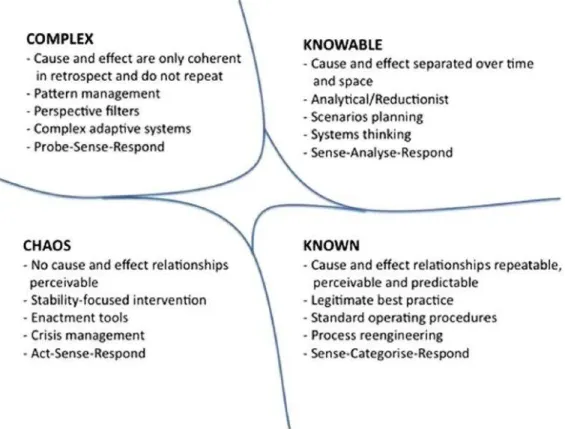
In response to Clark (1994), Kozma (1994) and Russell (1999) the selection of a specific medium is subservient to context, and the dimension of face-to-face or at-a-distance is a sub-set of context. Thus I argue that it is context that drives the decision of what and how to blend. The Cynefin framework (Figure 4) provides a good initial point of departure to establish context.
For Known knowledge cause and effect are repeatable, perceivable and predictable and legitimate best practice and standard operating procedures have been established. In this case direct (behaviourist) instruction is the most appropriate. Using problem-based learning in this field would lead to frustration and a waste of time (Clark, Kirschner and Sweller, 2012) the blended learning model would therefore concentrate on Instruction. In a contact environment this would amount to lectures and demonstrations and in a distance environment books (physical or digital) or (instructional) videos.
For Complex knowledge cause and effect are only retrospectively coherent, and pattern recognition is required. Here a constructivist approach is appropriate. Learners learn how to make sense of complexity. It is important to recognise that constructivist learning is more about learning to learn than about learning to
acquire skills is highly
(Kintu and
Zhu, 2016, p.192). This is the quadrant of abductive reasoning.
Figure 4: The Cynefin framework (Kurtz and Snowden, 2003, p.464)
Construction tasks, problem-based learning and open-ended learning environments would be appropriate here. In a low-technology environment physical puzzles would be useful and in a high-technology environment spreadsheets and other information-processing tools would be recommended.
In the Knowable domain that calls for analytical and reductionist thinking with cause and effect separated over time an Integrated use of behaviourist and constructivist learning would be appropriate. This is the domain of puzzles rather than problems. Puzzles have solutions known to the instructor but not to the learners, while problems may have endless solutions. The aim in this quadrant is to teach systems thinking. In a contact environment this is where discussions and debates are likely and in a distance environment it is the domain of chat groups and bland discussion forums.
The Electronic Journal of e-Learning Volume 18 Issue 2 2020
www.ejel.org 120 ©ACPIL
The Chaos domain is the domain of experience. There is no perceived cause and effect relationship and interventions are aimed at regaining stability. Traditionally this is known
or Immersed. In this quadrant there is no evidence of planned intervention of either a behavioural or constructivist nature. Yet this is where Shipley (2017) argues that most learning takes place. This is the domain of the field-trip, the experiential learning and the apprenticeship. In this context teaching is notably absent and learning is incidental and serendipitous. The technology involved here is the logbook, and the blog, and the methodological focus should be on assessment rather than instruction.
4.
Conclusion and recommended definition
Thus far this paper has shown that, although in the early uses of the term Blended learning, homage was paid to dimensions of learning theory and pedagogy, the majority of definitions are restricted to mentioning a mixture of face-to-face and web-based instruction. This paper argues that more attention should be paid to
D T
cognitivism) to produce an optimal learning outcome with or w (2002, p.54).
T C (2006) integrated model is proposed as a framework for designing blended learning. The
K “ (2003) Cynefin framework and in fact each quadrant
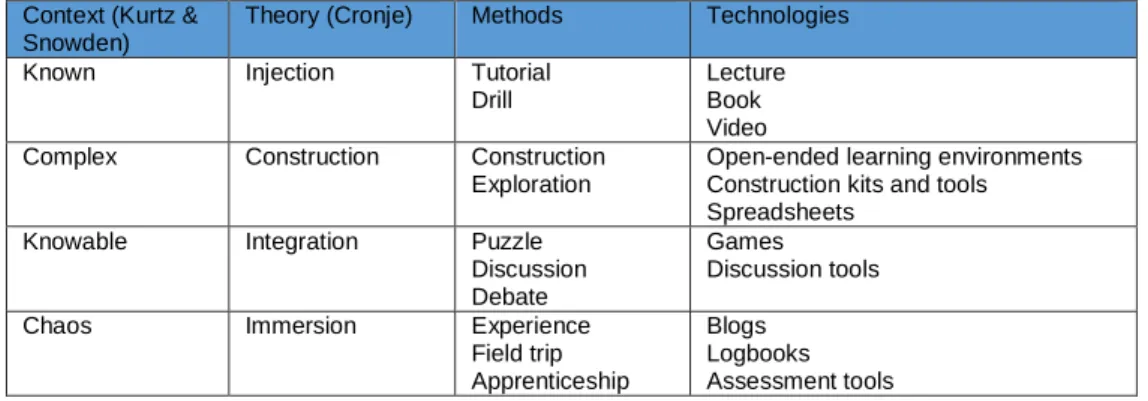
can be mapped directly from the one model to the other. From this a blended learning decision matrix can be developed that would resemble Table 2.
Table 2: Blended learning decision matrix
Context (Kurtz & Snowden)
Theory (Cronje) Methods Technologies
Known Injection Tutorial
Drill
Lecture Book Video Complex Construction Construction
Exploration
Open-ended learning environments Construction kits and tools Spreadsheets
Knowable Integration Puzzle
Discussion Debate
Games Discussion tools
Chaos Immersion Experience
Field trip Apprenticeship
Blogs Logbooks Assessment tools
Table 2 is by no means exhaustive but serves as an example of how decision-making could take place around identifying an optimal blend of learning methodologies and technologies.
From the above discussion, it becomes clear a definition of blended learning that is based on the dimensions of face-to-face and technology-mediated instruction, does not provide an adequate theoretical underpinning for such decisions. A definition of blended learning should include context, theory, method and technology, which is why I propose the following definition of blended learning:
The appropriate use of a mix of theories, methods and technologies to optimise learning in a given context.
References
Banditvilai, C., 2016. Enhancing stud lended learning. Electronic Journal of e-Learning, 14(3), pp.220 229.
Charbonneau-Gowdy, P., 2018. Beyond s : seeking solutions to challenges in online and blended learning programs. Electronic Journal of e-Learning, 16(1), pp.56 66.
Clark, R.E., 1994. Media will never influence learning. Educational technology research and development, 42(2), pp.21 29. Clark, R.E., Kirschner, P.A. and Sweller, J., 2012. Putting students on the path to learning the case for fully guided
instruction. American Educator, 36(March), pp.6 11.
Cronje, J.C., 2006. Paradigms r toward integrating objectivism and constructivism in instructional design and the learning sciences. Educational Technology Research and Development, 54(4), pp.387 416.
D N T J M C B “ K L “ T A T e
education. International Journal of Science Education, 15(6), pp.627 636. Driscoll, M., 2002. Blended learning: l get beyond the hype. E-learning, 1(4), pp.1 4.
Elander, K.R., 2012. Merging paradigms: The integration of objectivist and constructivist approaches in university settings. [online] ProQuest Dissertations and Theses. Capella University. Available at:
<https://search.proquest.com/docview/1035351588?accountid=8144>.[Accessed 6 Nov 2019]
Elander, K. and Cronje, J.C., 2016. Paradigms revisited: a quantitative investigation into a model to integrate objectivism and constructivism in instructional design. Educational Technology Research and Development, 64(3), pp 389 - 405. Elen, J., 2017. Implications: cherishing the middle ground. In:L. Lin and J.M. Spector, eds. 2017. The Sciences of Learning
and Instructional Design. Routledge, pp.85 93.
Friesen, N., 2012. Defining blended learning. Learning Spaces, [online] (August), p.10. Available at: https://www.normfriesen.info/papers/Defining_Blended_Learning_NF.pdf. [Accessed 6 Nov 2019]
Graham, C.R., 2006. Blended learning systems. In C.J. Bonk and Graham, eds. 2012.The handbook of blended learning, Hoboken, NJ: Wiley E Sons. pp.3 21.
Gynther, K., 2016. Design Framework for an adaptive MOOC enhanced by blended learning:. Electronic Journal of e-Learning, 14(1), pp.15 30.
J I Š M G H M GI“ Electronic Journal of e-Learning, 15(3), pp.220 234.
Jonassen, D.H., 1991. Objectivism versus constructivism: do we need a new philosophical paradigm? Educational technology research and development, 39(3), pp.5 14.
Kintu, M.J. and Zhu, C., 2016. Student characteristics and learning outcomes in a blended learning environment
intervention in a Ugandan University, Mountains of the Moon University and Vrije Universiteit Brussel. The Electronic Journal of e-Learning, 14(3), pp.181 195.
Kozma, R., 1994. Will media influence learning? Reframing the debate. Educational technology research and development. [online] Available at: <http://link.springer.com/article/10.1007/BF02299087> [Accessed 1 Jul. 2016].
Kurtz, C.F. and Snowden, D.J., 2003. The new dynamics of strategy: sense-making in a complex and complicated world. IBM systems journal, 42(3), pp.462 483.
Lowrey, A.E., 2013. Behaviorism vs. constructivism. Available at:: <https://athenaeum.libs.uga.edu/handle/10724/29910>. [Accessed 6 Nov. 2019]
N M M K Y H “ -taking activities in a
blended learning course. Electronic Journal of e-Learning, 14(1), pp.43 53.
Nortvig, A.-M., Petersen, A.K. and Hattesen Balle, S., 2018. A literature review of the factors influencing e-learning and blended learning in relation to learning outcome, student satisfaction and engagement. The Electronic Journal of e-Learning, 16(1), pp.46 55.
O B J FUN A B L A “ T P D Electronic
Journal of e-Learning, 12(1), pp.77 88.
Russell, T.L., 1999. The no significant difference phenomenon: a comparative research annotated bibliography on technology for distance education: as reported in 355 research reports, summaries and papers. Raleigh, NC: North Carolina State University.
Shipley, P., 2017. Coaching and evidence-based learning. Journal of Community Safety and Well-Being, 2(3), pp.116 118. Soeiro, D., de Figueiredo, A.D. and Ferreira, J.A.G., 2012. Mediating diversity and affection in blended learning: a story with
a happy ending. Electronic Journal of e-Learning, 10(3), pp.339 348.
Tshabalala, M., Ndeya-Ndereya, C. and van der Merwe, T., 2014. Implementing blended learning at a developing university: obstacles in the way. Electronic Journal of e-Learning, 12(1), pp.101 110.
Uziak, J., Oladiran, M.T., Lorencowicz, E. and B K “
blackboard platform for delivering an engineering course. Electronic Journal of e-Learning, 16(1), pp.1 15.
Vignare, K., 2007. Review of literature, blended learning: using ALN to change the classroom will it work. In:AG Picciano & CD Dziuban (Red.), Blended learning: research perspectives (pp 37-63). Needham, MA: Sloan Consortium.
Weegar, M.A. and Pacis, D., 2012. A comparison of two theories of learning-behaviorism and constructivism as applied to face-to-face and online learning. In: Proceedings, e-leader conference, Manila.
ISSN 1479-4403 122 ©ACPIL Reference this paper: Elizondo-Garcia, J., and Gallardo, K., 2020. Peer Feedback in Learner-Learner Interaction Practices. Mixed Methods Study on an xMOOC. The Electronic Journal of e-Learning, 18(2), pp. 122-135, available online at www.ejel.org
Peer Feedback in Learner-Learner Interaction Practices. Mixed
Methods Study on an xMOOC
Josemaria Elizondo-Garcia and Katherina Gallardo
Tecnologico de Monterrey, Mexico[email protected] [email protected] DOI: 10.34190/EJEL.20.18.2.002
Abstract: Although xMOOCs have shown benefits due to their accessibility to expert knowledge, the quality of their
pedagogical proposal remains contest I -learner interaction
practices in xMOOCs generate an improvement in the quality of learning and academic achievement. Peer feedback is a practice that can enhance learning in an environment with diverse student profiles and limited instructor participation. The present mixed methods study was devoted to identifying the perceptions of xMOOC participants regarding learner-learner interaction and feedback practices. In the Energy Saving course on MexicoX platform, 1,176 participants answered an initial survey, 486 participants answered a final survey and 14 participants were interviewed after completing the course. Results show that most of the participants are willing to interact with their peers and participate in peer feedback activities. Although, in practice its value for summative assessment is an important factor that may predict involvement. It is found that diversity of expertise level is not an obstacle for participants to interact. Rather, participants consider that they may benefit from diversity by assessing their peer assignments and learning different alternatives and strategies in which a problem can be solved. Further, it is identified that peer assessment activities are more adequate for providing feedback than discussion forums, since the first promotes an environment in which participants can observe the performance of their peers showed in a more complex assignment. The findings of this study allow us to analyse inherent and external factors that configure learner-learner interaction and that affect peer feedback in xMOOCs. It is concluded that more research is needed in order to understand the effect of some factors that may affect peer interaction and peer feedback in xMOOCs and to propose better strategies to improve peer feedback effectiveness.
Keywords: feedback, peer feedback, peer review, discussion boards, learner-learner interaction, formative assessment, MOOC
1.
Introduction
Since their creation and first implementation, massive open online courses (MOOC) have provided an opportunity to gather the knowledge of many people and generate learning. They have afforded open access to content in several disciplines by experts from prestigious universities. That is why MOOCs, since their inception, have been considered promising for distance learning. In recent years, studies have assessed the intrinsic educational value of MOOCs and the advancements they offer in the field of e-learning (Gamage, Fernando and Perera, 2015; Martín, González and García, 2013; Sánchez, 2016).
Although these courses are an innovation in online education, some authors consider that it has not yet been proven that they have a strong enough foundation to represent a jump in pedagogical quality, in terms of generation of learning in comparison with other online training models (Aguaded and Medina-Salguero, 2015, Ramírez-Fernández, 2015). Therefore, it is necessary to know MOOCs' deficiencies, so efforts can be oriented to focus on the dimensions that require the most improvements. Two of these areas is learning assessment and peer interaction.
Their massive scale and the diversity of their participants turn MOOCs into a unique learning environment that
deserves to be studied. T MOOC
C and Ho, 2016). This diversity, in consequence, requires being considered to generate appropriate evaluation processes. Further, the students-teachers ratio makes it practically impossible for students to receive from the teacher individual feedback on their performance (Ashton and Davies, 2015). Therefore, two important
MOOC
2.
Literature Review
2.1 Learner-learner interaction
According to Moore (1989), there are three types of interaction required for effective learning: learner-content, learner-instructor and learner-learner. Learner-learner interaction can be achieved through group activities and peer feedback. Some studies suggest that learner-learner interaction is essential for a better online learning experience and can improve the learners' learning achievements (Gunawardena, Linder-VanBerschot, LaPointe and Rao, 2010). Although, this type of interaction is the one that participants prefer the least as it does not fulfil the need for time flexibility required by them (Kurucay and Inan, 2017). In xMOOCs, the two most common peer interaction activities are discussion forums and peer assessment.
2.2 Feedback in MOOCs
Richards and Schmidt (2010) define feedback as any information that generates a report on the outcome of a behaviour. In online learning environments, students are interested to know if they will be able to succeed or fail according to the achievement of their educational goals (self-regulated learning) and would like to receive more feedback elements instead of more evaluations (Daradoumis, Bassi, Xhafa and Caballé, 2013). Although instructors can provide better feedback than students, it has been found that students can produce more effective feedback by providing explanations to their peers in terms they understand best and according to their level of understanding (Brookhart, 2017). Furthermore, when students provide appropriate feedback, both the receiving and the giving parties benefit from it. Some studies have found similar and even higher levels of effectiveness in peer feedback than in teacher feedback (Ashton and Davies, 2015, Eksi, 2012; Ruegg, 2015).
Automatic multiple-choice tests to assess knowledge and understanding in the course are commonly used on all platforms. However, there are well-known limitations to this type of mechanisms to measure high-level skills such as analysis, synthesis, and evaluation (Suen, 2014). Although new technologies allow scalable ways to implement discussion forums and review student progress, they remain limited when evaluating and providing feedback for complex tasks such as written work (Admiraal, Huisman and Pilli, 2015; Admiraal, Huisman and Van de Ven, 2014; Piech et al., 2013). Further, the limited capability of the teacher to evaluate individual performance has led to an increased interest in developing alternative automatic evaluation practices and in researching them in order to be more valid and reliable, as well as to improve peer evaluation practices (Daradoumis, Bassi, Xhafa and Caballé, 2013; Reilly, Stafford, Williams and Corliss, 2014; Spector, 2014).
2.3 Peer feedback in MOOCs
Peer evaluation has been used extensively in MOOCs due to two advantages that no other mechanism has: it allows the evaluation of large groups because the evaluation and feedback are carried out by other participants instead of the teacher. Further, it allows the evaluation of products that could not be evaluated automatically (Kulkarni et al., 2013). Yurdabakan (2016) points out that this technique has been used for decades, which highlights some benefits noted in the literature prior to the emergence of MOOCs: peer evaluation emphasizes skills, encourages participation, increases the focus of attention towards learning, provides feedback to students, increases attendance and teaches responsibility, develops critical thinking, increases student learning and encourages collaborative learning.
Peer evaluation also helps students see the work from an advisor perspective. Evaluating the work of their peers exposes students to solutions, strategies, and points of view that they would not see otherwise (Kulkarni et al., 2013). Najafi, Rolheiser, Harrison and Haklev (2015) point out that peer review is an opportunity for participants to reflect on the knowledge acquired and to apply it. The positive effect of peer feedback increases as the feedback is based on the meaning of the task on not on its surface characteristics. Thus, peer review is more effective when based on higher order writing elements, rather than relying on matters of lower order (Comer, Clark and Canelas, 2014; Cho and Cho, 2011). This effectiveness increases when incorporating rubrics with precise terminology that can adequately guide the participants (Kulkarni et al., 2013, Ashton and Davies, 2015).
Although students benefit both from giving and receiving assessments and feedback, they hold divided opinions regarding peer review. While some firmly believe that this benefits their learning, others do not
The Electronic Journal of e-Learning Volume 18 Issue 2 2020
www.ejel.org 124 ©ACPIL
consider it useful and prefer to not participate in it (Meek, Blakemore and Marks, 2017. That is, while some believe that it improves their learning, increases their motivation and leads them to develop critical thinking, other students consider it difficult, uncomfortable and time-consuming (Mulder, Pearce and Baik, 2014; Yurdabakan, 2016). Bali (2014) reported less participation in peer review activities when these are non-mandatory.
Moreover, many students consider that their classmates do not possess the necessary abilities to evaluate their work nor provide adequate feedback (Johnston, 2015). Meek, Blakemore and Marks (2017) state that it is difficult to say that the participants of a MOOC have peers since some of them are not familiar with the same knowledge areas or even share the same language. The authors also point out that it is not realistic to expect every student to carry out peer evaluation when some of them are not actively engaged with the course or have another level of commitment in relation to it.
2.4 Discussion forums
As a means of social learning, MOOCs rely on interaction with others, as is the case in discussion forums, in which participants can provide valuable feedback for the student and for other classmates who read them. Lee and Rofe (2016) designed an evaluation mechanism that would enhance peer learning in MOOCs, so they changed the dynamics of peer evaluation in a way that privileged feedback. The students were asked to present in the discussion forums the assignments that would be evaluated by peers and to provide feedback. In this way, students perceived areas of opportunity on which they could improve their work and thus submit a better product for evaluation. Also, these forums became a space where they could find many examples of how others performed the task. In this way, using discussion forums, the socialization of peer learning was leveraged. Peer review can be a good mechanism to encourage interaction among peers in cases that generate discussion to improve performance (Johnston, 2015).
Discussion forums in xMOOCs are affected by MOOC characteristics, as well as peer assessment practices. It
has been found that MOOC
facilitate a speedy exchange of ideas (Liu, Kang and McKelroy, 2015). As in other online environments, it has been found that participants have different roles while participating in discussion forums. Further, Wang. et. al (2015) found that participants with the role of observers in discussion forums in MOOCs learn even when they do not type comments.
2.5 Factors that affect peer interaction
Some studies on peer interaction in xMOOCs focus on factors and strategies used for improving engagement and involvement. They suggest that by incorporating some of these elements peer interaction and peer feedback may be improved. Some elements are described below:
Social involvement. It is a factor that can be decisive in the achievement of the MOOC participants' goals. A study by Kizilcec and Schneider (2015) showed that learners with the intention of taking the course with colleagues or friends were more likely to complete the course and obtain a certificate. These learners were more involved with the course materials (watch videos and perform the required tasks) than those who did not sign up with someone else.
Level of expertise. Mackness, Mak and Williams (2010) pointed out that the difference in the levels of expertise of the participants in a MOOC can hinder their openness, connection and interactivity. In their study it was identified that 8% of the participants who decided to stop participating in the forums gave as a reason the difference in the levels of expertise among the novices and the participants familiar with the concepts and technologies.
Anonymity. Peer review can be a good mechanism to encourage interaction among peers in cases that generate discussion to improve performance. This also considers that students will be more likely to accept feedback if their peers are like them in terms of knowledge of the subject and if the students know the name of their reviewers, even if they do not know each other outside the course (Johnston, 2015; Lu and Bol, 2007).
Training. Training videos are an effective alternative to promote more participation and better engagement in MOOCs (Ashton and Davies, 2015; Luo, Robinson and Park, 2014). Other types of trainings prepare participants
to offer accurate scores by asking them to grade an assignment evaluated previously by an instructor (Ashton and Davies, 2015; Kulkarni et al., 2013).
Scoring the feedback. In a study, students who received a grade on their feedback given to a peer offered more extensive and detailed feedback (Neubaum, Wichmann, Eimler and Krämer, 2014). By increasing the complexity and degree of responsibility of the participant, peer evaluation is one of the most challenging and promising types of evaluation instructors can include in a MOOC.
2.6 Approach
Although the advantages and benefits of the learner-learner interaction are recognized in virtual learning environments, there is not enough evidence from research to recognize these benefits on xMOOCs. Moreover, some suggestions and proposals have been made to improve peer interaction, but these do not usually consider the participants' perceptions. Thus, there is a need to delve deeper into the experiences of these participants to identify the most appropriate conditions for xMOOCs in which participants could enhance their learning through interaction with their peers.
The learner-learner interaction processes proposed by xMOOCs are very limited by their learning model. Their instructional model tends to place greater emphasis on the learner-content interaction, ignoring the kind of learning that can occur in the learner-learner relationship and collaborative work. It is necessary to know more about the experiences of the participants to identify what are the favourable conditions in which they can improve their learning from the interaction with their peers.
Feedback has been considered an educational process with important benefits in learning, which can have a positive impact on its effectiveness. In addition, the benefits for participants of engaging in peer interaction and feedback activities in xMOOC have not been sufficiently explored. Based on this approach, the following research question was established: What perceptions do participants in xMOOCs have concerning the factors that affect peer interaction and peer feedback?
3.
Method
3.1 ContextThe context in which the research was carried out was the first implementation of an xMOOC called Energy Saving, using the MexicoX platform. The theme of energy saving is incorporated into the current need for sustainable development and care of resources. Thus, it attracts a diversity of learners interested in knowing new and alternative measures to reduce and make more efficient the energy consumption in their home, in industry, in transport and, even, from within infrastructure.
In the first implementation of the Energy Saving course, 4,402 registered participants had enrolled. These are all those who have an account in the MexicoX platform and chose the Energy Saving course to access and receive information by e-mail about it. Of these, 1,459 completed at least one course activity, that is, they received a grade in at least one course activity. The duration of the course was six weeks and every week corresponded to a different theme.
The Energy Saving course included both typical peer interaction practices in xMOOCs, discussion forums and a peer review activity. A different discussion forum was attended by participants every week of the course. Every discussion forum started with three activating questions or sentences that participants would use to share their opinions and impressions. They were not explicitly asked to give feedback
comments and contribute to the discussion.
Further, the course included a peer review activity. During the third week students were asked to elaborate a three-action plan to save energy at home, in which they should include energy measurements and economic savings. Then, during the fifth week they shared a link with their plan. Participants had one week to review their pe assignment. They used a checklist to indicate whether required assignment elements were included or not. It was ensured that each assignment would be reviewed by five peers and every participant would review five assignments. Only those participants who reviewed their peer assignments received a grade on their assignment.
The Electronic Journal of e-Learning Volume 18 Issue 2 2020
www.ejel.org 126 ©ACPIL
3.2 Design
To answer these research questions, a Mixed Methods design was chosen, with dominant and sequential status. Quantitative research was carried out first, followed by qualitative research. The dominant status focused on the qualitative part (Johnson and Onwuegbuzie, 2004). Given the mixed nature of this study, when defining the instruments, it was sought that the quantitative approach would allow knowing the general perceptions of the participants. On the other hand, the qualitative approach would allow capturing in detail the experience and beliefs that the MOOC participants have about the formative evaluation processes presented in them.
Within this Mixed Methods study a descriptive method was considered for the quantitative research. Regarding the qualitative part of the study, a phenomenological approach was chosen (Tójar, 2006) to conduct the study. A phenomenological approach focuses on understanding the meaning that events have for people as a centre of study. The main objective is the attempt to understand the object of the experience of the phenomenon (Wilding and Whiteford, 2005), which in this case is the learner-learner interaction in a MOOC. 3.3 Participants
Most of the course participants were Mexican (97%). The rest of the participants reside in Spanish-speaking countries such as Colombia, Ecuador and Argentina. 35% of the participants had a high school degree and 36% had an undergraduate degree, as the highest level of studies; 11% had a technical degree, and 11% had a master's degree. Regarding the discipline of studies of their technical career, undergraduate or graduate, 39% said that Engineering or Computer Science was their area of knowledge, while 15% indicated Business Administration and 8% indicated Natural Sciences. As their main occupation, 35% of the participants indicated that they were an undergraduate student, and 35.8% indicated that they were full-time employees. Additionally, 52% indicated that it was the first time they participated in a MOOC.
From the 486 participants who answered the final survey, 272 participants agreed to be contacted by e-mail to share their experience in the course. All these participants were contacted to request an interview. Interviews were conducted with those participants who replied the e-mail and agreed to have a meeting by video conference. In total, 14 were conducted.
3.4 Instruments
For the quantitative research, surveys at the beginning and the end of the course were conducted. The survey at the beginning of the course included five multiple-choice questions related to the dispositions and beliefs of the participants for peer interaction and feedback (see Appendix 1). The survey at the end of the course included eight questions, six of multiple choice and two open-ended, related to their participation and satisfaction in activities of interaction and feedback between peers in the Energy Saving course (see Appendix 2).
For the qualitative research, a semi-structured interview and an instrument for participant observation were designed. The semi-structured interview consisted of 15 questions designed with the intention of knowing the participants' experience in the learner-learner interaction activities and the automatic and peer feedback activities (see Appendix 3). In addition, a participant observation guide was designed to keep track of the interactions in the discussion forums of the course and thus be able to demonstrate the experiences, relationships and constructions of knowledge that arose among the participants of the course. The observation in the discussion forums was made considering the characteristics of feedback presented by Shute (2008) and Nelson and Schunn (2009).
3.5 Procedure
The initial survey was conducted at the beginning of the course. It was one of the first activities that the participants carried out for the course, alongside the general instructions and the agenda of the course. The final survey was added in the last lesson of the course, so it was answered by the participants after concluding all the learning activities.
In the final survey of the course, a final question was included in which the participants indicated if they were willing to be contacted via mail to comment on their experience throughout the course. In this way, by e-mail, all participants were requested to attend a virtual interview with an approximate duration of 30 minutes.
Once their acceptance and confirmation were received, they were given a link to a virtual room to be interviewed at a time convenient to the participants.
3.6 Data analysis
First, a descriptive analysis of the quantitative data obtained from the initial and final surveys was carried out. This data also guided the orientation of the interviews conducted later. After observing the discussion forums and transcripts of the interviews, the analysis of the data obtained through the interviews and the discussion forums continued. The names of the participants interviewed were coded to protect their identity.
For the process of data analysis, the steps indicated by Apps (1991, cited by Tójar, 2006) for phenomenological studies were followed. This author follows the epistemological proposal of Husserl (1965), who considered the phenomenological reduction, and the imaginative variation to capture the essence of the phenomenon. The directions of Merriam and Tisdell (2015) to build and name the categories (or topics) were also considered.
4.
Results
With the quantitative study, the dispositions and general beliefs of the participants were analysed, along with information on their participation in the interaction activities. For the qualitative study 14 interviews were conducted. The following categories emerged, which refer to factors both inherent to and external to the participants that configure the learner-learner interaction that have an impact on the feedback between peers in MOOCs: 1) Dispositions and interest to interact, 2) Instructional mediators, 3) P , and 4) Utility of peer feedback.
The quantitative and qualitative results that describe each category of analysis are presented below. 4.1 Peer interaction
4.1.1 Interaction interests
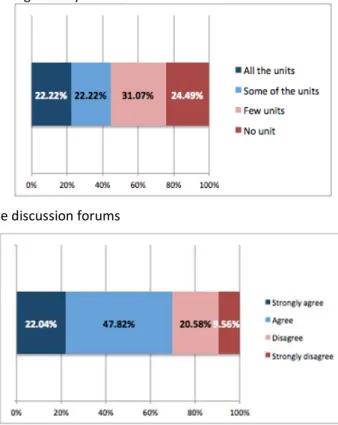
Below are some results obtained from the exit survey. Concerning participation rate in discussion forums, 44% of the participants indicated that they participated in all or some of the units. Further, 70% of the participants indicated that they agreed or strongly agreed with perceiving an improvement in their knowledge on the
Figure 1: Participation in the discussion forums
The Electronic Journal of e-Learning Volume 18 Issue 2 2020
www.ejel.org 128 ©ACPIL
Regarding discussion forums, 64% of the participants indicated that they agreed or strongly agreed that they
s subject by participating in the discussion forums. In
addition, 28% indicated that they helped other participants with their questions through the discussion forums. However, the comments in the final survey indicate that some of the participants did not find answers to their questions in the discussion forums and that they could hardly establish a conversation, that is, an exchange of ideas.
Figure 3: I ubject in the discussion forums
Figure 4: I solved the questions of other participants in the discussion forums
Based on the qualitative results, it was possible to study the interaction interests of the participants. It was identified that participants develop different roles and types of activities during interaction (analyse, reflect, share, etc.) The diversity of profiles presented in the sample of this study also reflects the diversity of purposes and roles during an interaction. While some participants access the discussion forums only as observers, there are others who prefer more active participation.
Those participants that consider their selves as novices opt for only to read comments rather than to bring
answers to peers. A participant [P11] I eme for me. I
I So, roles of participation in discussion forums are determined for -perception of expertise.
4.1.2 Dispositions to interact
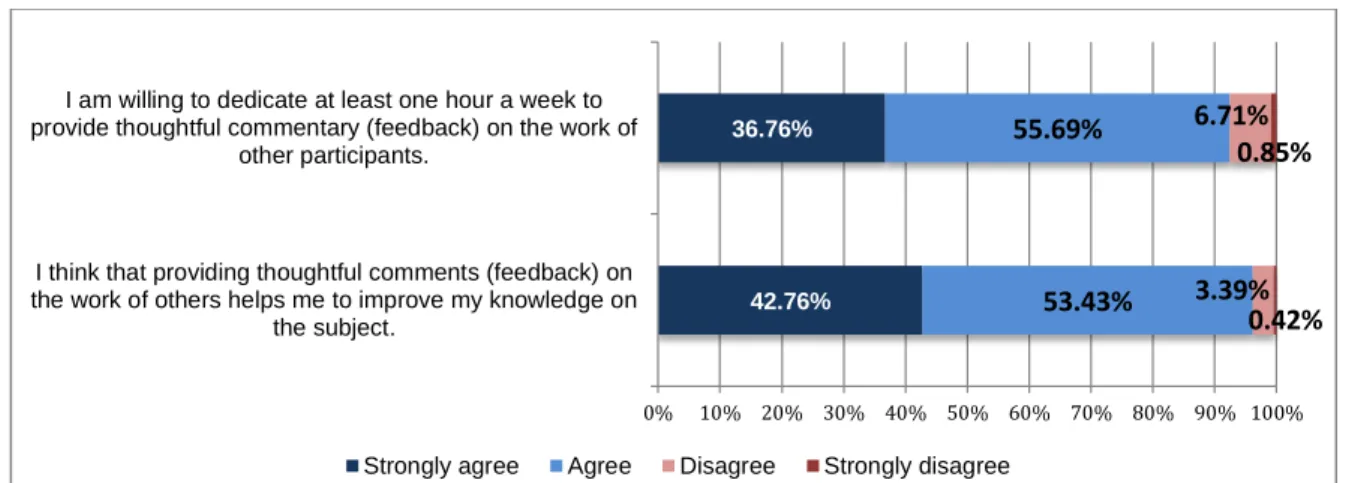
Most of the participants (92%) indicated that they agreed or strongly agreed that they would be willing to dedicate at least one hour a week to provide feedback on the work of other participants. Also, 96% of the participants indicated that they agreed or strongly agreed that they thought providing feedback on the work of others helped them to improve their knowledge on the study subject.
Figure 5:P ns and beliefs on peer feedback
Time disposition and perception of feedback efficacy are not factors that hinder their participation in learner-learner interaction and feedback activities. It is important to point out that, even when most of the participants that concluded the course showed disposition to participate in discussion forums and peer review activities, some participants could prescind from participation in these activities and still obtain the course certification. From 733 participants who obtained an approving grade, 178 participants obtained a grade different than zero (0). Those participants submitted their assignment and assessed at least three other assignments.
4.2 Instructional mediators
One instructional mediator that was used in the course to improve the feedback practice was to include a video explaining how to evaluate the work of other participants, in preparation for peer review activity. Several participants, 82%, indicated that they watched this video. Through the interviews, other instructional mediators could be found in these courses, carried out through technological elements.
Regarding the clarity of the assignment instructions, there were some participants who considered that in the practice of peer evaluation some instructions were a bit ambiguous, so they were limited as to how to provide better feedback. Moreover, participants needed to use another service as Slide Share o Google Drive to upload the assignment and then copy the link in the MOOC interface, this condition was an obstacle for some participants that had not use this type of service.
In the interviews, participants suggested some improvements to facilitate participation in discussion forums. Participant [P8] said: "I think there could be a notification that can take you to an e-mail and let you know when someone replied to your comment. Otherwise, you need to keep checking the website." In addition, participant [P14] indicated: "I think the forums should include a point, which would be 'give your opinion on the subject or whatever, and do some research on the subject,' and that would give you the opportunity to contribute something else".
4.3 P
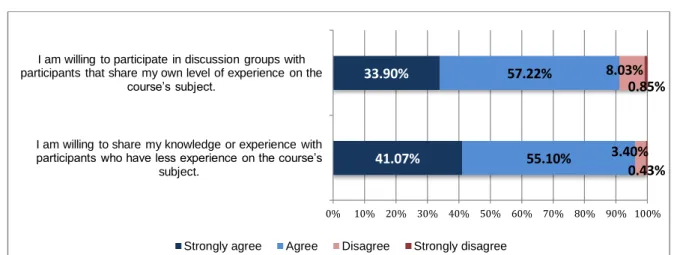
When asked about their willingness to participate with others according to their level of experience, 91% of the participants agreed or strongly agreed that they would be willing to participate in discussion groups with participants with the same level of experience as theirs on the course . In addition, 96% of the participants agreed or strongly agreed to be willing to share knowledge or experience with participants who have less experience on the subject. Of these participants, 24% had previously reviewed written works by other participants in MOOC courses.
42.76% 36.76%
53.43% 55.69%
3.39% 6.71%
0.42% 0.85%
0% 10% 20% 30% 40% 50% 60% 70% 80% 90% 100% I think that providing thoughtful comments (feedback) on
the work of others helps me to improve my knowledge on the subject.
I am willing to dedicate at least one hour a week to provide thoughtful commentary (feedback) on the work of
other participants.
The Electronic Journal of e-Learning Volume 18 Issue 2 2020
www.ejel.org 130 ©ACPIL
Figure 6:P rding to the level of expertise
Although the participants indicated a willingness to collaborate with participants with different levels of mastery on the subject, it is important to indicate that they acknowledged the diversity in the levels of knowledge and mastery on the course subject and the degrees of responsibility of the participants. This was expressed by [P11] by declaring "The amount of knowledge that people had in the topics discussed in the forums was very noticeable. And in the practice part, I think some took it very seriously and some did not. There was a noticeable difference in the quality of the work of our classmates."
The expertise of the participants not only makes them more capable of providing more informed and precise comments. The participants also take advantage of their previous experiences to generate strategies that help them to advance successfully in the course. Some interaction strategies carried out in the course were started by initiative of the participants, who reported having previously acquired this type of experience. The participant [P4] commented: "What I did was to look up my partner's e-mail in the welcome forum and I shared the link I had told him about in the forum ... During my online master s program, that was something we were asked to do."
4.4 Utility of feedback
By asking the participants if they had been provided feedback in the discussion forums, participant [P10] mentioned: "The forums had very simple comments such as 'I agree with the subject and I think it's a good strategy for saving energy' and there were people who answered like that, obviously that is not a contribution". In addition, participant [P2] noted: "Yes, there is some feedback, but more like 'I agree with what you're saying.' Nobody really refuted anything, nobody told me: 'Hey, but look, there's also this...'" Through observation in the discussion forums, comments such as: "You are correct" and "Good point" could be found.
On the other hand, participants found benefits when reviewing the work to provide feedback. Participant [P9] said: "A lot of those comments from your classmates are very valuable, you have a point of view according to the way you are. Because other classmates think differently. They have a different experience, so they can exchange different ways of solving a problem, of arriving at different solutions." In addition, participant [P6] commented: "I think you can see other points of view, that is important, what each person is focused on, the strategies they implement and above all the way in which they work. That gives you a lot, how everyone thinks differently and presents their work in a different way. It gives you knowledge in terms of points of view, how everyone analyses the information and how the information is presented. Not all of us think of water, electricity and gasoline, for example; there are some people who thought of additional things. For example, solar water heaters, things that had not occurred to me, and maybe they are good options for energy saving, which was the main theme of the course".
The diversity of profiles of the participants allows them to get to know different perspectives or approaches to contextualize, understand and solve a problem. This represents an opportunity to acquire new knowledge at different levels. Diversity is considered by the participants themselves as an advantage of these courses because they have multiple experiences that contribute to their own understanding. Participant [P12] said: "The advantage is that they are not people from your own area. My way of seeing the problem is different. It helps you to be more global. For example, if you work in a company that distributes in Mexico, you can get to know different ways of how the processes of production, marketing, etc. are carried out in other places." Also, when asking participant [P9] what kind of advantages he finds when interacting with other participants, he commented: "Because people from different states and countries participate. I can get different points of view. There is a cultural exchange that is important to me."
41.07% 33.90%
55.10% 57.22%
3.40% 8.03%
0.43% 0.85%
0% 10% 20% 30% 40% 50% 60% 70% 80% 90% 100% I am willing to share my knowledge or experience with
participants who have less experience on the course’s subject.
I am willing to participate in discussion groups with participants that share my own level of experience on the
course’s subject.
When asked about the separation by groups of collaboration according to the characteristics of the participants, they did not consider it convenient, as that would eliminate these benefits provided by diversity. When asking if it would be convenient to make subgroups in the forums to improve the interaction, the participant [P3] commented: "It would be difficult to assign them because maybe I could tell you, I know of sustainability but maybe I'm not very immersed in the issue of energy saving. And maybe some would see it as a kind of discrimination."
5.
Discussion
The results of this study support the discussion regarding the convenience of integrating working groups in MOOC courses and the criteria for integrating these groups. This is a recent debate, for which there are still few studies devoted to finding better proposals (Kizilcec, 2013). In this regard, it is worth mentioning that participants disagree on separating according to their level of expertise. Participants consider that by integrating working groups in MOOC the opportunity to know the experiences of other participants is reduced. In the present study, it is evident that the participants consider diversity an enriching learning opportunity, as it allows them to know different ways in which the same problem can be contextualized, understood and solved.
Furthermore, Mackness, Mak y Williams (2010) had reported that differences in expertise level of participants may hinder their openness, connection and interactivity. In contrast, results of the present study show that participants are willing to interact and provide feedback to participants with different levels of expertise. In the present study we found that limitations to interact and provide feedback are not due the differences in participants levels of expertise. Rather, some conditions that limit these processes refer to perception of their capacity to evaluate and to the relevance of the activities for obtaining knowledge that may be applied in their professional activities. These results are consistent with Meek, Blakemore y Marks (2016) results, which identify that participants have divided opinions about the benefits of feedback. While some believe that it improves their learning and increases their motivation, other students find it difficult, uncomfortable and time-consuming.
In the present study we found that participants identify other benefits of peer feedback in xMOOCs with respect to other virtual environments. Bali (2014) had identified that participants describe examples of their own country of origin in the discussion forums. Further, we found that the participants associate the usefulness of the feedback to the diversity of participants, since they receive different solutions to the problems presented. In this course, it was also identified that by providing feedback in peer evaluation practice, participants see products from their peers and recognize the characteristics of good practices. These results coincide with Kulkarni et al. (2013) who pointed out that feedback helps the student see the work from an advisory perspective. They also coincide with what Meek, Blakemore and Marks (2016) marked out, that evaluating the work of their peers exposes students to solutions, strategies and points of view that they would not otherwise see.
Results of the current work agree with those from Bali (2014) who reported that participation in peer review activities was affected by the non-mandatory character of these activities in the MOOC. It is shown that summative value of peer interaction and peer review activities is associated with the level of participation on these activities. This occurs even when most of participants indicate high disposition to interact and review. Further, these results agree with previous findings about the importance of training videos as an effective alternative to promote more participation and better engagement in MOOCs (Ashton and Davies, 2015; Luo, Robinson and Park, 2014).
Regarding peer feedback in discussion forums, the students criticized that some of the received feedback only stayed in the agreement or disagreement of what was proposed. This type of feedback was considered less effective by participants. These results agree with what Cho and Cho (2016) pointed out, the positive effect of feedback on performance increases as it is based on the meaning and not on surface characteristics of homework.
6.
Conclusions
Results of the present study permit a better understanding of factors that affect learner-learner interaction in MOOCs. In order to promote peer interaction and peer feedback in MOOCs it is important to consider this learning ions, thus to propose ideas that may counter its disadvantages and leverage its benefits. For instance, while massivity and diversity in online courses may be conceived as impediments to an appropriate interaction that promotes learning, benefits in partic . Moreover, some suggestions from MOOC participants should be considered to improve their interaction in this learning environment.
These results allow to understand the importance of performance observation to improve the quality of peer feedback. It is known that feedback provided from one student to another is based on the observation of their performance. Peer review activities have the virtue of presenting to the reviewer a complete elaborated product that show student progress. That facilitates the opportunity to evaluate participant competences. Moreover, in discussion