Hotline: 612-746-4522 | E-mail: [email protected] | Data Portal: https://data.mncm.org/login © MN Community Measurement, 2014. All rights reserved.
Page 1
DATA COLLECTION GUIDE
Direct Data Submission
Depression Care Measures 2014
(02/01/2013 to 01/31/2014 Dates of Service)
Changes from Draft Data Collection Guide:
1. Updated Evaluation & Management CPT Codes found on Page 19. Please note: These are optional codes that can be used to identify visits.
2. Depression PHQ-9 Follow-up Assessment at 6-months and 12-months measures are publicly reported as of September 2013. These measure results have been available privately to medical groups via the MNCM Data Portal since the inception of Depression Care data collection (2009). They are two of 10 available Depression Care measures and revisions have been made to Appendix F to indicate they are publicly reported measures.
3. Medical groups can upload denominator counts and information OR they can enter information directly into the data portal. See pages 34-35 for more information.
Hotline: 612-746-4522 | E-mail: [email protected] | Data Portal: https://data.mncm.org/login © MN Community Measurement, 2014. All rights reserved.
Page 2
Table of Contents
Overview of the Process and Timeline ... 3
Measure Specifications ... 4
Major Depression and Dysthymia Diagnosis Codes ...6
Table 1: ICD-9 Diagnosis Codes for Identifying Major Depression or Dysthymia ... 6
Codes Used to Identify Patients who Meet Exclusion Criteria ...7
Table 2: ICD-9 Diagnosis Codes for Identifying Patients Meeting Exclusion Criteria ... 7
Measure Logic/Flow Charts ...9
Data Collection and Submission Instructions ... 12
Data Collection and Submission Preparations and Considerations: ... 13
Section A: Identifying the Patient Population (Denominator) ... 16
Section B: Clinic Level Population Counts ... 21
Section C: Data Collection ... 23
Data Elements and Field Specifications ... 26
Section D: Patient Data File Creation ... 32
Section E: Patient Data File Submission ... 34
Section F: MNCM Validation ... 38
Appendices ... 40
Appendix A: Registration on the MNCM Data Portal ... 41
Appendix B: Resources to Help You Get Started ... 42
Appendix C: Timelines for Data Submission and Public Reporting ... 43
Appendix D: Notes about the PHQ-9 Test ... 45
Appendix E: Explaining the Depression Measures to Providers and Clinical Staff ... 46
Appendix F: Suite of Available Depression Care Measures ... 47
Appendix G: About MN Community Measurement and Measure Development ... 51 Appendix H:About Direct Data Submission ... Error! Bookmark not defined.
Hotline: 612-746-4522 | E-mail: [email protected] | Data Portal: https://data.mncm.org/login © MN Community Measurement, 2014. All rights reserved.
Page 3
Overview of the Process and Timeline
Process Step Helpful Dates to Remember
Registration
Medical group registers clinics and providers on MNCM Data Portal and electronically signs the Site Terms of Use Agreement and Business Associate Agreement.
Resources: Download Clinic & Provider Registration Instructions from the RESOURCES Tab on the MNCM Data Portal https://data.mncm.org/login or www.mncm.org.
Registration begins December 16, 2013 Deadline: February 7, 2014
Denominator Certification
Medical group submits a denominator document outlining the method for identifying the patient population to the MNCM Data Portal. MNCM reviews and approves the denominator. MNCM must approve your denominator certificate before data is collected.
Resources: Download Depression Care 2014 Denominator Template from the RESOURCES Tab on the MNCM Data Portal.
Submit denominator document in December 2013 or early January 2014 MNCM responds within
2-3 business days after receiving the denominator document
Data Collection and Submission
Data collection begins after the billing cycle is completed for the measurement period. Medical group prepares CSV (.csv) file to submit via MNCM Data Portal. Resources: Download Data Collection Depression Care 2014 and Depression Care 2014 Data Collection Spreadsheet Template from the RESOURCES Tab on the MNCM Data Portal.
MNCM Data Portal opens: January 13, 2014
MNCM Data Portal closes: February 14, 2014
Preliminary Results Review, Quality Checks
Medical group reviews preliminary results internally to verify the rates are as expected; provides comments on rate or population changes. MNCM then reviews preliminary results and comments.
Resources: Home tab, Data Submission (scroll to Data Comparison tool).
Completed after data submission and prior to validation audit
Data Validation
MNCM auditor conducts audit to validate that the submitted data matches the source data in the patient medical record.
Resources: MNCM will email instructions and post list of randomly-selected patients for audit on the data portal.
March 2014
Two-Week Medical Group Review Period
Medical group reviews preliminary results together with statewide results. Final opportunity to verify results before they are publicly reported on MNCM’s consumer-facing website.
Resources: MNCM will email Information and directions to appropriate all medical group contacts registered in the portal.
April 2014
Data Results
After the successful submission and validation of the clinical data, MNCM will post the results on www.mnhealthscores.org.
Hotline: 612-746-4522 | E-mail: [email protected] | Data Portal: https://data.mncm.org/login © MN Community Measurement, 2014. All rights reserved.
Page 4
Depression Care Measures 2014
Direct Data Submission
(02/01/2013 to 01/31/2014 Dates of Service)
Measurement Specifications
Hotline: 612-746-4522 | E-mail: [email protected] | Data Portal: https://data.mncm.org/login © MN Community Measurement, 2014. All rights reserved.
Page 5
Description A measure of the percentage of adults patients who have reached remission at six months (+/- 30 days) after being identified as having an initial PHQ-9 score > nine. Remission is defined as a PHQ-9 score less than five.
Methodology Population identification is accomplished via a query of a practice management system or Electronic Medical Record (EMR) to identify the population of eligible patients (denominator). Data elements are either extracted from an EMR system or abstracted through medical record review.
Full population data is required.
Rationale The priority aim addressed by this measure is to improve the outcomes of treatment for patients with major depression or dysthymia. The Center for Disease Control and Prevention states that 15.7% of people report being told by a health care professional that they had depression at some point in their lifetime. Persons with a current diagnosis of depression and a lifetime diagnosis of depression or anxiety were significantly more likely than persons without these conditions to have cardiovascular disease, diabetes, asthma and obesity and to be a current smoker, to be physically inactive and to drink heavily. According to National Institute of Mental Health (NIMH), 6.7 percent of the U.S. population ages 18 and older (14.8 million people) in any given year have a diagnosis of a major depressive disorder. Major depression is the leading cause of disability in the U.S. for ages 15 - 44. Additionally,
dysthymia accounts for an additional 3.3 million Americans. Suicide rates for Minnesotans are 10.4 per 100,000 or 1.3 suicides per day, with the highest rates among the following groups: males (four times greater than females), ages 30 to 49 years, and non-Hispanic whites.
Measurement Specifications
Hotline: 612-746-4522 | E-mail: [email protected] | Data Portal: https://data.mncm.org/login © MN Community Measurement, 2014. All rights reserved.
Page 6
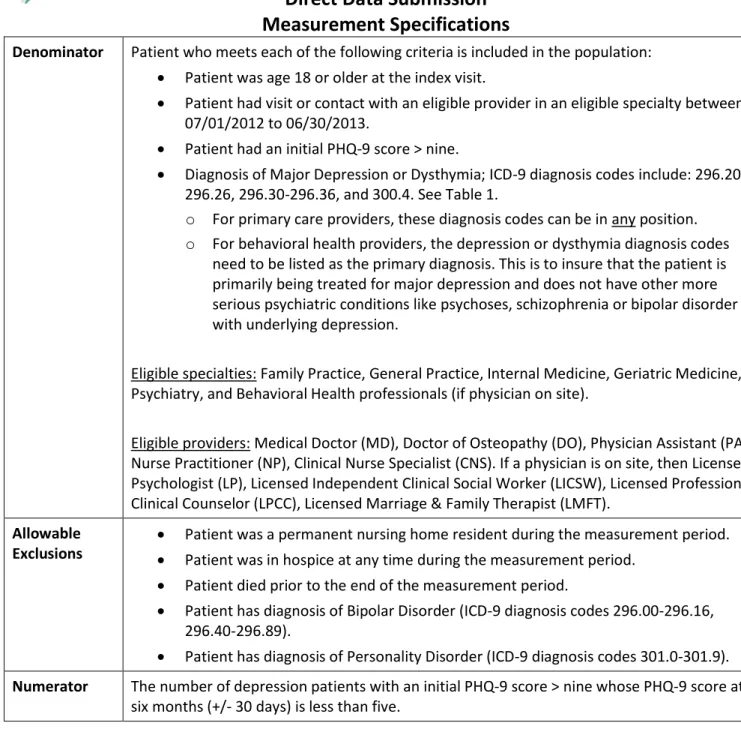
Denominator Patient who meets each of the following criteria is included in the population: Patient was age 18 or older at the index visit.
Patient had visit or contact with an eligible provider in an eligible specialty between 07/01/2012 to 06/30/2013.
Patient had an initial PHQ-9 score > nine.
Diagnosis of Major Depression or Dysthymia; ICD-9 diagnosis codes include: 296.20-296.26, 296.30-296.36, and 300.4. See Table 1.
o For primary care providers, these diagnosis codes can be in any position.
o For behavioral health providers, the depression or dysthymia diagnosis codes need to be listed as the primary diagnosis. This is to insure that the patient is primarily being treated for major depression and does not have other more serious psychiatric conditions like psychoses, schizophrenia or bipolar disorder with underlying depression.
Eligible specialties: Family Practice, General Practice, Internal Medicine, Geriatric Medicine, Psychiatry, and Behavioral Health professionals (if physician on site).
Eligible providers: Medical Doctor (MD), Doctor of Osteopathy (DO), Physician Assistant (PA), Nurse Practitioner (NP), Clinical Nurse Specialist (CNS). If a physician is on site, then Licensed Psychologist (LP), Licensed Independent Clinical Social Worker (LICSW), Licensed Professional Clinical Counselor (LPCC), Licensed Marriage & Family Therapist (LMFT).
Allowable Exclusions
Patient was a permanent nursing home resident during the measurement period. Patient was in hospice at any time during the measurement period.
Patient died prior to the end of the measurement period.
Patient has diagnosis of Bipolar Disorder (ICD-9 diagnosis codes 296.00-296.16, 296.40-296.89).
Patient has diagnosis of Personality Disorder (ICD-9 diagnosis codes 301.0-301.9).
Numerator The number of depression patients with an initial PHQ-9 score > nine whose PHQ-9 score at six months (+/- 30 days) is less than five.
Major Depression and Dysthymia Diagnosis Codes
Table 1: ICD-9 Diagnosis Codes for Identifying Major Depression or Dysthymia
ICD-9 Diagnosis Code
ICD-9 Diagnosis Code Description
296.2 Major depressive disorder single episode
296.20 Major depressive affective disorder single episode unspecified degree 296.21 Major depressive affective disorder single episode mild degree 296.22 Major depressive affective disorder single episode moderate degree
Measurement Specifications
Hotline: 612-746-4522 | E-mail: [email protected] | Data Portal: https://data.mncm.org/login © MN Community Measurement, 2014. All rights reserved.
Page 7
ICD-9 Diagnosis Code
ICD-9 Diagnosis Code Description
296.23 Major depressive affective disorder single episode severe degree without psychotic behavior 296.24 Major depressive affective disorder single episode severe degree specified as with psychotic
behavior
296.25 Major depressive affective disorder single episode in partial or unspecified remission 296.26 Major depressive affective disorder single episode in full remission
296.3 Major depressive disorder recurrent episode
296.30 Major depressive affective disorder recurrent episode unspecified degree 296.31 Major depressive affective disorder recurrent episode mild degree 296.32 Major depressive affective disorder recurrent episode moderate degree
296.33 Major depressive affective disorder recurrent episode severe degree without psychotic behavior
296.34 Major depressive affective disorder recurrent episode severe degree specified as with psychotic behavior
296.35 Major depressive affective disorder recurrent episode in partial or unspecified remission 296.36 Major depressive affective disorder recurrent episode in full remission
300.4 Dysthymic disorder
Codes Used to Identify Patients who Meet Exclusion Criteria
Table 2: ICD-9 Diagnosis Codes for Identifying Patients Meeting Exclusion Criteria
ICD-9 Diagnosis Code ICD-9 Diagnosis Code Description
296.00 Bipolar I Disorder, Single Manic Episode, Unspecified 296.01 Bipolar I Disorder, Single Manic Episode, Mild 296.02 Bipolar I Disorder, Single Manic Episode, Moderate
296.03 Bipolar I Disorder, Single Manic Episode, Severe Without Psychotic Features 296.04 Bipolar I Disorder, Single Manic Episode, Severe With Psychotic Features 296.05 Bipolar I Disorder, Single Manic Episode, In Partial Remission
296.06 Bipolar I Disorder, Single Manic Episode, In Full Remission 296.10 Manic disorder, recurrent episode; Unspecified
296.11 Manic disorder, recurrent episode; Mild 296.12 Manic disorder, recurrent episode; Moderate
296.13 Manic disorder, recurrent episode; Severe Without Psychotic Features 296.14 Manic disorder, recurrent episode; Severe With Psychotic Features 296.15 Manic disorder, recurrent episode; In Partial Remission
296.16 Manic disorder, recurrent episode; In Full Remission 296.40 Bipolar I Disorder, Most Recent Episode Manic, Unspecified 296.41 Bipolar I Disorder, Most Recent Episode Manic, Mild 296.42 Bipolar I Disorder, Most Recent Episode Manic, Moderate
296.43 Bipolar I Disorder, Most Recent Episode Manic, Severe Without Psychotic Features 296.44 Bipolar I Disorder, Most Recent Episode Manic, Severe With Psychotic Features 296.45 Bipolar I Disorder, Most Recent Episode Manic, In Partial Remission
Measurement Specifications
Hotline: 612-746-4522 | E-mail: [email protected] | Data Portal: https://data.mncm.org/login © MN Community Measurement, 2014. All rights reserved.
Page 8
ICD-9 Diagnosis Code ICD-9 Diagnosis Code Description
296.46 Bipolar I Disorder, Most Recent Episode Manic, In Full Remission 296.50 Bipolar I Disorder, Most Recent Episode Depressed, Unspecified 296.51 Bipolar I Disorder, Most Recent Episode Depressed, Mild 296.52 Bipolar I Disorder, Most Recent Episode Depressed, Moderate
296.53 Bipolar I Disorder, Most Recent Episode Depressed, Severe Without Psychotic Features 296.54 Bipolar I Disorder, Most Recent Episode Depressed, Severe With Psychotic Features 296.55 Bipolar I Disorder, Most Recent Episode Depressed, In Partial Remission
296.56 Bipolar I Disorder, Most Recent Episode Depressed, In Full Remission 296.60 Bipolar I Disorder, Most Recent Episode Mixed, Unspecified
296.61 Bipolar I Disorder, Most Recent Episode Mixed, Mild 296.62 Bipolar I Disorder, Most Recent Episode Mixed, Moderate
296.63 Bipolar I Disorder, Most Recent Episode Mixed, Severe Without Psychotic Features 296.64 Bipolar I Disorder, Most Recent Episode Mixed, Severe With Psychotic Features 296.65 Bipolar I Disorder, Most Recent Episode Mixed, In Partial Remission
296.66 Bipolar I Disorder, Most Recent Episode Mixed, In Full Remission 296.7 Bipolar I Disorder, Most Recent Episode Unspecified
296.80 Bipolar Disorder NOS
296.81 Atypical manic disorder
296.82 Atypical depressive disorder
296.89 Bipolar II Disorder
301.0 Paranoid personality disorder
301.10 Affective personality disorder unspecified 301.11 Chronic hypomanic personality disorder 301.12 Chronic depressive personality disorder
301.13 Cyclothymic disorder
301.20 Schizoid personality disorder unspecified
301.21 Introverted personality
301.22 Schizotypal personality disorder 301.3 Explosive personality disorder
301.4 Obsessive-compulsive personality disorder 301.50 Histrionic personality disorder unspecified 301.51 Chronic factitious illness with physical symptoms 301.59 Other histrionic personality disorder
301.6 Dependent personality disorder
301.7 Antisocial personality disorder 301.81 Narcissistic personality disorder 301.82 Avoidant personality disorder 301.83 Borderline personality disorder 301.84 Passive-aggressive personality 301.89 Other personality disorders 301.9 Unspecified personality disorder
Measurement Specifications
Hotline: 612-746-4522 | E-mail: [email protected] | Data Portal: https://data.mncm.org/login © MN Community Measurement, 2014. All rights reserved.
Page 9 Measure Logic/Flow Charts
Is the patient age 18 or older?
Has the patient been seen by a provider during the
measurement period? INCLUDE IN CLINIC LEVEL POPULATION COUNT #1
Does the patient have a diagnosis code listed in Table
1 on Page 7?
INCLUDE IN CLINIC LEVEL POPULATION COUNT #2 Is the diagnosis in the primary position if the patient was seen by a behavioral health provider or in any position
if they were seen by a primary care provider?
Did the patient have a PHQ-9 test administered? INCLUDE IN CLINIC LEVEL POPULATION COUNT #4 Does the patient have a diagnosis of 311.x? INCLUDE IN CLINIC LEVEL POUPLATION COUNT #3 PATIENT NOT INCLUDED
Clinic Level Population
Counts Measure Logic
Flowchart for ALL patients
*Answer questions using the following measurement periods: 02/01/2013 to 05/31/2013 06/01/2013 to 09/30/2013 10/01/2013 to 01/31/2014 PATIENT NOT INCLUDED No No No Yes No Yes No No Yes No Yes Yes Yes
Measurement Specifications
Hotline: 612-746-4522 | E-mail: [email protected] | Data Portal: https://data.mncm.org/login © MN Community Measurement, 2014. All rights reserved.
Page 10 Is the patient age 18
or older?
Has the patient been seen by a provider during the
measurement period?
Does the patient have a diagnosis code listed in Table
1 on Page 7?
Is the diagnosis in the primary position if the patient was seen by a behavioral health provider or in any position
if they were seen by a primary care provider?
Did the patient have a PHQ-9 test administered?
2014 Depression Care Measure
Flow Chart for Patient WHO ARE
NOT Indexed
Please see pages 26-31 for more detailed information about each
component
*Answer questions using the following measurement periods: 02/01/2013 to 05/31/2013 06/01/2013 to 09/30/2013 10/01/2013 to 01/31/2014 PATIENT NOT INDEXED Yes Yes
Was the score over 9? Yes Yes Yes INCLUDED IN DENOMINATOR; CONSIDERED INDEXED PATIENT
Patient is now “indexed” - must submit ALL follow-up PHQ-9
score regardless of score Yes No No No No No No
Measurement Specifications
Hotline: 612-746-4522 | E-mail: [email protected] | Data Portal: https://data.mncm.org/login © MN Community Measurement, 2014. All rights reserved.
Page 11 Was the patient
administered a PHQ-9?
SUBMIT ALL PHQ-9 SCORES REGARDLESS OF SCORE Answer both questions to determine numerator criteria
Was the PHQ-9 test administered within 6 months (+/- 30 days) of the patient’s indexed visit?
Was the most recent score within the timeframe less than
5?
Was the most recent score within the timeframe reduced by 50% of the index visit’s PHQ-9 score? Was the PHQ-9 test administered within 12 months (+/- 30 days) of the patient’s indexed visit?
Was the most recent score within the timeframe reduced by 50% of the index visit’s PHQ-9 score? Was the most
recent score within the timeframe less
than 5? INCLUDED IN NUMERATOR FOR REMISSION RATE INCLUDED IN NUMERATOR FOR RESPONSE RATE INCLUDED IN NUMERATOR FOR RESPONSE RATE INCLUDED IN NUMERATOR FOR REMISSION RATE Answer both questions to determine if patient meets numerator criteria Yes Yes Yes Answer both questions to determine if patient meets numerator criteria Yes Yes Yes PATIENT REMAINS IN DENOMINATOR No No No No No No PATIENT REMAINS IN DENOMINATOR No Yes
2014 Depression Care Measure Flow Chart for Patient WHO ARE Indexed Please see pages 26-31 for more detailed
information about each component *Answer questions using the following measurement periods:
02/01/2013 to 05/31/2013 06/01/2013 to 09/30/2013 10/01/2013 to 01/31/2014
Hotline: 612-746-4522 | E-mail: [email protected] | Data Portal: https://data.mncm.org/login © MN Community Measurement, 2014. All rights reserved.
Page 12
Depression Care Measures 2014
Direct Data Submission
(02/01/2013 to 01/31/2014 Dates of Service)
Data Collection and Submission Instructions
Hotline: 612-746-4522 | E-mail: [email protected] | Data Portal: https://data.mncm.org/login © MN Community Measurement, 2014. All rights reserved.
Page 13
Data Collection and Submission Preparations and Considerations
Before collecting and submitting data to MNCM, please review the following items.
Data submission preparations
Your medical group and clinics MUST BE REGISTERED in the MNCM Data Portal. Please see Appendix A for more information about registration.
Save the MNCM websites in your “Favorites” internet folder for future reference.
o MNCM Data Portal: https://data.mncm.org/login
o MNCM website: www.mncm.org
o MN HealthScores: www.mnhealthscores.org
Create a folder in your network drive dedicated to all data submission documents.
o Save all spreadsheets, forms and data submission materials in the dedicated folder. Name versions of documents clearly, so you are using the most recent files.
Log in to the MNCM Data Portal at https://data.mncm.org/login. In the Resources tab of the data portal, you are able to access the following items:
o Direct Data Submission Resources. Download the following
Depression Care Measures 2014 Direct Data Submission Guide Depression Care Measures 2014 Denominator Certification Form Depression Care Measures 2014 Data Collection Form
Depression Care Measures 2014 Spreadsheet Template
Patient attribution
A patient is attributed to the clinic site and provider of the indexed visit meaning the visit where the patient had a diagnosis code for major depression or dysthymia AND a PHQ-9 score greater than nine. The portal then matches all subsequent contact dates and PHQ-9 scores to this patient within the medical group regardless of the clinic location of the contact.
Note for Primary Care Clinics: If a medical group assigns a primary care provider for each patient, it is acceptable to use that provider ID in this field. If a group does not assign a primary care provider, then use the provider ID of the provider who cared for the patient at the visit.
A patient is attributed to one clinic and one provider within your medical group that are considered responsible for managing the patient’s care. This method was developed in order to capture and attribute all eligible patients. Please use the following attribution methods in order:
1. After identifying the eligible patients for this measure based on the denominator criteria, first, attribute the patient to the clinic and provider within your medical group that are assigned to the patient OR are responsible for the patient’s care. If the patient does not have an assigned clinic or provider within your medical group, then
Data Collection and Submission Instructions
Hotline: 612-746-4522 | E-mail: [email protected] | Data Portal: https://data.mncm.org/login © MN Community Measurement, 2014. All rights reserved.
Page 14
2. Attribute the patient to the clinic and provider within your medical group that saw the patient most often in the measurement period. If more than one provider saw the patient equally, then
3. Attribute the patient to the clinic and provider within your medical group that saw the patient most recently in the measurement period.
Denominator Certification
You only need to submit one denominator form if both #1 and #2 listed below are true. If they are not met, you will need to submit multiple denominator certification forms.
1. The correct date of birth and date of visit ranges for each measurement period are included in the form. 2. You will pull data for each measurement period the same way.
About Total Population Submission
This measure requires total population submission. When a medical group or clinic submits “total population”, they are submitting data for all of the eligible visits that occurred during the measurement period. The criterion in the “Denominator” section of the Measure Specifications on page 6 define the eligible population and provides details on who should be identified/included in the patient data file.
You must submit data for all patients who meet inclusion criteria during the current measurement period and data for all patients who have been indexed in previous measurement periods.
Patient ID
The patient ID number must be maintained for patients across all measurement periods. This means that data for a patient must always be submitted using the same patient ID. If you have questions about this, please contact MNCM by email at [email protected].
PHQ-9 Scores
You must submit data for ALL follow-up PHQ-9 scores once a patient is indexed regardless of the score of the PHQ-9 test. You should expect to have some scores 9 and below in your patient data file.
Patient Data File Creation
Data will be collected and put into an Excel template titled “Depression Care Data Collection Spreadsheet” which can be found on the MNCM Data Portal. Once all data is collected and input into the Excel template, the file will need to be saved as a CSV file in order to upload the file to the MNCM Data Portal. Please note:
1. The Excel template provided has the correct formatting. Do NOT use “General” formatting in Excel. The Excel template provided on the MNCM Data Portal will provide the correct formatting.
2. After creating the CSV file, do NOT open the CSV file in Excel. Opening the CSV file in Excel destroys the formatting and alters the data. To view the data again, open the original Excel file. If you need to make changes to your file, make the changes in your original excel file, not in the .csv file, and save the
Data Collection and Submission Instructions
Hotline: 612-746-4522 | E-mail: [email protected] | Data Portal: https://data.mncm.org/login © MN Community Measurement, 2014. All rights reserved.
Page 15
changes to a new .csv file. If the CSV file is mistakenly opened in Excel, simply re-save a new CSV file from the original Excel file. Rename the old CSV file or delete it entirely. If at any point in the process it is discovered that corrections to the data are needed, make the necessary changes in the Excel file and save as a new CSV file using a different name.
What is a CSV file? Why is a CSV file needed for data submission? CSV stands for “comma separated values.” A CSV file is a common and simple format that is used to import /transport data between systems or software applications that are not directly related (e.g., from a spreadsheet to a database). Please see page 33 for more information on how to create a CSV file from an Excel file.
Patient Data File Submission
Data submission consists of submitting clinic level population counts AND a patient data file for each measurement period.
Review Section B on pages 21-22 for more information about the clinic level population counts. Review Section C on pages 23-31 for more detailed information about the patient data file. The patient
data file must be submitted using the measurement period dates of service below. The patient data files must also be submitted to the MNCM Data Portal in chronological order as outlined below:
File Measurement Period Dates of Service Submission Order
File #1 02/01/2013 to 05/31/2013 First
File #2 06/01/2013 to 09/30/2013 Second
Data Collection and Submission Instructions
Hotline: 612-746-4522 | E-mail: [email protected] | Data Portal: https://data.mncm.org/login © MN Community Measurement, 2014. All rights reserved.
Page 16
Section A: Identifying the Patient Population (Denominator)
Denominator Definition: The denominator is the bottom number in a fraction.
This step of the process includes identifying the total number of patients who are eligible for the measure using a standard set of criteria. Please review the “Denominator” section noted in the Measure Specifications in this guide for the detailed criteria used to identify eligible patients for the denominator. You will need to identify the patient population which you will include on the patient data file AND you will need to identify the clinic level populations which you will submit counts to MNCM during data submission.
Step 1: Denominator Certification
This must be done prior to identifying your population and collecting data.
To help medical groups achieve accuracy and/or inadvertently pulling the wrong patient population for the measure, MNCM will complete an upfront review of each medical group’s source code or methodology that is used to produce the patient population (denominator) to help identify potential errors. The denominator certification process is intended to help identify potential issues prior to data submission. However, the responsibility to submit an accurate denominator rests with the medical group. Contact [email protected] with any specific questions.
PLEASE NOTE: Denominator certification may also include a comprehensive review by MNCM of the process steps used to identify the denominator, including the final list of patients. Save all original queries, documents, spreadsheets and process steps that are used to identify the patient population. MNCM may ask to review this information.
Denominator Template Form
This template is provided to ensure all medical groups are using the same set of criteria to identify patients for the denominator. Medical groups are asked to complete this form and submit it to the MNCM Data Portal. The denominator form asks for source code or “screen shots,” which are helpful in MNCM’s review of the
denominator.
1. Login to the MNCM Data Portal ( https://data.mncm.org/login).
2. Go to the RESOURCES tab and select Depression Resources from the drop-down menu. Download the
Depression Care Measures 2014 Denominator Template Form.
3. Complete the form and save the form on your network directory.
4. Login to the MNCM Data Portal and click on Denominator Certification under the Depression Measure 02/01/2013 to 05/31/2013 section. Follow the instructions to upload the form to the data portal. 5. MNCM will review the method and respond within 2-3 business days. MNCM will either (1) contact the
medical group if more clarification is needed, in which case the medical group will need to make the necessary revisions and re-upload the form, or (2) approve and certify the method in the MNCM Data Portal; an automatic e-mail will notify the medical group that the method is certified.
Data Collection and Submission Instructions
Hotline: 612-746-4522 | E-mail: [email protected] | Data Portal: https://data.mncm.org/login © MN Community Measurement, 2014. All rights reserved.
Page 17
Details for the Denominator Methodology
The following elements are included on the Depression Care Measures 2014 Denominator Template Form. Medical groups will need to indicate on the form how they will identify each element for MNCM:
Date of birth range. ICD-9-CM codes. Visit date range.
o If submitting one form for all three measurement periods, you must include all three date of service date ranges. Board certified specialties of providers included in the search.
Whether exclusions will be taken and how exclusions will be handled.
o EMR groups can list which accepted exclusions will be filtered through the query process.
o Medical groups that will manually abstract data can describe that exclusions will be identified and documented during record review.
Step 2: Identifying patient population
After your denominator form has been approved by MNCM, you will be able to query your system to determine the patient population for this measure.
If a medical group opened or acquired a new clinic in the last year, the new clinic must register and submit data with the medical group. Please contact [email protected] to discuss submitting this data.
For medical groups that implemented a new practice management system or EMR in the last two years, the patient population list will need to be generated using both systems. Two queries or patient lists will be necessary. The lists should then be combined and a common identifier(s) selected to de-duplicate the list. Contact [email protected] with any questions.
1. Eligible Providers and Encounter Types
Patients who have visits with provider who practice in the following specialties are included in the depression measurement. Eligible providers include primary care and behavioral health providers. Behavioral health providers are eligible for the measure if there is a physician who is on-site (i.e., a physician who also practices at the clinic anytime during the measurement period). The following is a list of eligible specialties and providers:
Primary Care Behavioral Health
Family Practice Psychiatrist
Internal Medicine Physician Assistant
Geriatric Medicine Nurse Practitioner
Obstetrics/Gynecology * Clinical Nurse Specialist Physician Assistant Psychologist (LP)
Nurse Practitioner Clinical Social Worker (LICSW) Counselor (LPCC) Marriage and Family Therapist (LMFT)
*OBGYN providers who function in a primary care role are encouraged to submit data for their patients, but it is voluntary.
Keep a “Crosswalk”:
It is very important to keep a “crosswalk” between the unique identifier and the patient’s name and DOB, so that records can be located by clinic staff at the time of validation by MNCM.Data Collection and Submission Instructions
Hotline: 612-746-4522 | E-mail: [email protected] | Data Portal: https://data.mncm.org/login © MN Community Measurement, 2014. All rights reserved.
Page 18
2. Eligible Patients
If a patient IS NOT AN INDEXED patient: In order to be eligible for this measure, patients must initially meet the following criteria:
1. Depression Diagnosis.
Patients must have one of the following diagnoses (the diagnosis must be in the primary position for behavioral health providers and can be in any position for primary care providers):
296.2.x Major depressive disorder, single episode. 296.3x Major depressive disorder, recurrent episode. 300.4 Dysthymic disorder.
2. PHQ-9 Score above 9.
Patients must have been administered a PHQ-9 test at a face-to-face visit with an eligible provider AND must have scored above a 9.
Once the two above criterions are met, the patient is considered an “indexed” patient. The “indexed” visit is the visit in which the patient had an eligible diagnosis AND scored above nine on the PHQ-9 test at a face-to-face visit with an eligible provider.
If a patient IS AN INDEXED patient: Once the patient has been indexed, all follow-up PHQ-9 scores must be included in the patient data file. Include these scores regardless of diagnosis, who or where the PHQ-9 test was administered. Acceptable encounter/visit types for follow-up PHQ-9 scores for an indexed patient include:
Office visit.
Telephone encounter. E-Visit.
Any other contact with the patient in which a PHQ-9 is administered.
System Query: Helpful data elements that can be included in the system query
Please refer to the data elements and field specifications to determine how to format the data elements that must be submitted to MNCM: Patient ID number Patient date of birth Clinic or facility Provider name and NPI Provider type/specialty code Insurance payer
Insurance member ID Gender
Zip code
Race/ethnicity, country of origin and preferred language
Data Collection and Submission Instructions
Hotline: 612-746-4522 | E-mail: [email protected] | Data Portal: https://data.mncm.org/login © MN Community Measurement, 2014. All rights reserved.
Page 19
Evaluation and Management (E & M) Current Procedural Terminology (CPT) Codes
(optional)
The following list of codes may be helpful in determining what types of visits to include for identifying the patient population (denominator). E & M codes do not need to be used when querying a practice management system to determine visit counts; however, they have been included here to help further define what is meant by a “face-to-face” visit with a provider. Please refer to a CPT coding manual for more details.
Description CPT Codes
Psychotherapy pt / family or diagnostic evaluation
E & M Codes Preventive Codes Office Consultation
Preventive Medicine Counseling, Individual
Preventive Medicine Counseling, Group Other Preventive Medicine Services Other Outpatient Encounters Unlisted E & M Codes
90791- 90792; 90838; 90832-90838 99201-99205; 99211-99215 99385-99387; 99395 -99397 99241-99245 99401-99404 99411- 99412 99420; 99429 98960-98962; 99078; 99217- 99220; 99341-99345; 99347-99350; 99499
Allowable Exclusions:
Patient death. Hospice. Permanent Resident of Nursing Home. Bipolar Disorder (see Table 2 on pages 7-8). Personality Disorder (see Table 2 on pages 7-8).
For Patient Death, Hospice and Permanent Resident of Nursing Home Exclusions
Do NOT exclude patients “up front” in the query process for identifying your population. Include the eligible patients as part of the submission file and enter a valid exclusion code and date. Please document how you are identifying exclusions in your denominator certification document. If an exclusion event occurs after a patient has already been submitted, a subsequent record could contain data for the “Exclusion Reason” and “Exclusion Date” fields. Having an exclusion reason and date would prevent the patient being counted in the outcome calculations. If you do not know the exact date of the event, it is acceptable to enter a date that represents the month in which it occurs like 06/01/2014 to represent June 2014.
For Bipolar Disorder and Personality Disorder Exclusions
It is acceptable to exclude patients with a bipolar or personality disorder (listed in Table 2 on pages 7-8) in any position for both behavioral health and primary care providers upfront. Medical groups can now structure their queries to exclude any patient with a secondary or primary diagnosis of bipolar or personality disorder.
For patients that have already been submitted to the data portal and now have bipolar or personality disorder as a diagnosis (primary or not), please submit a record for each patient that includes the appropriate exclusion
Data Collection and Submission Instructions
Hotline: 612-746-4522 | E-mail: [email protected] | Data Portal: https://data.mncm.org/login © MN Community Measurement, 2014. All rights reserved.
Page 20
code in the patient data file. It is acceptable to create a fake encounter with the date of 02/01/2013. This will exclude the patient from the measure. Moving forward, any new patient who has bipolar or personality disorder can be excluded upfront through queries and does not need to be submitted in the patient data file with a visit and exclusion code and date.
PLEASE NOTE: These exclusions may be taken by the medical group if the information is available, however, it is optional. If the information is unknown to the clinic, the patient is to be included.
Patient Registries
A patient registry is an important tool to help clinics track patient progress and to use for quality improvement purposes. However, MNCM cautions the use of a patient registry for identifying patients in the population or for the collection of clinical data. Many registries give a “snapshot” of patients at a given time and would therefore not include all patients according to established patient criteria or may not reflect the most recent clinical data (e.g., most recent screening exam). Registries that are programmed to update the patient
population and clinical results on a continual basis (24/7) or built using measure specifications can possibly be used, however, please discuss this with MNCM.
You can use the data submission template as a registry, but make sure you only send us what we need and in the original CSV format when downloaded from the portal. If changes are made to the spreadsheet, it will not upload correctly into the MNCM portal.
During the validation audit, the MNCM auditor will review the patient record for validation and not the patient registry. If a clinic uses data from a patient registry, the auditor may find a more recent date/value in the medical record and this would be counted as a validation error.
Data Collection and Submission Instructions
Hotline: 612-746-4522 | E-mail: [email protected] | Data Portal: https://data.mncm.org/login © MN Community Measurement, 2014. All rights reserved.
Page 21
Section B: Clinic Level Population Counts
Clinic level population counts are used to calculate general clinic level depression care rates for your clinic (See Appendix F for more information). In addition to creating a file of all your patients with depression and their PHQ-9 scores that meet the inclusion criteria for the measure (see next section), you will be asked to provide specific summary counts in the data portal. These counts that are calculated will not necessarily match the number of patients in the patient data file. The population counts are important and contribute to the measurement calculations.
If your clinic does not use the phq-9 test, you still need to submit clinic level population counts.
Purpose
To provide information about the population of patients cared for at each clinic site and to understand the processes related to diagnosis, monitoring and treatment of depression.
The incidence of major depression/dysthymia in the clinic’s adult population. The use or overuse of the non-specific ICD-9 code for depression (311).
The utilization of the PHQ-9 tool for patients with diagnosed depression/dysthymia.
All counts pertain to the current measurement period only. Please review the measurement period for which you are submitting data, the name of the period will be next to your medical group name. All are counts of unique patients, not the number of visits. For example, this means that a patient could be counted once in the first measurement period and once in the third measurement period.
Clinic Level Population Count 1: Total Adult Patients
The total number of unique adult patients (ages 18+) seen in your clinic for any reason with a contact with an eligible provider during the measurement period.
Clinic Level Population Count 2: Total Adult Patients with Depression
Diagnosis (296.2x, 296.3x or 300.4)
These ICD-9 codes define major depression and dysthymia and would be a subset of your total adult patients. It does not matter if this is a new diagnosis or if the patient is returning for a follow-up visit. If they have these codes during the measurement period, include them in the count. If the patient has an exclusion ICD-9 diagnosis codes, do NOT include them in this count.
The total number of adult patients with a contact with an eligible provider who have at least one contact in the measurement period with the following ICD-9 codes:
296.2x Major depressive disorder, single episode. 296.3x Major depressive disorder, recurrent episode. 300.4 Dysthymic disorder.
If the provider is primary care, the ICD-9 codes can be in any position.
If the provider is behavioral health, the ICD-9 codes need to be in the primary position only. This excludes patients with other psychiatric diagnoses with a secondary component of depression.
Data Collection and Submission Instructions
Hotline: 612-746-4522 | E-mail: [email protected] | Data Portal: https://data.mncm.org/login © MN Community Measurement, 2014. All rights reserved.
Page 22
If a clinic DID NOT have any patients with a diagnosis of major depression or dysthymia: A “0” should be entered for this count. You must also check “No Depression Patients Seen this Period.”
Clinic Level Population Count 3: Total Adult Patients with Depression NOS
(311) code
This would be another subset of your adult population. The total number of adult patients with a contact with an eligible provider with a 311 code (Depression NOS not elsewhere classified). Because one of the goals of measuring this population is accurate diagnosis (and subsequently coding), please only include in this count patients who have a 311 code and not the major depression/dysthymia codes of (296.2, 296.3 or 300.4). One way you could structure your query would be to search for ICD-9 code = 311 and is not equal to 296.2, 296.3 or 300.4. If the patient has an exclusion ICD-9 diagnosis codes, do NOT include them in this count.
Clinic Level Population Count 4: Total Adult Patients with a Completed
PHQ-9 AND diagnosis of Major Depression or Dysthymia (296.2x, 296.3x or
300.4)
This is a subset of the patients ages 18+ with the major depression/dysthymia diagnosis codes of (296.2, 296.3 or 300.4) Count the number of these patients during the measurement period who also have a PHQ-9 test done during the measurement period. If a patient has an exclusion ICD-9 diagnosis code, do NOT include them in this count.
PLEASE NOTE: It is acceptable to “count” a patient has having a PHQ-9 administered if the patient only partially completed the PHQ-9 tool, but do NOT send partial scores as part of the patient data file.
IF YOUR CLINIC DOES NOT USE THE PHQ-9 TEST: You will enter a “0” for this count. Do NOT check “No
Depression Patients Seen this Period” unless your clinic truly had no patients with a depression diagnosis seen during this measurement period.
Data Collection and Submission Instructions
Hotline: 612-746-4522 | E-mail: [email protected] | Data Portal: https://data.mncm.org/login © MN Community Measurement, 2014. All rights reserved.
Page 23
Section C: Data Collection
After the patient population (denominator) is identified, data will need to be collected for the elements found in the Data Elements and Field Specifications table on pages 26-31. Recordsare submitted at a patient visit or contact level; not at the level of an individual patient such as data submitted for the Optimal Diabetes Care or Optimal Vascular Care measures data submissions. This means there may be several records for one patient, one record for each PHQ-9 score administered. Please refer to the data elements and field specifications section for more detailed information about each data element.
Medical groups can collect clinical data from medical records by either: 1) extracting the data from an electronic medical record through a data query; or 2) abstracting the data from the medical record (paper record or EMR). Data collection occurs after:
1. The clinic’s billing and medical record updates are complete for the measurement period;
2. The denominator method is certified by MNCM; and 3. The patient population is pulled.
Excel Template
The Excel template was created to ensure all necessary data elements are collected for DDS. This file contains all of the necessary fields and the correct column formatting according to the measure specifications. Please download the Depression Care Measures 2014 Excel template from the MNCM Data Portal by going to the RESOURCES tab and selecting Depression Resources from the drop-down menu.
Key Points for File Creation
File submission reflects visit or contact level information; one row for each visit or contact. The PHQ-9 can be administered by means other than an office visit, like a telephone call, and that is why we refer to the date field as a contact date.
Once a patient has been indexed,all follow-up PHQ-9 scores are to be submitted, regardless of who administers the tool or diagnosis codes associated with susequent visits.
All PHQ-9 scores are expected to be submitted. If a patent was administered the PHQ-9 tool three times during one measurement period, there should be three records for this patient in the patient data file. It is important to only submit records with dates of service during the measurement period. Dates of
service outside of the measurement period will cause an ERROR upon submission.
Locating Data Elements in the Patient Record
The primary source of data is the clinic’s documentation in the medical record (e.g., flow sheets, progress notes, lab reports, etc.). Data collectors may also choose to review the outside correspondence in the clinic’s medical record that documents more recent data within the measurement period, but this is optional. If data is used from outside correspondence, please document this for the validation audit. Below are tips for locating data in the patient record. Please follow the measure specifications for data collection.
Data Collection Tips:
When manually collecting datausing an EMR, highlight the row, column or cell that contains the data needed. This reduces the chance of looking at the wrong row, column or cell.
Watch for TYPOS when entering data (number transpositions, etc.).
Data Collection and Submission Instructions
Hotline: 612-746-4522 | E-mail: [email protected] | Data Portal: https://data.mncm.org/login © MN Community Measurement, 2014. All rights reserved.
Page 24
As long as you are including all your patients with major depression (ICD-9 codes 296.2, 296.3 or 300.4), there are several different ways that the data collection process can be achieved:
Extract information from your EMR by query.
Combination of extracting info from EMR and manual chart abstraction. Establishing an integrated PHQ-9 tool solely within your EMR would mean that scores can be extracted by query.
Registry populated with patients with depression and their visits.
Download as much information as can be attained from a billing system into Excel and then abstract remaining data elements.
Tracking Where Data is Located in the Patient Record
It is important to keep track of where data is located in the patient record. For example, if data is used from an outside specialist or provider note (that is within the primary clinic’s record), document the source on the data collection form or Excel spreadsheet.
If you are collecting data directly in the Excel spreadsheet, create a “Notes” column and enter the data source details in this column. After you have completed data collection, SAVE A COPY of the Excel file and remove the “Notes” column in the file that will be used for submitting to MNCM.
Data Quality Checks
MNCM recommends completing several internal quality checks of the data before submitting data. Performing quality checks ensures that the data is accurate and able to be validated by a MNCM auditor. If corrections are needed, make these in the Excel file. There are several ways to conduct quality checks:
Option 1: Complete data quality checks of specific data elements in the Excel file using Excel’s AutoFilter. Please use the following directions to set the filter and review specific data elements.
1. Click inside any data cell and activate the AutoFilter by doing the following:
a. In Excel 2003, click the Data menu, point toFilter, and then click AutoFilter.
b. In Excel 2007 and Excel 2010, click theDatatab and in the Sort & Filter area click Filter.
2. The AutoFilter arrows now appear to the right of each column heading.
3. Click on the drop-down boxes of any column and scan for key entry errors, “out-of-range” or missing data and determine if the data needs to be corrected (e.g., If a date for a PH9-9 contact field was outside the measurement period, the field would not be accepted).
4. To display all data again, click on the same drop-down box and select All.
5. Remove the Filter option by doing the following:
a. In Excel 2003, click Data, Filter, and AutoFilteragain.
b. In Excel 2007 and Excel 2010, click the Filter option again in the Sort & Filter area.
Example Quality Check: Verify that if there are PHQ-9 scores 9 and below. Filter for all rows in Column V (PHQ-9 Score). When reviewing the list of scores submitted, confirm there are scores 9 and below. Make changes in the original Excel file if appropriate.
Data Collection and Submission Instructions
Hotline: 612-746-4522 | E-mail: [email protected] | Data Portal: https://data.mncm.org/login © MN Community Measurement, 2014. All rights reserved.
Page 25
Option 2: Complete an internal audit of clinical data by reviewing a random sample of records (either 8-10 records) or a full sample (30 records) to see if the data matches what was collected from the patient record. If errors are found, make the corrections in the Excel file, however also consider if the errors were isolated cases or indicative of a larger data collection problem. (e.g., there are no patients with PHQ-9 scores, and you are certain that PHQ-9 tests were administered.)
Option 3: Complete the general quality checks outlined below:
1. Complete quality checks listed in the “Notes” section of each data element in the Data Elements and Field Specifications table on pages 26-31.
2. Verify excluded records are removed and recorded on Exclusions Template. Please see Table 2 on pages 7-8 for all applicable codes used to identify patients who meet exclusion criteria.
3. Hyphens or zeroes (0’s): If the data field is supposed to be blank, do NOT enter hyphens or zero (leave blank).
4. Blank rows in spreadsheet: Check that the Excel file does not have blank rows at the bottom of the spreadsheet as blank rows can slow the data submission process. To check for blank rows: Press
Ctrl/End at the same time to go to the bottom-most cell in the spreadsheet. If there are several blank rows, remove them by highlighting the blank rows, right-clicking in the left margin, and selecting Delete (this deletes the rows and not only the text within the cells).
Option 4: Review and answer the following questions. If you answered “No” to any of the questions below, please return to the patient data file and correct the issues.
Did you use the same patient ID for patients that were already submitted to the data portal? Is the file sorted by patient ID and then contact date (oldest to newest)?
Did you include ALL follow-up PHQ-9 scores for patients that were indexed in this period or prior periods regardless of low PHQ-9 scores, non-face-to-face visits or visit diagnosis codes? Did you include scores from scanned PHQ-9s, flowsheets, or visit notes?
Does your excel file match the depression data collection spreadsheet template (the formatting and column headers)?
It is important to complete quality checks of the file before submitting data to MNCM. Completing these checks can help avoid delays in the file submission and ensure that you have the most accurate data. Make any changes/additions in the Excel file before submitting data to MNCM.
Data Collection and Submission Instructions
Hotline: 612-746-4522 | E-mail: [email protected] | Data Portal: https://data.mncm.org/login © MN Community Measurement, 2014. All rights reserved.
Page 26
Data Elements and Field Specifications
Column Field Name Notes Excel Format Example
A Patient ID Enter a unique patient ID that will identify each patient and assigned by the clinic. The patient ID assigned needs to identify the patient uniquely and the patient
ID needs to remain constant over all data submissions in order to track outcomes at six and twelve months. You may use any field in your system that uniquely identifies the patient. If the medical record number is the only field that uniquely identifies the patient over time, it is acceptable to use this. Blank values will create an ERROR upon submission.
Quality Check: Verify that each cell has an ID listed. Verify same IDs are used for patients across all data submission periods.
Text 987654
B Patient Date of Birth
Enter the patient’s date of birth. Patient must be 18 or older (no upper age limit) at the start of the measurement period. For example, for the 02/01/2013 to 05/31/2013 measurement period, include anyone born on or prior to 02/01/1995 to ensure that the patient is at least 18 years old during that measure period.
It is also acceptable to use age at the time of the encounter if the patient is age 18 or older at the time of the encounter.
Blank values will create an ERROR upon submission.
Quality Check: Verify each date of birth is within the accepted range.
Date
(mm/dd/yyyy)
05/08/1985
C Clinic ID Enter the MNCM Clinic ID of the clinic where the visit occurred for every patient submitted. MNCM assigns the clinic ID at the time of registration. Clinic IDs are also listed in the MNCM Data Portal.
Blank values will create an ERROR upon submission.
Quality Check: Verify all IDs match the MNCM ID in the portal.
Text 304
D Patient Gender Enter the patient’s gender: Female = F; Male = M; Unknown = U Blank values will create an ERROR upon submission.
Quality Check: Verify each cell has one of the accepted codes.
Data Collection and Submission Instructions
Hotline: 612-746-4522 | E-mail: [email protected] | Data Portal: https://data.mncm.org/login © MN Community Measurement, 2014. All rights reserved.
Page 27
Data Elements and Field Specifications
Column Field Name Notes Excel Format Example
E Zip Code, Primary Residence
Enter the patient’s five-digit zip code of primary residence at the most recent encounter on or prior to the last day of the measurement period.
If EMR query extracts a nine digit number, submit the nine digit number (the portal will remove the last four digits automatically).
Blank values and values less than five digits will create an ERROR upon submission.
Quality Check: Verify the zip code is five digits long and that each cell has data.
Text 55111
F Race/Ethnicity1
Please refer to a separate document entitled REL Data Field Specifications and Codes 2013 for these field specifications.
This document can be found under the RESOURCES tab in the data portal under the
“Race/Ethnicity/Language Data (REL)” section.
For more information about collecting this data from patients in your clinic practice, please refer to the Handbook on the Collection of Race Ethnicity and Language Data
available at www.mncm.org.
Quality Checks: Verify accepted codes are used. Blank cells (if there is no data is available) are acceptable.
Number 1 G Race/Ethnicity 2 H Race/Ethnicity 3 I Race/Ethnicity 4 J Race/Ethnicity 5 K Country of Origin Code Number 2 L Country of Origin “Other” Description Text CountryA M Preferred Language Code Number 1 N Preferred Language “Other” Description Text LanguageB
O Provider NPI Enter the 10-digit NPI number of the provider who manages the patient’s care. The provider from the index contact is the provider that the patient will be attributed to.
Blank values are acceptable if the visit was a follow-up PHQ-9 contact.
Quality Check: Verify each cell has data.
Data Collection and Submission Instructions
Hotline: 612-746-4522 | E-mail: [email protected] | Data Portal: https://data.mncm.org/login © MN Community Measurement, 2014. All rights reserved.
Page 28
Data Elements and Field Specifications
Column Field Name Notes Excel Format Example
P Provider Specialty Code
Enter the specialty code of the physician (see codes below). If the provider is not a physician, enter the code that best describes the clinic’s specialty.
1 = Family Practice 8 = Psychiatry
2 = Internal Medicine 9 = Obstetrics/Gynecology * 5 = Geriatric Medicine
*PLEASE NOTE: OBGYN providers who function in a primary care role and/or treat patients with major depression are encouraged to submit data for their patients with major depression and associated PHQ-9 scores but this submission is voluntary. Contact MNCM at [email protected] if there is a provider who wishes to submit data and the code is not listed above or if you have questions.
Blank values will create an ERROR upon submission.
Quality check: Verify that each cell has an accepted code.
Number 8
Q Insurance Coverage Code
Please refer to a separate document entitled Insurance Coverage Data Field Specifications and Codes for these field specifications.
This document can be found under the Resources tab in the data portal under the
“Insurance Coverage Info” section from the drop-down menu.
PLEASE NOTE: This should be the patients’ most recent insurance on or prior to the last date of the measurement period.
Quality Checks: Verify accepted codes are used and that all 99 codes have a name entered in Column R. Verify SSN are NOT submitted.
Number 1 R Insurance Coverage “Other” Description Text CIGNA S Insurance Plan Member ID Text FBZXV12345
Data Collection and Submission Instructions
Hotline: 612-746-4522 | E-mail: [email protected] | Data Portal: https://data.mncm.org/login © MN Community Measurement, 2014. All rights reserved.
Page 29
Data Elements and Field Specifications
Column Field Name Notes Excel Format Example
T Diagnosis Enter the diagnosis code for the visit. If a patient has multiple diagnoses, only list one. 296.2x = Major depressive disorder, single episode
296.3x = Major depressive disorder, recurrent episode 300.4 = Dysthymic disorder
Please see Table 1 on pages 6-7 for a list of acceptable diagnosis codes.
Blank values will be accepted ONLY IF the patient is an indexed patient. If this field is left blank and the patient HAS NOT previously been previously indexed, the
information will be discarded by the portal.
Quality Check: Verify a diagnosis is listed if the patient has not been previously indexed.
Text 296.32
U Contact Date Enter the date of visit, telephone call, e-visit or other contact that is associated with the PHQ-9 tool given to the patient.
Once the patient has been identified as meeting the inclusion criteria of diagnosis codes and PHQ-9 greater than 9, include all subsequent contact dates and PHQ-9 scores for the patient, regardless of diagnosis, staff
administering the PHQ-9 or setting in which the PHQ-9 is administered within your medical group.
Blank values will create an ERROR upon submission.
Quality Check: Verify each contact date is within the measurement period.
Date
(mm/dd/yyyy)
08/31/2014
V PHQ-9 Score Enter the PHQ-9 total score associated with the contact date entered in Column U. It is expected that once the patient has been identified as meeting the
inclusion criteria, include ALL subsequent PHQ-9 scores that are a part of your medical record will be included regardless of diagnosis or PHQ-9 score. If no PHQ-9 was done, leave blank. You do not need to submit contact dates
in which a PHQ-9 test was not done, however if your EMR system automatically pulls these visits, the portal will accept them.
Number
Data Collection and Submission Instructions
Hotline: 612-746-4522 | E-mail: [email protected] | Data Portal: https://data.mncm.org/login © MN Community Measurement, 2014. All rights reserved.
Page 30
Data Elements and Field Specifications
Column Field Name Notes Excel Format Example
V (cont.) PHQ-9 Score (cont.)
Do NOT include decimals as part of the score, only submit whole scores. Do NOT include incomplete PHQ-9 scores. In this situation, leave the score
field blank. For example, if a patient only answers the first five questions which total up to a score of four, submitting “4” might falsely indicate remission when this may not be the case.
Only include a score of “0” if this is the patient’s actual score (all answers are “Not at All”). DO NOT use zero to indicate a blank score.
If a patient still has a high PHQ-9 (greater than nine) score 13 months or more after the index visit (activation) then the patient’s record will be marked as “re-activation” and the measurement cycle will begin again. This patient is still meeting inclusion criteria and has another chance for meeting the outcome of remission.
Blank values will create an ERROR upon submission.
Quality Check: Verify only whole numbers are entered and that no score is above 27.
W Exclusion Reason If the patient has a valid reason for exclusion from the depression measures, enter the exclusion reason code. The following codes are acceptable exclusion codes. Leave BLANK if the patient does not meet exclusion criteria.
1 = Death 3 = Hospice
4 = Permanent Resident of Nursing Home 5 = Bipolar Disorder (see Table 2 on pages 7-8) 6 = Personality Disorder (see Table 2 on pages 7-8)
For Patient Death, Hospice and Permanent Resident of Nursing Home Exclusions: Do NOT exclude patients “up front” in the query process for identifying your
population. Include the eligible patients as part of the submission file and enter a valid exclusion code and date. Please document how you are identifying exclusions in your denominator certification document. If an
Data Collection and Submission Instructions
Hotline: 612-746-4522 | E-mail: [email protected] | Data Portal: https://data.mncm.org/login © MN Community Measurement, 2014. All rights reserved.
Page 31
Data Elements and Field Specifications
Column Field Name Notes Excel Format Example
W (cont.)
Exclusion Reason (cont.)
exclusion event occurs after a patient has already been submitted, a subsequent record could contain data for the “Exclusion Reason” and “Exclusion Date” fields. Having an exclusion reason and date would prevent the patient being counted in the outcome calculations. If you do not know the exact date of the event, it is acceptable to enter a date that represents the month in which it occurs like 06/01/2014 to represent June 2014.
For Bipolar Disorder and Personality Disorder Exclusions:
It is acceptable to exclude patients with a bipolar or personality disorder in any position for both behavioral health and primary care providers up front. See Table 2 on pages 7-8 for a list of acceptable exclusion diagnosis codes. Medical groups can now structure their queries to exclude any patient with a secondary or primary diagnosis of bipolar or personality disorder.
Quality check: Verify that each cell has an accepted code.
X Exclusion Date Date the patient exclusion is documented.
Blank values are accepted if the patient does not meet exclusion criteria.
Quality Check: Verify this column is populated if Column W has a code in it.
Date
(mm/dd/yyyy)