Full Length Research Article
THE ORDER OF DEFUZZIFICATION FOR INTUITIONISTIC FUZZY DEMATEL METHOD
Norzanah Abd Rahman, *Zamali Tarmudi, Munirah Rossdy and Fatihah Anas Muhiddin
Department of Mathematics, Faculty of Computer and Mathematical Sciences, Universiti Teknologi MARA
(UiTM), Locked Bag 71, 88997 Kota Kinabalu, Sabah, Malaysia
ARTICLE INFO ABSTRACT
The ability to map the relationship between elements in a system that is characterized by either a cause or effect group is the main advantage of the DEMATEL method. It has been integrated with fuzzy set theories since it can provide more reasonable results in an uncertain environment. However, the computational complexity of the Intuitionistic Fuzzy DEMATEL (IF-DEMATEL) method has become one of the limitations to researchers in previous studies. Thus, the aim of this paper is to investigate the effects of the order of defuzzification in IF-DEMATEL. Three sets of calculations (A, B, and C) are executed to achieve this objective using a hypothetical example. The results show that there is a significant effect of the defuzzification order in IF-DEMATEL.
Copyright©2017, Norzanah Abd Rahman et al.This is an open access article distributed under the Creative Commons Attribution License, which permits unrestricted use, distribution, and reproduction in any medium, provided the original work is properly cited.
INTRODUCTION
As a method that has the ability to interpret the degree of preferences of the elements, fuzzy sets have improved the drawbacks in classical sets (Ejegwa, 2014). After years of fuzzy set generalisation and improvement, intuitionistic fuzzy sets (IFs) that have been initiated by Atanassov have received tremendous attention from researchers since it has defined the degree of uncertainty in the sets. They integrated it in multi-criteria decision making (MCDM) problems to deal with the vagueness in human judgement (Sadia Husain, 2012), and to overcome the variances of personal judgement made by decision-makers (Kordi, 2012), The approximation procedure of IFs in MCDM is so-called fuzzification and defuzzification, which is the conversion of a crisp quantity to fuzzy quantity, and vice versa (Atanassova, 2012 and Bevrani, 2012) Similarly, Angelov (Angelov, 1995), called it a crispification (analogue to defuzzification) that involves basic defuzzification operators such as Centre of Area (COA) and Mean of Maximum (MOM). According to Nataša (Nataša, 2007), the method of mapping a fuzzy set to a crisp set (defuzzification) can be categorized into maxima methods and derivatives, distribution methods and derivatives, and area methods. More recently, the defuzzification process converts fuzzy data into crisp scores (CFCS) that include
*Corresponding author: Zamali Tarmudi.,
Department of Mathematics, Faculty of Computer and Mathematical Sciences, Universiti Teknologi MARA (UiTM), Locked Bag 71, 88997 Kota Kinabalu, Sabah, Malaysia.
standardisation of fuzzy numbers, calculation of the left and right normalized value, computation of the total normalized value and calculation of crisp value (Mahdi Mahmoodi, 2014), There are a lot of defuzzification methods proposed by researchers and the selection process is quite challenging because they need to consider the computational aspects and the accuracies of results involved in their studies. In a previous study by Saneifard and Asghary (Saneifard, 2011) a method for defuzzification based on Probability Density Function (PDF) was proposed which involved the ranking of the fuzzy numbers and differentiating the alternatives clearly. They showed that their method was able to improve the shortcoming of the other methods. Consequently, the computation of fuzzy numbers ranking captured researchers’ attention since it involves the collection of points in fuzzy sets. Anandan and Uthra (Anandan, 2014) also applied an Area of Region (AOR) to three types of membership functions (MFs) which are triangular, trapezoidal, and octagonal fuzzy. They showed that the difference of MFs had no effect to its ranking. Another example of a new method for fuzzy numbers ranking was proposed by Ezzati, Khodabin, and Salahaddin (Ezzati, 2013) where they modified the central value of fuzzy numbers. Their method was developed based on the quarters of fuzzy numbers. In this paper, the order of defuzzification of IFs in DEMATEL will be focused on using the expected value method that is discussed in the methodology section. This expected value (EV), which was introduced by Grzegorzewski (Grzegorzewski, 2003) is used to compute the distance of crisp value for ranking the intuitionistic fuzzy numbers (IFNs) that
ISSN: 2230-9926
International Journal of Development Research
Vol. 07, Issue, 02, pp.11468-11473, February,2017
International Journal of
DEVELOPMENT RESEARCH
Article History:
Received 17th November, 2016 Received in revised form 11th December, 2016 Accepted 22nd January, 2017 Published online 28th February, 2017
Key Words:
DEMATEL,
are not linearly ordered. In 1976, the DEMATEL method was introduced by Fontela and Gabus who exploited the graph and matrix theory. It has been used in many different studies since it can express the causal relationship between elements and illustrate the weight between criteria (Mitra Bokaei Hosseini, 2013), Moreover, Chuang et al. (2013) claimed that DEMATEL has a special characteristic in terms of its groups (effect and cause) and has an ability to map these groups into diagrams using the graph theory. Alireza and Abdollah Yavaran (2014), found that this method considered the relation feedback on the paired comparisons that are not shown by other MCDM. Furthermore, Xie et al. (2014), stated that DEMATEL can expose the essential causal relationship and main factor of the systems, since it has an ability to compute the degree of reason and centre.
In other words, the illustration of both groups will reveal the dependency on each criterion (Akhbar Alam-Tabriz, 2014 and Yousefi Nejad Attari, 2012). It also captures the importance of all criteria in all levels (Heydari, 2012). For these reasons, researchers were interested to utilise this method in various fields such as management (Heydari,, 2015 and Bijoyeta Roy, 2012), gas industry (Mohammad Reza Mehregan, 2012), medical tourism (Chen, 2012), and many more. The integration of IFs in DEMATEL, which is well-known as IF-DEMATEL, has been greatly applied by researchers in many areas. In one study, Razieh Keshavarfard and Ahmad Makui (Razieh Keshavarzfard, 2015), found that the implementation of triangular intuitionistic fuzzy number (TIFN) has increased the existing computational complexity due to the defuzzification process that took place in the last step of their decision making model. On the other hand, Kannan Govindan
et al. (Kannan Govindan, 2015), did not mention such
complexity phases of defuzzification of trapezoidal intuitionistic fuzzy number (TrIFN) since they performed it in the first step before entering the DEMATEL steps. Amin and Mahdi (Amin Vafadarnikjoo, 2014), also replaced the fuzzy values with crisp values first before they normalized initial direct-relation matrix of the DEMATEL method. In addition,
Li et al. (2014) compared both orders of defuzzification
process of fuzzy DEMATEL and discovered that the final step was more reasonable in terms of accuracy of the results. Thus, in this paper, the authors will offer a numerical example of trapezoidal IF-DEMATEL to illustrate the significance of order of the defuzzification process. The remainder of this paper is presented as follows: Section 2 presents the methodology which consists of preliminaries of IFs, the DEMATEL method, and a numerical example of the proposed methodology. Section 3 shows the findings of sets A, B, and C before the conclusion is made in Section 4.
MATERIALS AND METHODS
In this section, the preliminaries of IFs and the DEMATEL method will be briefly explained. After that, the proposed methodology of this paper will be presented.
Intuitionistic Fuzzy Sets (IFs)
IFs are an extension of fuzzy sets that determine the degree of uncertainty by subtracting one with the sum of membership and non-membership degree in decision maker’s judgments (Atanassov, 1986 and Atanassov, 1999).
Definition 1: Let a set X be fixed. An IF in X is defined as an object of the following form:
} | ) ( ), ( ,
{ x x v x x X
P P P
Where the functionsP(x)X [0,1]and ] 1 , 0 [ )
(x X
vP define the degree of membership and the
degree of non-membership of the elementsxX respectively and for everyxX .
1 ) ( ) (
0P x vP x
Definition 2: The value of the degree of non-determinacy (or uncertainty) of the element ∈ to the IFs can be calculated as: ) ( ) ( 1 )
(x P x vP x
P
Intuitionistic Fuzzy Numbers (IFN)
According to [30], an IFN can be defined as:
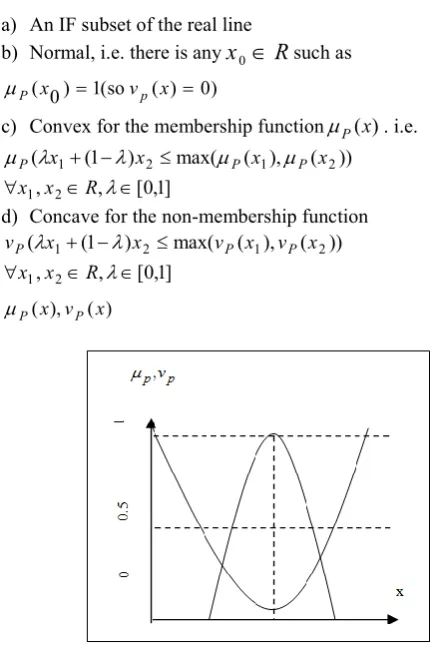
a) An IF subset of the real line
b) Normal, i.e. there is any
x
0
R
such as) 0 ) ( so ( 1 ) 0
(x vp x
P
c) Convex for the membership function
P(x). i.e.] 1 , 0 [ , , )) ( ), ( max( ) 1 ( ( 2 1 2 1 2 1 R x x x x x
x P P
P
d) Concave for the non-membership function
] 1 , 0 [ , , )) ( ), ( max( ) 1 ( ( 2 1 2 1 2 1 R x x x v x v x x
vP P P
) ( ), (x vP x
P
[image:2.595.306.524.301.627.2]
Figure 1. Membership and non-membership function of P
Defuzzification: Expected Value (EV) for ranking the IFN
In this paper, EV that can obtain the crisp interval in IFN developed by [12] is utilized. Suppose that the Expected Interval (EI) of Pis given by:
)] ( ), ( [ )
(P E P E P
EI where
12 12
2
1 ( )
2 1 ) ( 2 1 2 ) ( a
a f x dx
b
b h x dx
a b P
4 3 4 3 4 3 ) ( 2 1 ) ( 2 1 2 ) ( b
b k xdx
a
a g x dx
b a P
E A A
Then, the following definition is true.
Definition 3: The expected value EV(P) of an intuitionistic fuzzy number P {x,
P(x),vP(x)|xX} is the centre of the expected interval of that intuitionistic fuzzy number such as the following:2 ) ' ( ) ( )
(P E P E P
EV
Theorem 1: Suppose that P(a,b,c,d;a',b',c',d') be a Trapezoidal Intuitionistic Fuzzy Number (TrIFN) in X as illustrated by [30] as follows:
otherwise d x c c d x d c x b b x a a b a x x P , 0 , , 1 , ) ( otherwise d x c c d c x c x b b x a a b x b x vP , 1 ' ' , ' ' ' ' ' , 0 ' ' , ' ' ' ) ( When ' ' ' ; ' ' ' , , c d c x a b x d c d x d a b a x
,a'ab'bcc'dd'X, Then the Expected Value (EV) is calculated as follows:
) ' ' ' ' ( 8 1 )
(P a b c d a b c d
EV
According to [31], ifbb'andcc', then
) ' ' 2 2 ( 8 1 )
(P a b c d a d
EV
The DEMATEL Method
According to (Elham Falatoonitoosi, 2013) DEMATEL consists of four basic steps as explained below:
Step 1: Finding the initial direct-influenced (average) matrix according to expert opinion on the values of relationship between different factors. This average matrix is developed based on scales which are: no influence (0), low influence (1), high influence (2) and very high influence (3). The direct-influenced matrix can be formulated as follows:
A H 1 ] [ 1 1 1
H k k nxn H k k ij nxn ij X x H a [image:3.595.336.530.51.430.2]Where H is the number of experts, n is the number of factors (criteria), k is the correspondent expert and Xk is the non-negative matrix that is constructed from the expert’s answer.
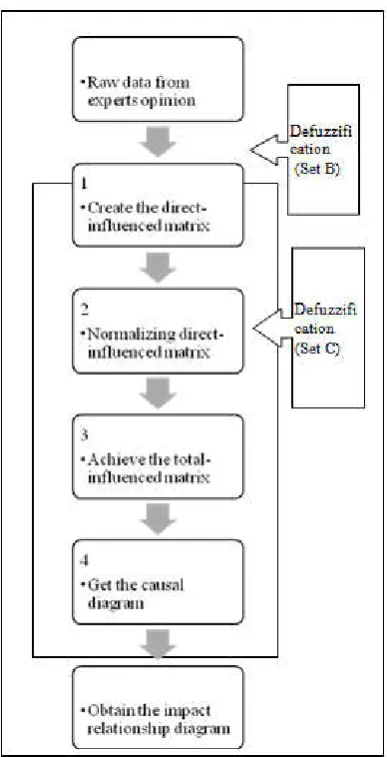
Figure 2. The illustration of the proposed methodology
Step 2: Normalize the initial direct-influenced matrix. The computation of normalized initial direct-influenced matrix, D, is shown below:
} max , max{max 1 1
n j n i ij ij a a s s A DWhere, sis the maximum of the sum of
n
j 1aij which is a
total direct effect that the criterion i receives the most from
other criteria, and the sum of
n
i 1aij as total direct effects
that the criterion j receives the most from other criteria.
Step 3: Calculate the total-relation matrix (T). A continuous reducing of the indirect effects of problems beside the powers of matrix D, like to an engrossing Markov chain matrix, guarantees convergent solutions to the matrix inversion.
) ( ] [ 1 T D I D
T nxn
Step 4: Develop the causal relationship diagram.
The sum of rows and columns of T is computed as follows:
where [ri]nx1 represents the total effects by criterion to other
criteria j. [cj]1xn represents the total effects received by criterion j from the other criteria i. The Prominence and Relation can be computed as follows:
i
i
c
r
i c i r
Relation Prominance
Numerical Example
[image:4.595.315.553.48.207.2]In this paper, three sets of DEMATEL method using hypothetical example were performed. First, the original DEMATEL (no defuzzification) was performed in Set A. In Set B, defuzzification of TrIFN was performed before the original DEMATEL was performed. In Set C, the defuzzification of TrIFN was performed after Step 2 in the DEMATEL method. The proposed methodology of numerical example is illustrated in Figure 2. The table below shows five Trapezoidal intuitionistic fuzzy linguistic scales namely Very High influence (4), High Influence (3), Medium influence (2), Low influence (1) and No influence (0).
Table 1. The trapezoidal intuitionistic fuzzy linguistic scales
Linguistic phrases
TrIFN Expected
values VH
1,1,1,1
,(1,1,1,1) 1.00 H
0.7,0.8,0.9,1
,0.7,0.8,0.9,1
0.85 M 0.3,0.4,0.5,0.6 ,0.2,0.4,0.5,0.7 0.45L 0,0.1,0.2,0.3 ,0,0.1,0.2,0.3 0.15
[image:4.595.319.548.223.365.2]N 0,0,0,0,(0,0,0,0) 0.00
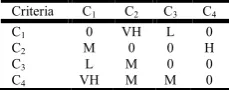
[image:4.595.62.265.349.450.2]Table 2. Raw data from a decision-maker
Table 3. The prominence and relation of Sets A, B and C
Set A B C
+ − + − + −
C1 4.246 -0.620 4.534 -0.602 1.367 0.917 C2 4.931 -0.740 5.427 -0.570 2.437 -0.592 C3 2.164 0.087 1.988 0.104 1.619 -0.246 C4 4.150 1.273 4.646 1.061 2.182 -0.079
FINDINGS
Suppose that a decision-maker wants to select a car according to price (C1), safety (C2), comfort (C3) and colour C4). In order to select the best car (from several alternatives), the decision-maker has to develop the influenced score of each criterion and compute the influenced score of each alternative. Table 2 shows the raw data gathered from a decision-maker: The initial-direct influenced matrix, normalized initial-direct influenced matrix and the total relation matrix are computed using the respective equations in the DEMATEL method. Finally, the prominence (
+
) and relation (−
) of sets A, B and C are shown as follows: [image:4.595.310.555.391.553.2]Figure 3. The causal diagram for Set A
Figure 4. The causal diagram for Set B
Figure 5. The causal diagram for Set C
Conclusion
The relation (
− )
of Sets A, B and C in Table 3 showed the criteria that belong to either effect group or cause group. If the value of relation is negative, the criteria belong to the effect group and vice versa. Thus, C1 and C2 in Sets A and B belong to the effect group, while C3 and C4 are in the cause group. Meanwhile, in Set C, only C1 belongs to the cause group while the other three criteria (C2, C3, and C4) belong to the effect group. This relation of each set was shown in the causal diagram. The findings revealed that there were similarities and differences in all sets. In terms of similarities, the decision-maker found that the safety criteria (C2) showed the highest score in+
for Set A (4.931), Set B (5.427), and Set C (2.437) compared to the other criteria. As illustrated in the causal diagram, C2 was the most influenced by other criteria. However, there are few differences in terms of the criteria ranking in Sets B and C when compared to Set A.[CELLRAN GE]
[CELLRAN GE] [CELLRAN
GE]
[CELLRAN GE]
-1 -0.5 0 0.5 1 1.5
0 2 4 6
RE
LATIO
N
PROMINANCE
Criteria C1 C2 C3 C4
C1 0 VH L 0
C2 M 0 0 H
C3 L M 0 0
[image:4.595.104.219.481.526.2]Set A: 2 > 1 > 4 > 3
Set B: 2 > 4 > 1 > 3
Set C: 2 > 4 > 3 > 1
The criteria ranking in Set B slightly changed since the first and the last rank are similar to the ranking in Set A. However, the ranking in Set C showed a great change and the range of relation was also altered from -0.8 to 1 compared to the other two which are A (-1 to 1.5) and B (-0.8 to 1.2). These results have demonstrated that the defuzzification before attaining total-influenced matrix (Step 3) is more accurate and reasonable in uncertain situations. Thus, decision-makers or researchers should consider the order of defuzzification since it shows significant effects or changes in the results of the IF-DEMATEL method.
Acknowledgments
This research is funded by Ministry of Higher Education (MOHE), Malaysia under Research Acculturation Grant Scheme (RAGS), and Universiti Teknologi MARA, Malaysia. Reference number: 600-RMI/RAGS 5/3 (148/2014).
REFERENCES
Akhbar Alam-Tabriz, Neda Rajabani, & Mojtaba Farrokh. 2014. An integrated fuzzy DEMATEL-ANP-TOPSIS methodology for supplier selection. Global Journal of
Management Studies and Research, 1(2), p.p. 85-99.
Alireza, M. and Abdollah Yavaran, B. 2014. A survey of the cause-effect (causal) relations evaluation in implementation of knowledge management success by DEMATEL method. Academy Business & Scientific
Research, 3(4), 495-506.
Amin Vafadarnikjoo, and Mahdi Saeedpoor. 2014. An intuitionistic fuzzy DEMATEL methodology for prioritizing the components of SWOT matrix in the Iranian insurance company. International Journal of Operational
Research, 20(4), 439-452. doi:10.1504/IJOR.2014.063152
Anandan, V. and Uthra, G. 2014. Defuzzification by area of region and decision making using Hurwicz criteria for fuzzy numbers. Applied Mathematical Sciences, 8(63), 3145-3154.
Angelov, P. (1995). Crispification: Defuzzification of intuitionistic fuzzy sets. Centre of Biomedical Engineering. Bulgaria.
Atanassov, K. T. 1986. Intuitionistic fuzzy sets. Fuzzy Sets and
Systems, 20, p.p. 87-96.
Atanassov, K. T. 1999. Intuitionistic fuzzy sets: Theory and applications. New York: Physica-Verlag
Atanassova, V. and Sotirov, S. 2012. A new formula for de-i-fuzzification of intuitionistic fuzzy sets. 16th International
Conference on IFSs, 18(3), p.p. 49-51.
Bevrani, H. 2012. Defuzzification [slide]. Department of Electrical and Computer Engineering. University of Kurdistan.
Bijoyeta Roy, Preeti Gupta, and Santanu Kr. Misra. 2012. An integrated DEMATEL and AHP approach for personnel estimation. International Journal Computer Science and
Information Technology & Security, 2(6), p.p.1206-1212.
Chen, C. A. 2012. Using DEMATEL method for medical tourism development in Taiwan. American Journal of
Tourism Research, 1(1), p.p. 26-32.
Chuang, H. M., Lin, C. K., Chen, D. R. and Chen, Y. S. 2013. Evolving MCDM Applications Using Hybrid Expert-Based
ISM and DEMATEL Models: An Example of Sustainable Ecotourism. The Scientific World Journal
(751728). doi:10.1155/2013/751728
Ejegwa, P. A., Akowe, S. O., Otene, P. M. and Ikyule, J. M. 2014. An overview on intuitionistic fuzzy sets.
International Journal of Scientific & Technology Research,
3(3), p.p. 142-145.
Elham Falatoonitoosi, Zulkiflle Leman, Shahryar Sorooshian, & Meysam Salimi. 2013. Decision-making trial and evaluation laboratory. Research Journal of Applied
Sciences, Engineering and Technology, 5(13), p.p.
3476-3480.
Ezzati, R., Khodabin, M. and Salahaddin, M. 2013. A new approach for defuzzification of a fuzzy number and its application for ranking fuzzy numbers. Journal of Fuzzy
Set Valued Analysis, p.p. 1-13. doi:
10.5899/2013/jfsva-00156
Grzegorzewski, P. 2003. Distances and orderings in a family of intuitionistic fuzzy numbers. Retrieved from http://www.eusflat.org/proceedings/EUSFLAT_2003/paper s/18Grzegorzewski1.pdf
Heydari, N. and Dehghan, R. 2012. Strategic environment analysis using DEMATEL method through systematic approach: Case study of petroleum drilling company in
Iran. 2nd International Conference on Management (2nd
ICM 2012) Proceeding [11th-12th June 2012], Malaysia.
Kannan Govindan, Roohollah Khodaverdi, and Amin Vafadarnikjoo. 2015. Intuitionistic fuzzy based Dematel method for developing green practices and performances in a green supply chain. Expert Systems with Applications, 42(2015), p.p. 7207–7220. doi:10.1016/ j.eswa.2015.04.030
Katrina, K. 2015. DEMATEL method in practice: Finding the causal relation among key competencies. The 9th
International Days of Statistic and Economics, September
10-12, p.p. 725-732.
Kordi, M. and Brandt, S. A. 2012. Effects of increasing fuzziness on analytic hierarchy process for spatial multicriteria decision analysis. Computers, Environment
and Urban Systems, 36(1), p.p. 43–53.
doi:10.1016/j.compenvurbsys.2011.07.004
Li, Y., Liu, J. and Deng, Y. (2014). Defuzzify firstly or finally: Does it matter in fuzzy DEMATEL under uncertain environment? Expert System and Applications, p.p. 1-14. Mahapatra, G. S. and Roy, T. K. 2013. Intuitionistic fuzzy
number and its arithmetic operation with application on system failure. Journal of Uncertain Systems, 7(2), p.p. 92-107.
Mahdi Mahmoodi, and Gelayol Safavi Jahromi. 2014. A new fuzzy DEMATEL-TODIM hybrid method for evaluation criteria of knowledge management in supply chain.
International Journal of Managing Value and Supply
Chains(IJMVSC), 5(2), p.p. 29-40.
Mitra Bokaei Hosseini, and Mohammad Jafar Tarokh. 2013. Type-2 fuzzy set extension of DEMATEL method combined with perceptual computing for decision making.
Journal of Industrial Engineering International, 9, p.p.
1-10. doi: 1-10.1186/2251-712X-9-10
Mohammad Reza Mehregan, Saye Mostafa Razavi, & Mohammad Reza Akhavan Anvari. 2012. Identification and evaluation of strategic decisions in gas industry using DEMATEL method. Iranian Journal of Management
Nataša, S. 2007. Fuzzy set and fuzzy techniques: Lecture 11-defuzzification. Retrieved from http://www.cb.uu.se/ ~joakim/course/fuzzy/vt07/lectures/L11_4.pdf
Puri, J. and Yadav, S. P. 2015. Intuitionistic fuzzy data envelopment analysis: An application to the banking sector in India. Expert Systems with Applications, 42, 2015. p.p. 4982-4998.
Razieh Keshavarzfard, and Ahmad Makui. 2015. An IF-DEMATEL-AHP based on triangular intuitionistic fuzzy numbers (TIFNs). Decision Science Letters, 4(2015), p.p. 237-246.
Sadia Husain, Yasir Ahmad, & M. Afshar Alam. 2012. A study on the role of intuitionistic fuzzy set in decision making problems. International Journal of Computer
Applications (0975-888), 48(19), p.p. 35-41.
Saneifard, R. and Asghary, A. 2011. A method for defuzzification based on probability density function (II).
Applied Mathematical Sciences, 5(28), p.p. 1357-1365.
Xie, H., Duan, W., Sun, Y. and Du, Y. 2014. Dynamics DEMATEL group decision approach based on intuitionistic fuzzy numbers. TELKOMNIKA, 12(4), p.p. 1064-1072.
Yousefi Nejad Attari, M., Bagheri, M. R. and Neishabouri Jami, E. 2012. A decision making model for outsourcing of manufacturing activities by ANP and DEMATEL under fuzzy environment. International Journal of Industrial
Engineering & Production Research, 23(3), p.p. 163-174.