6288
CUSTOMER ENGAGEMENT IN SOCIAL COMMERCE: A
THEORETICAL REVIEW
1ABDELSALAM H H BUSALIM, 2AB RAZAK CHE HUSSIN, 3AHMAD FADHIL YUSOF
1,2,3 Faculty of Computing, Universiti Teknologi Malaysia, Skudai, 81310 Johor Bahru, Malaysia
E-mail: 1[email protected], 2[email protected], 3[email protected]
ABSTRACT
Social commerce (s-commerce) has changed both businesses and customers. The role of customer has dramatically changed with the rapid growth of commerce. Customer engagement behavior in the s-commerce context has become a key competitive advantage for companies that aim to build a customer-centric business and utilize the power of social media. Numerous studies have conducted to understand the customer behavior to engage in s-commerce, but little effort have been made to incorporate the previous studies to provide theoretical foundation of customer engagement in s-commerce context. The aim of this study is to identify the well utilized theories and factors that influence customer engagement behavior in s-commerce. The study used a systematic Literature Review (SLR) as a method to identify and analyze the theories and factors related to customer engagement. The results shows that the theories which constitute the foundation of customer engagement studies can be classified into: social related theories, technological related theories, behavioral theories and motivational theories, and most of the well utilized factors are tapped under theses classifications. This study provides a comprehensive view of the theoretical foundation of customer engagement studies in s-commerce, and provide theoretical basis for IS research towards the development of empirical research on customer engagement and s-commerce.
Keywords: Social Commerce, Social Media, Customer Engagement Behavior, Systematic Literature
Review
1. INTRODUCTION
The Social media represent one of the most transformative impacts of IT on business [1]. Social media empowered by Web 2.0, enable individuals to communicate, collaborate in vast and international scale [2]. Social commerce (s-commerce) emerged as new form of e-commerce involves using social media which support social interactions and user contributions to assist commercial activities [3]. Despite that several studies considering s-commerce is a sub-set of the traditional e-commerce, there are some differences between them. [2] have distinguished between the two concepts in three aspects. First s-commerce utilizes Web 2.0 features as basis for social interaction, particularly, the core of Web 2.0 features such as user generated content and content sharing [4], whereas e- commerce is used Web 1.0 which provides a classic way of browsing. Second aspect is the business goals, the focus of e-commerce is mainly on increasing the technical efficiency such as quick search, improving recommendations based on customer’s preferences. However, the main business goal in s-commerce is social goal, such as networking, collaboration and
6289 This digital content generated by customers has an economic value [9]. However, the key of business success for companies who aim to gain economic value from social commerce rely on customer engagement[10]. Literature emphasizes that the sustainability and operability of websites are highly rely on customer engagement and continues use[11], [12]. Customer engagement plays key role for the success of virtual environment including commerce [13],[14].The configuration of s-commerce platforms built in two major ways[15]. First, social networks sites can add commercial
features which allow transactions and
advertisements for users, Facebook and LinkedIn are representing the first category. In July 2014 Facebook announced the testing of new buy button for its news feed pages. As well as for Twitter, which announced new button for a small percentage of U.S Twitter users[16]. Second, the traditional e-commerce websites such as Amazon and eBay plug in social networking features to communicate and well understand their customers[17], [18].
The concept of customer engagement (CE) emerged in 2006 as a sub-set of the term engagement which sought to study the customer’s
behavior and emotions toward the
interactions/participation with brands or services [19]. However, engaging customers consistently is a continuing challenge for companies that sell online [20]. In the s-commerce context, most research studies focus on the impact of s-commerce on business outcomes and little investigation has been done to explore customers’ engagement behavior in s-commerce [21]. Previous study was highlighted the lack of studies that identify the factors influencing customer engagement behavior in s-commerce [22]. Moreover, [23] highlighted that ,to harness the impact of s-commerce, there is a need to understand how brands can leverage social media platforms such as Facebook and Twitter in order to engage and collaborate with customers. Overall, s-commerce research still in early stage, s-commerce is increasing and has been the subject of interest in several studies since 2010 [3]. There is scarcity of studies that uncover the theories and factors that influence customer engagement and provides insights to understand the theoretical foundation of customer engagement in s-commerce context [3].The published studies up to date in the this context are fragmented. There is no systematic effort to draw meaningful insights from these studies. for example, the only attempt by [24] conducted a review to explain how consumers behave on s-commerce and provided five stages of
a consumer decision-making process
.
Moreover,little effort has been made to systematically review these studies in order to provide a clear view of s-commerce for academics and practitioners. However, a proper systematic literature review
(SLR) to address the theories used to study CE in
the s-commerce context is missing. Towards these ends, this study has undertaken a SLR approach to contribute to IS field by exploring the theories and the well-utilized factors that have been used in previous s-commerce studies. This study attempt to answer the following research questions:
RQ1: What theories were used to understand customer engagement in s-commerce studies? RQ2: What are the well-utilized factors were studied to understand consumer customer engagement in s-commerce?
The remainder of this paper organized as follow: Section 2 provides literate review on customer engagement and s-commerce, Section 3 highlights methodology used in this study, Section 4 reports the SLR results, Section 5 discuss the results and finally, Section 6 provides the conclusion and remarks of the study.
2. WHAT IS SOCIAL COMMERCE?
Looking at s-commerce definitions in literature reveals that it still does not have a standard
definition and is associated with some
6290 interaction among customers [17], [18]. The majority of the previous studies focus on the first type of s-commerce [28]–[30]. On the other hand, [31] considered Amazon as a practical form of s-commerce because it contains social interactions in the form of online reviews. Group buying websites such as Groupon.com are also considered as a form of s-commerce, where people form a group in order to purchase products with discount advantages [32], [33].
3. CUSTOMER ENGAGMENT
Customer engagement (CE) concept has been built on different theoretical backgrounds, and defined by various researchers in different disciplines. In general, the term engagement means to be involved, occupied and interested in
something[14]. The concept of customer
engagement has three comprising dimensions which are: behavioral, cognitive and emotional. Scholar literature has defined CE in terms of a combination of cognitive, behavioral, and emotional aspects. The cognitive aspect represent that customers are interested in the activities of a company, behavioral aspect refers to the actual participation in commercial or other related activities, and the emotional aspects represent the positive feeling towards any activities of a company. [34] Defined customer engagement as “the level of a customer’s cognitive, behavioral and emotional existence in an online brand community”. However, most of the studies focus on customer engagement as a behavior aspect which considers all non-transactional behaviors (e.g., such as word-of-mouth, blogging and ratings) that can affect a firm [35] [36] [37]. In IS research domain, customer engagement comprises both user participation and involvement [38], and can be defined as “the intensity level of a customer to participate together with the company and with other customers in a cooperative knowledge exchange and information-sharing process [39]. Consistent with this, CE defined as “the intensity level of customer’s participation and connection with the company’s offerings and activities initiated by either the customer or the company [36].
Because s-commerce involves two main attributes (social activities and commercial activities), CE in s-commerce environment contains both transactional and non-transactional behavior. The direct transaction indicates the purchasing behavior of a customer during the buying process. Similarly, non-transactions refer to referral, information-sharing activities, information seeking,
and after-sales phases of the customer [10]. However, this study used the well-known definition by [40] who defined CE as “customer’s behavioral manifestations that have a brand or firm focus, beyond purchase, resulting from motivational drivers”.
4. METHODOLOGY
This study conducted a Systematic Literature
Review (SLR) as a method to review, analyze and synthesis s-commerce and customer engagement literature in order to investigate the well-utilized theories/factors that used, and finally to provide comprehensive view on the theoretical foundation of customer engagement on s-commerce context. SLR can create solid basis for advancing knowledge, facilitating the development of theory, as well as discovering new area of research [41]. Based on the procedure described in [42], this study employed four phases to identify, analyze, codify and report on the previous studies in relation to customer engagement. The first phase is identifying and extracting the relevant studies. The second phase involves designing and executing a detailed coding protocol of the capturing and coding procedure. The third phase encompasses the actual coding of relevant information and nodding classification. The final stage involves analyzing and reporting of the literature findings.
6291
Table 1: Inclusion and Exclusion Criteria
Inclusion Criteria Exclusion Criteria
1. Full-text 2. Published within selected period of time (2010-2015).
3. Published in the above selected database. 4. Study manuscript written in English. 5. In the domain of e-commerce or s-e-commerce.
1. Uncompleted studies. 2. Non English. Outside the selected time.
4.Duplicated studies
5. RESULTS
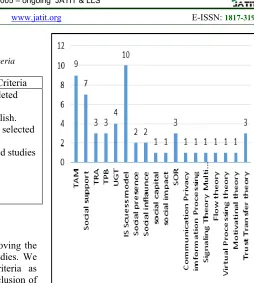
The total number of studies after removing the duplication using Mendeley, was 207 studies. We then applied the inclusion/exclusion criteria as shown in Table 1 on the abstract and conclusion of each study. In this step total 86 studies were eliminated based on abstract and conclusion. Full-text scanning was used for the rest of the remaining studies with the consideration of the exclusion criteria. Moreover, after applying manual search on each primary study, 12 additional studies were found to be related to the topic. Thus, the final set of primary studies was 133. Figure 1 illustrates the study selection process that has been carried out for this SLR. These studies have been analyzed using Nvivo 10 software to extract the findings. All extracted studies were saved in Nvivo. Tree-level nodes, namely (theories and factors) were created as pre-codification scheme. The analysis process for this review were conducted in two levels. First level is to capture all the literature related to the factors and theories and analyze them to identify the well utilized factor/theories that customer engagement in s-commerce context. The second level dedicated to analyze in-depth of the extracted details of each node in order to be able to synthesis and classify the well-utilized factors/theories to derive the intended findings. Using this deductive analysis approach enable the researcher to categorize the findings under related aspect. The detailed results from this analysis is described in the following sub-sections,
Figure 2: Summary of theories
4.1 Well Utilized Theories/ Factors
The results show that most of the s-commerce studies used theories under Explanation and prediction (EP) category as a theoretical foundation for their models. This due to Explanation and
prediction theory provides both testable
6292 4.2 Social Related Theories/Factors
The important role of social aspect brought by the social nature of s-commerce allows the researchers to derive theoretical insights into s-commerce from social-related theories [24]. These theories include: social support theory; social presence theory; social influence theory; and social exchange theory. SST indicates that when social support exists in a social network, it would be natural for community members to share commercial information and recommendations as an extension of their sharing of other supportive information [44]. However, social support (e.g., information support and emotional support) fulfills customers’ social needs and inspires them to conduct useful interaction between each other. As these interactions and supportive information exchanges increase, customers enter into more satisfying and warm relationships. For example, Twitter members regularly provide social support for others [45] [46].
A recent study by [47] highlighted the potential role of social information on the consumer purchase decision. The social presence theory highlights that customers are able to establish a personal, warm and sociable interaction amongst each other in the s-commerce environment[10]. Based on the social exchange theory customers consider both costs and benefits to decide whether or not to engage in s-commerce activities. For example [48] adopted the social exchange theory to study the concept of user engagement in the context of online brand communities. Meanwhile, social influences can help to explain the effect of social exchanges on a customer’s behavior. A study by[14] found that social influence factors (e.g., social identity and maintaining interpersonal interconnectivity) have a positive effect on a user’s engagement on Facebook pages.
Relationship quality is found to be one of the most well utilized factors that has impact on customer engagement in s-commerce. Relationship quality refers to “the intensity and tightness of a relationship, which plays an important role in influencing customer loyalty” [49]. Prior research has utilized relationship quality as a lens through which to understand customers’ interactions with brands [50] [51]. Through the literature review, three main components which help to construct relationship quality, namely: trust, relationship commitment, and relationship satisfaction[49] [50] [51] [52]. Trust refers to the belief that the service provider is honest and benevolent [53].
Commitment defines a customer's desire to continue a relationship with a retailer[52]. It is a psychological state which occurs when an ongoing relationship with a service provider is so important as to warrant maximum efforts at maintaining it [44]. Commitment is the key to a long term relationship. Finally, satisfaction is defined as being the emotional state that represents the overall evaluation of interactive experience with the service provider [44], [52]. In the s-commerce context, customer engagement needs the establishment of trust, commitment and satisfaction in a buyer-seller relationship[54]. Relationship quality presents positive influence on customer engagement behavior [55] [56] [44].
4.3 Motivation Related Theories Factors
The Uses and gratification theory (UGT) was developed by [57]. It is one of the mass communications and has been widely employed to investigate the wide range of traditional media such as television, newspapers, radio and telephones[58]. Since the growth of internet usage, the interest in applying UGT in various domains has continued to flourish [13]. The main objective of UGT is to attempt to understand the psychological needs of people which encourage them to use media and the reasons that motivate them to engage in certain
types of media [59]. UGT has three basic
assumptions [58]. First, people are active users of
media. Second, people select media for intentional
communication purposes, and their behaviors are goal-oriented. Finally, they know their motives behind selecting a specific type of medium. One of the strengths of UGT and its classification of benefits lies in the flexibility of study of various behavioral patterns across different media usage contexts [13]. UGT has received attention in s-commerce and social shopping research: both practically in investigating what motivates customers to engage in s-commerce platforms/fan pages; and also how to satisfy customers’ needs (as mentioned in the studies by[22] [13] [60] [61] [62].
6293 to [64], both hedonic and utilitarian factors compose the dimensions of web consumptions. The hedonic and utilitarian motivations are determined by the degree of utility provided and/or the
enjoyment provided to users [28]. Customers with
utilitarian motivation seek to achieve certain goals through online communities such as finding information about products or services before they make any purchasing decision. While, hedonic motivation focuses on a customer’s emotional needs, which take into account non-functional behaviors such as, fantasy, sensuality, and enjoyment. [65] pointed out that hedonic customers seek websites that provide more than transactional security and quick access to a large amount of information. Instead, activities that are fun, exciting, and enjoyable, and which satisfy intrinsic needs are the main consideration to them [66]. [63] refers to hedonic motivations as a customer’s enjoyment of the shopping experience itself.
Likewise, motivation theory suggests that a customer’s extrinsic motivation (e.g., Perceived usefulness) and the intrinsic motivation (e.g., entertainment value) have a positive impact on users’ attitudes toward using s-commerce websites
[67]. Likewise, motivation theory suggests that a
customer’s extrinsic motivation (e.g., Perceived usefulness) and the intrinsic motivation (e.g., entertainment value) have a positive impact on users’ attitudes toward using s-commerce websites [67].
4.4 Technological Related Theories Factors The results show that factors such as website quality and technological issues in s-commerce have gained considerable attention among researchers. Research shows that the level of customer engagement on s-commerce is influenced by the quality (e.g., service quality and information quality) of particular websites[64]. Prior studies adopted IS success model [68] [69] to expose insights on s-commerce platforms. The IS model suggests that e-commerce success can be determined by six dimensions, specifically: system quality, information quality, user satisfaction, system use, individual impact, and organizational impact respectively. The model suggests that customers’ attitude, for example, in relation to satisfaction and behavior such as purchase or
repurchase intention) depends on their belief about the quality of the e-commerce systems[64]. The IS success model was used to examine the internet shopping site qualities on hedonic and utilitarian values, in addition to their influence on repurchase intention. Another attempt to use the D&L model was by [70] in order to study the stickiness of users in business to customer group buying sites.
Interactivity is another key factor influence CE in s-commerce. It is defined as the degree to which a communication technology allows the design of an environment where individuals can exchange messages and communicate with each other [71]. S-commerce, as a dynamic environment, allows customers to create content, share shopping experiences with others and post shopping messages [10]. Customers interact with the s-commerce environment through enabled technological features. These features refer to the subjective properties of
the s-commerce platform [10]. Therefore,
Interactivity as a key design feature has been found to influence customer response to the online medium [10]. the s-commerce environment with high perceived interactivity provides a suitable platform for self-presentation, content generation and exchange of social support [44][10]. It has been noticed that numerous studies have investigated the influence of interactivity on for instance, television as new channels appear in e-commerce [71], eWOM [56]; s-commerce sites [10], [72]; and the virtual environment such as virtual goods [73]. Therefore, interactivity is considered to be a key engagement factor in the new e-commerce era.
Overall, the technological aspect of s-commerce represent a key part that encourage customers to engage in s-commerce activities. Prior research discussed suitable design features related to e-commerce and Web 2.0, in s-e-commerce and propose a set of principles for s-commerce platform design [4]. Another effort has been made [74] who introduces a model that captures the essential features of the s-commerce business model.
4.5 Behavioral Related Theories Factors
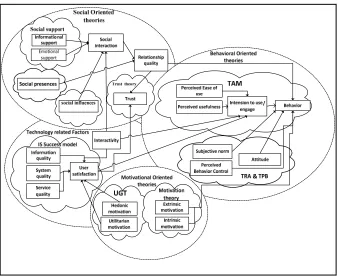
s-6294 commerce and customer behavior research. for example, a study by [7] used both TAM and TPB to examine the behavioral predictors of using s-commerce sites. TAM emphasize on the important role of Perceived ease of use and usefulness of s-commerce intension to use, where TPB and TRA provides the attitude, perceived behavior control as antecedence towards continuance participation intension [11] . In summary, Figure 3 summarizes all the well utilized theories and factors that have been applied in previous studies.
5. DISCUSSION AND IMPLICATIONS
The growth of s-commerce usage has been
shown influence on engaging customer in this new phenomenon. This study is conducted to systematically review the studies on customer engagement in s-commerce. The study investigates and categorizes the theories/ factors influencing customers’ engagement in s-commerce. The results show that the theoretical foundation of CE in s-commerce is basis on social, technological, motivational, and motivational theories. This broad
view can contribute to achieving deep
understanding as to how customers in these dynamic environments engage and co-create value. As practical implication, the findings of this study reveals that social theories/factors play important role in engaging customers. Thus, companies that seeking for competitive advantage and marketing potential are advised to integrate social networks sites in their e-commerce sites. In addition, the influence of technological factors such as interactivity, information quality and service quality enrich the communication between customers and develop participant conversation. This indicates that customer are intended to engage in platforms that allow them to create content and share it with other customers.
Overall, the results of this study theoretically contributes to IS research in two perspectives. First this study provides a holistic model to show the theoretical foundation of customer engagement behavior in s-commerce context. The model explains the impacts of social, technological and motivation aspects on customer engagement, which advance the knowledge on what stimulate customers to engage in s-commerce activities. Second, this study is one of the earliest studies that provides theoretical dimensions for customer engagement behavior in s-commerce (Social, technological, motivation, and behavioral), this can help the researchers to deeply understand the
theoretical foundation of the customers
engagement. Thus, the results in this aspect will provide long-term impact to IS research by providing theoretical basis for developing empirical research on customer engagement.
The findings of this study open motivation for new research in the context of s-commerce. For example, most of the studies still focusing on the behavioral and social aspect of s-commerce, while the technological aspect is key concept in the near future. More research is needed to investigate the technological features that effect customer to engage in s-commerce platforms.
6. CONCLUSION AND FUTURE WORK The emergence of s-commerce as new phenomenon in business has redefined the relationship with the customer. The role of customer has dramatically changed with the rapid growth of s-commerce, they are more proactive and they are willing to play significant role with new product and services. This study used an SLR method to provide an overview of the theoretical foundation of customer engagement in s-commerce by identifying the theories and factors used in previous studies. Throughout the collected studies. The results of this review show that the theories and factors which have been used in previous studies can be classified into: social related theories, motivational theories, behavioral theories and Technological related. Moreover, most of the studies attempting to investigate the influence of socialization notion on commerce, because customers are nowadays more value creators compared with couple of years back. This justify the high number of studies using social theories and factors. This study contributing to the body of knowledge by addressing the theoretical foundation of the previous studies on customer engagement in s-commerce context, and identifying the well-utilized factors.
The findings form this study ignites some opportunities for further research. First, the proposed model can be examined empirically in the context of s-commerce. Second, further research can contribute to the CE by integrating some of the identified theories, which will give more insights on what encourage customers to engage in s-commerce. Third, new research can extend the proposed model using other theories to provide different perspective to understand and expose new
6295 ACKNOWLEDGEMENT
This work is supported by the Malaysia Ministry of Higher Education (MOHE) and Research Management Centre (RMC) at the Universiti Teknologi Malaysia (UTM) under the Research
University Grant Category (VOT
Q.J130000.2528.16H49).
REFERENCES
[1] V. Todri, “Social Commerce : An Empirical Examination of the Antecedents and Consequences of Commerce in Social
Network Platforms,” in Proceeding of Thirty
Fifth International Conference on Information Systems, 2014, pp. 1–18.
[2] M. Sigala, “Collaborative commerce in tourism: implications for research and
industry,” Curr. Issues Tour., pp. 1–10, Jan.
2015.
[3] C. Wang and P. Zhang, “The Evolution of Social Commerce : The People , Management , Technology , and Information Dimensions,” Commun. Assoc. Inf. Syst., vol. 31, pp. 105– 127, 2012.
[4] Z. Huang and M. Benyoucef, “From e-commerce to social e-commerce: A close look
at design features,” Electron. Commer. Res.
Appl., vol. 12, no. 4, pp. 246–259, 2013. [5] Z. Huang and M. Benyoucef, “User-centered
investigation of social commerce design,” in
Online Communities and Social Computing,
vol. 8029, Berlin, 2013, pp. 287–295.
[6] L. Sturiale and A. Scuderi, “Evaluation of Social Media Actions for the Agrifood
System,” Procedia Technol., vol. 8, pp. 200–
208, 2013.
[7] D.-H. Shin, “User experience in social
commerce: in friends we trust,” Behav. Inf.
Technol., vol. 32, no. 2015, pp. 52–67, 2013. [8] T. Hennig-Thurau, E. C. Malthouse, C.
Friege, S. Gensler, L. Lobschat, A. Rangaswamy, and B. Skiera, “The Impact of
New Media on Customer Relationships,” J.
Serv. Res., vol. 13, pp. 311–330, 2010. [9] Amir Afrasiabi Rad and M. Benyoucef, “A
Model for Understanding Social Commerce Amir,” J. Inf. Syst. Appl. Res., vol. 4, no. 2, pp. 1–64, 2011.
[10] H. Zhang, Y. Lu, S. Gupta, and L. Zhao, “What motivates customers to participate in
social commerce? The impact of
technological environments and virtual
customer experiences,” Inf. Manag., vol. 51,
pp. 1017–1030, 2014.
[11] N. Hajli, M. Shanmugam, P. Powell, and P. E. D. Love, “A study on the continuance participation in on-line communities with
social commerce perspective,” Technol.
Forecast. Soc. Change, vol. 96, pp. 232–241,
2015.
[12] M. M. Al-Debei, E. Al-Lozi, and A. Papazafeiropoulou, “Why people keep coming back to Facebook: Explaining and predicting continuance participation from an extended theory of planned behaviour
perspective,” Decis. Support Syst., vol. 55, no.
1, pp. 43–54, 2013.
[13] T. Verhagen, E. Swen, F. Feldberg, and J. Merikivi, “Benefitting from virtual customer environments: An empirical study of
customer engagement,” Comput. Human
Behav., vol. 48, pp. 340–357, 2015.
[14] M. J. De Oliveira, M. K. Z. Huertas, and Z.
Lin, “Factors driving young users’
engagement with Facebook: Evidence from
Brazil,” Comput. Human Behav., vol. 54, pp.
54–61, 2016.
[15] C. Bianchi, L. Andrews, M. Wiese, and S. Fazal-E-Hasan, “Consumer intentions to engage in s-commerce: a cross-national
study,” J. Mark. Manag., vol. 0, no. 0, pp. 1–
31, 2017.
[16] K. Findings and J. Sussin, “Market Guide for Social Customer Service Applications,” Gartner, no. October, 2014.
[17] T.-P. Liang and E. Turban, “Introduction to the Special Issue Social Commerce: A Research Framework for Social Commerce,” Int. J. Electron. Commer., vol. 16, no. 2, pp. 5–14, 2011.
[18] L. Xiang, X. Zheng, H. Zhang, and X. Hu, “What Drive Social commerce: The role of
Parasocial intreaction,” in Proceeding of the
19th Pacific Asia Conference on Information Systems, 2014.
[19] S. D. Vivek, S. E. Beatty, V. Dalela, and R. M. Morgan, “A generalized Multidimensional
scale for measuring customer engagement,” J.
6296 41, 2014.
[20] Gartner Inc., “The Key to E-Commerce Success Is Your Customer Engagement Strategy,” 2014.
[21] L. Guo-xin and Y. Xue, “Exploring Social Commerce Adoption in China : A Uses and
Gratification Perspective,” in International
Conference on Management Science &
Engineering, 2014, pp. 546–554.
[22] R. E. Crossler, “Intention to Engage in Social
Commerce : Uses and Gratifications
Approach,” in the Twentieth Americas
Conference on Information Systems, 2014.
[23] N. De Vries and J. Carlson, “Examining the drivers and brand performance implications of customer engagement with brands in the
social media environment,” J. Brand Manag.,
vol. 21, no. 6, pp. 1–21, 2014.
[24] K. Z. Zhang and M. Benyoucef, “Consumer behavior in social commerce: A literature
review,” Decis. Support Syst., vol. 86, pp. 95–
108, 2016.
[25] L. Zhou, P. Zhang, and H. D. Zimmermann, “Social commerce research: An integrated
view,” Electron. Commer. Res. Appl., vol. 12,
no. 2, pp. 61–68, 2013.
[26] S. Sharma and R. E. Crossler, “Disclosing too
much? Situational factors affecting
information disclosure in social commerce
environment,” Electron. Commer. Res. Appl.,
vol. 13, no. 5, pp. 305–319, 2014.
[27] P. Marsden and C. Paul, The Social
Commerce Handbook: 20 Secrets for Turning
SocialMedia Into Social Sales. McGraw-Hill,
New York, 2012.
[28] E. Pöyry, P. Parvinen, and T. Malmivaara, “Can we get from liking to buying? Behavioral differences in hedonic and
utilitarian Facebook usage,” Electron.
Commer. Res. Appl., vol. 12, pp. 224–235, 2013.
[29] C. S. P. Ng, “Intention to purchase on social commerce websites across cultures: A
cross-regional study,” Inf. Manag., vol. 50, no. 8,
pp. 609–620, 2013.
[30] M. Shanmugam, S. Sun, A. Amidi, F. Khani, and F. Khani, “The applications of social
commerce constructs,” Int. J. Inf. Manage.,
vol. 36, no. 3, pp. 425–432, 2016.
[31] N. Amblee, “Harnessing the Influence of
Social Proof in Online Shopping:,” Int. J.
Electron. Commer., vol. 4415, no. November,
pp. 91–114, 2011.
[32] S. Kim and H. Park, “Effects of various characteristics of social commerce (s-commerce) on consumers’ trust and trust
performance,” Int. J. Inf. Manage., vol. 33,
no. 2, pp. 318–332, 2012.
[33] Q. Wang, J. Xu, and J. Liu, “Group purchase: A win-win combination of social networking
services with e-commerce typical
representative-Nuomi.com,” in Proceedings
of 2nd International Conference on
Information Science and Engineering, 2010,
pp. 2111–2114.
[34] T. K. H. Chan, M. K. O. Lee, and Z. W. Y. Lee, “Antecedents and consequences of customer engagement in online brand
communities,” J. Mark. Anal., vol. 2, no. 2,
pp. 81–97, 2014.
[35] P. C. Verhoef, W. J. Reinartz, and M. Krafft, “Customer Engagement as a New Perspective
in Customer Management,” J. Serv. Res., vol.
13, no. 3, pp. 247–252, 2010.
[36] S. D. Vivek, S. E. Beatty, and R. M. Morgan, “Customer Engagement: Exploring Customer
Relationships Beyond Purchase,” J. Mark.
Theory Pract., vol. 20, no. 2, pp. 122–146, 2012.
[37] T. H. a. Bijmolt, P. S. H. Leeflang, F. Block, M. Eisenbeiss, B. G. S. Hardie, A. Lemmens, and P. Saffert, “Analytics for Customer
Engagement,” J. Serv. Res., vol. 13, no. 3, pp.
341–356, 2010.
[38] M. I. Hwang and R. G. Thorn, “The effect of user engagement on system success: A meta-analytical integration of research findings,” Inf. Manag., vol. 35, no. 4, pp. 229–236, 1999.
[39] C. Wagner and A. Majchrzak, “Enabling Customer-Centricity Using Wikis and the
Wiki Way,” J. Manag. Inf. Syst., vol. 23, no.
3, pp. 17–43, Dec. 2007.
[40] J. Van Doorn, K. N. Lemon, V. Mittal, S. Nass, D. Pick, P. Pirner, and P. C. Verhoef, “Customer Engagement Behavior: Theoretical
Foundations and Research Directions,” J.
6297 [41] J. Webster and R. Watson, “Analyzing the
Past To Prepare for the Future: Writing a
Literature Review,” MIS Q., vol. 26, no. 2, pp.
13–23, 2002.
[42] W. Bandara, S. Miskon, and E. Fielt, “A
systematic, tool-supported method for
conducting literature reviews in information
systems,” in Proceeding of 19th Eroupean
conference on Information Systems, 2011, p. Paper 221.
[43] Y. Levy and T. . Ellis, “A Systems Approach to Conduct an Effective Literature Review in Support of Information Systems Research,” Informing Sci. J., vol. 9, pp. 181–212, 2006. [44] T.-P. Liang, Y.-T. Ho, Y.-W. Li, and E.
Turban, “What Drives Social Commerce: The Role of Social Support and Relationship
Quality,” Int. J. Electron. Commer., vol. 16,
no. 2, pp. 69–90, 2011.
[45] a. Gruzd, B. Wellman, and Y. Takhteyev,
“Imagining Twitter as an imagined
community,” Am. Behav. Sci., vol. 55, no. 10,
pp. 1294–1318, 2011.
[46] N. Hajli and J. Sims, “Social commerce: The transfer of power from sellers to buyers,” Technol. Forecast. Soc. Change, vol. 94, pp. 350–358, 2015.
[47] A. Chen, Y. Lu, and B. Wang, “Customers? purchase decision-making process in social commerce: A social learning perspective,” Int. J. Inf. Manage., vol. 37, no. 6, pp. 627– 638, 2017.
[48] X. Zheng, C. M. K., K. O. C. Matthew, and L. L. Liang, “Buliding brand loyalty through
user engagement in online brand
communities,” Inf. Technol. People, vol. 28,
no. 1, pp. 90–106, 2015.
[49] T. Hennig-Thurau, K. P. Gwinner, and D. D.
Gremler, “Understanding Relationship
Marketing Outcomes: An Integration of
Relational Benefits and Relationship
Quality,” J. Serv. Res., vol. 4, no. 3, pp. 230–
247, 2002.
[50] Y. Wang, C. Management, J. Raymond, and M. N. Hajli, “Co-Creation in Branding through Social Commerce : The Role of Social Support , Relationship Quality and
Privacy Concerns,” in Proceeding of
Twentieth Americas Conference on Information Systems, 2014, pp. 1–16.
[51] J. Romero, “Exploring customer engagement behavior : construct proposal and its
antecedents,” in Proceeding of 2nd
International Symposium on Partial Least
Squares Path Modeling, 2015, vol. 31517, pp.
1–12.
[52] M. N. Hajli, “The role of social support on relationship quality and social commerce,” Technol. Forecast. Soc. Change, vol. 87, pp. 17–27, 2014.
[53] A. Gustaffsson, M. D. Johnson, and I. Roos, “The Effects of Customer Satisfaction, Relationship Commitment Dimensions, and
Triggers on Customer Retention,” J. Mark.,
vol. 69, no. 4, pp. 210–218, 2005.
[54] C. M. Sashi, “Customer engagement, buyer-seller relationships, and social media,” Manag. Decis., vol. 50, no. 2, pp. 253–272, 2012.
[55] S.-M. Wang, “Exploring the factors influencing the usage intention of Facebook fan page - A preliminary study,” in Proceeding of 19th Americas Conference on
Information Systems, 2013, vol. 2, pp. 1595–
1600.
[56] S.-C. Chu and Y. Kim, “Determinants of consumer engagement in electronic word-of-mouth (eWOM) in social networking sites,” Int. J. Advert., vol. 30, no. 1, p. 47, 2011. [57] E. Katz, J. G. Blumler, and M. Gurevitch,
“Uses and Gratifications Research,” public
Opin. Q., vol. 14, no. 3, pp. 419–442, 1973. [58] C. Xu, S. Ryan, V. Prybutok, and C. Wen, “It
is not for fun: An examination of social
network site usage,” Inf. Manag., vol. 49, no.
5, pp. 210–217, 2012.
[59] A. M. Rubin, “An examination of television
viewing motives,” J. Commun., vol. 8, no. 3,
pp. 141–165, 1994.
[60] A. Rohm, V. D. Kaltcheva, and G. R. Milne, “A mixed-method approach to examining brand-consumer interactions driven by social
media,” J. Res. Interact. Mark., vol. 7, pp.
295–311, 2013.
6298 [62] B. Jahn and W. Kunz, “How to transform
consumers into fans of your brand,” J. Serv.
Manag., vol. 23, no. 3, pp. 344–361, 2012.
[63] K. C. Anderson, D. K. Knight, S. Pookulangara, and B. Josiam, “Influence of hedonic and utilitarian motivations on retailer loyalty and purchase intention: A facebook
perspective,” J. Retail. Consum. Serv., vol.
21, pp. 773–779, 2014.
[64] C. Kim, R. D. Galliers, N. Shin, J.-H. Ryoo, and J. Kim, “Factors influencing Internet shopping value and customer repurchase
intention,” Electron. Commer. Res. Appl., vol.
11, no. 4, pp. 374–387, Jul. 2012.
[65] S. Ramaswami, T. Strader, and K. Brett, “Determinants of on-line channel use for
purchasing financial products,” Int. J.
Electron. Commer., vol. 5, pp. 95–118, 2000. [66] Y. H. Kim, D. J. Kim, and K. Wachter, “A
study of mobile user engagement (MoEN): Engagement motivations, perceived value, satisfaction, and continued engagement
intention,” Decis. Support Syst., vol. 56, pp.
361–370, 2013.
[67] T. Verhagen, F. Feldberg, B. Van Den Hooff, S. Meents, and J. Merikivi, “Understanding users’ motivations to engage in virtual worlds: A multipurpose model and empirical testing,” Comput. Human Behav., vol. 28, no. 2, pp. 484–495, 2012.
[68] W. H. Delone and E. R. Mclean, “The DeLone and McLean Model of Information
Systems Success: A Ten-Year Update,” J.
Manag. Inf. Syst., vol. 19, no. 4, pp. 9–30, 2003.
[69] W. H. Delone and E. R. Mclean, “Measuring e-Commerce Success : Applying the DeLone & McLean Information Systems Success
Model,” Int. J. Electron. Commer., vol. 9, no.
1, pp. 37–41, 2004.
[70] W.-T. Wang, Y.-S. Wang, and E.-R. Liu, “The stickiness intention of group-buying websites: The integration of the commitment– trust theory and e-commerce success model,” Inf. Manag., vol. 53, no. 5, pp. 625–642, 2016.
[71] L. Blasco-Arcas, B. Hernandez-Ortega, and J. Jimenez-Martinez, “Adopting television as a new channel for e-commerce. The influence of interactive technologies on consumer
behavior,” Electron. Commer. Res., vol. 13,
pp. 457–475, 2013.
[72] J. B. Kim, “The Mediating Role of Presence on Consumer Intention to Participate in a
Social Commerce Site,” J. Internet Commer.,
vol. 14, no. 4, pp. 425–454, 2015.
[73] A. Animesh and A. Pinsonneault, “An odyssey into virtual worlds: exploring the impacts of technological and spatial environments on intention to purchase virtual
products,” MIS Quarterly, vol. 35, no. 3, p.
789, 2011.
[74] D. Kim, “Under what conditions will social
commerce business models survive?,”
6299 Selected search
Engines
Data Data
Online Databases KEYWORDS
“Social commerce” ‘S‐commerce’ “Electronic Social
commerce” “social e‐commerce” ____________________
Search Fields Title, abstract ,Keywords
Science Direct Scopus Web of science IEEE Explore AIS eLibrary ACM Digital Library
Search Results
Screening Title & Abstract
n= 225 n= 207
n= 87 Duplicate
Removal
n= 18
Full‐Text Screening + Forward Search
132 Relevant Studies on SC
[image:12.612.156.494.391.668.2]Figure 1: Study Selection Process