162
FACTORS AFFECTING SELLER LOYALTY IN BUSINESS
E-MARKETPLACE : A CASE OF INDONESIA
1 GABRIELLA JANE ADITHA SANTOSO, 2TOGAR ALAM NAPITUPULU
1 Master in Information Systems Management, Bina Nusantara University, Indonesia
2 Master in Information Systems Management, Bina Nusantara University, Indonesia
E-mail: 1 [email protected], 2[email protected]
ABSTRACT
The development of commerce in Indonesia, especially marketplace is very fast. The number of e-marketplaces operating in Indonesia continues to increase over time. This condition makes the competition in e-marketplace business becomes more competitive. To survive, e-marketplace must be able to maintain and increase their number of customers. Basically, customers in the e-marketplace business are not just buyers, the sellers who market their goods and / or services in the e-marketplace are also customers of the e-marketplace. Some constraints experienced by the seller can cause the seller to leave the e-marketplace, this can be a serious threat for the e-marketplace that only acts as an intermediary. Although many studies have been conducted to determine the factors affecting buyer loyalty, but differences in objective and technical experience of buyers and sellers cause studies conducted on buyers can not be applied directly to sellers. Based on these backgrounds, then conducted research to find the factors that affect the loyalty of sellers in e-marketplace business. The research model was established and developed based on some previous research. Some factors such as efficiency, security and privacy, communication, reliability, information, value added services, image, cost, and promotion are examined to obtain answers to research objectives. The sample in this research is taken from the seller in e-marketplace in Indonesia. The method of analysis used in this research is Structural Equation Modeling (SEM). The results of this study found that the satisfaction, image, cost, promotion and value added services have a positive impact on the loyalty of the seller. Satisfaction is a factor that has the greatest influence on seller loyalty.
Keywords: E-marketplace; E-commerce; Factors; Seller Loyalty; Structural Equation Modeling
1.
INTRODUCTIONThe Internet has become a part of everyday life and has influenced how people communicate, work and spend their free time. Another significant change caused by the growth of the internet is how the company runs its business. The Internet not only has the potential to change the way to run a business, it also has the potential to create new ones and new business (Afuah and Tucci, 2001). Running a business through the internet is generally known as electronic commerce (e-commerce).
There are many type of e-commerce, one of them is marketplace. E-marketplace is a type of e-commerce site that connects sellers that is people that provide products or services with buyers that is people looking for products or services to buy. In Indonesia, examples of e-commerce portals that have e-marketplace models are Tokopedia, Bukalapak, Lazada, Mataharimall, Shopee, and Blanja. This e-marketplace business model has an
advantage in terms of inventory, operational and margin efficiencies so it becomes very popular and enthused by many companies. Many new e-marketplace emerge every year, this condition makes the competition in e-marketplace business becomes more competitive. To survive, e-marketplace must be able to maintain and increase their number of customers. As mentioned earlier, the seller is one of the main components of the e-marketplace business, with many e-e-marketplace options available, sellers will have the freedom to choose and can easily switch to another e-marketplace if they experience even the most minor inconvenience (Hyperwallet, 2017).
163 their merchandise and their social networks, both of which are competitive resources of C2C platform providers (Chen et al., 2009).
There are many studies that learn about the loyalty of buyers but still a few who learn about the loyalty of the sellers, whereas buyers and sellers has some fundamental differences.
First, sellers and buyers have different primary goals. Sellers have the primary goal of gaining long-term profit through selling as many products as possible to as many buyers as possible to earn as much money as possible with the lowest possible transaction costs. In contrast to buyers who have a primary goal to meet their needs through the purchase of appropriate products from the right seller with the least amount of money and the lowest possible transaction costs (Sun and Finnie, 2004).
Second, sellers and buyers visit different website pages as well as follow the processes designed for different functions which is selling and buying products. As a buyer, the main activity is to search products and do check out processes of their shopping cart, while the seller interacts mostly with the website pages designed to facilitate online sales (Sun, 2010).
Broadly speaking, sellers and buyers have different goals and technical experience related to the transactions they do on the e-marketplace. Therefore, research conducted on buyer loyalty can not be applied directly to the seller loyalty.
The objectives of this research are identifying the factors that influence loyalty of sellers in e-marketplace business in Indonesia. It will benefit the e-marketplace’s owner to improve their company performance by adjusting their strategies related to sellers as their customers. The result of this research is only valid for the e-marketplace in Indonesia and may give different result if it’s done in a different country.
2.
LITERATURE REVIEW2.1 E-Marketplace
E-marketplace is part of e-commerce. According to Turban et al. (2008) e-marketplace is a virtual marketplace where buyers and sellers meet and
conduct various transactions. Marketplace
(electronic or other) has three main functions, that is:
[1] Meet buyers and sellers.
[2] Facilitating the exchange of information,
goods, services and payments related to market transactions.
[3] Provide institutional infrastructure, such as
legal and regulatory frameworks that enable efficient functioning of the market.
2.2 Service Quality in E-Marketplace
E-service quality can be defined as extent to which a website facilitates efficient and effective shopping, purchasing, and delivery of products and
services (Zeithaml et al.,2000)[11]. According to the
literature study conducted by Janita and Miranda
(2013)[12], it is found that most researchers use the
dimensions of efficiency, security and privacy, communication, reliability, and information as a component of e-service quality. In addition, one dimension is added, called value-added services, which in the field of e-marketplace, this dimension can be a distinguishing element that will provide a competitive advantage for the company.
1) Efficiency
The efficiency dimension refers to four aspects related to accessibility, usability, design, and system availability. Accessibility indicates a user's ability to access the information provided on the website. Usability is defined as the ability of the customer to find information or make transactions with least amount of effort. Design is a related aspect of website's overall layout, i.e., that is well organized and structured. System availability refers to the good technical operation of the website. The company may not have full control over this dimension because it may be affected by the customer's equipment or connection to the Internet
(Janita and Miranda, 2013)[11].
2) Security and Privacy
Some authors use the terms security and privacy as the same term. Privacy on e-service quality is the degree to which the site is safe and protects customer information. Privacy can be differentiate into two types, that is financial and non-financial. Financial security deals with online information communication (eg credit card numbers), and non-financial security related to maintaining personal information (eg telephone numbers) (Janita and
164
3) Communication
Communication is defined as keeping the client properly informed in a language that they can understand. Communication on e-services consists of online communication (e-mail or chat) and traditional communications (telephone, fax, and conventional mail). A quality website should offer many forms of contact (Janita and Miranda, 2013)[12].
4) Reliability
Reliability is the ability to provide consistent and reliable service, or it may be interpreted as performing right services for the first time and in accordance with the promise given, eg accuracy in billing, keeping records correctly, and performing the service right at the designated time (Parasuraman et al., 1985).
5) Information
Information is a dimension that is provided to users to establish a perception of the quality of a service. In particular, the information provided must be sufficient, secure, on time, relevant, easy to understand, with a high level of both detail and depth, and in an appropriate format (Janita and Miranda, 2013) [12].
6) Value Added Services
The value-added service dimension is
complementary of the usual transactions of e-marketplace transactions and facilitate the completion of those transactions by delivering the product to the buyer and facilitating the seller reception of the corresponding payments. Value added services provided by e-marketplace can be financial services, which include payment services such as electronic cards or cards, logistics services that complement transaction processing such as transportation, storage, insurance, and so on. These resources can reduce the costs involved in the overall process and allow the seller to provide quality, speed and proper delivery (Janita and
Miranda, 2013)[12].
2.3 Image
Image or corporate image is an important factor in the process of a thorough evaluation of a service. Corporate image is a perception or view of how an organization is held in the customer's memory, and works as a filter that influences how a company's operations are perceived by the customer. Positive experiences received over time will lead to a
positive image (Janita and Miranda, 2013)[12].
2.4 Cost
Cost has several meanings depending on the context used. Mulyadi differentiates costs in a broad sense and narrow sense. In a broad sense, cost is the sacrifice of economic resources measured in units of money, which have occurred or may occur to achieve a particular goal. In a narrow sense, cost is part of the cost of goods sacrificed in an attempt to earn an income (Mulyadi, 2012).
Some of the costs that exist in e-marketplace
according to Petrescu (2007) is transaction fees,
membership or license fees, advertising,
professional service fees, and value-added service fees.
2.5 Promotion
Promotion is a form of direct persuasion using various incentives that can be regulated to stimulate the purchase of products immediately and increase the amount of goods purchased by customers (Swastha and Irawan, 2003). This activity covers about how an e-marketplace can attract new visitors and make the old visitors back. The number of visits made by customers on an e-marketplace can be one indicator to see how well the e-marketplace is being used as a sales media. Sales promotions can be used to attract attention and provide information that leads consumers to do purchase transactions (Reza, 2016).
2.6 Satisfaction
Satisfaction in general can be expressed as a result of customer evaluation after they consume products or services. Satisfaction only occurs when perceived performance of the product or service meets or exceeds the customer's expectations. It can be concluded that customer satisfaction is the ratio between the expectation of the product or service provided by the company with the customer's perception of the product or the performance of the service itself (Daikh, 2015).
2.7 Loyalty
165 service providers or suppliers. Second, attitudes that reflect: "the level of psychological attachment and customer advocacy attitude toward service providers or suppliers.”.
2.8 Satisfaction and Loyalty
Before making a purchase, the customer will develop an expectation of quality standards that will be compared to the actual quality of the product or service. This expectation will be continued with the purchase of the product or service. During the use of the product or service, the customer will feel the function of the real product or service. After using the product or service, customers will compare between their expectations with the actual function of the product or service. From the comparison process, the results will be obtained whether the customer is satisfied or not satisfied with the product or service used. Satisfaction indicates a positive attitude and feel for the product or service that then develops into loyalty (Azizah dan Widyastuti, 2013).
2.9 Previous Research
A literature study related to previous research was conducted to take into account all relevant factors for analysis of this work. Janita and Miranda
(2013)[12] in her journal entitled “The antecedents of
client loyalty in business-to-business (B2B) electronic marketplaces”, conducted a study to determine factors affecting client loyalty in the business-to-business electronic marketplace (B2B). Factors that allegedly affect client loyalty are the perceptions of quality, satisfaction, and image of the e-marketplace. Where the perception of quality is assessed based on six dimensions of efficiency, security and privacy, communication, reliability, information, and value added services. The results of this study found that satisfaction does not have a direct impact on client loyalty, but the image of e-marketplace, the perception of quality and value is the antecedent of client loyalty.
Napitupulu and Aditomo (2015) in his journal entitled “Factors Affecting Customer Loyalty in Business E-Comerce: A Case of Indonesia”, conducted a study to determine the factors that affect customer loyalty in e-commerce business in Indonesia. Customer loyalty is influenced by customer satisfaction and customer satisfaction itself is influenced by several factors such as perceived usefulness, perceived ease-of-use, customer risk perception, customer support, customer trust, promotion, information quality,
transaction guarantee, and brand image of e- Commerce. The results of this study found that customer satisfaction is affected by transaction guarantees, perceived usefulness, brand image of
e-commerce, quality information, promotion,
customer trust and customer support. From the results of this study also found that customer satisfaction affects customer loyalty significantly so that factors that affect customer satisfaction will indirectly affect customer loyalty.
Sardinha (2015) in his research entitled
“E-loyalty in e-commerce: A study at
GIRISSIMA.COM” conducts research to determine customer behavior and factors affecting e-loyalty in e-commerce GIRISSIMA.COM. The results of this study found that loyalty is influenced by e-satisfaction, e-trust, price and web design.
3.
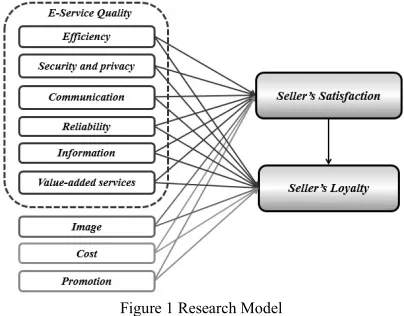
RESEARCH METHODOLOGY [image:4.612.317.519.424.582.2]This research is conducted to find the main factors that influence the loyalty of the seller in e-marketplace business. The identification of factors to be studied is formed based on literature such as journal, text book, and other sources on the internet which then formed into a research model shown in Figure 1 below.
Figure 1 Research Model
The variables and indicators used in this study were adapted from previous research and adjusted to the research topic. Efficiency will be measured using items adapted from Parasuraman et al. (2005). Security and privacy, communication, information, value added services, image, satisfaction and loyalty will be measured using
items adapted from Janita and Miranda (2013)[12].
166 from Napitupulu and Aditomo (2015). Relation of satisfaction and loyalty developed based on Azizah and Widyastuti (2013). The measurement for these conceptual or latent variables was based on a five-point Likert scale with scale anchors from “1” – strongly disagree to “5” – strongly agree. To test the validity of the questionnaires, a pilot survey of 10 respondents was first conducted to ensure that the questionnaire was uniformly understood.
This study takes a population of people who ever do selling through e-marketplace website portal in Indonesia. The instrument that used for data collection in this study is questionnaires. Questionnaire was given to respondents who were sampled from the study population. Questionnaires
were conducted via electronic media
(www.docs.google.com).Data were analyzed using
Structural Equations Modeling (SEM) method which will be divided into 5 stages: model
specification, model identification, model
estimation, model evaluation, and model
respecification.
The first stage is the model specification will be done by creating the path diagram to show the relationship pattern among the variables studied. The path diagram of a model consists of a measurement model and a structural model.
Measurement model describes the relationship between latent variables with the indicators while the structural model describes the relationship between latent variables. The following is the equation of the measurement model to be used which can similarly be expanded for the other latent variables as well:
EFI1 = λ1 EFI + eEFI1 EFI2 = λ2 EFI + eEFI2 EFI3 = λ3 EFI + eEFI3
Where,
EFI1, EFI2, EFI3 = efficiency Indicators λ1, λ2, λ3 = factor loadings
eEFI1, eEFI2, eEFI3 = error terms
Equation of the structural model developed based on research model on Figure 1 is:
[1]SAT = β10 + β11 EFI + β12 SEC + β13 COM +
β14 REA + β15 INF + β16 VAS + β17 IMG + β18
COS + β19 PRO + eSAT4
[2]LOY = β20 + β21 EFI + β22 SEC + β23 COM +
β24 REA + β25 INF + β26 VAS + β27 IMG + β28
COS + β29 PRO + eLOY4
[3] LOY = β30 + β31 SAT + eLOY4
Where,
SAT = seller satisfaction LOY = seller loyalty β10, β20, β30 = constant β11, β12, …., β31 = coefficient EFI = efficiency
SEC = security and privacy COM = communication REA = reliability INF = information
VAS = value-added services IMG = image
COS = cost PRO = promotion e = error term
The hypotheses for the study are as follows:
Hypotheses 1: Efficiency will have a positive
influence on e-marketplace seller satisfaction.
Hypotheses 2: Security and privacy will have a
positive influence on e-marketplace seller satisfaction.
Hypotheses 3: Communication will have a
positive influence on e-marketplace seller satisfaction.
Hypotheses 4: Reliability will have a positive
influence on e-marketplace seller satisfaction.
Hypotheses 5: Information will have a positive
influence on e-marketplace seller satisfaction.
Hypotheses 6: Value added services will have a
positive influence on e-marketplace seller satisfaction.
Hypotheses 7: Image will have a positive
influence on e-marketplace seller satisfaction.
Hypotheses 8: Cost will have a positive influence
on e-marketplace seller satisfaction.
Hypotheses 9: Promotion will have a positive
influence on e-marketplace seller satisfaction.
Hypotheses 10: Efficiency will have a positive
influence on e-marketplace seller loyalty.
Hypotheses 11: Security and privacy will have a
positive influence on e-marketplace seller loyalty.
Hypotheses 12: Communication will have a
positive influence on e-marketplace seller loyalty.
Hypotheses 13: Reliability will have a positive
influence on e-marketplace seller loyalty.
Hypotheses 14: Information will have a positive
influence on e-marketplace seller loyalty.
Hypotheses 15: Value added services will have a
positive influence on e-marketplace seller loyalty.
Hypotheses 16: Image will have a positive
167
Hypotheses 17: Cost will have a positive
influence on e-marketplace seller loyalty.
Hypotheses 18: Promotion will have a positive
influence on e-marketplace seller loyalty.
Hypotheses 19: Seller satisfaction will have a
positive influence on e-marketplace seller loyalty.
The second stage is model identification. Model identification can be performed by calculating degree of freedom (df) value. The model is said to be under-identified if the value of df <0 is said to be just-identified if the value of df = 0, and is said to be over-identified if the value of df> 0. A model is qualified to be tested if the model is over-identified and df value is known (Santoso, 2011).
The third stage is to choose the model estimation that will be used. The SEM model estimation used in this research is Maximum Likelihood (ML) estimation. In general, Maximum Likelihood (ML) estimates are the most popular and most used estimates in SEM research. Maximum Likelihood (ML) model estimates were chosen because they were able to provide unbiased results when multivariate normality was met.
The fourth stage is to evaluate the model. Model evaluation is divided into two types, namely measurement model evaluation and structural model evaluation. The measurement model evaluation will consist of validity and reliability test. The structural model evaluation will consist of normality test and goodness of fit criteria index test.
The fifth stage is the model respecification if the test results of goodness of fit criteria indicate that the model used is not fit.
4.
RESULTS4.1 Descriptive Analysis
Out of 407 respondents, 175 (43%) of the respondent are females and 232 (57%) of the respondent are males. A majority of the respondents 197 (48%) is from Tokopedia, 63 (16%) is from Prelo, 43 (11%) is from Elevenia, 27 (7%) is from Shopee, 20 (5%) is from Lazada, 18 (4%) is from Carousell, 14 (3%) is from Blanja, 13 (3%) is from Bukalapak, 8 (2%) is from Qoo10, 3 (1%) is from Blibli, 1 (0%) is from Mataharimall indicated have a monthly sales frequency 229 (56%) 0-50 orders, 155 (38%) 51-1000 orders, and 23 (6%) >1000 orders.
4.2 Measurement Model Evaluation
The measurement model evaluation consist of validity and reliability test. Validity test using Item to Total Correlation was conducted to ensure the validity of measurement used. According to Sarwono and Budiono (2012) the correlation between two variable is a strong correlation if the correlation is greater than 0.50. From 11 research variables can be seen that all the variables have Item to Total Correlation over 0.50 so it can be used for this research.
Reliability test using Cronbach’s Alpha was conducted on most variables to measure the interreliability. According to Gliem et. al. (2003) an instrument has an acceptable level of reliability when Cronbach’s Alpha is greater than 0.70. From 11 research variables can be seen that all the variables have Cronbach's Alpha coefficients over 0.70 so it can be used for this research.
4.3 Structural Model Evaluation
[image:6.612.336.518.454.670.2]The structural model evaluation consist of normality test and goodness of fit criteria index test. Normality test in this study using residual normality test. The result of normality test can be seen at Figure 2, 3, 4 below, can be seen that data is normally distributed.
168 Figure 3 P-Plot Equation [2]
Figure 4 P-Plot Equation [3]
Goodness of Fit test aims to investigate to what extent the hypothesized model fit with the data. The result of goodness of fit test can be seen at Table 1 below.
Table 1 Result of Goodness of Fit Test Goodness of Fit
Index
Cut of Value Results Conclusion
Chi-Square (χ2) Expectedly
small
1199.3 80
Good Fit
Degree of Freedom (df)
Expectedly big 444 Good Fit
Goodness of Fit
(GFI) ≥ 0.90 is Good Fit, 0.80 ≤ GFI < 0.90 is Marginal Fit
0.846 Marginal
Fit
Adjusted Goodness of Fit (AGFI)
≥ 0.90 is Good Fit, 0.80 ≤ AGFI < 0.90 is Marginal Fit
0.806 Marginal
Fit
Root Mean Square Error of Approximation (RMSEA)
≤ 0.08 is Good Fit, < 0.05 is Close Fit
0.065 Good Fit
Tucker Lewis Index (TLI)
≥ 0.90 is Good Fit, 0.80 ≤ TLI < 0.90 is Marginal Fit
0.907 Good Fit
4.4. Regression Results
The regression was carried out to determine the relationship between efficiency (EFI), security and privacy (SEC), reliability (REA), information (INF), value-added services (VAS), image (IMG), cost (COS), promotion (PRO) and satisfaction (SAT) with seller loyalty (LOY). The results of the regression models are given in the following equations.
SAT = 0.184VAS + 0.318IMG + 0.153 COS +
0.266 PRO ……….……. (1)
LOY = 0.284IMG + 0.111 COS…...……. (2)
LOY = 0.568 SAT………... (3)
Further detail of the result of the regression is presented in Table 2, including standard errors (SE) and significancy of the standardized coefficient of the regression in terms of p-value (p).
Table 2 Standardized Regression Results
Estimate S.E. P
SAT <- EFI -.023 .049 .666
SAT <- SEC .020 .059 .736
SAT <- COM .055 .176 .760
SAT <- REA .005 .232 .980
SAT <- INF .082 .125 .491
SAT <- VAS .184 .084 .025**
SAT <- IMG .318 .082 ***
SAT <- COS .153 .035 .001**
SAT <- PRO .266 .053 ***
LOY <- EFI -.010 .055 .865
LOY <- SEC .112 .067 .097
LOY <- COM .016 .197 .935
LOY <- REA -.156 .264 .502
LOY <- INF .258 .142 .057
LOY <- VAS -.157 .096 .094
LOY <- IMG .284 .098 .002**
LOY <- COS .111 .040 .044**
LOY <- PRO -.003 .064 .965
LOY <- SAT .568 .103 ***
**significant at significant level 5%
169 It can be seen from Table 2 that efficiency does not significantly influence seller satisfaction with p-value p = 0.666 and also does not significantly influence seller loyalty with p-value p = 0.865. These findings is different with the results of research conducted by Janita and Miranda (2013)[12]. This may be caused by the way to sell goods in various web portals e-marketplace is similar, so it does not give a significant impact on the satisfaction and/or loyalty of the seller
Security and privacy does not significantly influence customer satisfaction with p-value 0.736 and also does not significantly influence seller loyalty with p-value p = 0.097. This finding is in line with the results of research conducted by
Mustafa (2011)[14] which says that security is more
related to trust or customer trust but can not be an indication of customer satisfaction. But this finding different from the results of research by Janita and
Miranda (2013)[12] which says that security affects
customer loyalty. This may be caused the security of the existing e-marketplace web portal is already good because the e-marketplace providers may already understand the importance of security to gain the trust of their customers (sellers and buyers).
Communication does not significantly influence customer satisfaction with p-value 0.760 and also does not significantly influence seller loyalty with p-value p = 0.935. This finding is different with the results of research conducted by Hussain et al.
(2014)and also Kumar and Srivastava (2013). This
is probably because most e-marketplace is able to provide good communication facilities so it does not give a significant impact on the satisfaction and/or loyalty of the seller.
Reliability does not significantly influence customer satisfaction with p-value 0.980 and also does not significantly influence seller loyalty with p-value p = 0.502. These findings differ from those of Omar et al. (2015) where reliability has a direct positive effect on perceive service quality and satisfaction. This is probably because most of the existing e-marketplace is able to provide reliable service so it does not give a significant impact on the satisfaction and/or loyalty of the seller.
Information does not significantly influence customer satisfaction with p-value 0.491 and also does not significantly influence seller loyalty with p-value p = 0.057. These findings differ from those of Sadeh et al. (2011). This is probably because most of the existing e-marketplace has been able to provide information that is appropriate and easily
understood by the seller so it does not have a significant impact on the satisfaction and/or loyalty of the seller.
Value added services significantly influence customer satisfaction with p-value 0.025 but does not significantly influence seller loyalty with p-value p = 0.094. This finding is consistent with the
results of Janita and Miranda (2013)[12] research
which says that value added services affects customer satisfaction but contrary to the result that value added services affect customer loyalty. This might be happen, according to opinion of Mcllroy
and Barnett (2000)[15] that customer satisfaction is
not an accurate indicator of customer loyalty. Image significantly influence customer satisfaction with p-value < 0.01 and also significantly influence seller loyalty with p-value p = 0.002. These findings are consistent with the results of research conducted
by Janita and Miranda (2013)[12] and Napitupulu
and Aditomo (2015). Therefore, image can be a matter of concern in developing e-marketplace business.
Cost significantly influence customer satisfaction with p-value p = 0.001 and also significantly influence seller loyalty with p-value p = 0.044. This finding is consistent with the results of research
conducted by Sardinha (2015)and also consistent
with the opinion of Peter and Donnelly (2007) who said that price is the main factor behind satisfaction and loyalty to a product because customers feel happy if they get a lot of benefits from the product compared with the expenditure.
Promotion significantly influence customer
satisfaction with p-value < 0.01 but does not significantly influence seller loyalty with p-value p = 0.965. This finding is in accordance with the results of Hooi (2012) where customers are more emphasis on product quality compared to promotions offered by the company. This explains why even though the customer is satisfied with the promotions offered but it does not create loyalty among customers with the product or service Seller satisfaction significantly influence seller loyalty with p-value, p < 0.01. These findings are in line with Arokiasamy (2010) and Mohsan et al. (2011) where customer satisfaction has a significant influence on customer loyalty. However, Mcllroy
and Barnett (2000)[15] said that customer
e-170 marketplace company must ensure its customers (who in this case are the sellers) feel very satisfied. In other words, 7 of the hypotheses, i.e., H6, H7, H8, H9, H16, H17, and H19 are accepted, and the other 12 hypotheses, i.e., H1, H2, H3, H4, H5, H10, H11, H12, H13, H14, H15, and H18 are rejected.
4.5. Direct, Indirect and Total Effect Analysis
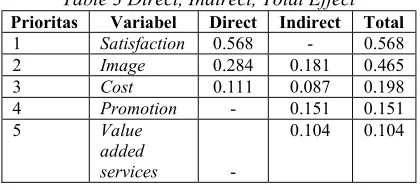
[image:9.612.90.300.325.420.2]Since hypotheses 19 are accepted, factors that affect seller satisfaction also affect seller loyalty indirectly. So, the direct effect, indirect effect and total effect analysis will be done to measure all factors affected seller loyalty which is value added services, image, cost and promotion variables that has a direct and indirect effect to the loyalty variable.
Table 3 Direct, Indirect, Total Effect
Prioritas Variabel Direct Indirect Total
1 Satisfaction 0.568 - 0.568
2 Image 0.284 0.181 0.465
3 Cost 0.111 0.087 0.198
4 Promotion - 0.151 0.151
5 Value
added
services -
0.104 0.104
It can be concluded from Table 3, that the factors that have influence from the greatest to the smallest to the seller loyalty is satisfaction, image, cost, promotion, and value added services.
5.
CONCLUSIONSAlthough customer loyalty is a widely studied topic, most of them are study about customer as a buyer. The study about customer as a seller are still few. In fact, seller has an important role on e-marketplace business.
From the research results, it could be concluded that the factors below in order of the greatest contribution to the very small influence on seller satisfaction in business e-marketplace is : satisfaction, image, cost, promotion and value added services. Satisfaction is the factor that has the greatest influence on e-marketplace seller loyalty. So factors that significantly affect seller satisfaction will indirectly affect the seller loyalty and should always be considered by company in ensuring sustainability of the business as loyalty is the most contributor to sustainability.
REFRENCES:
[1] Afuah, A., & Tucci, C. L. (2001). Intenet
Business Model and Strategies. McGraw-Hill Higher Education.
[2] Arokiasamy, A. R. (2013). The impact of
customer satisfaction on customer loyalty and intentions to switch in the banking sector in Malaysia. The Journal of Commerce, Vol. 5, No. 1, pp. 14-21.
[3] Azizah, & Widyastuti, Ami. (2013). Hubungan
Antara Kepuasan Konsumen Dengan Loyalitas Merek Pada Pengguna Kartu Prabayar Simpati. Jurnal Psikologi, Fakultas Psikologi UIN Sultan Syarif Kasim Riau, Vol.9, No.1, pp. 1-8.
[4] Chen, J., Zhang, C. and Xu, Y. (2009). The
Role of Mutual Trust in Building Members' Loyalty to a C2C Platform Provider. International Journal of Electronic Commerce, Vol. 14, No. 1, pp. 147-71.
[5] Daikh, J. (2015). A Research Proposal: The
Relationship between Customer Satisfaction and Customer Loyalty. MBA Student Scholarship. Paper 42.
[6] Gliem, J. A., & Gliem, R. R. (2003).
Calculating, Interpreting, and Reporting Cronbach’s Alpha Reliability Coefficient for Likert-Type Scales. 2003 Midwest Research to Practice Conference in Adult, Continuing, and Community Education.
[7] Godwin, J. Udo, Kallol K. Bagchi & Peeter J.
Kirs. (2010). An assessment of customers’ e-service quality perception, satisfaction and intention. International Journal of Information Management, Vol. 30, Issue 6, pp. 481-492.
[8] Hooi, K. K. (2012). Customer Loyalty,
Satisfaction And Marketing Mix: Empirical Evidence From Infant Formula Industry (Doctoral dissertation, USM).
[9] Hussain, R., Nasser, A., & Hussain, Y. K.
(2014). Service quality and customer satisfaction of a UAE-based airline: An
empirical investigation. Journal of Air
Transport Management, Vol. 42, pp. 167-175.
[10] Hyperwallet. (2017). The State of Ecommerce
Marketplace Selling in 2017.
[11] Janita & Miranda. (2013). Exploring Service
Quality Dimensions in B2B Marketplaces. Journal of Electronic Commerce Research, Vol. 14 No. 4, pp. 363-386.
[12] Janita & Miranda. (2013). The antecedents of
client loyalty in business-to-business (B2B)
electronic marketplaces. Industrial Marketing
171
[13] Kumar, R. K., & Srivastava, M. (2013). The
antecedents of customer loyalty: An empirical
investigation in life insurance context. Journal
of Competitiveness, Vol. 5, No. 2, pp. 139-155.
[14] Ludin, I. H. B. H., & Cheng, B.L. (2014).
Factors Influencing Customer Satisfaction and E-Loyalty: Online Shopping Environment among the Young Adults. Management Dynamics in the Knowledge Economy, Vol. 2 No. 3, pp. 462-471.
[15] Mohsan, F., Nawaz, M. M., Khan, S. M.,
Shaukat, Z., & Aslam, N. (2011). Impact of customer satisfaction on customer loyalty and intentions to switch: Evidence from banking
sector of Pakistan. International Journal of
Business and Social Science, Vol. 2, No. 16, pp. 263-270.
[16] Mulyadi. (2012). Akutansi Biaya, Edisi ke-5.
Yogyakarta: STIM YKPN.
[17] Napitupulu, T. A., & Aditomo, H. C. (2015).
Factors Affecting Customer Loyalty in Business E-Comerce: A Case of Indonesia. Journal of Theoretical and Applied Information Technology (JATIT), Vol. 6, No. 3.
[18] Omar, Hamed F. Hamed, Saadan, K.B. &
Seman, K.B. (2015). Determining the Influence of the Reliability of Service Quality on Customer Satisfaction The Case of Libyan E-Commerce Customers. International Journal of Learning & Development, Vol. 5, No. 1.
[19] Parasuraman, A., Zeithaml, V. A. and Berry, L.
L. (1985). A conceptual model of service quality and its implications for future research. Journal of Marketing, Vol. 49, Issue 4.
[20] Parasuraman, A., Zeithaml, V., Malhorta, A.
(2005). E-S-QUAL: A Multiple-Item Scale for
Assessing Electronic Service Quality. Journal
of Service Research, Vol. 7, Issue 3.
[21] Peter, J.Paul, James H. Donnelly, Jr. (2007).
Marketing Management Knowledge and Skills 8th Edition. New York: McGraw-Hill Irwin.
[22] Petrescu, A. M. I. (2007). An
Interorganizational Perspective of
E-Marketplaces: The Case of Econstroi.com. University of Porto, Portugal.
[23] Rauyruen, P. and Miller, K. E. (2007).
Relationship quality as a predictor of B2B
customer loyalty. Journal of Business
Research, Vol. 60, No.1, pp. 21-31.
[24] Reza, F. (2016). Strategi Promosi Penjualan
Online Lazada.co.id. Jurnal Kajian
Komunikasi, Vol. 4, No.1, pp. 64-74.
[25] Sadeh, S., Sadeh, E., Mousavi, L. and Asgari,
F. (2011). The effects of website quality dimensions on customer satisfaction in
e-retailing system. Middle-East Journal of
Scientific Research, Vol. 10 No. 3, pp. 366-369.
[26] Santoso, Singgih. (2011). Structural Equation
Modeling (SEM) Konsep dan Aplikasi dengan AMOS 18. Jakarta : Elex Media Komputindo.
[27] Saputro, H. D. (2013). Membangun Loyalitas
Pelanggan Melalui Kualitas Produk, Harga dan Pelayanan Pada Toko Bangunan Indah Kiat Gemilang di Kudus. Universitas Dian Nuswantoro, Semarang.
[28] Sardinha, I. B. (2015). E-loyalty in
e-commerce: A study at GIRISSIMA. COM (Doctoral dissertation).
[29] Sarwono, J. & Budiono, H. (2012). Statistik
Terapan Aplikasi untuk Riset, Skripsi, Tesis dan Disertasi (Menggunakan SPSS, AMOS dan Excel). Jakarta: Penerbit PT Elex Media Komputindo.
[30] Sun, H. (2010). Sellers’ Trust and Continued
Use of E-marketplaces. Journal Association for Information Systems, Vol. 11 No. 4, pp. 182-211.
[31] Sun, Z & Finnie, G.R. (2004). Intelligent
Techniques in E-Commerce: A Case-based Reasoning Perspective. Springer-Verlag. New York.
[32] Swastha, B. & Irawan. (2003). Manajemen
Pemasaran Modern, Edisi Kedua. Liberty Offset. Yogyakarta.
[33] Turban, E., Lee, J. K., King, D., McKay, J., &
Marshall, P. (2008). Electronic Commerce
![Figure 2 P-Plot Equation [1]](https://thumb-us.123doks.com/thumbv2/123dok_us/8905159.956473/6.612.336.518.454.670/figure-p-plot-equation.webp)
![Figure 4 P-Plot Equation [3]](https://thumb-us.123doks.com/thumbv2/123dok_us/8905159.956473/7.612.110.289.322.521/figure-p-plot-equation.webp)