Full Length Research Article
A SURVEY ON NEEDS AND ISSUES OF CLOUD BROKER FOR CLOUD ENVIRONMENT
1
Dr. V. Geetha, *
1Rizwan Mohammed Hayat and
1M. Thamizharasan
Department of Information Technology, Pondicherry Engineering College, Pondicherrry, India
ARTICLE INFO ABSTRACT
Cloud computing has become an emerging technology for outsourcing various IT needs of organizations, offering access to their infrastructure and application services on a subscription and pay-as-you-go basis. Since the Cloud Environment is developing day by day, there are many Cloud providers offering same or different Cloud services with different pricing policy, performance attributes and features. Thus, it becomes difficult and challenging for Cloud users to find the best of Cloud services which can satisfy their requirements in terms of parameters such as performance, cost and security. So, there is a need for Cloud Broker to help the users to find the right provider for their requests. There are many cloud brokers who doing brokering services with different features and methods. This paper aims at comparing the features of brokers which includes comparing cloud providers, ranking the providers and reputation system for providers to benefit the Cloud users.
Copyright © 2014 Dr. V. Geetha et al. This is an open access article distributed under the Creative Commons Attribution License, which permits unrestricted use, distribution, and reproduction in any medium, provided the original work is properly cited.
INTRODUCTION
Cloud computing is a type of computing that relies on sharing computing resources rather than having local servers or personal devices to handle applications (http://en.wikipedia.org/wiki/Cloud_computing). It has recently emerged as a technology for organization’s IT infrastructure in economical. It provides three main services according to the users requirements. They are 1. Software as a Service (SaaS) which provides application services such as Email, Customer Relationship Management (CRM) and Enterprise Resource Planning (ERP), 2. Platform as a Service (PaaS) which provides a platform for developing applications on top of it, such as Amazon Web Services, Microsoft Azure, Google App Engine etc., 3. Infrastructure as a Service (IaaS) which provides an environment for deploying, storage, virtual machines and networks. It also allows dynamic provisions and scalable applications using ‘Pay-as-you-go’ and ‘Subscriptions’ pricing models according to users’ requirements. According to the definition by NIST (2013), ― “Cloud Computing is a model for on-demand network access to a shared pool of configurable computing resources that can be rapidly provisioned and released with minimal management effort or service provider interaction”. Over the recent years, the Cloud service providers are significantly increasing and
*Corresponding author: Rizwan Mohammed Hayat
Department of Information Technology, Pondicherry Engineering College, Pondicherrry, India
providing support to the users at one or more of the above mentioned layers. Since all organizations are migrating to Cloud, there is a lack of interoperability between vendors and organizations. Thus it makes it hard for the Cloud users to find the right Cloud providers for the requirements.
A Cloud Broker is a third-party individual or business that acts as an intermediary between the Cloud users and Cloud service provider. In general, a broker is someone who acts as an intermediary between two or more parties during negotiations. The broker's primary role may simply be to save the user’s time by researching services from different providers and helps users to get the best provider for their requirement. Once the broker completed his search, he presents the customer with a short list of recommended cloud providers and the customer contacts the providers of choice to arrange service. A cloud broker may also be granted the rights to negotiate contracts with cloud providers on behalf of the users. In large scale organizations, the cloud brokers are given rights manage the services, monitoring the users and so on. NIST (2013) described cloud broker as ― “an entity that manages the use, performance and delivery of cloud services, and negotiates relationships between cloud providers and cloud consumers.” The next section explains about the types of cloud brokers and their roles. It is followed by the impacts and advantages of cloud brokering. Then we will be discussing about various available brokering frameworks. Then we will explain the comparison of those various frameworks discussed and finally the conclusion of this paper will be stated.
ISSN: 2230-9926
International Journal of Development Research
Vol. 4, Issue, 5, pp. 1035-1040, May,2014
International Journal of
DEVELOPMENT RESEARCH
Article History:
Received 26th February, 2014
Received in revised form 30th March, 2014
Accepted 07th April, 2014 Published online 20th May, 2014
Key words:
Types of Cloud Brokers
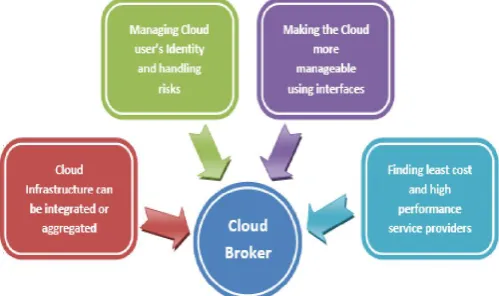
[image:2.595.40.290.229.377.2]Cloud Brokerage (CB) is a brokering service in which any number of Cloud services can be delivered to a user. Services can range from the one time registration in SaaS, to integrating the data between all other layers such as PaaS and IaaS. i.e., an ERP across SaaS layer can be added to a management layer across IaaS layers. A recent study (http://www.gartner.com/it-glossary/cloud-services-brokerage-csb) has shown that cloud compliance and data storage are gaining prominence gradually. Most of the organizations are approaching a cloud broker to arrange and manage their services. It is expected that almost 25% of companies will use the cloud broker by 2016 and hence the data losses would be reduced by 30%.
Figure 1. Types of Cloud Brokers
There are three types of brokering services which fall into the patterns according to Gartner (http://www.gartner.com/it-glossary/cloud-services-brokerage-csb): Aggregation, Integration, and Customization Brokerage.
Cloud Aggregator: Some Cloud brokers are involved in
collecting the detailed information about the services of Cloud providers and adding capabilities by improving some aspects of those services. They are also involved in adding and managing the hosting services.
Cloud customizer: This type of Cloud broker mainly focus on
customizing multiple cloud services from different cloud providers and integrating together for an organization.
Brokers that arbitrage cloud services: These brokers helps the
Cloud users to choose several cloud providers for their requirements that are dependent on attributes such as costs or performance (http://cctoffice.com/2013/12/3-types-of-cloud-brokers-that-can-save-the-cloud/).
Roles of Cloud Brokers
The role of cloud brokers is a complex one that combines the roles of cloud providers, integrator, and customizer. The common role of cloud brokers is to make users or organizations simpler to acquire the services, provision, and payment policy for cloud services. One example, (http://www.appdirect.com/) AppDirect from Comcast is providing a way of access and manages at least 150 different cloud services. There are lots of cloud brokers available but each can be distinguished by the differentiation in the
management interface and the way in which services are exposed to the cloud users and organizations. For cloud broker Apptix, the engine behind that interface is Parallels. From the views of Cloud users and providers, Cloud brokers are provided with three primary roles: (http://www.datacenterdynamics.com/focus/archive/2013/12/c loud-brokerage-%E2%80%93-definitions-advantages-and-potential-downsides)
Intermediation
A Cloud broker can act as an intermediation that provides support for the cloud users and cloud providers. From the cloud providers perspective, the intermediation services includes identity and access management of new services helps in service level management and reporting, security management and supervision on pricing policy and billing. From the Cloud user’s perspective, the intermediation services are simple consultancy services.
Aggregation and customization
A broker can act as an aggregation that goes a step further and provides the intermediation services while bundling and customizing multiple cloud services into one or more customer-tailored cloud services. An aggregation service includes data integration, securing the process integrity and ensuring data portability between the cloud users and the various cloud providers.
Brokerage enabling
Some cloud brokers are not directly involved in cloud customer contact, but rather enable other brokers to provide their brokerage services. For example, the cloud broker of PaaS layer can enable the other broker of SaaS layer to combine various cloud services into the one or more aggregated cloud services for the cloud customer.
Impact of Cloud Brokering
According to recent researches (http://www.businessweek.com/stories/2010-12-06/here- come-the-cloud-services-brokersbusinessweek-business-news-stock-market-and-financial-advice), Cloud brokerage is expanding at 75 percent every year, driven in the establishment of broad cloud interoperability standards that make it easier to provide bundled packages of previously disparate services and resources. According to Gartner (Cloud services brokerages), 20 percent of cloud services will be consumed through a service brokerage by 2015, up by about 5 percent today. In the future, all organizations may start to join with large number of different cloud providers. Cloud Brokers are going to serve as intermediaries, offering and managing services like customizing the services, integrating two or more providers providing same services, security and aggregation. Since all companies are migrating to clouds nowadays, some integration is needed between cloud services and corresponding cloud service providers like SAP and Oracle.
Advantages of Cloud Brokers
Though each broker varies with their arrangement of the services, the advantages many cloud brokers includes
(http://www.infoq.com/articles/cloud-service-brokers):
They help the users determine the best framework for their individual need based a number of functional and non-functional requirements. This includes provisioning assistance and budget guidance, as wee as identifying how to select and integrate disparate services across multiple hybrid approaches.
Normalize multiple cloud services available on the market by integrating outputs from multiple cloud service providers.
Get better discounts and access more information from cloud providers.
Select the best cloud provider for specified requirements.
Provide additional approval workflow functionality, enhanced control, compliance, and security.
Brokering Frameworks
In recent years, many research scholars have made a lot of research on different brokering frameworks. The need and issues of brokering in Cloud has received a lot of attention in academia and industry in the recent years. A cloud broker should help the cloud users to find the optimal cloud providers for their requests and helps the cloud providers to maximize their profits by getting more cloud users. The cloud broker should bring the users and providers in a single point through which both can interact each other’s.Some of the various brokering present are InterCloud, SLA-based tiered pricing model, CloudRank and SMI Cloud. Let us see those frameworks in detail below.
InterCloud Framework (Buyya et al., 2010)
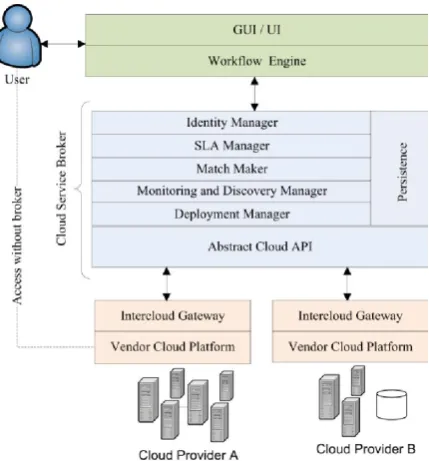
[image:3.595.312.557.489.640.2](Buyya et al., 2010) has presented the architecture of a federated Cloud computing environment named InterCloud which supports the scaling of applications across multiple Cloud providers. The main idea of the InterCloud framework is to enhance Cloud providers provisioning capabilities and workloads by leasing the computational and storage capabilities from other providers.
Figure 2. Cloud Service Broker Architecture (Buyya et al., 2010)
The proposed architecture consists of a Cloud Broker, a Cloud Exchange and a Cloud Coordinator. Clients’ approaches a Cloud broker to help them to meet their specified QoS requirements, Cloud Coordinators, acts as gateway between their internal datacenters and external Clouds publish their services and Cloud Exchange acts as an intermediate bringing together service providers and users.
The figure explains the overall architecture of InterCloud framework which has cloud broker. The cloud broker contains SLA manager, identity manager, monitoring and discovery manager and deployment manager. Here the users approach the cloud broker with their requirements and the broker use discovery manager to track the request, and identity manager to find the provider and SLA manager to bind user and provider.
Even though InterCloud helps the user to map a cloud provider for their requisite there is no scope to provide healthy competition between cloud providers.
SLA-based tiered pricing model (Srijith K. Nair et al., 2010)
[image:3.595.58.273.532.763.2]This framework is for brokering multiple providers to provide a SLA-based tiered pricing model. Here, an enterprise or a provider approaches a cloud broker with a set of functional and SLA-based requirements and then the cloud broker choose the suitable match for the functional requirements and other requirements like pricing, SLA parameters and non-functional requirements like compliance and certification capabilities. The cloud broker provides the broker service or can act as a middle-man to provide identity management, access management, policy enforcement, and audit capabilities to them. In general, this framework is designed for Cloud providers and brokering for them.
Figure 3. SLA-based tiered pricing model Architecture (Srijith K. Nair et al., 2010)
The figure explains the architecture of brokering model in which the provider approaches the cloud broker and broker picks up the best match for them and it will be showed to the users who approaches them.
SMI Cloud Framework (Saurabh Kumar Garg et al., 2013)
[image:4.595.44.275.201.434.2](Saurabh Kumar Garg et al.) Proposed the Service Measurement Index Cloud framework (SMICloud), it helps Cloud users to find the best Cloud provider and thus the SLA’s can be initiated. The SMICloud framework allows Cloud users to make service selection based on QoS requirements and ranking those the service provider using Analytic Hierarchy Process (AHP) algorithm and performance of the service providers. This framework provides assessment of Cloud services in terms of KPIs and user requirements. Figure 4 explains the architecture of the SMI cloud.
Figure 4. SMI Cloud Broker Architecture (Saurabh Kumar Garg et al., 2013)
The SMI cloud consists of different components. They are as follow
SMICloud Broker: This component is responsible for interaction with cloud users to understand their application needs. It collects all their requirements and performs discovery and ranking of suitable services using other components such as the SMICalculator and Ranking systems. SLA Management is the component that keeps track of customers’ SLAs with Cloud providers and their fulfilment history. The Ranking System ranks the services selected by the Cloud Broker which are appropriate for user needs. The SMI Calculator computes the various KPIs which are used by the ranking system for prioritizing Cloud services.
Monitoring: This component first discovers Cloud services that can satisfy users’ essential QoS requirements. Then, it monitors the performance of the Cloud services, for example for IaaS it monitors the speed of VMs, memory, scaling latency, storage performance, system latency and accessible bandwidth. It also maintains way of how SLA requirements of previous clients are being satisfied by the Cloud provider.
Service Catalogue: Stores the services and their features advertised by various Cloud providers. The details about services that are asked by the users, which are provided to them as a response to the request given by the users, are also stored in the service catalogue.
The SMI cloud framework has some limitations within it. First moving on to the method of calculating the rank of the service provider, the values are collected from the provider rather than the users. There is no guarantee such that the value provided by the provider can be authentic. Some provider may provider false values which can increase their credibility which is not genuine. The AHP mechanism used here will take some random values for metrics if the values are not provided by the provider. In such case the random values can vary the rank of the provider.
CloudRank Framework (Zibin Zheng et al., 2013)
This is the framework of QoS ranking prediction. This framework mainly focuses on ranking prediction of QoS properties, different values from different users of the same cloud service are collected and rank is predicted based on the QoS parameters. A user who is requesting ranking prediction from the CloudRank framework can obtain service ranking prediction of all available cloud services by providing observed QoS values of cloud services. The figure explains the overall system architecture of CloudRank framework. Initially, the users are classified as active users and trained users. The QoS are observed from both users and then the similarities between the users are calculated. Then, based on the similarity values, a list of similar active users and trained users can be identified. After that, two algorithms are proposed to make personalized ranking by observing the past service usage experiences of those users. Finally, the ranking prediction results are provided to the active user.
Figure 5. CloudRank Architecture (Zibin Zheng et al., 2013)
This CloudRank framework will provide the ranking of the cloud provider whereas fail to seal them for a service.
Some other authors also proposed different frameworks on brokering such as (Kwei-Jay Lin et al., 2005) Proposed a paper on distributed trust management for e-services such as ecommerce. In this brokering framework, every user is associated with a broker and the broker collects the reputation ratings from that user about the services they use. The users provides to their brokers about the service rating each interaction with the Cloud provider in order to build up the reputation for them. (Shantanu pal et al., 2011) Proposed a paper that security and privacy solution lies both at the service provider level as well as service user level in a cloud environment. This framework provides security, infrastructure
[image:4.595.321.552.415.586.2]as well as data stored in cloud platform. (Habib et al., 2012) had taken survey on the trust related issues in cloud computing such as SLAs, broker audits, feedback and rating etc.
Comparison of parameters
This paper compares the parameters of different Cloud Brokering frameworks. The comparison uses secondary data which has been collected from various journals, blogs, articles, whitepapers and websites of the organization for the study. The following are some of the important parameters for cloud brokering: (Akanksha Kherdikar, 2014)
Entitlement
Cloud brokers can provide different deployment of multiple pricing models based upon which feature the particular user access with real time usage tracking as well as dynamic creation, revision and deployment of those pricing models.
Analytics
An analytics produced by cloud brokers should be a deep analyzing process from different vendors. It should be based on the customer needs.
Billing and Payment
A cloud service brokerage is a service which provides the service from various vendors, but it should deal with only one helpdesk and only paying one bill.
Security
A cloud service broker should manage the security concerns. The can negotiate with managed security for both their cloud providers and their customers. This can reduce the security risk by proper authentication, authorization and access control.
Customization
A cloud broker should always customize the services for the individual customer as their business needs.
Time
The broker should simply save the time of their customer by researching services from different vendors and providing them based on their business needs.
Complexity
The broker may provide the customer with an application program interface and user interface that hides any complexity and allows the customer to work with their cloud services as if they were being purchased from a single vendor.
Availability
[image:5.842.111.728.81.173.2]Availability is the important thing for the cloud brokerage. Since the broker will provide the service by researching the vendors. They should provide 24 * 7.
Table 1. Comparison of the parameters in the different frameworks
Sl no Frameworks/Models Entitlement Analytics Billing &
Payment Security Customization Time Availability
Customer Service
Business
Model Integration SLA Complexity
1 Service Measurement Index
Cloud framework
Y Y Y N N Y Y N N N Y Y
2 InterCloud framework N Y N Y N Y N N N N Y Y
3 SLA-based tiered pricing model Y N N N N N N N N N N N
4 QoS ranking prediction
(CloudRank) framework
N N N N N N N N N N N N
5 Distributed Trust Management
for e-commerce services
Y N Y N N Y N N N N N N
Customer service
Apart from being an intermediary a broker should also provide the additional features such facilitating the replications, encryptions of the date for transfer between the cloud and with the data life cycle management (DLM).
Table 1 explains the comparison of parameters in the different frameworks.
Conclusion
The Cloud brokers are becoming the essential part in Cloud environment where to make a user to find an optimal provider and making a provider to pick up their best match. Even though there are lots of frameworks, each proposal is providing services for a particular task in cloud. The need of brokering should be to fulfill the requirement of both the cloud provider and cloud user. The brokering present in the cloud should completely take care of the process between the cloud user and the cloud provider. A broker should help users to find their optimal provider, help providers to get more users, binding the SLA between the users and providers and monitor the workflow between them, making reputation for Cloud providers and rank them based on the ratings from the users. This makes a healthy competition between the cloud providers and enhances themselves in all aspects.
REFERENCES
AppDirect: http://www.appdirect.com/.
Mrs. Akanksha Kherdikar, “A Comparative Study of Traditional Cloud Service Providers and Cloud Service Brokers” NCI2TM: 2014.
Buyya R., Ranjan R. and Calheiro R. N. 2010. InterCloud: Utility-Oriented Federation of Cloud Computing Environments or Scaling of Application Services. In
ICA3PP2010, 10th International Conference on
Algorithms and Architectures for Parallel Processing.
Cloud Computing: http://en.wikipedia.org/wiki/ Cloud_computing
Cloud Broker Advantages: http://www.infoq.com/articles/ cloud-service-brokers
Flextronics (FLEX): http://www.businessweek.com/stories/
2010-12-06/here-come-the-cloud-services- brokersbusinessweek-business-news-stock-market-and-financial-advice
Gartner: http://www.gartner.com/it-glossary/cloud-services-brokerage-csb
Gartner. Cloud services brokerages: The dawn of the next intermediation age.
Kwei-Jay Lin, Haiyin Lu, Tao Yu, Chia-en Tai, “A Reputation and Trust Management Broker Framework for Web Applications”, Proceedings of the 2005 IEEE International Conference on e- Technology, e-Commerce and e-Service (EEE'05) on e-Technology, e-Commerce and e-Service, March-April 2005 pp .262-269.
Pal, S., S. Khatua, N. Chaki, & S. Sanyal, 2011. “A new trusted and collaborative agent based approach for ensuring cloud security,” Annals of Faculty Engineering Hunedoara International Journal of Engineering; scheduled for publication in Vol. 10, Issue 1, February, 2012. ISSN: 1584-2665.
Roles of Cloud Brokers: http://www.datacenterdynamics. com/focus/archive/2013/12/cloud-brokerage-%E2%80% 93-definitions-advantages-and-potential-downsides Ronnie D. Caytiles and Byungjoo Park “A Study on Analysis
and Implementation of a Cloud Software Engineering and Its Applications Vol. 7, No. 2, March, 2013
Saurabh Kumar Garg, Steve Versteeg, Rajkumar Buyya, “A framework for ranking of cloud computing service”s, Future Generation Computer Systems 29 2013. 1012-1023. Sheikh MahbubHabib, SaschaHauke, Sebastian Ries and Max M¨uhlh¨auser, “Trust as a facilitator in cloud computing: a survey,” Journal of Cloud Computing: Advances, Systems and Applications, Springer 2012.
Srijith K. Nair, Sakshi Porwal, Theo Dimitrakos, Ana Juan Ferrer, Johan Tordsson, Tabassum Sharif, Craig Sheridan, Muttukrishnan Rajarajan and Afnan Ullah Khan “Towards Secure Cloud Bursting, Brokerage and Aggregation” Web Services (ECOWS), 2010 IEEE 8th European Conference, 1-3 December, 2010.
The NIST Definition of Cloud Computing Version 26-12-2013.
Types of Brokers: http://cctoffice.com/2013/12/3-types-of-cloud-brokers-that-can-save-the-cloud/
Zibin Zheng, Member, IEEE, Xinmiao Wu, Yilei Zhang, Student Member, IEEE, Michael R. Lyu, Fellow, IEEE, and Jianmin Wang “QoS Ranking Prediction for Cloud Services” IEEE TRANSACTIONS ON PARALLEL AND DISTRIBUTED SYSTEMS, VOL. 24, NO. 6, JUNE 2013