IJPSR (2013), Vol. 4, Issue 9 (Research Article)
Received on 02 May, 2013; received in revised form, 07 June, 2013; accepted, 21 August, 2013; published 01 September, 2013
COMPARATIVE STUDY OF IMMUNOMODULATORY ACTIVITY OF OCIMUM SPECIES IN MICE
R. Caroline Jeba*1 and G. Rameshkumar 2
Department of Industrial Biotechnology, Dr. M. G. R Educational and Research Institute University 1, Maduravoyal, Chennai- 600 095, Tamil Nadu, India
Arvind Remedies Ltd., 2 38, 39, 40, Sidco Industrial Estate, Kakkalur- 602 003, Tamil Nadu, India
ABSTRACT:
Aim: To compare the immunomodulatory effect of Ocimum sanctum
and Ocimum basilicum in mice.
Methods: Acute oral toxicity test was performed as per OECD -23 guidelines. Maximum dose level of 2000 mg/kg was selected for toxicological evaluation. Delayed type hypersensitivity reaction were carried out for assessment of cell mediated immune functions
Result: Administration of Ocimum sanctum and Ocimum basilicum
did not produced any mortality or any signs of behavioral changes or toxicity at the dose level of 2000 mg/kg body weight in mice. The result of the present study showed that acute administration of extract
of Ocimum sanctum and Ocimum basilicum may be safe as the LD50
may be greater than 2000mg/kg. Treatment with Ocimum sanctum
enhanced DTH reaction, which is reflected from foot pad thickness when compared with Ocimum basilicum and control groups whereas a similar effect was observed when compared to the reference drug Aswagandha choorna, which is a well-known immune booster.
Conclusion: Increase in DTH reaction in mice in response in T cell dependent antigen revealed the stimulatory effect of Ocimum sanctum
on T cells.
INTRODUCTION: Plant and plant products are being used as a source of medicine since long. The medicinal properties of plants have been investigated in the recent scientific developments throughout the world, due to their potent antioxidant activities, no side effects and economic viability 1.
QUICK RESPONSE CODE
DOI:
10.13040/IJPSR.0975-8232.4(9).3518-23
Article can be accessed online on: www.ijpsr.com
DOI link: http://dx.doi.org/10.13040/IJPSR.0975-8232.4(9).3518-23
Flavonoids and phenolic compounds widely distributed in plants which have been reported to exert multiple biological effects, including antioxidant, free radical scavenging abilities, anti-inflammatory, and anti- carcinogenic etc 2. They were also suggested to be a potential iron chelator 3,
4
.
Novel natural antioxidants from some plants have been extensively studied in the past few years for their antioxidant and radical scavenging properties. Medicinal plants have been used for centuries and have become part of complementary medicine worldwide because of their potential health benefits.
Keywords:
Ocimum Sanctum, Ocimum basilicum Immunomodulatory
Correspondence to Author:
R. Caroline Jeba
In India, earliest references are available in Rigveda which is said to be written between 3500 – 1600 B.C. 5. Plant metabolites are known to have direct positive effects in the treatment and management of infectious diseases and cancer. In addition, the indirect effects of plant metabolites through immunomodulation are well studied 6.
The medicinal plants are rich in secondary metabolites and essential oils of therapeutic importance7. Plants as a therapeutic option were achieving significance due to their safety profile besides being economical, effective and easily available. Plants play an essential role in the health care needs for the treatment of diseases and to improve the immunological response against much pathology 8. Plant extracts have been proved for its activity in boosting the humoral 9 and cell mediated immunity 10 against viruses 11, bacteria 12, fungi 13 protozoa 14 and cancer 15.
The immune system is a very complex and regulated organ system that involves the cooperation and interaction of a number of different cell types, cell products, tissues, and organs. Immunomodulator has been defined as a substance, biological or synthetic which can stimulate, suppress or modulate any of the components of immune system including both innate and adaptive arms of the immune response16. Immunomodulators are being used as an adjuvant in conditions of immunodeficiency in cancer and other immunodeficiency syndrome.
Many of the immunomodulators currently available such as levamisole, glucans, telerones and L-fucose are not free from side effects. So screening for new immunomodulators is an urgent need 17. Development of plant based immunomodulators has added advantages of least side effects, economical and easily available.
Immunostimulants, also known as
immunostimulators, are substances (drugs and nutrients) that stimulate the immune system by inducing activation or increasing activity of any of its components.
The present study was undertaken to scientifically validate the immunostimulatory activity of Ocimum
sanctum and Ocimum basilicum in mice of
immunostimulant screening.
MATERIALS AND METHODS:
Chemicals: All the chemicals were obtained from Sigma, St. Louis, MO.
Collection of Plant:
Plant Material: The leaves of both varieties of
Ocimum sanctum and Ocimum basilicum were
collected from Tirunelveli and Kanyakumari district. The samples were authenticated, and specimens were deposited in Arvind Remedies LTD. The samples were dried in shade, stored at 25°C in air tight containers, and powdered to 40 mesh whenever required.
Extraction of Plant Material: The shade dried leaves of Ocimum sanctum and Ocimum basilicum
were weighed and extracted with methanol in a Soxhlet apparatus. The extraction was done for 72 hours. The extract was then concentrated under vacuum in a rotary evaporator and dried extracts are stored in desiccators for future use.
Acute Toxicity Study: Acute oral toxicity test was performed as per OECD-423 guidelines. The animals (140-160g b.wt) were randomized into three groups.
Group I – Vehicle control (0.3% CMC, 10ml/kg dose volume), Group II – Ocimum sanctum
(2000mg/kg, p.o) and Group III – Ocimum
basilicum (2000mg/kg, p.o), containing three
female animals per group.
The animals were observed intensively for first 24 hours following Ocimum sanctum and Ocimum
basilicum administration and 14 days for any signs
of behavioral changes, mortality and body weight (OECD 423).
Assessment of Cell Mediated Immuno-modulatory Effect of Ocimum sanctum and Ocimum basilicum: For assessment of cell mediated immune functions, Delayed type hypersensitivity reaction and; Neutrophil adhesion tests, were carried out. Mice were divided into four groups of five animals each. The control group I received vehicle, while the remaining three groups received Ocimum sanctum, Ocimum basilicum and
Ashwagandha choorna orally from 1st day to 14th
Delayed Type Hypersensitivity Reaction: All the animals were immunized by intraperitoneal administration of 0.2ml of 10% SRBCs/mice on 15th day and challenged by s.c. administration of 0.025ml of 1×10⁹ SRBCS/ml into right hind foot pad on day 1918. DTH response was measured at 24 and 48 h after SRBCs challenge and expressed as mean percent increase in paw volume by using Plethysmometer.
Neutrophil Adhesion Test: Animals were pretreated for a period of two weeks and on the 14th day of the treatment, blood samples from all the groups were collected by puncturing retro-orbital plexus under mild ether anaesthesia. Blood was collected in vials containing disodium EDTA and analyzed for total leukocyte count (TLC) and differential leukocyte count (DLC) by fixing blood smears and staining with Leishman’s stain. After initial counts, blood samples were incubated with nylon fiber (80 mg/ml of blood sample) for 15 min at 37oC. The incubated blood samples were again analyzed for TLC and DLC. The product of TLC and % neutrophil gives neutrophil index (NI) of blood sample. Percent neutrophil adhesion was calculated as follows 19,
Neutrophil adhesion = NIU – NIT x 100 NIU
Where, NIU: Neutrophil Index before incubation with nylon fiber; NIT: Neutrophil Index after incubation with nylon fiber.
All the experimental protocols were approved by the IAEC (MSU/Ethical/2010/1 dt 10.11.2010).
RESULT AND DISCUSSION:
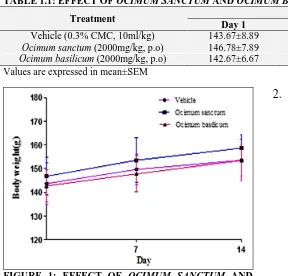
1. Acute Toxicity: Experimental screening method is imperative in order to establish the safety and efficacy of traditional and herbal products and also to set up the active components of the herbal products 20. There were no significant differences in the body weight between the control and treated groups (Figure 1, Table 1.1). Administration of
Ocimum sanctum and Ocimum basilicum did
not produced any mortality or any signs of behavioral changes or toxicity at the dose level of 2000mg/kg body weight in mice. The results of present study showed that acute administration of extract of Ocimum sanctum
and Ocimum basilicum may be safe as the
LD50 may be greater than 2000mg/kg. It
emphasizes the call for carrying out toxicity studies even in natural plant products and drug of indigenous medicinal system.
TABLE 1.1: EFFECT OF OCIMUM SANCTUM AND OCIMUM BASILICUM ON BODY WEIGHT OF MICE
Treatment Body weight (g)
Day 1 Day 7 Day 14
Vehicle (0.3% CMC, 10ml/kg) 143.67±8.89 149.67±6.35 153.56±8.89
Ocimum sanctum (2000mg/kg, p.o) 146.78±7.89 153.56±9.45 158.67±5.57
Ocimum basilicum (2000mg/kg, p.o) 142.67±6.67 147.78±7.56 153.45±6.45
Values are expressed in mean±SEM
FIGURE 1: EFFECT OF OCIMUM SANCTUM AND
OCIMUM BASILICUM ON BODY WEIGHT OF MICE
2. Delayed type Hypersensitivity Reaction:
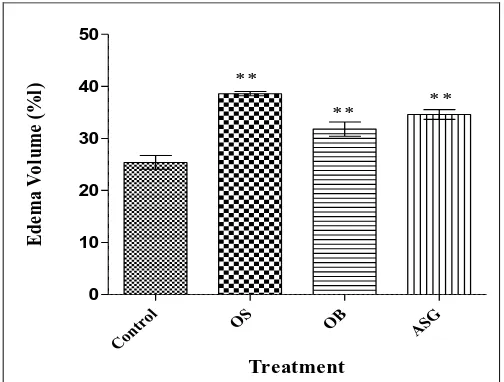
Immunomodulatory agents of plant and animal origin enhance the immune responsiveness of an organism against a pathogen by activating the immune system. The cell-mediated immune response assessed by DTH reaction using plethysmometer showed significant increase for Ocimum sanctum when compared with Ocimum basilicum and control groups, whereas a similar effect was observed when compared to the reference drug, Aswagandha
choorna. This increase in DTH reaction in
mice in response to T cell dependent antigen revealed the stimulatory effect of O. sanctum
[image:3.612.45.333.442.718.2]TABLE 1.2: EFFECT OF OCIMUM SANCTUM AND OCIMUM BASILICUM ON DELAYED TYPE HYPERSENSITIVITY REACTION OF MICE
Group & Treatment Foot pad thickness (Mean (%) Oedema)
24th hour 48th hour
Control 25.40±1.33 22.60±1.08
O. sanctum (200mg/kg) 38.60±0.40** 26.00±1.00
O. basilicum (200mg/kg) 31.80±1.39** 24.40±0.93
Ashwagandha choorna (100mg/kg) 34.60±0.93** 27.60±1.03
Now-a-days many of the disorders are due to the imbalances of immunological processes like Delayed type hypersensitivity (cell mediated) reactions and humoral responses 21. Delayed type hypersensitivity is a part of the process of graft rejection, tumor immunity and most important immunity to many intracellular infectious micro-organisms, especially those causing chronic diseases viz tuberculosis 22. Cell-mediated immunity (CMI) involves effector mechanisms carried out by T lymphocytes and their products (lymphokines) 23.
DTH requires the specific recognition of a given antigen by activated T lymphocytes, which subsequently proliferate and release cytokines. Delayed type hypersensitivity reaction is characterized by large influxes of non-specific inflammatory cells, in which the macrophage is a major participant. It is a type IV hypersensitivity reaction that develops when antigen activates sensitized TDTH cells. These cells generally appear to be a TH1 subpopulation although sometimes TC cells are also involved.
Activation of TDTH cells by antigen presented through appropriate antigen presenting cells results in the secretion of various cytokines including interleukin-2, interferon-γ, macrophage migration inhibition factor and tumor necrosis factor 24. The overall effects of these cytokines are to recruit macrophages into the area and activate them, promoting increased phagocytic activity vis-a-vis increased concentration of lytic enzymes for more effective killing.
Several lines of evidence suggest that DTH reaction is important in host defense against parasites and bacteria that can live and proliferate intracellularly. The interaction of sensitized T-cells, with antigen presenting cell, results to the release of cellular mediators, such as histamine, initiation of arachidonic acid metabolism 25 and eventually to
interferon-g that will lead to DTH reaction. Several inflammatory processes have been suggested as regard these possible mechanisms. For example, activation of complements, releasing of mediators by activated mast cells, kinin, reactive oxygen or nitrogen species from archidonic acid metabolites and pro-inflammatory cytokines 26.
When activated, TH1 cells encounter certain antigens, viz. SRBCs. They secrete cytokines that induce a localized inflammatory reaction called delayed type hypersensitivity 27. DTH comprises of two phases, an initial sensitization phase after the primary contact with SRBC antigen. During this period TH1 cells are activated and clonally expanded by APC (antigen presenting cells) with class II MHC molecule (e.g. Langerhans cells and macrophages are APC involved in DTH response). A subsequent exposure to the SRBCs antigen induces the effector phase of the DTH response, where TH1 cells secrete a variety of cytokines that recruits and activates macrophages and other non-specific inflammatory mediators.
Cont
rol OS OB ASG
0 10 20 30 40 50
Treatment
E
d
em
a
V
o
lu
m
e
(%
l)
FIGURE 2: EFFECT OF OCIMUM SANCTUM AND
[image:4.612.81.537.68.145.2] [image:4.612.313.565.482.673.2]The delay in the onset of the response reflects the time required for the cytokines to induce the recruitment and activation of macrophages 28. The infiltrating cells are thus immobilized to promote defensive (inflammatory) reaction. Treatment with
O. sanctum enhanced DTH reaction, which is
reflected from the increased footpad thickness when compared to control group suggesting heightened infiltration of macrophages to the inflammatory site. This study may be supporting a possible role of O. sanctum in assisting cell-mediated immune response.
3. Effect of Ocimumm sanctum and Ocimumm basilicum on Neutrophil Adhesion Test: The percentage reduction in the neutrophil count in nylon fibre treated blood samples from the herb treated groups was evaluated. Ocimum
sanctum treated group showed significant
(p<0.05) decrease in neutrophil adhesion when compared to vehicle treated group whereas no significant change was observed in Ocimum
basilicum treated group. The results were
comparable with that of reference drug Aswagandha choornam.
Cytokines are secreted by activated immune cells for margination and extravasation of the
phagocytes mainly polymorphonuclear
neutrophils. Significantly evoked increase in the adhesion of neutrophils to nylon fibres indicates the margination of cells in the blood vessels and the number of neutrophils reaching the site of inflammation.
Hence, it can be inferred that the proposed herb has potent immunomodulatory effect. In innate immunity neutrophils were considered as a multi-functional cell types that contribute to bacterial clearance by recognition, phagocytosis and killing whereas leucocytes are responsible for the production of antibodies leading to enhancement of immunity 29.
Further, these Neutrophils contain a variety of toxic substances which are involved in effective killing or inhibiting the growth of bacteria, fungi. The mediators of this cell will be increased only when the immune system is stimulated. Therefore, the TLC and DLC count analyzed gives the effective involvement of neutrophils in immunity.
On the other hand, macrophages are poly-morphonuclear lymphocytes that play an important role in the modulation of immune system. These cells then secrete number of cytokines likes CSF and IL-1 which in turn stimulates neutrophils and increases neutrophil index 30. This gives host defense the ability to counter the infectious diseases.
Our results demonstrated that the rise in neutrophil index as shown by enhanced adhesion of neutrophil to nylon fiber further suggests that O. sanctum may be useful in promoting the protection of body by phagocytosis, even in diseased conditions where immunity is depressed.
TABLE 1.3: EFFECT OF OCIMUM SANCTUM AND OCIMUM BASILICUM ON NEUTROPHILS ADHERENCE TEST IN MICE
Treatment Untreated blood (UTB) Fibrin treated blood (FTB) Neutrophil Adhesion %
Control 227.607.30 185.603.41 62.006.52
Ocimum sanctum (200mg/kg) 335.406.90 286.405.27 47.004.38*
Ocimum basilicum (200mg/kg) 352.603.31 305.003.48 49.602.27
Aswagandha chooma (100mg/kg) 302.604.23 267.202.60 35.405.94** All values are mean±SEM, n=5 (**P<0.001, *P<0.05 when compared to control group).
REFERENCES:
1. Auudy. B., Ferreira. F., Blasina. L., Lafon. F., Arredondo. F., Dajas. R., Tripathi, P.C. Screening of antioxidant activity of three Indian medicinal plants traditionally used for the management of neurodegenerative diseases. J. Ethanopharmacol. 2003; 84:131-138.
2. Miller, A.L. Antioxidant flavonoids: structure function and clinical. Alt. Med. Rev 1996); 1:103-111.
3. Boyer, R.F., Clark, H.M., Leroche, A.P. Reduction and release of ferritin iron by plant phenols. J. Inorq. Biochem. 1998; 32: 171-181.
4. Harsteen, B. Flavonoids, a class of natural of high pharmacological potency. Biochem. Pharmacol. 1983; 30: 1141-1148.
5. .Sirkar, N.N. Pharmacological basis of Ayurvedic therapeutics. In: Atal, C.K., Kapoor, B.M. (Eds.), Cultivation and utilization of medicinal plants. Published by PID CSIR 1989
[image:5.612.42.564.544.609.2]Rodríguez-Padilla, C. In vitro rat lymphocyte proliferation induced by Ocinum basilicum, Persea americana,
Plantago virginica, and Rosa spp. Extracts. Journal of Medicinal Plants Research 2008; 2(1): 005–010.
7. Prakash, P., Gupta, N. Therapeutic uses of Ocimum sanctum Linn (Tulsi) with a note on eugenol and its pharmacological actions: A short review. Indian J Physiol Pharmocol 2005; 49(2): 125–131.
8. Borchers, A.T., Sakai, S., Henderson, G.L., Harkey, M.R., Keen, C.L., Stern, J.S., Terasawa, K., Gershwin, M.E. Shosaiko-to and other Kampo (Japanese herbal) medicines: a review of their immunomodulatory activities.
J Ethnopharmacol 2000; 73: 1–13.
9. Rehman, J., Dillow, J.M., Carter, S.M., Chou, J., Le, B.B., Maisel, A.S. Increased production of antigen-specific immunoglobulins G and M following in vivo treatment with the medicinal plants Echinacea angustifolia and Hydrastis canadensis. Immunol Lett, 1999; 68: 391–396 10. Upadhyay, S., Dhawan, S., Garg, S., Talwar, G.P.
Immunomodulatory effects neem (Azadirachta indica) oil.
Int J Immunopharmacol, (1992; 14: 1187–1193.2
11. Calixto, J.B., Santos, A.R., Cechinel Filho, V., Yunes, R.A. A review of the plants of the genus Phyllanthus: their chemistry, pharmacology, and therapeutic potential. Med Res Rev 1998; 18: 225–258.
12. Boyanova, L., Neshev, G. Inhibitory effect of rose oil products on Helicobacter pylori growth in vitro: preliminary report. J Med Microbiol, 1999; 48: 705–706. 13. Ali, M.I, Shalaby, N.M., Elgamal, M.H., Mousa, A.S.
Antifungal effects of different plant extracts and their major components of selected aloe species. Phytother Res, 1999; 13: 401–407.
14. Sharma, P., Sharma, J.D. Plants showing antiplasmodial activity from crude extracts to isolated compounds. Indian J Malariol 1998; 35: 57–110.
15. Wong, C.K., Leung, K.N., Fung, K.P., Choy, Y.M. Immunomodulatory and anti-tumour polysaccharides from medicinal plants. J Int Med Res 1994; 22: 299–312. 16. Agarwal, S.S., Singh, V.K. Immunomodulators: A review
of studies on Indian plants and synthetic peptides, Part I: Medicinal plants. PINSA, 1999; B65, 3 & 4: 179–2 17. Ali, M.I, Shalaby, N.M., Elgamal, M.H., Mousa, A.S.
Antifungal effects of medicinal different plant extracts and their major components of selected aloe species. Phytother Res 1999; 13: 401–407.
18. Mathew, S., Kuttan, G. Immunomodulatory and antitumour activities of Tinospora cardifolia. Fitoterpia
1999; 70: 35–43.
19. Nelson, D.A., Mildenhall, P. Studies on cytophilic antibodies: The production by mice of macrophage cytophilic antibodies to sheep erythrocytes: relationship to the production of other antibodies and development of delayed type hypersensitivity. Australian Journal of Experimental Biology and Medical Sciences, 1967; 45: 113.
20. Wilkinson, P.C. Neutrophil adhesion test. In: Vane, J.K., Ferreria, S.H. (Eds.), Handbook of Experimental Pharmacology, I, first ed. SpringerVerlag, Berlin, 1978; 109
21. Mythilpriya, R., Shanti, P and Sachdanandam, P. Oral acute and subacute toxicity studies with kalpaomruthaa, a modified indigenous preparation on rats. Journal of Health Science 2007; 53(4): 351-358
22. Kanjiwani, D.G., Marathe, T.P., Chiplunkar, S.V., Sathaye, S.S. Evaluation of immunomodulatory activity of metha-nolic extract of Piper betel Scand. J Immunol 2008; 67: 589-593
23. Elgert, K.D. Immunology: Understanding the immune system. New York, Wiley 1996; 306.
24. Miller, L.E., Ludke, H.R., Peacock, J.E., Tomar, R.H. Manual of Laboratory Immunology. Lea and Febiger, London, 1991; 1-18.
25. Askenase, P.W., Van Loveren, M. Delayed type hypersensitivity: Activation of mast cells by antigen specific T-cell factors initiates cascade of cellular interactions. Immunology Today 1983; 4: 259–264. 26. Grisworld, D.E., Alessi, S., Walz, D.T. Stimulation of
contact sensitivity to oxazolone by disodium cromoglycate. Int Arch Allergy Immunol 1982; 69: 93-97. 27. .Vinegar, R., Truax, J.F., Selph, J.L., Jihnston, P.R.,
Venable, A.L., McKenzie, K.K. Pathway to carragenan induced inflammation in the hind limb of the rat. Federat Proc, 1987; 46: 118-126.
28. Bafna, A.R., Mishra, S.H. Immunomodulatory activity of methanol extracts of flower-heads of Sphaeranthus indicus Linn. Ars Pharmaceutical 2004; 45(3): 281-291.
29. Rao, C.V. Immunology. Introduction, India: Rajkamal Electric press 2006; 1-12.
30. Soehnlein, O., Kenne, E., Rotzius, P., Eriksson, E.E., Lindbom, L. Neutrophil secretion products regulate anti-bacterial activity in monocytes and macrophages. Clin Exp Immunol 2008; 151: 139-145.
31. Stanforda, S.J., Pepperb, J.R., Mitchell, J.A. Cytokine modulation of granulocyte macrophage-CSF and granulocyte-CSF release from stimulated vascular smooth muscle cells. Eur J Pharmacol 2002; 436: 241-244.
All © 2013 are reserved by International Journal of Pharmaceutical Sciences and Research. This Journal licensed under a Creative Commons Attribution-NonCommercial-ShareAlike 3.0 Unported License.
This article can be downloaded to ANDROID OS based mobile. Scan QR Code using Code/Bar Scanner from your mobile. (Scanners are available on Google Playstore)
How to cite this article: