4424
CONTEXT AWARE IN ADAPTIVE UBIQUITOUS E-LEARNING
SYSTEM FOR ADAPTATION PRESENTATION CONTENT
1SALMA EL JANATI, 2ABDELILAH MAACH, 3DRISS EL GHANAMI
1,2,3 Mohammed V University in Rabat, Mohammadia School of Engineers (EMI), LRIE Laboratory
Morocco
E-mail: 1[email protected]
ABSTRACT
The Advances in adaptive learning systems (ALS) and the rapid development of ubiquitous systems (US) mean that e-learning is not limited to certain parameters. However, the e-learning system (E-LS) must take into account the context-aware of learners to help them to complete their activity. The traditional online educational systems suffer from lack of immediate help and limitations in the presentation of pedagogical content, which yield the learner unable to receive learning resources that meet his/her needs and reduces the effectiveness of learning. In this paper, we suggest a new framework to sense the learner’s context and adapt it automatically to the adequate presentation content, which meet the learner’s preferences and needs of learners who suffer from hearing and visual impairments. This framework is based on mixing Dynamic Adaptive Hypermedia System (DAHS) and Ubiquitous Learning System (ULS). It proposes a box tools that performs information, transcoding and location in order to generate a new presentation content based on the context-aware of the learner.
Keywords: Adaptive Learning Systems, Ubiquitous Systems, E-learning, Hypermedia System, Context-aware, Learner Model, Transcoding, Speech-to-text.
1. INTRODUCTION
The number of studies deployed for educational systems (ES) around the world is growing at a rapid pace. Although, many researchers show that using Adaptive learning system (ALS) in ES increase motivation and interest of the learner. The Adaptive learning is defined as a usage of technology to help the learner in their learning process [1]. It is born to emphasize the interaction between the computer science and human learning. ALS is a highly multidisciplinary domain that combines human science, sciences of education, psychology, didactic, ergonomics, and artificial intelligence. It includes the adaptive content and recommendation, adaptive navigation, and adaptive presentation. ALS supports the learning and personalizes access to course material. It improves learning process, reduces time required, and require less effort to offer a powerful lifelong to e-learning solution. These systems provide the pedagogical content, presentation, and services to meet the learner’s needs.
The current models of ALS are not conducive to dynamic adaptation of presentation content of learner. They are limited in terms of variety and depth; they are not integrated in teaching and e-learning based on the learner's curriculum [2]. We found relatively few studies in education with such a specific focus in pedagogical presentation content. Up to now, there is no consensus for the most appropriate models of presentation or attributes of the education system to include in context awareness of the dynamic adaptive hypermedia system. This restriction prevents the possibility of adapting dynamically the content to the adequate presentation based on the context-aware (preferences, situations, disabilities) of learners.
4425 presentation content to the learner. However, the ALS could integrate context-awareness to suggest a useful and acceptable system using Ubiquitous System (US). Our research suggests an innovative approach to include context information into the learning modeling to generate the appropriate presentation that responds learners’ preferences and their physical impairments (visual and hearing impairments).
This paper is divided into seven sections. The first section presents a literature review of adaptive e-learning system. In the second section, we present our approach to mix DAHS and ULS. The third section is devoted to describing the context-aware provided by mixing the two approaches, their levels and their standards. The fourth section describes the Box tools used in our approach, the proposed architecture system, their components, and the simulation. Finally, we conclude with a conclusion and future work.
2. LITERATURE REVIEW
The scientific fields of the Adaptive learning system (ALS) are interested in computing and adaptive learning environment, whose main mission is to go with the learner in their learning process to respond their needs [3]. The design of ALS was subject of various works in the literature. ALS is defined as an environment that mobilizes human and artificial agents and offers them situations of interaction, locally or through computer networks, as well as conditions of access to the formative resources [4]. It includes monitoring activities, representing these activities in associated models to facilitate dynamically the learning process and analyzing learner preferences, learning styles, and interests. In adaptive learning systems the characteristics, prior knowledge, background of the learner can be interpreted by the system with the help of the technology.
However, the design of ALS is based on the normalization, technology standards (LOM, SCORM, IMS learning design, IMS Lips, etc.), development (HTM, XHTML, XML, DTD, etc.), and platforms of distance learning [5].
In the literature, ALS covers a variety of systems: Controlled / Self-controlled Systems [6], Open Systems [7], Learning Management Systems (LMS) [8], Intelligent Tutoring Systems (ITS) [9], Adaptive Hypermedia System (AHS) [10], and Dynamic Adaptive Hypermedia Systems (DAHS).
According to Brusilovsky, ALS groups the mentioned technologies into Intelligent Tutoring technology [11] and Adaptive Hypermedia technology. Several adaptive hypermedia systems
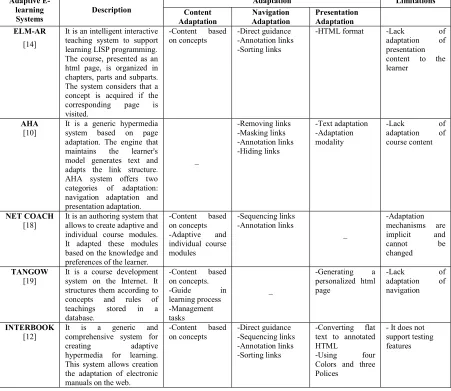
for education have emerged and have even influenced a number of recent systems. Examples include the INTERBOOK system [12], the SmexWeb system [13], the ELM-ART system [14], the KOD system [15], the Calls system [16], the ALFANET system [17], the AHA [10], the NET COACH system [18] and TANGOW system [19], etc. Table 1 looks at some of the most cited systems in the literature by presenting the techniques deployed for the realization of adaptation and theirs limitations.
In our research, we are interested by these systems, specifically by the DAHS. This area of research aims to increase the functionality of hypermedia making it more personalized or even adaptable [12]. The DAHS build a model of goals, preferences and knowledge of learners and use this information to adapt the content to the learner’s needs.Moreover, these systems suggest a list of the most relevant links for advance further in the field [20]. The DAHS includes four main components: Domain Model, Learner Model, Multimedia Database, Generator Courses, and inference Mechanism of Adaptations [21].
The first aspect of DAHS research concerns the learner model. This model is fundamental for adaptability. A second aspect of this research is the question of pedagogical tools in particular, the representation and the assembly of resources adapted to the educational context.
DAHS consist of three levels of adaptation: Adaptation Content, Adaptation Navigation, and Adaptation Presentation.
The adaptation content is defined as a model of adaptation that integrates technology, pedagogy, and content [22]. This model emphasized that teachers need not only a pedagogical and content knowledge but also technological knowledge. It is based on the selection of the content and adapts it to the learner’s needs. The most mechanisms of adaptation used in adaptation content are Genetic algorithms [23], Bayesian networks [24], Neuro-fuzzy network [25], Extensible text [26], Semantic Web [27], and Index of learning styles (ILS) [28].
4426 Adaptation presentation consists of the presentation of the pedagogical content using the multimedia adaptation [30], which manipulates media such as text, images, sound and video. For the adaptive presentation, it is important to use different media in a single application. A video with subtitles that are synchronized with the spoken audio is an example of a simple adapted multimedia that responds learner’s needs. Others methods used in the adaptive presentation are the modality adaptation and text adaptation [31].
Existing systems have a lack of adaptation of presentation content. The most adaptations of presentation are based on HTML, police and color personalization, and adaptation of modality. These adaptations are not enough to meet the learner’s preferences and needs of learners with visual and hearing disabilities. For this reason, we propose a new framework, which takes into account the context-aware (preferences, interests and disability) of the learner based on two approaches: DAHS and ULS.
Adaptive E-learning Systems
Description
Adaptation Limitations
Content Adaptation Navigation Adaptation Presentation Adaptation ELM-AR [14]
It is an intelligent interactive teaching system to support learning LISP programming. The course, presented as an html page, is organized in chapters, parts and subparts. The system considers that a concept is acquired if the
corresponding page is
visited.
-Content based
on concepts -Direct guidance -Annotation links -Sorting links
-HTML format
-Lack of
adaptation of
presentation content to the learner
AHA
[10]
It is a generic hypermedia system based on page adaptation. The engine that maintains the learner's model generates text and adapts the link structure. AHA system offers two categories of adaptation: navigation adaptation and presentation adaptation. _ -Removing links -Masking links -Annotation links -Hiding links -Text adaptation -Adaptation modality
-Lack of
adaptation of
course content
NET COACH
[18]
It is an authoring system that allows to create adaptive and individual course modules. It adapted these modules based on the knowledge and preferences of the learner.
-Content based on concepts
-Adaptive and
individual course modules
-Sequencing links -Annotation links
_
-Adaptation mechanisms are
implicit and
cannot be
changed
TANGOW
[19] It is a course development system on the Internet. It structures them according to concepts and rules of
teachings stored in a
database.
-Content based on concepts.
-Guide in
learning process -Management tasks
_
-Generating a
personalized html page
-Lack of
adaptation of
navigation
INTERBOOK
[12]
It is a generic and
comprehensive system for
creating adaptive
hypermedia for learning. This system allows creation the adaptation of electronic manuals on the web.
-Content based on concepts
-Direct guidance -Sequencing links -Annotation links -Sorting links
-Converting flat text to annotated HTML
-Using four
Colors and three Polices
[image:3.612.85.536.290.681.2]- It does not support testing features
4427
3. MIXING DAHS AND AU-LS
In recent years, two complementary technologies have been introduced in the world of learning: Dynamic Adaptive Hypermedia System (DAHS) and Ubiquitous Learning System (ULS). In our study, we will mix the two technologies in order to exploit the fusion result to develop a powerful context and adapt the pedagogical content to the adequate presentation taking into consideration this context aware and learner’s needs.
3.1 DAHS
DAHS are the result of a combination of two approaches: Adaptive System and Hypermedia System. In this combination, the Adaptation refers to the fact that the system changes its behavior based on the context in which it is used. However, the context may model not just aspects of the learner of the system, but also information about the place, localization, geography, culture, where it is being used, the time, the device used for interaction, or any other contextual aspect, like the aspect of learner, their characteristics, and their physical impairments.
According to several authors, three concepts are used interchangeably in AHS: hyperdocument, hypertext, and hypermedia [32]. Hypermedia is based on the hypertext while a multimedia can be defined as a set of nods related by links. The nodes are elementary units linked to data fragments (sound, animation, etc.). When we have a text in this fragment, the hypermedia called hypertext. The major interest of the AHS is the global structure of hyperspace and not the content [32]. The use of hypermedia in education has given birth to three generations of educational hypermedia: Classic Hypermedia, Adaptive Hypermedia and Dynamic Adaptive Hypermedia.
The Classical Hypermedia System presents information in a non-linear manner. The links are coded in the objects of the interface and the system manages the interaction with the learner by activating the links between the different nodes of the document [32]. These systems provide learners with ease and freedom of navigation in the information hyperspace. Nevertheless, this ease of navigating in the hypermedia structure involves two major risks for learners. First, the lost in hyperspace syndrome and second, the phenomenon of cognitive overload [29]. Indeed, learners find themselves lost in front of the mass of information available, even disoriented of their initial objectives. To address these problems, several researches have been
carried out and new systems have been set up. These systems include Adaptive Hypermedia.
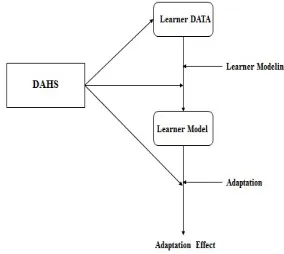
The Adaptive Hypermedia offers content that meets the learner’s needs, according to their preferences and interests. These systems have tried to minimize the negative aspect of classic hypermedia without solving all the problems related to adaptation [33]. However, the realization of the adaptation of the content and presentation is complex since it consists of changing the content fragments, dynamically integrating new multimedia bricks. Owing to these limitations, research has focused on Dynamic Adaptive Hypermedia that improves the quality of adaptation by taking into consideration content, navigation and presentation, also dynamically integrating new data. DAHS consist of two processes. The first process based on the collection of the data of learner in order to update the learner model. This model used by the system to perform the adaptation to the presentation. Thereafter, the application must act according to the learning model to product an adaptation effect that responds to the learner needs. Figure 1 introduces the adaptive process of DAHS.
[image:4.612.360.502.400.527.2]
Figure 1: Adaptive Process in Dynamic Adaptive Hypermedia System
3.2 ULS
4428 a required manner and taking into account the geography, country and culture of learner to respond their needs and the appropriate content. ULS support the network communications and context aware technologies in order to leverage its highly mobile and accessible mobile carriers to improve the learner’s level of independence.
ULS is a learning system that can be transferred to mobile devices by cable or wireless, and then can be operated in these mobile devices. The materials of these systems can be videos, audios, animation, powerPoint that can be transferred to the new technology. Context aware of ubiquitous learning detects the physical environment and adopts the behavior of the learner accordingly [35]. However, the most research in adaptive ubiquitous learning focused on applying recommendation algorithms to provide to the learner the adaptive learning resources. In a ULS, the learner becomes important as a guide for learning, helping learners to analyze and evaluate sources of information. The five main proprieties for a Ubiquitous learning system are Autonomous, Distributed, implicit Human Computer Interaction (iHCI), intelligent, and context aware [36].
Some researchers in the u-learning developed a prototype system for ubiquitous e-learning (UE-L) to adapt the courseware to the learner’s interests, preferences, and specifications [37]. The context-aware of this learner was enabled using Read-frequency identification (RFID) technology.
Others researchers developed a website of UE-L with different devices and designed a context-aware ULS based on the RFID in order to enable learners to learn with the traditional learning resources and the real resources. Others studies aim to provide the adaptability with an ubiquitous learning approach and produce a system which support the selection of learning material serving the rich media content to the learner [38].
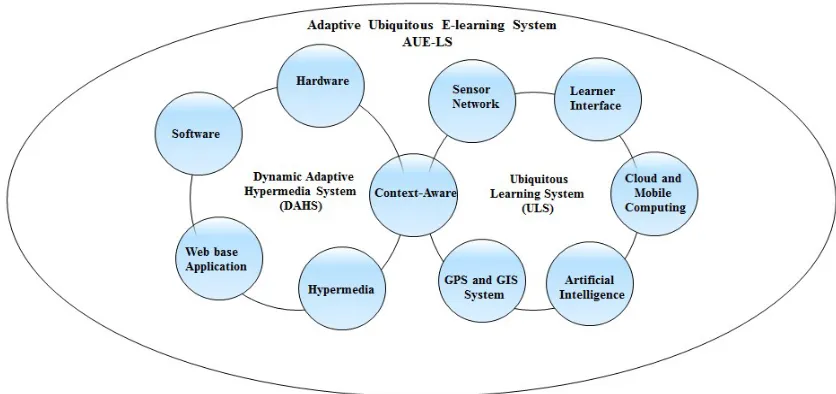
Ubiquitous System implies an ability to adapt the content to environmental conditions. Many studies have recently described the ability to apply ubiquitous technology to e-learning system [24]. Other studies have described the challenge in ALS to ULS [39]. U-learning System (ULS) may detect more context data than ALS. In our contribution, we will improve the quality of the content presentation and adapt it to the context aware as a learner model with the fusion of the DAHS and ULS. Figure 2 represents the fusion approach of the two technology DAHS and ULS.
[image:5.612.106.524.509.706.2]The proposed architecture based on the Context-aware of the learner; takes into consideration the location context of learner provided by ULS to adapt the content presentation to the proximity and language of the country, and their preferences of the adequate content presentation to respond their needs.
4429
4. AUE-LS CONTEXT-AWARE
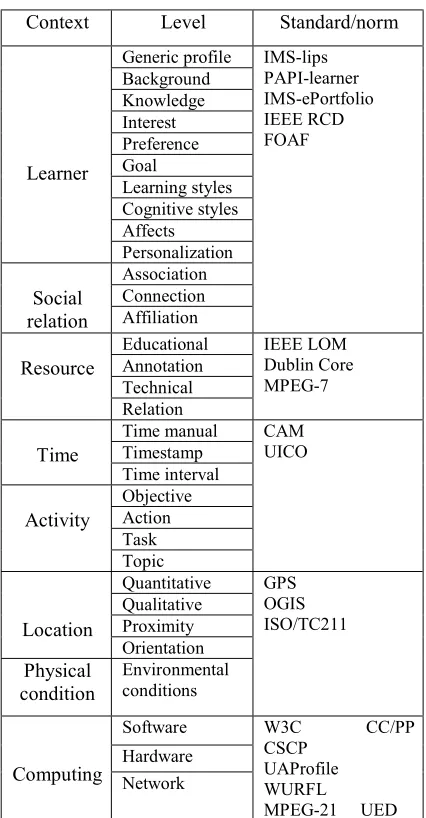
There is a growing interest in using context awareness as a technique to develop an adaptive e-learning system to be flexible, adaptable and able to act in a dynamical way on behalf of the learner. Context modeling is the first step in the process of creating application context-aware. This model allows the application and middleware to facilitate the interaction with the context by providing an abstract description of the observable. The diversity context information and its use in different domains generate different ways to model them. In this section, we present the seven main axes to adapt the presentation to the context learner: Learner, Social relation, Resource, Time, Activity, Location, Physical condition, and Computing.
4.1 Learner
Learner model has been extensively researched in the areas of adaptive educational hypermedia and educational learner modeling. The main standards that have been proposed in the literature, which inspired by: IMS_LIP [40], PAPI-Learner [41], IMS-ePortfolio [42], IEEE RCD [43], and FOAF [44]. This model involves eight categories: Genetic profile, Background, Knowledge, Preference, Learning goals, Learning style , Cognitive style, and Affects.
4.1.1 Genetic profile
The generic profile category is based on personal information of learner that includes identification, authentication, name, contact, gender, e-mail, information of acceptability, security such as Password and IP address, language capability, and physical disability.
4.1.2 Background
The background of the learner is a set of elements modeled include their experience in related areas, their cultural characteristics, and their traditions.
4.1.3 Knowledge
Knowledge category represents prior knowledge of learner such as; such as metacognitive processes, comprehending strategies, vocabularies, skills, and even self-understanding.
4.1.4 Preference
The preference category detects the interests and preferences of learners, including their search term, their reads, their comments, and tags.
4.1.5 Learning goal
Learning goal is related to gaining an ability of learner to solve problems based on their skills and their prior knowledge rather than having simply completed a given task.
4.1.6 Learning style
Learning styles are a range of competing and contentious theories. It is based on a common concept that learners differ in the way they acquire their knowledge. Felder-Silver-man inventory describes the learning styles of learner along different dimensions [45].
4.1.7 Cognitive style
Cognitive style describes the way learner think, perceive and remember information. It differs in their preferred way of cognitive processing and presentation (textual, auditory or visual) [45].
4.1.8 Affects
Affects is a state of mind such as a sensation, an emotion, a feeling, or mood. Some research based on the influence of emotions on learning using the OCC model that specifies 22 emotion categories of learner [46].
4.2 Social Relation
The learner model characterizes by the social relation, which describes the associations, connections, and affiliation between learners.
4.3 Resource
Resource category is organized into several subcategories including a technical description, education characteristics, and the manner of using the learning resources (LR). There are many standards used for the description of learning resources such as: The IEEE Learning Object Metadata (LOM) [47], and MPEG-7 [48].
4.4 Time
Time category includes the information about the date, time, week, and month of the learning activity. It is used with other pieces of time context such as: time manual, time interval, and timestamp, which detects the period whose contextual information is relevant.
4.5 Location
4430 information about learner and the relationships between the learning objects. It includes the proximity, the orientation, and communicative ability of the learner. Several specifications and standards have been elaborated to detect the location of learner such as: Global Positioning System (GPS), Open GIS Consortium standards (OGIS), and ISO/TC211 [49].
4.6 Activity
Activity category consists of capturing the actions, the purposes and the tasks of the learner. Data captured consist of events in an educational system, and data related to the session and time. There are many models elaborate the activity context of learning such as: the UICO [50] models and Contextualized Attention Metadata (CAM) [51].
4.7 Physical Condition
The Physical condition takes into account the learner and the system as well as environmental conditions related to the educational application such as the illumination level, noise level, and weather conditions.
4.8 Computing
The computing category includes the static and dynamic characteristics of the network to have an available bandwidth. The hardware propriety of
this category comprises the input and output data capabilities of devices or storage. Whereas, the software proprieties of computing category describe whether the context supports certain APIs, platform integration, media formats and presentation use.
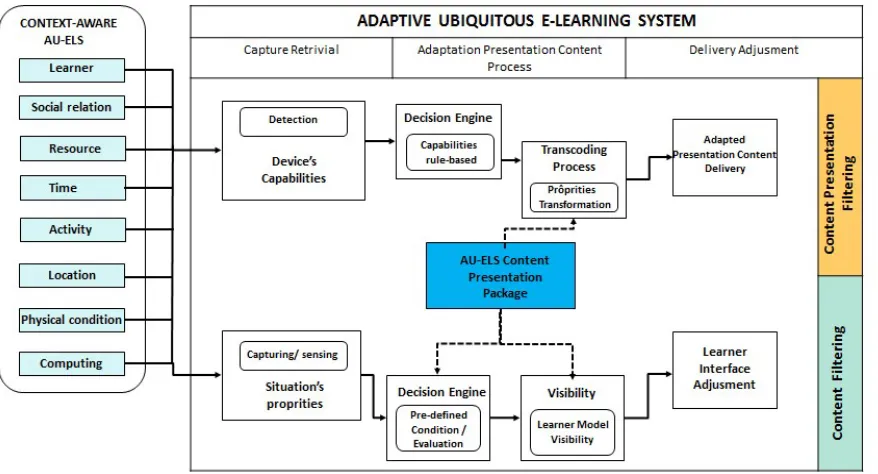
The use of the computing context must support the intelligent interfaces that select the adequate LR to the learner that respond their needs. The relevant standards and norms used to describe the computing proprieties are: CC/PP [52], UAprofile [53], MPEG-21 [54] and CSCP [55]. Figure 3 presents our proposed model of context-aware, inspired by to build our Adaptive Ubiquitous E-learning System.
[image:7.612.93.532.466.703.2]However, the most of the context-aware system do not involve the content presentation model until late in the project, which is in our view an obstacle for the adaptation of the presentation of the pedagogical content. The context-aware can actively support the learner’s learning effectiveness in an actual setting. These categories suggested by adaptive learning environment help to understand the concept of learner. Table 2 shows the different levels of AUE-LS context-aware that we must take into consideration and the relevant standards and norms used.
4431
Table 1: levels of AUE-LS context aware
Context Level Standard/norm
Learner
Generic profile IMS-lips PAPI-learner IMS-ePortfolio IEEE RCD FOAF Background
Knowledge Interest Preference Goal
Learning styles Cognitive styles Affects Personalization
Social relation
Association Connection Affiliation
Resource
Educational IEEE LOM Dublin Core MPEG-7 Annotation
Technical Relation
Time
Time manual CAM UICO Timestamp
Time interval
Activity
Objective Action Task Topic
Location
Quantitative GPS OGIS ISO/TC211 Qualitative
Proximity Orientation Physical
condition
Environmental conditions
Computing
Software W3C CC/PP CSCP
UAProfile WURFL
MPEG-21 UED Hardware
Network
5. CONTEXT FRAMEWORK FOR AUE-LS
Our contribution presents a new approach of adaptation content presentation. It uses a combination of the context awareness of AU-ELS, transcoding approach and the standard web technology, In order to improve the presentation of content to the learner.
In our proposed approach, we propose a Box tool, which offer a transcoding service to learner, and taking into account the location of learner to present the content in the adequate language.
5.1 AUE-LS Box Tools
The AUE-LS Box tools consist of the use of the context, transcoding and the location tools to improve the presentation of the pedagogical content.
5.1.1 Transcoding Box tools
Transcoding approaches are the ability to adapt digital files, which the content can be viewed on different playback devices and viewed by different learners with several needs and impairments. These approaches work as an interpreter and a transcoder translates files to a suitable format for the end learner. It allows the creation of a more adaptive and accessible presentation content by matching learner requirements with preferences and contents. The transcoding operation takes into consideration several parameters such as the input presentations content
f
in1,...,
f
inn and converts them into output presentations content in the specified formatf
out. Thus, we denote a transcoding operation by:
,...,
,
(
)
1
1 in in in out out out
in
f
d
f
f
d
f
d
n
n
4432
5.1.2 Location Box tools
Location Box tools of AUE-LS offers to the learner the possibility to use the multimedia and the web page with the appropriate language using location tools and the translator. It provides content and services to learners based on location and learner profile. The location box tools locate the learner using the Geo-location system and determine the learner's country. Then, the location box tools recommend the language with which the content will be proposed. This recommendation is based on a list that contains for each country the language to recommend.
The architecture of the Location box tools consists of three components: database that contains a list of the country and their language, the learner Geo-location, and content translated into different languages. The learner navigates to a location-aware system in the AUE-LS browser (1).
Then, the application web page loads and requests coordinate from the AUE-LS browser by making a Geolocation function call. The browser AUE-LS intercepts this and requests learner permission (2). Thereafter, the browser retrieves coordinate information from the device it is running on. For example, a combination of IP address, Wi-Fi, and possibly GPS coordinates. It is an internal function of the browser (3). The browser sends these coordinates to a trusted external location service, which returns location coordinates that can now be sent back to the host of the Geolocation system to detect the country (4). The database of the list of countries allows the detection of the appropriate learner language to deliver the web page and the content presentation with this language (5). Figure 4 shows the architecture of the Geolocation box tools of AUE-LS.
Transcoder presentation
Transcoder operation Needs of learner
Text-to-speech Converts text input into a spoken voice output, or speech Preferences\Visual impairment
Text-to-image Converts text input into image output Preferences\Hearing impairments
Text-to-video Converts text input into video output Preferences
Speech-to-text Converts speech or audio input into text output Preferences\Hearing impairments
Speech-to-video Converts speech or audio input into video input Preferences
Image-to-animation Converts images inputs into animation Preferences\Hearing impairments
Image-to-video Converts image input into video output. Preferences\Hearing impairments
4433
5.2 AUE-LS Architecture
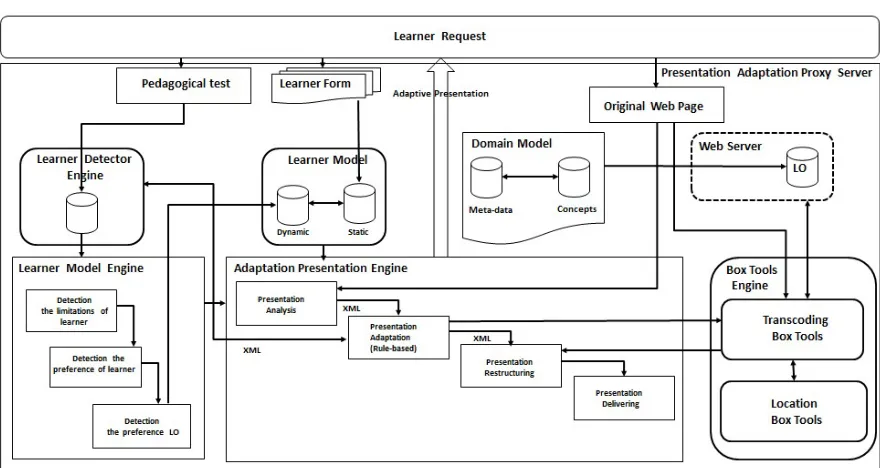
AUE-LS consists of a Presentation Adaptation Proxy as a proxy between learner request, components, features, and engines of the system to generate the adequate Learning Object (LO) of learners. AUE-LS is automatically responsive to each learner on their presentation demand, and it is able to predict learner presentation preferences and interests. The architecture of AUE-LS, as described in Figure 5, is divided into four engines: Learner Detector Engine (LDE), Learner Model Engine (LME), Box Tools Engine (BTE), and Adaptation Presentation Engine (APE).
5.2.1 Learner Model
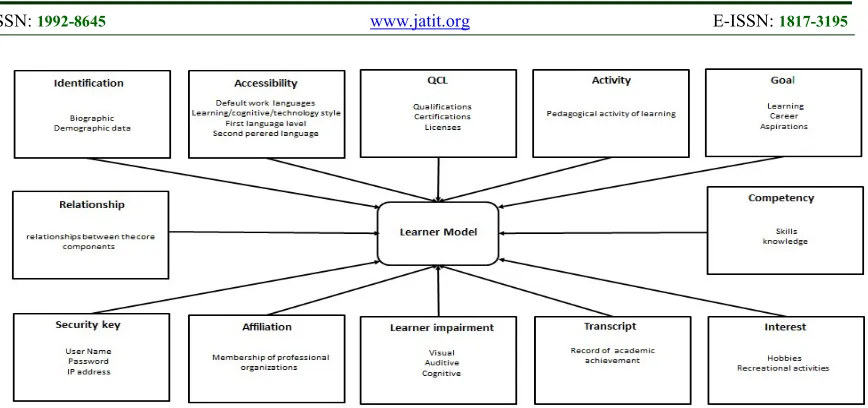
Learner Model is the key component of the AUE-LS. In this model we extend the context-aware model using IMS LIP standard which are the most well know learner profile. The learner is able to provide information and completes the learner form that will feed the static and dynamic data of Learner Model.
The IMS LIP model is accompanied by an XML schema for the exchange of learning data between cooperating systems such as: learning
management systems, system human resources, learner data management systems, knowledge management systems, and other systems using learning process. It defines a user data structure in eleven categories to be imported or exported between systems interoperable. Its eleven categories are: Identification, Accessibility, QCL, Activity, Goal, Competency, Interest, Transcript, Affiliation, Security key, and Relationship. In our approach we inspired by this model and we add another category named learner impairments. Our Learner Model is shown in Figure 6.
The learner profile can change from time to time and the learner can modify its profile directly. The Learner Model can be contain basic information for the learner such as user name, age, mobile number, e-mail and address. The information in this component is rarely changed.
5.2.2 Learner Detector Engines (LDE)
[image:10.612.87.527.115.349.2]The LDE allows caching the learner information regarding their interest and their presentation preferences, through the pedagogical test that detects the preferences and impairments of learning in order to be stored in Learner Model Engine.
4434
5.2.3 Learner Model Engine (LME)
LME processes information recorded in LDE to establish the limitation learner and define their preferences of presentation and LO. These operations update the dynamic LM that interacts with the Adaptation Presentation Engine.
5.2.4 Domain Model
The Domain model is divided into two domains: the metadata and the domain concepts. The metadata facilitates the search and the recovery of Pedagogical object (PO) of the concept. This Model is related to the e-learning web server that provides LO.
5.2.5 Adaptation Presentation Engine (APE)
APE is the most important Engine in AUE-LS that manages the interaction between the components and the engines of the system. It is composed of four components: Presentation Analysis, Presentation Adaptation, Presentation Restructuring, and Presentation Delivering. The main role of presentation analysis is to extract the content of the original web page to be explored.
The presentation Adaptation module recovers the LO learner’s preferences detected at Learner Model Engine in order to exploit the LO media and choose the adapted transcoding mode.
While, the Presentation Restructuring module allows the reception of the appropriate presentation content from the transcoding engine and update or create the new web page with the new presentation content. Presentation delivering is responsible for the transmission of the adaptive presentation content to the learner.
5.3 Simulation
In our simulation, we present a real example of learners suffer from hearing impairments which use the AU-ELS model in order to adapt the educational content to the appropriate presentation.
5.3.1 Learner Model Structure using IMS
LIP
[image:11.612.96.530.68.272.2]In our architecture, the pedagogical test and the learner form generate the IMS XML file. The IMS XML file dispatches data and saves it in the database of system. Figure 7 and Figure 8 show two parts of the IMS XML file: accessibility category and learner impairments category.
4435
[image:12.612.88.545.67.728.2]Figure 7: Part of IMS Accessibility XML file
Figure 8: Part of IMS Learner_impairments XML file
5.3.2 Transcoding Speech to Text
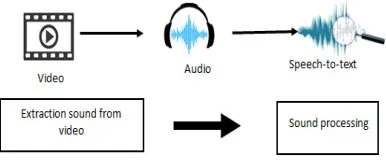
[image:12.612.327.520.169.250.2]In order to offer the adequate presentation content to learners who suffer from hearing impairment, we convert the content video to text using the approach proposed in Figure 9.
Figure 9: Architecture of transcoding speech-to-text
The first step consists of extracting the sound from video in wav format using an encoder, and then the sound processing uses the Speech Recognition algorithms to transform the sound to text based on Deep Learning. In this part, we have developed a script under Python to ensure the conversion of video to text. The first part of the script is used to encode the video and extract the sound in wav format as shown in Figure 10.
Figure 10: Python script for audio extraction
4436 Learning architecture. Figure 11 shows a part of script of Speech-To-Text Step.
5.3.3 Results and limitations
Our survey results confirm that the combination of the DAHS and UL allows to know more information about the context-aware of learner (their preferences, their localizations, and their disabilities) using IMS_LIP standard. This study gives to learners who suffer from hearing disabilities the opportunity to follow different courses with the conversion of the video presentation and the speech presentation to text presentation.
This study is not without limitations. First, this approach does not integrate the adaptation of navigation, which makes navigation between pages difficult and do not keep the same transcoding presentation while changing the page. Second, the transcoding approach requires a very large learning database (VLDB). As such, it requires special management, maintenance and technologies to operate. Third, this approach is based on Google APIs, which need to be always connected to the internet. These limitations will be taken into considerations to improve the adaptation and the quality of the suggested system.
6. CONCLUSION
This paper presented a new e-learning framework for adaptation content presentation. This framework takes into consideration the learner’s context-aware based on mixing two approaches DAHS and U-LS. Moreover, the suggested approach tries to solve the lack of adaptation of presentation content, in order to propose to learners who suffer from visual and hearing impairments the
appropriate presentation content. The proposed architecture consists of four engines; Learner directory engine, learner model engine, adaptation presentation engine, and box tools engine. In the simulation part, we present a real example of learner suffers from hearing impairment. In the learner directory engine, we saw a part of XML IMS_LIP files that dispatchers data between these engines and the other components of system including the new category of learner impairment. In the transcoding box tools engine, we proposed a python script to ensure the conversion of speech to text, which help the learner to follow courses. In the future work, we will deploy the architecture of the AU-ELS and the approach of the location box tools based on ubiquitous learning. Thus, we will propose a new approach to monitor and manage the learner’s activities.
REFRENCES :
[1] GROFF, Jennifer et MOUZA, Chrystalla. “A framework for addressing challenges to classroom technology use”. AACe Journal, 2008, vol. 16, no 1, p. 21-46.
[2] Mellet-D'huart, Daniel et Michel, Georges. “Réalité virtuelle et apprentissage”, 2005. [3] KARA, Nuri et SEVIM, Nese. Adaptive Learning
Systems: Beyond Teaching
Machines. Contemporary Educational Technology, 2013, vol. 4, no 2, p. 108-120. [4] EL JANATI, Salma et MAACH, Abdelilah.
Towards a new adaptive E-learning framework for adapting content to presentation. In : 2017 Intelligent Systems and Computer Vision (ISCV). IEEE, 2017. p. 1-7.
[5] SMRŽ, Pavel. “Integrating natural language processing into e-learning: a case of Czech”. In : Proceedings of the Workshop on eLearning for Computational Linguistics and Computational Linguistics for eLearning. Association for Computational Linguistics, 2004. p. 1-10. [6] Tchounikine & al, P. Platon-1 : “Quelques
dimensions pour l’analyse des travaux de recherche en conception d’EIAH”. Rapport de l’Action Spécifique : Fondements théoriques et méthodologiques de la conception des EIAH .département STIC du CNRS, 2004.
[7] BALOYI, G. P. “Learner support in open distance and e-learning for adult students using technologies. Journal of Communication”, 2014, vol. 5, no 2, p. 127-133.
[8] COLE, Jason et FOSTER, “Helen.Using Moodle: Teaching with the popular open source course
4437 management system”. O'Reilly Media, Inc., 2007.
[9] Wenger, E. “Artificial Intelligence and Tutoring Systems. Los Altos, CA: Morgan Kaufmann”, 1987.
[10] DE BRA, Paul et CALVI, Licia. “AHA: a generic adaptive hypermedia system”. In : Proceedings of the 2nd Workshop on Adaptive Hypertext and Hypermedia. sn, 1998. p. 5-12. [11] BRUSILOVSKY, Peter. “Methods and
techniques of adaptive hypermedia. User modeling and user-adapted interaction”, 1996, vol. 6, no 2-3, p. 87-129.
[12] BRUSILOVSKY, Peter. “Methods and Techniques of Adaptive Hypermedia. Adaptive Hypertext and Hypermedia”,1998, pp.1-43. [13] DE KOCH, Nora Parcus. Software Engineering
for Adaptive Hypermedia Systems-Reference Model, Modeling Techniques and Development Process. 2001.
[14] WEBER, Gerhard et BRUSILOVSKY, Peter. ELM-ART: An adaptive versatile system for Web-based instruction. 2001.
[15] SAMPSON, Demetrios, KARAGIANNIDIS, Charalampos, et CARDINALI, Fabrizio. An architecture for web-based e-learning promoting re-usable adaptive educational e-content. Educational Technology & Society, 2002, vol. 5, no 4, p. 27-37.
[16] CONLAN, Owen, HOCKEMEYER, Cord, WADE, Vincent, et al. Metadata driven approaches to facilitate adaptivity in personalized eLearning systems. The Journal of Information and Systems in Education, 2002, vol. 1, no 1, p. 38-44.
[17] SANTOS, Olga C., BOTICARIO, Jesus, et BARRERA, Carmen. Authoring a Collaborative Task Extending the IMS-LD to be Performed in a Standard-based Adaptive Learning Management System called aLFanet. In : ICWE Workshops. 2004. p. 180-187.
[18] WEBER, Gerhard, KUHL, Hans-Christian, et WEIBELZAHL, Stephan. Developing adaptive internet based courses with the authoring system NetCoach. In : Workshop on Adaptive Hypermedia. Springer, Berlin, Heidelberg, 2001. p. 226-238.
[19] CARRO, Rosa M., MORIYÓN, Roberto, PULIDO, Estrella, et al. Teaching tasks in an adaptive learning environment. 1999.
[20] DELESTRE, Nicolas. “Metadyne, un hypermédia adaptatif dynamique pour
l’enseignement ”. Thèse de doctorat. Université de Rouen, 2000.
[21] PAPANIKOLAOU, Kyparisia A.,
GRIGORIADOU, Maria, KORNILAKIS, Harry, et al. “Personalizing the interaction in a Web-based educational hypermedia system: The case of INSPIRE. User modeling and user-adapted interaction”. 2003.
[22] Paramythis, A.,Loidl-Reisinger, S. “Adaptive learning environments and elearning standards”. Electronic Journal on e-Learning, 2(1),2004,pp.181–194.
[23] SAMIA, Azough. E-Learning Adaptatif: Gestion intélligente des ressources pédagogiques et adaptation de la formation au profil de l'apprenant. 2014.
[24] Russell, S., Norvig, P. “Artificial Intelligence: A Modern Approach. second edn”. Morgan- Kaufman, Los Altos, CA , 2003.
[25] SEVARAC, Zoran. Neuro fuzzy reasoner for student modeling. In : Sixth IEEE International Conference on Advanced Learning Technologies (ICALT'06). IEEE, 2006. p. 740-744.
[26] Höök K., KARLGREN J.,WAERN A. et al. “A glass box approach to adaptive hypermedia. User models and User adaptive interaction”,1996.
[27] BUNT, Andrea, CARENINI, Giuseppe, et CONATI, Cristina. “Adaptive content presentation for the web”. In : The adaptive web. Springer, Berlin, Heidelberg, 2007. p. 409-432.
[28] Felder, R.M. & Soloman, B.A., “Index of Learning Styles Questionnaire”, North Carolina State University, 2001.
[29] BRUSILOVSKY, Peter. “Adaptive navigation support: From adaptive hypermedia to the adaptive web and beyond”. PsychNology Journal, 2004, vol. 2, no 1, p. 7-23.
[30] Russell, S., Norvig, P. “Artificial Intelligence: A Modern Approach”. second edn. Morgan- Kaufman, Los Altos, CA , 2003.
[31] NAKABAYASHI, Kiyoshi, MARUYAMA, Mina, KOIKE, Yoshimasa, et al. “An Intelligent Tutoring System on the WWW Supporting Interactive Simulation Environment with a Multimedia Viewer Control Mechanism",1996. [32] BRUSILOVSKY, Peter et MILLÁN, Eva. “User
4438 [33] BELTRAN, Thierry. “Hypermédias éducatifs: de
la théorie à la pratique”. In : Deuxième colloque Hypermédias et Apprentissages. EPI; CUEEP; INRP, 1993. p. 169-181.
[34] LIU, Gi-Zen et HWANG, Gwo-Jen. “A key step to understanding paradigm shifts in e-learning: towards context-aware ubiquitous learning”. British Journal of Educational Technology, 2010, vol. 41, no 2, p. E1-E9. [35] HWANG, Gwo-Jen. “Criteria and strategies of
ubiquitous learning”. In : IEEE International Conference on Sensor Networks, Ubiquitous, and Trustworthy Computing (SUTC'06). IEEE, 2006. p. 72-77.
[36] POSLAD, Stefan. “Human–Computer Interaction”. 2009.
[37] TZOUVELI, Paraskevi, MYLONAS, Phivos, et KOLLIAS, Stefanos. “An intelligent e-learning system based on learner profiling and learning resources adaptation”. Computers & Education, 2008, vol. 51, no 1, p. 224-238.
[38] YE, Juan, DOBSON, Simon, et MCKEEVER, Susan. “Situation identification techniques in pervasive computing: A review”. Pervasive and mobile computing, 2012, vol. 8, no 1, p. 36-66. [39] MUNTEAN, Cristina Hava et MUNTEAN,
Gabriel-Miro. “Open corpus architecture for personalised ubiquitous e-learning. Personal and Ubiquitous Computing”, 2009, vol. 13, no 3, p. 197-205.
[40] SGOUROPOULOU, Cleo. “Developing and handling learner profiles for European learner information systems”. In : Handbook on quality and standardisation in e-learning. Springer, Berlin, Heidelberg, 2006. p. 251-261.
[41] IEEE LTSC . IEEE P1484.2.1/D8, 2001-11-25 Draft Standard for Learning Technology. Public and Private Information (PAPI) for Learners (PAPI Learner). Core Features. [42] HALLAM, Gillian et CREAGH, Tracy.
“ePortfolio use by university students in Australia: a review of the Australian ePortfolio Project”. Higher Education Research & Development, 2010, vol. 29, no 2, p. 179-193. [43] KONSTANTINIDIS, Stathis, KALDOUDI,
Eleni, et BAMIDIS, Panagiotis D. “Enabling content sharing in contemporary medical education: a review of technical standards”. The Journal on Information Technology in Healthcare, 2009, vol. 7, no 6, p. 363-375.
[44] BRICKLEY, Dan et MILLER, Libby. “FOAF vocabulary specification 0.91”. 2007.
[45] FELDER, Richard M., SILVERMAN, Linda K., et al. “Learning and teaching styles in engineering education”. Engineering education, 1988, vol. 78, no 7, p. 674-681.
[46] ORTONY, Andrew, CLORE, Gerald L., et COLLINS, Allan. “The cognitive structure of emotions. Cambridge university press”, 1990. [47] RISK, USEATYOW. “Draft standard for
learning object metadata”. IEEE standard, 2002, vol. 1484, no 1.
[48] Martinez, J. “Mpeg-7 overview(version 10). http”, (2005).
[49] A. Sorokine, “Spatial Data Exchange Formats and Standards: Comparative Study,” Proc. Bull. Geospatial Information and Technology (GISAssociation), vol. 4, no. 6, pp. 70-78, 1996. [50] RATH, Andreas S., DEVAURS, Didier, et LINDSTAEDT, Stefanie N. “UICO: an ontology-based user interaction context model for automatic task detection on the computer desktop”. In : Proceedings of the 1st Workshop on Context, Information and Ontologies. ACM, 2009. p. 8.
[51] WOLPERS, Martin, NAJJAR, Jehad, VERBERT, Katrien, et al. “Tracking actual
usage: the attention metadata
approach”. Journal of Educational Technology & Society, 2007, vol. 10, no 3, p. 106-121. [52] Kiss, Cédric. “Composite capability/preference
profiles (cc/pp): Structure and vocabularies 2.0”, 2007.
[53] “User Agent Profile (UAProf),” WAP Forum, 2006.
[54] VETRO, Anthony. MPEG-21 digital item adaptation: enabling universal multimedia access. IEEE multimedia, 2004, vol. 11, no 1, p. 84-87.
[55] HELD, Albert, BUCHHOLZ, Sven, et SCHILL, Alexander. “Modeling of context information
for pervasive computing