IJPSR (2015), Vol. 6, Issue 11 (Research Article)
Received on 09 May, 2015; received in revised form, 23 June, 2015; accepted, 10 September, 2015; published 01 November, 2015
DEVELOPMENT AND VALIDATION OF A STABILITY INDICATING RP-HPLC METHOD FOR SIMULTANEOUS DETERMINATION OF ACETYLCYSTEINE AND CEFIXIME IN PHARMACEUTICAL FORMULATION
Lalit B. Rathod*, Vasanti Suvarna and Neha K. Shinde
SVKM’s Dr. Bhanuben Nanavati College of Pharmacy, Mumbai, Maharashtra, India.
ABSTRACT: This paper describes a simple, precise, and validated high-performance liquid chromatographic method for the simultaneous quantitative determination of Acetylcysteine and Cefixime in pharmaceutical formulation in the presence of degradation products. The separation was achieved using a Kromasil C8 reverse phase column (25X 0.46mm I.D, 5µ particle size) at room temperature with an isocratic mixture of methanol:KH2PO4 (50mM, pH 3.0) (30:70) at a flow rate of 1ml/min and
detection at 228 nm. To establish stability indicating capability of the method, drug product was subjected to the stress conditions of acid, base, oxidative, hydrolytic, thermal and photolytic degradation. The degradation products were well resolved from Acetylcysteine and Cefixime. The developed method was validated as per ICH guidelines with respect to specificity, linearity, accuracy, precision and robustness. The developed methodology is an economic, time-saving, straight forward and precise assay for the determination of Acetylcysteine and Cefixime in pharmaceutical preparation. It can be readily utilized for Quality Assurance (Q.A) and Research and Development (R&D) laboratories of pharmaceutical industry.
INTRODUCTION: Acetylcysteine,
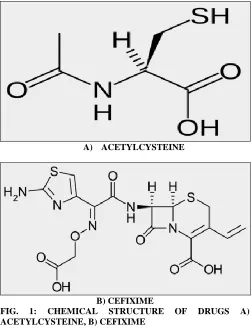
(2R)-2-acetamido-3-sulfanylpropanoic acid, is mainly used as a mucolytic in bronchitis or pulmonary diseases. By depolymerizing mucopolysaccharides it reduces the viscosity of pulmonary secretions 1. Besides its mucolytic effect it also has oxidant and anti-inflammatory effects. It is used as an antidote in Paracetamol poisoning 2 and as adjunctive therapy to patients suffering from clinical septic shock. N-Acetylcysteine causes cleavage of disulfide bonds by converting them to two sulfhydryl groups.
QUICK RESPONSE CODE
DOI:
10.13040/IJPSR.0975-8232.6(11).4886-94
Article can be accessed online on: www.ijpsr.com DOI link: http://dx.doi.org/10.13040/IJPSR.0975-8232.6(11).4886-94
This action results in the breakup of mucoproteins in lung mucus, reducing their chain lengths and causes thinning of the mucus thus facilitates easy removal of the same and therefore improving conditions such as bronchitis and flu 3.
Cefixime,(6R,7R)-7-[(2Z)-2-(2-amino- 1,3-thiazol- 4-yl)-2-[(carboxymethoxy)imino]-3-ethenyl-8-oxo-5-thia-1-azabicyclo[4.2.0]oct-2-ene- 2 - carboxylic acid, is oral third generation cephalosporin. Several investigations on Cefixime have indicated that it is an orally active antibiotic with similar antibacterial spectrum and resistance to β-lactamase as for parenteral third generation cephalosporins. Cefixime has potent antibacterial activity against a wide range of bacteria. It is highly stable towards β-lactamases and has long duration of action. Memon et al. reported Cefixime as a safe, effective, Keywords:
Degradation, Development, Stability-Indicating, Acetylcysteine, Cefixime, RP-HPLC, And Validation
Correspondence to Author: Lalit B. Rathod
Dr. Bhanuben Nanavati College of Pharmacy, Gate No: 1, Mithibai College Campus, 1st Floor, V.M. Road, Vile Parle (West), Mumbai-400056, India.
and cheaper oral option for the treatment of multidrug-resistance 4, 5.
A) ACETYLCYSTEINE
B) CEFIXIME
FIG. 1: CHEMICAL STRUCTURE OF DRUGS A) ACETYLCYSTEINE, B) CEFIXIME
A thorough literature survey revealed that Post-column derivatization method is available for determination of endogenous and high therapeutic concentration of N-Acetylcysteine in plasma detected by fluorimetry 1. Few methods are reported for the determination of Acetylcysteine by LC-UV-MS and RP-HPLC in pharmaceutical formulation 6.
Some analytical methods have been reported for the determination of Cefixime in pharmaceutical formulation and bulk API using HPLC 9, 10. But so far no stability indicating liquid chromatography (LC) method has been reported for the simultaneous determination of Acetylcysteine and Cefixime in pharmaceutical formulation.
Therefore, attempts were made in this study to develop a fast, sensitive, selective, and robust stability indicating Reverse Phase High-Performance Liquid Chromatography (RP-HPLC) method for the simultaneous determination of Acetylcysteine and Cefixime in pharmaceutical
formulation. The proposed method is able to separate Acetylcysteine and Cefixime with each other and their degradation products. The developed LC method was validated with respect to specificity, linearity, limit of detection and quantification, precision, accuracy and robustness. Forced degradation studies were performed on the drug products. Developed method separates all degradation products from Acetylcysteine and Cefixime, and exhibits stability indicating nature. These studies were performed in accordance with established International Conference on Harmonization (ICH) guidelines.
MATERIALS AND METHODS: Reagents and Chemicals:
Acetylcysteine and Cefixime standards were supplied by Neon labs, Andheri, Mumbai. The HPLC grade methanol and analytical grade potassium di-hydrogen phosphate, ortho-phosphoric acid, triethylamine, sodium dihydrogen orthophosphate, disodium hydrogen phosphate, hydrogen peroxide (30%) were purchased from Lobachemie (Mumbai, India). High purity water was prepared by using Millipore Milli-Q Plus water purification system.
Equipment:
The chromatography analysis was performed using A Perkin Elmer series 200 (Perkin Elmer, Tokyo, Japan), equipped with PDA detector, binary solvent manager. The output signals were monitored and processed using Totalchrome Navigator software. Photo-stability studies were carried out in photo-stability chamber. Thermal photo-stability studies were performed in a dry air oven (Cintex, Mumbai, India).
Chromatographic conditions:
The separation was achieved on KROMASIL C8 reverse phase column (25X 0.46mm I.D, 5µ particle size) with mobile phase containing a isocratic mixture of Methanol :KH2PO4 (50mM,
pH 3.0) (30:70% v/v) at a flow rate of 1.0 mL/min. The eluted compounds were monitored at the wavelength of 228 nm. The sample injection volume was 20 µL.
[image:2.612.48.300.95.423.2]standard about 90 mg and Cefixime working standard about 60 mg were transferred into two different 10 mL volumetric flasks. About 5mL of HPLC grade methanol was added to each volumetric flask and sonicated for 5 mins and made up to the mark with HPLC grade methanol which gave the final concentration (9000 µg/mL& 6000 µg/mL) of Acetylcysteine and Cefixime respectively. This solution was further diluted with diluent to give a solution containing 90 µg/mL and 60 µg/mL concentrations of Acetylcysteine and Cefixime respectively.
Preparation of Sample solution:
A composite of 20 tablets with label claim of 300mg of Acetylcysteine and 200mg of Cefixime were grinded into a fine powder. Quantity of resulting powder equivalent to 500mg was accurately weighed and transferred into a 50 mL volumetric flask. 25mL methanol (HPLC grade) was added and the solution was sonicated for 25-30 mins and the volume was adjusted with methanol (HPLC grade) and filtered through Whatman filter paper.
This solution was further diluted with diluent to give a solution containing 90µg/mL and 60µg/mL concentrations of Acetylcysteine and Cefixime respectively.
Forced degradation studies:
Forced degradation studies were performed on 90µg/mL and 60µg/mL concentration of Acetylcysteine and Cefixime respectively on tablets to provide an indication of the stability-indicating property and specificity of proposed method. Peak purity test was carried out for the Acetylcysteine and Cefixime peaks by using PDA detector on stress samples. All the solutions used in forced degradation studies were prepared by dissolving the drug product in small volume of stressing agents.
After degradation, these solutions were diluted with diluent to yield stated Acetylcysteine and Cefixime concentration of about 90µg/mL and 60µg/mL. Conditions employed for performing the stress studies were as follows 11.
Preparation of stock solution:
A mixture of standard Acetylcysteine and Cefixime (900µg/mL: 600µg/mL) were prepared in mobile phase [Methanol:KH2PO4 (50mM, pH 3.0)
(30:70)].
Acid degradation:
2mL of the stock solution was pipetted out and transferred into 10 mL volumetric flask containing 3mL of mobile phase. To this 1 mL of 2N HCL was added and the mixture was kept at 80⁰C for 2hrs. The solution was brought to ambient temperature, neutralized by addition of 1mL 2N NaOH and diluted to 10 mL with mobile phase.
Base degradation:
2mL of the stock solution was pipetted out and transferred into 10mL volumetric flask containing 3 mL of mobile phase to this 1 mL of 1N NaOH was added and the mixture was kept at 80⁰C for 30 mins. The solution was brought to ambient temperature, neutralized by addition of 1mL 1 N HCl and diluted to 10 mL with mobile phase.
Oxidative degradation:
2mL of the stock solution was pipetted out and transferred into 10 mL volumetric flask containing 3mL of mobile phase to this 1ml of 0.3% hydrogen peroxide was added and the mixture was kept at room temperature for 1hr and diluted to 10 mL with mobile phase. 5 mL of this solution was diluted to 10 mL with mobile phase.
Thermal Degradation:
Weighed accurately 90mg of Acetylcysteine working standard and 60mg of Cefixime working standard and stored at 80⁰C for 30 mins. The flasks were cooled at R.T and 5 mL of methanol was added and sonicated for 15-20 mins. Final concentration of 90µg/mL and 60µg/mL of Acetylcysteine and Cefixime respectively was achieved with mobile phase.
Photolytic Degradation:
RESULTS AND DISCUSSION:
Method Development and Optimization:
The main objective of the chromatographic method was to separate and quantitate Acetylcysteine and Cefixime in the presence of degradation products. An isocratic method was employed using 25mM potassium dihydrogen orthophosphate (pH 6.0) and acetonitrile in the ratio of 45:55 v/v as mobile phase, Kromasil C18 column (25 mm x 0.46 mm I.D., 5μm) with flow rate of 1.0 mL/min on HPLC equipped with Photo Diode Array (PDA) detector. Retention time of Acetylcysteine was not reproducible and tailing factor for Cefixime peak was found to be more than 2.0, hence to reduce the tailing and to obtain reproducibility an attempt was made with methanol and potassium dihydrogen phosphate (25mM, pH6.0), (60:40 v/v).
Peak fronting for Cefixime was observed and retention time of Acetylcysteine was found to be in void volume, to increase retention time of Acetylcysteine mobile phase mixture was modified Methanol: Potassium dihydrogen phosphate (25mM, pH6.0) (65:35 v/v) and Kromasil C8 (25 X 0.46mm I.D., 5μm) was selected. On the optimization of mobile phase ratio, Acetylcysteine and Cefixime peaks were well resolved from degradation products. Based on these experiments, the final optimized conditions are described below: Kromasil C8 (25X0.46mm I.D., 5μm particle size) was used as stationary phase. The mobile phase consists of methanol: potassium dihydrogen phosphate buffer (50mM, pH3.0)(30:70 v/v). The
detection was monitored at 228nm. The injection volume was 20μL. The typical retention time of Acetylcysteine and Cefixime were about 3.2 and 4.1 mins respectively.
Forced Degradation:
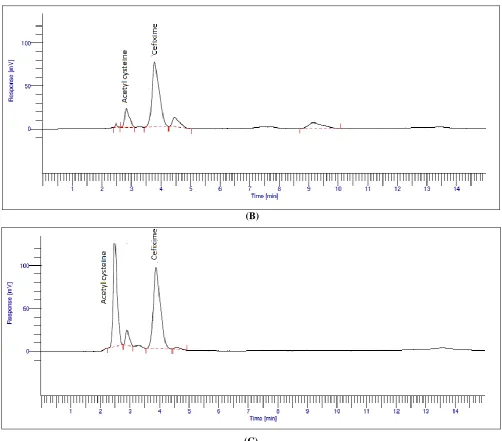
The purpose of the forced degradation study was to ensure the peak purity of the Acetylcysteine and Cefixime in the presence of degradation products and establish the stability indicating ability of the methodunder acidic, basic, peroxide and photolytic degradation conditions, Cefixime was found stable but Acetylcysteine degrades significantly. Acid degradation leads to the formation of major degradant at RRT 0.86 with respect to Cefixime
(Fig. 1 A). Under base and oxidative degradation, major degradant observed at RRT 0.64 with respect to Acetylcysteine (Fig. 1 B-C). All major and minor degradation products formed under these stress conditions were well resolved from both analyte peaks. Acetylcysteine and Cefixime were found stable under photolytic degradation and thermal degradation. Peak purity test was carried out for the Acetylcysteine and Cefixime peak by using PDA detector in stress samples analysis. The purity angle was within the purity threshold limit in all of the stressed samples, demonstrating the homogeneity of the peaks. The purity of both analytes was unaffected by the presence of degradation products and thus confirms the stability-indicating power of the developed method. A summary data of stress study is shown in (Table 3).
(B)
[image:5.612.55.557.49.490.2](C)
FIG. 2: TYPICAL HPLC CHROMATOGRAMS OF (A) ACID DEGRADATION SAMPLE, (B) BASE DEGRADATION SAMPLE, AND (C) PEROXIDE DEGRADATION SAMPLE.
(a) (b) (c)
[image:5.612.49.565.541.728.2]sValidation of the Method:
The proposed method was validated by determining its performance characteristics regarding specificity, accuracy, precision, limit of detection and quantification, linearity, range and robustness.
System Suitability:
System suitability shall be checked for the conformance of suitability and reproducibility of chromatographic system for analysis. System suitability was determined before sample analysis from five replicate injections of the standard solution containing 90μg/mL of Acetylcysteine and 60μg/mL Cefixime. The acceptance criteria were less than 2% Relative Standard Deviation (RSD) for peak areas, USP tailing factor less than 2.0 and USP plate count more than 5000 for Acetylcysteine and Cefixime peaks from standard solution. All critical parameters tested met the acceptance criteria (Table 2).
Specificity:
Specificity of the method was exhibited by analyzing blank and placebo prepared as per test method. These results demonstrated that there was no interference at the retention time of Acetylcysteine and Cefixime from the other excipients and, therefore, confirms the specificity of the method (Fig. 3).
Limits of Detection (LOD) and Quantification (LOQ):
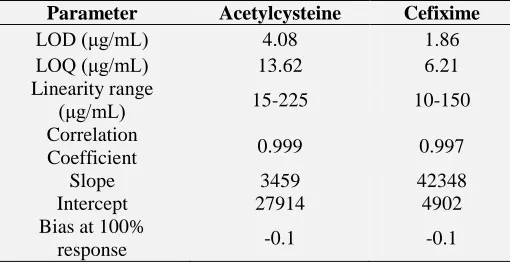
The LOD and LOQ were determined at a signal-to-noise ratio of 3:1 and 10:1, respectively, by injecting a series of dilute solutions with known concentrations. The limit of detection and limit of quantification values are reported in (Table 1).
TABLE 1: EVALUATION OF LOD, LOQ AND LINEARITY DATA
Parameter Acetylcysteine Cefixime
LOD (μg/mL) 4.08 1.86 LOQ (μg/mL) 13.62 6.21 Linearity range
(μg/mL) 15-225 10-150 Correlation
Coefficient 0.999 0.997
Slope 3459 42348
Intercept 27914 4902 Bias at 100%
response -0.1 -0.1
Linearity:
Linearity test solutions were prepared by diluting the stock solutions to the required concentrations. The solutions were prepared at six concentration levels from LOQ to 120% levels of test concentration (LOQ-225 μg/mL for Acetylcysteine and 150μg/mL Cefixime). Calibration curves were plotted between the responses of peak versus analyte concentrations. The coefficient correlation, slope, y-intercept of the calibration curve and % bias at 100% response are reported (Table 3) and result shows that an excellent correlation existed between peak area and concentration of Acetylcysteine and Cefixime.
Precision:
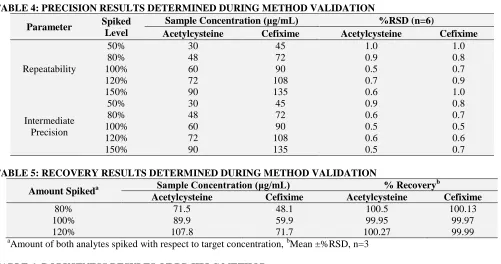
The precision of method was verified by repeatability and intermediate precision. Repeatability was checked by injecting six individual preparations of sample containing Acetylcysteine and Cefixime at 50, 80%, 100%, 120% and 150% level of test concentration (45,72,90,108,135 μg/mL for Acetylcysteine and 30,48,60,72,90μg/mL for Cefixime). The relative standard deviation of the percentage assay of each analyte was calculated and found to be less than 1.9% in repeatability and less than 1.8% in intermediate precision study, which confirms the good precision of the method. The % RSD values are presented in (Table 4).
Accuracy:
Accuracy study was performed by spiking Acetylcysteine and Cefixime active substances into the placebo matrix and samples were prepared for analysis as previously described under sample preparation. Recovery was evaluated in triplicate at 80%, 100%, and 120% level of test concentration (72, 90, 108μg/mL for Acetylcysteine and 48, 60, 72μg/mL for Cefixime). The percentage recoveries for both components were calculated (Table 5). The percentage mean recovery of Acetylcysteine and Cefixime from the formulation varied from 99.95 to 100.50 % indicating that the developed method was accurate for the determination of Acetylcysteine and Cefixime in pharmaceutical formulation.
[image:6.612.46.301.602.733.2]but deliberate, changes to the method parameters. The variables evaluated in the study were pH of the mobile phase buffer (± 0.2 unit), flow rate (± 0.1 ml/min) and % organic in the mobile phase (+10%) and system suitability parameters such as % RSD, retention time, tailing factor and theoretical plates
of .3.0 and Cefixime standard were studied. In all the deliberate varied chromatographic conditions, system suitability parameters met the acceptance criteria (Table 6). Thus, the method was found to be robust with respect to variability in applied conditions.
TABLE 2: SYSTEM SUITABILITY RESULTS
Parameters Acceptance criteria Acetylcysteine Cefixime
Retention time (Mean+%RSD, n=5)
>2.21 and <4.21 min +1.0a > 4.20 and <6.20 min+1.0b
3.21+0.1 5.20+0.1
Area (%RSD, n=5) <2.0 1.0 0.9
USP plate count >2000 5124 3545
USP tailing <2.0 0.94 0.98
TABLE 3: SUMMARY OF FORCED DEGRADATION RESULTS
Stress conditions % Degradation
Acetylcysteine Cefixime
Acid hydrolysis
(2 N HCl at 80°C, 2 hr) 21 30
Base hydrolysis
(1 N NaOH at 80°C, 30 min) 15 14
Oxidation
(0.3% H2O2 at room temp, 1 hr)
29 14
Thermal
(At 80°C, 30min) 18 26
[image:7.612.54.555.404.668.2]Photolytic 29 5
TABLE 4: PRECISION RESULTS DETERMINED DURING METHOD VALIDATION
Parameter Spiked
Level
Sample Concentration (μg/mL) %RSD (n=6)
Acetylcysteine Cefixime Acetylcysteine Cefixime
Repeatability
50% 30 45 1.0 1.0
80% 48 72 0.9 0.8
100% 60 90 0.5 0.7
120% 72 108 0.7 0.9
150% 90 135 0.6 1.0
Intermediate Precision
50% 30 45 0.9 0.8
80% 48 72 0.6 0.7
100% 60 90 0.5 0.5
120% 72 108 0.6 0.6
150% 90 135 0.5 0.7
TABLE 5: RECOVERY RESULTS DETERMINED DURING METHOD VALIDATION
Amount Spikeda Sample Concentration (μg/mL) % Recovery
b
Acetylcysteine Cefixime Acetylcysteine Cefixime
80% 71.5 48.1 100.5 100.13
100% 89.9 59.9 99.95 99.97
120% 107.8 71.7 100.27 99.99
aAmount of both analytes spiked with respect to target concentration, bMean ±%RSD, n=3
TABLE 6: ROBUSTNESS RESULTS OF RP-HPLC METHOD:
Variation in Chromatographic Conditions
Observed system suitability parameters
Acetylcysteine Cefixime
tRa Ab Tc Nd tRa Ab Tc Nd
v/v)
Methanol:KH2PO4 (50 mM, pH 3.0) (32:68
v/v) 3.05 0.6 0.97 4970 4.74 0.9 0.92 3216 Mobile Phase Buffer pH 2.8 3.11 0.6 1.0 5009 4.54 0.4 0.97 3236 Mobile Phase Buffer pH 3.2 3.31 0.7 0.90 5032 4.98 0.4 0.97 3309 Wavelength at 225nm 3.31 0.7 0.96 5001 4.98 0.8 0.91 2906 Wavelength at 231nm 3.11 0.7 0.93 4616 4.54 0.8 0.99 3132
aRetention time (min) of the analyte peak. b
%RSD of the analyte peak areas from 5 injections.
cTailing factor of the analyte peak dPlate count of the analyte peak
Stability of Analytical Solutions:
The solution stability of Acetylcysteine and Cefixime in the assay method was investigated by leaving standard and sample solutions in tightly capped volumetric flask at room temperature in dark for 24 hr. The same sample solutions were analyzed at the end of the study period against freshly prepared standard solutions. The variability in the assay of both substances was within ± 3% during solution stability. The results from solution stability experiments confirmed that the sample solution and standard solutions were stable up to 12 hrs.
CONCLUSION: A simple and efficient reverse-phase HPLC method was developed and validated for quantitative determination of Acetylcysteine and Cefixime in pharmaceutical dosage forms. The method was found to be precise, accurate, linear, robust,rapid and economical during validation as per ICH guideline Q2 (R1). Satisfactory results were obtained from the validation of the method. The method is stability indicating and can be used for routine analysis of production samples and to check the stability of the Acetylcysteine and Cefixime tablets.
CONFLICT OF INTEREST: The authors
confirm that this article content has no conflicts of interest.
ACKNOWLEDGEMENT: The authors are
thankful to the Principal of Dr. Bhanuben Nanavati College of Pharmacy, Vile Parle, Mumbai, India for providing all necessary facilities and
encouragement throughout the research work, the authors thank Mr. Atul Sherje for the support in the project work.
REFERENCES:
1. Vander Heyden, Y., Mangelings, D., Van Brempt, J., & Spapen, H. Development and validation of an HPLC method with post-column derivatisation for assay of N-acetylcysteine in plasma. Acta Chromatogr, 14: 2004; 149-164.
2. Beuhler, M. C., & Dulaney, A. R.: Further case details regarding IV N-Acetylcysteine overdoses. Clinical Toxicology, 49(9): 2011; 878-878.
3. Sanaa, S., Rajania, D. A., Sumedhab, D. N., Pravinb, P., & Shripadb, D. N.: Development and validation of RP-HPLC method for the estimation of N-Acetylcysteine in wet cough syrup. Int. J. Drug Dev. & Res, 4(2): 2012; 284-293. 4. Talebpour, Z., Pourabdollahi, H., Rafati, H., Abdollahpour, A., Bashour, Y., & Aboul-Enein, H. Y. Determination of cefixime by a validated stability-indicating HPLC method and identification of its related substances by LC-MS/MS studies. Scientia pharmaceutica, 81(2): 2013; 493.
5. Patel, N. S., Tandel, F. B., Patel, Y. D., & Thakkar, K. B. Development and validation of stability-indicating HPLC method for simultaneous estimation of cefixime and linezolid. Indian journal of pharmaceutical sciences, 76(6): 2014; 535.
6. Toussaint, B., Pitti, C., Streel, B., Ceccato, A., Hubert, P., & Crommen, J.: Quantitative analysis of N-acetylcysteine and its pharmacopeial impurities in a pharmaceutical formulation by liquid chromatography–UV detection–mass spectrometry. Journal of Chromatography A, 896(1): 2000; 191-199.
7. D. Tzanavaras, The Open Chemical and Biomedical Methods Journal, 3: 2010; 37-45
8. Hariprasad, T., Gurumoorthy, P., & Ali, J. N.: International Journal of Innovation in Pharma Biosciences and Research Technology.
9. Sarade, M. R. B., & Pharm, B. RP–HPLC Method Development And Validation For The Simultaneous Estimation Of Ofloxacin And Cefixime In Tablet Dosage Form.
10. Patel, S. A., & Patel, J. V: RP-HPLC method for simultaneous estimation of cefixime trihydrate and linezolid in tablet dosage form. International Journal of Pharmaceutical, Chemical and Biological Sciences, 3(2): 2013; 372-379.
actarit, its process related impurities and degradation products: Insight into stability profile and degradation pathways. Journal of Pharmaceutical Analysis, 4(6): 2013; 374-383.
12. Mali, A. D.: Zero, First, Second Order Derivative and Area under Curve Spectrophotometric Methods For Determination of Cefixime Trihydrate In Pharmaceutical Formulation. International Journal of Pharmacy and Pharmaceutical Sciences, 7: 2015;
13. Dey, S., Pradhan, P. K., Upadhayay, U. M., Shah, S., & Goswami, K.: UV spectrophotometric Determination of Cefixime in Bulk and its Dosage Form. Journal of Pharmacy Research Vol, 5(12): 2012;
14. ICH Q1B, Photostability testing on new drug substances and products, 1996.
15. ICH Q1A (R2), Stability Testing of new Drug Substances and Products, 2003.
16. ICH Q2 (R1), Validation of Analytical Procedures: Text and Methodology, 2005
All © 2013 are reserved by International Journal of Pharmaceutical Sciences and Research. This Journal licensed under a Creative Commons Attribution-NonCommercial-ShareAlike 3.0 Unported License.
This article can be downloaded to ANDROID OS based mobile. Scan QR Code using Code/Bar Scanner from your mobile. (Scanners are available on Google Playstore)
How to cite this article: