A SOCIOLINGUISTIC VIEW OF EUPHEMISM IN ARABIC AND ENGLISH: A COMPARATIVE
ANALYSIS
*Loae Fakhri Jdetawy
School of Languages, Civilisation and Philosophy, College of Arts and Sciences, Universiti Utara Malaysia,
06010 UUM Sintok, Kedah Darul Aman Malaysia
ARTICLE INFO ABSTRACT
In this paper, the researcher aims to elaborate the nature of euphemisms through carrying out an analysis of euphemisms in both Arabic and English. The present contrastive study is geared mainly towards probing into the euphemistic language that Arabic language speakers and English language speakers resort to when certain tabooed topics and concepts are brought to the fore. The analysis was done in the light of Brown and Levinson's Politeness Theory (1978, 1987). The speakers in all languages try to avoid the taboo expressions which is one of the main reasons behind the adoption of euphemism. Therefore, it has been a topic of interest that attracts the attention of many researchers. The study concluded that euphemism a universal phenomenon in all natural languages. In addition, is not only a lingual phenomenon, but also a social, a cultural, and a psychological phenomenon existing in human society and that the social and cultural factors are very influential in expressing euphemism. The study has also concluded that the development of euphemism has a strong relationship with the development of taboo words at the first place. Actually, the existence of taboo words or taboo ideas stimulates the creation of euphemisms. The study concluded that despite the fact that Arabic and English are not linguistically, geographically and culturally related, however certain similarities and differences between the two languages in terms of the use of euphemism were found. These similarities and differences can be mainly attributed to cultural and religious beliefs and values. Euphemism in Arabic and English is mainly used as a communicative and rhetorical means for the same goal and effect since it is used to facilitate social interaction through replacing taboo words and various socially unacceptable topics with more acceptable and more pleasant ones, or that it is used in the attempt to avoid either fearful, offensive or unpleasant subjects. Moreover, the implementing of euphemism in Arabic and English is almost similar in subjects such as death. However, both languages differ as regards the emphasis, details and range of the complex metaphor. On the other hand, the use of euphemisms varies between English and Arabic in the case of copulate or sexual intercourse as the Arabic sex euphemisms tend to be more decent and covert than English ones. Arabic euphemisms differ from English euphemisms in another aspect which is the use of euphemizers. As for the adoption to euphemisms and to observance of the politeness principle and the face theory, the study concluded that the basic difference between the two languages is that the degree of politeness in euphemisms in Arabic is higher than in English. As for the taboo topics and euphemisms categories in Arabic and English, the study concluded that there is a similar set of common areas that are euphemized or censored in both languages. However, due to the cultural, religious and social differences between the two languages and due to the non-universality of some Arabic language taboos many other euphemisms’ categories can be found in Arabic but not in English language.
Copyright © 2019, Loae Fakhri Jdetawy. This is an open access article distributed under the Creative Commons Attribution License, which permits unrestricted use, distribution, and reproduction in any medium, provided the original work is properly cited.
INTRODUCTION
“A language without euphemisms would be a defective
instrument of communication” (Burchfield 1985: p. 23).
In order for human beings to survive, they have to co-operate with each other by different ways of cooperation. Thus to cooperate, one needs to communicate by using some way of indicating attitudes, ideas, intentions, etc.
ISSN: 2230-9926
International Journal of Development Research
Vol. 09, Issue, 10, pp. 30833-30846, October, 2019Article History: Received xxxxxx, 2019 Received in revised form xxxxxxxx, 2019
Accepted xxxxxxxxx, 2019 Published online xxxxx, 2019 Article History:
Received 08th July, 2019
Received in revised form 20th August, 2019
Accepted 11th September, 2019
Published online 30th October, 2019
Key Words:
Natural languages,
Linguistically, geographically Expressing euphemism, English and Arabic.
RESEARCH ARTICLE
OPEN ACCESS
Citation: Loae Fakhri Jdetawy. 2019. “A sociolinguistic view of euphemism in arabic and english: a comparative analysis”, International Journal of
Such communication can be achieved by using the language verbally. Therefore, verbal communication plays a very important role in any society. Individuals of any society should have an ability to use the system of language appropriately as a means of social interaction with native speakers since one cannot use some words in every situation. Hence, language can be regarded as verbal behaviour and one aspect of the total communicative behavior by which members of a society interact. According to Ghounane (2013), language is an essential means of communication and an integral part of human social interaction through which we can express our views, emotions and attitudes. Besides, the context, in which language is used, has also a great importance. In addition, there are social factors which play a crucial role in directing language use between speakers. This means that the use of language depends largely on the social context where interaction occurs. Consequently, there are some aspects that affect language including the social structure, the social environment and values of the society.
Moreover, people within any society are organized into groups and these groups can be characterized in terms of shared attitudes and beliefs, which are expressed by the accepted behaviour of the members of the group, including, of course, their language behavior. Accordingly, common attitudes, beliefs, and values are reflected in the way members of the group use language, for example, what they choose to say and how they say it. Pan (2013) added that in social interaction, people have to use different words to convey their thoughts and ideas. However, some of the words are impolite and embarrassed if directly spoken, which often make the communication unpleasant. These words are unacceptable in all societies for social, religious or cultural reasons and due to particular customs, beliefs, attitudes and views of the society, and thus these words are considered taboo-words. So, in order to avoid the embarrassment or ease the sting of taboo-words, man has created euphemism (ibid). In other words, the existence of taboo-words or taboo ideas stimulates the creation of euphemism (Fromkin and Rodman, 1988). This study aims to elaborate the nature of euphemisms through carrying out an analysis of adoption of euphemisms in both Arabic and English languages.
Problem Statement
Euphemisms can be categorized as “what the user of language should avoid, what he should not say, or write” (Akhmanova, 1976: p. 99). A speaker or writer of any language can subtly alter his language for better (i.e. euphemistic) or for the worse (i.e. dysphemistic) if he/she wishes. Mazid (2004) maintains that the study of euphemisms has concentrated on culturally sensitive areas and this is why they have not received a lot of academic attention. Furthermore, the analysis of euphemisms in Arabic is scattered in linguistic and literary references. Accordingly, the researcher believes that euphemisms address culturally sensitive areas and this is why they have not received a lot of academic attention from applied linguists in general and sociolinguists in particular. Hence, this study aims to elaborate the nature of euphemisms through carrying out an analysis of euphemisms in both Arabic and English. The present contrastive study is geared mainly towards probing into the euphemistic language that Arabic language speakers and English language speakers resort to when certain tabooed topics and concepts are brought to the fore.
Taboo Language
Chaika (1994) pointed out that language and society are so intertwined that it is impossible to understand one without another. She added that language represents the society’s culture as through Language, people can express their feelings, emotions and ideas. However, in real communication, people often forget about the different principles of their culture. They tend to speak and act by using words and gestures that are forbidden. These words and acts are called taboos. Similarly, Ghounane (2013) stated that language is deeply rooted in the culture of the people within any society, including the taboos of the society. However, ignoring these taboos during interaction may lead to severe assault between speakers since every individual has to behave appropriately in his/her society depending on its norms, values, beliefs, etc. In this vein, one should note that all languages have certain words, expressions, sentences and topics which are banned to be uttered or discussed in public, i.e., taboo- words. So, taboo-words are those words which are not to be used in ‘polite society’.
The word 'taboo' was borrowed from Tongan, a Polynesian language, and in that society it refers to acts which are ‘forbidden’ or which are to be avoided. When an act is taboo, reference to this act may also become taboo. Thus, it is sometimes forbidden to do such an act or to talk about it. Taboo certain topics such as body parts, bodily functions, sexual activity and practices, certain religious and ideological concept make up a large part of the set of taboo words of many cultures and can be regarded as socially forbidden. Societies differ in what topics are taboo because such topics which are forbidden reflect the particular customs and views of the society. Therefore, certain topics may be considered taboo in certain societies but in other societies they can be acceptable (Hayakawa, 1978: 95-97; Fromkin and Rodman, 1988). Taboo words are topics and concepts not used because of their common law or socio-religious unlawfulness. Such unlawfulness of the taboo words causes that people use these dirty, naughty, rude and unpleasant concepts in a good, friendly, kind, polite and far from any frankness mood. However, and through decades, people used to enrich language with euphemism as a linguistic device. Through euphemisms, the speakers in all linguistic societies and in certain situations, theytend to replace some words of negative connotations, i.e. taboo words, with more positive ones which have a good influence on the listeners (Khadra and Hadjer, 2017). Hence, the avoidance of taboo words and expressions are one of the main reasons behind the adoption of euphemism. Therefore, euphemism has been a topic of interest that attracts the attention of many researchers. Taboo-words of many cultures include many types such as words which have religious connotations and hence they are considered profane if used outside the formal or religious ceremonies. Other types of taboo words are related to death, disease, poverty, sex, and natural bodily functions. Ghounane (2013) indicated that taboos exist in all languages and cultures, although each society has its own norms and taboos. So, taboos are also related to the cultural beliefs of the society. This means that there are taboos which are universal and others are culture-specific.
Euphemisms
others; in this case, it is important to choose words and expressions that avoid naming things directly or sugar-coat ideas. This is the purpose of euphemism (Hamad and Al-Shunnaq, 2011). Euphemism is a lingual phenomenon existing in human society. It plays an important role in facilitating social interaction. So, the essence of euphemism lies in the use of inoffensive words or phrases instead of offensive or harsh ones, i.e. taboo-words. The word ‘euphemisms’, it is derived from Greek. The prefix ‘eu-’ means ‘good, well’; the stem ‘pheme’ means ‘speak’; the suffix ‘-ism’ means ‘action or result’. The word means ‘speaking well of…’, ‘good speech’, ‘to speak favorably’ and ‘words of good omen’. Euphemism is defined as mild, pleasant words, roundabout expression that are used instead of harsh or blunt or direct words. In other words, euphemisms are words with meanings or sounds thought somehow to be nicer, cleaner or more elevated and so used as substitutes for words deemed unpleasant, crude or ugly in sound or sense (Wilson, 1993). So, euphemism is seen as alternatives to dispreferred and indelicate word or expression with softened ones; a way of describing an offensive thing by an inoffensive expression; a mild name for something disagreeable (Allan and Burridge, 1991).
Euphemism, according to Ortony (1993) and Sadock (1993), can be regarded as one of the important figures of speech that would seem to play a role in the production and comprehension of the most popular varieties of indirect speech acts. Thus, euphemism can be considered as one variety of indirect speech acts in the sense that indirect means are chosen because the intended action is too offensive, prying, pushy, or embarrassing to approach directly. In this case, both of euphemisms and indirect speech acts rest their success upon an apparent clash between what is done (said) and what is intended. It is worth mentioning that the use of taboo-words and on the other hand the extent to which euphemisms are employed to stand against this type of language depend on the religious and cultural beliefs of a given society and its socio-cultural structure. Besides, such use varies from one individual to another depending on certain social factors such as anger, frustration and annoyance...etc. Other factors may include gender, age and the educational background of the speaker (Ghounane, 2013). Additionally, euphemisms are changed continually in languages from one generation to another due to the mode of the native speakers and the mood of the age, i.e., psychological reasons stand behind this changeability which is termed nowadays as treadmill or, semantic change or
pejoration which justifies the infinite number of euphemisms in languages. Therefore, euphemisms are in constant state of flex which means that always there are new euphemistic creatures. Some have short life then they lose the euphemistic value and then turn into taboo words themselves or unconscious ones, while other may last for generations, or even centuries (Wilson, 1993).
Functions of Euphemisms
There are many purposes that lie behind the use of euphemisms. These purposes include: 1) Religious purpose: euphemisms are used to avoid mentioning explicitly some spiritually imperiling religious expressions or taboos for not inviting misfortune by ominous statements as the names of deity; 2) political purpose: politicians use euphemisms to shield themselves from accountability and more responsibility for their illegal or wrong actions by disguising and clouding thought of the audience like the expression ‘collateral
damage’ that is used to replace the expression ‘civilian
deaths’. Modern linguists term the deliberate usage of
euphemisms ‘doublespeak’ by, which is intended to "obfuscate the language in order to deny or shift responsibility in certain situations such as public relations and politics”. Doublespeak can be made by either bald euphemisms, as ‘downsizing’ or ‘rightsizing’ for 'firing of many employees' or ambiguous phrases, as ‘wet work’ for ‘assassination' (Al-Qadi, 2009); 3) social purpose: euphemisms are necessities in dealing with sensitive and repulsive topics. They are intended to avoid using expressions which wound susceptibilities and which are not preferred to talk about topics directly like death, sex, excretion processes, war, sickness, blindness, etc. Therefore, euphemizing is the safest strategy for: a) discussing these subjects secretly in the presence of others and prevent strong negative stereotypes from prejudicing a hearer as the uses of
‘economically disadvantaged’ for ‘poor’, ‘developmentally
disabled’ for ‘retarded’, and ‘illegitimate child’ or ‘love child’ for ‘bastard’; b) obscuring the identity of subject of a conversation from potential eavesdroppers in order to protect the guilty as when a prostitute solicits a customer by saying: ‘do you want to party?’ or ‘are you looking for a good time?’. Euphemism has the function of politeness and beautification, which is helpful to develop benign communication. Accordingly, it's widely used in our daily communication to express something unpleasant (Pan, 2013). Further, through the use of euphemisms, people try to look for substitutions that can hide or cover up the harmonious power of taboo words and consequently protect human relations during social interaction. Euphemisms are also employed to avoid embarrassment and face-losing through replacing offensive expressions that can cause harm and shame for speakers (Ghounane, 2013). According to Allan and Burridge (1991), euphemisms are used as alternatives to dispreferred expression, and are used in order to avoid possible loss of face. Other functions of euphemism include:
Euphemism helps to convey those ideas that have become a social taboo, and are too embarrassing to mention directly such as sexuality and death. In other words, euphemism is used to avoiding taboo. Some English euphemisms are associated with taboo. Hence, euphemisms can be used as substitutes in order to avoid embarrassment, anxiety and public shame caused by taboo words.
Euphemism can maintain harmony between the speaker and the listener, i.e. it harmonizes communication to decrease the original difference of both sides. Hence, if the addressee is pleased with the addresser’s words, the conversation comes to harmonious level.
Euphemisms function as powerful linguistic tools to smooth communication and preserve interpersonal relationships in non-hostile verbal encounters.
With the development of social economy, people spontaneously pursue the language civilization to show that they are civilized and cultivated. So when people have to refer to something unpleasant, they prefer to employ some mild, implicit and euphemistic expressions.
Form a positive communication atmosphere and establish harmonious social relationship and eventually obtain the communication goals.
Euphemism can be used to disguise through beautifying things and avoid negative impact. However, euphemism is not always used out of good motives as by using euphemism, ambiguity can sometimes be produced and truth can be hidden.
The pragmatic functions of euphemism include maintaining politeness, covering up, inducing, tactical, and humor functions.
Types of Euphemisms
Rawson (1981: 1-3) divided euphemisms into two general types: positive and negative. The positive euphemisms inflate and magnify, making the euphemized items appear grander or more important than they really are. They also include many occupational titles that can be used to protect or save worker's egos by elevating their Job status such as ‘access controller’ instead of ‘doorman’. Other kinds of positive euphemisms include imposing Job titles adopted to bolster one's self-image or impress one's friends and acquaintances. Examples of these include ‘counsel’ in place of ‘lawyer’, ‘health care professional’ for ‘nurse’ or ‘doctor’, ‘chief executive officer’ instead of ‘president’ or ‘chairman of the board’, and ‘territory
manager’ instead of ‘salesman’. The negative euphemisms
deflate and diminishes. It is defensive in nature, offsetting the power of tabooed terms and otherwise eradicating from the language everything that people prefer not to deal with directly. Thus negative euphemisms replace language that people prefer to avoid using. Examples include ‘harvesting’ in place of ‘killing’, ‘collateral damage’ instead of ‘civilian causalities’ or ‘deaths’, ‘relationship’ for ‘sexual relationship’, and ‘intestinal fortitude’ in place of ‘guts’ (Rawson, 1981: 3).
Many euphemisms, whether positive or negative, can be used consciously and unconsciously. In many social circumstances, euphemisms can be used to avoid embarrassment or to protect another's ego, for example, at a formal dinner party, a guest might ask for directions to the ‘little girls room’ to avoid the embarrassment of using the word ‘toilet’, which is itself a euphemism that was coined so long ago that it is recognized as the plain-language version of the location being referred to. In fact, the American cultural taboo about the elimination of personal bodily waste is so great that American-English language offers only euphemisms for naming the location in which this activity occurs. Such a use of this kind of language is called the ‘unconscious use of euphemism’ (ibid). Similarly, Al-Qadi (2009) asserted that euphemisms can be either positive when they are intended to express the solidarity with the addressee especially with the titles of low-level or ‘fancy’ occupations like ‘environmental engineer’ for ‘garbage man’ and ‘mental hospital’ for ‘madhouse’, or
negative if the expressions refer to the social ranks that cause ‘face loss’ or insult to the referent, so they are negatively euphemized to cover their bad connotation such as ‘
low-income’ for ‘poverty’. Some euphemisms are described as
conscious because they are intentionally coined to make what
is unreal or bad seem real or respectful especially in the language of advertising and politics such as ‘redeployment of
troops’ for ‘withdrawal’, whereas others are termed
unconscious euphemisms due to their unknown ‘original
motivations’ or checkered (ibid).
Euphemisms in English
The forms or styles that are used by the communicators can be divided into two categories: expository and explanatory accounts, and they can be further employed for two quite different purposes: euphemism and dysphemism (the term dysphemism, from Greek ‘dys-’ means ‘bad’ + ‘pheme-’ means ‘speech’, is roughly an opposite of euphemism that means the usage of an intentionally harsh word or expression instead of polite one). Allan and Burridge (1991: 14-27) called the combination of both euphemism and dysphemism as
‘x-phemism’. The term X-phemism is used to replace one
expression with another that carries positive or negative associations. Euphemism is used for making something sound better while dysphemism is used for making something sound worse. Dysphemism then is, roughly speaking, the opposite of euphemism. Grant (1977: 24) used the term ‘malphemism’ instead of dysphemism and explains that such an expression is used to be offensive and indicates negative discernment. He mentioned that one man's euphemism may be regarded as another man's malphemism or obscenity. Other scholarsbelievedthateuphemismcanbedividedintothreemajorcat egories: euphemism, dysphemism, and doublespeak. Doublespeak is a similar entity to both euphemism and dysphemism, but it contains stronger intentions to interchange or confuse the truth of the issue and deceive the audiences (Lutz, 1987: 382-3; 1990: 34; and Hasegawa, 2003). Allan and Burridge, 2006) added another category of euphemism called ‘orthophemism’ which means straight talking. To sum up, a clear distinction can be made between these types. First is for X-phemism in which the speaker conveys his perspective to the audience and there is no intention to deceive. If you consider the receiver's feelings and avoid negative aspects toward the interlocutors’ affection, it is euphemism. If it intentionally and/or unintentionally works negatively, the term is dysphemism. If locution, however, contains intention and motivation to mislead or deceive the audience, then the expression becomes doublespeak. Doublespeak is when the speaker pretends not to render the truth of the issue but to switch the locution intentionally and obfuscate the truth (Hasegawa, 2005).
Every language has rules about how it should be used. This set of rules and / or styles is known as speech etiquette; which defines what topics can be spoken about in what situations and what words should be used. If these rules or styles or forms of the language are not taken into consideration in certain situations, they may sometimes offend others or make a terrible situation. On the other hand, manipulating and applying these forms appropriately can enhance satisfactory relationships with others. Therefore, languages have euphemisms and people consciously and unconsciously use them to protect themselves from being offensive and / or to make a positive relationship between the communicators. Moreover, when interlocutors use euphemism, they do not at all want to change their language, but they want to communicate in a convenient or efficient manner about the topics they are referring to (Hasegawa, 2001). Examples on euphemisms in English include (Alta’ai, 2010: 373-374):
‘women in sensible shoes’ for ‘lesbianism’, ‘pre-owned
vehicles’ for ‘used cars’, ‘correctional facility’ for ‘prison’. ‘bathroom tissue, t. p. or bath tissue’ for ‘toilet paper’, ‘sanitation worker or sanitary engineer’ for ‘garbage man’,
‘economically depressed neighborhood’ for ‘ghetto’, ‘mature’
‘torture’, ‘intellectually challenged’ for ‘being mentally retarded’, ‘adult entertainment’ for ‘pornography’, ‘premature birth’ instead of ‘abortion’, ‘fatally wounded’ instead of ‘killed’, ‘curvy’ instead of ‘fat’, and ‘lost their lives’ for ‘were killed’.
Formations of Euphemisms in English
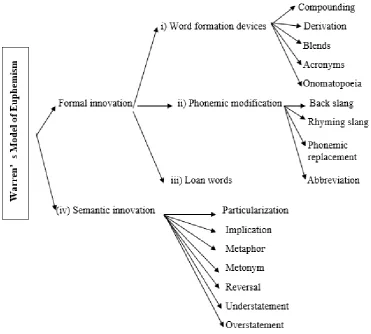
There are various ways to form euphemisms in English. As Warren’s perspective, she listed (1992) two main ways of creating euphemisms: formal and semantic innovations. Each way is then subcategorized as described below:
Formal innovation: involves the followings:
a. Word formation devices: They include five ways (Warren, 1992:133). They are:
Compounding: The combining of two individually innocuous words (e.g.: ‘carcass’ for 'corpse'), ‘hand job’ for ‘menstruation’.
Derivation: The modification of a Latin term (‘fellare’, to suck) to form printable modern English (e.g.: ‘fellatio’ for ‘oral sex’).
Blends: Warren gives no examples to what she means by this term, or how blend is formed.
Acronyms: (WC for water closet) and ‘SNAFU’ (‘Situation Normal All fucked up’), a military euphemism for a possibly catastrophic event.
Onomatopoeia: Here the sound of ‘things’ hitting together during the sex act is employed to refer to the act itself. (e.g.: ‘bonk’ for ‘sexual intercourse’).
b. Phonemic modification: the form of an offensive word is modified or altered, for example:
Back slang: 'enob' for 'bone', (Rawson, 1981:88), and ‘epar’ for ‘rape’ (Warren 1992:133). The words are reversed to avoid explicit mentioning.
Rhyming slang: 'Bristols' for 'breasts', a shortened, and further euphemized version of ‘Bristols cities’ (titties) which becomes a “semi-concealing device” (Burchfield, 1985:19).
Phonemic replacement: 'shoot' for shit, which Rawson (1981:254) terms “a euphemistic mispronunciation”, i.e. one sound of the offensive term is replaced.
Abbreviation: ‘eff'’ as in ‘eff off’ for ‘fuck off’.
c. Loan words: Durell (1968: ix) says that "it has always struck him that most, if not all, the banned words seem to be of Saxon provenance, while the euphemisms constructed to convey the same meaning are of Latin-French". Some examples include:
French: 'mot' for 'cunt' and ‘lingerie’ for ‘underwear’.
Latin: ‘faces’ for ‘excrement’ and ‘anus’ for ‘ass hole’. Aside from typical motivation for euphemism, Latin is often favoured as the uneducated and the young cannot interpret the meanings. However, often such substitutions are just as vulgar if one understood the meaning of Latinate (Laszka, 1990:421).
Other languages: ‘cojones’ for ‘testicles’, is Spanish, and ‘schmuck’ for ‘penis’ in Yiddish literally means ‘pendant’.
2. Semantic innovation: In this kind of innovation, a “novel sense for some established word or word combination is created” (Warren, 1992:133). Warren's examples about semantic innovation are:
Particularization: A general term is used, which required to be ‘particularized’ within the context to make sense, e.g. ‘satisfaction’ for ‘orgasm’ and ‘innocent’ for ‘virginal’, both of which require contextually based inference by the reader/listener to be comprehensible.
Implication: In this case, several steps are required to reach the intended meaning, e.g. ‘loose’, which implies ‘unattached’, which leads to the interpretation ‘sexually easy/available’.
Metaphor: A multitude of colorful metaphorical euphemisms surround ‘menstruation’, centering around ‘red’, e.g., ‘the cavalry has come’, a reference to the red coats of the British cavalry, ‘it is a red letter day’ and ‘flying the red flag’ (Allen and Burridge, 1991:62). Other metaphorical euphemisms are ‘globes’, ‘brown eyes’ and ‘melons’ for ‘breasts’ (Rawson, 1981:38), and ‘riding’ for ‘sex’, which is common to many languages (ibid).
Metonymy: (Otherwise called 'general-for-specific) is a linguistic device and a figure of speech. Metonymy is a word or a phrase that is substituted for another depending on some actual relation between the things signified. It can be a word as ‘bottle’ for drinking alcohol or an idiomatic expression as ‘heavy rain’ for “it is raining cats and dogs” (Leech, 1974:54, Al-Qadi, 2009: 15). Euphemistic metonymies contain common subjects in languages and they may vary from culture to culture, and accordingly from language to language. Further, this category includes the maximally general ‘it’ (sex) and the contextually dependent ‘thing’ (male, female sexual organs, etc.). further examples include ‘bottle’ for (alcoholic drink).
Reversal or irony: Examples like: ‘blessed’ (damned) and ‘enviable disease’ (syphilis), both of which enable reference to something ‘bad’ by using opposites.
Understatement or litotes: Examples like ‘sleep’ (die), ‘deed’ (act of murder), (rape) and ‘not very bright’ (thick/stupid) fall into this category.
Overstatement or hyperbole: Instances include ‘fight to glory’ (death) and those falling under Rawson's (1981:11) basic rule of bureaucracies: ‘the longer the title, the lower the rank’. For example, ‘visual engineer’ (window cleaner) and ‘personal assistant’ (secretary) (ibid).
Furthermore, euphemisms can be also couched into further figures of speech such as: 1) Synecdocheisa nomination or description of one thing or idea by using words usually used of something else with very similar qualities without using the words “as or like”. Such transferred meanings can be utilized as euphemistic expressions as in English ‘to spend a penny’ means to ‘urinate’, the lady may declare in public with humor ‘my friend has come’ referring to her monthly period, and to compare the need of urination or defecation to ‘the call of
nature’. Synecdoche differs from metaphor (usually used of
2) Circumlocutionis the roundabout saying of embarrassing ideas by using more words than needed so, it is the use of more words that are necessary to express an idea. Expressions about the toilet in English are formed with phrases such as ‘to wash one’s hand’, and ‘to powder one’s nose’. Further examples include the English expression ‘in the family way’ to signify pregnancy. 3) Hyperboles (overstatements) are found in euphemisms like ‘flight to glory’meaning ‘death’, or ‘personal assistant’ for ‘secretary’: the longer the title, the lower the rank so longer titles may be used to give a sense of importance to that title. On the other hand, there are euphemistic understatements like ‘sleep’for ‘die’. Many general-for- specific euphemisms are also understatements, e.g. ‘deed’for ‘act of murder’. 4) Borrowing: euphemism could be formed through borrowing through which certain words and expressions are borrowed from other languages, usually French or Latin. English borrows from French, for example, ‘liaison’ for ‘illicit sexual intercourse’ and ‘brassiere’ for ‘a bra’, and from Latin, ‘halitosis’ for ‘bad
breath’, the use of ‘perspire’instead of ‘sweat’
‘expectorate’instead of ‘spit’, ‘defecate’and ‘faeces’instead of ‘shit’, ‘genitals’ or ‘genitalia’instead of ‘sex organs’. 5) Remodelings: are like one-for-one substitutions in which either the onset or rhyme of the dispreferred term is retained, but complemented by the rest of some semantically unrelated word like ‘sugar’or ‘shoot’for ‘shit’, ‘tarnation’for ‘damnation’, ‘cripes’or ‘crumbs’for ‘Christ’. 6) Omissions: this is a strategy used for euphemizing in English whereby words thought to be rude are omitted. This can be by means of (1) quasi- omission suspension dots (…), dashes (---), asterisks (***) and in articulated sounds, e.g., mm, er, etc.; and (2) full-omissions. 7) Other ways for forming euphemisms include
clippings like ‘jeeze’for ‘Jesus’, ‘bra’for ‘brassiere’ (both end-clipped), and the archaic ‘nation’for
‘damnation’; acronyms like ‘snafu’for ‘situation normal, all fucked up’; abbreviations like ‘S.O.B.’for ‘son-of-a- bitch’ (Warren, 1992; Rawson, 1981; Leech ,1974; Burchfield, 1985; Allen and Burridge,1991 in Rabab’ah and Al-Qarni, 2012; Zaro, 1996).
Euphemisms in Arabic
[image:6.595.109.481.57.391.2]The concept of euphemism in Arabic has been an interested topic, started with the works done by ancient Arab linguists until the modern who were influenced by the western linguists. Many Arab linguists have defined euphemism as substituting a pleasant term for an offensive one; in other words, it means stating an unpleasant matter in pleasant expression (Khadra & Hadjer, 2017). The euphemism category has been in the focal point of Arab and Muslim philologists and critics since the beginning of literary and linguistic researches, so that most of them began to introduce, name and analyze the methods, incentives and meaning scopes of this kind of linguistic behavior. To name this kind of meaning assigning, the ancients used propositions such as ‘
ﻒّﻄﻠﺘﻟا
’ meaning stating something softly, or sometimes they made use of the methods for coining euphemism. The ancient Arab linguists used various terms for referring to euphemism, they discussed this phenomenon and studied it under courses of Metonymy ‘ﺔﯾﺎﻨﻜﻟا
’. In Arabic, the semantic areas for euphemism are sexuality, disasters and tragic events like death and illness. Furthermore, observing modesty and shame, reducing the negative meaning loads of frank phrases and softening them, fear and pessimism, courtesy, amusement and innovation and respect all are the main reasons for using euphemism (Ali and Hamid 2011). Arab linguists gave many definitions for euphemisms. For instance, Ath-thubeiti (2001 in Khadra and Hadjer, 2017)defined euphemism as the “kindness or mildness in speech, it is the bright face of taboo, when taboo or forbidden words are replaced with mild and pleasant words to avoid any unpleasant and fearful connotation” (P. 5:8). In addition, Al-Qadi (2009) pointed out that "euphemisms in Arabic have similar meaning to Arabic root ‘
ﻒﻄﻟ
’ and its derivative ‘ﺔﻓﺎﻄﻟ’ which are to be kind and to mitigate horrible meanings." (P. 18). Various Arabic terms have been used to refer to euphemism such as ‘ﻒّﻄﻠﺘﻟا ،ﺾﯾﺮﻌﺘﻟا ﻦﺴﺣ’ ‘euphemism, beauty of innuendo’, ‘ ﻦّﺴﺤﻤﻟا ﻲﻈﻔﻠﻟا’ ‘verbal beautification’, ‘ﺔﯾرﻮﺘﻟا’ ‘equivocation’, ‘ﻒﯿﻄﻠﺘﻟا’ ‘softening’, and ‘ﺔﯾﺎﻨﻜﻟا’ ‘metonymy’ (Khadra and Hadjer, ibid). Other terms include ‘ﺮﯿﺒﻌﺘﻟا ﻒﻄﻟ’ ‘kind expression’ and ‘ ﻦﺴﺣ ﺮﯿﺒﻌﺘﻟا’ ‘nice expression’ (Al-Khuli, 1982). Similarly, euphemism (Arabic: يﻮﻐﻟ ﻒﯿﻄﻠﺗ /ﻞﯿﻤﺴﺗ) is defined as innocuous word or expression used in place of one that may be found offensive. Similar meanings are found for euphemisms in Arabic with the Arabic root ‘ﻒﻄﻟ’ and its derivative ‘ﺔﻓﺎﻄﻟ’ which are “to be kind, friendly, thin, fine, delicate, dainty, graceful, elegant, nice, amiable, etc., to make mild, soft, and gentle, and to mitigate, alleviate, ease, soothe, moderate, to treat with kindness”, etc. (Cowan, 1976).Formations of Euphemisms in Arabic
Euphemisms in Arabic can be expressed by adopting various ways. The ways through which euphemisms are formed include the following (Khadra and Hadjer, 2017: 13-15):
Formal changes
a. Phonemic replacement: it is used to refer euphemistically to some taboo words. E.g.: ‘
دﻮﻨھ
’ (Indian) as replacement ‘دﻮﮭﻧ
’ (breasts).b. Back slang: it is a form of slang in which words are spoken and pronounced backwards. E.g.: ‘
ﺢﺘﻓ
’(Fatah) as replacement of ‘ﻒﺘﺣ
’ (death).c. Loan words: they are words transferred directly from one language to another with little or no modification. E.g.: ‘
ماﺪﻣ
’ is a French word (Madame) that refers to wife ‘ﺔﺟوﺰﻟا
’; ‘ﻲﺳ ﻮﯿﻠﺑد
’ (WC) is English loan words that refer to ‘ضﺎﺣﺮﻣ
’ (lavatory).Semantic change
These categories are wider than the formal and it may include; Metaphor, i.e. using figurative speech in which word shows the different form of the literal meaning, e.g. ‘ﻦﺼﺤﻟا’ (the castle) and ‘ﻖﻠﻐﻟا’ (the lock) are used to denote female sex organ ; Overstatement or Hyperbolic substitute, i.e. using longer expressions, e.g. ‘ﺔﺻﺎﺨﻟا تﺎﺟﺎﯿﺘﺣﻻا يوذ’ (those of special need) as replacement of ‘ﻦﯿﻗﻮﻌﻣ’ (handicapped people), ‘ ءﺰﺠﻟا قﺎﺴﻠﻟ يﻮﻠﻌﻟا’ (upper part of leg) as replacement of ‘ﺬﺨﻓ’ (hip); Synonym, i.e. using terms which are similar in meaning, e.g. ‘ﺚﯿﻠﻟا’, ‘ﻢﻐﯿﻀﻟا’ and ‘ﮫﻣﺎﺳا’ as replacement of ‘ﺪﺳﻻا’ (lion); Reversal or Antonym, i.e. giving terms which are opposite in meaning, e.g. ‘ﺮﯿﺼﺒﻟا’ (sighted) instead of ‘ﻰﻤﻋﻻا’ (blind); Hypernym or general for specific, i.e. using words with broad meaning constituting a category under which more specific words fall, e.g. ‘ﺔﺸﺣﺎﻔﻟا’ is used instead of ‘ﺎﻧﺰﻟا’ (prostitution), ‘قﺎﺤّﺴﻟا’ (lesbianism), and ‘طاﻮﻠﻟا’ (sodomy); Homonymy, i.e. using words having the same pronunciation and spelling but with different meaning, e.g. ‘ﺚﻓ ّﺮﻟا’ is used instead of ‘ةﺮﺷﺎﺒﻤﻟا’ (copulation) and ‘ﺢﯿﺒﻘﻟا مﻼﻜﻟا’ (bad talk).
There are other ways to form euphemisms in Arabic in which they are divided according to the number of words contained and word class.
One-word Euphemism
One-word euphemism is classified into nouns and adjectives.
a. Nouns: euphemism may take the form of one word (noun), as stated in the examples below: ‘ﺪﻌﻘﻤﻟا’ (seat) is used to refer to the human backside.
b. Adjective: ‘ﻞﺣا ّﺮﻟا’ (the late), ‘ﺪﯿﻘﻔﻟا’ (the lost) are adjectives used as euphemisms to replace ‘ﺖﯿﻤﻟا’ (dead), ‘ﺔﻠﻘﺜﻤﻟا’ (loaded) is employed instead of ‘ﻞﻣﺎﺣ’ (pregnant).
Two-word euphemism
a. Euphemism consists of two noun or noun + noun collocation ‘ﮫﯿﻟا فﺎﻀﻣو فﺎﻀﻣ – ﻲﻤﺳﻻا مزﻼﺘﻟا’, e.g.: ‘شاﺮﻔﻟا ﺢﯾﺮط’ (bed-ridden) is used to refer to ‘ﺾﯾﺮﻣ’ (sick).
b. Euphemism consists of verb and noun or verb + noun collocation ‘ﺢﯾﺮﺼﻟا ﻲﻠﻌﻔﻟا ﻲﻤﺳﻻا مزﻼﺘﻟا’, e.g.:‘ ىراﻮﯾ ىﺮﺜﻟا’ (burial) is used instead of ‘تﻮﻤﻟا’ (death). c. Euphemism consists of verb and prepositional phrase
or verb + preposition collocation ‘ي ّﺮﺠﻟا ﻲﻠﻌﻔﻟا مزﻼﺘﻟا’, e.g.: ‘مﻼﺴﺑ ﺪﻗﺮﯾ’ (lie peacefully) is also used instead of ‘تﻮﻤﻟا’ (death).
d. Euphemism consists of preposition and noun or preposition+ noun collocation ‘ي ّﺮﺠﻟا مزﻼﺘﻟا’, e.g.: ‘ ﻲﻓ ﺪﻠﺨﻟا تﺎّﻨﺟ’ (in paradise) is used instead of ‘تﻮﻤﻟا’ (death).
More than two-word Euphemism
In addition, ladies may refer to menstruation instead of the euphemistic phrase ‘ﺔﯾﺮﮭﺸﻟا ةدﺎﻌﻟا-monthly period’ which literally means ‘monthly habit’ in Arabic by using the sentences ‘ةﻼﺻ ﻲﻠﻋ ﺎﻣ- I don’t pray’. In this way, circumlocution encompasses saying more than what is expected. 4) Remodelling: remodellings are “another device for euphemizing in colloquial rather than standard Arabic. They involve the substitution of a semantically unrelated or a nonsensical word for an offensive or a dispreferred one” Farghal (1995b: 375). This process is phonological and sometimes (but not necessarily) gives rise to semantic distortion. Al-Tha’albi (1972: 371) argued that ‘ﺐﻠﻘ -ﻟاal-Qalb’ (Remodellings) is typical of Arabs use of the language, e.g.,
bakala (lit ʻto mix flour with date jamʼ) versus labaka (lit. ʻto become confused). 5) Arabic euphemistic formulas: in Arabic, the context sometimes requires mentioning obscene expressions. If it is so, the native speakers’ recourse is to use some euphemistic formulas to mitigate that horrible meaning. Arabic has a number of euphemistic formulas. For example: ‘ﷲ ﺮﻔﻐﺘﺳا-I ask Allah for forgiveness’, ‘ﺪﯾﺪﺸﻟا ﻲﻣاﺮﺘﺣا ﻊﻣ-with my high respect’, and ‘يﺮﯾﺪﻘﺗ ﻊﻣ-with my appreciation’. These Arabic euphemistic formals have high usage because of the conservative property of the language (Qanbar, 2011; Rabab’ah and Al-Qarni, 2012; Farghal, 2005; Farghal, 1995b).
Euphemism and Culture
Language is not simply a formal system of sounds, words and syntactical structures. Language is also a way of communication by human people within their beliefs, attitudes, customs, behaviors, social habits, etc. and this is what is meant by culture. Culture is defined as “a set of beliefs, values, morals, and norms that are put by the society in order to restrict the behaviour of its members and, henceforth, their language” (Ghounane, 2013: 66). Language is part of culture. In fact, it is commonly accepted that language and culture are closely intertwined and that language and culture have shaped one another and have become inseparable. Language has a solid relationship with culture and language events are basically seen as cultural events. Brown (2001: 165) said that “a language is a part of a culture and a culture is a part of a language; the two are intricately interwoven so that one cannot separate the two without losing the significance of either”. So, in order to behave appropriately in the society, the person should be aware of the culture. However, ignoring the values of and the elements of the culture while communicating will serve assault between the speaker and the listener, and hence the communication process will seem strange, awkward and result in taboos (Rahardjo, 2002). This intimacy between language and culture is even more present in the case of Arabic language and culture. As for the Arabic culture, the Arab world is comprised of nearly 290 million people who share a common history, values, language, and culture. The national language of all Arab countries is Modern Standard Arabic as all Arab Muslim countries. In fact, MSA is used in formal prestigious situations including education, press and administration. whereas various Arabic dialects are employed as a code in informal settings such as family conversations, markets and streets ...etc. (Ghounane, 2013).
Arabic language is steeped in the context of culture and has become inseparable from the Islamic culture over the last fourteen centuries. The Islamic faith plays an important role in the Arab culture. To a very lesser extent, taboo and euphemism in Arabic are culture-specific. Euphemism is an apparent
technique in the main book of Arabs and Moslems i.e. the Holy Quran. This fact proves how far Arabs adhere to the linguistic and non-linguistic etiquettes which are deeply rooted in their culture. Husamuddin (1985:39 in Ghounani, 2013) indicated that in Islam, religious matters and beliefs should be handled with care in order to avoid any misunderstanding or misinterpretation of sacred concepts and beliefs. In addition, Islam teaches people to show reverence, politeness, and glorification of their God, Prophets, and religious symbols and issues. For example, if mentioned, God's name should be followed by the phrase ‘
ﻰﻟﺎﻌﺗو ﮫﻧﺎﺤﺒﺳ
’ (glory to Him) which shows glorification. Reverence and respect should be shown toward His prophet Mohammed by following his teachings so that the name of the prophet is to be followed by the expression ‘ﻢّﻠﺳو ﮫﯿﻠﻋ
ﷲ ﻰّﻠﺻ
’ (peace and blessings be upon him) when spoken, heard, or written (Qanbar, 2011:99-100). Besides, not only is it the religion of the vast majority of Arabs, but it probably has implications on the way Arabs think, behave, dress, and look at the world. In fact, Islam has created boundaries that restrict Muslims’ daily speech as well as their behaviours. Furthermore, almost all Arab states adhere to a general set of cultural guidelines and values. Some of these include: utter respect for the divine, modesty, and to a certain extent an overall socially conservative way of life (Abbas, 2015). For example, the most vital topic, that Islam has regulated, is Muslims’ sexual life. According to Sadiqi (2003: 78-79), the strongest linguistic taboos, in Muslim societies, are related to female body and its changes. She also claims that girls “socialize in an environment where sexual discrimination is sanctioned by society.many words in English that tend to be euphemized in writing or daily conversational contexts. For example, contemporary English euphemisms for death tend to be quite variant; expressions such as passed away, passed on, kicked the bucket, gone south, and others are used in casual conversations. Hayakawa (1982) stated that the most tabooed topics in Western culture are limited to what he called the triangle of taboo including sex, religion and politics, however sex remains the most tabooed topic in Western culture. This includes terms referring to the private organs of humans and their bodily functions in addition to homosexuality, menstruation and masturbation. In this vein, Trudgill (2000: 29) reported that “the tabooed items vary from one society to another. The strongest taboo-words in the English speaking world are still associated with sex, followed with excretion”. For example, menstruation, for over decades, has been considered by Western culture as something unclean, dirty and embarrassing. In some societies, for example, women are treated as untouchable during their menstrual period. According to Brown and Levinson (1987), menstruation is usually considered as a face-threatening act since “it involves different degrees of embarrassment according to the people who mention it”. To sum up, there is a close connection between culture, taboos -which stem mainly from topics that are regarded by a society as unpleasant- and the use of euphemism. every culture has its own unspeakable language which is banned in polite discourse. And since every culture has its own taboos such as the human body, death, crime, and sex, thus there are euphemisms that resulted by the existence of these taboos and that they are basically found to replaces all unwanted words and expressions with preferred/ disliked ones. There appears to be a common and predominant trend among the euphemized words in all cultures. Researchers argue that what we call “disliked expressions” are usually “taboo terms, and that euphemism is the common strategy to replace taboo words. According to Ilaria Parini (in Abbas, 2015), every culture has its own taboos, that is, realities that are somehow refused by the members of that society. The process of linguistic tabooization originates from the attitudinal tabooization of realities, that is to say the international refusal to name tabooed facts and circumstances. However, the contradictory necessity to name something which is un-nameable gives rise to two linguistic phenomena in opposition, that is, euphemism and dysphemism.
Differences and similarities in terms of the use of euphemism (Arabic vs. English)
Euphemisms are structurally and basically employed in both Arabic and English as a linguistic device and a figure of speech. When adopting euphemisms, certain words or phrases are substituted for another depending on some actual relation between the things they signified. Further, both English and Arabic use euphemisms to mitigate the force of bad connotations. According to Al-Qadi (2009), English and Arabic are not linguistically, geographically and culturally related. Al-Qadi added that English and Arabic euphemisms are mainly couched in three figures of speech: metonymy, synecdoche and circumlocution. Also, both languages borrow from other languages for euphemisms. The basic difference is that the degree of politeness in euphemisms in Arabic is higher than in English. There are some similarities and differences in terms of euphemism strategies used in Arabic and English, which can be attributed to cultural and religious beliefs and values. The strategies of euphemism found in the Arabic
language are part-for-whole', 'overstatement', understatement', 'deletion', metaphor', 'general-for-specific', and 'learned words and jargons. English language native speakers employ ‘understatement’, ‘deletion’, ‘learned words and jargons’, ‘metaphors’, and ‘general-for-specific’ (Rabab'ah and Al-Qarni, 2012). Further, euphemisms are employed negatively in preventing face loss by erasing from the language everything that people prefer not to deal with directly and straightforwardly. It appears that most euphemisms in English and Arabic are utilized negatively. For instance, in both languages, ‘poverty’ in English and‘ﺮﻘﻓ’ in Arabic is euphemized with ‘low-income’ in English and ‘دوﺪﺤﻤﻟا ﻞﺧﺪﻟا’in Arabic. Euphemistic contain common subjects that they may vary from culture to culture, and accordingly from language to language. The subjects of death, disease, religion, crime, punishment, sex and the excretive process of the body are considered the common subjects of euphemisms (Leech, 1983). Other euphemistic subjects, which have developed over past centuries are age, alcohol, war, politics, disability, drugs, fornication, bodily functions like excretion, reticence, social rank and other social relations, mental illness (Burchfield, 1985). Euphemism looms larger in the arena of sex. In the vast history of humanity, sex was publicly unspeakable. Nowadays it has become one of the much-tackled topics everywhere on radio, television, dish satellite, the Internet, schools and universities. However, many other euphemisms’ categories can be found in Arabic but not in English language and that is due to cultural and religious differences.
Euphemisms in Arabic and English are classified into various categories, through which they might vary due to the cultural, religious and social, etc., differences among the speakers of both languages. The thematic index of euphemisms covers more than thirty topics such as alcohol, body parts, body processes (mainly excretions), business, crime, death, disability, drugs, mental illness, military, politics, religion, sex, etc. All are considered profanities -with obvious degrees of diversity- (Al-Qadi, 2009). Thus, they require a great carefulness in using them publicly (Leech, 1974). Below, are the prominent categories of euphemisms in Arabic and English. It is worth mentioning that no Arabic dictionaries were found for euphemisms. Arabic euphemistic items and phrases are collected from linguistic and literary references. 1) Death (Arabic) e.g. ‘ﮫﺑر راﻮﺟ ﻰﻟا ﻞﻘﺘﻧا’ ‘he moved to become near his Lord.’ (died); ‘ﮫﺑر ﺔﻤﺣر ﻰﻟا ﻞﻘﺘﻧا’ ‘he transferred to the mercy of Lord.’ (died); ‘ﺔﯾﺪﺑﻻا ﺔﺣاﺮﻟا’ ‘permanent rest’ (death). Death (English) e.g. ‘pass away’, ‘expire’, ‘depart’, ‘go to a better place or world’, ‘breathe one’s last’ (die); ‘the hereafter’, ‘the great certainty’, ‘land of no return’ (death); ‘happy release’ (death) especially after a painful illness; ‘at peace’, ‘at rest’ (dead). 2) Sexual intercourse (Arabic) e.g. ‘ مﺎﻨﯾ ﮫﺘﺟوز ﻊﻣ’ ‘he sleeps with his wife’ (sexual intercourse); ‘ ﺔﻗﻼﻋ ﺔﯿﺴﻨﺟ’ ‘sexual relation’ (sexual intercourse by fornication); ‘ﻲﻠﺳﺎﻨﺗ ﻮﻀﻋ’ ‘propagative organ’ or ‘ﺐﯿﻀﻗ’ ‘bar’ (penis); ‘ ءطو ﮫﺘﺟوز’ ‘tread’ (used especially by Islamic scholars refers to sexual intercourse). Sexual intercourse (English) e.g. ‘make love’, ‘acting like rabbits’ (have sex); ‘playboy’ (having sex with many women); ‘have a roving eye’ (be interested in having sexual relations outside marriage); ‘a lady of evening’, ‘a call girl’, ‘a fancy woman’, ‘a light woman’ (a prostitute). 3) Occupations (Arabic) e.g. ‘ﺔﯿﻟﺰﻨﻣ ﺔﻠﻣﺎﻋ’ ‘female home worker’ instead of ‘ﺔﻣدﺎﺧ’ (female servant); ‘ﺔﻓﺎﻈﻧ ﻞﻣﺎﻋ’ ‘a
cleanliness worker’ instead of ‘لﺎّﺑز’ (garbage man).
(gardener); ‘tonsorial artist’ (barber); ‘housekeeper’ (maid); ‘prison officer’ (jailer). 4) Urination and defecation (Arabic) e.g. ‘ءﺎﻌﻣﻻا نﻼﯿﺳ’ ‘stomach movement’, ‘تﺎﺟاﺮﺨﻟا’ ‘discharges’, ‘تﻼﻀﻓ’ ‘wastes’ for ‘زاﺮﺑ’ ‘faeces’; ‘ءﻼﺨﻟا ﺖﯿﺑ’ ‘privy’ for ‘ضﺎﺣﺮﻣ’ ‘toilet’; ‘ﺢﯾر’ ‘wind’ (release intestinal gas through the anus). Urination and defecation (English) e.g. ‘a comfort station’ (a toilet); ‘ease for oneself’ and ‘pay a visit’ (to defecate / urinate); ‘pass gas’ or ‘pass wind’, ‘back talk’,
‘make a rude noise’ (release intestinal gas through the anus).5)
Diseases (Arabic) e.g. ‘ﻢﯿﻠﺳ’ ‘healthy’, ‘شاﺮﻔﻟا ﺢﯾﺮط’ ‘ bed-ridden’, ‘ﻲﻌﯿﺒط ﺮﯿﻏﻊﺿو ﻲﻓ’ ‘in abnormal situation’ to referred to ‘ﺾﯾﺮﻣ’ ‘sick. Diseases (English) e.g. ‘French malady’ and ‘the great pox’ for ‘syphilis’, the ‘falling evil’ foe ‘epilepsy’, ‘king’s evil’ for ‘scrofula’, ‘Emerads’ for ‘hemorrhoids’.6) Disabilities (Arabic) e.g. ‘ﺔّﯿﻌﻤﺳ ﻞﻛﺎﺸﻣ’ ‘hearing impaired’ referred to ‘ﻢﺻأ -شﺮطأ’ ‘deaf’; ‘ﺮﯿﺼﺑ’ ‘sighted’ referred to ‘ﻰﻤﻋأ’ ‘blind’;‘ﻖﻄﻨﻟا ﻲﻓ ﺔﻠﻜﺸﻣ’ ‘speech problem’ to referred to ‘ﻢﻜﺑأ’ ‘mute’. 6) Disabilities (English) e.g. ‘differently-abled’, ‘challenged’, ‘special needs’ for disabled or handicapped. 7) Human body (Arabic) e.g. ‘رﺪﺻ’ ‘chest’ for ‘ءاﺪﺛأ’ ‘breasts’; ‘قﺎﺴﻠﻟ يﻮﻠﻌﻟا ءﺰﺠﻟا’ ‘upper part of leg’ for ‘ﺬﺨﻔﻟا’ ‘hip’. Human body (English) e.g. ‘backside’, ‘rump’, ‘posterior’ (buttock); ‘the lance’, ‘the sword’, ‘the weapon’ (penis) (Brown & Levinson, 1987; Khadra & Hadjer, 2017; Linfoot-Ham, 2005; Ghounane, 2014; Khanfar, 2012; Grinova, 2017; Salih, 2013; Hasegawa, 2001; Holder, 2002; Farghal, 2005; Gomaa and Shi, 2012; and Rawson, 1981).
Unlike English language, ‘woman’ is euphemized in Arabic language and that is due to the sensitivity of topic in the Arabic culture. Hence, there are many euphemistic words that denote
‘
ةأﺮﻣا
’ ‘woman’ such as ‘ثﺮﺤﻟا
’ ‘tilling’ and ‘ﺖﯿﺒﻟا
’ ‘home’.Further, for unmarried woman, words such as ‘
ﺔﻤﯾﺮﻛ
’ ‘honorable’ and ‘نﻮﺼﻟاو ﺔﻔﻌﻟا ﺔﺒﺣﺎﺻ
’ ‘owner of purity and virtuousness’ are used. Determining what constitutes a taboo in a society, however, is far more complex. In addition, although there is no scholarly valid reference providing a list of all of the taboo topics in Arabic culture, the process of analyzing different English–Arabic linguistic societies revealed a similar set of common areas that are euphemized or censored. These include the human body, sex, profanity, blasphemy, and Islamic religious references. Yet, the non-universality of some Arabic language taboos creates a sort of difference between Arabic and English as well as other languages (Abbas, 2015).Euphemisms and Politeness
According to Al-Kharabsheh (2011), communication is not only a matter of exchanging talks but also a matter of being polite and knowing how to send the message without affecting the face of the interlocutor. In the course of communication, speakers often face cognitive dissonance inducing situations in which there is a need to choose between referring to something directly or relieving someone of some responsibility by sacrificing semantic transparency and letting hearers infer the true meaning. The very existence of sharp straightforward words that may inspire fear of supernatural forces such as death will automatically trigger a quest for euphemism, i.e. alternatives that do not arouse abomination, revulsion or dread. Many languages have specific means to show politeness, difference, respect, or a recognition of the social status of the speaker and the hearer. Politeness is best expressed as the practical application of good manners or etiquette (Spolsky,
1998: 19-20). It is a culturally defined phenomenon, and what is considered polite in one culture can often be quite rude or simply strange in another. Thus, we can say that politeness is essential asymmetrical or relative relation; since what is polite with respect to the hearer or to some third party will be impolite with respect to the speaker, and vice versa (Lakoff, 1975: 53; Leech, 1983: 107). One of the techniques to show politeness is the use of euphemisms which make use of ambiguity as well as connotation. In addition, some ambiguous euphemistic expressions are socially accepted and sometimes deemed a polite strategy in English and some other languages (Hasegawa, 2003: 6). Connotations are thought to colour what a word really means with emotion or value judgments. It is found that one of the main reasons for using euphemisms is a desire for increased positive connotations (or fewer negative ones). Thus, it is often useful to avoid words with strong connotations, especially taboo words, when striving to achieve a neutral point of view (palmer, 1993: 92). The notion of politeness has undergone much interest since its development by Brown and Levinson (1978; 1987). Brown and Levinson developed the theory of politeness which claims that speakers avoid threats to the face of those they address by various forms of indirectness, vagueness, and so on, and thereby 'implicate' (hint at) their meanings rather than assert them directly. In additionally, politeness theory belongs to socio-pragmatic field of research which takes into consideration the relationship between the speaker/listener, the topic and setting.
[image:10.595.310.555.658.763.2]According to Brown and Levinson (1987), politeness is considered as a major factor that motivates speakers towards the use of euphemism. Allan and Burridge (1991: 14) asserted that “a euphemism is used as an alternative to a dispreferred expression, in order to avoid possible loss of face: either one's own face or, through giving offence, that of the audience, or of some third party." As a result of this fact, communicators have two possible motives for referring to a distasteful topic euphemistically. The first one is to minimize threat to the addressee's face and the second is to minimize threat to them own. These two authors attribute euphemisms to face- saving and – less explicitly – dysphemisms to deliberate face – threatening (negative face) (ibid: 5-11). Certainly, dysphemisms may be face– threatening to the hearer or to some third party, and euphemisms may be face – saving. However, face – threatening accounts for negative politeness in general, even without touching any taboo concept, and likewise face – saving accounts for positive politeness in general, even without touching any taboo concept. So, polite/impolite lexical expressions are not necessarily euphemisms/dysphemisms (ibid: 14-27). Crespo- Fernandez (2005, p. 82) suggested the below graph to illustrate the euphemistic mechanisms embedded in politeness:
Politeness theory is based on the notion that participants are rational beings, but with two kinds of 'face' connected with their public self-image:
1. Positive face (or face- saving): a desire to be appreciated and valued by others; desire for approval. It seeks to establish a positive relationship between parties.
2. Negative face (face- threatening): making a request less infringing; respects a person's right to act freely and a desire to be unimpeded (Brown and Levinson, 1987: 65-74, 211-15).
Some acts (face threatening acts) intrinsically threaten face. Orders and requests, for example threaten negative face, whereas criticism and disagreement threaten positive face. The interlocutors therefore must either avoid such acts altogether or find ways of performing them (ibid). Besides, the widely used approach used to express politeness comes from face-saving view. This framework plays a crucial role in analyzing how people build social relationships during interaction. They also claim that the main aim behind this strategy is to prevent damaging faces of people. Brown and Levinson took the notion of face proposed by Goffmann (1967) to claim that euphemism is a useful linguistic tool to diminish the threat to the speaker’s own social image. According to this theory, the inflexion and indirectness of speech stem from the need of accommodating politeness in conversation. Apparently, when we communicate with other members in other societies, we have to respect one’s own face and to avoid threatening another’s face. In order to avoid these face-threatening acts, Brown and Levinson (1987) postulate what is called Politeness Strategies. They state that these strategies are based on the following three sociological factors including the relative power of the hearer over the speaker, the social distance between the speaker and the hearer and the ranking of the imposition in doing the face-threatening act (Brown and Levinson, ibid.). Politeness is, from this standpoint, considered as an important aspect in human interaction since it protects the face of both the speaker and the listener. Further, the relationship between euphemism, politeness and face is deeply rooted. Crespo- Fernandez (2005: 78) stated that "euphemism, face and politeness are interrelated phenomena which pursue a common aim: social harmony in communication". Figure (3)
[image:11.595.54.286.598.763.2]demonstrates the relationship between euphemism, politeness and face:
Figure 3. The reflexivity between politeness, euphemism and face (Crespo-Fernandez, 2005: 84)
Conclusion
This paper has investigated the nature of euphemism in both English and Arabic. The researcher has found some concluding remarks that are related to this topic in both languages. Some of these remarks, according to this contrastive study, tackled points of similarity as well as difference between the two languages. The study concluded that euphemism is not only a lingual phenomenon, but also a social, a cultural, and a psychological phenomenon existing in human society and that the social and cultural factors are very influential in expressing euphemism. Many scholars had studied euphemism from various points of views such as linguistic, social-linguistic, rhetoric view, pragmatics, semantics and so on. In addition, being closely related to culture backgrounds, religious thoughts, life styles, etc., euphemism in different cultures shares the same psychological and linguistic pattern as the basis of their formation. A word can be thought of as a reaction to stimulus. When a word has long been associated with the stimulus it causes, the word itself carries some characteristics of the stimulating subject. If some elements of the reaction are closely related with the word that describes them, people tend to substitute the word by a word, which does not have such negative associations. The analysis of the literature of the current study showed that the development of euphemism has a strong relationship with the development of taboo words at the first place. Actually, the existence of taboo words or taboo ideas stimulates the creation of euphemisms.