IJPSR (2014), Vol. 5, Issue 12 (Research Article)
Received on 04 May, 2014; received in revised form, 07 July, 2014; accepted, 14 August, 2014; published 01 December, 2014
DEVELOPMENT AND VALIDATION OF SPECTROPHOTOMETRIC METHOD FOR SIMULTANEOUS ESTIMATION OF NIGELLA SATIVA SEED OIL AND GINGER EXTRACT IN THE SAME DOSAGE FORM
B. Snehalatha*, M. Momin, A. V. Mishal and T. R. Kale
Quality Assurance Department, Oriental College of Pharmacy, Plot no.3,4,5; Sector-2, Near Sanpada Railway Station, Sanpada, Navi-Mumbai- 400705. India.
ABSTRACT: The combination of Nigella sativa seed oil and ginger extract is used as antiulcer agent and to treat abdominal pain, diarrhoea and flatulence. The paper describes validated simultaneous equation method for the simultaneous estimation of
Nigella sativa seed oil and Ginger extract in a combined dosage form. Nigella sativa
seed oil and Ginger extract were found to have absorption maxima at 256 and 282 nm respectively in 5% SLS solution. Both these drugs obeyed Beer's law in the concentration range of 100-500μg/mL. The high values of correlation coefficients (r2) indicated good linearity of calibration curve for both the drugs. The results of analysis have been validated statistically and by recovery study the value of standard deviation ranging from 97-99.21 % for Nigella sativa seed oil and 98-101.6 % for ginger extract were indicative of the accuracy and precision of the proposed method. The proposed method was successfully applied for the determination of nigella sativa seed oil and Ginger extract in the pharmaceutical formulation. This method was found to be simple, sensitive, accurate, precise and economical and applicable for the simultaneous determination of Nigella sativa seed oil and Ginger extract in combined dosage form.
INTRODUCTION: Nigella sativa is an annual flowering plant, native to south and southwest Asia. Nigella sativa oil contains an abundance of conjugated linoleic (18:2) acid, thymoquinone,
dithymoquinone, melanthin, nigilline,
damascenine, and tannins. Melanthin is toxic in large doses and nigelline is paralytic, so this spice must be used in moderation. Thymoquinone, found in the seed oil extract of N. sativa, has been shown to have anti-neoplastic effects in rats and mice and in cultured human cells from several types of
cancer, including pancreatic ductal
adenocarcinoma.
QUICK RESPONSE CODE
DOI:
10.13040/IJPSR.0975-8232.5(12).5235-39
Article can be accessed online on:
www.ijpsr.com
DOI link: http://dx.doi.org/10.13040/IJPSR.0975-8232.5(12).5235-39
It has protective antioxidant and anti-inflammatory
1-2
effects, and promotes apoptosis (cell death) of the cancer cells.
Ginger - the "root," or actually the rhizome, of the plant Zingiber officinale has been a popular spice and herbal medicine for thousands of years. It has a long history of being used as medicine in Asian, Indian, and Arabic herbal traditions. In China, for example, ginger has been used to help digestion and treat stomach upset, diarrhea, and nausea for more than 2,000 years.
Ginger is native to Asia where it has been used as a cooking spice for at least 4,400 years. It has been used to help treat the common cold, flu-like symptoms, headaches, and painful menstrual periods 3. Ginger has been used to treat diseases related to gastrointestinal tract such as flatulence, indigestion, nausea and vomiting 4-6.
Keywords:
Nigella sativa seed oil, Ginger extract, Simultaneous equation method, Absorption maxima
Correspondence to Author: B. Snehalatha
Assistant Professor,
Quality assurance department, Oriental College of Pharmacy, Plot no.3, 4, 5; Sector-2, Near Sanpada Railway Station, Sanpada, Navi-Mumbai- 400705. India.
The ginger extract composes of oleoresin containing volatile oils of gingerols, shogoals, α-zingiberene, β- bisabolene, β- sesquiphellandrene and ar-curcumene 7.
Literature survey revealed that various analytical methods such as UV spectroscopy, HPLC, pulse polarography can be used for determination of two drugs. The UV spectrophotometric analysis8 is often preferred in quality control testing and ordinary laboratories due to its broader availability, suitability and ease of use.
The present study involves developing and validating spectrophotometric method for simultaneous determination of floating beads containing Zingiber officinale extract and Nigella sativa seed oil as a drug candidate, which remain in stomach or upper part of GIT for prolonged period of time, therefore the maximum drug release is maintained at desired site.
MATERIALS AND METHODS: Instrument & Apparatus
A double beam UV-visible Spectrophotometer (Shimadzu, UV-1800, Japan), attached to a computer software UV probe 3.2, with a spectral width of 2 nm, wavelength accuracy of 0.5 nm and pair of 1 cm matched quartz cells, Analytical balance (Sartorius Balance), volumetric flasks, pipettes of borosilicate glass.
Reagents and Materials
Nigella sativa seed oil was extracted with ether in laboratory, Ginger extract was received as a gift sample from Konark Herbals and Health Care, Nani Daman, Sodium Lauryl Sulphate, Distilled water, Whatman filter paper
Preparation of diluents
Sodium Lauryl Sulphate solution (5%). [Dissolve 5 gm of Sodiul Lauryl Sulphate (SLS) in 100 mL of water]
Preparation of Standard Stock Solutions
Accurately weighed Nigella sativa seed oil (100 mg) and Ginger extract (100 mg) was transferred to a separate 10 mL volumetric flask and dissolved and diluted to the mark with SLS solution to obtain a standard solutions having concentration Nigella
sativa seed oil (10 mg/mL) and Ginger extract (10 mg/mL).
Method:
In simultaneous equation method, five working standard solutions having concentration 100, 200, 300, 400, 500 μg/mL for both Nigella sativa seed oil and Ginger extract (100 mg) were prepared in SLS solution and λmax of Nigella sativa seed oil and Ginger extract (100 mg) were calculated, absorptivity coefficients were calculated using calibration curve. The concentration of two drugs in the mixture can be calculated using following equations;
…………. (1)
………… (2)
Where, Cx and Cy= Concentration of Nigella sativa seed oil and Ginger extract respectively.
A1 = Absorbance of mixture at 256 nm
A2 = Absorbance of mixture at 282 nm
ax1 = Absorptivity of Nigella sativa seed oil at 256
nm
ax2 = Absorptivity of Nigella sativa seed oil at 282
nm
ay1 = Absorptivity of Ginger extract at 256 nm
ay2 = Absorptivity of Ginger extract at 282 nm
Method Validation: Linearity
Calibration curves were plotted over a concentration range of 100 – 500 μg/mL for both
Nigella sativa seed oil and Ginger extract. Accurately measured standard working solutions of
Precision:
Intraday Precision
Mixed solutions containing 100-500 μg/mL of
Nigella sativa seed oil and 100-500 μg/mL of Ginger extract were analyzed 3 times on the same day and % RSD was calculated.
Interday Precision
Mixed solutions containing 100-500 μg/mL Nigella sativa seed oil and 100-500 μg/mL of Ginger extract were analyzed on 3 different days and % RSD was calculated.
Accuracy
The accuracy of the method was determined by calculating recoveries of Nigella sativa seed soil and Ginger extract in mixture by the standard addition method. Known amounts of standard amount of Ginger extract was added at 50, 100 and 150 % levels to pre-quantified sample solutions of 1000 μg/mL Nigella sativa seed oil + 1000 μg/mL Ginger extract mixture. The absorbance of Nigella sativa seed oil and Ginger extract were recorded at λ1 and λ2. The percentage recovery was calculated
by measuring the absorbance of both drug at their absorbance maxima and fitting these values into simultaneous equation. Each response was average of three determinations.
Limit of Detection and Limit of Quantitation The limit of detection (LOD) and the limit of quantitation (LOQ) of the drug were derived by calculating the signal-to noise ratio (S/N, i.e., 3.3 for LOD and 10 for LOQ) using the following equations designated by International Conference on Harmonization (ICH) guidelines.
LOD = 3.3 × σ/S LOQ = 10 × σ/S
Where, σ = the standard deviation of the response, S = Slope of calibration curve.
Analysis of Ginger extract and Nigella sativa
seed oil in Combined Dosage Form
Beads equivalent to 0.3 gm of Nigella sativa seed oil and 0.1 gm of Ginger extract were weighed and transferred into 10 mL volumetric flask. Using this solution, dilution equivalent to 200μg/mL was prepared. Absorbance of the resulting solution was measured at 256 nm and 282 nm against SLS
solution, relative concentration of two drugs in the sample was calculated using above equations (1) and (2).
RESULTS AND DISCUSSION:
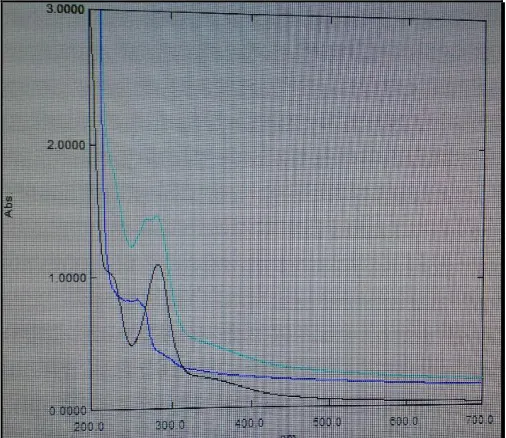
In simultaneous equation method, the primary requirement for developing a method for analysis is that the entire spectra should follow the Beer’s law at all wavelengths, which was fulfilled in case of both these drugs. The two wavelengths used for the analysis of the drugs were 256 nm (λmax of Nigella sativa seed oil) and 282 nm (λmax of Ginger extract) at which the calibration curves were prepared for both the drugs. The overlain UV absorption spectra of Nigella sativa seed oil (256 nm) and Ginger extract (282 nm) in SLS solution is shown in (Figure 1).
FIGURE 1: OVERLAIN ABSORPTION SPECTRA OF NIGELLA SATIVA SEED OIL (256 NM) AND GINGER EXTRACT (282 NM) IN SLS SOLUTION
Validation of the Proposed Method Calibration curve
Linear correlation was obtained between absorbance versus concentrations of Nigella sativa
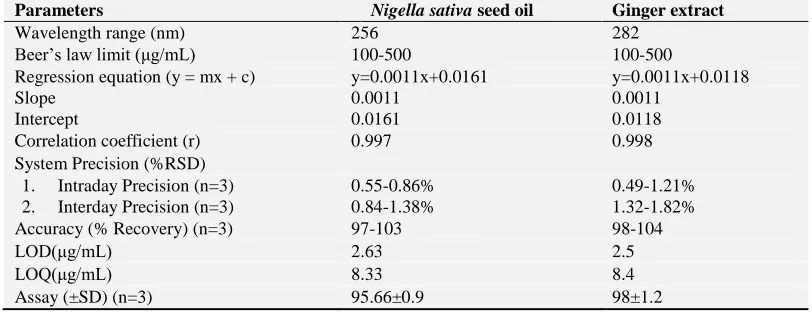
[image:3.612.315.568.300.519.2]TABLE 1: REGRESSION ANALYSIS DATA AND SUMMARY OF VALIDATION PARAMETER FOR THE PROPOSED METHOD
Parameters Nigella sativa seedoil Ginger extract
Wavelength range (nm) 256 282
Beer’s law limit (μg/mL) 100-500 100-500
Regression equation (y = mx + c) y=0.0011x+0.0161 y=0.0011x+0.0118
Slope 0.0011 0.0011
Intercept 0.0161 0.0118
Correlation coefficient (r) 0.997 0.998
System Precision (%RSD)
1. Intraday Precision (n=3) 0.55-0.86% 0.49-1.21%
2. Interday Precision (n=3) 0.84-1.38% 1.32-1.82%
Accuracy (% Recovery) (n=3) 97-103 98-104
LOD(μg/mL) 2.63 2.5
LOQ(μg/mL) 8.33 8.4
Assay (±SD) (n=3) 95.66±0.9 98±1.2
% RSD = Percent relative standard deviation LOD = Limit of detection
LOQ = Limit of quantitation SD = Standard deviation n = number of replicates
The validation parameters were studied at all the wavelengths for the proposed method. Accuracy was determined by calculating the recovery and the mean was determined (Table 2). The method was
successfully used to determine the amounts of
[image:4.612.103.509.81.237.2]Nigella sativa seed oil and Ginger extract present in the beads (Table 3 and Table 4).
TABLE 2: RECOVERY DATA FOR THE PROPOSED METHOD
Drug Level
Amount of sample taken (μg/mL)
Amount added (μg/mL)
Amount added (%)
% Mean Recovery ± SD*(n=3)
Nigella sativa seed oil I 200 0 0 97±1.2
II 200 100 50 98±1.74
III 200 200 100 99.25±1.23
IV 200 300 150 99.21±1.25
Ginger extract I 200 0 0 98±0.58
II 200 100 50 99.33±0.96
III 200 200 100 102±0.25
IV 200 300 150 101.6±0.21
*SD is Standard deviation and n is number of replicates.
TABLE 3: FORMULATION COMPOSITION
Sr. no. Ingredients % w/v
1 Sodium alginate 3
2 Calcium Chloride 10
3 Gingerextract 1
4 Nigella sativa seed oil 3
5 Tween 80 1
TABLE 4: ANALYSIS OF NIGELLA SATIVA SEED OIL AND GINGER EXTRACT BEADS
Formulation Amount added (%w/v) Amount found
(%w/v) %Amount found
Nigella sativa seed oil and Ginger extract Beads
Nigella sativa seed oil
Ginger extract
Nigella sativa
seed oil
Ginger extract
Nigella sativa seed oil
Ginger extract
[image:4.612.54.559.385.538.2]CONCLUSIONS: The developed simultaneous equation method is found to be simple, sensitive, accurate and precise and can be used for routine analysis of Nigella sativa seed oil and Ginger extract. The developed method was validated as per ICH guidelines. Statistical analysis proved that the method is repeatable and selective for the analysis of Nigella sativa seed oil and Ginger extract in their combined pharmaceutical formulations.
ACKNOWLEDGEMENTS: The authors are thankful to Konark Herbals and Health Care, Nani Daman, India for providing gift sample of Ginger extract for research. The authors are thankful to Oriental College of Pharmacy College, Sanpada, Navi Mumbai, India for providing all the facilities to carry out the work.
REFERENCES:
1. Chehl N, Chipitsyna G, Gong Q, Yeo CJ and Arafat HA:
Anti-inflammatory effects of the Nigella sativa seed extract, thymoquinone, in pancreatic cancer cells. HPB (Oxford) 2009; 11(5): 373–381.
2. Ali Siddique, Zoheir A. Damanhouri, and Firoz anwar: A
review on therapeutic potential of Nigella sativa: A
miracle herb. Asian Pac J Trop Biomed 2013; 3: 337–352.
3. Rahnama P, Montazeri A, Huseini HF, Kianbakht S and
Naseri M: Effect of Zingiber
officinale R. rhizomes (ginger)on pain relief in primary
dysmenorrhea: a placebo randomized trial .BMC Complementary and Alternative Medicine 2012;12.
4. Amolnat Tunsirikongkon et al: Formulation Development
of Herbal Capsule Containing Oleoresin of Zingiber
Officinale Extract. International Journal of Pharmacy and
Pharmaceutical Sciences 2013; 5(4): 439-445.
5. Modares M, Besharat S, Kian FR, Mahmoudi M and
Sourmaghi HS: Effect of Ginger and Chamomile capsules on nausea and vomiting in pregnancy. Journal of Gorgan University of Medical Sciences 2012; 14(1): 46-51.
6. Naderi Z, Mozaffari-Khosravi, Dehghan A, Hosseini HF,
Najdarradeh A: The effect of ginger (Zingiber officinale) powder supplement on pain in patients with knee osteo arthritis: a double-blind randomized clinical trial. Journal of Shaeed Sdoughi University of Medical sciences 2012; 20(5): 657-667.
7. Chrubasik S, Pittler MH, Roufogalis BD. Zingiberis
rhizoma: A comprehensive review on the ginger effect and efficacy profiles. Phytomedicine 2005; 12: 684–701.
8. Beckett A.H. and Stenlake J.B. Practical Pharmaceutical
Chemistry – Part Two. CBS Publishers and Distributors, Fourth edition 2005.
All © 2014 are reserved by International Journal of Pharmaceutical Sciences and Research. This Journal licensed under a Creative Commons Attribution-NonCommercial-ShareAlike 3.0 Unported License.
This Article can be downloaded to ANDROID OS based mobile. Scan QR Code using Code/Bar Scanner from your mobile. (Scanners are
available on Google Playstore) How to cite this article:
Snehalatha B, Momin M, Mishal AV and Kale TR: Development and Validation of Spectrophotometric Method for Simultaneous
Estimation of Nigella Sativa Seed Oil and Ginger Extract in the Same Dosage Form.Int J Pharm Sci Res2014; 5(12): 5235-39.doi: