Full Length Research Article
THE « BURNOUT » DETERMINANTS AND ITS CONSEQUENCE ON THE PERCEIVED PERFORMANCE
OF TUNISIA CALL CENTERS ‘OPERATORS: VALIDATION OF THE SCALES OF MEASUREMENT
*Asma Dellagi Malouche and Neji Bouslama
Tunisia
ARTICLE INFO ABSTRACT
Nowadays, call centres are more and more numerous in Tunisia. Despite the high turnover in the incoming centre calls, many students work there for a definite period. For those who have opted for a whole career in it, they would often suffer from an acute state of stress. The following article deals with the call centres art, the work exhaustion syndrome “Burnout” and its determinants. Its objective consists in carrying out a survey with 405 operators and validates the following scales of measurement variables: role ambiguity, role conflict, reduced motivation, “Burnout” and perceived performance.
Copyright © 2015 Asma Dellagi Malouche and Neji Bouslama.This is an open access article distributed under the Creative Commons Attribution License, which permits unrestricted use, distribution, and reproduction in any medium, provided the original work is properly cited.
INTRODUCATION
With the increase in competition, the improvement in the customer relation is revealed to be a profitable differentiation axis. This can, in particular, be translated in the improvement of: the information supplied to the customer, the interaction with the sales force as well as the service provided quality. During the last fifteen years, the call centres witnessed a great development. It concerns a new form of organization that is composed of a coupling of communication and information technology. According to (Kislowski, 1996): “the word call centre encompasses all the specialized operations through which the salaried, using computers, receive incoming calls (or emit outgoing calls), such calls being managed and controlled by a phone system called Automatic Call Distribution or an equivalent, and for which the coupling telephony-computing is present.” For (Sylvain Bonnafoux, Paul and Gammal, Stéphane Roux 2006): “Call centres are also called contact centres, customers’ management service by hotline distance, since call centres haven’t received their official definition yet. They first appeared during the 60ies in the U.S.A and they haven’t developed in France until the nineties to become the third important market in Europe.
*Corresponding author: Asma Dellagi Malouche
Tunisia
Today, there are 209 international call centers established in Tunisia1: “The External Investments Promotion Agency (EIPA), the call centres, for the greater part, specialized in customer relationship and by distance sale employ 8000 Tunisians, essentially young graduates who represent a skilled and cheap labour while 15% of students continue in the fields of telecommunication or new technology2. In Tunisia, the number of call centres is increasing steadily. Most of them are French, and then come respectively the Italian and the German relocated call centres. To outsource one’s call centre in the Mediterranean countries, in particular, in the Maghreb is, according to some specialists, a way to save money. The field is a job generator. The youngsters, forming the majority of the call centres employees, are often recruited at the second-year university level. Among the Mediterranean countries’ assets is the Maghrebi friendliness and conviviality, which adapt to the distance customer relationship. Another asset is the geographical and cultural proximity to Europe, especially to France and Spain. Finally, the last asset concerns the “turnover” rate which is lower in Tunisia than that of France. Call centres can be classified according to various criteria: according to the source and origin of the calls (calls emission
1
PhonecenterMag.com
2
PhonecenterMag.com
ISSN: 2230-9926
International Journal of Development Research
Vol. 5, Issue, 02, pp. 3335-3342, February,2015
DEVELOPMENT RESEARCH
Article History:
Received 04th November, 2014
Received in revised form 01st December, 2014 Accepted 20th January, 2015
Published online 27th February, 2015
Key words:
Call centres, “burnout”,
and reception), the proposed services (customer support, marketing, information services, and appointment taking...). There is the following standard typology: appointment setting and transfer, information department, telemarketing, telesales, customer after-sales service, customer complaint services, debts revival and recovering, assistance and security services, internal services support.
Call centre operators or teleconsultant or agents
An operator is an actor within the system; he or she should have not only technical (as technology users), but also organisational and relational skills and competence (Clergeau, 2002). The job of operator is the same in all the call centres. Subdued to a computer system according to the first operator free for the received call type (ACD-Automatic call Distributor), these operators should often meet the communication initiative by reading textually the scripts appearing on the computer screen and written by the supervisors’ team in charge of the project. According to the interlocutors’ reactions and responses, different information are encoded and need, automatically other adequate scripts that the operator is obliged to respect. Once the call is treated, the operator can take several seconds of rest before the computer system transmit or dial automatically a new call (Richardson and Marshall, 1996). “In a landscaped space, twenty, forty, eighty operators are activating; headsets on their head, eyes fastened on the computer screen, on line all day long with customers, prospects or debtors, absent only every two hours to take some rest in a neighbouring room. Between the tables or the translucent boxes, team leaders or supervisors are circulating to supervise, motivate or assist operators. In a separate office, the floor manager keeps constantly an eye on the statistics supplied, continuously, by the computerized telephone exchange” (Stuchlik, 2002). This is an operator’s day.
The incoming call centres performance
According to Pichault and Zune, 2000, the call centres performance and management styles conception differ whether they were call transmitters or call receivers. The performance research implies the realization of the optimization of the productivity and/or the quality. Performance being always the enterprise ultimate objective and its evaluation varying from an enterprise to another and from an operation to another. As for the incoming call centres, performance is measured according to the quality and production performance (Feinnberg et al., 2000). In fact, customers should get an answer from the very first call, it’s about quality and the queue must be nonexistent in order to optimize the production. In the same way, Clergneau et al. (2002) indicate two performance measures. A performance based on the optimization of productivity, meaning to respond to a maximum number of calls in a minimum time (Buscatto, 2002) and a performance base on the service quality. The service quality in a call centre, for Chang and Huang (2000) should consider six determinants:
Accessibility: the call centre should be easily accessible to users.
Swiftness: waits should be short
Reliability: capacity to supply the right solutions to customers from the first contact.
A variety of services: the presentation of an array of services to meet the customers’ demands.
An administrative assistance: the existence of an efficient system in order to share and locate the fitting information.
The humanware: the call centre staff should be courteous and able to supply the professional as well as the personalized services to users.
The Burnout in the call centres
Three-dimensional syndrome (Maslach 1981)
Maslach and Jackson, 1981 have received most attention as for their definition of the “burnout”. They would define this phenomenon “as a psychological state or a syndrome characterized by three distinct, but linked symptoms: the emotional exhaustion, the depersonalisation and the reduction of the self-actualization (which manifests with the people professionally involved with others). “Emotional exhaustion is the sensation to have no more energy, to be worn out, to undergo work and consider this latter as an unbearable chore on both the behavioural and the affective levels” (Maslach, 1981). Depersonalisation is characterized by a change in the manner by which someone perceives customers.
This latter tends to view customers as mere objects and is liable to show them feelings of aversion (Maslach, 1982; Omdahal and O’Donnelc, 1999). Depersonalization is characterized by a distancing attitude, not only toward the customer, but also toward family members and colleagues. There would be a relational disinvestment leading to indifference and aloofness toward others. This corresponds to “emotional armour plating with total absence of emotion” (Maslach, 1999). The lack of personal accomplishment means negative self-assessment in terms of professional capacities in front of work situations. It can also engender despair when the successive efforts are fruitless. Furthermore, depersonalisation is associated with inefficiency attribution, reduced motivation, self-underestimation and work as well as capacities depreciation. This leads to an inefficiency impression and an inability to advance, being convinced of his or her inaptitude to satisfy his/her entourage expectations (Singh et al., 1994).
The burnout determinants in call centres
Very few articles in the marketing literature have been consecrated to burnout determinants. Singh et al., 1994 have studied the burnout effect on the Marketing staff’s attitudes and behaviour (Low and al 2001) as well as the effect of the motivation and stressors on the sales representatives’ burnout.
The reduced motivation
essentially for pleasure and self-satisfaction rather than the ensued consequences.
Stressors
They are stressors known as role conflicts, role ambiguity and role overload and which have already been introduced as the burnout determinants. The overload role is the least invoked construct in the sales force researches unlike the two other stressors (role conflict and ambiguity role). We choose to exclude it.
Role conflict
Bulent Mengûç (1997) brings back that the role conflict concerns the incompatibility of the communicated expectations affecting the role perceived performance (Rizzo et al., 1970; Walker et al., 1975). An employee role conflict appears when this latter is asked to answer to many contradictory calls at the same time.
Role ambiguity
Role ambiguity happens when someone lacks clear information about the expectations associated to his/her role, the required methods for this role and/or the consequences ensued from it (Rizzo et al., 1970; Walker et al., 1975).
Hypotheses and Operating Framework
Our work’s subject is to ask Tunisian call centre operators about their professional exhaustion determinants as well as their consequences on the perceived performance. In order to answer to our study aim, we will precise, in what follows, the major elements of the study of the operating framework (work hypotheses as well as their validation instruments and the following procedures concerning data capture and processing.
Research hypotheses
Hypotheses relating to role tensions
Falcon and Lapeyrière, 1998; Koufane; Négroni, and Vion, 2000) have presented the existing difficulties in the professional relations of workers in contact with the public. Actually, they are often obliged to adopt contradictory and conflicting behaviour with their feelings. People express ambiguous feelings, of pleasure and disgust, of love and hatred, of surprise and saturation at the same time.
H1: Role ambiguity is positively correlated with the three professional exhaustion dimensions
H1a. The higher the role ambiguity is, the higher the emotional draining is.
H1b. The higher the role ambiguity is, the higher the cynicism is.
H2: Role conflict is positively correlated with the three professional exhaustion dimensions
H2a. The higher the role conflict is, the higher the emotional exhaustion is.
H2b. The higher the role conflict is, the higher the depersonalisation is.
Hypotheses relating to motivation
Motivation is present in most of the conceptions that defined the “burnout». In fact, many researches studied the relation linking motivation to the “burnout” or stress to the health problems resulting from it (Anderson and Iwaniki, 1984; Bakker, Killmer, Siegrist & Schaufeli, 2000; Blais et al., 1992; Léveillé et al., 2000). Bakker et al., 2000 hold up as an example the case of the German nurses who haven’t felt the burnout anymore because were highly implicated and motivated by their work.
H3: Motivation is negatively correlated with the three professional exhaustion dimensions
H3a. The lower the motivation is, the higher the emotional exhaustion is.
H3b. The lower the motivation is, the higher the depersonalisation is.
Hypotheses relating to the demographic characteristics
We will successively distinguish: age, sex, family status and the education level to establish the hypotheses. Age is the most relevant demographic characteristic in the study of the burnout phenomenon (Mor and Laliberte, 1984; Birch et al., 1986. Poulin and Walter, 1993). Young people, generally, carry off higher scores in the three dimensions of the burnout (Maslach and Jackson 1981; Schwab and Iwaniki, 1982). This observation is linked to the fact that the enterprise seniority is negatively correlated with the burnout. Maslach and Jackson (1986) show a decline in scores with the age and experience for the three dimensions, but these scores are higher for the emotional exhaustion and the depersonalisation. As far as the family status is concerned, and contrary to the theory, we postulate that married people have higher level of professional exhaustion than the unmarried ones. Several empirical studies underline the relationship between the burnout and the educational level (Mor and Laliberte, 1984; Birch et al., 1986). People with high educational level tend to show professional exhaustion scores superior to that of people having a lesser educational level. The tendency is significant to the depersonalisation for all the educational levels. The lowest educational levels as well as the highest ones get high score of emotional exhaustion.
H4: Married people have a higher professional exhaustion level than unmarried ones
H-4.a. Married people have a higher professional exhaustion level than unmarried ones
H-4.b. Married people have a higher depersonalisation level than unmarried ones
H-5: Women have a higher tendency to reach the burnout than men
H-5.a. Women have a greater tendency to reach emotional exhaustion than men
H-5.b. Women have a greater tendency to reach depersonalisation than men
H-6 Old workers have a higher tendency to be reached by the burnout than younger operators
H-6.a. The elderly are more liable to reach emotional exhaustion than younger workers
H-6.b. The old workers have a higher tendency to be reached by depersonalisation than younger operators
H-7: The burnout is negatively correlated with the call centres operators’ ancientness
H-7.a. The longer the call centre operator’s service is, the lower emotional exhaustion is.
H-7.b. The longer the call centre operator’s service is, the lower depersonalisation is.
H-8: The burnout is negatively correlated with the operators’ perceived performance
H-8.a. The higher the emotional exhaustion is, the lower the perceived performance is.
H-8.b. The higher the depersonalisation is, the lower the perceived performance is.
Scales purging
In this study section, we are going to introduce different used measure scales while justifying some of these uses. We intend to measure the following variables:
The burnout determinants which are: reduced motivation and stressors.
The three-dimensional burnout (professional exhaustion, depersonalization and reduced professional efficiency.
Perceived performance
At this level, our choice should be justified for each structure in terms of scales permitting the most appropriate measure. It should be noticed that we used different intervals to carry out our measures, and more particularly the Likert five intervals scale test. The more specific structures to measure are stressors and motivation.
The Burnout measurement
MBI, the measuring instrument is made of 16 items (5 for the emotional exhaustion dimension;5 for the depersonalisation dimension and 6 for the professional efficiency dimension).
The emotional exhaustion scale was measured by 5 items on a scale of 5 points going from 1 to 5:
®Item1: I feel emotionally worn out by my work. ®Item2: I feel totally ruined at the end of the day. ®Item3: To work all day long is painful.
®Item4: I feel worn out due to work.
®Item5: I’m tired when I wake up in the morning to face a working day.
The depersonalisation has been measured by 5 items on a 5 points scale going from 1to 5
®Item1: I’m less interested in my job since I am in a call centre.
®Item2: Being an operating makes me less enthusiastic. ®Item3: I only want to work without being bothered by anyone.
®Item4: I became more cynical concerning my contribution in this centre.
®Item5: I sometimes doubt of my job’s importance.
The professional efficiency dimension scale has been measured by five items on 5 points scale ranging from 1 to 5
®Item1: I can effectively solve problems occurring at work. ®Item2: I feel I can make an efficient contribution in my enterprise.
®Item3: I think I am rather a good operator.
®Item4: To accomplish this work, makes me blooming. ®Item5: In this job, I accomplished many things worth it. ®Item6: At work, I am sure I do things efficiently.
Motivation measuring
Intrinsic motivation is measured by an Anderson and Oliver (1994) scale based on three items. The referee indicates on a Likert scale if he “highly agrees noted 7”and “highly disagree noted 1”.
®Item1: When I do well, it gives me a feeling of self – fulfilment.
®Item2: I feel a great satisfaction when I do my work well. ®Item3: When I am successful in my work, this contributes to my growth and development.
The measurement of role ambiguity (Rizzo, House and Lirztman, 1970)
®Item1-I have clear and planned commercial objectives as far as my seller work.
®Item5: I have the feeling that I correctly schedule my work time to achieve my selling objectives.
®Item6:I know my responsibilities, I know what is expected from me.
Role conflict measurement
See appendix
®Item1: I do things that should have been done otherwise. ®Item2: I should get around certain rules to achieve certain objectives.
®Item3: I do things that can be accepted by some persons and refused by others.
®Item4: I have objectives without the resources nor the means to achieve them.
®Item5: I have objectives with the necessary staff to achieve them.
®Item6: I should do useless tasks.
®Item7: I should work with one or a whole group who work in a totally different way from mine.
®Item8: I receive incompatible demands from many people.
The measure of socio-demographic indicators
The measurement of socio-demographic subscripts, examples: gender, age, civil status, employment status, ancientness and schooling, has been carried out through the formulation of simple items collecting the referees characteristics. Such items are of three kinds: nominal (ex: sex, family situation, employment status and schooling), ordinal (ex: age) or continuous (ex: seniority at work).
Perceived performance measurement
Based on a previous exploratory study with fifteen operators working in the same call centre, we managed to get some items, referring to the most often cited performance indicators (Kinnie and al. , 2000; Bain and Taylor, 2000) quantitative (number of calls per hour, call term, sales number) as well as qualitative (organisation membership). We managed to take into custody the following items:
®Item1: Regarding my personal objectives, my results are satisfying.
®Item2: I managed to answer a maximum of calls in a minimum of time.
®Item3: I am able to give good solutions to customers since the first contact.
®Item4: I introduce a range of services to meet the customers’ demands.
®Item5: To appeal to administrative aid to find the suitable information.
®Item6: I maintain my courtesy with customers.
®Item7: I help to increase the CA in a better position than the competition.
The operating mode
We have established a variables questionnaire which was distributed among CharguiaII ten call centres operators (Charguia II being the area where call centres are highly
concentrated). Call centres operate for French customers in many sectors (7 com, Stream, Mezzo, Média-contact, Phone world, Transcom, Téléperformance, dps, OCC (Outstanding Call Center), Sell by tel. In all, we have collected 405 that were the object of the analysis. The statistics processing used as a first step, consist essentially in the reliability of the measurement of the reserved scales analysis and the factorial analysis (to reduce factors and thus facilitating the interpretation of variables). The sample is composed of 185 men and 220 women. The average age is 29.They are, most of the time, single and second-year university level.
Validation of scales measurement
We applied scale validation procedure to the different constructs that compose our model. For each construct, we’ll make a factorial analysis as a major component in order to identify the structure characteristic as either close or multidimensional and to see whether the scale is factorizable or not by using the statistical test KMO. We calculate, then, Cronbach Alpha coefficient on our data sample (405 operators). We suppress, afterwards, irrelevant variables. Our model structures are the following: Role conflict, role ambiguity, motivation, burnout and operator’s perceived performance.
“burnout” measurement Scale purification
A first factorial analysis on (SPSS version 17), revealed that the concept is represented through six dimensions, not confirming to the Maslach Burnout Inventory scale which is three-dimensional.
A first factor designating emotional exhaustion made of four items (item1, item2, item3 and item4).
A second factor defining personal depersonalisation made of three items (item7, item8 and item10).
A third factor representing reduced efficiency and which includes only two items.
A fourth factor including two items which also represent reduced efficiency.
A fifth factor having one item.
A sixth factor including one item only.
cumulative variance of 73,738 and a Cronbach alpha coefficient of 0,683. The confirmative analysis indicates a good scale convergent validity (table 1) and the adjustment indexes are satisfactory (table 2).
Table 1. Regression Weights: (Group number1-Default model)
Estimate S.E. C.R P Label burn4~ DP1 1,000
burn3~DP1 ,950 , 048 19,640 *** par_2 burn2~DP1 ,916 ,047 19,453 *** par_3 burn1~DP1 1,043 ,047 22,183 *** par_4 burn10~DP1 1,000
burn8~DP1 ,971 ,090 10,737 *** par_5 burn7~DP1 ,907 ,085 10,611 *** par_6
The convergent validity of the motivation concept is excellent. Using a “sem_stats.xsls” worksheet, we verify the discriminating validity by calculating the internal consistency coefficient Jo Rho Joreskog and the average variance extracted for the sake of the burnout concept.
Rho vc= 0,627 and Joreskog rho= 0,927
Motivation measurement scale purification
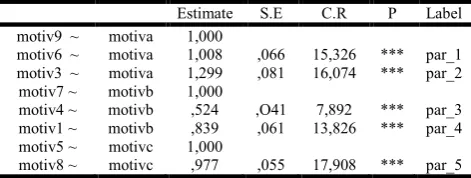
The first obtained structure thanks to factorial analysis created a four- factor structure with a representation quality of three items inferior to 0,5: Item4 quality equals 0,389, that of item 10 is equivalent to 0,265 and that of item12 equals 0,399. In a second factorial analysis we get rid of the fourth item and the structure remains the same except for the items 10 and 12 which is still unsatisfying. So, we launch a third factorial analysis eliminating the tenth item, the resulting structure is always three-dimensional, it succeeds to explain 72,347% of the total variance, nevertheless, the representation quality of the twelfth item is still lesser than 0,5. We decide then on eliminating the latter item and restart another factorial analysis that give us a new three-dimensional structure with a KMO of 0,739, a Barlett sphericity test of 1651,031, a ddl of28 and a cumulative variance that equals 81,006. This new structure has a Cronbach α of 0,798.A t last; the definitive motivation structure is composed of three dimensions: A first factor which symbolises motivation by the individual performance. A second factor that designates motivation by the financial and personal conditions. A third factor which represents motivation by recognition. The confirmatory analysis indicates a good scale convergent validity (see Table 2) and the adjustment indexes are satisfactory (see Table 3). Regression weights (Group number1-Default model
Estimate S.E C.R P Label motiv9 ~ motiva 1,000
motiv6 ~ motiva 1,008 ,066 15,326 *** par_1 motiv3 ~ motiva 1,299 ,081 16,074 *** par_2
motiv7 ~ motivb 1,000
motiv4 ~ motivb ,524 ,O41 7,892 *** par_3 motiv1 ~ motivb ,839 ,061 13,826 *** par_4 motiv5 ~ motivc 1,000
motiv8 ~ motivc ,977 ,055 17,908 *** par_5
The table above shows that all the tests t (CR=coefficient/ coefficient standard error) are superior to1, 96
Motivation CMIN/DF RMSEA GFI AGFI NFI CFI 9items 1,697 0,042 0,979 0,960 0,960 0,990
The convergent validity of the motivation concept is excellent. Using the “sem_stats.xls”, we check the discriminating validity by calculating the internal consistency coefficient Joreskog Rho and average variance extracted for the burnout concept.
Rho vc= 0,652 and Joreskog rho=0,943
Role conflict measurement scale purification
The pre-existent role conflict measurement is, initially, provided with eight items. We have made a factorial analysis of the role conflict with an orthogonal rotation (Varimax on SPSS 17). The representation quality of the second item (I should bend certain rules to attain certain objectives), item 3 (I work with two groups or more, which operate differently) and the fifth item (I have objectives without having the resources nor the means to execute them) is inferior to 0,5. We make, then, a second factorial analysis deleting confict2, conflict3 and conflict5. We get, then, a two-dimensional structure where conflict1has a representation shared between the two factors. So, we chose to suppress this item and restart a factorial analysis over again which gave us the same structure with a community of the eighth item (I receive incompatible requests from many people) that equals 0429<0, 5 and which we chose to i and remake the factorial analysis as a principal component. This resulted in the following:
The statistical KMO test value (0,663), which is superior to 05.
The Khi two statistics equals 245,096 with two significant freedom degrees at 5%.
A cumulative variance equalling 64,085 and an adequate Cronbach α of 0,720.
In the end, the kept role conflict scale will be composed of no more than three items (item4, item6 and item7).
Role ambiguity scale measurement purification
Role ambiguity measurement is composed of six items. We carried out a factorial analysis of role ambiguity with an orthogonal rotation (Varimax on SPSS17). Item4 representation quality (I receive, as an operator clear explanation about what is required from me) equals 0,418, which is inferior to 0,5. We make, then a second factorial analysis by eliminating ambiguity4. We obtain, as a result, a two-dimensional structure. The statistical test KMO value (0,707) is superior to 0,5; the Khi two statistics equalling 638,854 with a freedom degree of 54 which is significant at 5%; and a cumulative variance that equals 75200 as well as a Cronbach α of 0,704 and that is satisfactory. Finally, the ambiguity role scale maintained will be that with a two-dimensional structure which is composed of two factors:
Table 2.
[image:6.595.44.280.680.769.2] The first factor composed of item6, item3 and item2 which represent role ambiguity concerning responsibilities.
A second factor composed of two items: item5 and item1 that designate role ambiguity as far as planning and objectives are concerned.
Perceived performance scale measurement purification
Perceived performance scale constituted through the exploratory survey, is defined by seven items. The first analysis with a principal component has showed a representation quality of item4 (0,443) <0, 5. To be able to decide of our scale ultimate composition, we needed to make another ACP by suppressing item4. We get, then, an item6 with values for each factor, which is not appropriate. We renew the experience by deleting item6 and we obtain an item4 with a negative value. We make another ACP suppressing the fourth item, we obtain an item7 having two values. So, we renew the manoeuvre after eliminating item7 and we get an item7 having a negative value. We make an ACP eliminating item6. We obtain an item7 (0, 06) <0, 5. Finally, the last ACP gave us a unidimensional structure with three items (item1, item2 and item3) with a KMO index of 0,667, a Barlett sphericity which equals 266,524, a ddl of 3, a cumulative value that equals 65,277 and a Cronbach α of 0,733 making it superior to 0,6. Our scale composition is, finally, stopped at 3
Conclusion Forward Ways of Research
Studies allowed us to depict call centers, to well understand the burnout syndrome in this field and to prove the operator’s job within the sales force. Thanks to the major components, we could purify the following variables: conflict role, ambiguity role, burnout, perceived performance. For constructs presenting more than three items, we have calculated the convergent validity as well as the discriminating one. According to the results, we could judge the chosen variables validity for our study. Secondly, we are going to try, by means of an ANOVA, to validate our research hypotheses and get from it managerial implications.
REFERENCES
Aguir, M.S., F. Karaesmen, O.Z. Aksin and F. Chauvet, 2004. The impact of retrials on call center performance. OR Spectrum, 26,353-376
Aksin, O.Z. and F. Karaesmen, 2006. “Characterizing the performance of process flexibility structures .Operations Research Letters Forthcoming.
Aksin, O.Z., F. Karaesmen, E.L. Ormeci, 2007. A review of workforce cross-training in call centers from an operations management perspective. In Workforce Cross Training Handbook, D.Nembhard (ed), CRC Press, forthcoming. Anderson et Oliver, R.L. 1987. Perspectives on
Behavior-Based versus Outcome-based Sales Force Control Systems,
Journal of Marketing, Vol.51, October, p.76-88.
Avramidis, A.N., A. Deslauriers and P.l’Ecuyer, 2004. Modeling daily arrivals to a telephone call center.
Management Science, 50(7), 896-908
Babakus, E., Cravens, D.W, Johnson, M. and Moncrief, W.C. 1996. Investigating the Relationships among Sales,
Management Control, Sales Territory Design, Salesperson Performance and Sales Organisation Effectiveness. International Journal of Research in Marketing, vol.13, p.345-363.
Babakus, E., Cravens, D.W, Johnson, M. and Moncrief, W.C. 1999. The Role Emotional Exhaustion in Sales Force Attitude and Behavior Relationships, Journal of Academy of Marketing Science, Volume 27, hiver, N°1, pages 58-70 Bakker, A.B., Demerouti, E. and Verbeke, 2004. « Using the
job demands-resources model to predict burnout and performance. Human Resource Management., 43:83-104 Behrman D.N. and Perreault, Jr W.D. 1984. A Role Stress
Model of the performance and Satisfaction of Industrial Salesperson, Journal of Marketing, 48 (Fall), 9-21
Bernett, H.G., M.J. Fisher and D.M.B. Masi, 2002. Blended Call Center performance analysis. IT Professional, 4(2),33-38
Boles, J.S., Johnston, M.W. and Hair, J.F. 1997. Role stress, Work Family conflict and Emotional Exhaustion: Inter-relationships and Effects on some Work-related Consequences” Journal of Personal Selling and Sales Management, 17, 17-28 Brown
Burke, R.J. and Mikkelson, A. 2005. Burnout job stress and attitudes towards the use of force by Norwegian police officers. Policing: An international Journal of Police Stratégies & Management, 28.p.269-278
Charles–Pauvers, B., Le Quentree, E. and Urbain, C. 2004. « Pratiques de GRH, fonctionnement d’équipe et liens avec la performance: Le cas d’un centre d’appel », Actes AGRH.
Cordes, C.L. and Dougherty, T.W. 1993. A review and integration of research on job burnout », Academy of Mangement Review, 18, p.621-656
Décaudin, J.M. and Bouguerra, A. 2004. Etudes marketing avec SPSS, Pearson Education France, 4ème édition
Dejours, C., 2000. Travail, usure mentale, Paris, Bayard Editions
Demerouti, E., Bakker, A.B., Nachreiner F. and Schaufeli, W.B. 2001. “The job demands-resources model of burnout.
Journal of Applied Psychology, 86:499-512
Didier Truchot, 2004. Epuisement professionnel et burnout: Concepts, modèles, interventions. éditions: Dunod, Paris Douglas N. Behrman and William D. Perrault Jr. 1981.
Sources of Job related ambiguity and their consequences upon salespersons’ job satisfaction and performance.
Management science, vol. 27, N°11, Novembre, p. 1246-1260
Douglas N. Behrman and William D. Perrault, Jr. 1984. A Role Stress Model of the performance and Satisfaction of Indutrial Salesperson. Journal of Marketing, Vol., 9-12.
El Akremi Assaad, Guerrero Sylvie and Neveu Jean-Pierre 2006. Comportement organisationnel vol 2:Justice organisationnelle, enjeux de carrière et épuisement professionnel : De Boeck Emin Babakus, David W. Cravens, Mark Johnston,William
Élisabeth Grebot, 2008. Stress et burnout au travail: identifier, prévenir, guérir.Eyrolles. Éditions d’Organisation
Evrard Y. Prasb and Roux, E., 2000. Market. Etudes et Recherches en Marketing, Paris: Dunod
Graham, John, R. 2004. Burnout and salesman and performance. American Salesman. July 1,
Jean-Pierre Neveu, 2006. « Quand le cœur n’y est plus : De l’épuisement professionnel à l’agressivité envers le client » XVII è Congrès de l’AGRH-Le travail au cœur de la GRH IAE de Lille et Reims Management School, 16 et 17 novembre, Reims
Kenneth Teas, 1983. Supervisory Behavior, Role Stress and the Job Satisfaction of Industrial Salespeople. Journal of Marketing Research. Vol.XX (February) 84-91
Moncrief, C. 1999. The role of Emotional Exhaustion in sales Force Attitude and Behavior Relationships. Journal of the Academy of Marketing Science, volume 27, N°1, pages 58-70,
Suzanne Peters and Dr. Patrick Mesters, 2007. Vaincre l’épuisement professionnel: Tous les clés pour comprendre le burnout. Editions Robert Laffont, S.A., Paris,
Thomas Knapp, Adrian Burki, Andreas Lüthi and Daniel Zanetti, 2006. Burn-out: Le stress au travail: La maladie du XXIè siècle; Edition Les Presses du Belvédère