Full Length Article
Mapping morality with a compass: Testing the theory of
‘morality-as-cooperation’ with a new questionnaire
q
Oliver Scott Curry
a,⇑, Matthew Jones Chesters
b, Caspar J. Van Lissa
c aInstitute of Cognitive and Evolutionary Anthropology, University of Oxford, United Kingdomb
School of Psychology, University of East London, United Kingdom c
Department of Methodology & Statistics, Utrecht University, Netherlands
a r t i c l e i n f o
Article history: Received 28 March 2018 Revised 24 October 2018 Accepted 25 October 2018 Available online xxxx
Keywords: Morality Cooperation Game theory Moral foundations Scale development
a b s t r a c t
Morality-as-Cooperation (MAC) is the theory that morality is a collection of biological and cultural solu-tions to the problems of cooperation recurrent in human social life. MAC uses game theory to identify distinct types of cooperation, and predicts that each will be considered morally relevant, and each will give rise to a distinct moral domain. Here we test MAC’s predictions by developing a new self-report mea-sure of morality, the Morality-as-Cooperation Questionnaire (MAC-Q), and comparing its psychometric properties to those of the Moral Foundations Questionnaire (MFQ). Over four studies, the results support the MAC-Q’s seven-factor model of morality, but not the MFQ’s five-factor model. Thus MAC emerges as the best available compass with which to explore the moral landscape.
Ó2018 The Authors. Published by Elsevier Inc. This is an open access article under the CC BY-NC-ND license (http://creativecommons.org/licenses/by-nc-nd/4.0/).
1. Introduction
What is morality? What explains its content and structure? And how is it best measured? In recent years, the study of morality has become the focus of a thriving interdisciplinary endeavour, encom-passing research not only in psychology, but also in evolutionary theory, genetics, biology, animal behaviour, anthropology, neuro-science and economics (Haidt, 2007; Shackelford & Hansen, 2016; Sinnott-Armstrong, 2007). A common view in this body of work is that the function of morality is to promote cooperation (Curry, 2016; Greene, 2015:40; Haidt & Kesebir, 2010:800;Rai & Fiske, 2011:59;Sterelny & Fraser, 2016:1;Tomasello & Vaish, 2013:231).1
However, previous cooperative accounts of morality have not made full use of the mathematical analysis of cooperation – the theory of nonzerosum games – to provide a systematic taxonomy of cooperation. They have instead tended to focus on a relatively narrow range of cooperative behaviours (typically kin altruism and reciprocal altruism), and omitted others (for example, coordi-nation and conflict resolution) (Table 4 inCurry, 2016). Thus, pre-vious accounts have attempted to explain morality from an unnecessarily restricted base, and missed the opportunity to fur-nish a broader, more general theory of morality.
The present paper has two goals. First, we use nonzerosum game theory to provide the rigorous, systematic foundation that the cooperative approach to morality has previously lacked. We show how this rich, principled explanatory framework – which we call ‘Morality-as-Cooperation’ (MAC; Curry, 2016; Curry, Mullins, & Whitehouse, 2019) – incorporates more types of cooper-ation, and thus explains more types of morality, than previous approaches. The current version of the theory incorporates seven well-established types of cooperation: (1) the allocation of resources to kin (Hamilton, 1963); (2) coordination to mutual advantage (Lewis, 1969); (3) social exchange (Trivers, 1971); and
https://doi.org/10.1016/j.jrp.2018.10.008
0092-6566/Ó2018 The Authors. Published by Elsevier Inc.
This is an open access article under the CC BY-NC-ND license (http://creativecommons.org/licenses/by-nc-nd/4.0/).
qCurry’s work on this article was supported by the John Fell Oxford University Press Research Fund, and by a Large Grant from the UK’s Economic and Social Research
Council (REF RES-060-25-0085) entitled ‘‘Ritual, Community, and Conflict” and a STREP grant from the European Commission’s Sixth Framework Programme (project no. 043225) entitled ‘‘Explaining Religion”. Thanks to Helena Cronin, Rosalind Arden and Darragh Hare for comments on the manuscript, Harvey Whitehouse and Jon Jong for useful discussions and support, and Gerard Saucier for sharing data.
⇑Corresponding author at: Institute of Cognitive and Evolutionary Anthropology, University of Oxford, 64 Banbury Road, Oxford OX2 6PN, United Kingdom. E-mail address:[email protected](O.S. Curry).
1
‘‘Moral systems are interlocking sets of values, virtues, norms, practices, identities, institutions, technologies, and evolved psychological mechanisms that work together to suppress or regulate selfishness and makecooperativesocial life possible.” (Haidt & Kesebir, 2010). ‘‘[M]orality functions to facilitate the generation and maintenance of long-term social-cooperativerelationships” (Rai & Fiske, 2011). ‘‘Human morality arose evolutionarily as a set of skills and motives forcooperating with others” (Tomasello & Vaish, 2013). ‘‘[T]he core function of morality is to promote and sustaincooperation” (Greene, 2015). ‘‘[M]oral facts are facts aboutcooperation, and the conditions and practices that support or undermine it” (Sterelny & Fraser, 2016). Emphasis added.
Contents lists available atScienceDirect
Journal of Research in Personality
conflict resolution through contests featuring displays of (4) hawk-ish and (5) dove-hawk-ish traits (Maynard Smith & Price, 1973); (6) divi-sion (Skyrms, 1996); and (7) possesdivi-sion (Gintis, 2007).
Second, we test MAC’s prediction that each of these types of cooperation will be considered morally relevant, and each will give rise to a distinct moral domain, by developing a new self-report measure of moral values – with facets dedicated to (1) family val-ues, (2) group loyalty, (3) reciprocity, (4) bravery, (5) respect, (6) fairness and (7) property rights – and examine its psychometric properties.
2. How cooperation explains morality
The theory of Morality-as-Cooperation (MAC) argues that morality consists of a collection of biological and cultural solutions to the problems of cooperation recurrent in human social life (Curry, 2016). Below we review the general argument, before look-ing at how specific types of cooperation explain correspondlook-ing types of morality.
Life begins when molecules start making copies of themselves. These ‘replicators’ are ‘selfish’ in the technical sense that they pro-mote their own replication (Dawkins, 1976/2006). They can pro-mote their replication at theexpense of other replicators. These
competitiveinteractions have a winner and a loser; one’s gain is another’s loss; they are zerosum games (Maynard Smith, 1982; Von Neumann & Morgenstern, 1944). But replicators can also repli-cate inconcertwith other replicators (Dawkins, 1998). These coop-erative interactions can have two winners; they are win-win situations; they are nonzerosum games. Natural selection
can favour genes for cooperation – that is, genes for
evolutionarily-stable phenotypic strategies designed to achieve superior equilibria in nonzerosum interactions – and has done throughout the history of life. Natural selection for genes that employ cooperative strategies has driven several ‘major transi-tions’ in the evolution of life on Earth, including the formation of cells, chromosomes and multicellular organisms (Maynard Smith & Szathmáry, 1995). Natural selection has also favoured genes for cooperation between individuals, in a wide variety of species (Dugatkin, 1997), including humans. Humans descend from a long line of social primates; they have spent 50 million years living in social groups (Shultz, Opie, & Atkinson, 2011), and two million years making a living as intensely collaborative hunter-gatherers (Tooby & DeVore, 1987). This has equipped humans with a range of biological – including psychological – adaptations for coopera-tion. These adaptations can be seen as natural selection’s ‘attempts’ to solve the problems of cooperation. More recently, improvisa-tional intelligence and cultural transmission (Boyd, Richerson, & Henrich, 2011; Pinker, 2010) have made it possible for humans to attempt to improve upon natural selection’s solutions by invent-ing evolutionarily-novel solutions – ‘tools and rules’ – for further bolstering cooperation (Binmore, 1994a, 1994b; Hammerstein, 2003; Nagel, 1991; Popper, 1945). Together, these biological and cultural mechanisms provide the motivation for social, cooperative and altruistic behaviour; and they provide the criteria by which individuals evaluate the behaviour of others. According to MAC, it is precisely these solutions to problems of cooperation – this col-lection of instincts, intuitions, inventions and institutions – that constitute human morality (Curry, 2005, 2016).2
Which problems of cooperation do humans face? And how are they solved? Evolutionary biology and game theory tell us that
there is not just one problem of cooperation but many, with many different functionally, and perhaps phenotypically, distinct solu-tions (Lehmann & Keller, 2006; Nunn & Lewis, 2001; Robinson & Goforth, 2005; Sachs, Mueller, Wilcox, & Bull, 2004). Our review of this literature suggests that there are (at least) seven well-established types of cooperation: (1) the allocation of resources to kin; (2) coordination to mutual advantage; (3) social exchange; and conflict resolution through contests featuring (4) hawkish dis-plays of dominance and (5) dove-ish disdis-plays of submission; (6) division of disputed resources; and (7) recognition of possession. We briefly review each of these below, and we consider how each type of cooperation provides an explanation for a corresponding type of morality (Table 1).
2.1. Allocation of resources to kin (Family Values)
Genes that benefit replicas of themselves that reside in other individuals – that is, genetic relatives – will be favoured by natural selection if the cost of helping is outweighed by the benefit to the recipient gene(s) (Dawkins, 1979; Hamilton, 1963). So, evolution-ary theory leads us to expect that under some conditions organ-isms will possess adaptations for detecting and delivering benefits (or avoiding doing harm) to kin. This theory of kin selec-tion explains many instances of altruism, in many species (Gardner & West, 2014), including humans (Kurland & Gaulin, 2005; Lieberman, Tooby, & Cosmides, 2007). MAC predicts that because strategies for kin altruism realise a mutual benefit, they will be regarded as morally good. This theory can explain why car-ing for offsprcar-ing (Edel & Edel, 1959/1968; an ‘ethic of care’;
Gilligan, 1982), helping family members (Fukuyama, 1996; Wong, 1984), and avoiding inbreeding (Lieberman, Tooby, & Cosmides, 2003; Westermarck, 1994) have been widely regarded as important components of morality.
2.2. Coordination to mutual advantage (Group Loyalty)
In game theory, situations in which individuals are uncertain about how to behave in order to bring about a mutual benefit are modelled as coordination problems (Lewis, 1969). Humans and other animals use a variety of strategies – such as focal points, traditions, leadership, signalling, badges of membership, and ‘the-ory of mind’ – to solve these problems (Alvard, 2001; Boos, Kolbe, Kappeler, & Ellwart, 2011; Curry & Jones Chesters, 2012; McElreath, Boyd, & Richerson, 2003), and form stable coalitions and alliances (Balliet, Wu, & De Dreu, 2014; Bissonnette et al., 2015; Harcourt & de Waal, 1992). MAC predicts that because solu-tions to coordination problems realise mutual benefits, they will be regarded as morally good. This theory can explain why participat-ing in collaborative endeavours (Royce, 1908), favouring your own group (Bernhard, Fischbacher, & Fehr, 2006; Gert, 2013), and adopting local conventions (Gibbard, 1990a, 1990b) have been widely regarded as important components of morality.
2.3. Social exchange (Reciprocity)
In game theory, social dilemmas – prisoners dilemmas, public goods games, tragedies of the commons – arise when the fruits of cooperation are vulnerable to ‘free riders’, who accept the bene-fit of cooperation, without paying the cost (Ostrom & Walker, 2002). This problem can be overcome by a strategy of ‘conditional cooperation’ or ‘reciprocal altruism’, such as tit-for-tat (Axelrod, 1984; Trivers, 1971). Evidence for conditional cooperation has been found in numerous animal species (Carter, 2014), including humans (Cosmides & Tooby, 2005; Henrich et al., 2005; Jaeggi & Gurven, 2013). MAC predicts that because solutions to social dilemmas realise mutual benefits, they will be regarded as morally 2
good. This theory can explain why reciprocity in general (Chilton & Neusner, 2009; Confucius, 1994), as well as its various subcompo-nents – trust (Baier, 1995), patience (Curry, Price, & Price, 2008), gratitude (Emmons, 2004), guilt (Gibbard, 1990b), apology (Ohtsubo & Watanabe, 2009), and forgiveness (Downie, 1965; Godfray, 1992; Richards, 1988) – have been widely regarded as important components of morality.
2.4. Contests between Hawks (Heroism) & 2.5 Doves (Deference)
Conflict over resources – food, territory, and mates
(Huntingford & Turner, 1987) – presents organisms with an oppor-tunity to cooperate by competing in less mutually-destructive ways (Maynard Smith & Price, 1973). There are three ways of achieving this: contests (featuring the display of hawkish and dove-ish traits), division, and possession.
Game theory has shown that conflicts can be settled through ‘contests’, in which individuals display reliable indicators of their ‘fighting ability’, and the weaker ‘contestant’ defers to the stronger (Gintis, Smith, & Bowles, 2001; Maynard Smith & Price, 1973). Such contests are widespread in nature (Hardy & Briffa, 2013; Riechert, 1998), and often form the basis of dominance hierarchies where resources are allocated by ‘rank’ (Preuschoft & van Schaik, 2000). Humans have a similar repertoire of status-related behaviours (Fiddick, Cummins, Janicki, Lee, & Erlich, 2013; Mazur, 2005; Sell, Tooby, & Cosmides, 2009), and culturally elaborated hierarchies (Boone, 1992; Rubin, 2000). MAC predicts that because hawkish dis-plays of dominance, and dove-ish disdis-plays of submission, together realise mutual benefits, they will be regarded as morally good. This theory can explain why these two apparently contradictory sets of traits (Berlin, 1997) – the ‘heroic virtues’ of fortitude, bravery, skill, and wit, and the ‘monkish virtues’ of humility, deference, obedience, and respect – have been widely regarded as important components of morality (Curry, 2007; MacIntyre, 1981a, 1981b).
2.6. Division (Fairness)
When the contested resource is divisible, game theory models the situation as a ‘bargaining problem’ (Nash, 1950). Here, one solution is to divide the resource in proportion to the relative (bar-gaining) power of the protagonists (Skyrms, 1996). In the case of equally powerful individuals, this results in equal shares (Maynard Smith, 1982). Evidence for a ‘sense of fairness’ comes from non-human primates’ adverse reactions to unequal treatment in economic games (Brosnan, 2013; Brosnan & de Waal, 2014). With regard to humans, rules such as ‘‘I cut, you choose”, ‘‘meet in the middle”, ‘‘split the difference”, and ‘‘take turns”, are ancient and widespread means of resolving disputes (Brams & Taylor, 1996). And ‘equal shares’ is a spontaneous and cross-culturally prevalent decision rule in economic games (Henrich et al., 2005) and similar situations (Messick, 1993). MAC predicts that because dividing resources avoids a costly fight, and therefore realises a mutual benefit, it will be regarded as morally good. This theory
can explain why fairness (Rawls, 1958) and willingness to compro-mise (Pennock & Chapman, 1979) have been widely regarded as important components of morality.
2.7. Possession (Property Rights)
Finally, game theory shows that conflicts over resources can be resolved by deference to prior possession (Gintis, 2007; Hare, Reeve, & Blossey, 2016; Maynard Smith, 1982). The recognition of prior possession is widespread in nature (Sherratt & Mesterton-Gibbons, 2015; Strassmann & Queller, 2014). Humans also defer to prior possession in vignette studies (DeScioli & Karpoff, 2015; Friedman & Neary, 2008), experimental games (the ‘endowment effect’;Kahneman & Tversky, 1979), the law (Rose, 1985), and inter-national relations (Johnson & Toft, 2014). Private property, in some form or other, appears to be a cross-cultural universal (Herskovits, 1952). MAC predicts that because deferring to prior possession avoids a costly fight, and therefore realises a mutual benefit, it will be regarded as morally good. This theory can explain why the right to own property and the prohibition of theft (Becker, 1977; Locke, 2000; Pennock & Chapman, 1980) have been widely regarded as an important components of morality.
3. Summary and predictions
[image:3.595.33.561.85.159.2]Morality-as-Cooperation (MAC) is the theory that morality con-sists of a collection of biological and cultural solutions to the prob-lems of cooperation recurrent in human social life. MAC draws upon the mathematics of cooperation to identify and distinguish between different types of cooperation, and thereby explain different facets of morality. The present review has identified seven types of cooperation, and hence seven candidate moral domains: obligations to family, group loyalty, reciprocity, bravery, respect, fairness, and property rights. Thus MAC can explain why specific forms of cooper-ative behaviour – helping kin, helping one’s group, reciprocating costs and benefits, displaying ‘hawkish’ and dove-ish traits, dividing disputed resources, and respecting prior possession – are regarded as morally good, and why the corresponding forms of uncooperative behaviour – neglecting kin, betraying one’s group, free-riding, cow-ardice, disrespect, unfairness and theft – are regarded as morally bad. Starting from these first principles, MAC makes the following predictions about morality. First, with regard to content, MAC pre-dicts that people will regard each type of cooperation as morally relevant; that is, as falling within the moral domain. Second, with regard to structure, MAC predicts that because the incidence and value of these different types of cooperation vary independently in social life (and are perhaps subserved by different psychological mechanisms) the strength of endorsement of each of the corresponding types of morality will vary independently too. In other words, each of these seven types of cooperation will give rise to a distinct moral domain. Accordingly, the theory predicts that moral values will exhibit a multifactorial structure, varying on these seven dimensions. Moreover, as a corollary of this prediction Table 1
Overview of morality-as-cooperation.
Label Problem/Opportunity Solution Virtues Vices Epithet
1 Family Kin selection Kin Altruism Duty of care, special obligations to kin Incest, neglect Blood is thicker than water
2 Group Coordination Mutualism Loyalty, unity, solidarity, conformity Betrayal, treason United we stand, divided we fall
3 Reciprocity Social Dilemma Reciprocal Altruism Reciprocity, trustworthiness, forgiveness Cheating, ingratitude One good turn deserves another
4 Heroism Conflict Resolution (Contest) Hawkish Displays Bravery, fortitude, largesse Cowardice, miserliness With great power comes great responsibility
5 Deference Conflict Resolution (Contest) Dove-ish Displays Respect, obedience, humility Disrespect, hubris Blessed are the meek
6 Fairness Conflict Resolution (Bargaining) Division Fairness, impartiality, equality Unfairness, favouritism Let’s meet in the middle
regarding structure, MAC predicts that behaviour not tied to a specific type of cooperation will not constitute a distinct moral domain. These predictions about the content and structure of morality distinguish MAC from previous evolutionary and cooper-ative theories of morality.
3.0.1. Moral Foundations Theory
The most widely-used, and thus far most extensive, attempt to map the moral domain is Moral Foundations Theory (MFT;Haidt & Graham, 2007) operationalised in the Moral Foundations Question-naire (MFQ;Graham et al., 2011). Like MAC, MFT takes a coopera-tive approach to morality, and maintains that there are many moral domains. But, unlike MAC, MFT does not derive its domains from any underlying theory of cooperation (Haidt & Joseph, 2011), and proposes only five: Care, Fairness, Ingroup, Authority and Purity.3Like MAC, MFT includes domains dedicated to group loyalty (Ingroup), deference (Authority) and fairness (Fairness). But unlike MAC, MFT does not include domains dedicated to family, reciprocity, heroism, or property. MFT has no foundation dedicated to kin altru-ism; the MFQ does have two items pertaining to kin, but they appear under Fairness and Ingroup. Nor has MFT any foundation dedicated to reciprocal altruism: MFT places reciprocity (a solution to iterated prisoners’ dilemmas) and fairness (a solution to bargaining prob-lems) under the same heading, and the MFQ has no items pertaining to reciprocity. MFT has no foundations, and the MFQ has no items, dedicated to hawkish displays of dominance, such as bravery. And the only mention of property occurs in an item about inheritance under the foundation of Fairness.
MFT also includes domains – Care and Purity – that are not related to a specific type of cooperation, and that MAC therefore predicts will not constitute coherent domains.
MAC predicts that moral psychology will be sensitive to the benefits (care, altruism) and costs (harms) of social interaction — for what is cooperation but a particular configuration of benefits and costs? But, as we have seen, MAC suggests that there are dif-ferent types of benefits and costs — with difdif-ferent causes and con-sequences. For example, some ‘harms’, such as murder, are considered morally bad because they violate one or more cooper-ative principles (they break implicit social contracts against the use of force, and constitute an escalation of conflict, as opposed to its peaceful resolution). Other ‘harms’, such as punishment or self-defence, are considered morally good because they promote cooperation. This perspective suggests that it is a mistake to attempt to analyse benefits and costs in isolation, outside of their cooperative context, by placing them in a separate, generic domain dedicated to care or harm.
‘Purity’, meanwhile, has been described as the avoidance of ‘‘people with diseases, parasites [and] waste products” (Haidt & Joseph, 2004). It has no explicated connection to cooperation; on the contrary, it is regarded as an ‘‘odd corner” of morality precisely because it is not ‘‘concerned with how we treat other people” (Haidt & Joseph, 2004). By contrast, MAC suggests that the problem of avoiding pathogens (and other disgust-eliciting stimuli) is not a moral problemper se; instead, ‘pure’ or ‘impure’ behaviour is mor-alised only when it provides benefits, or imposes costs on, others –
for example, by putting their health at risk. So, avoiding rotten fruit on a tree is not a moral issue, but coughing in public without cov-ering your mouth is. And, because there are many different ways in which disgusting behaviour might influence others – the problem of avoiding incest is not the same as the problem of avoiding peo-ple with poor personal hygiene – MAC suggests that it is a mistake to single out ‘purity’ as a separate, generic domain.
3.0.2. Relational Models Theory
Similarly, like MAC, Fiske’s Relational Models Theory (RMT) takes a cooperative approach to morality, and maintains that there are many moral domains. But, unlike MAC, RMT does not derive its domains from any underlying theory of cooperation, and proposes only four: Unity, Hierarchy, Equality and Proportionality (Fiske & Rai, 2014; Rai & Fiske, 2011).4Unlike MAC, RMT’s domain of Unity does not distinguish between family and group; Hierarchy does not distinguish between hawkish heroism and dove-ish deference; and Equality and Proportionality do not distinguish between reciprocity and fairness. Interestingly, like MAC, and unlike MFT, RMT argues that there are no distinct domains dedicated to ‘harm’ or ‘purity’.5
3.0.3. Theory of Dyadic Morality
Unlike MAC (and MFT and RMT), Gray’s Theory of Dyadic Moral-ity (TDM) (Schein & Gray, 2018) does not take a cooperative approach to morality, but instead argues that the function of moral rules is to minimise harm to others (and is therefore a form of util-itarianism). TDM recognises that there may be different ‘‘genres” of harm that correspond to MFT’s domains, but argues that all moral violations are processed by general-purpose psychological mecha-nisms, as opposed to distinct special-purpose mechanisms. Like MAC, and RMT, TDM does not accept MFT’s claim that ‘purity’ is a distinct domain of morality – indeed, TDM has marshalled con-siderable evidence to suggest that ‘impure’ or disgusting acts are merely a particular form of harmful behaviour (Gray, Schein, & Ward, 2014).
3.0.4. Side-Taking Theory of Morality
Finally, like MAC, DeScioli and Kurzban’s ‘side-taking’ theory of
morality (STTM) agrees that cooperation explains moral
behaviour: ‘‘evolutionary theories of morality [that] focus on understanding cooperation. . .do an excellent job of explaining why humans. . .care for offspring, cooperate in groups, trade favors, communicate honestly, and respect property” (DeScioli, 2016: 23). However, whereas MAC would argue that these cooperative theories also explain why people make and express moral
3 Care/Harm is said to relate to ‘‘virtues such as kindness and compassion, and also in corresponding vices such as cruelty and aggression”. Fairness/Reciprocity relates to the virtues of ‘‘fairness and justice”, ‘‘individual rights and equality”. Ingroup/Loyalty relates to ‘‘virtues such as loyalty, patriotism, and heroism” and vices such as betrayal and treason. Authority/Respect relates to ‘‘respect, awe, and admiration toward legitimate authorities” and ‘‘virtues related to subordination: respect, duty, and obedience”. And Purity/Sanctity relates to the virtues of being ‘‘chaste, spiritually minded, pious” and the vices of "lust, gluttony, greed, and anger" (Haidt & Graham, 2007).
4‘‘Unity is the motive to care for and support the integrity of in-groups by avoiding or eliminating threats of contamination and providing aid and protection based on need or empathic compassion. Hierarchy is the motive to respect rank in social groups where superiors are entitled to deference and respect but must also lead, guide, direct, and protect subordinates. Equality is the motive for balanced, in-kind reciprocity, equal treatment, equal say, and equal opportunity. Proportionality is the motive for rewards and punishments to be proportionate to merit, benefits to be calibrated to contributions, and judgments to be based on a utilitarian calculus of costs and benefits.” (Rai & Fiske, 2011).
5
judgements– for example, to decide with whom to cooperate in future (Krasnow, Delton, Cosmides, & Tooby, 2016), to warn friends and family of uncooperative individuals, to enhance one’s reputa-tion as trustworthy or heroic (Barclay, 2016), or to recruit allies to prosecute an offender (Petersen, 2013) – STTM argues instead that the sole function of moral judgements is to provide salient focal points around which people coordinate when taking sides in interpersonal conflicts (DeScioli & Kurzban, 2009, 2013). STTM maintains that a wide range of content, including cooperative rules, can fulfil this function.
Thus MAC makes predictions about the content and structure of morality that are more extensive and detailed than those of previ-ous theories. For the remainder of this paper we will focus on test-ing MAC’s predictions against those of the most well-developed theory – MFT – and return to the implications of our findings for the other theories in the general discussion.
Previous empirical research provides some support for MAC’s predictions about the content and structure of morality.
3.1. The content of morality
With regard to content, an analysis of the historical ethno-graphic records of 60 societies found that the moral valence of these seven cooperative behaviours was uniformly positive, and that there is evidence for the majority of these cooperative moral values in the majority of cultures, in all regions of the world (Curry et al., 2019). Research on more contemporary populations paints a similar picture. First, a survey of family values involving student samples from 30 countries (Byrne & van de Vijver, 2014; Georgas, Berry, Van de Vijver, Kagitçibasi, & Poortinga, 2006) and responses to items in the World Values Survey, conducted in over 65 societies (Inglehart & Baker, 2000), indicate that ‘helping kin’ is widely considered to be morally good. Second, responses from internet samples to the Ingroup items in the Moral Foundations Questionnaire (Graham et al., 2011), and responses from student samples in 20 countries to items from the Schwartz Basic Values Survey (Schwartz, 1992) both indicate that ‘helping your group’ is widely considered to be morally good. Third, endorsement of the norms of positive and negative reciprocity in student samples (Eisenberger, Lynch, Aselage, & Rohdieck, 2004), in Britain and Italy (Perugini, Gallucci, Presaghi, & Ercolani, 2003), and responses to some items in the Values in Action Inventory of Strengths in 54 countries (Park, Peterson, & Seligman, 2006; Peterson & Seligman, 2004) and Schwartz’s Values Scale (Schwartz, 1992) indicate that ‘reciprocity’ is widely considered to be morally good. Fourth, investigations into the concept of honour, among students in the US and Turkey (Cross et al., 2014) indicate that various hawkish traits such as bravery are considered to be morally good. Fifth, responses to Authority items in the Moral Foundations Questionnaire (Graham et al., 2011), and to items from the Schwartz Basic Values Survey (Schwartz, 1992) indicate that ‘respecting superiors’ is widely considered to be morally good. Sixth, responses to items in the Merit Principle Scale in student samples (Davey, Bobocel, Son Hing, & Zanna, 1999) indicate that ‘dividing disputed resources’ is considered to be morally good. And seventh, responses to items in the World Values Survey (reported in Weeden & Kurzban, 2013) indicate that ‘respecting property’ is widely con-sidered to be morally good.
However, previous research has not provided a full test of MAC’s predictions about the content of morality; no previous study has investigated the moral relevance of all seven forms of cooper-ative behaviour in a single, contemporary, representcooper-ative sample. Instead, the studies reviewed above have measured different
aspects of morality, in different ways; the scales they employ typ-ically measure something other than the moral relevance (or valence) of cooperation (for example, they ask whether a person or a society possesses a particular trait, rather than whether the trait is moral); and the samples they use are typically composed only of students.
3.2. The structure of morality
With regard to structure, no previous research has investigated MAC’s prediction that these seven different types of cooperation will give rise to distinct domains of morality. This is because no previous attempts to map the moral domain – even those that have argued that the function of morality is to promote cooperation – have been guided by the mathematics of cooperation reviewed above, and hence none contain all of the domains predicted by MAC (Curry, 2016).
Nevertheless, despite its limitations, it is possible to ask whether previous work using the Moral Foundations Question-naire (MFQ) supports MAC’s predictions where the two theories overlap. Here the evidence is mixed. Factor analysis has provided only limited support for MFT’s five-factor model. The original exploratory factor analysis of data collected using the MFQ sug-gested a two-factor model (Table 2 inGraham et al., 2011). Con-firmatory factor analysis of this data suggested that MFT’s five-factor model provided a better fit; but the size of the improve-ment was marginal, and more importantly, none of the resulting five-factor models exhibited a conventionally ‘acceptable’ model fit (CFIs0.88; Table 10;Graham et al., 2011). Subsequent inde-pendent replications in Italy (CFI = 0.88; Bobbio, Nencini, & Sarrica, 2011), New Zealand (CFI = 0.83; Davies, Sibley, & Liu, 2014), Korea (CFI = 0.68; Glover et al., 2014), Sweden (CFI = 0.68;Nilsson & Erlandsson, 2015), and Turkey (CFI = 0.78;
Yilmaz, Harma, Bahcekapili, & Cesur, 2016), as well as a 27 coun-try study using the short-form MFQ (CFIs0.70; Iurino & Saucier, submitted), all suggest a similar pattern. For this reason, an alternative two-factor model – consisting of an ‘individualis-ing’ domain of Care and Fairness, and the ‘bind‘individualis-ing’ domain of Ingroup, Authority and Purity – is typically used in research (for example, see: Lewis & Bates, 2010; Smith, Alford, Hibbing, Martin, & Hatemi, 2016).
Thus empirical research with the MFQ does not support MAC’s prediction that group, deference and fairness will be distinct domains; but it does support MAC’s prediction that domainsnot
tied to specific forms of cooperation – namely Care and Purity – willnotconstitute distinct domains.
However, it is not clear whether these findings indicate a prob-lem with the cooperative approach to morality in general, or merely a problem with the way that it has been operationalised and measured in Moral Foundations Theory and the MFQ. After all, proponents of MFT have acknowledged that the original list of foundations was somewhat ‘‘arbitrary” (p. 107), based on a lim-ited review of only ‘‘five books and articles” (p. 107); that this list was never meant to be ‘‘exhaustive” (p. 104); and that they ‘‘do not know how many moral foundations there really are” (p. 58). And they have positively encouraged research that could ‘‘demonstrate the existence of an additional foundation, or show that any of the current five foundations should be merged or eliminated” (Graham et al., 2013, p. 99).
new measure of morality, the ‘Morality-as-Cooperation Questionnaire’.6
4. Study 1: Developing a Morality-as-Cooperation Questionnaire (MAC-Q)
In order to test MAC’s predictions regarding the content and structure of morality, we used the theories of cooperation reviewed above to develop a self-report measure of moral attitudes to seven types of cooperative behaviour (helping your family, help-ing your group, reciprocathelp-ing costs and benefits, behelp-ing brave, defer-ring to authority, dividing disputed resources, and respecting property), used it to gather data from a large sample representative of the UK adult population, and submitted the results to factor analysis.
4.1. Methods
In order to measure moral attitudes to the seven types of coop-erative behaviour, we followed the MFQ in employing two scales, addressing Relevance and Judgement, each of which is composed of multiple three-item subscales reflecting each of the proposed moral domains (MFQ;Graham et al., 2011).7
The Relevance scale was originally developed in order to test whether, in addition to ‘liberal’ concerns such as care and fairness, ‘conservative’ concerns such as authority, group loyalty, and purity are also considered relevant to morality (Graham, Haidt, & Nosek, 2009; Haidt & Graham, 2007). Here we use the scale to test whether the types of cooperative behaviour envisaged by MAC (especially the new domains of Family, Reciprocity, Heroism and Property) are considered morally relevant, and also whether they represent distinct domains. The Relevance scale asks participants ‘‘When you decide whether something is right or wrong, to what extent are the following considerations relevant to your think-ing?”. Sample items from our version included ‘‘Whether or not someone did what they had agreed to do”, and ”Whether or not someone kept something that didn’t belong to them”. Participants responded using an animated slider on a visual analogue scale marked 0–100, and labelled from left-to-right ‘‘Not at all Relevant, Not very relevant, Slightly relevant, Somewhat relevant, Very rele-vant, Extremely relevant”.
The Judgement scale was originally developed in order to over-come a perceived limitation of the Relevance scale, namely that it might assess second-order views about how one makes moral judgements, rather than the first-order moral judgements them-selves. According toGraham et al. (2009), relevance ‘‘does not neces-sarily measure how people actually make moral judgements”, hence
Judgement items were introduced to provide ‘‘more contextualized and concrete items that could more strongly trigger the sorts of moral intuitions that are said to play an important role in moral judgement”. Here we use the scale to provide an additional test of whether the types of cooperative behaviour envisaged by MAC rep-resent distinct domains. The Judgement scale asks participants ‘‘To what extent do you agree with the following statements?”. Sample items included ‘‘You should always put the interests of your family first”, and ‘‘Courage in the face of adversity is the most admirable trait”. Again, participants responded using an animated slider on a 0–100 visual analogue scale, which was labelled ‘‘Strongly Disagree, Disagree, Neither, Agree, Strongly Agree”.
We generated items for the new MAC-Q scales based on a com-prehensive review of the game-theoretic, evolutionary, psycholog-ical, and philosophical literature on cooperation and morality outlined above (Curry, 2005, 2016; Curry et al., 2019). We focussed on the principal moral value in each of the seven hypothesised domains of moral value. For example, for Hawkishness, we focussed on heroism, as opposed to fortitude, generosity or wit. And we aimed to produce items that could, in principle, be used and understood by anyone at any time – the items focussed on interpersonal relationships, and avoided any mention of modern technology or governments. The two sets of items were pretested, to identify heavily skewed or bimodal items. This resulted in 57 Moral Relevance items and 97 Moral Judgement items (available athttps://osf.io/w5ad8/).
4.1.1. Participants & procedure
Participants were recruited via a market polling firm (PurePro-file). An invitation email was sent to a sample of adults over 18 years-of-age living in the UK and being primary speakers of English. The study was made available on the PureProfile website from 3 to 14 September 2015.
Respondents were provided with information on the study aims and methods. If they provided informed consent, participants were directed to the study site. Participants were told that the goal of the study was to investigate people’s sense of right and wrong – described as ‘‘what people think of as morally good versus morally bad; moral versus immoral; ethical versus unethical; praiseworthy versus blameworthy”. They then completed versions of the Rele-vance and Judgement scales. The two scales, and items therein, were presented in randomised order. Participants then provided basic demographic data (including age, sex, nationality). Partici-pants could participate only once. Participation took around 12 min, for which participants were paid the equivalent of £0.5.
Responses collected via anonymous internet-based surveys (such as this) depend on participants’ sustained effort and engage-ment, and so are vulnerable to inattention and careless-responding, which affect data quality and the integrity of results (Meade & Craig, 2012). To detect careless responses we used a direct, instructed question as an attention check (Desimone, Harms, & Desimone, 2015).8 The attention-check item appeared after the main MAC-Q and MFQ item sets, as careless responding increases with survey length and participation time. We also applied further quality controls to remove participants who: did not com-plete the survey or did not provide demographic data; or who pro-vided responses suggesting spoiled or inauthentic answers (for example, always rating the items 0, 50 or 100, including those that were reverse-coded).
6 OSC conceived of the study, secured funding, wrote the items, collected data, contributed to preliminary analyses, and took the lead in writing the report. MJC wrote the items, collected data, conducted preliminary analyses, and contributed to writing the report. CJV conducted the main analyses, and contributed to writing the report.
7
For Study 1, we aimed for a sample size of 10 cases per item (10 * 154), though the procedures are reliably robust with > 1000 cases (MacCallum, Widaman, Zhang, & Hong, 1999). Similarly, for Study 2 we aimed for 10 cases per item (10 * 30). For Study 3a we aimed for 10 cases per free parameter (10 * 42). The resulting sample sizes exceed requirements for three-indicator factors (Wolf, Harrington, Clark, & Miller, 2013). For Study 3b the sample size was determined by the number of participants who accepted the invitation complete the follow-up. All materials used to generate the data reported here are either in the public domain or else available on the Open Science Framework page for this paper (osf.io/w5ad8). We have listed all the materials used but not reported here. And all R and MPlus syntaxes required to reproduce the reported results are also available on the OSF page. Regrettably, we are unable to share the data, because the participant consent form included a form of words that inadvertently precluded data sharing. We have now changed the wording of our standard informed consent form to avoid this problem in future.
8
4.2. Results
2396 people initially accessed the survey. After removing inat-tentive (544), incomplete (151), and spoiled (305) responses the final sample consisted of 1392 UK working-age adults (628 males, 763 females, 1 transgender; age M = 47.14, SD = 11.14).
4.2.1. Selecting items for analysis
Our initial item pool contained an oversampling of items per subscale. Accordingly, multicollinearity prevented analysis of the entire pool of items, as indicated by the low determinant of the correlation matrices for the Relevance (det = 4.80 * 10 17) and Judgement items (det = 1.45 * 10 19). This suggests substantial redundancy amongst the items. We therefore reduced the total item pool to three items per subscale; the minimum required to estimate latent variables (Kline, 2005). We retained those items which most closely captured the essence of each domain, based on theoretical consistency and empirical considerations – namely, we examined the correlation of each item with the average of all other items within its subscale, excluding the item itself (item-total correlation without item). This resulted in a reduced item pool of 21 items for Relevance and 21 for Judgement. The determi-nant for Relevance still fell slightly below the threshold of 1 * 10 5 (det = 8.15 * 10 6), but no further problems were encountered dur-ing analysis. The determinant for Judgement was acceptable (det = 1.77 * 10 3). The full text of the final sets of Relevance and Judgement items are given inAppendices A and B.
4.2.2. Content
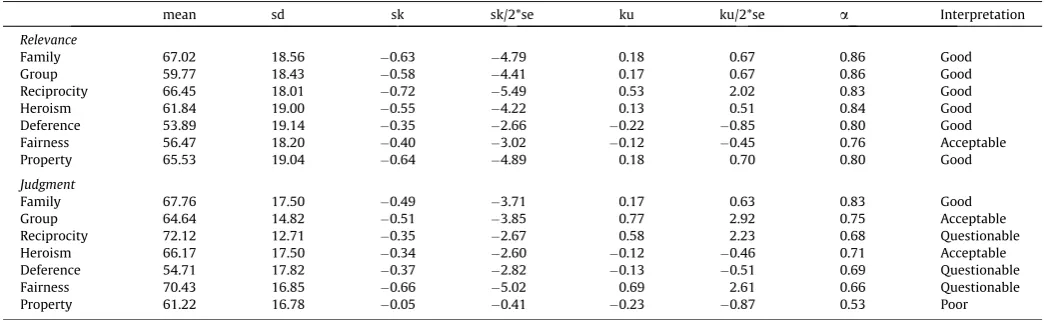
Descriptives for the Relevance and Judgement items are given in Tables S1 and S2. Descriptives for the seven Relevance and Judge-ment subscales, are given inTable 2. Ratings for the Relevance items and subscales ranged from ‘somewhat’ to ‘very’ relevant to morality.
4.2.3. Structure
4.2.3.1. Internal consistency. Cronbach’s alphas for the seven sub-scales (Table 2) ranged from 0.76 to 0.86 for Relevance, and 0.53 to 0.83 for Judgement.
4.2.3.2. Exploratory factor analysis. Given that the Relevance and Judgement scales were developed to measure two aspects of moral psychology thought to be different, we began by analysing each separately, before attempting to combine them.
Although we hada priorihypotheses about the factor structure, we first conducted exploratory factor analyses, on each scale, to see whether the hypothesised structure emerged from the data. The Kaiser-Meyer-Olkin index indicated superb sampling adequacy for Relevance (KMO = 0.95, individual items: 0.91–0.97), and mer-itorious sampling adequacy for Judgement (KMO = 0.85, individual items: 0.62–0.92). Bartlett’s test of sphericity indicated that nei-ther of the correlation matrices were identity matrices, moral Rel-evance
v
2(210) = 16207.75, p< .001, and Judgementv
2(210) = 8766.97,p< .001. The data are thus fit for factor analysis.Parallel analysis (Horn, 1965) revealed that, for both the moral Relevance and Judgement data, seven factors had eigenvalues greater than those derived from randomly generated data.9 We extracted these seven factors using factor analysis with ML estima-tion and oblimin rotaestima-tion to allow factors to correlate. For Relevance, these factors explained 63% of variance in participants’ responses (explained variance per factor 7.22–11.15%). For Judgement, these
factors explained 50% of variance in participants’ responses (explained variance per factor 5.24–9.84%).
The pattern matrices of the resulting factor solutions for the Relevance and Judgement scales are given in Tables S3 and S4. For both Relevance and Judgement, the resulting seven factors clearly corresponded to the seven hypothesised moral domains. All items loaded highest on their corresponding factor, with an average factor loading of 0.69 for Relevance (ranging from 0.45 to 0.84), and an average of 0.63 for Judgement (ranging from 0.42 to 0.82). Cross-loadings were all smaller than 0.24 (absolute value), which is negligible.
4.2.3.3. Confirmatory factor analysis. We conducted confirmatory factor analysis in order to measure the objective fit of our seven-factor models to the data (Table S5).10MAC’s seven-factor model was found to have a ‘good’ (RMSEA), ‘acceptable’ (CFI), and ‘good’ (SRMR) fit for the Relevance data, and a ‘mediocre’ (RMSEA), ‘unac-ceptable’ (CFI), and ‘good’ (SRMR) fit for the Judgement data.
4.2.4. Combining the scales
Whether and to what extent the Relevance and Judgement scales differ, and whether it is necessary to account for potential discrepancies between them to make a unified scale, has never been explicitly tested. Here we remedy this by comparing a model that does not take any difference between Relevance and Judge-ment into account, with two alternative models that do.
We began by examining the mean score correlations before model estimation (and latent variable correlations derived from the final model). These revealed that most subscales were moder-ately correlated, but Fairness and Property were not (Table S6), and that it would be important to take this discrepancy into account when combining the scales.
First, we considered the ‘‘simple domains” approach taken by MFT/MFQ, whereby Relevance and Judgement items are taken together as indicators of the seven underlying moral domains. Sec-ond, we considered a ‘‘different but related” approach, whereby separate latent variables are estimated for each of the seven Rele-vance and Judgement subscales, and these latent variables are allowed to correlate freely. Third, we considered a ‘‘multi-trait, multi-method” approach (Widaman, 1985), which separates the variance of each questionnaire item into two components: A ‘‘trait” component, and a ‘‘method” component. In this case, the ‘‘trait” components are seven latent constructs, reflecting the moral domains. Two ‘‘method” components capture variance introduced by the two questionnaire versions: Relevance versus Judgement. The model thus reflects the assumption that there are seven under-lying domains of morality (traits), which might be tapped in slightly different ways by the Relevance and the Judgement ques-tionnaires. This allows us to estimate people’s scores on the moral domains, controlling for variance relating to the two questionnaire versions. Results of these three models are given in Table S7.11The
9 According to contemporary psychometric literature (Dinno, 2009),Horn’s (1965) parallel analysis is the preferred method for determining the number of factors to retain.
10
All analyses were conducted in Mplus Version 7 (Muthén & Muthén, 1998–2012). Per the developers’ recommendation, we used robust maximum-likelihood estima-tion, which yields Satorra-Bentler scaledv2
values to account for potential non-normality (Satorra, 2000). Model fit was evaluated using three absolute fit indices, namely the Root Mean Square Error of Approximation (RMSEA, values < 0.01, 0.05 and 0.08 are considered to indicate excellent, good, and mediocre fit;MacCallum, Browne, & Sugawara, 1996), Comparative Fit Index (CFI, acceptable fit > 0.9;Bentler & Bonett, 1980), and Standardized Root Mean Square Residual (SRMR, good fit < 0.08;Hu & Bentler, 1999).
11
fit of the Simple Domains model was ‘mediocre’ (RMSEA), ‘unaccept-able’ (CFI), and ‘not good’ (SRMR). The fit of the Different But Related model was ‘good’ (RMSEA), ‘acceptable’ (CFI), and ‘good’ (SRMR). And the fit of the Multi-Trait Multi-Method model was ‘good’ (RMSEA), ‘acceptable’ (CFI), and ‘good’ (SRMR). Satorra-Bentler scaled chi-square difference tests (Satorra & Bentler, 2010) indicated that the fit of all three models differed significantly from one another. Thus, we can conclude that: the Simple Domains model was not sup-ported; the two models that allowed potential discrepancies between Relevance and Judgement ratings were better supported; and of these two models, the Different but Related achieved the best fit.
4.3. Discussion
The results support MAC’s prediction about the content of morality, namely that each of the seven types of cooperation would be considered morally relevant. Indeed, the four new domains uniquely predicted by MAC (family, reciprocity, heroism, property) were considered more relevant than domains shared with MFT (group, deference, fairness).
The results also support MAC’s predictions regarding the struc-ture of morality, namely that each of the seven types of coopera-tion would constitute a distinct domain. Exploratory factor analysis delivered the predicted seven factors, on both the Rele-vance and Judgement scales. And confirmatory factor analysis demonstrated that the seven factor model was a good fit for both scales, separately and combined. The results also suggest caution when combining the scales: simply aggregating the two method-ologically distinct Relevance and Judgement scales is inferior to a model that accounts for potential discrepancies between them.
Thus, as uniquely predicted by MAC, the MAC-Q successfully identifies novel moral domains relating to family, reciprocity (as opposed to fairness), heroism, and property, thereby providing evi-dence of domains not countenanced by previous theories. And the MAC-Q also succeeds in distinguishing moral domains relating to groups, deference and fairness not distinguished by previous mea-sures. In this way, Study 1 provides a first glimpse of a larger, higher resolution map of the moral domain.
5. Study 2: Testing Moral Foundations (MFT/MFQ)
How does the MAC-Q compare to the MFQ? MFT suggests a five-factor model of morality; however, previous research with the MFQ has yielded mixed results. Here we conduct an
indepen-dent test of MFT’s predictions. The results also allow us to investi-gate whether MAC-Q provides a good measure of the domains recognised by both theories (regarding groups, deference, and fair-ness); and to test MAC’s prediction that domains not related to specific forms of cooperation (Care and Purity) would not consti-tute distinct domains.
5.1. Methods
Methods were identical to Study 1, with the following excep-tions. We used the 30-item MFQ, with the original 1–6 scale (Graham et al., 2011). And the data were gathered during the early piloting and pre-testing phase of candidate MAC-Q items, on three separate occasions: from the 3rd to the 4th of December 2013; and the 11th of April to the 11th May, and the 16th to the 18th of September 2014. (Participants also completed a short-form version of the Big Five Inventory, not reported here (Rammstedt & John, 2007).
5.2. Results
1467 accessed the survey online. After removing inattentive (111), incomplete (67) and spoiled (247) responses the final sam-ple consisted of 1042 UK working-age adults (541 males, 499 females, 2 transgender; age, Mean = 48.06 years, SD = 13.94).
5.2.1. Content
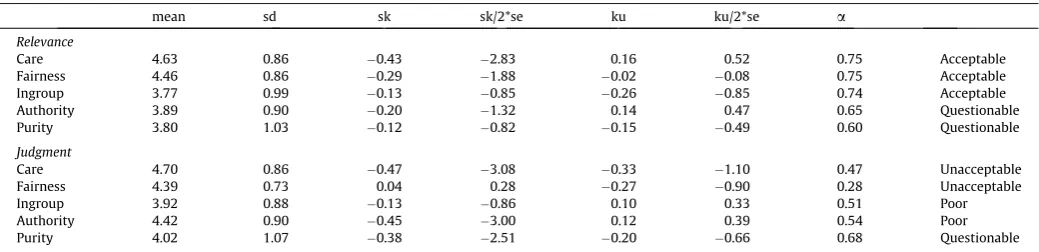
Descriptives for the MFQ Relevance and Judgement items given in Tables S8 and S9. Descriptives for the five subscales, for the Rel-evance and Judgement scales, are given inTable 3. Ratings for the Relevance items ranged from ‘slightly’ (‘conforming to tradition’, ‘acting in a way that God would approve’) to ‘very’ relevant to morality. Ratings for the Relevance items ranged from ‘somewhat’ to ‘very’ relevant (Care).
5.2.2. Structure
5.2.2.1. Internal consistency. Cronbach’s alpha for the five subscales (Table 3) ranged from 0.60 to 0.75 for Relevance, and 0.28 to 0.68 for Judgement.
5.2.2.2. Exploratory factor analysis. Again, although we hada priori
[image:8.595.41.564.86.246.2]hypotheses about the factor structure, we first conducted explora-tory factor analyses, on each scale separately, to see whether the hypothesised structure emerged from the data. The determinants for Relevance and Judgement were both below the threshold of Table 2
MAC-Q subscales: Means, standard deviations & alphas.
mean sd sk sk/2*se ku ku/2*se a Interpretation
Relevance
Family 67.02 18.56 0.63 4.79 0.18 0.67 0.86 Good
Group 59.77 18.43 0.58 4.41 0.17 0.67 0.86 Good
Reciprocity 66.45 18.01 0.72 5.49 0.53 2.02 0.83 Good
Heroism 61.84 19.00 0.55 4.22 0.13 0.51 0.84 Good
Deference 53.89 19.14 0.35 2.66 0.22 0.85 0.80 Good
Fairness 56.47 18.20 0.40 3.02 0.12 0.45 0.76 Acceptable
Property 65.53 19.04 0.64 4.89 0.18 0.70 0.80 Good
Judgment
Family 67.76 17.50 0.49 3.71 0.17 0.63 0.83 Good
Group 64.64 14.82 0.51 3.85 0.77 2.92 0.75 Acceptable
Reciprocity 72.12 12.71 0.35 2.67 0.58 2.23 0.68 Questionable
Heroism 66.17 17.50 0.34 2.60 0.12 0.46 0.71 Acceptable
Deference 54.71 17.82 0.37 2.82 0.13 0.51 0.69 Questionable
Fairness 70.43 16.85 0.66 5.02 0.69 2.61 0.66 Questionable
Property 61.22 16.78 0.05 0.41 0.23 0.87 0.53 Poor
1 * 10 5 (det = 3.26 * 10 3 and 5.24 * 10 2, respectively). The Kaiser-Meyer-Olkin index indicated superb sampling adequacy for Relevance (KMO = 0.92, individual items: 0.89–0.95), and mer-itorious sampling adequacy for Judgement (KMO = 0.84, individual items: 0.58–0.88). Bartlett’s test of sphericity indicated that nei-ther of the correlation matrices were identity matrices, Relevance
v
2(105) = 5927.70,p< .001, and Judgementv
2(105) = 3053.52,p< .001. The data are thus fit for factor analysis.
For the Relevance scale, parallel analysis revealed that only three factors had eigenvalues greater than those derived from ran-domly generated data. These factors explained 48% of variance in participants’ responses (explained variance per factor ranged from 7% to 21%). The pattern matrix of the resulting factor solution for the Relevance scale is displayed in Table S10. The three factors can be interpreted as: (i) Care/Fairness, (ii) Ingroup/Authority, and (iii) Disgust (consisting of a single item). The average factor loading was 0.60 (ranging from 0.33 to 0.76); cross-loadings were all smaller than 0.31 (absolute values). Extracting five factors did not reveal the hypothesised domains (also Table S10).
For the Judgement scale, parallel analysis revealed that five fac-tors had eigenvalues greater than those derived from randomly generated data. These factors explained 40% of variance in partici-pants’ responses (explained variance per factor ranged from 5% to 10%). The pattern matrix of the resulting factor solution for the Judgement scale is given in Table S11. The resulting five factors can be interpreted as: (i) Care/Fairness, (ii) Purity, (iii) Patriotic Authority, (iv) Family and (v) Gender Roles (consisting of a single item). These do not correspond closely to the five hypothesised foundations. The average absolute factor loading was 0.54 (ranging from 0.34 to 0.71); cross-loadings were all smaller than 0.25 (abso-lute values).
5.2.2.3. Confirmatory factor analysis. We conducted confirmatory factor analysis in order to measure the objective fit of MFT’s five-factor model to the data (Table S12). The five-five-factor model pro-vides a ‘mediocre’ (RMSEA), ‘acceptable’ (CFI), and ‘good’ (SRMR) fit to the Relevance data, and a ’mediocre’ (RMSEA), ‘unacceptable’ (CFI), and ‘good’ (SRMR) fit to the Judgement data.
5.2.3. Combining the scales
Again, we investigated whether and to what extent these two scales form one unified measure, or whether it is necessary to account for potential discrepancies between them. Mean score cor-relations before model estimation (and latent variable corcor-relations derived from the final model) revealed that most subscales were moderately correlated (Table S13). Nevertheless, we compared the same three models as before, as well as a fourth Hierarchical model (Graham et al., 2011), which represents the two super-factors of individualising and binding (Table S14).
The fit of the Simple Domains model was ‘mediocre’ (RMSEA), ‘unacceptable’ (CFI), and ‘not good’ (SRMR). The fit of the Different But Related model was ’mediocre’ (RMSEA), ‘unacceptable’ (CFI), and ‘good’ (SRMR). The fit of the Multi-Trait Multi-Method model was ’mediocre’ (RMSEA), ‘acceptable’ (CFI), and ‘good’ (SRMR). The fit of the Hierarchical model was ‘mediocre’ (RMSEA), ‘unac-ceptable’ (CFI), and ‘not good’ (SRMR). Satorra-Bentler scaled chi-square difference tests indicated that the fit of the Multi-Trait Multi-Method model did not differ significantly from that of the Different but Related model, but both of these models fit signifi-cantly better than the five-factor Simple Domains model com-monly used in the literature, and better than the Hierarchical model. Thus the data did not support the Simple Domains model, or the Hierarchical model. The best fitting models were those that allowed for potential discrepancies between Relevance and Judge-ment ratings – the Multi-Trait Multi-Method and Different But Related models.
5.3. Discussion
The results of this study support MFT’s claim that the contents of the five foundations are considered morally relevant. As such, the results support MAC’s prediction that cooperative behaviour relating to groups, deference and fairness (as well as the general category of ‘care’) will be regarded as morally relevant; but they appear to contradict MAC’s prediction that ‘purity’ will not be con-sidered morally relevant.
However, the results do not support MFT’s proposed five-factor structure of morality. Consistent with previous research, the over-all internal reliability of the scale was low.12 Exploratory factor analysis did not yield the predicted five factors, on either Relevance or Judgement scales. (Nor did it reliably reveal the two ‘individualis-ing’ and ‘bind‘individualis-ing’ factors.) Confirmatory analysis demonstrated that none of the five-factor models achieved a good fit on all criteria, either separately or when combined. Specifically, the MFQ was not able to distinguish between moral attitudes relating to groups and deference; Ingroup and Authority items loaded on the same factor. Nor was the MFQ able to distinguish attitudes to fairness; Fairness items loaded on the same factor as Care. Neither Care nor Purity emerged as distinct factors on the Relevance scale, only Purity was a distinct factor on the Judgement scale.
[image:9.595.33.553.85.211.2]Thus MFT’s predictions were not supported. The MFQ was not able to identify the domains uniquely predicted by MFT (Care Table 3
MFQ subscales: Means, standard deviations & alphas.
mean sd sk sk/2*se ku ku/2*se a
Relevance
Care 4.63 0.86 0.43 2.83 0.16 0.52 0.75 Acceptable
Fairness 4.46 0.86 0.29 1.88 0.02 0.08 0.75 Acceptable
Ingroup 3.77 0.99 0.13 0.85 0.26 0.85 0.74 Acceptable
Authority 3.89 0.90 0.20 1.32 0.14 0.47 0.65 Questionable
Purity 3.80 1.03 0.12 0.82 0.15 0.49 0.60 Questionable
Judgment
Care 4.70 0.86 0.47 3.08 0.33 1.10 0.47 Unacceptable
Fairness 4.39 0.73 0.04 0.28 0.27 0.90 0.28 Unacceptable
Ingroup 3.92 0.88 0.13 0.86 0.10 0.33 0.51 Poor
Authority 4.42 0.90 0.45 3.00 0.12 0.39 0.54 Poor
Purity 4.02 1.07 0.38 2.51 0.20 0.66 0.68 Questionable
Note.Range for all subscales is 1–6.
12
and Purity), and the MFQ not able to distinguish the domains (groups, deference and fairness) predicted by both MFT and MAC. Taken together, the results of Studies 1 and 2 provide further support for MAC. First, as MAC predicts, cooperative behaviour is considered relevant to morality (although the relevance of ‘purity’ remains to be explained), and the seven distinct types of coopera-tion give rise to seven distinct moral domains. Second, as MAC also predicts, behaviours not tied to a specific form of cooperation (‘care’ and ‘purity’) do not reliably emerge as distinct domains. Third, the MAC-Q distinguishes distinct domains relating to groups, deference and fairness, whereas the MFQ does not. And fourth, the MAC-Q’s breadth of conceptual coverage, internal con-sistency, factor structure, and model fit, are all superior to those of the MFQ.
Of course, in order to provide a more robust test of MAC’s pre-dictions, of the replicability of MAC’s proposed model, and to establish the relative utility of the MAC-Q, it will be necessary to examine the psychometric properties of the final scale, and com-pare them to the MFQ.
6. Study 3a: Confirming and Validating the MAC-Q
In order to replicate and confirm a further test of MAC’s predic-tions regarding the content and structure of morality, to examine the psychometric properties of the final scale (including its exter-nal and predictive validity), and to investigate how these compare to those of the MFQ, we gathered a further round of data using the MAC-Q, the MFQ, and a range of external scales and measures addressing related constructs.
6.1. Methods
Methods were identical to Study 1, with the following excep-tions. Data were gathered 27 June to 12 July 2016. Participants were recruited via a market polling firm (Qualtrics.com) in the US. Participation took around 27 min, for which participants were paid the equivalent of $0.75. We used the 42-item MAC-Q, the 30-item MFQ, and a series of domain-related criteria scales to assess divergent and convergent validity.
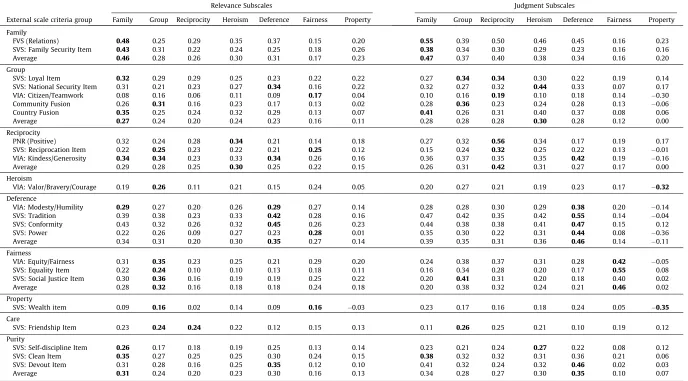
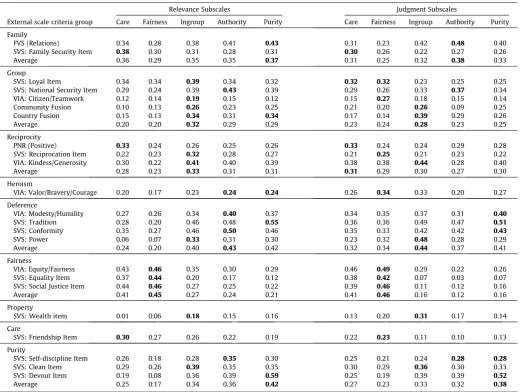
MAC Kinship criterion scales were the Relations subscale of the Family Values Scale (FVS;Byrne & van de Vijver, 2014), and the Family Security item from the Schwartz’s Basic Values Scale (SVS;Schwartz, 1992). MAC Mutualism (and MFQ Ingroup) crite-rion scales were the Citizen/Teamwork subscale of the Virtues in Action Scale (VIA; Goldberg et al., 2006; Peterson & Seligman, 2004), the Loyalty and National Security items from the SVS, and pictorial measures of Identify Fusion with Community and Country (Gómez et al., 2011). MAC Reciprocity (and MFQ Fairness) criterion scales were the Positive subscale of the Personal Norm of Reciproc-ity Scale (PNR;Perugini et al., 2003), the Kindness/Generosity sub-scale of the VIA, and the kindness the Reciprocation item from the SVS. MAC Heroism criterion scales were the Valor/Bravery/Courage subscale of the VIA, and the Power subscale of the VIA. MAC Defer-ence (and MFQ Authority) criterion scales were the Conformity and Tradition subscales of the SVS, and the Modesty/Humility subscale of the VIA. MAC Fairness (and MFQ Fairness) criterion scales were the Equity/Fairness subscale of the VIA, and the Equality and Social Justice items from the SVS. MAC Property criterion scale was the Wealth item from the SVS. In addition, we also collected data on two criteria scales related to the additional MFQ domains. Care cri-terion scales were items from the Benevolence subscale of the SVS. And the Purity criterion scales were the self-discipline, clean, and devout items on the SVS.
For predictive validity, we also included a new quasi-objective measure of cooperative behaviour. The Cooperative Action Scale
asked participants how many times they had performed various cooperative actions in past year (Table S32).13
6.2. Results
1157 accessed the survey online. After removing inattentive (537), incomplete (70) and spoiled (81) responses the final sample consisted of 469 US working-age adults (238 males, 230 females, 1 transgender; age,Mean= 46.82 years,SD= 16.78).
6.2.1. MAC-Q content
Descriptives for all MAC-Q Relevance and Judgement items are given in Tables S15 and S16. Descriptives for all seven MAC-Q sub-scales are given inTable 4. Ratings for the Relevance items and subscales ranged from ‘somewhat’ to ‘very’ relevant to morality.
6.2.2. MAC-Q structure
6.2.2.1. Internal consistency. Cronbach’s alphas for all seven sub-scales (Table 4) ranged from 0.76 to 0.88 for Relevance, and 0.64 to 0.86 for Judgement.
6.2.2.2. Exploratory factor analysis. Once again, we conducted exploratory factor analyses, on each scale separately, to see whether the hypothesised structure emerged from the data. The determinant for Relevance fell slightly below the threshold of 1e 5, 3.10e 06. The determinant for Judgement was good, 1.95e 4. The Kaiser-Meyer-Olkin index indicated superb sampling adequacy for Relevance (KMO = 0.93, individual items: 0.87–0.95), and meritorious sampling adequacy for Judgement (KMO = 0.88, individual items: 0.68–0.95). Bartlett’s test of sphericity indicated that neither of the correlation matrices were identity matrices, moral Relevance
v
2(210) = 5836.55, p< .001, and Judgementv
2(210) = 3920.71,p< .001. The data are thus fit for factor analysis. For the Relevance scale, parallel analysis revealed that seven
factors had eigenvalues greater than those derived from randomly generated data. These factors explained 66% of variance in partici-pants’ responses (explained variance per factor ranged from 7% to 11%). The pattern matrix of the resulting factor solution for the Rel-evance scale is given in Table S17. The resulting seven factors clearly corresponded to the seven hypothesised moral domains. All items loaded highest on their corresponding factor, with an average factor loading of 0.69 (ranging from 0.45 to 0.84). Cross-loadings were all smaller than 0.24 (absolute value), which is negligible.
For the Judgement scale, parallel analysis revealed thatfive fac-tors had eigenvalues greater than those derived from randomly generated data. These factors explained 51% of variance in partici-pants’ responses (explained variance per factor 8–13%). The pat-tern matrix of the resulting factor solution for the Judgement scale is displayed in Table S18. The five factors can be interpreted as: (i) Family, (ii) Group/Reciprocity, (iii) Martial Virtues, (iv) Fair-ness and (v) Property. Broadly speaking, mutualism and reciproc-ity, and heroism and deference, were combined. The average absolute factor loading was 0.58 (ranging from 0.29 to 1.01); cross-loadings were all smaller than 0.40 (absolute values). How-ever, extracting seven factors did reveal the hypothesised domains (also Table S18), with all items loading highest on their corre-sponding factor, with an average factor loading of 0.60 for Rele-vance (ranging from 0.34 to 0.87), and cross-loadings smaller than 0.38 (absolute value).
13
6.2.2.3. Confirmatory factor analysis. MAC’s seven-factor model was found to have a ‘good’ (RMSEA), ‘acceptable’ (CFI), and ‘good’ (SRMR) fit for the Relevance data, and a ‘mediocre’ (RMSEA), ‘unac-ceptable’ (CFI), and ‘good’ (SRMR) fit for the Judgement data (Table S19).
6.2.3. Combining the scales
Again, we investigated whether and to what extent these two scales form one unified measure, or whether it is necessary to account for potential discrepancies between them.
Mean score correlations before model estimation (and latent variable correlations derived from the final model) revealed that most subscales were moderately correlated, but Fairness and Prop-erty were not (Table S20). This again suggested that it would be necessary to take this discrepancy into account when creating a scale that combined the two Relevance and Judgement scales (Table S21).
The fit of the Simple Domains model was ‘unacceptable’ (RMSEA), ‘unacceptable’ (CFI), and ‘not good’ (SRMR). The fit of the Different But Related model was ‘good’ (RMSEA), ‘acceptable’ (CFI), and ‘good’ (SRMR). The fit of the Multi-Trait Multi-Method model was ‘good/mediocre’ (RMSEA), ‘unacceptable’ (CFI), and ‘good’ (SRMR). Satorra-Bentler scaled chi-square difference tests indicated that the fit of all three models differed significantly from one another. Thus the Simple Domains model was not supported. The two models that allowed potential discrepancies between Rel-evance and Judgement ratings achieved a significantly better fit on all indices. And of these two models, the Different but Related model achieved the best fit.
6.2.4. MFQ content
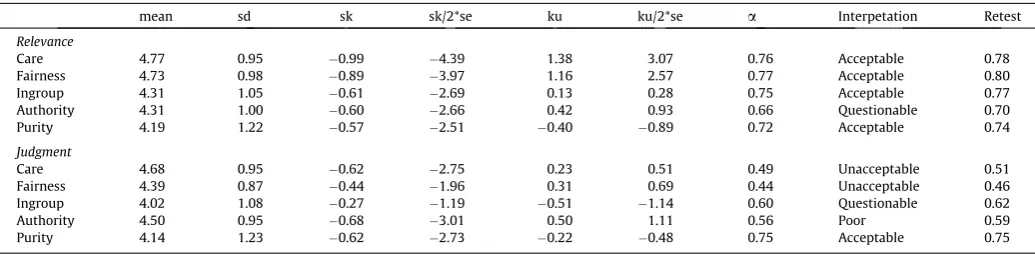
Descriptives for all MFQ Relevance and Judgement items are given in Tables S22 and S23. Descriptives for all five MFQ subscales are given inTable 5. Ratings for the Relevance items and subscales ranged from ‘somewhat’ to ‘very’ relevant to morality.
6.2.5. MFQ structure
6.2.5.1. Internal consistency.Cronbach’s alphas for the five sub-scales ranged from 0.66 to 0.77 for Relevance, and 0.44 to 0.75 for Judgement.
6.2.5.2. Exploratory factor analysis.Again, we first conducted exploratory factor analyses, on each scale separately, to see whether the hypothesised structure emerged from the data. The determinants for Relevance and Judgement were both above the threshold of 1 * 10 5 (det = 7.63 * 10 4 and 2.00 * 10 2, respec-tively), indicating the correlation matrices were fit for factor analysis.
The Kaiser-Meyer-Olkin index indicated superb sampling ade-quacy for Relevance (KMO = 0.93, individual items: 0.86–0.95), and meritorious sampling adequacy for Judgement (KMO = 0.85, individual items: 0.70–0.89). Bartlett’s test of sphericity indicated that neither of the correlation matrices were identity matrices, Rel-evance
v
2(105) = 3317.67, p< .001, and Judgementv
2(105) = 1810.67,p< .001. The data are thus fit for factor analysis.For the Relevance scale, parallel analysis revealed that onlytwo
[image:11.595.32.558.86.246.2]factors had eigenvalues greater than those derived from randomly generated data. These factors explained 51% of variance in partici-pants’ responses (explained variance per factor 24% - 27%). The
Table 5
MFQ subscales: Means, standard deviations, alphas & retest reliabilities.
mean sd sk sk/2*se ku ku/2*se a Interpetation Retest
Relevance
Care 4.77 0.95 0.99 4.39 1.38 3.07 0.76 Acceptable 0.78
Fairness 4.73 0.98 0.89 3.97 1.16 2.57 0.77 Acceptable 0.80
Ingroup 4.31 1.05 0.61 2.69 0.13 0.28 0.75 Acceptable 0.77
Authority 4.31 1.00 0.60 2.66 0.42 0.93 0.66 Questionable 0.70
Purity 4.19 1.22 0.57 2.51 0.40 0.89 0.72 Acceptable 0.74
Judgment
Care 4.68 0.95 0.62 2.75 0.23 0.51 0.49 Unacceptable 0.51
Fairness 4.39 0.87 0.44 1.96 0.31 0.69 0.44 Unacceptable 0.46
Ingroup 4.02 1.08 0.27 1.19 0.51 1.14 0.60 Questionable 0.62
Authority 4.50 0.95 0.68 3.01 0.50 1.11 0.56 Poor 0.59
Purity 4.14 1.23 0.62 2.73 0.22 0.48 0.75 Acceptable 0.75
[image:11.595.33.551.618.745.2]Note. Range for all subscales is 1–6. Table 4
MAC-Q subscales: Means, standard deviations, alphas & retest reliabilities.
mean sd sk sk/2*se ku ku/2*se a Interpretation Retest
Relevance
Family 73.50 20.27 1.00 4.45 1.08 2.39 0.87 Good 0.88
Group 66.90 20.94 0.82 3.65 0.61 1.36 0.88 Good 0.89
Reciprocity 76.18 18.04 0.91 4.02 0.82 1.82 0.84 Good 0.86
Heroism 67.94 20.53 0.81 3.58 0.56 1.24 0.82 Good 0.84
Deference 65.20 20.77 0.68 3.01 0.35 0.77 0.79 Acceptable 0.81
Fairness 61.59 20.56 0.47 2.10 0.04 0.09 0.76 Acceptable 0.79
Property 70.40 21.96 0.94 4.18 0.62 1.37 0.84 Good 0.86
Judgment
Family 71.01 20.80 0.77 3.43 0.31 0.68 0.86 Good 0.87
Group 71.58 16.19 0.59 2.60 0.86 1.90 0.73 Acceptable 0.74
Reciprocity 77.24 14.19 0.44 1.97 0.09 0.20 0.70 Acceptable 0.71
Heroism 73.58 17.72 0.84 3.71 0.75 1.66 0.76 Acceptable 0.78
Deference 64.15 19.07 0.63 2.79 0.20 0.45 0.71 Acceptable 0.71
Fairness 77.66 16.53 1.15 5.11 2.25 5.01 0.64 Questionable 0.66
Property 62.16 22.79 0.39 1.73 0.68 1.51 0.70 Acceptable 0.71