2017 3rd International Conference on Artificial Intelligence and Industrial Engineering (AIIE 2017) ISBN: 978-1-60595-520-9
Risk Analysis and Evaluation Process of PDM Project Based
on Fuzzy Analytic Hierarchy
Zhi-qing ZHANG
*, Ya-wei LI
and Yan AO
Hengda College of Management, Wuhan University of Science and Technology, Wuhan, China *Corresponding author
Keywords: PDM project, Assessment index, Fuzzy analytic hierarchy process.
Abstract. Based on the comprehensive analysis of the major risk factors of PDM project, this paper establishes risk evaluation index system. In addition, it determines the weight of various indexes by adopting the thought of quantifying the expert’s opinions and applying the fuzzy analytic hierarchy process and evaluates the enterprise risk in PDM project by using fuzzy synthetic evaluation method. It provides bases for the enterprise to make decisions about PDM project and take risk control measures.
Introduction
Product data management (PDM) is a kind of software frame (or data platform) developed with the software technology as the basis, the product as the core and the distributed network, subordinated structure, graphic user interface and database management technology as a base. It can realize the integrated management of data, process and resources in relation to products [1]. As the key of production and operation management of an enterprise, product data have become an important content and support of implementing informational project such as ERP. However, from the PDM implementation effect in recent years, it can be seen there is still a high failure rate. Therefore, it has very important research value to study the key successful factors of implementing PDM project, establishing risk management strategy, control the risk in the life cycle of the PDM project. Learning from foreign scholars' research on software project risk results provides an important basis for risk analysis and evaluation of PDM project. Hao (2011)[2] Proposed software project risk management system and the system for a more in-depth research; Zafar(2015)[3] shows an application of the metrics in an environment of multiple projects of software development with the goal of analyzing its applicability and utility as support tool for decision-making and risk monitoring during project life cycle; Janjua (2016)[4] contacted 14 experts of 6 different countries through an open ended questionnaire to take their opinion about software project effective risk management and results indicated that to measure the effectiveness of risk management, it must be viewed in broader context of project success; Otto B(2012)[5] proposes how to evaluate and implement the business benefit of product data management (PDM), aiming to understand the "means - end relationship" between PDM and product data. In method selection, the paper adopts fuzzy analytic hierarchy process (FAHP). Introducing the thought and method of fuzzy mathematics to analytic hierarchy process (AHP) can combine qualitative analysis with quantitative analysis effectively, which provides scientific and feasible methods for multi-target risk evaluation of medium and large-size project on certain condition [6,7].
Risk Factor Analysis and Evaluation Index System of PDM Project
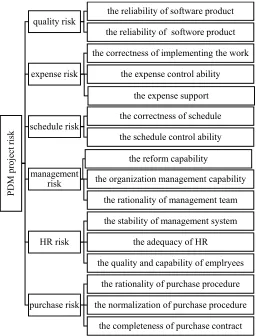
(1) Quality risk. The quality of PDM software product refers to the using value and attributive of software and the quality of project work, which is the guarantee of realizing the product value. Quality risk is mainly determined by factors like the reliability of software product and the satisfaction of project work.
(2) Expense risk. As PDM project is invested flexibly, and the expense is estimated flexibly, the change of external environment will cause some risks of capital need beyond the plan. The main factors affecting the risk of expense are the correctness of estimation and budget, the expense control ability and the expense support, etc.
(3) Schedule risk. PDM project involves many employees and departments. The environment is complicated and the schedule has a big elasticity. The major influencing factors of schedule risk mainly includes the correctness of schedule and the control ability of schedule, etc.
(4) Management risk. Management risk mainly refers to that affects the coordination of constituents of projects. The implementation of PDM project will certainly result in reform and the reform may encounter the obstruction. How to reduce the obstruction, capability of reforming and capability of organization management is related to the rationality of management system.
(5) Human resource (HR) risk. PDM project team is usually made up of enterprise party, PDM software support provider and consultant. Therefore, how to coordinate the project participants is the key factor to affect the risk of project. HR risk index mainly includes the stability of employee team, the adequacy of HR and the quality and capability of project employees.
(6) Purchase risk. Purchase risk refers to what affects the project implementation owing to improper selection of PDM product, and contract administration disorder, etc. The rationality of purchase plan, the normalization of purchase procedure and the completeness of purchase contract are the major influencing factors of the risk.
Figure 1. Risk index system of PDM project.
Risk Evaluation of PDM Project
Step 1: Construct Fuzzy Consistent Matrix
According to the index system in Diagram 1, compare the same layer of various factors subordinated to (or influencing) various factors of the above layer by comparison between each two factors and
construct fuzzy consistent matrixR( )rij 6 6 . In order to describe the relative importance of any two
indexes in the above layer quantitatively, 0.1-0.9 scale method is adopted as Table 1. Table 1. 0.1-0.9 Scale method.
Compare Factor Ui with Uj The evaluation value of Ui
extremely important 0.9
very important 0.8
obviously important 0.7
slightly important 0.6
equal 0.5
slightly unimportant 0.4
obviously unimportant 0.3
very unimportant 0.2
extremely unimportant 0.1
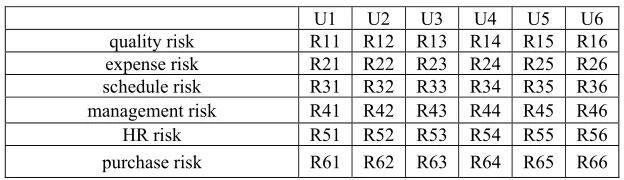
The fuzzy evaluation matrix R of the important degree of Factor U1, U2,…, U6 through comparison is shown in Table 2.
PDM
proj
ect
risk
quality risk the reliability of software product the reliability of softwore product
expense risk
the correctness of implementing the work
the expense control ability
the expense support
schedule risk the correctness of schedule the schedule control ability
management risk
the reform capability
the organization management capability
the rationality of management team
HR risk
the stability of management system
the adequacy of HR
the quality and capability of emplryees
purchase risk
the rationality of purchase procedure
the normalization of purchase procedure
[image:3.612.104.501.552.672.2]Table 2. Fuzzy evaluation matrix R of PDM project.
U1 U2 U3 U4 U5 U6 quality risk R11 R12 R13 R14 R15 R16 expense risk R21 R22 R23 R24 R25 R26 schedule risk R31 R32 R33 R34 R35 R36 management risk R41 R42 R43 R44 R45 R46 HR risk R51 R52 R53 R54 R55 R56 purchase risk R61 R62 R63 R64 R65 R66
Step 2: Calculate the Weight of Evaluation Index
According to fuzzy consistent matrix, solve the weight i of each factor and make the single rank. The computational formula is as below:
6
1
1 1 1
, 1, 2, , 6
6 2 6
i ik
k
r i
a a
(1)In these formulas, 6 is the order of fuzzy matrix,
a
is the parameter to meeta(6 1) / 2 .Step 3: Determine Fuzzy Evaluation Set and Evaluate the Grade Subordination Degree
The fuzzy evaluation set refers to the set of the evaluation value given to the evaluation object under one evaluation index. The paper adopts 5-level evaluation system and the fuzzy evaluation set V={ the risk is very high, the risk is slightly high, the risk is ordinary, the risk is slightly low and the risk is low } to form fuzzy evaluation matrix of factor Ui (i=1,…,6)
11 12 13 14 15 21 22 23 24 25
1 2 3 4 5
i
k k k k k
e e e e e
e e e e e
E
e e e e e
(2)
Hereinto, k is index k of factor Ui,
e
kj
j
1,
,5
is the subordinate degree of index k to the evaluation Vj of Level j. The value of should be determined according to the following method: make statistics of the score result by utilizing Delphi method and get that there are Qik1 of Level V1 evaluations, Qik2 of Level V2 evaluations,…Qik5 of Level V5 evaluations for index Uik., then5
1
j
ikj
ikj
kj
Q
Q
e
(3)Step 4: Make Single Hierarchy Fuzzy Comprehensive Evaluation
According to the marks of experts and supervisors to each index, apply the above method of constructing the fuzzy consistent matrix of various factors to construct the fuzzy consistent matrix of various factors. Through calculation, get the single-hierarchy comprehensive evaluation vector of Factor Ui. The computational formula is:
i ik i
U
E
(4)Hereinto,
ik is the weight vector of various indexes of Factor Ui (i=1,…,6).Step 5: Make Multi-hierarchy Fuzzy Comprehensive Evaluation
Firstly, construct the fuzzy evaluation matrix E={U1 U2 U3 U4 U5 U6 } between the PDM project risk U and the evaluation set V, and then utilize the weight
i of various factors to calculate thewhole risk U of the PDM project. The computational formula is as below:
i
U
E
(5)At last, determine the risk of PDM project according to the maximum subordinate degree principle.
Examples of Application
In the marketing process, enterprises often need to comprehensively evaluate suppliers’ product quality, productivity, product structures and sales situations, and enterprise market influences, etc., which requires the fuzzy evaluation system [11-12]. Take the index shown in Diagram 1 as the example, and apply the fuzzy analytic hierarchy process to the fuzzy comprehensive evaluation of PDM project risk of Y enterprise.
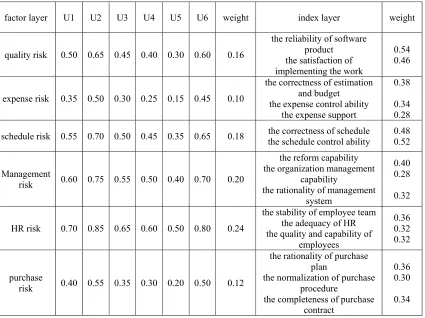
(1) Construct questionnaire and employ experts to give marks. Calculate fuzzy consistent matrix and weight of various factors and codes by using fuzzy analytic hierarchy process. Make Parameter
=(6 1) / 2
[image:5.612.97.522.343.661.2]a , the computational result is shown in Table 3.
Table 3. Fuzzy consistent matrix and weight of PDM project and various codes.
factor layer U1 U2 U3 U4 U5 U6 weight index layer weight
quality risk 0.50 0.65 0.45 0.40 0.30 0.60 0.16
the reliability of software product the satisfaction of implementing the work
0.54 0.46
expense risk 0.35 0.50 0.30 0.25 0.15 0.45 0.10
the correctness of estimation and budget the expense control ability
the expense support
0.38
0.34 0.28
schedule risk 0.55 0.70 0.50 0.45 0.35 0.65 0.18 the schedule control ability the correctness of schedule 0.48 0.52
Management
risk 0.60 0.75 0.55 0.50 0.40 0.70 0.20
the reform capability the organization management
capability
the rationality of management system
0.40 0.28
0.32
HR risk 0.70 0.85 0.65 0.60 0.50 0.80 0.24
the stability of employee team the adequacy of HR the quality and capability of
employees
0.36 0.32 0.32
purchase
risk 0.40 0.55 0.35 0.30 0.20 0.50 0.12
the rationality of purchase plan
the normalization of purchase procedure
the completeness of purchase contract
0.36 0.30
0.34
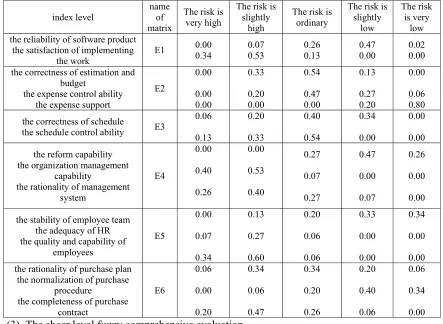
Table 4. Fuzzy evaluation matrix of each code risk of PDM project.
index level name of matrix
The risk is very high
The risk is slightly
high
The risk is ordinary
The risk is slightly
low
The risk is very
low the reliability of software product
the satisfaction of implementing
the work E1
0.00
0.34 0.07 0.53 0.26 0.13 0.47 0.00 0.02 0.00 the correctness of estimation and
budget
the expense control ability the expense support
E2 0.00 0.00 0.00 0.33 0.20 0.00 0.54 0.47 0.00 0.13 0.27 0.20 0.00 0.06 0.80 the correctness of schedule
the schedule control ability E3
0.06 0.13 0.20 0.33 0.40 0.54 0.34 0.00 0.00 0.00 the reform capability
the organization management capability
the rationality of management system E4 0.00 0.40 0.26 0.00 0.53 0.40 0.27 0.07 0.27 0.47 0.00 0.07 0.26 0.00 0.00
the stability of employee team the adequacy of HR the quality and capability of
employees E5 0.00 0.07 0.34 0.13 0.27 0.60 0.20 0.06 0.06 0.33 0.00 0.00 0.34 0.00 0.00 the rationality of purchase plan
the normalization of purchase procedure
[image:6.612.83.524.186.641.2]the completeness of purchase contract E6 0.06 0.00 0.20 0.34 0.06 0.47 0.34 0.20 0.26 0.20 0.40 0.06 0.06 0.34 0.00 (3) The sheer level fuzzy comprehensive evaluation
Table 5. Single-hierarchy fuzzy comprehensive evaluation.
factor layer comprehensive evaluation vector level of risk quality risk (0.1564 0.2816 0.2002 0.2538 0.1080) The risk is slightly high. expense risk (0.0000 0.1934 0.3650 0.1972 0.2444) The risk is ordinary. schedule risk (0.0964 0.2676 0.4728 0.1632 0.0960) The risk is ordinary. management risk (0.1952 0.2764 0.2140 0.2104 0.1040) The risk is slightly high.
HR risk (0.1312 0.3252 0.1104 0.1188 0.1224) The risk is slightly high purchase risk (0.0896 0.3002 0.2708 0.2124 0.1236) The risk is slightly high (4) Make multi-hierarchy fuzzy comprehensive evaluation
= 0.16 0.10 0.18 0.20 0.24 0.12
U i E
0.1564 0.2816 0.2002 0.2538 0.1080 0.0000 0.1934 0.3650 0.1972 0.2444 0.0964 0.2676 0.4728 0.1632 0.0960 0.1952 0.2764 0.2140 0.2104 0.1040 0.1312 0.3252 0.1104 0.1188 0.1224 0.0896 0.3002 0.2708 0.2124 0.1236
= 0.1237 0.2819 0.2554 0.1839 0.1240
Conclusion
As the fundamental management contents of manufacturing enterprises, product data is emphasized all the time. However, the failure rate of PDM projects is found to be very high after investigating several enterprises. Therefore, the research on the risk of implementing PDM project has great theoretical and practical significances. In the risk evaluation of PDM project, this paper establishes fuzzy snapper evaluation model through constructing risk evaluation index system for PDM project. It makes comprehensive analysis of enterprise risk in PDM project qualitatively and quantitatively and thus overcomes the restriction of other risk evaluation methods that can only evaluate single risk qualitatively or quantitatively. Therefore, the evaluation result is more objective and rational, which provides a scientific basis for the decision-maker to make risk analysis before conducting PDM project as well as providing a certain reference for the enterprise to carry out project risk prevention.
Acknowledgement
This research was financially supported by the Key Projects of Hubei Provincial Department of Education Humanities and Social Sciences under Grant 17D008 and the Humanities and Social Science Foundation of Ministry of Education of China under Grant 15YJA630103.
References
[1] D.M. Zhao, Risk Evaluation Model and Application of a Software Project, Computer Engineering and Application, 23 (2006) 192-194.
[2] W.U. Hao, Software Project Risk Management, Hunan Agricultural Machinery, 36(2011) 480-483. [3] K. Zafar, Software Project Risk Management by using Six Sigma Approach, International Journal of Engineering Research & General Science, 4(2015)17-21.
[4] U.I. Janjua, J. Jaafar, F.W. Lai, Expert's opinions on software project effective risk management, International Conference on Computer and Information Sciences. IEEE, 2016: 471-476.
[5] B. Otto, Managing the business benefits of product data management: the case of Festo, Journal of Enterprise Information Management, 25(2012)272-297
[6] X.J. Liu and J.C. Zeng, The Evaluation and Selection of Supply Chain Partner based on AHP and Fuzzy Process, Journal of Taiyuan Heavy Machinery Institute, 6(2004) 82-86.