2016 International Congress on Computation Algorithms in Engineering (ICCAE 2016) ISBN: 978-1-60595-386-1
1 INTRODUCTION
The joint surface is the weak link of CNC machine tool. On one hand, the stiffness of the joint surface directly affect the machine tool rigidity; on the other hand, the material damping of machine tool structural component is less which makes the 90% damping of the whole machine tool structure system derive from the joint surface [1], so there is great significance for the study which combines surface stiffness with damping characteristics to enhance machine perfor-mance. With the development of high-end machine, the coupling portion is increasingly prominent and now has become the focus of attention of scholars from various countries [2] to establish binding portion containing a combination of theoretical models based on the sub-structure synthesis and through measure-ment frequency response function to identify the pa-rameters of the stiffness and damping characteristics of the junction, and the composite beam structure with
a system containing a bolt engaging portion of excita-tion experiments conducted to identify the binding portion of the bolt parameters [3]. The accuracy of the calculation is improved [4] through considering the combined surface layer and binding elastic finite ele-ment panel both on the flat-panel joint surface model-ing and parameter identification. Base on the equiva-lent model parameter of identifying composite struc-ture of wavelet transform based, conduct an experi-mental study on the composite beam of joint part with two bolts to analyze the impacts of the contact surface press and area of joint surface on the characteristics of the composite structure, and to discuss the identified equivalent model parameter [5]. Establish the spring damper model of joint surface and simplify it to two sets of tangential and normal spring damper. Then calculate its stiffness and damping value via matrix. Currently the parameter identification regarding the characteristic of joint surface mainly aims at the con-crete structure. Its performance data cannot be zoomed by size because of nonlinearity [6]. So the data of joint surface fail to be applied as general data to analyze the
A Method of Dynamic Parameter Identification of the Joint Surface
based on Acceleration and its Application
Yuansheng Li1,2, GuangpengZhang1, FangfangXian1 & LiyuWang1
1Xi’an University of Technology, Xi’an, Shaanxi, China 2
Gansu Normal University for Nationalities, Hezuo, Gannan Tibetan Autonomous Prefecture, Gansu, China
ABSTRACT: The acceleration sensor is easy to install and can be applied to the measurement of complex me-chanical structure. In this paper, a new method for the identification of dynamic stiffness and damping of the unit with acceleration is proposed, the experimental verification of the method is correct, and then the effect of the vibration frequency and the normal pressure on the dynamic stiffness and damping of the joint surface is ana-lyzed. Analytical results show that, the vibration frequency has little effect on the dynamic stiffness of the joint surface, but the damping effect on the surface is relatively strong. As the exciting frequency becomes less, the damping value of the excited frequency is smaller with the increase of the excitation frequency, and the combina-tion with the increase of the vibracombina-tion frequency and the damping value of the combined surface tends to be flat and has a nonlinear point. The influence of surface pressure on the dynamic stiffness of the joint surface is small, and the damping effect on the joint surface is relatively strong. When the surface pressure is very small, the damping value of the surface pressure is decreased fast with the increase of the vibration frequency; when the surface is with large pressure, the damping value of the combined surface tends to be flat with the increase of the vibration frequency.
Keywords: the joint surface; parameter identification; dynamic stiffness; damping
character of others. In order to better apply it to engi-neering practice, the basic performance data of unit joint surface are obtained via experiments according to the processing requirement and medium condition of parts, and a method of dynamic parameter identifica-tion is proposed.
2 THE THEORETICAL MODEL
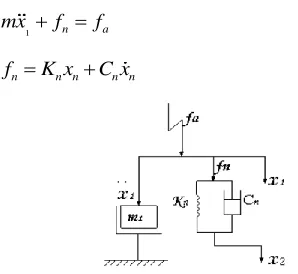
The joint surface kinetics model is shown in Figure 1 and the equation is:
1 n a
mx
f
f
(1)n n n n n
[image:2.516.55.204.184.321.2]f
K x
C x
(2)Figure 1. Dynamic experimental model.
In the equations, fn is normal dynamic force of joint
surface, fa is exciting force, xn is normal dynamic
dis-placement of joint surface, and 1
mx
is inertia force. Kn,Cn are respectively normal dynamic stiffness andnormal damping of joint surface.
The exciting force above is simple harmonic force. The normal dynamic force fn and displacement xn of
joint surface can be expressed by the following equa-tions:
cos
n n
f F t (3)
cos
n n n
x X
t (4)
sin
n n n
x X t (5)
And then put equation (3), (4) and (5) into the equa-tion (2), we can get:
cos cos sin
n n n n n n n
F t K X t C X t
Calculated by trigonometric function, it can be sim-plified:
cos
n n
n F K X (6) sin
n n
n
F C
X
(7)
Among them, Fnis a dynamic force amplitude,
nis phase difference between the normal dynamic force fn and the normal dynamic displacement xn, ω is
exci-tation frequency, and X is the normal dynamic dis-placement amplitude.
From equation (6) and (7) we can get the method of identifying the dynamic stiffness and damping of the bolt’s joint surface based on displacement. Thereinto, the joint surface dynamic force amplitude can be cal-culate by exciting force and inertia force by cosine.
2
2
1 2 1cos 1,
n a a a
F f mx f mx x f (8)
In the formula, cos
x f1, a
is the phase differenceof the acceleration relative to the exciting force.
3 THE METHOD OF IDENTIFYING THE
DAMPING AND STIFFNESS OF THE JOINT SURFACE BASED ON ACCELERATION
In the general harmonic vibration, the relationship between displacement and the corresponding accelera-tion can be expressed as:
2
1
x
x (9)
Put equation (9) into equation (6) and (7) respec-tively, and it can be obtained:
2
cos
n n
n n F K A
(10) sin n n
n n F C A (11)
Wherein, An is acceleration value of the joint
sur-face. Formulas (10) and (11) are the method of identi-fying the dynamic stiffness and damping of the bolt’s joint surface based on displacement. In the experiment, the data that can be measured directly is up and down acceleration values A1, A2, and their phase differences
1,
,
2,
A fa A fa relative to excitation force.
Thereinto, the joint surface dynamic force can be ob-tained by equation (8), and the phase differences
A A1, 2
of acceleration A1 and A2 can be expressed as follow:
A A1, 2
A f2, a
A f1, a
(12)
The acceleration of joint surface An via vector
cal-culation can be expressed as:
2 2
1 2 2 1 2cos 2, 1
n
Due to
n
is a dynamic combination of surface displacement xn relative to dynamic force of the jointsurface fn of phase, can be defined
An,fn
dy-namic acceleration expressed as a combination of surface An relative to the dynamic force of the joint
surface fn phase. Therefore, the relationship can be
expressed as:
0, , 180
n xn fn An fn
(14)
Phase
,
n n A f can be expressed as:
A fn, n
A An, 1
f An, 1
(15)
In equation (15),
A An, 1
is the phase of the joint surface acceleration relative to the acceleration A1, and
f An, 1
is the phase of the joint surface dynamic force relative to the acceleration A1.It can be obtained from the vector relationship among the inertia force, the dynamic force of the joint surface and the exciting force, and among the A1 and An vector and A2:
2
2 1
1
sin ,
sin n,
n
A A A
A A
A
(16)
1
1
sin ,
sin , a
n
n
F A f
f A
F
(17)
Thus, if the acceleration A1, A2 and the phases 1, , 2,
A fa A fa relative to the exciting force can be measured, the dynamic stiffness and damping of the bolt’s joint surface can be identified. That realizes that the dynamic stiffness and damping of the joint surface can be identified just by acceleration sensor.
4 THE EXPERIMENTAL VERIFICATION
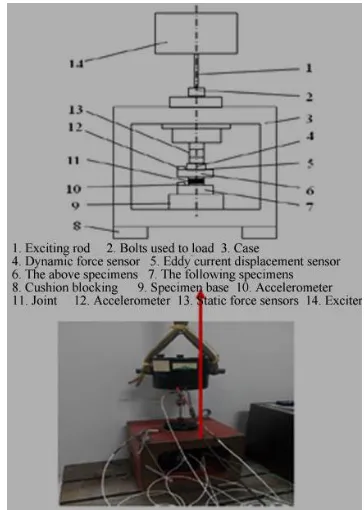
The experimental apparatus is shown in Figure 2, screw the exciting rod 1, exert some static force on the specimen base 9 to maintain the joint surface under a certain surface pressure, and the static state force sen-sor 11 is used to detect the preload. The data acquisi-tion instrument through the software output sinusoidal voltage signals, which act on the test specimen via exciter after increased by the power amplifier and the dynamic force sensor 4 can measure the signals of dynamic force in real time. Due to the function of force, the joint surface vibrates, which makes the Ed-dy current displacement sensor 5 detect the displace-ment signals. As the displacedisplace-ment sensor is fixed on the upper part of the specimen, the tested displacement is the normal vibration displacement of the top test specimen relative to the bottom one which is the rela-tive displacement of normal dynamic force of the joint
[image:3.516.271.453.146.401.2]surface. Then use M+P dynamic analysis software system for constant displacement control, to get the dynamic characteristic parameters of the joint surface under the different vibration amplitude. The accel-erometer 10 detects the acceleration signal of the test specimen. The symmetrical arrangement of displace-ment sensor and accelerometer can guarantee the symmetry of structure and quality.
Figure 2. Experimental apparatus.
[image:3.516.263.462.515.578.2]The collected data are used to calculate respectively the damping value by the identification method based on displacement and acceleration, and the results are shown in Table 1. The maximum error of two methods is 6.55%, which proves it is feasible.
Table 1. The comparison of identification results of the joint surface.
Identification method 29Hz 47Hz 300Hz Calculation of damping value
based on displacement 41570.3 62735.1 9401.4 Calculation of damping value
based on acceleration 44059.4 58625.5 9439.5
Error 5.99% 6.55% 0.4%
5 ANALYSIS OF EXPERIMENTAL RESULTS
5.1 Effect of vibration frequency on the dynamic stiffness and damping of the joint surface
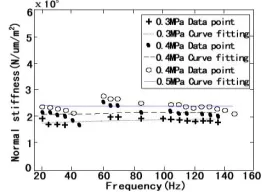
Figure 3 shows the matching materials 45 steel of 45 steel of the joint surface adopt dry contact form at the vibration amplitude of 25nm, to get the normal dy-namic stiffness and vibration frequency of the joint surface under the condition of different normal surface pressure Pn. We can see that, the under that condition, the dynamic stiffness changes little with the increasing vibration frequency.
(a) Pn=0.3Mpa
(b) Pn=0.4Mpa
[image:4.516.297.427.97.443.2](c) Pn=0.5Mpa
Figure 3. Effects of the vibration frequency on the dynamic stiffness of the joint surface.
(2) Effects of the vibration frequency on the damping of the joint surface
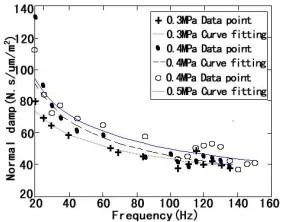
Figure 4 shows the matching materials 45 steel of 45 steel of the joint surface adopt dry contact form at the vibration amplitude of 25nm, to get the normal damping and vibration frequency of the joint surface under the condition of different normal surface pres-sure Pn. We can see that, under that condition, the vibration frequency has great influence on the joint surface damping with strong nonlinearity. The
damp-ing declines quickly at low frequency, while it de-clines slowly or even keeps unchanging at high fre-quency.
(a) Pn=0.3MP
(b) Pn=0.4MP
(c) Pn=0.5MP
Figure 4. Effects of the vibration frequency on the damping of the joint surface.
5.2 Effect of surface pressure on the dynamic stiffness and damping of the joint surface
(1) Effects of the normal pressure on the normal dy-namic stiffness of the joint surface
[image:4.516.82.223.136.524.2] [image:4.516.298.429.531.627.2]Figure 5 shows the matching materials 45 steel of 45 steel of the joint surface adopt dry contact form at the vibration amplitude of 25nm, to get the relation be-tween the normal dynamic stiffness and surface press.
From the image above, it can be concluded that at the vibration amplitude of 25nm, the normal dynamic stiffness is increasing with the increasing of the nor-mal surface pressure, which is consistent with the change law of the static stiffness.
[image:5.516.82.226.188.299.2](2) Effects of the normal pressure on the normal damping of the joint surface
Figure 6. Effects of the normal surface pressure on the damping of the joint surface.
Figure 6 the matching materials 45 steel of 45 steel of the joint surface adopt dry contact form at the vibra-tion amplitude of 25nm, to get the relavibra-tion between the normal damping and surface press.
From the image above, it can be concluded that at low surface pressure and under the condition of low
surface pressure and the vibration amplitude of 25nm, the normal damping is increasing with the increasing of the normal surface pressure. This is because, under the low normal surface pressure, micro-convex be-tween mutual contacts of joint surfaces is smaller and the consumed energy is less. With the increasing of the normal surface pressure, micro-convex is enlarg-ing and the consumed energy is increasenlarg-ing, which makes the normal damping coefficient increase.
REFERENCES
[1] Liu Chunshi, Sun We, Li Xiaopeng & Zhang Yimin. 2009. Research on dynamic characteristics of combined interface based on nonlinearity for NC machine tool.
Manufacturing Technology & Machine Tool, (8): 42-47. [2] Damjan Celic & Miha Boltezer. 2008. Identification of
the dynamic properties of joints using frequency re-sponse functions, Journal of Sound and Vibration, 317: 159-174.
[3] Xiao Yichuan, Wu Liangsheng, Ma Jianfeng & Ma Shuhui. 2014. Method for establishing dynamic model and identifying parameters of plate-like joint interfaces.
Journal of Beijing University of Technology, 40(12): 2. [4] L. Heller, E. Foltete & J. Piranada. 2009. Experimental
identification of nonlinear dynamic properties of built-up structures, Journal of Sound and Vibration, 317: 183-196.
[5] Yang Jiahua, Wu Liangsheng & Guan Hua. 2000. Re-search on identification of interface parameter of two joint’s planes. Journal of Beijing Polytechnic University, 26(3): 20-23.
[6] R.A. Ibrahim & C.L. Pettit. 2005. Uncertainties and dy-namic problems of bolted joints and other fasteners.