2017 3rd International Conference on Electronic Information Technology and Intellectualization (ICEITI 2017) ISBN: 978-1-60595-512-4
Load Shedding Control of Wind Turbine Based
on Model Predictive Control Algorithm
Zhonglei Chen, Tao Jiang, De Tian, Xudong Guo, Haifeng Zhu,
Ying Deng and Guoqiang Zhang
ABSTRACT
With the increasing capacity of wind turbines, the key parts of wind turbine bear the increasing load, and the structural reliability have become increasingly demanding, thus, Requirements of wind turbine control system control algorithm, can not only realize power optimization control, also can achieve down load control. Based on the theory of model prediction, design a nonlinear, variable parameter, wind turbines model predictive controller for transmission chain load slow target, designed the Matlab and GL bladed joint simulation model predictive controller. Case study adopted 2MW doubly-fed wind power unit model parameter, design variable pitch model predictive controller respectively MPC and MMPC composite model predictive controller, and simulation comparison and application of a wide range of PI control, it is shown the results that the model predictive control to reduce the wind turbine speed fluctuation amplitude, leading to smaller gear dynamic torque ripple; With the soft logic composite model predictive control algorithm, action frequency of variable pitch control is decreased.
INTRODUCTION
With the increasing capacity of wind power, increasing the reliability and fatigue life of wind turbine is becoming more and more important. A variety of technologies ________________________
Zhonglei Chen, De Tian, Ying Deng, Guoqiang Zhang, School of Renewable Energy, North China Electric Power University, Beijing, 102206, China.
have been used to improve the operational performance of the unit by technology workers. Traditional PID control has become the mainstream control strategy of wind turbine with the characteristics of high efficiency, operational stability and security. However, due to the fluctuation of the natural wind, the wind turbine has the characteristics of wide wind speed range, large wind turbulence disturbance and nonlinearity. But the traditional PID control strategy can only have good control effect near the working point of the specific linear model. The phenomenon that turbulence wind load impact will cause serious damage to the gear box can’t be solved. Therefore, the load shedding control of wind turbines, such as the slowdown of the load of the gearbox and the reduction of the frequency of the pitch-regulated device, are one of the ways to explore the extension of the life of the wind turbine. T.G van Engelen et al. conducted a study on structural load mitigation [1-6], different control algorithms are used to suppress dynamic loads, such as passive resistance of stop-band filtering, H∞ robust control, and structural damping load shedding of gearbox couplings. But these methods are all passive plus resistance to load shedding. Therefore, it is necessary to study a non-linear, variable parameter intelligent control algorithm for load shedding. Based on the study and research of wind power generation system model predictive control application [9-11], this paper designs a composite wind turbine model predictive controller and compares it with the traditional PI controller by simulation, and verifies the effect of the model predictive controller on reducing the torque ripple of the drive chain. Finally, through the research of Matlab and TUV GL bladed software interface, a joint simulation platform of wind turbine load control is designed, which can effectively implement the model predictive controller simulation, and verify the application of the model prediction algorithm in the load mitigation control of variable speed and variable pitch wind turbine. It provides an effective verification environment for the wind turbine control system composite model predictive control algorithm.
BASIC PRINCIPLES OF MODEL PREDICTIVE CONTROL
Model Predictive Control (MPC) is an advanced control algorithm, which can deal with nonlinear large time delay system. It is a control strategy with limited time domain rolling optimization, which is different from other control algorithms. At present, the model predictive control is mainly used in the field of petrochemical industry, and the good effect is taken, but the actual wind turbine control system has no MPC algorithm application. With the rapid development of wind power industry, the requirements of the control system continue to improve, many experts and scholars believe that, MPC wind turbine control algorithm may be on the wind turbine control technology to bring new opportunities for development.
is calculated in advance, so as to achieve the purpose of suppressing the impact of the load, so it is of great practical engineering significance.
In this paper, 2MW double-fed induction generator (DFIG) wind turbine is used as the control object. The main parameters of the model are the rated speed of 12m/s, the rated output power of 2WM, hub center height of 70.04m, generator rated speed of 1600r/m, gearbox speed ratio of 102.94, the generator rated torque of 11850N.
The MPC controller is designed based on the principle of model control forecasting in literature[8],Wind turbine generator system is consisted of wind turbine rotor, mechanical subsystems, electrical subsystems and variable pitch mechanisms [12]. The wind turbine system model can be represented by the equation (1) as follows:
(1)
Where A, B, C, D are the state of the working point, and the coefficient matrix is: A: [56*56*23double], B: [56*3*23double], C: [1*56*23double], D: [1*3*23double].
The state space structure is the linearized model matrix of the nonlinear model of the wind turbine at 19m/s wind speed point [12], and the definition of 56 state quantities is given in literature. Normally the model is solved by TUV GL-bladed software. There are three input variables: wind speed V, pitch angle β and generator torque Tg demand, the output variable is only the generator speed measurement value ωg. The load of the wind turbine is completely limited by the speed, the load will be limited when speed is stable. In order to do model predictive control, the transfer function (1) is required to be separated as follows:
(2)
Where u (k), x (k), y (k) represent the input vector, state vector and output vector matrix at time k. At the time of k, the output of the system is predicted and the speed
output vector sequence of the system is: ,
where p is the predicted time domain.
The prediction process uses x (k) as the starting point of the state variable, and the starting point of the predicted output is the measured rotational speed output value y (k) at the current time. Controlling the input quantity u (k) in the predicted time domain is also need to consider for predicting the future dynamic output of the system. The control target of the wind turbine model predictive controller is to reduce the difference between the speed output trajectory and the rated speed of the system by changing the control input quantity β after the disturbance occurs above the rated wind speed. For this reason, an optimization function (3) is introduced to
Du Cx y Bu Ax x ) ( ) ( ) ( ) ( ) ( ) 1 ( k Du k Cx k y k Bu k Ax k x
)}
|
(
),...
|
2
(
),
|
1
(
represent the cumulative error between the predicted output and the desired target. The smaller the value of the optimization function, the better the performance of the controller, and the smaller the dynamic load impact.
(3)
Where: p is the predicted time domain, ωn is the weight of the output speed, ωβ is the weight of the pitch angle requirement, ω∆βis the weight of the variation of the
pitch angle requirement; eni is the difference between the output speed and the
speed setpoint at time i; eβiis the deviation of the pitch angle requirement and the target setpoint at time i; ω∆βis the amount of change in the pitch angle requirement at time i.
Usually the wind turbine in the optimization control due to the mechanical and design protection limit and other constraints, the pitch model predictive control above the rated wind speed should meet the constraints:
rpm rpm s s 1800 850 / 8 / 8 90 5
(4)
Therefore, the optimal control problem can be expressed as the minimum value of the penalty function under the condition of control constraint, which is the working principle of the wind turbine model predictive controller [8].
WIND TURBINE COMPOUND MODEL PREDICTIVE CONTROL
MPC Controller Design for Wind Turbine
The MPC controller based on the state space prediction model is shown in Fig. 1 and the traditional pitch PI controller model is shown in Fig. 2. The measurement output of the controller is the difference between the actual generator speed and the rated rotor speed, the control variable is the demand of the pitch angle, the pitch angle demand and wind speed are considered as measurable disturbance. After parameter adjustment and optimization, the output of the pitch MPC controller is obtained:
k p
k i
i i
ni
ne e
Figure 1. Component of MPC controller of the pitch.
Figure 2. PI Controller structure diagram.
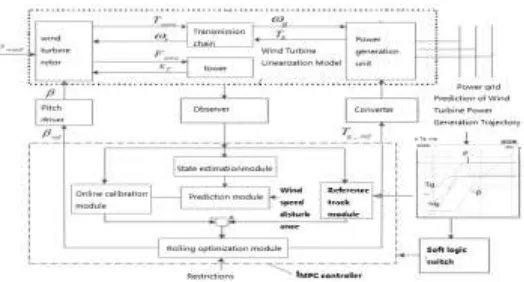
[image:5.612.174.436.334.475.2]Based on the research of model predictive control principle, the traditional pitch PI controller (fig.4) and pitch MPC controller are built by Simulink using Matlab model forecast toolbox. Then the MMPC composite model predictive controller is set up and embedded into the TUV GL-bladed software based on the non-linear model of the wind turbine. The control simulation of the whole operating condition of the wind turbine with variable speed and pitch is carried out. Composite model predictive control system structure is shown in Figure 3.
Figure 3. Structure diagram of MMPC model predict control system of wind turbine.
Design of Joint Simulation Platform.
external controller interface file DLL program and the intermediate interactive platform program do not involve the control algorithm. Each call executes only the read-in and read-out operation of the data. Data transmission process as shown in Fig.4:
Figure 4. Combined real-time simulation platform.
The co-simulation platform can visually display the simulation process, and easy to find the controller defects. The simulation results are stored in Bladed and can be analyzed at the end of the simulation. The co-simulation platform program has the advantage of being able to quickly perform controller modification and parameter adjustment.
CASE SIMULATION AND ANALYSIS OF RESULTS
Simulink Simulation Results
Simulink Simulation Results
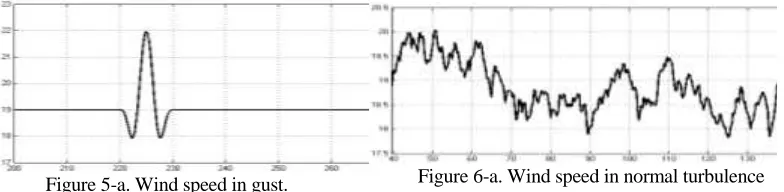
Using the wind turbine model predictive control system shown in Fig.3. Due to the limitation of space, only the MPC controller and the PI controller at the operating point of the rated power-constant speed zone of 19m/s ±9% of the constant speed range are given to carry out Simulink simulation. In order to get the simulation results under different wind speed changes, two wind speed conditions are chosen here: (1) 19m/s-20m/s step wind speed (2) average wind speed of 19m / s turbulence wind speed. The simulation uses the same wind turbine linearization model and the same sampling time, and records the output value of the generator speed and pitch angle in the simulation process. In the figure, the dotted line is the PI Figure 5-a. Wind speed in gust. Figure 6-a. Wind speed in normal turbulence
[image:7.612.112.504.93.189.2]is 19m/s.
Figure 5-b. The output of generator speed in gust.
Figure 6-b. Change of generator speed in turbulent wind.
Figure 5-c. The output of pitch angle in gust
Fig6-c. Change of pitch angle in turbulent wind
Figure 5. Output of generator speed and pitch angle in step response of wind.
[image:7.612.113.503.223.320.2]controller emulation output, and the solid line is the MPC controller simulation output. The simulation results are as shown in Fig 5 and Fig 6:
Simulation Results Analysis:
SIMULATION RESULTS OF STEP WIND SPEED
The three graphs in Figure 6 record the simulation results of the wind speed, measured generator speed and pitch angle.at step wind disturbance. It can be seen from the figure, when the step wind speed occurs, the generator speed fluctuations, and the pitch angle is changed accordingly to control the speed. The maximum rotor speed fluctuation of PI control is significantly higher than the MPC control speed and shock obvious. The speed MPC controlled achieves stability within 10s, and PI controller stability time is longer, PI controller generator speed changes drastically increase the drive chain fatigue load. The control of the pitch controller for the pitch controller is oscillatory, and the pitch angle under the MPC controller is a step change and quickly gives an exact set point, but the frequency of the pitch angle change increases.
SIMULATION RESULTS OF TURBULENT WIND SPEED
The three graphs in Figure 7 record the simulation results of the wind speed, measured generator speed and pitch angle.at turbulent wind disturbance. Turbulence wind fluctuation range is about 17.58m/s-20m/s. The generator speed has a large fluctuation, the generator speed under the control of PI controller has a high amplitude and high vibration frequency, but MPC controller can control the wave in a very small range, reducing the fatigue load of the drive chain. The vibration amplitude of pitch angle demand under PI controller is slightly larger than the MPC, larger pitch energy is needed, increasing the probability of the pitch operator failure.
Composite Model Predictive Control Simulation Results Based On Joint Simulation Platform
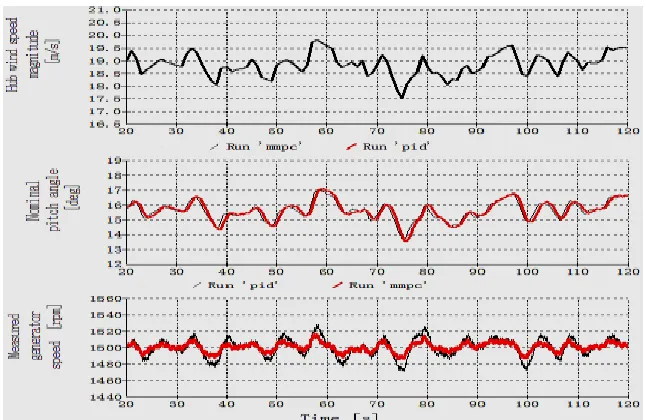
In order to obtain the nonlinear control effect of the composite MMPC controller, this paper adopts the 2MW wind turbine model in the Bladed software as the nonlinear model of the wind turbine, and uses the joint simulation platform to establish the engine connection, and the control response result is shown in Fig 7.
Figure 7. Output of generator speed and pitch angle in MMPC model predictive control.
CONCLUSIONS
This paper discusses the application of the model predictive control theory in the nonlinear system of the wind turbine control. The simulation proves the feasibility of the implementation of the predictive control algorithm of the MMPC model, and provides a new technical method for the intelligent control of the large wind turbine. The main conclusions are as follows:
(1) The model predictive control method is a kind of control algorithm commonly used in the automation field. It is usually considered that the calculation is complicated, the response is slow. The MPC and PI controller results are simulated by Simulink toolbox, but the results show that the MPC algorithm has better effect than the PI control algorithm. Compared with the speed response of Figure 6-b and Figure 5-b, there is a tendency for the overshoot to decrease.
(3) Of course, the actual model of the wind turbine is difficult to predict, this case uses GL-bladed software to access, and follow-up must be added to the intelligent learning to predict the actual application. This is the deficiency of the paper, and further improvement is needed in the future.
REFERENCES
1. T.G van Engelen: Design Model and Load Reduction Assessment for Multi-rotational Mode Individual Pitch Control (Higher Harmonics Control). Proceedings of the European Wind Energy Conference, Athens, Greece, 2006.
2. Van Engelen, T. G., Bongers, P. M. M., Pierik, J. T. G., & van Baars: G. E. Integral control for damping of mechanical resonance and protection against grid failures: Results in a full load operating condition. In Proceedings of the European community wind energy conference, Lubeck-Travemunde, Germany, 1993.
3. Ying Deng, Shiming Yu, Xiangming Wang, LeiSun, JingjingLiang: Researches of a controller for reducing load of driving chain in wind turbine based on H∞ control [C]. Proceedings of the IEEE International Conference on Automation and Logistics, August 2007, pp.287-292.
4. Ying Deng, Dan Zhang, Feng Zhou, De Tian: Individual Pitch Control for Load Reduction Based on Norm Theory. [J]. Advanced Mechanics and Materials Research, 2014, 448-453pp 1879-1883.
5. Ying Deng, Jingjing Liang, Xiangming Wang, Lei Sun: Study on Reducing the Driver Chain Load of Wind Turbine Generator [J] .Journal of Solar Energy, Vol.30, No. 10, 1240-1243, 2009. 6. Weihui Hu, Sheng LIN, Zhongzheng Qin, Yaxin Zhang: Structural features and applications of high-power wind turbine gearbox vibration support. [J] Mechanical 2010 4 Total Volume 36, P74-77.
7. Guoqiang Zhang: Wind turbine model predictive control research and joint simulation platform design [D]. North China Electric Power University, 2015.
8. Song Y D, Li P, Liu W, et al: An overview of renewable wind energy conversion system modeling and control[J]. Measurement and Control, 2010, 43(7): 203-208.
9. Bianchi F D, De Battista H, Mantz R J: Wind turbine control systems: principles, modelling and gain scheduling design[M]. Springer, 2006.
10. Van Baars G E, Bongers P M M: Wind turbine control design and implementation based on experimental models[C]. Decision and Control, Proceedings of the 31st IEEE Conference on IEEE, 1992: 2454-2459.