Semantic Parsing with Relaxed Hybrid Trees
Wei Lu
Information Systems Technology and Design Singapore University of Technology and Design
Abstract
We propose a novel model for parsing natural language sentences into their for-mal semantic representations. The model is able to perform integrated lexicon ac-quisition and semantic parsing, mapping each atomic element in a complete seman-tic representation to a contiguous word sequence in the input sentence in a re-cursive manner, where certain overlap-pings amongst such word sequences are allowed. It defines distributions over the novelrelaxed hybrid treestructures which jointly represent both sentences and se-mantics. Such structures allow tractable dynamic programming algorithms to be developed for efficient learning and decod-ing. Trained under a discriminative set-ting, our model is able to incorporate a rich set of features where certain unbounded long-distance dependencies can be cap-tured in a principled manner. We demon-strate through experiments that by exploit-ing a large collection of simple features, our model is shown to be competitive to previous works and achieves state-of-the-art performance on standard benchmark data across four different languages. The system and code can be downloaded from
http://statnlp.org/research/sp/.
1 Introduction
Semantic parsing, the task of transforming natu-ral language sentences into formal representations of their underlying semantics, is one of the clas-sic goals for natural language processing and ar-tificial intelligence. This area of research recently has received a significant amount of attention. Var-ious models have been proposed over the past few years (Zettlemoyer and Collins, 2005; Kate and
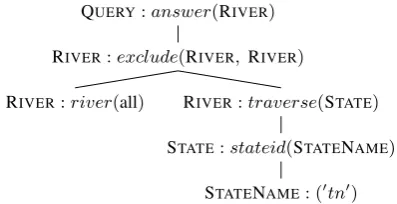
QUERY:answer(RIVER)
RIVER:exclude(RIVER, RIVER)
RIVER:traverse(STATE)
STATE:stateid(STATENAME)
STATENAME: (0tn0) RIVER:river(all)
[image:1.595.317.516.204.306.2]What rivers do not run through Tennessee ?
Figure 1: An example tree-structured semantic representation (above) and its corresponding nat-ural language sentence.
Mooney, 2006; Wong and Mooney, 2006; Lu et al., 2008; Jones et al., 2012).
Following previous research efforts, we perform semantic parsing under a setting where the seman-tics for complete sentences are provided as train-ing data, but detailed word-level semantic infor-mation is not explicitly given during the training phase. As one example, consider the following natural language sentence paired with its corre-sponding semantic representation:
What rivers do not run through Tennessee ?
answer(exclude(river(all), traverse(stateid(0tn0)))) The training data consists of a set of sentences paired with semantic representations. Our goal is to learn from such pairs a model, which can be effectively used for parsing novel sentences into their semantic representations.
Certain assumptions about the semantics are typically made. One common assumption is that the semantics can be represented as certain re-cursive structures such as trees, which consist of atomic semantic units as tree nodes. For exam-ple, the above semantics can be converted into an equivalent tree structure as illustrated in Figure 1. We will provide more details about such tree struc-tured semantic representations in Section 2.1.
Currently, most state-of-the-art approaches that deal with such tree structured semantic represen-tations either cast the semantic parsing problem as a statistical string-to-string transformation prob-lem (Wong and Mooney, 2006), which ignores the potentially useful structural information of the tree, or employ latent-variable models to cap-ture the correspondences between words and tree nodes using a generative approach (Lu et al., 2008; Jones et al., 2012). While generative models can be used to flexibly model the correspondences be-tween individual words and semantic nodes of the tree, such an approach is limited to modeling local dependencies and is unable to flexibly incorporate a large set of potentially useful features.
In this work, we propose a novel model for parsing natural language into tree structured se-mantic representations. Specifically, we propose a novel relaxed hybrid tree representation which jointly encodes both natural language sentences and semantics; such representations can be effec-tively learned with a latent-variable discriminative model where long-distance dependencies can be captured. We present dynamic programming al-gorithms for efficient learning and decoding. With a large collection of simple features, our model reports state-of-the-art results on benchmark data annotated with four different languages.
Furthermore, although we focus our discussions on semantic parsing in this work, our proposed model is a general. Essentially our model is a dis-criminative string-to-tree model which recursively maps overlapping contiguous word sequences to tree nodes at different levels, where efficient dy-namic programming algorithms can be used. Such a model may find applications in other areas of natural language processing, such as statistical machine translation and information extraction.
2 Background
2.1 Semantics
Various semantic formalisms have been consid-ered for semantic parsing. Examples include the tree-structured semantic representations (Wong and Mooney, 2006), the lambda calculus expres-sions (Zettlemoyer and Collins, 2005; Wong and Mooney, 2007), and dependency-based compo-sitional semantic representations (Liang et al., 2013). In this work, we specifically focus on the tree-structured representations for semantics.
Each semantic representation consists of
se-mantic units as its tree nodes, where each sese-mantic unit is of the following form:
ma≡τa:pα(τb∗) (1)
Here ma is used to denote a complete seman-tic unit, which consists of its semanseman-tic typeτa, its function symbolpα, as well as an argument listτb∗ (we assume there are at most two arguments for each semantic unit). In other words, each seman-tic unit can be regarded as a function which takes in other semantics of specific types as arguments, and returns new semantics of a particular type. For example, in Figure 1, the semantic unit at the root has a type QUERY, a function nameanswer, and a single argument type RIVER.
2.2 Joint Representations
Semantic parsing models transform sentences into their corresponding semantics. It is therefore es-sential to make proper assumptions about joint representations for language and semantics that capture how individual words and atomic seman-tic units connect to each other. Typically, differ-ent existing models employ differdiffer-ent assumptions for establishing such connections, leading to very different definitions of joint representations. We survey in this section various representations pro-posed by previous works.
The WASPsemantic parser (Wong and Mooney, 2006) essentially casts the semantic parsing prob-lem as a string-to-string transformation probprob-lem by employing a statistical phrase-based machine translation approach with synchronous gram-mars (Chiang, 2007). Therefore, one can think of the joint representation for both language and se-mantics as a synchronous derivation tree consist-ing of those derivation steps for transformconsist-ing sen-tences into target semantic representation strings. While this joint representation is flexible, allow-ing blocks of semantic structures to map to word sequences, it does not fully exploit the structural information (tree) as conveyed by the semantics.
imme-diately associated with a particular semantic unit, from words which are remotely associated.
The SCISSOR model (Ge and Mooney, 2005) performs integrated semantic and syntactic pars-ing. The model parses natural language sentences into semantically augmented parse trees whose nodes consist of both semantic and syntactic labels and then builds semantic representations based on such augmented trees. Such a joint representation conveys more information, but requires language-specific syntactic analysis.
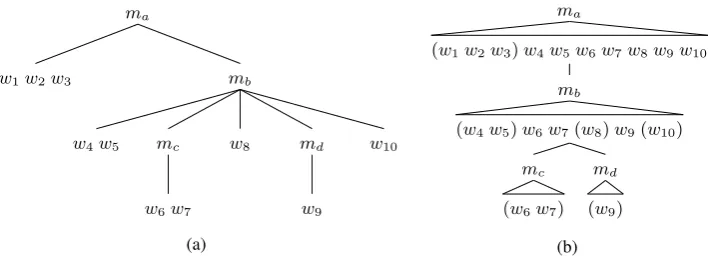
Thehybrid treemodel (Lu et al., 2008) is based on the assumption that there exists an underlying generative process which jointly produces both the sentence and the semantic tree in a top-down re-cursive manner. The generative process results in a hybrid tree structure which consists of words as leaves and semantic units as nodes. An example hybrid tree structure is shown in Figure 2 (a). Such a representation allows each semantic unit to map to a possibly discontiguous sequence of words. The model was shown to be effective empirically, but it implicitly assumes that both the sentence and semantics exhibit certain degree of structural sim-ilarity that allows the hybrid tree structures to be constructed.
UBL (Kwiatkowski et al., 2010) is a semantic parser based on restricted higher-order unification with CCG (Steedman, 1996). The model can be used to handle both tree structured semantic rep-resentations and lambda calculus expressions, and assumes there exist CCG derivations as joint rep-resentations in which each semantic unit is associ-ated with a contiguous word sequence where over-lappings amongst word sequences are not allowed. Jones et al. (2012) recently proposed a frame-work that performs semantic parsing with tree transducers. The model learns representations that are similar to the hybrid tree structures using a generative process under a Bayesian setting. Thus, their representations also potentially present simi-lar issues as the ones mentioned above.
Besides these supervised approaches, recently there are also several works that take alternative learning approaches to (mostly task-dependent) semantic parsing. Poon and Domingos (2009) pro-posed a model for unsupervised semantic pars-ing that transforms dependency trees into seman-tic representations using Markov logic (Richard-son and Domingos, 2006). Clarke et al. (2010) proposed a model that learns a semantic parser
Symbol Description
n A complete natural language sentence m A complete semantic representation
h A complete latent joint representation (or, a relaxed hybrid treefor our work)
H(n,m) A complete set of latent joint representations that contain the(n,m)pair exactly n,na A contiguous sequence of words
w,wk A natural language word
m, ma A semantic unit
h,ha A node in the relaxed hybrid tree
Φ The feature vector φk Thek-th feature
[image:3.595.308.525.60.213.2]Λ The weight vector (model parameters) λk The weight for thek-th featureφk
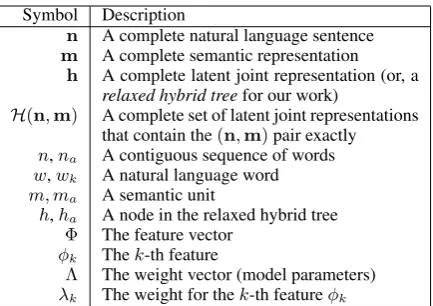
Table 1: Notation Table
for answering questions without relying on seman-tic annotations. Goldwasser et al. (2011) took an unsupervised approach for semantic parsing based on self-training driven by confidence esti-mation. Liang et al. (2013) proposed a model for learning the dependency-based compositional se-mantics (DCS) which can be used for optimiz-ing the end-task performance. Artzi and Zettle-moyer (2013) proposed a model for mapping in-structions to actions with weak supervision. 3 Approach
We discuss our approach to semantic parsing in this section. The notation that we use in this paper is summarized in Table 1.
3.1 Model
In standard supervised syntactic parsing, one typi-cally has access to a complete syntactic parse tree for each sentence in the training phase, which ex-actly tells the correct associations between words and syntactic labels. In our problem, however, each sentence is only paired with a complete se-mantic representation where the correct associa-tions between words and semantic units are un-available. We thus need to model such information with latent variables.
For a given n-m pair (where n is a complete natural language sentence, and m is a complete semantic representation), we assume there exists a latent joint representationhthat consists of bothn
andmwhich tells the correct associations between words and semantic units in such a pair. We use
H(n,m)1 to denote the set of all such possible
ma
mb
w10
md
w9
w8
mc
w6w7
w4w5
w1w2w3
(a)
ma
(w1w2w3)w4w5w6w7w8w9w10
mb
(w4w5)w6w7(w8)w9(w10)
md
(w9)
mc
(w6w7)
[image:4.595.123.478.63.192.2](b)
Figure 2: Two different ways of jointly representing sentences and their semantics. The hybrid tree representation of Lu et al. (2008) (left), and our novel relaxed hybrid tree representation (right). In our representation, a wordwcan be eitherimmediatelyassociated with its parentm(the words which appear inside the parenthesis), orremotelyassociated withm (the words that do not appear inside the parenthesis, and will also appear under a subtree rooted by one ofm’s children).
latent joint representations that contain bothnand
mexactly.
Given the joint representations, to model how the data is generated, one can either take a gener-ative approach which models the joint probability distribution over(n,m,h)tuples, or a discrimina-tive approach which models the distribution over
(m,h)tuples given the observationn. Following several previous research efforts (Zettlemoyer and Collins, 2005; Kwiatkowski et al., 2010; Liang et al., 2013), in this work we define a discriminative model using a log-linear approach:
P(m,h|n; Λ) = P eΛ·Φ(n,m,h)
m0,h0∈H(n,m0)eΛ·Φ(n,m0,h0) (2)
HereΦ(n,m,h) is a function defined over the tuple(n,m,h)that returns a vector consisting of counts of features associated with the tuple, andΛ
is a vector consisting of feature weights, which are the parameters of the model.
In practice, we are only given then-mpairs but the latent structures are not observed. We there-fore consider the following marginal probability:
P(m|n; Λ) = X
h∈H(n,m)
P(m,h|n; Λ)
=
P
h∈H(n,m)eΛ·Φ(n,m,h)
P
m0,h0∈H(n,m0)eΛ·Φ(n,m0,h0) (3)
The above probability is defined for a particular
n-mpair. The complete log-likelihood objective
for the training set is:
L(Λ) =X
i
logP(mi|ni; Λ)−κ||Λ||2
=X
i
log X
h∈H(ni,mi)
P(mi,h|ni; Λ)−κ||Λ||2 (4)
where (ni,mi) refers to the i-th instance in the training set. Note that here we introduce the ad-ditional regularization term−κ· ||Λ||2 to control
over-fitting, whereκis a positive scalar.
Our goal is to maximize this objective function by tuning the model parametersΛ. Let’s assume
Λ =hλ1, λ2, . . . , λNi, whereN is the total num-ber of features (or the total numnum-ber of parameters). Differentiating with respect toλk, the weight as-sociated with thek-th featureφk, yields:
∂L(Λ)
∂λk = X
i X
h
EP(h|ni,mi;Λ)[φk(ni,mi,h)]
−X
i X
m,h
EP(m,h|ni;Λ)[φk(ni,m,h)]−2κλk (5)
whereφk(n,m,h)refers to the number of occur-rences for thek-th feature in the tuple(n,m,h).
Given the objective value (4) and gradients (5), standard methods such as stochastic gradient de-scent or L-BFGS (Liu and Nocedal, 1989) can be employed to optimize the objective function. We will discuss the computation of the objective func-tion and gradients next.
3.2 Relaxed Hybrid Trees
. . .
NUM:count(STATE)
STATE:state(STATE)
states STATE:next to(CITY)
bordershow many . . .
(a)
. . .
NUM:count(STATE) . . . bordershow manystates (. . . )
STATE:state(STATE)
. . .borders how many (states) STATE:next to(CITY)
. . .(borders how many) . . .
[image:5.595.170.430.65.231.2](b)
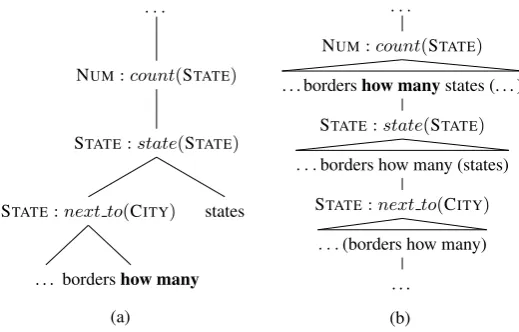
Figure 3: An example hybrid tree and an examplerelaxed hybrid treerepresentation. When the correct latent structure can not be found, the dependency between the words “how many” and the semantic unit “NUM :count(STATE)” can not be captured if the hybrid tree is used, whereas with our relaxed hybrid tree representation, such a dependency can still be captured.
certain restrictions on the latent structures (h) will need to be imposed. We define in this section the set of all valid latent structures H(n,m) for the
(n,m) pair so that some efficient dynamic pro-gramming algorithms can be deployed.
We introduce our novelrelaxed hybrid tree rep-resentations which jointly encode both natural lan-guage sentences and the tree-structured semantics. Arelaxed hybrid treeh defined over(n,m) is a tree whose nodes are(n, m)pairs, where eachnis a contiguous sequence of words fromn, and each
m is a semantic unit (a tree node) from m. For any two nodesha ≡(na, ma)andhb ≡(nb, mb) that appear in the relaxed hybrid treeh, ifhais the parent ofhb inh, thenmamust also be the parent ofmb inm, andnamust contain nb. If the low-est common anclow-estor ofha andhb inhis neither
ha norhb, then naandnb do not share any com-mon word. Note that words that appear at different positions innare regarded as different words, re-gardless of their string forms.
Figure 2 (b) shows an example relaxed hybrid treestructure that we consider. Assume we would like to jointly represent both the natural language sentencen≡w1w2. . . w10and its corresponding
semantic representationm ≡ ma(mb(mc, md)). In the given example, the semantic unitmamaps to the complete sentence,mbmaps to the sequence
w4w5. . . w10,mcmaps tow6w7, andmdmaps to
w9. Certain words such as w4 and w10 that
ap-pear directly below the semantic unit mb but do not map to any of mb’s child semantic units are highlighted with parentheses “()”, indicating they
areimmediately associatedwithmb. These words play unique roles in the sub-tree rooted bymband are expected to be semantically closely related to
mb. Note that each word is immediately associ-ated withexactly onesemantic unit.
Wong and Mooney, 2007).
To better illustrate the differences, we show a concrete example in Figure 3, where the correct latent structure showing the correspondences be-tween words and semantic units can not be found with the hybrid tree model. As a result, the hy-brid tree model will fail to capture the correct de-pendency between the words “how many” and the semantic unit “NUM : count(STATE)”. On the other hand, with our relaxed hybrid tree represen-tation, such a dependency can still be captured, since these words will still be (remotely) associ-ated with the semantic unit.
Such a relaxed hybrid tree representation, when further constrained with the word association pat-terns that we will introduce next, allows both the objective function (4) and the gradients of (5) to be computed through the dynamic programming algorithms to be presented in Section 4.
3.3 Word Association Patterns
As we have mentioned above, in the relaxed hy-brid tree structures, each word wunder a certain semantic unitm can either appear directly below
m only (immediately associated withm), or can also appear in a subtree rooted by one ofm’s child semantic unit (remotely associated withm).
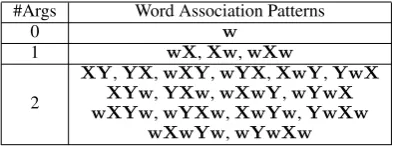
We allow several different ways for word asso-ciations and define the allowable patterns for se-mantic units with different number of arguments in Table 2. Such patterns are defined so that our model is amendable to dynamic programming al-gorithms to be discussed in Sec 4. In this table,
wrefers to a contiguous sequence of natural lan-guage words that are immediately associated with the current semantic unit, while X and Y refers to a sequence of natural language words that the first and second child semantic unit will map to, respectively.
For example, in Figure 2 (b), the word sequence directly below the semantic unit ma follows the patternwX(since the word sequencew1w2w3 is
immediately associated withma, and the remain-ing words are remotely associated withma), and the word sequence belowmbfollowswXwYw2. The word association patterns are similar to those hybrid patterns used in hybrid trees. One key difference is that we disallow the unary
pat-2This is based on the assumption thatm
candmdare the
first and second child ofmbin the semantic representation,
respectively. Ifmdis the first child in the semantic
represen-tation andmcis the second, the pattern should bewYwXw.
#Args Word Association Patterns
0 w
1 wX,Xw,wXw
2
XY,YX,wXY,wYX,XwY,YwX XYw,YXw,wXwY,wYwX wXYw,wYXw,XwYw,YwXw
[image:6.595.318.517.62.135.2]wXwYw,wYwXw
Table 2: The complete list of word association pat-terns. Here #Args means the number of arguments for a semantic unit.
ternX. The reason is, when computing the parti-tion funcparti-tion in Equaparti-tion 3, inclusion of patternX
will result in relaxed hybrid trees consisting of an infinite number of nodes. However, this issue does not come up in the originalhybrid treemodels due to their generative setting, where the training pro-cess does not involve such a partition function.
3.4 Features
The features are defined over the(n,m,h)tuples. In practice, we define features at each level of the relaxed hybrid tree structure h. In other words, features are defined over(n, m)tuples wherenis a contiguous sequence of natural language words (immediately or remotely) associated with the se-mantic unit m(recall that hcontains both n and
m, and each level ofhsimply consists of a seman-tic unit and a contiguous sequence of words). Each feature over (n, m) is then further decomposed as a product between two indicator feature func-tions, defined over the natural language words (n) and semantic unit (m) respectively: φ(n, m) =
φi(n) ×φo(m). For each φi(n) we define two types of features: thelocal features, which are de-fined over immediately associated words only, and thespan features, which are defined over all (im-mediately or remotely) associated words to cap-ture long range dependencies.
The local features include word unigrams and bigrams, the word association patterns, as well as character-level features3 which perform implicit
as to make a fair comparison with previous works which also did not make use of external resources. For the features defined onm(i.e.,φo(m)), we in-clude only the string form of m, as well as m’s function name as features.
Finally, we also define features over m only. Such features are defined over semantic unit pairs such as(ma, mb)wheremais the parent node of
mbas inm. They include: 1) concatenation of the string forms ofmaandmb, 2) concatenation of the string form ofma andmb’s type, and 3) concate-nation of the function names ofmaandmb.
4 Algorithms
In this section we describe the efficient algorithms used for learning and decoding. The algorithms are inspired by the inside-outside style algorithms used for the generative hybrid tree models (Lu et al., 2008), but are different in the following ways: 1) we need to handle features, including long-distance features, 2) we need to additionally handle the computation of the partition function of Equation (3).
4.1 Learning
The training process involves the computation of the objective function (4) as well as the gradient terms (5).
The objective function (4) (excluding the regu-larization term which can be trivially computed) is equivalent to the following:
L(Λ) =X
i
log X
h∈H(ni,mi)
eΛ·Φ(ni,mi,h)
−X
i
log X
m0,h0∈H(ni,m0)
eΛ·Φ(ni,m0,h0) (6)
In the first term, Ph∈H(ni,mi)eΛ·Φ(ni,mi,h) is
in fact the sum of the scores (as defined byΦand
Λ) associated with all such latent structures that contain bothmi andniexactly. The second term is the sum of the scores associated with all the la-tent structures that contain ni exactly. We focus our discussions on the computation of the first part first.
We use
m(p)
wi. . . wjto denote the combined score of all such latent relaxed hybrid tree structures that contain both the semantic tree rooted bymand the natural language word sequence wi . . . wj that forms the word association patternpwith respect
tom. For example, the score of the relaxed hybrid
tree in Figure 2 (b) is contained by ma(wX)
w1. . . w10
(here p = wX because only w1w2w3 are
imme-diately associated withma).
We give an illustrative example that shows how these scores can be computed efficiently using dy-namic programming. Consider the following case whenmhas at least one child semantic unit:
m(wXw) wi. . . wj =
m(w)
wi ⊗
m(wXw) wi+1. . . wj
+ m(w)
wi ⊗
m(Xw)
wi+1. . . wj
Here the symbol⊗meansextract and compute, a process that involves 1) extraction of additional features when the two structures on the right-hand side are put together (for example, the local bi-gram feature “wiwi+1” can be extracted in the
above case), and 2) computation of the score for the new structure when the two structures from both sides of⊗are combined, based on the scores of these structures and newly extracted features.
The above equation holds because for any re-laxed hybrid tree contained by the left-hand side, the left-most word wi is always immediately
as-sociated withm. The term
m(wXw)
wi+1. . . wjis present-ing a similar but smaller structure to the term on
the left-hand side. The other term
m(wX)
wi. . . wj can also be computed based on similar equations. In other words, such terms can be computed from even smaller similar terms in a recursive manner. A bottom-up dynamic programming algorithm is used for computing such terms.
When the semantic unitmhas two child nodes, similar equations can also be established. Here we give an illustrative example:
m(wXwYw)
wi. . . wj = Pj−1
k=i
m(wX)
wi. . . wk⊗
m(wYw) wk+1. . . wj Finally, we have the following equation:
m wi. . . wj =
P p
m(p)
wi. . . wj
The left-hand side simply means the combined score for all such relaxed hybrid trees that have
can move up to process such pairs that involvem’s parent node.
The above process essentially computes the in-side score associated with the(n, m) pair, which gives the sum of the scores of all such (incomplete) relaxed hybrid trees that can be constructed with
(n, m)as the root. Similar to (Lu et al., 2008), we can also define and compute theoutsidescores for
(n, m)(the combined score of such incomplete re-laxed hybrid trees that contain(n, m)as one of its leave nodes) in an analogous manner, where the computation of the gradient functions can be effi-ciently integrated in this process.
Computation of the second part of the objective function (6) involves dynamic programming over a packed forest representation rather than a single tree, which requires an extension to the algorithm described in (Lu et al., 2008). The resulting al-gorithm is similar to the one used in (Lu and Ng, 2011), which has been used for language gener-ation from packed forest representgener-ations of typed
λ-calculus expressions.
4.2 Decoding
The decoding phase involves finding the optimal semantic treem∗given a new input sentencen:
m∗= arg max
m P(m|n) (7)
This in fact is equivalent to finding the follow-ing optimal semantic treem∗:
m∗ = arg max
m
X
h∈H(n,m)
eΛ·Φ(n,m,h) (8)
Unfortunately, the summation operation inside the arg maxprevents us from employing a simi-lar version of the dynamic programming algorithm we developed for learning in Section 4.1. To over-come this difficulty, we instead find the optimal semantic tree using the following equation:
m∗= arg max
m,h∈H(n,m)e
Λ·Φ(n,m,h) (9)
We essentially replace the Poperation by the
maxoperation inside thearg max. In other words, we first find the best latent relaxed hybrid treeh∗ that contains the input sentencen, and next we ex-tract the optimal semantic treem∗fromh∗.
This decoding algorithm is similar to the dy-namic programming algorithm used for comput-ing the inside score for a given natural language
sentence n (i.e., the algorithm for computing the second term of Equation (6)). The difference here is, at each intermediate step, instead of computing the combined score for all possible relaxed hybrid tree structures (i.e., performingsum), we find the single-best relaxed hybrid tree structure (i.e., per-formingmax).
5 Experiments
We present evaluations on the standard GeoQuery dataset which is publicly available. This dataset has been used for evaluations in various seman-tic parsing works (Wong and Mooney, 2006; Kate and Mooney, 2006; Lu et al., 2008; Jones et al., 2012). It consists of 880 natural language sen-tences paired with their corresponding formal se-mantic representations. Each sese-mantic represen-tation is a tree structured represenrepresen-tation derived from a Prolog query that can be used to interact with a database of U.S. geography facts for retriev-ing answers. The original dataset was fully anno-tated in English, and recently Jones et al. (2012) released a new version of this dataset with three additional language annotations (German, Greek and Thai). For all the experiments, we used the identical experimental setup as described in Jones et al. (2012). Specifically, we trained on 600 in-stances, and evaluated on the remaining 280.
We note that there exist two different versions of the GeoQuery dataset annotated with completely different semantic representations. Besides the version that we use in this work, which is an-notated with tree structured semantic representa-tions, the other version is annotated with lambda calculus expressions (Zettlemoyer and Collins, 2005). Results obtained from these two versions are not comparable.4 Like many previous works,
we focus on tree structured semantic representa-tions for evaluarepresenta-tions in this work since our model is designed for handling the class of semantic rep-resentations with recursive tree structures.
System Acc.EnglishF1 Acc.ThaiF1 Acc.GermanF1 Acc.GreekF1 WASP 71.1 77.7 71.4 75.0 65.7 74.9 70.7 78.6 HYBRIDTREE+ 76.8 81.0 73.6 76.7 62.1 68.5 69.3 74.6 UBL-S 82.1 82.1 66.4 66.4 75.0 75.0 73.6 73.7 TREETRANS 79.3 79.3 78.2 78.2 74.6 74.6 75.4 75.4
[image:9.595.127.474.63.157.2]RHT(all features) 83.6 83.6 79.3 79.3 74.3 74.3 78.2 78.2
Table 3: Performance on the benchmark data, using four different languages as inputs. RHT: relaxed hybrid tree (this work).
same answers as the gold standard (Jones et al., 2012). We report accuracy scores – the percentage of inputs with correct answers, and F1 measures – the harmonic mean of precision (the proportion of correct answers out of inputs with an answer) and recall (the proportion of correct answers out of all inputs). By adopting such an evaluation method we will be able to directly compare our model’s performance against those of the previous works.
The evaluations were conducted under such a setting in order to make comparisons to previous works. We would like to stress that our model is designed for general-purpose semantic parsing that is not only natural language-independent, but also task-independent. We thus distinguish our work from several previous works in the literature which focused on semantic parsing under other as-sumptions. Specifically, for example, works such as (Liang et al., 2013; Poon and Domingos, 2009; Clarke et al., 2010) essentially performed seman-tic parsing under different settings where the goal was to optimize the performance of certain down-stream NLP tasks such as answering questions, and different semantic formalisms and language-specific features were usually involved.
For all our experiments, we used the L-BFGS algorithm for learning the feature weights, where feature weights were all initialized to zeros and the regularization hyper-parameter κwas set to 0.01. We set the maximum number of L-BFGS steps to 100. When all the features are considered, our model creates over 2 million features for each lan-guage on the dataset (English: 2.1M, Thai: 2.3M, German: 2.7M, Greek: 2.6M). Our model re-quires (on average) a per-instance learning time of 0.428 seconds and a per-instance decoding time of 0.235 seconds, on an Intel machine with a 2.2 GHz CPU. Our implementation is in Java. Here the per-instance learning time refers to the time spent on computing the instance-level log-likelihood as
well as the expected feature counts (needed for the gradients).
Table 3 shows the evaluation results of our sys-tem as well as those of several other comparable previous works which share the same experimen-tal setup as ours. UBL-Sis the system presented in Kwiatkowski et al. (2010) which performs se-mantic parsing with the CCG based on mapping between graphs, and is the only non-tree based top-performing system. Their system, similar to ours, also uses a discriminative log-linear model where two types of features are defined. WASPis a model based on statistical phrase-based machine translation as we have described earlier. The hy-brid tree model (HYBRIDTREE+) performs learn-ing uslearn-ing a generative process which is augmented with an additional discriminative-reranking stage, where certain global features are incorporated (Lu et al., 2008). The Bayesian tree transducer model (TREETRANS) learns under a Bayesian genera-tive framework, using hyper-parameters manually tuned on the German training data.
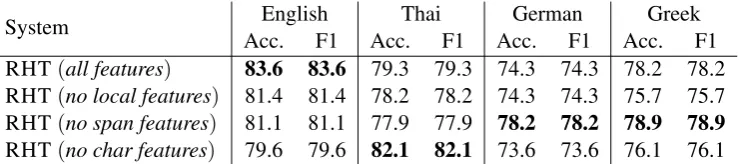
We can observe from Table 3 that the semantic parser based on relaxed hybrid tree gives compet-itive performance when all the features (described in Sec 3.4) are used. It significantly outperforms the hybrid tree model that is augmented with a dis-criminative reranking step. The model reports the best accuracy and F1 scores on English and Thai and best accuracy score on Greek. The scores on German are lower than those of UBL-S and TREETRANS, mainly because the span features appear not to be effective for this language, as we will discuss next.
effective-System Acc.EnglishF1 Acc.ThaiF1 Acc.GermanF1 Acc.GreekF1
RHT(all features) 83.6 83.6 79.3 79.3 74.3 74.3 78.2 78.2
RHT(no local features) 81.4 81.4 78.2 78.2 74.3 74.3 75.7 75.7
RHT(no span features) 81.1 81.1 77.9 77.9 78.2 78.2 78.9 78.9
[image:10.595.116.486.62.144.2]RHT(no char features) 79.6 79.6 82.1 82.1 73.6 73.6 76.1 76.1
Table 4: Results when certain types of features (local features, span features and character-level features) are excluded.
ness vary across different languages. The local features, which capture local dependencies, are of particular importance. Performance on three languages (English, Thai, and Greek) will drop when such features are excluded. Character-level features are very helpful for the three European languages (English, German, and Greek), but ap-pear to be harmful for Thai. This indicates the character-level features that we propose do not perform effective morphological analysis for this Asian language.5 The span features, which are
able to capture certain long-distance dependen-cies, also play important roles. Specifically, if such features are excluded, our model’s perfor-mance on three languages (Greek, English, Thai) will drop. Such features do not appear to be help-ful for Thai and appear to be harmhelp-ful for Ger-man. Clearly, such long-distance features are not contributing useful information to the model when these two languages are considered. This is espe-cially the case for German, where we believe such features are contributing substantial noisy infor-mation to the model. What underlying language-specific, syntactic properties are generally caus-ing these gaps in the performances? We believe this is an important question that needs to be ad-dressed in future research. As we have mentioned, to make an appropriate comparison with previ-ous works, only simple features are used. We be-lieve that our system’s performance can be further improved when additional informative language-specific features can be extracted from effective language tools and incorporated into our system.
6 Conclusions
In this work, we present a new discriminative model for semantic parsing which extends the
hy-5The character-level features that we introduced are in-deed very general. We have conducted several additional ex-periments, which show that our model’s performance for each language can be further improved when certain language-specific character-level features are introduced.
brid treemodel. Such an extension is similar to the extension of the generative syntactic parser based on probabilistic context-free grammars (PCFG) to the feature-based CRF parser (Finkel et al., 2008), but is slightly more complex due to latent struc-tures. Developed on top of our novelrelaxed hy-brid tree representations, our model allows cer-tain long-distance dependencies to be captured. We also present efficient algorithms for learn-ing and decodlearn-ing. Experiments on benchmark data show that our model is competitive to previ-ous works and achieves the state-of-the-art perfor-mance across several different languages.
Future works include development of efficient algorithms for feature-based semantic parsing with alternative loss functions (Zhou et al., 2013), development of feature-based language generation models (Lu et al., 2009; Lu and Ng, 2011) and multilingual semantic parsers (Jie and Lu, 2014), as well as the development of efficient semantic parsing algorithms for optimizing the performance of certain downstream NLP tasks with less super-vision (Clarke et al., 2010; Liang et al., 2013).
Being able to efficiently exploit features defined over individual words, our model also opens up the possibility for us to exploit alternative representa-tions of words for learning (Turian et al., 2010), or to perform joint learning of both distributional and logical semantics (Lewis and Steedman, 2013). Furthermore, as a general string-to-tree structured prediction model, this work may find applications in other areas within NLP.
The system and code can be downloaded from
http://statnlp.org/research/sp/.
Acknoledgments
References
Yoav Artzi and Luke Zettlemoyer. 2013. Weakly su-pervised learning of semantic parsers for mapping instructions to actions. Transactions of the Associa-tion for ComputaAssocia-tional Linguistics, 1(1):49–62.
David Chiang. 2007. Hierarchical phrase-based trans-lation. Comput. Linguist., 33(2):201–228, June.
James Clarke, Dan Goldwasser, Ming-Wei Chang, and Dan Roth. 2010. Driving semantic parsing from the world’s response. InProc. of CONLL ’10, pages 18–27.
Jenny Rose Finkel, Alex Kleeman, and Christopher D. Manning. 2008. Efficient, feature-based,
condi-tional random field parsing. InProc. of ACL/HLT,
pages 959–967.
Ruifang Ge and Raymond J. Mooney. 2005. A statis-tical semantic parser that integrates syntax and
se-mantics. InProc. of CONLL ’05, pages 9–16.
Dan Goldwasser, Roi Reichart, James Clarke, and Dan Roth. 2011. Confidence driven unsupervised
se-mantic parsing. InProc. of ACL ’11, pages 1486–
1495.
Zhanming Jie and Wei Lu. 2014. Multilingual mantic parsing: Parsing multiple languages into
se-mantic representations. InProc. of COLING, pages
1291–1301.
Bevan Keeley Jones, Mark Johnson, and Sharon Gold-water. 2012. Semantic parsing with bayesian tree transducers. InProc. of ACL ’12, pages 488–496.
Rohit J. Kate and Raymond J. Mooney. 2006. Us-ing strUs-ing-kernels for learnUs-ing semantic parsers. In
Proc. of COLING/ACL, pages 913–920.
Tom Kwiatkowski, Luke Zettlemoyer, Sharon Goldwa-ter, and Mark Steedman. 2010. Inducing proba-bilistic ccg grammars from logical form with
higher-order unification. InProc. EMNLP’10, pages 1223–
1233.
Mike Lewis and Mark Steedman. 2013. Combined
distributional and logical semantics. Transactions
of the Association for Computational Linguistics, 1:179–192.
Percy Liang, Michael I Jordan, and Dan Klein. 2013. Learning dependency-based compositional seman-tics. Computational Linguistics, 39(2):389–446.
D. C. Liu and J. Nocedal. 1989. On the limited mem-ory bfgs method for large scale optimization. Math. Program., 45(3):503–528, December.
Huma Lodhi, Craig Saunders, John Shawe-Taylor, Nello Cristianini, and Chris Watkins. 2002. Text classification using string kernels. The Journal of Machine Learning Research, 2:419–444.
Wei Lu and Hwee Tou Ng. 2011. A probabilis-tic forest-to-string model for language generation
from typed lambda calculus expressions. In Proc.
of EMNLP ’11, pages 1611–1622.
Wei Lu, Hwee Tou Ng, Wee Sun Lee, and Luke S. Zettlemoyer. 2008. A generative model for pars-ing natural language to meanpars-ing representations. In
Proc. of EMNLP ’08, pages 783–792.
Wei Lu, Hwee Tou Ng, and Wee Sun Lee. 2009. Nat-ural language generation with tree conditional
ran-dom fields. InProc. of EMNLP, pages 400–409.
Ted Pedersen, Siddharth Patwardhan, and Jason Miche-lizzi. 2004. Wordnet:: Similarity: measuring the
re-latedness of concepts. InProc. of HLT-NAACL ’04
(Demonstration), pages 38–41.
Hoifung Poon and Pedro Domingos. 2009.
Unsuper-vised semantic parsing. In Proc. of EMNLP ’09,
pages 1–10.
Matthew Richardson and Pedro Domingos. 2006.
Markov logic networks. Machine learning,
62(1-2):107–136.
Mark Steedman. 1996.Surface structure and
interpre-tation. MIT press.
Joseph Turian, Lev Ratinov, and Yoshua Bengio. 2010. Word representations: A simple and general method for semi-supervised learning. InProc. of ACL ’10, pages 384–394.
Yuk Wah Wong and Raymond J. Mooney. 2006. Learning for semantic parsing with statistical
ma-chine translation. In Proc. of HLT/NAACL ’06,
pages 439–446.
Yuk Wah Wong and Raymond J Mooney. 2007.
Learning synchronous grammars for semantic pars-ing with lambda calculus. InProc. of ACL ’07.
Luke S Zettlemoyer and Michael Collins. 2005.
Learning to map sentences to logical form: Struc-tured classification with probabilistic categorial grammars. InProc. of UAI ’05.
Junsheng Zhou, Juhong Xu, and Weiguang Qu. 2013. Efficient latent structural perceptron with hybrid
trees for semantic parsing. InIJCAI, pages 2246–