2017 2nd International Conference on Wireless Communication and Network Engineering (WCNE 2017) ISBN: 978-1-60595-531-5
A MAC Protocol Based on RS-Polar Coding for
Airborne Tactical Networks
Wei ZHAO*, Bo ZHENG, Heng-yang ZHANG and Wei-lun LIU
Information and Navigation College, Air Force Engineering University, Xi’an, China
*Corresponding author
Keywords: Airborne tactical networks, Medium Access Control protocol, RS-Polar coding, Low
delay, High reliability.
Abstract. For the features of high speed moving, sparse distribution, diversity of data service, etc., and high reliability and low latency of QoS demand when transmitting time-sensitive information in airborne tactical networks, we present a random access multi-channel medium access control protocol based on RS-Polar coding technology. In the protocol, by adopting error correcting coding technology of RS-Polar cascaded, the multi-packet reception technology, it can ensure the real-time and reliability of packet transmission without the use of channel reservation and time-slot allocation, and improve the network throughput effectively. By establishing the channel collision model and the multi packet reception model in the bursts propagation stage, the mathematical expressions of packet success probability, packet end-to-end delay and network throughput are derived. The simulation results show that packet end-to-end delay of the protocol is less than 2ms, and when the load is less than 2000 packet/s, the packet success probability is higher than 99%, so the protocol can meet the performance requirements of the airborne tactical network effectively.
Introduction
Airborne tactical network refers to a distributed, no central, low delay and reliable information interactive network, which is structured temporarily, fast and dynamically in the execution of tactical tasks for multiple aircrafts in certain airspace[1][2]. When users are in the implementation of cooperative awareness, collaborative decision-making, collaborative strike and other tasks for "time-sensitive targets" in the network, the transmission of sensitive information must satisfy the requirement of low end-to-end delay and high success transmission probability, and the network must have the capability of supporting distant multi-hop communication. As an important part of the airborne tactical network protocol stack, Medium Access Control (MAC) protocol is one of the key technologies to ensure the transmission of time sensitive information and the realization of large scale user networking. Therefore its performance will directly affect the indexes including network throughput, packet transmission rate and end-to-end delay of the Quality of Service (QoS) [3].
send data at any time and access the channel at once, greatly reducing the access delay but lacking effectively QoS guarantee mechanism[9].
On the basis of multi-channel random access protocol, this paper adopts error correction coding technology to solve the problems of high probability of packet conflict and small network throughput. As a new type of channel encoding scheme Polar code was proposed at the beginning of this century[10], and shown better performance of resisting multiuser interference. Therefore, data packets using Polar encoding can still been correctly received in the channel when in the conflict. As a kind of erasure codes, RS code has good fault-tolerant ability, and if the packet is divided into several equal bursts, the RS code can realize the recovery of the original packet as long as a certain number of bursts can be received at the receiver. Therefore, a RS-Polar coding based multichannel media access control (RP_MAC) protocol was proposed in this paper by introducing multi-channel mechanism, RS-Polar cascaded error correcting coding technique and multi-packet reception technology. Theoretical analysis and simulation results show that the protocol not only has the characteristics of low latency and strong dynamic networking ability, but also improves the probability of successful packet transmission and network throughput.
Definition of Related Parameters and Protocol Description
Definition of Main Parameters of Protocol
n
N : Total number of nodes in network;
c
N : Channel number;
λ: The packet arrival rate of a node. Arrival process is Poisson distribution, unit: packets/s;
c
V : Single channel transmission rate;
b
N : In the buffer the number of equal bursts for packet resolution;
b
L : Burst packet length after resolution;
b
T : Transmission time of burst, Tb=Lb/Vc;
pac
T : Average time of sending a packet;
empty
p : The probability that nodes do not need packets to send, its value is λ=0.
Protocol Description
The detailed description of the protocol follows: the packets generated by the upper layer are processed into equal length bursts by the burst generation module, and then the channel is randomly allocated to the bursts. When the packet is received, the MPR technique is adopted, and the received data is decoded and recombined by the packet recombinant module to recover the complete packet, and complete receiving process.
First, the code with a coding efficiency of η is carried out for packet in the burst generation module, which is encoded by concatenated coding method that RS code as the outer code, Polar codes as internal code. Then the packet is split into several smaller equal length bursts and access the channel randomly after adding the burst number and destination address in each burst. Splitting the packet into several bursts, on the one hand, the length of the shorter when burst transmission can reduce the collision probability in the channel, on the other hand, the RS- Polar concatenated coding can improve the success probability in the receiver. When the receiver successfully received the burst, judge the burst destination address at first. If the burst belongs to this node, burst generation module will decode and restructure this burst according to the burst identity information, and if doesn’t belong to this node, it will be discarded directly.
Protocol Modeling
Channel Collision Model
/
b b
T L
τ∆= as the unit time length representing the time required to send a 1bit data. Let τu is the time when burst u was received, so the time length of burst u occupying channel
isτ∆⋅[ ,τ τu u +Lb−1].
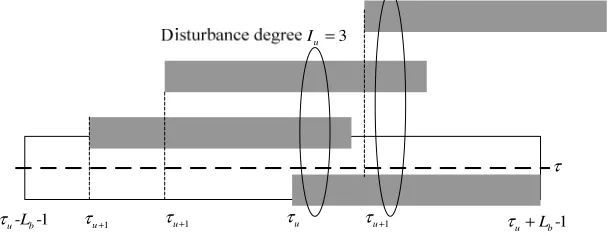
When the burst occupying the channel is occupied by other bursts at the same time, it is considered that the burst collides with other bursts. Let the disturbance degree of burst u isIu, and
it represents the number of bursts corresponding to the maximum number of bursts in channel for time segment in τ∆⋅[ ,τ τu u+Lb−1]. Figure 1 shows the collision diagram of the burst u in disturbance degreeIu =3.
τ
u
τ τu+1 τu+Lb-1
- -1
u Lb
τ τu+1 τu+1
3
u
[image:3.612.155.459.189.307.2]I =
Figure 1.Schematic diagram of bursts collision
Since the bursts access channel is random, the time required to complete the entire packet delivery can be approximately represented as
b b
pac c
T N T
N =
i
(1)
The average time period of a packet access network is Tpac/ (1−pempty), so the rate of the bursts
access network of a node are expressed as
=
/ (1 )
b in
pac empty
N r
T −p (2)
Definition Rin is the total rate of bursts access in the network
in in
R =N r⋅ (3)
The bursts on each channel obey the negative exponential distribution of λb=Rin/Nc in time intervals, so the probability density function of burst time intervals is
( ) bt, 0
b
f t e λ t
λ −
= ≥
(4) Corresponding to the discrete time domain
τ
, and let be ξi=τi−τi−1 shows bursts time interval, then the ξ ξ1, 2,⋅ ⋅ ⋅,ξi is independent identically distributed, so the distribution rate of discrete random variable ξi is{
i}
(k ), 0,1, 2,P ξ k τ λe−λ ⋅τ∆ k
∆
= = ⋅ = ⋅ ⋅ ⋅ (5) The specific collision situation is analyzed as follows:
(1) When Iu =1, indicates that the burst u did not collide, then
1 1 1
{ u 1} { u u b; u u b}= { u b} { u b}
P I Pτ τ L τ τ L Pξ L Pξ L
− + +
= = − ≥ − ≥ ≥ ≥ (6)
1
{ 1} { } { }
b b
u u u
i L j L
P I Pξ i Pξ j
+∞ +∞ + = = = =
∑
=∑
= (7)(2) When Iu = 2, indicates that the burst u collision with a neighboring burst, then
1 1
1
1 0
{ 2} = { 1} { }+ { } { 1}
{ ; }
b
u u b u b u b u b
L
u u b
i
P I P L P L P L P L
P i L i
ξ ξ ξ ξ
ξ ξ + + − + = = ≤ − ≥ ≥ ≤ − + ≥ ≥ −
∑
(8)The combination type (5) and (8) can be obtained
1 1 1 1 0 0 1 1 0
{ 2} = { } { } { } { }
{ } { } b b b b b b L L
u u u u u
i j L i L j
L
u u
i L j j
P I P i P j P i P j
P i P j
ξ ξ ξ ξ
ξ ξ − +∞ +∞ − + + = = = = − +∞ + = − = = = = + = = + = =
∑
∑
∑
∑
∑
∑
(9)(3) When Iu =3, 4,⋅ ⋅ ⋅,J, it is difficult to use the above process analysis, because the process of the bursts access channel is Poisson distribution, so we can use the following analysis process.
Let be u Lb, u Lb 1, , u Lb 1
X X X
τ− τ− + ⋅ ⋅ ⋅ τ+ − respective indicate the number of bursts arriving at time
, 1 , , 1
u Lb u Lb u Lb
τ − τ − + ⋅ ⋅ ⋅ τ + − , because of the arrival of bursts is the Poisson distribution, then the random variable u Lb, u Lb 1, , u Lb 1
X X X
τ − τ− + ⋅ ⋅ ⋅ τ+ − are independent and Poisson distribution with expectation of τ∆⋅λb.
Let variable u+i
I
τ indicates the disturbance degree burst u at time
τ
u+i, so+ 1
, 0,1, , 1
b
u u b
L
i i L j b
j
I X i L
τ τ + − +
=
=
∑
= ⋅ ⋅ ⋅ −(10)
According to the formula (10), u+i
I
τ is the sum of multiple independent identically distributed
random variables, so according to the Poisson distribution properties, the u+i
I
τ is Poisson
distribution of Lb⋅τ∆⋅λb
( )
+
( )
{ } , 0,1, 2
! b b u i L b b i L
P I i e i
i
τ λ τ
τ λ∆ − ∆
= = = ⋅ ⋅ ⋅
(11)
According to the definition of disturbance degree, we can conclude that the probability of the burst which disturbance degree is J
(
+ max)
( ) [0, 1], . . ( )
u
u b i
P I J P i L s t I J
τ
= = ∋ ∈ − = (12)
Multi-packet Receiving Model
Nodes with multi-packet receiving ability can simultaneously receive multiple bursts from other nodes on multiple channels. The burst length is fixed and equal, and each node has the same multi packet reception ability. In the time length of sending a burst, the multi-packet reception probability of nodes Sn k, represent the successful reception probability of k bursts from n colliding bursts, so the packet reception model at the receiver can be expressed as the matrix:
1,0 1,1
2,0 2,1 2,2
,0 ,1 ,2 ,
M M M M M
S S
S S S
S S S S
= S (13)
When the disturbance degree is greater than 3, all bursts can’t be successfully received.
Due to the asynchronous random transmission of nodes, each burst has equal status in the channel, and a random collision may occur when a burst reached the receiver. If a burst conflicted with other
1
n− bursts, when n≤M, it may be successfully received. Let be Sn is probability that one of the
bursts is successfully received, so
, 0
1, 2, ,
0
n n k
n k
k
S n M
S n
n M
=
= ⋅ ⋅ ⋅
=
>
∑
(14)
According to equation (14), the successful probability of a burst is determined by the MPR matrix of the channel. In order to analyze easily, the paper assumed that the receiver can successfully isolate all bursts when the disturbance degree is less than M, so the multi-packet
reception matrix is
( 1)
0 1 0 0 1
0 0 0 1 M M
× +
=
S
(15)
Let be pb indicated the successful probability of a single burst after propagation. Combining formula (12) and (15) can be obtained
1
{ }
M
b n n
i
p S P I i
=
=
∑
= (16)Performance Analysis
(1) Success transmission probability
Defining ppac represents the probability of successfully received by multi-packet receiver after
transmission. According to the principle of error-correcting codes, the receiver can recover the packet as long as Mb bursts are successfully received in a packet. Therefore, the success transmission probability is obtained
(1 )
b
b b
N
b k N k
pac b b
k M
N
p p p
k
−
=
= −
∑
(17)(2) Network throughput
Defining network throughput S represents the total number of successful packets within a unit
time, and the packet length is Lpac, then S is expressed as
pac in pac
b
L R P
S
N ⋅ ⋅
= (18)
(3) Packet end-to-end delay
Defining packet end-to-end delay is T, including transmission delay and propagation delay. Let
be Tpro represents the packet propagation time, and L’ represents the maximum communication
distance of single hop, and c is the speed of light, so Tpro can be approximated as
2
pro
L T
c
= ′ (19)
pac pro
T=T +T (20)
Simulation Analysis
The performance of the protocol is simulated and analyzed by using the OMNeT++ simulation platform, and the performance of the protocol is compared with the TDMA protocol and the IEEE 802.11 DCF protocol. In the simulation scene, all nodes are randomly distributed in L2 H
×
[image:6.612.95.287.527.678.2](5002×10km3) 3-D space, and each node selects the destination node randomly. The specific simulation parameters are set out in Table 1.
Table 1. Simulation parameters.
Parameter Value Single hop communication distance 250 km
c
V 3Mbps
n
N 50
c
N 10
pac
L 1024bit
η 1/3
b
N 28
b
M 14
M 1~3
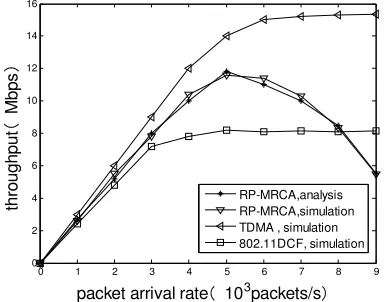
When M =2, it can be seen from Figure 2, for the RP_MAC protocol, when the traffic load is
4000 packet/s, the network throughput arrives at the top, but as the traffic load increased, the throughput decreases rapidly, and this is because the collision situation of the unexpected packet in the network has exceeded the coding error ability, resulting in the failure of packet reception. As can be seen from Figure 3, when M =2, the packet end-to-end delay of the RP_MAC protocol is about
2ms, and its size is about the sum of packet propagation delay and packet transmission delay. As the business load increased, the RP_MAC protocol's packet end-to-end delay is much smaller than the TDMA and IEEE 802.11 DCF protocols. We can see from Figure 4, when the network load is less than 4000 packet/s, the success transmission probability of RP_MAC protocol can be maintained at more than 90%, closing to TDMA, much higher than that of IEEE 802.11DCF, but with the increasing of network load, the success transmission probability decreased rapidly, and this is because the collision situation of the unexpected packet in the network has exceeded the coding error ability, resulting in the failure of packet reception.
0 1 2 3 4 5 6 7 8 9 0
2 4 6 8 10 12 14 16
( )
th
ro
u
g
h
p
u
t
M
b
p
s
(
packet arrival rate 103packets/s)
RP-MRCA,analysis RP-MRCA,simulation TDMA , simulation 802.11DCF, simulation
0 1 2 3 4 5 6 7 8 9 0
10 20 30 40 50 60
( )
d
e
la
y
m
s
(
packet arrival rate 103packets/s)
RP-MRCA,analysis RP-MRCA,simulation TDMA , simulation 802.11DCF, simulation
0 1 2 3 4 5 6 7 8 9 0
0.1 0.2 0.3 0.4 0.5 0.6 0.7 0.8 0.9 1
( )
tr
a
n
s
m
is
s
io
n
p
ro
b
a
b
ili
ty
%
(
packet arrival rate 103packets/s)
RP-MRCA,analysis RP-MRCA,simulation TDMA , simulation 802.11DCF, simulation
0 1 2 3 4 5 6 7 8 9 0
2 4 6 8 10 12 14 16 18 20
( )
th
ro
u
g
h
p
u
t
M
b
p
s
(
packet arrival rate 103packets/s)
← M=1
[image:7.612.207.397.287.438.2]← M=2 ← M=3
Figure 4. Transmission probability of three protocols. Figure 5. Influence of the M on throughput.
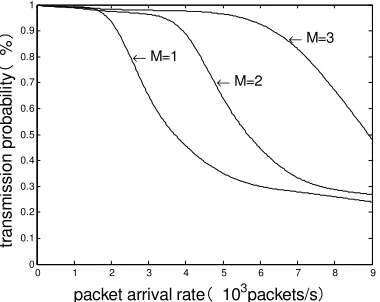
As shown in Figure 5-6, the throughput and the packet successful transmission probability of the network is significantly improved when the packet reception capacity is increased.
0 1 2 3 4 5 6 7 8 9 0
0.1 0.2 0.3 0.4 0.5 0.6 0.7 0.8 0.9 1
( )
tr
a
n
s
m
is
s
io
n
p
ro
b
a
b
ili
ty
%
(
packet arrival rate 103packets/s)
← M=1
← M=2
← M=3
Figure 6. Influence of the M on transmission probability.
The simulation results show that, compared to the IEEE 802.11 DCF, RP_MAC protocol has a better performance. When the traffic load less than 800packet/s, the packet successful transmission probability is close to TDMA, and packet end-to-end delay is only about 2 ms, so it is more suitable for a time-sensitive occasion. The simulation results of RP_MAC protocol are consistent with the theoretical results, and the model is proved to be accurate.
Conclusion
In view of the airborne tactical network application scenario, a multi-channel MAC protocol was proposed based on RS-Polar coding in this paper, by establishing the channel collision model and the multi-packet reception model in the burst packet propagation stage, the effect of the RS-Polar cascade coding technology on the real time and reliability of MAC protocol are analyzed. Theoretical analysis and simulation results show that this protocol not only has the characteristics of low delay but also better performance when load increasing because of the introduction of physical layer technology. Therefore, RP_MAC can satisfy requirements of temporary dynamic networking capability, low delay and high reliability requirements of QoS in the airborne tactical network.
Reference
[1] Kwah K J, Sagduyu Y, Yackoski J. Airborne Network Evaluation: Challenges and High Fidelity Emulation Solution [J]. IEEE Communications Magazine, 2014, 52(10): 30-36.
Opportunities, and Challenges [C]//ANC’13 Proceedings of the Second ACM MobiHoc Workshop on Airborne Network and Communications, Bangalore, India. ACM Press, 2013, 25-27.
[3] Liang Y X, Cheng G, Guo X J, et al. Research Progress on Architecture and Protocol Stack of the Airborne Network [J]. Journal of Software, 2016, 27(1): 96-111.
[4] Cheng B, Frederick J. Design Considerations for Next-Generation Airborne Tactical Networks [J]. IEEE Communications Magazine, 2014, 52(5): 138-145.
[5] Samil Temel, Ilker Bekmezci. LODMAC: Location Oriented Directional MAC protocol for FANETs [J]. Computer Networks, 2015, 83(3): 76-84.
[6] Wang W Z, Zhou J L, Luo P C. Adaptive Polling MAC Protocol for Tactical Data Link System[J]. Acta Armamentarii, 2009, 30(12): 1624-1631.
[7] Li J, Gong E, Sun Z Q, et al. Design and Implementation of STDMA Slot Allocation Algorithm for Aeronautical Ad Hoc Networks [J]. Acta Aeronautica et Astronautica Sinica, 2014, 35(12): 3371-3383.
[8] Chia H W, Ray G C, Shiao L T. Modeling and Estimation of One-Shot Random Access for Finite-User Multichannel Slotted ALOHA Systems [J]. IEEE Communications Letters, 2012, 16(8): 1196-1199.
[9] Lele W, Sasoglu E. Polar Coding for Interference Networks [C]//IEEE International Symposium on Information Theory (ISIT), Honolulu, 2014, 311-315.
[10]L. A. Uryvsky, A. M. Pieshkin. The Reed–Solomon Codes Analysis Technique on the optimum Block Codes Ground in the Channel with White Noise [C]//2016 International Conference Radio Electronics & Info Communications, Kyiv, 2016, 1-3.