2017 2nd International Conference on Wireless Communication and Network Engineering (WCNE 2017) ISBN: 978-1-60595-531-5
Comparing Function of OpenStack and VMware
Li-qiu JIANG and Da-wei XIAO
Institute of Computer Engineering City Institute, Dalian University of Technology Dalian, China
Keywords: VMware, Performance analysis, Design, Basic functions, Price system.
Abstract. In recent years, with the rapid development of OpenStack, there is an increasing number of discussions between OpenStack and VMware focused on the merits and defects. The key objective is finding alternative solutions of VMware for the enterprise in order to get rid of the high cost of VMware products, the limitation of custom difficulties of the business functions. This article will discuss the design of the VMware and OpenStack, systematically compare three aspects including users’ creating, applying, and managing basic virtual functions and price system between OpenStack and VMware.
Introduction
OpenStack is a open source cloud calculating project that is co-developed by one of top three hosting companies for cloud calculating RackSpace and NASA[1]. From launch to now, OpenStack has attracted more than 200 companies and 2000 developers. It achieved its reputation in short period of time due to the strong support from IBM, HP, AT & T, Red Hat, SUSE, Canonical, Cisco, Dell, VMware. In China, Sina, Huawei had also became one of the supporter. OpenStack can be used to build and manage public cloud and private cloud, as well as managing cloud computing resources, network resources and storage resources.
VMware is a virtual machine software, it provides virtualization solutions from desktop to the data center . Different sized global customers rely on VMware to reduce cost and operating expenses, ensure business continuity, strengthen security and environmental protection. From the data center to the cloud, and to mobile devices, VMware could virtualize different types of computing, helping clients to improve their agility, responsiveness and profitability[2].
Openstack and VMware Design Comparison
VMware Design Philosophy
VMware was founded in 1998, is a global leader in the x86 virtualization field. VMware uses ESXi virtualization technology, and provides a complete set of virtualization management products around the virtualization technology. VMware commercial products can be divided into[3]:
ESXi hypervisor—to run on bare machine hypervisor, same as Citrix XenServer. ESXi is a free product of VMware, tied with vSphere to enhance function of ESXi.
vSphere—is currently the main commercial product for VMware. vSphere separates applications and the operating system from the underlying hardware, offers ESXi a range of enterprise applications, such as online transfer tools, advanced security management, network and storage I/O control etc. Base on applicable virtual machine hardware resources and different available functions, vSphere is divided into three product series: Standard Edition, Enterprise Edition and Enhanced Enterprise Edition.
vCloud Director—transform VMware-based virtualized data center to the similar services of IaaS services. The main feature is containing self-service functions, such as: infrastructure services catalogs and bills etc.
It is a good choice to achieve automatic testing by building a good test framework, which could be applied to the projects with the following characteristics: (1) cycle is longer, (2) the tested products are relatively stable, and (3) the cost of writing the automatic testing tools is within the acceptable range. At this time, there will be much valuable in the use of automatic testing.
OpenStack Design Philosophy
OpenStack is an open source project, which provides an operating platform or tool-set to deploy the cloud. It aims to provide a software platform for service providers or enterprise to construct and manage public cloud and private cloud, to achieve cloud infrastructure services similar to Amazon EC2 and S3. (Infrastructure as a Service, IaaS)
OpenStack is a cloud computing platform co-developed by Rackspace and NASA.Besides the strong support from Rackspace and NASA, it also includes contribution and support from heavyweight companies like Dell, Citrix, Cisco, Canonical,the development was very fast. OpenStack community has more than 130 companies and 1350 developers, these organizations and individuals are all considered the OpenStack as the infrastructure as a service (referred to as IaaS) universal front-end resources. OpenStack project's primary task is to simplify the process of deployment of cloud and bring positive expandability.
OpenStack cloud product’s architecture is open, it is not restricted to any product dealer that the underlying implementation is compatible with many products. So while users use OpenStack deployment of cloud services, there are a variety of options, not being limited to only one product .OpenStack project is divided into computing services, storage services and network services. For computing services, OpenStack can integrate one or combination of more for KVM, QEMU, XEN, Hyper-V VMware ESXi. For the mirrored storage service, customers can use NFS, GlusterFS and other distributed file system to implement as well as to store business cabinet product to realize; same for network services, open vswitch, cisco, NEC OpenFlow, Nicira NVP (acquired by VMware) and so on ,had achieved the OpenStack network service interface.
IaaS
NIST authoritatively defines IaaS (Infrastructure as a service) as the service is available to consumers for the use of all facilities, including handling, storage, networks and other fundamental computing resources, users can deploy and run any software , including the operating system and applications. The consumers do not manage or control any cloud computing infrastructure, while it can control the choice of operating system, storage space, application deployment, it is also possible to obtain limited control of network components (e.g., firewalls, load balancers, etc.)[4].
Openstack and VMware Feature Comparison
The User Usage Environment
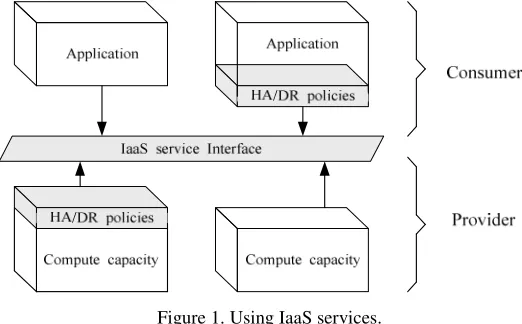
[image:3.612.171.432.204.366.2]Before comparing the function between OpenStack and VMware, it needs to be clear that how to use the user's application for IaaS services in a cloud environment. User applications can be divided into two categories in a cloud environment: cloud applications and traditional applications. Cloud application itself achieves high availability and scheduling of resources; however, the traditional applications need to rely on the level of infrastructure (IaaS) to achieve high availability and resource scheduling.Cloud applications and traditional applications using IaaS services as shown in Figure 1[5].
Figure 1. Using IaaS services.
Cloud applications and traditional applications compare the server architecture, horizontal scaling difficulty level, failure level and expanded level the four feature, as shown in Table 1.
Table 1. Cloud application and traditional application feature comparison.
Feature CloudApplication traditional applications
Server architecture Distributed Client-server architecture
The level of difficulty for horizontal expansion easy hard
The level of error Application -level fault Infrastructure -level fault Extended level Application –level extend Infrastructure –level extend
Feature Comparison
From the foregoing analysis: VMware’s design philosophy is to solve company’s concern on the process of visualization application,therefore the service offered by VMware aims on users of traditional application; and OpenStack design philosophy is that the user has entirely authority to use to basic infrastructure , more inclined to cloud applications. cloud platform of IaaS services provided by OpenStack also take into account to traditional application users’ need. OpenStack can meet the needs for traditional applications and cloud applications.
[image:3.612.79.529.423.515.2]Table 2. Open stack and VMware function comparison.
Comparison Project VMware OpenStack
Dynamic migration of virtual machines vMotion KVM Live Migration
Dynamic allocation of virtual machines DRS Nova Scheduler
Virtual Machine High Availability HA Evacuate
Dynamic migration of virtual machines
Virtual machine dynamic migration refers to the virtual machines migration from one physical host to another, and achieves non-stop during migration. There are two ways to achieve this: one requires shared storage devices, but usually the shared storage divises have high coasts; another method does not require shared storage, this migration is called block migration. Block migration is particularly useful for the maintenance of physical hosts, such as physical host core upgrade, upgrade security policies, while virtual machines without downtime.
Prior versions of vSphere 5.1 of VMware Vmotion only supports shared storage for Dynamic migration on virtual machines.While the OpenStack supports both forms of virtual machine migration[6].
Dynamic allocation of virtual machines
VMware's DRS (Distributed Resource Scheduler) distributed resource scheduling could apply real-time monitor usage of recourse on virtual machine and the physical host, dynamically migrating virtual machines to optimum performance physical machines according to the load situation. DRS is both suitable for the first time to create a virtual machine scene and virtual machine scene.
Scheduler from OpenStack could run the virtual machines on the most appropriate physical host according to the host resource usage, using different scheduling algorithms. But Scheduler from OpenStack is only applicable on creating virtual machines. OpenStack could achieve the function of DRS from VMware by using third-party monitoring software along with Scheduler and dynamic migration[7].
Virtual Machine High Availability
High availability for virtual machines means that when the physical machine fails to run , all virtual machines running on the host physical machine will run again on other physical hosts. But at this time, the virtual machine is shut down, and not saved data will be lost. VMware achieved virtual machine level for HA[8], and OpenStack incubator project Evacuate is being planned to achieve this functionality[9].
In summary, the traditional application of OpenStack has achieved VMware virtual machine management related functions, but because OpenStack focus more on cloud applications, so its aspects in solving dynamic migration of virtual machines, dynamic allocation and high availability of these features, which simplicity of operation worse than VMware, or even need the help of other third-party products to implementw. But these are reflected ,OpenStack open source architecture and flexibility, customers can extend OpenStack functions to suit your needs.
Compare Prices OpenStack and VMware
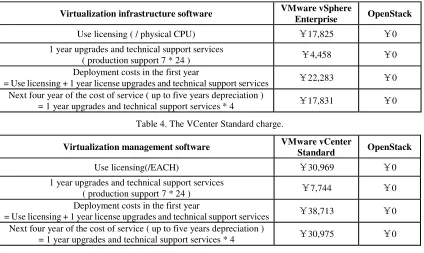
Table 3. The vSphere Enterprise Standard charge.
Virtualization infrastructure software VMware vSphere
Enterprise OpenStack
Use licensing ( / physical CPU) ¥17,825 ¥0
1 year upgrades and technical support services
( production support 7 * 24 ) ¥4,458 ¥0
Deployment costs in the first year
= Use licensing + 1 year license upgrades and technical support services ¥22,283 ¥0 Next four year of the cost of service ( up to five years depreciation )
[image:5.612.96.520.82.335.2]= 1 year upgrades and technical support services * 4 ¥17,831 ¥0 Table 4. The VCenter Standard charge.
Virtualization management software VMware vCenter
Standard OpenStack
Use licensing(/EACH) ¥30,969 ¥0
1 year upgrades and technical support services
( production support 7 * 24 ) ¥7,744 ¥0
Deployment costs in the first year
= Use licensing + 1 year license upgrades and technical support services ¥38,713 ¥0 Next four year of the cost of service ( up to five years depreciation )
= 1 year upgrades and technical support services * 4 ¥30,975 ¥0
From the shown charge from table 3 and table 4, using the number of the physical CPU core deployed from VMware, the higher cost of virtualization infrastructure software.So will bring huge software procurement cost burden for companies , and it in the aspects of the advantages are obvious for OpenStack.
Summary
When the business users decide to use OpenStack, they more focus on the use of the difference of KVM and VMware ESXi virtual machines created on performance. According to the actual test results showed that: KVM virtual machine performance with VMware ESXi to create similar, and sometimes virtual machine created by KVM performance will be better than VMware ESXi virtual machines.
OpenStack and VMware are two products with different design philosophy, it is difficult to simply evaluate which design is better than another, we also can not say that OpenStack can completely replace VMware, and vice versa. This paper argues that with the further development of cloud computing, Good integration between the two is more likely at a certain equilibrium point.However, the current trend in the development of OpenStack and existing functionality, the user can according to their demand for virtual machine management, such as not concern the VMware HA capabilities, OpenStack is one instead of VMware solutions, which can save the high cost of software and service charges.
References
[1] Huang Zhi-cheng. Research on Application of Open Source Cloud Computing Openstack in Computer Rooms of Universities[J], Jisuanji Yu Xiandaihua, 2013, 48(3):204-206.
[2] VMware Desktop Cloud Solutions Book[EB/OL].
http://wenku.baidu.com/view/59cb14f1ba0d4a7302763a2f.html, 2012-02-09.
[3] The Five Series Products of Vmware Virtualization Products[EB/OL].
[4] Liu Fang-ming. Security Risk Analysis on Cloud Computing Environment Virtualization Level[J].Financial Computer of China, 2015(11):65-67.
[5] MASSIMO.TCP-clouds, UDP-clouds, “design for fail” and AWS[EB/OL].
http://it20.info/2011/04/tcp-clouds-udp-clouds-design-for-fail-and-aws/, 2011-04-27
[6] Wu Zhu-hua. The Analysis of the Core Technology of Cloud Computing[M].Beijing: Posts & Telecompress, 2011.05.
[7] Nie Jing. On the Technical Advantages of the VMware vSphere Platform[J],Practical Electronics, 2015(8):96-97.
[8] Chen Bing. Study Based on VMware Architecture University Web Server and Disaster Recovery Mechanism[J], Practical Electronics, 2013(7):194.
[9] The Rebuild and Evacuate of OpenStack Nova[EB/OL].