Munich Personal RePEc Archive
Method of Supply Chain Optimization in
E-commerce
Suchánek, Petr and Bucki, Robert
Silesian University - School of Business Administration, The College
of Informatics and Management
May 2011
Online at
https://mpra.ub.uni-muenchen.de/32366/
METHOD OF SUPPLY CHAIN OPTIMIZATION IN
E-COMMERCE
Petr Suchánek
Silesian University in Opava, School of Business Administration in Karvina, Department of Informatics
Univerzitní náměstí 1934/3, 73340 Karviná, Czech Republic
Robert Bucki
The College of Informatics and Management in Bielsko-Biała, Department of Informatics
ul. Legionów 81, 43-300 Bielsko-Biała, Poland [email protected]
ABSTRACT
Rapid development of technologies and their penetration into all sectors generates a wide range of streamlining of production and trade processes. Electronic commerce is the area in which information and communication technology (ICT) is an essential and indispensable element. It is based on the use of e-commerce systems. An e-commerce system combines several parts consisting of customers, suppliers (sellers, dealers, producers, businessmen, etc.), the web server (web interface), the information system (ERP, CRM, the database system), the payment system, the dispatch system and the legislature itself. All these subsystems must be managed both at the operational level and in terms of the whole e-commerce system. E-commerce systems are tools meant to support the supply chain (SC), the quality of which as well as other parts of the e-commerce system largely depend on management processes representing supply chain management (SCM). The optimal way to ensure the success of SCM is to use the methods of modelling and simulation based on appropriate models and mathematical representation of a real SC. Such models are constructed with the use of process and value-chain oriented approaches or based on the concept of multi-agent systems. Different types of models in conjunction with a suitable mathematical representation allow us to perform the simulation process which outputs can help managers make suitable decisions. The paper aims at presenting contemporary approaches to the supply chain modelling within e-commerce systems. Moreover, the case study emphasized hereby is oriented to present the sample simulation approach in order to find the optimal allocation of resources which are meant to minimize shipping costs.
JEL Classification: C02, C51, C61, C69, M29
Key Words: e-commerce system, supply chain, supply chain management, warehouse, allocation of resources
Introduction
Electronic commerce (e-commerce) has become an essential support for business activities carried out between all types of chain store operators. In a simplified form e-commerce is just buying and selling products online. In fact, it encompasses the entire online process of developing, marketing, selling, delivering, servicing as well as paying for products and services purchased by internetworked, global marketplaces of customers with the support of the worldwide network of business partners. [9] Essential support for electronic commerce is understood as the so-called e-commerce system. E-commerce systems are, by their very nature, systems that allow quick and inexpensive entry of company doing business in the domestic and foreign markets. One of the key areas that could have a significant impact on cost is a supply chain (SC) and in particular its part focused on warehouses location. General objective is always to determine which warehouses to open and which of these warehouses should supply the various stores such that the sum of the maintenance and supply costs is minimized. Management of any flexible system including delivery routes is possible by means of a heuristic approach. Economic profits are generated by minimizing losses. [2] In case of transportation goods, it is necessary to minimize the length of the defined delivery routes. The process of stocking with setting the locations for more distribution centres becomes even more complex by adding new limitations. [1]
1 E-commerce System
information system encompasses the hardware and software used to deliver the solution to the final consumer of services. The architecture is a description of the design and contents of a computerized system. [3] System architecture must be designed so that the whole system ensures support for all key areas which are administration, sales, production, finance, logistic, supply chain, personnel, planning, IS/IT, security and finally management. Each key area is usually supported by one defined subsystem. To achieve the efficiency of the whole e-commerce system, all subsystems from which the system is composed, must be efficient.
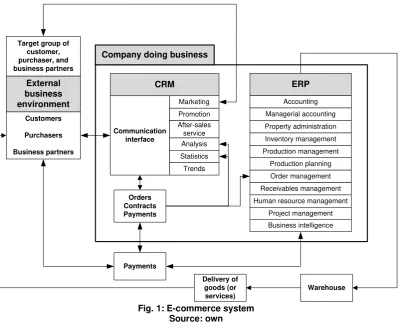
Main basic components of e-commerce systems are customers, Internet, web server, CRM (Customer Relationship Management), ERP (Enterprise Resource Planning), LAN (Local Area Network), cooperating suppliers and customers, payment system, warehouse system, delivery of goods, after-delivery (after-sales) services (Fig. 1). [12]
External business environment
Customers Purchasers Business partners
CRM
Communication interface
Marketing Promotion After-sales
service Analysis Statistics Trends
ERP
Accounting Managerial accounting Property administration Inventory management Production management
Production planning Order management Receivables management Human resource management
Project management
Orders Contracts Payments
Payments
Company doing business
Target group of customer, purchaser, and business partners
Warehouse Delivery of
goods (or services)
[image:3.595.101.502.225.547.2]Business intelligence
Fig. 1: E-commerce system Source: own
Basic components of e-commerce system are supported and controlled by the management (SCM - Supply Chain Management, FRM - Financial Resource Management, HRM - Human Resource Management, MRP - Manufacturing Resource Planning, CPM - Composite Product Mapping, etc.), hardware, software, people, co-operative suppliers, legislation, Internet services and so on. The whole e-commerce system must be seen as a part of business environment.
All managements and decision-making processes have to be targeted to the customers and their needs and requirements. Today, customers are more sophisticated and have higher expectations than those in past decades. They demand better products and services. This intense, competitive environment forces companies to operate more efficiently.
2 Supply chain in e-commerce
Supply chain is one of the key areas in e-commerce. The supply chain is generally defined as multi-system of operators, manufacturers, distributors, resellers and customers, among which is a flow of goods, information and finance. [5] The quality of the supply chain, as well as other parts of e-commerce system, largely depends on the set management processes. In this context, we speak of the SCM (Supply Chain Management). SCM concept includes not only the logistics process as well as strategic management of the entire supply chain, including supplier selection, distribution of production functions, outsourcing of capacity or processing of customer requirements. Successful implementation of SCM concept is fully dependent on the integration of enterprise resources, and together with ERP and CRM is the basic building block of information and corporate strategy of company. [11]
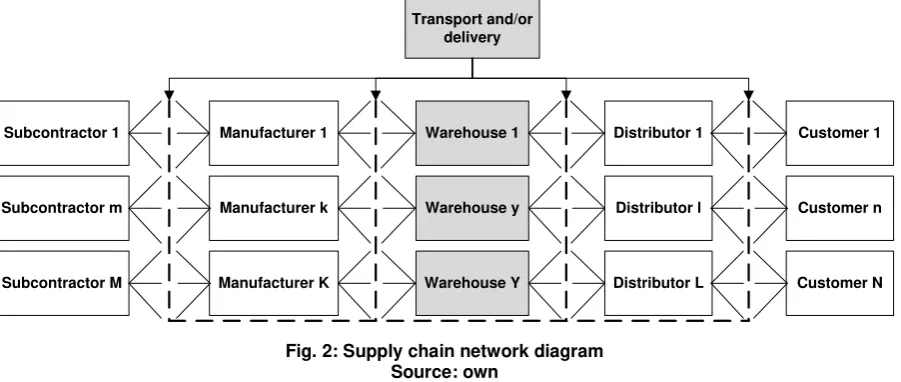
The aim of the supply chain is to deliver goods in the shortest time at the lowest possible price while ensuring the highest quality. Quality can depend, for example, on the safe transport appropriate to the nature of the goods and/or services and what is important, delivery of goods in the shortest time also leads to a reduction in storage costs. A characteristic feature of the supply chain is the network concept which contains a number of subjects, each with its objectives which are sought for in order to be achieved by means of the appropriate management system (Fig. 2).
Customer 1
Customer n
Customer N Manufacturer 1
Manufacturer k
Manufacturer K
Distributor 1
Distributor l
Distributor L Subcontractor 1
Subcontractor m
Subcontractor M
Transport and/or delivery
Warehouse 1
Warehouse y
[image:4.595.75.526.268.459.2]Warehouse Y
Fig. 2: Supply chain network diagram Source: own
A network of manufacturers, distributors, and subcontractors must be appropriately mapped to a network of warehouses. Warehouses may be owned by individual entities identified in the diagram as shown in Fig. 2 or entities (companies) specifically focused on warehouse activities.
Supply chain systems can be modelled by number of ways. In this context, the basic methods are process oriented and value-chain oriented approaches and for the purpose of simulation, multi-agents system approach is often implemented. The main difference between process modelling and value chain modelling is that process modelling specifies "how" a process is realized and implemented while value chain modelling specifies "why" the process occurs in terms of added value to the process participants. Specifying "why" and "what" is the main contribution of the value modelling approach compared to the process-oriented approach which focuses mainly on "how" and omits the "why". Optimization of all these approaches can be performed using linear and mixed integer programming. [10] E-commerce is a direct sale which requires minimal number or zero intermediaries in the distribution of goods. The general objective should be that all members in the distribution channel work together toward an end goal of giving the best value to the final customer. One of the methods used in the SCM is the so-called ECR (Efficient Customer Response). The ECR principle consists in cooperation between retailers and their suppliers based on four pillars that are demand management, supply management, enabling and integrating factors. Ultimately, ECR allows us to achieve maximum cost reduction, improved service, optimization of stock management and production optimization. ECR benefit for suppliers is an opportunity for better planning of production and logistics cost savings. On the other hand, ECR help customers increase product availability and relative price decrease. Other methods for promoting SCM are CRP (Continuous Replenishment), QR (Quick Response), VMI (Vendor Managed Inventory) or CPFR (Collaborative Planning, Forecasting and Replenishment).
and properly defined corporate strategy. In order to adapt to current market needs, companies should focus on most significant improvements.
Improvements should be based on measurable quantitative indicators, which are:
number of order entry points;
number of inventory locations;
amount of inventory;
number of manufacturing sites or locations;
storage costs;
shipping costs;
speed of information and material flow through the supply chain.
Generally, standard metrics for supply chain management performance include time, cost, and variability [6]. High values for any of these metrics mean costly and inefficient supply chains.
3 Selection of warehouse best location
The warehouse location selection is processing of selecting the allocation centre in the economic region where there are some supply stations and the certain demand point. Generally, the warehouse location selection model has to match the principles of adaptation, coordination, efficiency and strategy. [15]
Selecting the best warehouse location to minimize shipping costs in the e-commerce systems remains the issue which requires finding optimal allocation of resources and must be addressed carefully. The type of location which is chosen depends largely on the type of the e-business. However, there are various areas worth considering before making a final decision. The warehouse must be located correctly to efficiently meet clients and customers delivery requirements taking into account road access in the possible areas. Moreover, supply chain management is a high impact mission that must win market share and customer loyalty as well as result in reducing total supply chain costs and increasing in forecast accuracy. Another important issue is the need to improve in order-fulfillment cycle time and extend the strategic capability. Proper strategic logistics planning should unavoidably lead to reducing the costs of logistics operations in order to improve customer service levels. Distribution network design is a key business priority. Optimized distribution operations will significantly reduce distribution costs and product flows. These also let us model risk profiles and facilitate effective decision-making. Potential alternative distribution strategies must take into account customer locations while maintaining the present network design and consolidation of existing distribution depots. [13]
In the e-commerce systems there is the need to present an integrated model for the location of a warehouse, the allocation of retailers to warehouses and find the number of means of transport to deliver the demand and the required means of transport routing in order to minimize total transportation costs, fixed and operating costs and routing costs. Such models assume that the number of plants has already been determined and gives us the information what the number of warehouses to open is as well as how warehouses are allocated to plants. Moreover, we should know how retailers are allocated to warehouses and who the retailers really are. There is also the need to know in what order they will be visited and how many means of transport are required for each route. Minimum costs must be searched for. It is necessary to integrate location, allocation, and routing decisions in the design of a supply chain network. [7] Relocation of the manufacturer has adverse side effects such as causing the readjustment of many existing systems and creating many imminent strategic problems. One of such problems is the warehouse location of freight forwarders: they have to decide whether they should locate their warehouses in the new place, in current locations, or in new locations. The freight forwarders have to make responsible decisions and evaluate some potential warehouse locations. [14]
4 Problem formulation
There are N shops given,
n
1
,...,
N
.The warehouse operating cost in the m-th point equals
b
m,m
1
,...,
M
. The supply cost of the nth shop from the m-th warehouse equalsa
m,n. The capacity of the warehouse is marked byw
m,m
1
,...,
M
.The orders of the shops are represented by
z
n,n
1
,...,
N
.Let
x
m,n be the decision variable. The decision variable takes the following values:
0
1
,n mx
if the otherwise m-th warehouse supplies the nth shop5 Mathematical model
There are the following allowable solutions:
M m n mx
1,
1
- each shop is supplied by one warehouse only
N n m n nm
z
w
x
1
, - the warehouse accepts orders which can be realized
Let us introduce the criterion of minimizing costs:
min costs operating warehouse 1 costs supply products 1 1 , ,
M m m m M m N n n m nm a b y x
Q
at the same time
otherwise
x
if
y
N n n m m0
1
1
1 ,6 Heuristic algorithms
6.1 The choice of the cheapest warehouse (bm)
j M j m
b
b
1min
Not assigned shops with minimal costs are allocated to warehouses as follows:
j m N j n m
a
a
, 1 ,
min
The shops allocated if the following condition is fulfilled:
m n j j
w
z
z
The allocated shops
a
m,n,
m
1
,...,
M
,n
1
,...,
N
are disregarded in calculations. The used warehousesb
m ,m
1
,...,
M
are also disregarded in calculations.
6.2 The choice of the cheapest transport (am,n)
The minimal elements
a
m,n from the matrixA
a
m,n are chosen subsequently. If for the m-th shop the warehouse has already been chosen, we ignore it in the further calculations.If no new shop can be added to the m-th warehouse, we ignore it in the further calculations. In this way, we get the N-stage calculation process. Moreover, if
m,n
1
n
x
, we add the costb
m to thecriterion sum.
Conclusion
To optimize the final goods prize and maximize the profit of the manufacturers, distributors and sellers mean to take into account many factors that may influence the process of stocking and distribution by varying degrees. Certain factors of the optimum distribution and stocking processes are easy adapted to changing circumstances but the others might signify high input costs for every modification. The distribution centre location is one of those that should be planned very carefully before the realization as every additional change usually means new input costs. It is necessary to determine proper distribution channels. The distance between the locations of participating companies and expected customers means to set the locations of customers' centers. Determination of proper locations of customers' centers might be quite a sophisticated task as it is based just on the current orders, previous experiences and marketing survey. One approach to the discussed problem is formulated in the paper hereby. Economic control of the distribution system can be optimized for instance by the distribution channel specification which requires another approach. It means trying minimizing the total production time so that ready products are delivered to the output store in a stochastic way. The aim remains to avoid extra costs generated by prolonged delivery times and other unnecessary delays. The heuristic approach to the problem is shown in order to make the correct decision regarding the means of transportation which plays the most important role. The paper deals with a logistic problem consisting in setting the proper location for stock of materials and products and their distribution in order to collect them in the store or directly deliver to the customer. Moreover, the optimal distances between participating companies and expected customers are sought by taking into account dependences that influence the shipping prize, the prize for stocking both materials and products and the other significant constraints too in order to minimize the costs of stocking and distribution.
Acknowledgment
The content of the paper is based on the outputs of the project SGS/24/2010 - Use of BI and BPM to support effective management (the project is carried out at The Silesian University in Opava, School of
Business Administration in Karviná – Czech Republic).
References
[1] ANTONYOVÁ, A., BUCKI, R. The Process of Stocking with Setting the Locations for a Few Distribution Centers. Proceedings of the Workshop: Information Logistics. The College of Informatics and Management, Bielsko-Biała, 16-17 September 2010, pp. 30-33. ISBN 978-83-62466-01-6.
[2] BUCKI, R. Managing a Flexible Economic System. Acta academica karviniensia, vědecký recenzovaný
časopis, Slezská univerzita v Opavě, Obchodně podnikatelská fakulta vKarviné, č. 2, roč. 2010, s. 51-58. ISSN 1212-415X.
[3] BURD, S.D. Systems Architecture. 5th edition. Course Technology, 2005. 656 p. ISBN 978-0619216924.
[4] COOPER, M., LAMBERT, D., PAGH, J. Supply chain management: More than just a name for logistics. In The International Journal of Logistics Management, vol. 8, no. 1, 1997
[6] HAUSMAN, W.H. Supply Chain Performance Measures. In Corey Billington, Terry Harrison, Hau Lee, and John Neale, eds., The Practice of Supply Chain Management. New York: Springer Science & Media Inc., 2004.
[7] LASHINE, S.H., FATTOUH, M., ISSA, A. Location/Allocation and Routing Decisions in Supply Chain Network Design. In Journal of Modelling in Management, 2006. Vol. 1, Issue 2, pp. 173 – 183.
[8] OLIVER, R., WEBBER, M. Supply Chain Management: Logistics catches up with Strategy. In: Booz, Allen & Hamilton: Outlook 1982
[9] SACHENKO, A. Electronic Commerce Systems. [on-line] Retrieved March 20, 2011. URL: <http://www.scribd.com/doc/396840/Electronic-Commerce-Systems>
[10] SHAPIRO, J.F. Modelling the Supply Chain. 2nd Edition. Boston: South-Western College Pub, 2006. 680 p. ISBN 978-0495126096.
[11] SIXTA, J. Logistika jako filozofické řízení výrobního podniku. In Automatizace, 2004, Vol. 47, Issue 7-8, pp. 44.
[12] SUCHÁNEK, P. Business Intelligence as a Support of E-commerce Systems in Connection with Decision Making and Cross-Border Online Shopping. In Journal of Applied Economic Science, spring 2010, Volume V, Issue 1. pp. 94 – 102. ISSN 1843-6110.
[13] SUPPLY CHAIN PLANNING UK LTD. (SCP). Logistics Strategy & Supply Chain Strategy. [on-line] Retrieved March 25, 2011. URL: <http://www.scp-uk.co.uk/index.html>
[14] WAN, Y., CHEUNG, R.K., LIU, J., TONG, J.H. Warehouse Location Problems for Air Freight Forwarders: A Challenge Created by the Airport Relocation. In Journal of Air Transport Management, 1998. Vol. 4, Issue 4, pp. 201-20.
[15] XU, J., ZHENG, K. Research of logistics center location and case analysis[J]. In Journal of Northern Jiaotong University, 2001. Vol. 25, Issue 5, pp. 80-82.