Versatility of microbial proteases
Veloorvalappil N. Jisha, Robinson B. Smitha, Selvanesan Pradeep, Sasidharan Sreedevi,
Kizhakkepawothail N. Unni, Sreedharan Sajith, Prakasan Priji, Moolakkariyil Sarath Josh,
Sailas Benjamin
*Enzyme Technology Laboratory, Biotechnology Division, Department of Botany, University of Calicut, Kerala, India; *Corresponding Authors: [email protected], [email protected]
Received 10 April 2013; revised 3 June 2013; accepted 18 June 2013
Copyright © 2013 Veloorvalappil N. Jisha et al. This is an open access article distributed under the Creative Commons Attribution License, which permits unrestricted use, distribution, and reproduction in any medium, provided the original work is properly cited.
ABSTRACT
Proteases or peptidases constitute the largest
group of enzymes in bio-industry with a long
array of uses. They play an invincible role in
industrial biotechnology, especially in detergent,
food and pharmaceutical arena. This focused
review encompasses an overview on alkaline
proteases, mainly of microbial sources in a han-
dy module. Following an introduction and gen-
eral classification with evolutionary insight, ma-
jor sources of proteases (animal, plant and mi-
crobial including fungal, bacterial), their general
properties with mechanism of action and mo-
lecular masses are discussed. Proteases from
Bacillus
spp. have been given special attention.
In addition to this, an overview on the
applica-tions of proteases in detergent, tannery, food,
metal recovery and waste treatment industries is
also addressed briefly.
Keywords:
Review; Proteases; Classification;
Sources; Bacillus; Industrial Uses
1. INTRODUCTION
Recent years have witnessed a phenomenal increase in
the use of enzymes as industrial catalysts. Proteases (EC
3:4, 11-19, 20-24, 99) (synonymous as peptidase or pro-
teinase
)
constitute a very large and complex group of
enzymes, widely utilized in a host of industries. They
differ in properties such as substrate specificity, active
site and catalytic mechanism, pH and temperature optima,
and stability profiles. Studies relating to such properties
are imperative for the successful application of these
enzymes in their respective industry [1]. The main
sources of the enzymes were from animals (e.g.
calf sto-
mach), plants (e.g.
pineapple, fig, and papaya), microbes
(e.g.
Bacillus
spp.,
Pseudomonas
spp.) [2,3], etc. But the
production of enzymes from plant and animal sources is
limited due to climatic reasons and ethical issues, respec-
tively [2,3]. Microbial sources have occupied an invinci-
ble domain in the production of all the three—acidic,
neutral, and alkaline—major types of proteases. The
al-kaline proteases, an important group of industrial enzy-
mes are produced by a wide range of organisms include-
ing animals, fungi and bacteria.
Aeromonas
,
Alcaligenes
,
Arthrobacter
,
Bacillus
,
Halomonas
,
Pseudomonas
and
Serratia
are the major bacterial genera which contribute
to proteases [2].
Bacillus
-derived alkaline proteases are
of immense utility in other industrial sectors too,
viz.
,
leather, food, textile, organic synthesis, and waste water
treatment.
Bacillus
-derived alkaline proteases are stable
at elevated temperatures and pH, but majority of them
are incompatible with detergent matrices [4]. Therefore,
alkaline proteases with superior performance for
com-mercial exploitations, especially for detergents, are being
focused.
2. GENERAL CLASSIFICATION OF
PROTEASES
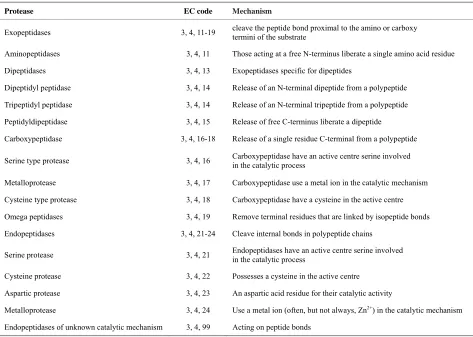
According to the Nomenclature Committee of the In-
ternational Union of Biochemistry and Molecular Biol-
ogy, proteases are classified under the subgroup 4 of
Group 3 (hydrolases) (
Table 1
). However, proteases do
not comply easily with the general system of enzyme
nomenclature due to their huge diversity of action and
structure. On the basis of their site of action on protein
substrates, proteases are broadly classified as endo- or
exo-enzymes [3]. They are further categorized as serine
proteases, aspartic proteases, cysteine proteases or met-
allo proteases—depending on their catalytic mechanism
(
Table 1
). Proteases are also classified into different
Table 1. General classification of proteases with their enzyme commission (EC) code, coupled with specific mechanism of action of
each subgroup.
Protease EC code Mechanism
Exopeptidases 3, 4, 11-19 cleave the peptide bond proximal to the amino or carboxy termini of the substrate
Aminopeptidases 3, 4, 11 Those acting at a free N-terminus liberate a single amino acid residue
Dipeptidases 3, 4, 13 Exopeptidases specific for dipeptides
Dipeptidyl peptidase 3, 4, 14 Release of an N-terminal dipeptide from a polypeptide
Tripeptidyl peptidase 3, 4, 14 Release of an N-terminal tripeptide from a polypeptide
Peptidyldipeptidase 3, 4, 15 Release of free C-terminus liberate a dipeptide
Carboxypeptidase 3, 4, 16-18 Release of a single residue C-terminal from a polypeptide
Serine type protease 3, 4, 16 Carboxypeptidase have an active centre serine involved in the catalytic process
Metalloprotease 3, 4, 17 Carboxypeptidase use a metal ion in the catalytic mechanism
Cysteine type protease 3, 4, 18 Carboxypeptidase have a cysteine in the active centre
Omega peptidases 3, 4, 19 Remove terminal residues that are linked by isopeptide bonds
Endopeptidases 3, 4, 21-24 Cleave internal bonds in polypeptide chains
Serine protease 3, 4, 21 Endopeptidases have an active centre serine involved in the catalytic process
Cysteine protease 3, 4, 22 Possesses a cysteine in the active centre
Aspartic protease 3, 4, 23 An aspartic acid residue for their catalytic activity
Metalloprotease 3, 4, 24 Use a metal ion (often, but not always, Zn2+) in the catalytic mechanism
Endopeptidases of unknown catalytic mechanism 3, 4, 99 Acting on peptide bonds
3. PHYLOGENETIC TREE
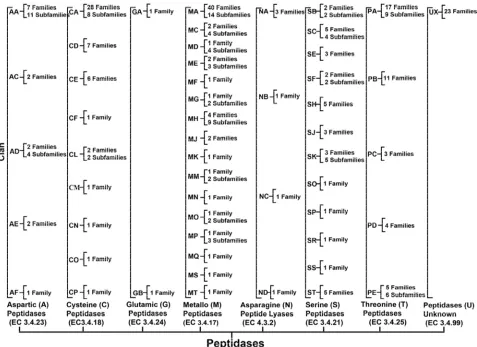
Based on their amino acid sequences, proteases
(pep-tidases) are classified into different clans and families,
which have diverged from a common ancestor [5]. Each
peptidases has been assigned a code letter denoting the
type of catalysis,
i.e
., S, C, A, M, or U for serine,
cys-teine, aspartic, metallo-, or unknown type, respectively
(
Figure 1
).
4. SOURCES OF MAJOR PROTEASE
Animal Proteases:
The most familiar proteases of
animal origin are pancreatic trypsin, chymotrypsin, pep-
sin and rennin. Trypsin is the main intestinal digestive
enzyme responsible for the hydrolysis of food proteins.
Chymotrypsin is found prepared from the pancreatic
ex-tracts of animals. Pure chymotrypsin is an expensive
enzyme, which is used only in diagnostic and analytical
applications. Pepsin is an acidic protease that is found in
the stomach of almost all vertebrates [3,6]. Pepsin had
been used in laundry detergents as early as 1913, which
is now being replaced by a mixture of serine and metal
microbial proteases, which appears to be less degradable
by detergents, alkaline conditions and high temperatures
[7]. Rennet is a pepsin-like protease that is produced as
an inactive precursor in the stomach of all nursing mam-
mals. It is converted to active rennin by the action of
pepsin. It is being used extensively in the dairy industry
to produce stable curd with good flavor [3].
Plant Proteases:
Papain, bromelin, keratinases, and
ficin are some of the well-known proteases of plant
ori-gin, however, their production from plant sources is a
time consuming process. Papain is a traditional plant
protease with a long history of use especially in tonics,
which is active between pH 5 and 9 [8]. It is extracted
from the latex of
Carica papaya
fruits. Bromelain is
prepared from the stem and juice of pineapples [9]. But
the problem associated with the production of plant
pro-teases lies in the selection of suitable climatic areas for
cultivation. As the concentration of enzyme in plant
tis-sue is generally low, processing of large amounts of
plant material is necessary.
Microbial proteases:
Although protease-producing
Figure 1. Classification of proteases (peptidases), depending on their amino acid sequences and evolutionary relationships.
due to their fast growth and simplicity of life for the
generation of new recombinant enzymes with desired
properties. Microorganisms account for a two-third share
of commercial protease production in the enzyme market
across the world [10]. Proteases play a decisive role in
detergent, pharmaceutical, leather, food and agricultural
industries. Currently, the estimated value of the global
sales of industrial enzymes is over 3 billion USD [4], of
which proteases account for about 60% of the total sales
[3,11].
Proteins are degraded by microorganisms, and they
utilize the degradation products as nutrients for their
subsistence. Degradation is initiated by proteinases (en-
dopeptidases) secreted by microorganisms followed by
further hydrolysis by peptidases (exopeptidases) at the
extra- or intra-cellular locations. A variety of proteases
are produced by microorganisms depending on the spe-
cies of the producer or the strains, even belonging to the
same species. Neutral and alkaline proteases hold great
potential for application in the detergent and leather
tan-ning industries due to the increasing trend in developing
environment-friendly technologies [3]. Alkaline
prote-ases have numerous applications in the food industries,
silver recovery from X-ray films and several
bioremedia-tion processes. There are two types of secreted
ases-intracellular and extra cellular. Intracellular
prote-ases are vital to sustain various cellular and metabolic
processes, such as, sporulation and cell differentiation,
protein turn over, enzyme maturation and hormones and
also in protoxin activation of
Bt
-based biopesticides.
Extracellular proteases carry out protein hydrolysis in
fermented media and enable the cell to absorb and utilize
hydrolytic products [12]. Alkaline serine proteases are
the most dominant group of proteases produced by
bac-teria, fungi, yeast and actinomycetes.
Fungal
proteases:
Fungal proteases magnetized the
interest of researches due to high diversity, broad
sub-strate specificity, and stability under extreme conditions;
it offers an advantage of separation of mycelium by
sim-ple filtration. Fungal proteases can conveniently be
pro-duced in solid-state fermentation process. Fungal
prote-ases are also used in for modifying food proteins. The
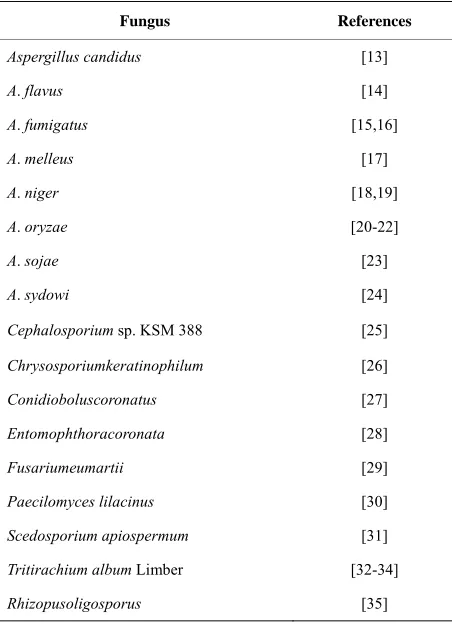
different alkaline proteases producing fungal species are
included in
Table 2.
Bacterial proteases:
Bacterial alkaline proteases have
and silk industries due to their high production capacity
and catalytic activity. Bacterial alkaline proteases are
characterized by their high activity at alkaline pH (8 -
12), with optimal temperature between 50
˚
C and 70
˚
C.
These properties of bacterial alkaline proteases make
them suitable for use in the detergent industry. Prominent
bacteria producing proteases are displayed in the
Table
3
.
Alkaline
proteases from
Bacillus
spp.:
Alkaline
pro-teases are of considerable interest in view of their
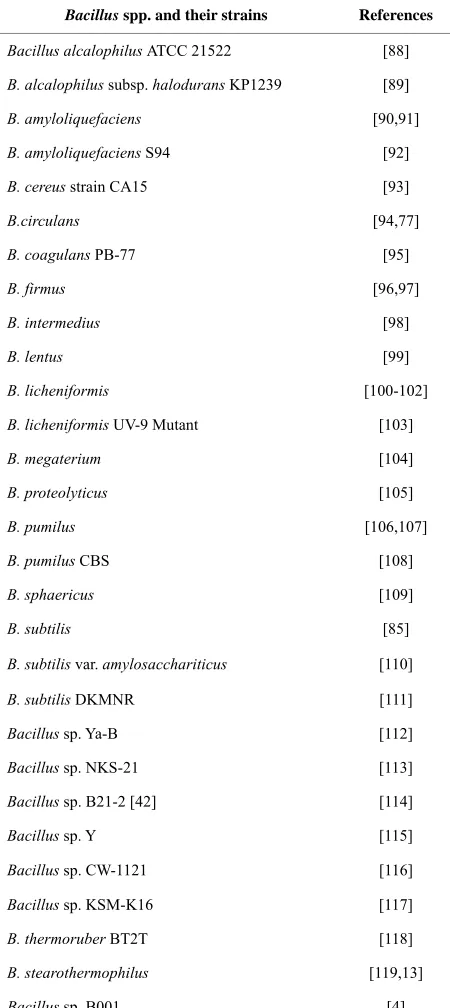
activ-ity and stabilactiv-ity at alkaline pH. Of all the alkalophilic
microorganisms, members of the genus
Bacillus
were
found to be predominant and a prolific source of alkaline
proteases (
Table 4
). Alkaline proteases are a physiolo-
[image:4.595.303.536.104.675.2]gically and commercially important group of enzymes
used primarily as detergent additives. They play a speci-
fic catalytic role in the hydrolysis of proteins. Alkaline
protease from
Bacillus
species RGR-14 shows silk degum-
ming efficiency [76].
B. firmus
MTCC7728 produces ex-
tracellular alkaline protease, with great potential in vari-
ous industries, and several processes like silver recovery,
bioremediation and protein hydrolysate production [77].
Three intracellular proteases were identified from
sporulated culture of
Bacillus thuringiensis-
subsp.
tene-brionis
by fractionation with ammonium sulfate; of these,
one with 81 kDa was identified as metalloprotease hav
Table 2. Major fungi producing alkaline proteases.
Fungus References
Aspergillus candidus [13]
A. flavus [14]
A. fumigatus [15,16]
A. melleus [17]
A. niger [18,19]
A. oryzae [20-22]
A. sojae [23]
A. sydowi [24]
Cephalosporium sp. KSM 388 [25]
Chrysosporiumkeratinophilum [26]
Conidioboluscoronatus [27]
Entomophthoracoronata [28]
Fusariumeumartii [29]
Paecilomyces lilacinus [30]
Scedosporium apiospermum [31]
Tritirachium album Limber [32-34]
Rhizopusoligosporus [35]
Table 3. Major bacteria producing proteases.
Organism References
Alteromonas sp. [36]
Arthrobacterprotophormiae [37]
Brevibacterium linens [38,39]
Hyphomonasjannaschiana VP 3 [40]
Lactobacillus helveticus [41]
Malbrancheapulchella var. sulfurea [42]
Microbacterium sp. [43]
Nocardiopsisdassonvillei [44,45]
Oerskoviaxanthineolytica TK-1 [46]
Pimelobacter sp. 2483 [47]
Pseudomonas aeruginosa [48]
Pseudomonas maltophilia [49]
Pseudomonas sp.SJ320 [50]
Salinivibrio sp. Strain AF-2004 [51]
Staphylothermusmarinus [52]
Streptomyces isolate EGS-5 [53]
Streptomyces microflavus [54]
Streptomyces moderatus [55]
Streptomyces rectus [56]
Streptomyces rectus var. proteolythicus [57]
Streptomyces rimosus [58]
Streptomyces sp. YSA-130 [59,60]
Thermoactinomycessp. [61,62]
Thermoactinomycesthalpophilus THM1 [63]
Thermobacteroidesproteolyticus [64]
Thermococcusceler, T. stetteri, T. litoralis [65]
Thermomonosporafusca [66,67]
Thermusaquaticus YT-1 [68]
Thermussp. strain Rt41A [69]
Torulathermophila [70]
Vibrio alginolyticus [71-73]
Vibrio metschnikovii RH 530 [74]
Xanthomonasmaltophila [75]
ing major proteolytic activity at 60
˚
C.
B. thuringiensis
[image:4.595.59.285.425.737.2]Table 4. Alkaline protease-producing Bacillus species.
Bacillus spp. and their strains References
Bacillus alcalophilus ATCC 21522 [88]
B. alcalophilus subsp. halodurans KP1239 [89]
B. amyloliquefaciens [90,91]
B. amyloliquefaciens S94 [92]
B. cereus strain CA15 [93]
B.circulans [94,77]
B. coagulans PB-77 [95]
B. firmus [96,97]
B. intermedius [98]
B. lentus [99]
B. licheniformis [100-102]
B. licheniformis UV-9 Mutant [103]
B. megaterium [104]
B. proteolyticus [105]
B. pumilus [106,107]
B. pumilus CBS [108]
B. sphaericus [109]
B. subtilis [85]
B. subtilis var. amylosacchariticus [110]
B. subtilis DKMNR [111]
Bacillus sp. Ya-B [112]
Bacillus sp. NKS-21 [113]
Bacillus sp. B21-2 [42] [114]
Bacillus sp. Y [115]
Bacillus sp. CW-1121 [116]
Bacillus sp. KSM-K16 [117]
B. thermoruber BT2T [118]
B. stearothermophilus [119,13]
Bacillus sp. B001 [4]
viour of the synthesis of intracellular protease was stu-
died by gelatin zymography in
B
.
thuringiensis
(
Btk
)
strains HD1,
Btk
HD73 [79]. Alkaline protease was
puri-fied and characterized from a mutant of
B. polymyxa
[80].
Several proteases may be produced by the same strain
under various culture conditions.
Alkaline proteases are generally produced by
sub-merged fermentation (SmF). In addition, solid-state fer-
mentation (SSF) processes have been exploited to a
lesser extent for the production of these enzymes [81,82].
Research efforts have been directed mainly toward the
evaluation of the effects of various carbon and
nitroge-nous nutrients as cost-effective substrates on the yield of
enzymes, requirement of divalent metal ions in the
fer-mentation medium and optimization of environmental
and fermentation parameters such as pH, temperature,
aeration and agitation. In addition, no defined medium
has been established for the best production of alkaline
proteases from different microbial sources. Each
organ-ism or strain has its own special conditions for maximum
enzyme yield. Production of an enzyme exhibits a
char-acteristic relationship with regard to the growth phase of
that organism. The synthesis of protease in
Bacillus
spe-cies is controlled by numerous complex mechanisms
operative during the transition state between exponential
growth and the stationary phases [83]. The extracellular
enzyme production pattern is varied with the
Bacillus
strains. There is a little or no enzyme production occurs
during the exponential growth phase [84]. However, in
the case of
B
.
subtilis
ATCC strain 14416 [85] and
B
.
sphaericus
strain BSE 18 [86], enzyme production was
growth-associated and it occurs at the mid-exponential
phase, and often a rapid auto deactivation process was
observed after the culture reached the maximum enzyme
activity. During alkaline protease production, it was also
observed that the pH of the fermented medium dropped
from alkaline to acidic; for instance, from pH 10.1 to 8.5
in the case of an alkalophilic
Bacillus
strain Ya-B [87].
Bacillus thuringiensis
proteases:
Bacillus
is a gram
+ve bacterium and is widely distributed in nature.
Bacil-
lus
spp., are important industrial tools for a variety of
reasons, including their capacity to secrete proteins in to
the extra-cellular media and their GRAS (generally
re-garded as safe) status with the food and drug
administra-tion [120]. This genus includes a variety of commercially
important species, responsible for the production of a
range of products including enzymes, fine biochemical
like antibodies and insecticides. Most species are
harm-less to humans and animals and only a few pathogens are
known.
B
.
thuringiensis
(
Bt
), one of the most widely
studied bacterium produces a potent insecticidal protein,
which makes it a successful biopesticide.
Bt
is also an
excellent source of proteases;
israelensis
,
kurstaki
and-tenebrionis
are the major sub-species of
Bt
(with many
strains) capable of producing different proteases [78,
121-127].
5. GENERAL PROPERTIES OF
ALKALINE PROTEASES
and 11, with a few exceptions exhibiting higher pH
op-tima, up to a pH range 12 - 13. The optimum temperature
of alkaline proteases ranges from 50
˚
C to 70
˚
C.
Interest-ingly, the enzyme from an alkalophilic
Bacillus
sp. B189
showed an exceptionally high optimum temperature of
85
˚
C. Alkaline proteases from
Bacillus
sp.,
Streptomyces
sp. and
Thermus
sp. are quite stable at high temperatures,
and the addition of CaCl2 further enhances enzyme
thermostability [129]. In general, alkaline proteases
re-quire metal ions for their maximum activity. The most
commonly used metal ions are Ca
2+, Mg
2+and Mn
2+.
Ca
2+ion is also known to play a major role in enzyme
stabilization by increasing the activity and thermal
sta-bility of alkaline proteases at higher temperatures [130,
62]. Other metal ions such as Ba
2+, Mn
2+, Mg
2+, Co
2+,
Fe
3+and Zn
2+are also used for stabilizing proteases [39].
These metal ions protect the enzyme against thermal
denaturation and play a vital role in maintaining the
ac-tive confirmation of the enzyme at higher temperatures.
Presence of Ca
2+is known to activate proteases by
in-creasing thermostability [131,132]. Metal ions like Hg
2+;
Cu
2+, Ag
2+, Fe
2+and Zn were found inhibitory to major-
ity of proteases [133,134].
6. MOLECULAR MASSES OF
PROTEASES FROM
BACILLUS
SPP
Alkaline proteases have different ranges of molecular
masses such as 45 kDa, 36 kDa for the proteases from
the wild strains and 40 kDa for the standard
B. subtilis
ATCC 6633 strain [135; 30 - 33 kDa [29], 40 kDa
[136] are other predominant proteases from
Bacillus
. In
general, molecular mass of protease is ranged between
15 and 45 kDa [10,137]. In some
Bacillus
sp., multiple
electrophoretic forms of alkaline proteases were
ob-served. The multiple forms of these enzymes may be due
to the non-enzymatic, irreversible deamination of
gluta-mine or asparagine residues in the protein molecules, or
of autoproteolysis.
Table 5
gives a summary of the
mo-lecular masses characterized from various species of
Ba-cillus
.
7. OVERVIEW ON THE INDUSTRIAL
APPLICATIONS OF PROTEASES
Proteases have a large variety of applications, mainly
in the detergents, leather processing, metal recovery,
medical purposes, food processing, feeds, and chemical
industries, as well as in waste treatment (
Table 6
).
Detergent additives:
The history of detergent
[image:6.595.309.538.111.308.2]en-zymes dates back to 1914, when two German scientists,
Rohm and Haas used pancreatic proteases and sodium
carbonate in washing detergents. The product was named
Burnus. The first detergent containing the bacterial en-
zyme was introduced into the market in 1956 under the
trade name Bio-40. An alkaline protease, alcalase, was
Table 5. Molecular masses of proteases characterized from
Bacillus spp.
Source Molecular
Weight (kDa) Reference
Bacillus sp. No. AH-101 30 [138]
B. pumilus MK6-5 28 [133]
B. pumilus UN-31-C-42 32 [139]
B. stearothermophilus F1 33.5 [119]
Bacillus licheniformis MIR29 25/40 [140]
Bacillus sp. NKS-21 30 [141]
Bacillus sp. SSR1 29, 35 [142]
Bacillus sp. GX6638 36 [143]
Bacillus pseudofirmus AL-89 24 [144]
Bacillus sp. B18 28, 30 [145]
effectively incorporated in detergent powder and was
marketed by Novo Industry, Denmark under the trade
name Biotex in 1963. Today, detergent enzymes account
for 89% of the total protease sales in the world; and a
significant share of the market is captured by subtilisins
and alkaline proteases from many
Bacillus
species [17,
32,74].
Leather tanning:
Leather processing involves several
steps such as soaking, dehairing, bating, and tanning. The
conventional methods of leather processing involve
haz-ardous chemicals such as sodium sulfide, which create
problems of pollution and effluent disposal. The use of
enzymes as alternatives to chemicals has proved suc-
cessful in improving leather quality and in reducing en-
vironmental pollution. Proteases are used for selective
hydrolysis of non-collagenous constituents of the skin
and for removal of non-fibrillar proteins such as albu-
mins and globulins; at present, alkaline proteases with
hydrated lime and sodium chloride are used for de-hair-
ing, which resulted in a significant reduction in the
amount of waste water generated
.
In addition, studies
carried out by different workers have demonstrated the
successful use of alkaline proteases in leather tanning
from
Aspergillus flavus
,
Streptomyces
sp.,
B
.
amyloliq-uefaciens
and
B
.
subtilis
[8].
Silver recovery:
Alkaline proteases are used in silver
recovery from used X-ray films. Used X-ray film
con-tains approximately 1.5% to 2.0% (by weight) silver in
its gelatin layers. The silver recovery by burning film
causes a major environmental pollution problem; hence
the enzymatic hydrolysis of the gelatin layers on the
X-ray film enables the recycling of both silver and
poly-ester film base [75].
Food
industry:
Alkaline proteases have been
Table 6. Common protease products from Bacillus spp. available in the market.
Organism Trade names Manufacturer
Bacillus licheniformis Alcalase Novo Nordisk, Denmark
Alkalophilic Bacillus sp. Savinase, Esperase Novo, Nordisk, Denmark
Alkalophilic Bacillus sp. Maxacal, Maxatase Gist-brocades, The Netherlands
Alkalophilic Bacillus sp. Opticlean, Optimase Solvay Enzymes GmbH, Germany
Alkalophilic Bacillus sp. Proleather Amano Pharmaceuticals Ltd., Japan
Aspergillus sp. Protease P Amano Pharmaceuticals Ltd., Japan
B. amyloliquefaciens (savinase) Durazym Novo Nordisk, Denmark
Alkalophilic Bacillus sp. Maxapem Solvay Enzymes GmbH, Germany
Variant of B. lentus Purafect Genencor International, Inc
of the global sales of industrial enzymes is over 3 billion
USD, of which proteases account for about 60% of the
total sales. Microbial alkaline proteases already play a
pivotal role in several industries, mainly in the detergents,
leather processing, silver recovery, medical purposes,
food processing, feeds, and chemical industries, as well
as in waste treatment their potential is much greater and
their applications in novel processes are likely to
in-crease in the near future. Advancement in biotechnology
offers a constructive position for the development of
proteases and will continue to facilitate their applications
to provide a sustainable environment for improving the
quality of human life.
baking, preparation of soya hydrolysates, and meat
ten-derization [140]. Proteases are invariably used in tonics,
especially for indigestion.
Waste
treatment:
Dalev in 1994 [146] reported an
enzymatic process using a
B
.
subtilis
alkaline protease in
the processing of waste feathers from poultry slaughter-
houses. Feathers constitute approximately 5% of the
body weight of poultry and can be considered as a high
protein source for food and feed, provided their rigid ke-
ratin structure is completely destroyed. Pretreatment with
NaOH, mechanical disintegration, and enzymatic hy-
drolysis resulted in total solubilization of the feathers.
The ended product was a heavy, grayish powder with a
very high protein content which could be used as a feed
additive. Similarly, many other keratinolytic alkaline pro-
teases were used in feed technology for the production of
amino acids.
9. PROSPECTS
Heterogeneity of proteases is its uniqueness, which
odds it out from its counterparts; of course, which makes
them versatile biocatalyst too. Nevertheless, its full
po-tential has not yet been tapped. In fact, its prospects in
waste management are underutilized, especially in urban
settings. The engineering of proteases for novel or
com-bined catalytic abilities with long half-life seems to be a
less addressed area. Protease-based industry looks
for-ward to receiving engineered fusion proteases with
mul-tiple activities combined in one. Thus, the ever-growing
protease market demands efficient and fast-acting
prote-ases at cheaper price.
Other
uses:
Besides their industrial and medicinal
ap-plications, proteases play an important role in basic
re-search. Their selective peptide bond cleavage is used in
the elucidation of structure-function relationship, in the
synthesis of peptides, and in the sequencing of proteins.
B
.
thuringiensis
is used for the integrated pest
manage-ment in forestry. The derivatives of
Bt
strain HD1 subsp.
kurstaki
have widely been used to control the forest pests
such as the gypsy moth (
Lymantriadispar
),
spruce
bud-worm (
Choristoneurafumiferana
),
the pine processionary
moth (
Thaumetopoeapityocampa
),
the European pine
shoot moth (
Rhyacioniabuoliana
) and the nun moth
(
Lymantriamonacha
) [147].
10. ACKNOWLEDGEMENTS
JVN is grateful to the University Grants Commission, Government of India for granting Rajiv Gandhi National Research Fellowship, SRB is grateful to the University of Calicut for granting the University Re-search Fellowship. There exists no conflict of interest.
8. CONCLUSIONS
Though this review gives a glimpse into the proteases,
it mainly focused on the general aspects of proteases
giving special emphasis on to the proteases from
Bacillus
spp., especially of alkaline proteases. Proteases play a
decisive role in detergent, pharmaceutical, leather, food
and agricultural industries. Currently, the estimated value
REFERENCES
neutral metalloprotease by fungal mixed substrate fer-mentation. Food Technology and Biotechnology, 43,
313-319.
[2] Shafee, N., Aris, S. N., Rahman, R.Z.A., Basri, M. and Salleh, A.B. (2005) Optimization of Environmental and Nutritional Conditions for the Production of Alkaline Protease by a Newly Isolated Bacterium Bacillus cereus Strain 146. Journal of Applied Sciences Research, 1, 1-8.
[3] Rao, M.B., Tanksale, A.M., Ghatge, M.S. and Deshpande, V.V. (1998) Molecular and biotechnological aspects of microbial proteases. Microbiology and Molecular Biology Reviews, 62, 597-635
[4] Deng, A.H, Wu, J., Zhang,Y., Zhang, G.Q. and Wen, T.Y. (2010) Purification and characterization of a surfactant- stable high-alkaline protease from Bacillus sp. B001. Bioresource Technology, 101, 7100-7106.
doi:10.1016/j.biortech.2010.03.130
[5] Rawlings, N.D. and Barrett, A.J. (1993) Evolutionary families of peptidases. Biochemical Journal, 290, 205-
218.
[6] Ward, O.P. (1985) Proteolytic enzymes. In: Moo-Young, M. Ed., Comprehensive biotechnology, the practice of biotechnology current commodity products, Pergamon Press, Oxford, 3, 789-818.
[7] Adinarayana, K. and Ellaiah, P. (2002) Response surface optimization of the critical medium components for the production of alkaline protease by a newly isolated Ba-cillus sp. Journal of Pharmaceutical Sciences, 5, 272- 278.
[8] Schechler, I. and Berger, A. (1967) On the size of the
active site in proteases I papain. Biochemical and Bio-physical Research Communications, 27, 157-162. doi:10.1016/S0006-291X(67)80055-X
[9] Secor, Jr. E.R., Carson, W.F., Cloutier, M.M., Guernsey, L.A., Schramm, C.M., Wu, C.A. and Thrall, R.S. (2005) Bromelain exerts anti-inflammatory effects in an ovalbu-min-induced murine model of allergic airway disease. Cellular Immunology, 237, 68-75.
doi:10.1016/j.cellimm.2005.10.002
[10] Kumar, C.G., Takagi, H. (1999) Microbial alkaline prote-ases: From a bioindustrial viewpoint. Biotechnology Ad-vances, 17, 561-594.
doi:10.1016/S0734-9750(99)00027-0
[11] Godfrey, T. and West, S. (1996) Introduction to industrial enzymology. Industrial enzymology, Mac. Millan Press, London, 1-8.
[12] Hartley, B.S. (1960) Proteolytic enzymes. Annual Review of Biochemistry, 29, 45-72.
doi:10.1146/annurev.bi.29.070160.000401
[13] Nasuno, S. and Ohara, T. (1971) Hyperproduction of proteinase and some hydrolytic enzymes by mutants of Aspergillus sojae. Agricultural and Biological Chemistry,
35, 829-835. doi:10.1271/bbb1961.35.829
[14] Malathi, S. and Chakraborty, R. (1991) Production of alkaline protease by a new Aspergillus flavus isolate un-der solid substrate fermentation conditions for use as a depilation agent. Applied Environmental Microbiology,
57, 712-716.
[15] Monod, M., Togni, G., Rahalison, L., Frenk, E. (1991) Isolation and characterization of an extracellular alkaline protease of Aspergillus fumigatus. Journal of Medical Microbiology, 35, 23-28.
doi:10.1099/00222615-35-1-23
[16] Larcher, G., Bouchara, J.P., Annaix, V., Symoens, F., Chabasse, D. and Tronchin, G. (1992) Purification and characterization of a fibrinogenolytic serine proteinase from Aspergillus fumigatus culture filtrate. FEBS Letters,
308, 65-69. doi:10.1016/0014-5793(92)81052-N
[17] Luisetti, M., Piccioni, P.O., Dyne, K., Donnini, M., Bul-gheroni, A., Pasturenzi, L., Donnetta, A. M. and Peona, V. (1991) Some properties of the alkaline proteinase from Aspergillus melleus. International Journal of Tissue Reac- tion, 13, 187-192.
[18] Barthomeuf, C., Pourrat, H. and Pourrat, A. (1992) Col-lagenolytic activity of a new semi-alkaline protease from Aspergillus niger. Journal of Fermentation and Bioengi-neering, 73, 233-236.
doi:10.1016/0922-338X(92)90168-T
[19] Dubey, R., Adhikary, S., Kumar, J. and Sinha, N. (2010) Isolation, Production, Purification, Assay and Characteri-zation of Alkaline Protease Enzyme from Aspergillus ni- ger and its Compatibility with Commercial Detergents. Developmental Microbiology and Molecular Biology, 1,
75-94.
[20] Nakadai, T., Nasuno, S. and Iguchi, N. (1973) Purifica-tion and properties of alkaline proteinase from Aspergil- lus oryzae Agricultural and Biological Chemistry, 37, 2685-2694.
[21] Murakami, K., Ishida, Y., Masaki, A. and Tatsumi, H. (1991) Isolation and characterization of the alkaline pro-tease gene of Aspergillus oryzae. Agricultural and Bio-logical Chemistry, 55, 2807-2711.
doi:10.1271/bbb1961.55.2807
[22] Murthy, M.V.R. and Lonsane, B.K. (1993) Effect of the composition of conidial inoculum development agar me-dia on promoting production of proteinase by Aspergillus oryzae CFTRI 1480 in solid state fermentation system. Chemie, Mikrobiologie, Technologie der Lebensmittel, 15,
179-184.
[23] Hayashi, K., Fukushima, D. and Mogi, K. (1967) Isola-tion of alkaline proteinase from Aspergillus sojae in ho-mogeneous form. Agricultural and Biological Chemistry,
31, 1237-1241. doi:10.1271/bbb1961.31.1237
[24] Danno, G. and Yoshimura, S. (1967) Studies on an alka-line proteinase of Aspergillus sydowi. Part I. Purification and some properties of the proteinase. Agricultural and Biological Chemistry, 31, 1151-1158.
doi:10.1271/bbb1961.31.1151
[25] Tsuchiya, K., Arai, T., Seki, K. and Kimura, T. (1987) Purification and some properties of alkaline proteinases from Cephalosporium sp. KSM388. Agricultural and Biological Chemistry, 51, 2959-2965.
doi:10.1271/bbb1961.51.2959
doi:10.1007/BF00367668
[27] Sutar, I.I., Srinivasan, M.C. and Vartak, H.G. (1991) A low molecular weight alkaline proteinase from Co-nidioboluscoronatus. Biotechnology Letters, 13, 119-124. doi:10.1007/BF01030462
[28] Jonsson, A.G. (1968) Protease production by species of Entomophthora. Applied Microbiology, 16, 450-457.
[29] Olivieri, F., Zanetti, M.E.and Oliva, C.R., Covarrubias, A. A. and Casalongu´e, C.A. (2002) Characterization of an extracellular serine protease of Fusariumeumartii and its action on pathogenesis related proteins. European Jour-nal of Plant Pathology, 108, 63-72.
doi:10.1023/A:1013920929965
[30] Den Belder, E., Bonants, P.J.M., Fitters, P.F.L. and Waal-wijk, C. (1994) New alkaline serine protease of Paecilo-myceslilacinus. European Patent Application, No. EP 0623672. Beck CM.
[31] Larcher, G., Cimon, B., Symoens, F., Tronchin, G., Cha-basse, D. and Bouchara, J.P. (1996) A 33 kDa serine pro-teinase from Scedosporiumapiospermum. Biochemical Journal, 315, 119-126
[32] Jany, K.D. and Mayer, B. (1985) Proteinase K from Tritirachium album Limber I. Molecular mass and se-quence around the active site serine residue. Biological chemistry Hoppe-Seyler, 366, 485-492.
doi:10.1515/bchm3.1985.366.1.485
[33] Ebeling, W., Hennrich, N., Klockow, M., Metz, H., Orth, H. D. and Lang, H. (1974) Proteinase K from Triti-rachium album Limber. European Journal of Biochemis-try, 47, 91-97. doi:10.1111/j.1432-1033.1974.tb03671.x
[34] Samal, B.B., Karan, B. and Stabinsky, Y. (1990) Stability of two novel serine proteinases in commercial laundry detergent formulations. Biotechnology and Bioengineer-ing, 35, 650-652. doi:10.1002/bit.260350611
[35] Devi, P.R., VijayaRaghavan, P., Vasudheven, I., Joshua, L and VijayaKumar, M. (2011) Purification and Charac- terization of Protease from Rhizopusoligosporus. Interna- tional Journal of Biological Technology, 2, 46-49.
[36] Yeo, I.O., Choi, S.H., Lee, J.S. and Kim, C.J. (1995) Characteristics of an alkaline protease from Alteromonas sp. Agricultural Chemistry and Biotechnology, 38, 106-
110.
[37] Takegawa, K., Mai, L.H., Miyauchi, C. and Iwahara, S. (1993) Purification and characterization of alkaline pro- teinase from Arthrobaderprotophormiae. Technical Bul- letin of Faculty of Agriculture, Kagawa University, 45,
115-120.
[38] Juhasz, O. and Skarka, B. (1990) Purification and cha- racterization of an extracellular proteinase from Brevibac- teriurn linens. Canadian Journal of Microbiology, 36,
510-512. doi:10.1139/m90-089
[39] Rattray, F.P., Bockelmann, W. and Fox, P.F. (1995) Puri- fication and characterization of an extracellular proteinase from Brevibacterium linens ATCC 9174. Applied Envi- ronmental Microbiology, 61, 3454-345.
[40] Shi, J., Coyne, V.E. and Weiner, R.M. (1997) Identifica- tion of an alkaline metalloprotease produced by the hy- drothermal vent bacterium Hyphomonas jannaschiana
VP3. Microbios, 91, 15-26.
[41] Valasaki, K., Staikou, A., Theodorou, L.G., Charamopou- lou, V., Zacharaki, P. and Papamichael, E.M. (2008) Puri- fication and kinetics of two novel thermophilic extracel- lular proteases from Lactobacillus helveticus, from kefir with possible biotechnological interest. Bioresource Tech- nology, 99, 5804-5813.
doi:10.1016/j.biortech.2007.10.018
[42] Ong, P.S. and Gaucher, M. (1972) Production, purifica- tion and characterization of thermomycolase, the extra- cellular serine protease of the thermophilic fungus Mal- branchea pulchella var. sulfurea. Canadian Journal of Microbiology, 22, 165-176. doi:10.1139/m76-023
[43] Gessesse, A. and Gashe, B.A. (1997) Production of alka- line protease by an alkalophilic bacteria isolated from an alkaline soda lake. Biotechnology Letters, 19, 479-481. doi:10.1023/A:1018308513853
[44] Tsujibo, H., Miyamoto, K., Hasegawa, T. and Inamori, Y. (1990) Purification and characterization of two types of alkaline serine proteases produced by an alkalophilic Ac- tinomycete. Journal of Applied Bacteriology, 4, 520-529.
[45] Kim, M. J., Chung, H. S. and Park, S. J. (1993) Properties of alkaline protease isolated from Nocardiopsis dasson- vilei. Korean Biochemical Journal, 26, 81-85.
[46] Saeki, K., Iwata, J., Watanabe, Y. and Tamai, Y. (1994) Purification and characterization of an alkaline protease from Oerskovia xanthineolytiw TK-I. Journal of Fermen- tation and Bioengineering, 77, 554-556.
doi:10.1016/0922-338X(94)90128-7
[47] Oyama, H., Kinjoh, M., Watari, M. and Murao, S. (1997) Purification and characterization of an alkaline protease produced by Pimelobacter sp. Z-483. Journal of Fermen- tation and Bioengineering, 84, 351-353.
doi:10.1016/S0922-338X(97)89258-6
[48] Tang, X.Y., Wu, B., Ying, H. J. and He, B. F. (2010) Bio- chemical properties and potential application of a solvent- stable protease from the high-yield protease producer Pseudomonas aeruginosa PT 121. Applied Biochemistry and Biotechnology, 160, 1017-1031.
doi:10.1007/s12010-009-8665-1
[49] Kobayashi, T., Ogasawara, A., Ito, S. and Saitoh, M. (1985) Purification and some properties of alkaline pro- teinase produced by Pseudomonas maltophila. Agricultu- ral and Biological Chemistry, 49, 693-698.
doi:10.1271/bbb1961.49.693
[50] Cheong, C., Chun, S.S. and Kim, Y.H. (1993) Production and properties of an alkaline protease from Pseudomonas sp. SJ-320. Korean Bidern Journal, 26, 479-484.
[51] Heidari, H.R.K., Ziaee, A.A., Schaller, J. and Amoozegar, M.A. (2007) Purification and characterization of an extra- cellular haloalkalineprotese produced by the moderately halophylic bacterium, Salinivibrio sp. strain AF-2004. Enzyme and Microbial Technology, 40, 266-272. doi:10.1016/j.enzmictec.2006.04.006
[52] Antranikian, G. and Klingeberg, M. (1991) Thermostable protease from Staphylothermus. PCT Patent Application, WO 9119791.
protease from an alkaline-resistant Streptomyces isolate EGS-5. International Journal of Academic Research, 3, 393.
[54] Rifaat, H.M., Hassanein, S.M., El-Said, O.H., Saleh, S.M. and Selim, M.S.M. (2006) Purification and characterisa- tion of extracellular neutral protease from Streptomyces microflavus. Arab Journal of Biotechnology, 9, 51-60.
[55] Chandrasekaran, S. and Dhar, S.C. (1983). A low-cost method for the production of extracellular alkaline protei- nase using tapioca starch. Journal of Fermentation Tech- nology, 61, 511-514.
[56] Peter, B. and Campbell, L.L. (1974) Properties of two ho- mologous alkaline proteases from Streptomyces rectus. Journal of Bacteriology, 120, 1109-1115.
[57] Mizusawa, K., Ichishima, E. and Yoshida, F. (1969) Pro- duction of thermostable alkaline protease by thermophilic Streptomyces. Applied Microbiology, 3, 366-371.
[58] Yang, S.S. and Wang, J.Y. (1999) Protease and amylase production of Steptomyces rimosus in submerged and so- lid state cultivations. Botanical Bulletin of Academia Si- nica, 40, 259-265
[59] Yun, S.W., Lee, K.P., Yu, J.H., Shin, C.S. and Oh, D.H. (1989) Purification and properties of alkaline protease from Streptomyces sp. YSA-130. Korean Journal of Ap- plied Microbiology and Bioengineering, 17, 358-364.
[60] Yum, D.Y., Chung, H.C., Bai, D.H., Oh, D.H. and Yu, J.H. (1994) Purification and characterization of alkaline serine protease from an alkalophilic Streptomyces sp. Bioscience Biotechnology and Biochemistry, 58, 470-474.
doi:10.1271/bbb.58.470
[61] Tsuchiya, K., Nakamura, Y., Sakashita, H. and Kimura, T. (1992) Purification and characterization of a thermostable alkaline protease from alkalophilic Thermoactinomyces sp. HS682. Bioscience, Biotechnology, and Biochemistry,
56, 246-250. doi:10.1271/bbb.56.246
[62] Lee, J.K., Kim, Y.O., Kim, H.K., Park, Y.S. and Oh, T.K. (1996) Purification and characterization of a thermostable alkaline protease from Thermoactinomyces sp. E79 and the DNA sequence of the encoding gene. Bioscience, Biotechnology, and Biochemistry, 60, 840-846.
doi:10.1271/bbb.60.840
[63] Anderson, J.K., Grimble, G.K. and Cowan, D.A. (1997) A process for producing a thermostable proteolytic enzyme from Thermoactinomyces thalpophilus THM1. PCT Pa- tent Application, WO 23605.
[64] Antranikian, G. and Klingeberg, M. (1991) Thermostable protease from Thermobacteroides. PCT Patent Applica- tion, WO 9119790.
[65] Antranikian, G. and Klingeberg, M. (1991). Thermostable protease from Thermococcus. PCT Patent Application, WO 9119792.
[66] Desai, A.J. andDhalla, S.A. (1969) Purification and pro- perties of a proteolytic enzyme from Thermophilic acti- nomycetes. Journal of Bacteriology, 100, 149-155.
[67] Gusek, T.W. and Kinsella, J. E. (1987) Purification and characterization of the heat-stable serine proteinase from Thermomonospora fusca YX. Biochemistry Journal, 246, 511-517
[68] Matsuzawa, H., Tokugawa, K., Hamaoki, M., Mioguchi, M., Taguchi, H., Terada, I., Kwon, S.T. and Ohta, T. (1988) Purification and characterization of aqualysin I (a thetmophilic alkaline serine protease) produced by The- mus aquaticus YT-I. European Journal of Biochemistry,
171, 441-447. doi:10.1111/j.1432-1033.1988.tb13809.x
[69] Peek, K., Daniel, R.M., Monk, C., Parker, L. and Cool- bear, T. (1992) Purification and characterization of a ther- mostable proteinase isolated from Thermus sp. strain Rt41A. European Journal of Biochemistry, 207, 1035-
1044. doi:10.1111/j.1432-1033.1992.tb17140.x
[70] Zakirov, M.Z., Shchelova, S.S. and Karavaeva, N.N. (1975) Torulathermophila, strain UzPT-1—A thermo- philic producing agent of proteolytic enzymes. Prikl Bio- khim Mikrobiol, 11, 686-690.
[71] Deane, S.M., Robb, F.T. and Woods, D.R. (1987) Produc- tion and activation of a SDS-resistant alkaline serine exo- protease of Vibrio alginolyticus. Journal of General Mi- crobiology, 133, 391-398.
[72] Long, S., Mothibelli, M.A., Robb, F.T. and Woods, D.R. (1981) Regulation of extracellular alkaline protease acti- vity by histidine in a collagenolytic Vibrio alginolytcus strain. Journal of General Microbiology, 127, 193-199.
[73] Deane, S.M., Robb, F.T. and Woods, D.R. (1986) Isola- tion and characterization of a Vibrio alginolytius mutant that overproduces extracellular proteases. Journal of Ge- neral Microbiology, 132, 893-898.
[74] Kwon, Y.T., Kim, J.O., Moon, S.Y., Lee, H.H. and Rho, H.M. (1994) Extracellular alkaline protease from alkalo- philic Vibrio metschnikovii strain RH530. Biotechnology Letters, 16, 413-418. doi:10.1007/BF00245062
[75] Debette, J. (1991) Isolation and characterization of an extracellular proteinase produced by a soil strain of Xan- thomonas maltophila. Current Microbiology, 22, 85-90. doi:10.1007/BF02105381
[76] Puri, S. (2001) An alkaline protease from a Bacillus sp.: Production and potential applications in detergent for- mulation and degumming of silk 2001. Master’s Thesis, University of Delhi, New Delhi.
[77] Rao, K. and Narasu, L. (2007) Alkaline protease from Ba- cillus firmus 7728. African Journal of Biotechnology, 6, 2493-2496
[78] Hotha, S. and Banik, R.M. (1997) Production of alkaline protease by Bacillus thuringiensis H14 in aqueous two- phase systems. Journal of Chemical Technology and Bio- technology, 69, 5-10.
doi:10.1002/(SICI)1097-4660(199705)69:1<5::AID-JCT B661>3.0.CO;2-I
[79] Reddy, Y.C. and Venkateswaeralu, G. (2002) Intracellular protease of Bacillus thuringiensis subsp. Kurstaki. And protease deficient mutant Btk-q. Current Microbiology,
45, 405-409. doi:10.1007/s00284-002-3767-9
[80] Madan, M., Dhillon, S. and Singh, R. (2002) Purification and characterization of alkaline protease from a mutant of Bacillus polymyxa. Indian Journal of Microbiology, 42,
155-159.
by solid substrate fermentation. Journal of Microbiology and Biotechnology, 8, 7-16.
[82] George, S., Raju, V., Krishnan, M.R.V., Subramanian, T.V. and Jayaraman, K. (1995) Production of protease by Ba- cillus amyloliquefaciens in solid-state fermentation and its application in the unhairing of hides and skins. Proc-ess Biochemistry, 30, 457-462.
[83] Strauch, M.A. and Hoch, J.A. (1993) Transition-state regulators: Sentinels of Bacillus subtilis post-exponential phase gene expression. Molecular Microbiology, 7, 337- 342. doi:10.1111/j.1365-2958.1993.tb01125.x
[84] Frankena, J., Van Verseveld, H.W., Stouthamer, A.H. (1985) A continuous culture study of the exocellular pro-tease in Bacillus licheniformis. Applied Microbiology and Biotechnology, 22, 169-176. doi:10.1007/BF00253604
[85] Chu, I.M., Lee, C. and Li, T.S. (1992) Production and degradation of alkaline protease in batch cultures of Ba-cillus subtilis ATCC 14416. Enzyme and Microbial Tech-nology, 14, 755-761. doi:10.1016/0141-0229(92)90116-6
[86] Dumusois, C. and Priest, F.G. (1993) Extracellular serine protease synthesis by mosquito-pathogenic strains of Ba- cillus sphaericus. Journal of Applied Bacteriology, 75,
416-419. doi:10.1111/j.1365-2672.1993.tb02796.x
[87] Tsai, Y.C., Juang, R.Y., Lin, S.F., Chen, S.W., Yamasaki, M. and Tamura, G. (1988) Production and characteriza- tion of an alkaline elastase produced by alkalophilic Ba- cillus Ya-B. Applied Environmental Microbiology, 54,
3156-3161.
[88] Horikoshi, K. (1971) Production of alkaline enzymes by alkalophilic microorganisms. Part I. Alkaline protease produced by Bacillus No. 221. Agricultural and Biologi- cal Chemistry, 35, 1407-1414.
doi:10.1271/bbb1961.35.1407
[89] Takii, Y., Kuriyama, N. and Suzuki, Y. (1990) Alkaline serine protease produced from citric acid by Bacillus al- calophilus subsp. Halodurans KP1239. Applied Microbi- ology and Biotechnology, 34, 57-62.
doi:10.1007/BF00170924
[90] George, S., Raju, V., Krishnan, M.R.V., Subramanian, T.V. and Jayaraman, K. (1995) Production of protease by Ba- cillus amyloliquefaciens in solid-state fermentation and its application in the unhairing of hides and skins. Pro- cess Biochemistry, 30, 457-462.
[91] El-Beih, F.M., Abu-Shady, M.R., Gamal, R.F. and Abd El-Rahim, M.K.I. (1991) Factors affecting the production of extracellular alkaline proteinase by two local isolates of B. amyloliquefaciens. Annals of Agricultural Sciences, 36, 363-376.
[92] Son, E.S. and Kim, J.I. (2002). Purification and Charac-terization of Caseinolytic Extracellular protease from Ba-cillus amyloliquefaciens S94. The Journal of Microbiol-ogy, 40, 26-32.
[93] Uyar, F., Porsuk, I., Kizil, G. and Yilmaz, E.I. (2011) Op- timal conditions for production of extracellular protease from newly isolated Bacillus cereus strain CA15. Eur- Asian Journal of BioSciences, 5, 1-9.
[94] Chislett, M.E. and Kushner, D.J. (1961) A strain of Ba- cillus circulans capable of growing under highly alkaline
conditions. Journal of General Microbiology, 24, 187-
190. doi:10.1099/00221287-24-2-187
[95] Gajju, H., Bhalla, T.C. and Agarwal, H.O. (1996) Ther- mostable alkaline protease from thermophilic Bacillus coagulans PB-77. Indian Journal of Microbiology, 36,
153-155.
[96] Landau, N.S., Egorov, N.S, Gornova, L.B., Krasovskaya, S.B. and Virnik, A.D. (1992) Immobilization of Bacillus firmus cells in cellulose triacetate fibres and films and their use in proteinase biosynthesis. Applied Biochemistry and Microbiology, 28, 84-88
[97] Moon, S.H. and Parulekar, S.J. (1991) A parametric study of protease production in batch and fed-batch cultures of Bacillus firmus. Biotechnology and Bioengineering, 37,
467-483. doi:10.1002/bit.260370509
[98] Itskovich, E.L., Znamenskaya, L.V., Balaban, N.P., Er- shova, T.A. and Leshchinskaya, I.B. (1995) Biosynthesis of alkaline proteinase by Bacillus intermedius. Microbi- ology, 64, 530-536.
[99] Bettel, C., Klupsch, S., Papendorf, G., Hastrup, S., Bran- ner, S. and Wilson, K.S. (1992) Crystal structure of the alkaline protease from Bacillus lentus at 1.4 angstrom resolution. Journal of Molecular Biology, 223, 427-445. doi:10.1016/0022-2836(92)90662-4
[100]vanPutten, A.B., Spitzenberger, F., Krezmer, G., Hitz-mann, B., Dors, M., Simutis, R. and Schügerl, K. (1996) Improvement of the production of subtilisin Carlsberg alkaline protease by Bacillus licheniformis by on-line process monitoring and control in a stirred tank reactor. Journal of Biotechnology, 49, 83-93.
doi:10.1016/0168-1656(96)01524-6
[101]Ageitos, J.M., Vallejo, J.A. and Sestelo, A.B.F. (2007) Pu- rification and characterization of a milk-clotting protease from Bacillus licheniformis strain USC13. Journal of Ap- plied Microbiology, 103, 2205-2213.
doi:10.1111/j.1365-2672.2007.03460.x
[102]Abuoul, E.H., Enein, A., Helmy, S. and El Azaly, Y. (2008) Optimization of the industrial production of alka- line protease by Bacillus licheniformis in different pro- duction scales. Australian Journal of Basic and Applied Sciences, 2, 583-593.
[103]Nadeem, M., Qazi, J.I., Iqbal, J. and Baig, S. (2009) Ef- fect of aeration and agitation rates on alkaline protease production by Bacillus licheniformis UV-9 mutant. Tur- kish Journal of Biochemistry, 34, 89-96.
[104]Yossana, S., Reungsang, A. and Yasuda, M (2006) Purifi- cation and characterization of alkaline protease from Ba- cillus megaterium isolated from thai fish, Scienceasia, 32,
1513-1874.
[105]Boyer, E.W. and Byng, G.S. (1996) Bacillus proteolyticus species which produce an alkaline protease. US Patent 5518917.
[106]Xiubao, Q., Hong, D., Ying, Y. and Ying, Y. (1990) Stu- dies on alkaline proteinase from alkalophilic Bacillus pu- milus. I. Some properties and applications. Acta Microbi- ologica Sinica, 30, 445-449.
pean Patent Application, EP 0572992.
[108]Jaouadi, B., Ellouz-Chaabouni, S., Rhimi, M., Bejar, S. (2008) Biochemical and molecular characterization of a detergent-stable serine alkaline protease from Bacillus pumilus CBS with high catalytic efficiency. Biochimie,
90, 1291-1305. doi:10.1016/j.biochi.2008.03.004
[109]Dumusois, C. and Priest, F.G. (1993) Extracellular serine protease synthesis by mosquito-pathogenic strains of Ba- cillus sphaericus. Journal of Applied Bacteriology, 75,
416-419. doi:10.1111/j.1365-2672.1993.tb02796.x
[110]Tsuru, D., Kira, H., Yamamoto, T. and Fukumoto, J. (1966) Studies on bacterial protease. Part XVI. Purifica- tion, crystallization and some properties of alkaline pro- tease of Bacillus subtilis var. amylosacchariticus. Agri- cultural and Biological Chemistry, 30, 1261-1268. doi:10.1271/bbb1961.30.1261
[111]Kezia, D., Chandrakala, G., Prasanthi, V., Naidu S.V. and Rao, M.N. (2011) Influence of different factors on pro- duction of purified protease by Bacillus subtilis DKMNR. International Journal of Pharma and Bio Sciences, 2, 73-85.
[112]Tsai, Y.C., Yamasaki, M., Yamamoto-Suzuki, Y. and Ta- mura, G. (1987) A new alkaline elastase of an alkalophilic Bacillus. Biochemistry International, 7, 577-583.
[113]Takagi, H., Kondou, M., Hisatsuka, T., Nakamori, S., Tsai, Y.C. and Yamasaki, M. (1992) Effects of an alkaline elas- tase from an alkalophilic Bacillus strain on the tenderiza- tion of beef meat. Journal of Agricultural and Food Chemistry, 40, 2364-2368. doi:10.1021/jf00024a008
[114]Fujiwara, N. and Yamamoto, K. (1987) Production of alkaline protease in a low-cost medium by alkalophilic Bacillus sp. and properties of the enzyme. Journal of Fer- mentation Technology, 65, 345-348.
doi:10.1016/0385-6380(87)90098-7
[115]Shimogaki, H., Takeuchi, K., Nishino, T., Ohdera, M., Kudo, T., Ohba, K., Iwama, M. and Irie, M. (1991) Puri- fication and properties of a novel surface-active agent and alkaline-resistant protease from Bacillus sp. Agricultural and Biological Chemistry, 55, 2251-2258.
doi:10.1271/bbb1961.55.2251
[116]Lee, W.J., Son, G.M. and Choi, C. (1991) Production and purification of alkaline protease from Bacillus sp. CW- 1121. Journal of the Korean Society of Food Science and Nutrition, 20, 388-394.
[117]Kobayashi, T., Hakamada, Y., Adachi, S., Hitomi, J., Yo- shimatsu, T., Koike, K., Kawai, S. and Ito, S. (1995) Pu- rification and properties of an alkaline protease from al- kalophilic Bacillus sp. KSM-K16. Applied Microbiology and Biotechnology, 43, 473-481.
doi:10.1007/BF00218452
[118]Manachini, P.L., Fortina, M.G. and Parini, C. (1988) Thermostable alkaline protease produced by Bacillus thermoruber, a new species of Bacillus. Applied Microbi-ology and BiotechnMicrobi-ology, 28, 409-413.
doi:10.1007/BF00268205
[119]Rahman, R.N.Z.A., Razak, C.N., Ampon, K., Basri, M., Yunus, W.M.Z. and Salleh, A.B. (1994) Purification and characterization of a heat-stable alkaline protease from Bacillus stearothermophilus Fl. Applied Microbiology
and Biotechnology, 40, 822-827. doi:10.1007/BF00173982
[120]Schallmey, M., Sing, A. and Ward, O.P. (2004) Develop- ments in the use of Bacillus species for industrial produc- tion. Canadian Journal of Microbiology, 50, 1-17. doi:10.1139/w03-076
[121]Andrews Jr., R.E., Bibilos, M.M. and Bulla Jr., L.A. (1985) Protease activation of the entemocidal protoxin of Bacillus thuringiensis subsp. kurstaki. Applied Environ- mental Microbiology, 50,737-742.
[122]Reddy, C.Y. and Venkateswaeralu, G. (2002) Intracellular protease of Bacillus thuringiensis subsp. Kurstaki. and protease deficient mutant Btk-q. Current Microbiology,
45, 405-409. doi:10.1007/s00284-002-3767-9
[123]Reddy, S.T., Kumar, S.K. and Venkatesweralu, G. (2000) Idetification and purification of the 69kDa intracellular protease involved in the proteolytic processing of the cry- stal δ-endotoxin of Bacillus thuringiensis sub sp tenebrio- nis. FEMS Microbiology Letters, 1837, 63-66.
[124]Zouari, N. and Jaoua, S. (1999) Production and charac- terization of metalloproteases synthesized concomitantly with δ-endotoxin by Bacillus thuringiensis subsp. kurs- taki strain grown on gruel-based media. Enzyme and Mi- crobial Technology, 25, 364-371.
doi:10.1016/S0141-0229(99)00054-X
[125]Reddy, Y.C. (2001) Studies on Bacillus thuringiensis pro- teases involved in the production of insecticidal toxins from protoxins. Ph.D. Thesis, Osmania University. [126]Zouari, N., Achour, O. and Jaoua, S. (2002) Production of
delta-endotoxin by Bacillus thuringiensis subsp kurstaki and overcoming of catabolite repression by using highly concentrated gruel and fish meal media in 2- and 20 dm3 fermenters. Journal of chemical Technology and Biotech- nology, 77, 877-882. doi:10.1002/jctb.650
[127]Tyagi, R.D., Sikati, F.V., Barnabe, S., Vidyarthi, A. and Valero, J.R. (2002) Simultaneous production of biopesti- cide and alkaline protease by Bacillus thuringiensis using waste water as a raw material. Water Science and Tech- nology, 46, 247-254.
[128]Al-Shehri, L., Abdul-Rahman, M. and Yassar, S. (2004) Production and some properties of protease produced by Bacillus licheniformis isolated from Tihametaseer, Saudi Arabia. Pakistan Journal of Biological Sciences, 7, 1631- 1635. doi:10.3923/pjbs.2004.1631.1635
[129]Nilegaonkar, S.S., Zambare, V.P., Kanekar, P.P., Dhake- phalkar, P.K., Sarnaik, S.S., Babu, N.K.C., Ramaniah, B., Rajaram, R, Ramasami, T. and Saikumari, Y.K. (1998) Novel protease for industrial applications. Patent Appli- cation No. 20080220499, 2008-09-11.
[130]Kumar, C.G. (2002) Purification and characterization of a thermostable alkaline protease from alkalophilic Bacillus pumilus. Letters in Applied Microbiology, 34, 13-17. doi:10.1046/j.1472-765x.2002.01044.x
[131]Kotlova, E.K., Ivanova, N.M., Yusupova, M.P., Voyu- shina, T.L., Ivanushkina, N.E. and Chestukhina, G.G. (2007) Thiol-dependent Serine proteinase from paecilo- myceslilacinus: Purification and catalytic properties, Bio- chemistry (Moscow), 72, 117-123.
[132]Li, X., Hummer, A., Han, J., Xie, M., Melnik-Martinez, K., Moreno, R.L., Buck, M., Mark, M.D. and Herlitze, S. (2005). G proteinβ2 subunit-derived peptides for inhibi- tion and induction of G protein pathways. Examination of voltage-gated Ca2+ and G protein inwardly rectifying K+ channels. Journal of Biological Chemistry, 280, 23945- 23959. doi:10.1074/jbc.M414078200
[133]Moallaei, H., Zaini, F., Larcher, G., Beucher, B. and Bou- chara, J.P. (2006) Partial purification and characterization of a 37 kDa extracellular proteinase from Trichophyton vanbreuseghemii, Mycopathologia, 161, 369-375. [134]Pena-Montes, C., González, A., Castro-Ochoa, D. and
Farres, A. (2008) Purification and biochemical characteri- zation of a broad substrate specificity thermostable alka- line protease from Aspergillusnidulans. Applied Microbi- ology and Biotechnology, 78, 603-612.
doi:10.1007/s00253-007-1324-y
[135]Disney, D.R., Vilela, D.M., Silvestre, M.P.C. and Schwan, R.F. (2008) Alkaline protease from Bacillus sp. isolated from coffee bean grown on cheese whey. World Journal of Microbiology and Biotechnology, 24, 2027-2034.
doi:10.1007/s11274-008-9706-6
[136]Niu, Q., Huang, X., Zhang, L., Li, Y., Li, J., Yang, J. and Zhang, K. (2006) A neutral protease from Bacillus nema- tocida, another potential virulence factor in the infection against nematodes. Archives of Microbiology, 185, 439-
448. doi:10.1007/s00203-006-0112-x
[137]Gupta, R., Beg, Q.K., Khan, S. and Chauhan, B. (2002) An overview on fermentation, downstream processing and properties of microbial alkaline proteases. Applied Microbiology and Biotechnology, 60, 381-395.
doi:10.1007/s00253-002-1142-1
[138]Takami, H., Akiba, T. and Horikoshi, K. (1989) Produc- tion of extremely thermostable alkaline protease from Bacillus sp. AH-101. Applied Microbiology and Biotech- nology, 30, 120-124. doi:10.1007/BF00263997
[139]Huang, G., Ying, T, Huo, P. and Jiang, Y.Z. (2006) Purifi- cation and characterization of a protease from thermo- philic Bacillus strain HS08. African Journal of Biotech-
nology, 5, 2433-2438.
[140]Ferrero, M.A., Castro, G.R., Abate, C.M., Baigorí, M.D. and Siñeriz F. (1996) Thermostable alkaline protease of Bacillus licheniformis MIR 29: Isolation, production and characterization. Applied Microbiology and Biotechnolo- gy, 45, 327-332. doi:10.1007/s002530050691
[141]Gupta, R. and Beg, Q. K. (2003) Purification and charac- terization of an oxidation-stable, thiol-dependent serine alkaline protease from Bacillus mojavensis. Enzyme and Microbial Technology, 32, 294-304.
doi:10.1016/S0141-0229(02)00293-4
[142]Singh, J., Batra, N. and Sobti, R.C. (2001) Serine alkaline protease from a newly isolated Bacillus sp. SSR1. Pro- cess Biochemistry, 36, 781-785.
doi:10.1016/S0032-9592(00)00275-2
[143]Durham, D.R., Stewart, D.B. and Stellwag, E.J. (1987) Novel alkaline-and heat-stable serine proteases from alka- lophilic Bacillus sp. strain GX6638, Journal of Bacteri- ology, 169, 2762-2768.
[144]Gessesse, A., Rajni, H.K. and Gashe, B.A. (2003) Novel alkaline proteases from alkaliphilic bacteria grown on chicken feather. Enzyme and Microbial Technology, 32,
519-524. doi:10.1016/S0141-0229(02)00324-1
[145]Fujiwara, N., Masui, A. and Imanaka, T. (1993) Purifica- tion and properties of the highly thermostable alkaline protease from an alkaliphilic and thermophilic Bacillus sp. Journal of Biotechnology, 30, 245-256.
doi:10.1016/0168-1656(93)90117-6
[146]Dalev, P.G. (1994) Utilisation of waste feathers from poultry slaughter for production of a protein concentrate. Bioresource Technology, 48, 265-267.
doi:10.1016/0960-8524(94)90156-2