Exact Simulation of Jump-Diffusion
Processes with Monte Carlo Applications
Casella, Bruno and Roberts, Gareth O.
University of Warwick
1 September 2011
Online at
https://mpra.ub.uni-muenchen.de/95217/
EXACT SIMULATION OF JUMP-DIFFUSION PROCESSES
WITH MONTE CARLO APPLICATIONS∗
By Bruno Casella† , and Gareth Roberts†
University of Warwick
We introduce a novel algorithm (JEA) to simulate exactly from a class of one-dimensional jump-diffusion processes with state-dependent intensity. The simulation of the continuous component builds on the recent Exact Algorithm ((1)). The simulation of the jump component instead employes a thinning algorithm with stochastic acceptance probabilities in the spirit of (14). In turn JEA allows unbiased Monte Carlo simulation of a wide class of functionals of the process’ trajec-tory, including discrete averages, max/min, crossing events, hitting times. Our numerical experiments show that the method outperforms Monte Carlo methods based on the Euler discretization.
1. Introduction. The purpose of this paper is twofold.
1. We present an algorithm (the Jump Exact Algorithm or JEA) to sim-ulate exactly from a general family of one-dimensional jump diffusion processes with state-dependent intensity. The algorithm can be re-garded as a generalisation of the Exact algorithm (EA) developed in (4) and (1) for the simulation of diffusion processes.
2. We apply the Jump Exact Algorithm to develop suitable Monte Carlo algorithms for the simulation of a number of jump-diffusions’ function-als of interest in financial applications.
Jump-diffusion processes are useful modelling tools in many applied areas ranging from neurobiology (13) to adaptive control (5) and computer sci-ence (26). In particular they have become increasingly popular in financial modeling since Merton seminal paper (20) thanks to their ability to account for some empirically observed effects like heavy tails of the returns’ distri-bution and volatility smiles. Recently, there has been growing interest for jump-diffusion models in structural credit risk modeling (6,25). In this con-text jump diffusions are able to support the empirical evidence that short
∗Research supported by EPSRC.
†Both authors are indebted to Alex Beskos, Omiros Papaspiliopoulos and Stefano
Peluchetti for many stimulating discussions.
AMS 2000 subject classifications:Primary 60K30; secondary 65C05
Keywords and phrases:Jump Diffusion, Simulation, Exact Algorithms, Barrier Option Pricing
maturity credit spreads are bounded away from 0. Generally speaking, by choosing the parameters of the jump process appropriately, we can generate a very wide variety of dynamics incorporating relevant empirically observed effects that otherwise would not be explained by traditional diffusion-based models. However computing with jump-diffusion processes, for example for pricing derivatives or determining default probabilities, is mathematically very challenging and it usually involves some kind of approximation. In prac-tice most quantities of financial interest can be represented as expectations of functionals of the underlying jump-diffusion and can be estimated within a Monte Carlo simulation framework. Typically this involves the employ-ment of a discretization scheme in order to simulate the process trajectory in between any two jumps. If the jump component is independent from the diffusion component, jumps’ times and sizes can be simulated exactly and the discretization error affecting the Monte Carlo estimator is expected to be the same as for pure diffusions. Instead when the intensity of the marked point process driving the jump component is state-dependent, the discretiza-tion error generated in the simuladiscretiza-tion of the continuous component reflects on the simulation of the jumps, thus resulting in larger bias of the Monte Carlo estimator. In a recent paper (14) develope an interesting simulation procedure to deal with this case. Their method is based on a thinning al-gorithm with state dependent acceptance probability for the simulation of the jump component and a discretization scheme for the simulation of the diffusion component. The authors prove that the weak convergence order of their scheme equals the order of the employed discretization in a restricted context where 1) the target functional depends on the realization of the diffusion trajectory at only one fixed time point; 2) the target functional is uniformly bounded.
Carlo simulation of a large class of target functionals, including challeng-ing path-dependent functionals. This is exemplified in Section 5 where we apply the JEA framework to simulate Monte Carlo prices of some financial derivatives. The key is the Brownian bridge decomposition: the Skeleton generated by the JEA algorithm decomposes the jump-diffusion process in a sequence of independent Brownian bridges. In a Monte Carlo context this allows us to take advantage of the many distributional results related to Brownian bridges’ functionals. Some of them are briefly reviewed in Ap-pendix A. Results from the numerical simulation reported in Section 6 are fully satisfactory. In fact on the one side they support our main theoretical statement, confirming the unbiasedeness of the Monte Carlo estimator; on the other side they motivate a practical interest in JEA techniques showing that, if a good level of approximation is required, JEA estimator is compu-tationally more efficient than competing estimators based on discretisation schemes.
2. Jump-diffusion processes with state-dependent intensities. Let
V := {Vt: 0≤t≤T} be a one-dimensional jump-diffusion process solving
the SDE:
(1) dVt=µ(Vt−)dt+σ(Vt−)dWt+
Z
E
g(z, Vt−)m(dz, dt), V0 =v0
whereµ, σ:R→Randg:R×E →R are presumed to satisfy the
appro-priate Lipschitz and linear growth conditions for the existence of a unique weak solution (16). Here m(dz, dt) is a random counting measure on the product spaceE×[0, T] withE ⊆Rwith associated intensity measure λm.
We assume that λm is absolutely continuous with respect to the Lebesque
measure onM×[0, T] and Markov-dependent onV:
(2) λm(dz, dt;Vt−) = λm(z, t;Vt−)dz dt = λ(t;Vt−)fZ(z; t)dz dt
where, for any v ∈ R, λ(·;v) is a positive real valued function on [0, T] and for any t ∈ R+, fZ(·;t) is a standard density function with support
E. According to (1) and (2), between any two jumps the process V be-haves as a homogeneus diffusion process with drift µ and diffusion coeffi-cientσ. Jumps’ times and sizes are state-dependent. The jumps’ times, say (t1, t2, . . . , tM), are generated by a renewal process on [0, T] with intensity
jump time ti, i = 1,2, . . . , M. In turn Zi and the state of the process Vt−
i
determine the amplitude g(Zti, Vt−i ) of the jump in ti. By an appropriate
choice of the functionsµ, σ, g, λ, and f, we can generate a wide variety of stochastic dynamics and, more crucially, we can incorporate information on the state of the system both in the continuous component and in the jump component.
We consider the problem of simulating exact (finite information on the) sam-ple paths ofV and the related problem of unbiased Monte Carlo estimation of:
(3) ν := E(φ(V)|V0=v0).
for general, eventually path-dependent, functionalφ. However, preliminarly, we shall introduce the transformed processX:={Xt: 0≤t≤T}:
(4) Xt=η(Vt) =
Z Vt
v
1
σ(u)du
wherev is an arbitrary element of the state-space ofV. We apply the gener-alized Ito’s Lemma for jump-diffusion processes to find the SDE ofX. From (1) we derive:
(5) dXt=α(Xt−)dt+dWt+
Z
E
∆η(z, Xt−) m(dz, dt), X0 =η(v0) :=x0
where, for x∈R,α(x) := µσ((ηη−1−1((xx)))) −12σ ′
η−1(x)
and
(6) ∆η(z, x) :=η
η−1(x) +gz, η−1(x)−x
with λm defined as in (2). Thus (5) and (2) define the dynamics of the
3. The simulation problem.
3.1. An introductory example: Merton model. To introduce the simu-lation problem we analyze briefly the standard Merton’s model. Merton’s model arises as a particular case of (1) and (2):
(7) dVt=µ Vt−dt+σ Vt−dWt+Vt−
Z
R
(ez−1) m(dz, dt); V0 = v0
with
(8) λm(z, t) =λ fNγ, β(z)
whereλis a strictly positive constant andfNγ, β(·) is a gaussian density with meanγ and varianceβ2. Thus the continuous component is driven by a
geo-metric Brownian motion; the jumps’ times (t1, t2, . . . , tM) are distributed
ac-cording to a homogeneous Poisson process with intensity functionλ; for any
i= 1,2, . . . , M, the jump corresponding toti is given byJi =eZi−1 where
Z1, Z2, . . . , ZM are i.i.d. normal random variables with meanγ and variance
β2. This modelisation of the jumps preserves the positivity of the process
V. We apply transformation (4) to (7) and (8) and find the following SDE representation for the transformed process Xt = η(Vt) = σ1(logVt−κ) (κ
fixed constant):
(9)
dXt=
µ
σ − σ
2
dt+dWt+
Z
R
z m(dz, dt); X0=x0:=
1
σ (logv0−κ)
withλm defined as in (8). From a simulation perspective the model (9)-(8)
has very attractive properties. In particular we can construct a simple and efficient algorithm to simulate from (9) just by simulating in advance the jumps’ times from a Poisson process (PP) and then the diffusion dynamics between any two jumps from a Brownian motion with driftα:= µσ −σ2. Algorithm1returns a partial finite realisation (a “Skeleton”) of the process
X defined over the time interval [0, T] with starting pointx0. We represent
it as:
(10)
S0(x0; 0, T) :=
n
(t0, xt0),(t−1, xt−1),(t1, xt1), . . . ,(t−M, xt−M),(tM, xtM),(tM+1, xtM+1)
Algorithm 1 Merton model
1.Simulate the jump times:(t1, t2, . . . tM)∼PP([0, T], λ)
2.Sett0= 0, tM+1=T.For anyi= 0,1, . . . , M repeat the following:
2.1.simulateXt−
i+1
=Xti+α(ti+1−ti) +ξi+1 withξi+1∼ N(0,(ti+1−ti))
2.2.simulate Xti+1=Zi+1+Xt−
i+1
withZi+1∼ N γ, β2
with t0 := 0 and tM+1 := T. We can simulate further information on the
processX thanks to the following representation, immediately derived from elementary Brownian motion constructions:
(11) X| S0(x0; 0, T)∼
M
O
i=0
BB(ti, xti;t−i+1, xt−i+1)
where we have denoted byBB(s1, a;s2, b) the measure of a Brownian bridge
starting in a at time s1 and ending in b at time s2. The representation
(11) of the conditional process X | S0 in terms of independent Brownian
bridges is very convenient as the law of many functionals associated with the Brownian bridge are very well known (e.g. finite-dimensional distributions, law of max/min, crossing probabilities of a given barrier..). As an example, (21) apply the Brownian bridge factorization (11) to derive Monte Carlo prices of barrier options under Merton model.
3.2. The general case. In the general case (5)-(2) the simulation of X is far more challenging due to two main problems:
P.1: jump component. The jumps’ times cannot be simulated in advance
as they depend on the state of the process
P.2: diffusion component. Basic probabilistic properties, like transition
densities, of the diffusion component in (5) usually are not known. This implies that:
(a) we cannot simulate directly a skeleton (10) of the process X
The Jump Exact Algorithm is designed to deal with these difficulties under rather general conditions.
4. The Jump Exact Algorithm.
4.1. Constructing the Jump Exact Algorithm.
4.1.1. The jump component (Problem P.1). We can break down the
state-dependancy of the jumps’ times by performing a simple transforma-tion of the jumps’ component in (5). To this end, we need to introduce our first assumption:
C.0 the functionλ(·,·) in (2) is bounded above by a constant λ
Let us denote by R(t, x) the ratio R(t, x) := λ(t;η−1λ (x)) ≤ 1 and define
I(u, t, x) := I{[0,R(t,x)]}(u) with u ∈ [0,1] where, for a given set A, IA(u)
is the indicator function of the event {u∈A}. Then Lemma 1 provides a suitable alternative representation of the processX (5)-(2).
Lemma 1
The jump-diffusion processX (5)-(2) is a solution of the following SDE:
(12) dXt=α(Xt−)dt+dWt+
Z
E∗∆η(z, Xt
−)I(u, t, Xt−)m∗(du, dz, dt)
whereX0 =x0,E∗ =E×[0,1] and m∗ is a random Poisson measure with
intensity:
(13) λm∗(du, dz, dt) =λfZ(z; t)du dz dt
Proof:
We can represent the jump component in (12) in the following way:
(14)
Z
E∗∆η(z, Xt
−)I(u, t;Xt−)m∗(du, dz, dt) =
Z
E
∆η(z, Xt−) ˆm(dz, dt)
with ˆm(dz, dt) := R
λmˆ(z, t) =
Z
[0,1]I(u, t;Xt
−)λfZ(z;t)du=fZ(z, t)λ(t;η−1(Xt−)) =λm(z, t)
so that the jump component (14) in (12) is distributed as the jump compo-nent in (5).
Let θ be a realisation of the marked Poisson process m∗ of intensity (13) driving the jump component in (12):
(15) θ:={τ, z, u}={(τ1, z1, u1), . . . ,(τm, zm, um)}, m∈N+
According to (12)-(13), the jumps’ times τ = (τ1, τ2, . . . , τm), are now
se-lected by a homogeneous Poisson process of intensity λ; each jump arrives with a mark (zi, ui) such thatZi∼fZ(z;τi) andUi∼Unif[0,1]. Notice that,
crucially, the jumps’ timesτi are independent from the state of the process
and can be simulated in advance along with the marks (zi, ui) affecting the
jumps’ size. We now turn the attention to the process’ behaviour in be-tween any two jump times (diffusion component) and we set up a suitable framework for undertaking problem P.2.
4.1.2. The diffusion component (Problem P.2).. Let us denoteQ(a;s1, s2)
the law of the continuous processω(a;s1, s2) starting inaat times1,
finish-ing at times2 driven by the diffusion component of (12):
(16) dωt=α(ωt)dt+d Wt
We assume that (16) satisfies the following conditions.
C.1 Given T ∈ R+, for any a ∈ R, the diffusion measure Q(a; 0, T) is absolutely continuous with respect to the Wiener measure on [0, T] started ina, sayW(a; 0, T), and Girsanov representation of the Radon-Nikodym derivative holds:
dQ(a; 0, T)
dW(a; 0, T)(ω) = exp
( Z T
0 α(ωs)dωs−
Z T
0 α 2(ω
s)ds
C.2 The drift function α is continuously differentiable. C.3 The function (α2+α′)/2 is bounded.
Now we observe that the dynamics (12) of the process X implies:
(17) {Xt: 0≤t < τ1} |θ, x0∼Q(x0; 0, τ1)
and, for anyi= 1, . . . , m:
(18) {Xt: τi ≤t < τi+1} |θ, xτi− ∼Q(xτi;τi, τi+1), τm+1:=T
wherexτi =xτi−+ ∆η
zi, xτ−
i
Iui, τi−, xτ−
i
. From (17) and (18) problem P.2(a) boils down to the simulation of an exact skeleton, say S(a;s1, s2),
fromQ(a;s1, s2) for givena∈Rand 0≤s1 ≤s2≤T. This is a challenging
task because in general (16) does not have explicit solution with identifiable transition densities. Under conditions C.1-C.3 the Exact Algorihtm 1 ((4), (1)) provides a suitable solution to this problem. Notice that for ease of exposition, we have confined our analysis to the basic Exact Algorithm 1 characterized by the most restrictive set of conditions C.1-C.3. However we can easily relax condition C.3 by applying the more general Exact Algorithm 2 and Exact Algorithm 3 (see (2)).
Lemma 2
Under conditions C.1-C.3 we can apply the Exact Algorithm 1 to simulate an exact skeleton SEA(a;s1, s2) from Q(a;s1, s2) for given a ∈ R and 0 ≤
s1 < s2 ≤T such that:
(19) SEA(a;s1, s2) :=
(s1, a),
n
tj, ωtj o
j=1,2,...,N,(s2, ωs2)
wheres1< t1 <· · ·< tN < s2.
Proof: See (2).
Thus the Exact Algorithm returns as output a Skeleton SEA(a;s1, s2) (2)
of the trajectory ofω(a;s1, s2) including: the (given) starting point at time
s1, (s1, a); the ending point at times2, (s2, ωs2); a (random) number N of intermediate points at (randomly located) time instants s1 < t1 < · · · <
tN < s2,
n
tj, ωtj o
j=1,2,...,N (problem P.2 (a)). Furthermore conditionally
on the EA1 output the process’ trajectory is distributed as a product of independent Brownian bridges (problem P.2 (b)). Lemma (3) formalises this crucial property.
Lemma 3
LetSEA(a;s1, s2)(19) be the Skeleton ofω(a;s1, s2)generated by the Exact
Algorithm. Then:
(20) ω(a;s1, s2)| SEA(a;s1, s2)∼
N
O
j=0
BB ti, ωti;ti+1, ωti+1
wheret0 ≡s1 so that ωt0 ≡aand tN+1 ≡s2. Proof:
See (2).
4.2. The JEA algorithm: Thinning and Exact Algorithm. The JEA
sim-ulation procedure follows easily from the results in Lemma 1 and Lemma
2. Under conditions C.0-C.3, Algorithm (2) returns an exact skeleton of the processX (5)-(2) up to time T >0.
An intuitively appealing way to see the Jump Exact Algorithm is as a com-bination of theExact Algorithm and theThinning Algorithm. In fact let us focus our attention on the model X under the original representation (5 )-(2). Given the assumption C.0, we can apply a thinning algorithm in order to simulate the jumps’ times (t1, t2, . . . , tM) from the appropriate renewal
process of intensityλ(t;η−1(Xt−)), t >0. This involves the usual two steps.
Proposal step: we propose a set of candidate jumps’ timesτ = (τ1, τ2, . . . , τm)
from a Poisson process of intensityλsuch that for anyt >0 andx∈R,
λ≥λ(t;x).
Acc./Rej. step: for any i = 1,2, . . . , m, given Xτ−
i = xτ
−
i , we accept τi
(as jumps’ time) with probability:
(21) Rτi, xτ−
i
=P rnIUi, τi, xτ−
i
Algorithm 2Jump Exact Algorithm (JEA)
1.Simulateθ from the marked Poisson processΘwith intensity(13):
θ={τ, z, u}={(τ1, z1, u1),(τ2, z2, u2), . . . ,(τm, zm, um)}
such thatτ1≤τ2≤ · · · ≤τm.
2.Setτ0= 0 andτm+1=T.Fori= 0,1, . . . , mrepeat:
2.1.apply the Exact Algorithm (EA) to ω(xτi;τi, τi+1) to simulate:
SEA(xτi;τi, τi+1) =
n
(τi, xτi), tj,i, xtj,i
j=1,2,...,Ni
,τ−
i+1, xτ−
i+1 o
2.2.setxτi+1=xτ−
i+1 + ∆η
zi, xτ−
i+1
Iui, τi−+1, xτ−
i+1
I{i<m}
3.Output:
SJ EA(x0; 0, T) :=Smi=0SEA(xτi;τi, τi+1)
The proposal step is straightforward. The set of resulting candidate jumps’ timesτ split the interval [0, T) inm+ 1 sub-intervals{[τi−1, τi)}i=1,2,...,m+1
(τ0 ≡0,τm+1≡T) on each of which the processX follows a pure diffusion
with SDE (16). Consider the first interval [0, τ1). Under assumptions A.1-A.3
we can apply the Exact Algorithm 1 to simulate a Skeleton SEA(x0; 0, τ1)
(x0 given) from the diffusionω(x0; 0, τ1) such that, from Lemma 2:
(22) SEA(x0; 0, τ1) =
(0, x0),
n
tj,1, xtj,1
o
j=1,2,...,N1
,(τ1−, xτ− 1 )
with 0 ≤ t1,1 ≤ t2,1 ≤ · · · ≤ tN1,1 ≤ τ1. Thus we can use the information provided by the EA-Skeleton to compute exactly the thinning acceptance probability (21) corresponding to the first candidate jump timeτ1. According
to (5):
Xτ1 =xτ1 =
xτ−
1 + ∆η(Z1, xτ − 1 ) if I
U1, τ1, xτ1−
= 1
xτ−
1 ifI
U1, τi, xτ− 1
= 0
last time interval [τm, τm+1 ≡T). Finally the Jump Exact Algorithm
man-ages to construct a Skeleton SJ EA of the process X by merging the
EA-skeletons SEA(xτi, τi, τi+1) defined on the time-intervals [τi, τi+1) selected
by the thinning proposal. By construction, the skeleton SJ EA will have
is-tantaneous jumps at those times (t1, t2, . . . , tM) ⊆(τ1, τ2, . . . , τm) accepted
by the thinning accept/reject test. For convenience of notation, we shall representSJ EA(x0; 0, T) in the following way:
(23)
SJ EA= m
[
i=0
SEA(xτi;τi, τi+1) =
m
[
i=0
n
t0,i, xt0,i
,t1,i, xt1,i
, . . . ,tNi+1,i, xtNi+1,i o
where, τ0 = 0,τm−+1 =T and τi := t0,i ≤ t1,i ≤ · · · ≤ tNi+1,i := τi−+1 for
anyi= 0,1, . . . , m. In Figure 1 we have provided a graphical representation of the JEA Skeleton under notation (23).
5. Monte Carlo applications.
5.1. Preliminaries. In this Section we give some examples of applications of the Jump Exact Algorithm to concrete Monte Carlo problems (Jump Exact Monte Carlo Algorithms). Thus we assume that the processV (1)-(2) is such that the transformed process X =η(V) (5)-(2) satisfies conditions C.0-C.3 and we consider the problem of the Monte Carlo estimation of:
(24) ν :=E(φ(V)|V0=v0)
JEA SKELETON
t
X_t
0 xτ1 xτ2 4
xτ 2−
0 τ1 τ2≡t1 T≡5
(t0, 0, xt0, 0)
(t0, 1, xt0, 1)≡(t1, 0, xt1, 0)
(t1, 1, xt1, 1)
(t2, 1, xt2, 1)
(t0, 2, xt0, 2) (
t1, 2, xt1, 2) (t2, 2, xt2, 2) (t 3, 2, xt3, 2)
Fig 1. This is a graphic illustration of the JEA skeleton for the model (38)-(39) with parameters x0 = 0, T = 5, α= 0.5, β= 0.5, l= 0.3, σ= 1, λ0 = 1. The solid circles are
the realised trajectory at the candidate jumps’ timesτ1 and τ2 where the thinning takes
place. The first jump in τ1 is rejected and the second inτ2 is accepted. Thus int1 =τ2
the first and unique jump occurs. The labels in round brackets attached to each circle are meant to exemplify the notation for the Skeleton introduced in (23).
We will need the following Brownian bridge-related notation. Given a Brow-nian bridge starting inaat times1and ending inbat times2, sayBB(s1, y1;s2, y2),
we denote byM(s1, y1;s2, y2) its maximum and by p(s1, y1, s2, y2;l1, l2) its
exit probability from the interval (l1, l2) conditionally on the event{y1∈(l1, l2)}:
M(s1, y1;s2, y2) := max
t {BBt(s1, y1;s2, y2) :s1≤t≤s2}
p(s1, y1, s2, y2;l1, l2) := 1−P r(BB(s1, y1;s2, y2)∈(l1, l2)| {y1 ∈(l1, l2)})
[image:14.595.125.465.178.435.2]that x0 ∈ (l1, l2), we will denote by τ(Xl1,l2) its first exit time from the set (l1, l2), i.e.
(25) τ(Xl
1,l2):= inf{t∈[0, T] :Xt∈/(l1, l2)}
under the convention that inf∅=∞.
5.2. Brownian bridge decomposition. The Jump Exact Algorithm allows a desirable factorization of the conditional process given SJ EA in terms of
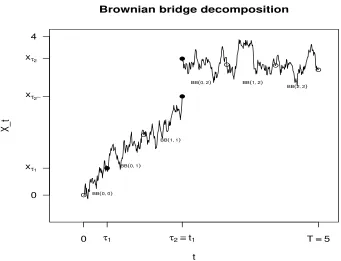
independent Brownian bridges. This crucial property is formalised by Propo-sition 1 and illustrated in Figure 2 where we have completed the Skeleton of Figure 1 by the appropriate Brownian bridge interpolation.
Proposition 1
Let SJ EA(x0; 0, T) (23) be the Skeleton of the process X generated by the
Jump Exact Algorithm. Then:
(26) X| SJ EA(x0; 0, T)∼
m
O
i=0
Ni O
j=0
BBtj,i, xtj,i;tj,i+1, xtj,i+1
Proof:
From the JEA construction of the Skeleton (23) and the EA Brownian bridge decomposition (20), for anyi= 0,1, . . . , m:
X(i) | SJ EA(x0; 0, T) =d ω
xt0,i;t0,i, tNi+1,i
| SEA
xt0,i;t0,i, tNi+1,i
∼
Ni O
j=0
BBtj,i, xtj,i;tj+1,i, xtj+1,i
where we have used the following notation X(i) :=
Xt:t0,i≤t < tNi+1,i . Representation (26) then follows from the Markov property of the proocess
X.
Proposition1implies that, by conditioning onSJ EA, we reduce the problem
Brownian bridge decomposition
t
X_t
0 xτ1 xτ2 4
xτ 2−
0 τ1 τ2≡t1 T≡5
BB(1, 1)
BB(0, 1)
BB(0, 0)
BB(0, 2) BB(1, 2)
BB(2, 2)
Fig 2. This is the complete realisation of the trajectory corresponding to the Skeleton in Figure 1. The continuous component of the trajectory is obtained by simulating the appropriate bridge (according to Lemma 3) on a very fine discrete grid (δ = 0.01). We have introduced the convenient notationBB(j, i)≡BB tj,i, xtj,i;tj+1,i, xtj+1,i
for any
j,i.
This is very valuable in Monte Carlo applications as many interesting func-tionals associated with Brownian bridge can be simulated exactly. In the rest of the current Section we will provide a sample of a number of challenging Monte Carlo problems that can be solved thanks to the Brownian bridge characterization (26).
5.3. Functional evaluated at a discrete set of time points. We consider the following class of functionals:
(27) φ(V) :=φ(VT1, VT2, . . . , VTn) =φ∗(XT1, XT2, . . . , XTn)
[image:16.595.124.465.175.436.2]φ η−1(u1), η−1(u2), . . . , η−1(un), η−(·) being the inverse ofη(·) (4).
Popu-lar examples of these functionals in finance are the payoffs ofdigital options,
european options anddiscrete (geometric and arithmetic) asian options. The Monte Carlo problem involves the joint simulation ofXT1, XT2, . . . , XTn. To
this end the JEA framework offers two main options.
1. We can split [0, Tn] in n sub-intervals [Ti, Ti+1), i = 0,1, . . . , n−1,
apply the Exact Algorithm to each of the sub-intervals and then sim-ply merge the individual sub-skeletons so that the resulting skeleton SJ EA(x0; 0, Tn) includes the target vector XT1, XT2, . . . , XTn.
2. We can choose an arbitrary splitting scheme to generate the Skele-ton on [0, Tn] and simulate the variables of interest XT1, XT2, . . . , XTn
from the appropriate Brownian bridge according to (26). There are several ways to simulate a discrete realisation from a Brownian bridge trajectory; a very convenient one resorts to trivial Brownian motion simulation through representation (43).
It is worth to point out here that the choice of the ”splitting” can have a relevant effect on the efficiency of the Exact Algorithm (and thus also of the Jump Exact Algorithm). We refer to (22) for a complete treatment of this point.
5.4. Path dependent functionals. The Brownian bridge decomposition (26) allows us to construct Monte Carlo estimators of (24) also for a num-ber of interesting path-dependent functionals. We provide some examples suggested by applications in option pricing.
5.4.1. Lookback options. Lookback options are a type of path-dependent options where the payoff depends on the maximum (or minimum) asset price over the life of the option [0, T] and eventually (floating strike type) by the value of the underlying at some maturity timeT. Since the functionη (4) is strictly increasing we can write the lookback options’ payoff as:
(28) φ(V) =φ
max
0≤t≤TVt, VT
=φ∗
max
0≤t≤TXt, XT
where φ∗(v, u) = φ η−1(v), η−1(u)
. Hence the crucial step of the Monte
Carlo procedure involves the simulation of the maximum of X given the
Skeleton. From (26) we have trivially that:
max
0≤t≤TXt| SJ EA(x0; 0, T) d
= max
i,j
n
Mtj,i, xtj,i;tj,i+1, xtj,i+1
As the distribution function of the maximum of a given Brownian bridge can be derived from simple properties of Brownian motion , we can easily simulate from it by applying the inverse transform method. See Appendix
A((48) and (49)).
5.4.2. Single Barrier options. Barrier options are an extremely popular class of path-dependent options which come in many flavours and forms. Their key characteristic is that they are either initiated (“knocked-in”) or exterminated (“knocked-out”) if the underlying processV exits a given set
H= (a, b) such that V0 =v0 ∈H. Firstly we discuss single barrier options
(a =−∞ or b = +∞). To fix the ideas let us consider a knock-out option on the underlyingV (1) with upper barrierb > v0 (i.e.H= (−∞, b)). If the
underlying does not cross the upper barrierb between 0 and T the option
pays off a functiongof the asset processV at maturity timeT. If the process crosses the barrier the option is killed and a rebateRis paid to its holder at the killing time. In this context, assuming a fixed continuously compounded interest rater, the payoff of the option under the transformed processX is:
(29) φ∗XT, τHX∗
=e−rTg∗(XT)(1−I{τX H∗≤T}
) +e−rτHX∗RI
{τX H∗≤T}
whereg∗(·) :=g(η−1(·)) andH∗ := (−∞, b∗) with b∗ =η−1(b). Thus
condi-tionally on the Skeleton (23) exact simulation of φ∗ involves the two steps: 1) the simulation of the one-sided crossing event of a Brownian bridgeI{...}
and 2) the simulation of the crossing timeτX given the crossing event. Both
steps can be performed efficiently applying the standard results from Brow-nian motion theory collected in Appendix A ((47) and (48)). Interestingly if we assume that the rebate is paid at the (fixed) maturity time T, i.e.
τX
H∗ ≡ T in (29), we can perform more efficient Rao-Blackwellised Monte Carlo estimation ofη (24) by averaging over the conditional expectations:
E(φ∗ | SJ EA(x0,0, T)) =e−r T
h
g∗(xT) + (R−g∗(xT))P r
τHX∗≤T | SJ EA
i
(30)
5.4.3. Double barrier options. We consider the payoff function φ∗ (29) with τX
H∗ ≡ T under the assumption that H∗ = (a∗, b∗) for −∞ < a∗ <
x0 < b∗ < +∞. In the JEA framework, the simulation problem involves
the two-sided crossing probability of the Brownian bridge. It is known that closed-form expressions for such probability are not available. This makes the simulation task much harder than in the single barrier case. In particu-lar: 1) Rao-Blakwelised estimation (30) is not feasible; 2) trivial simulation strategies based on the knowledge of the crossing event’s probability cannot be performed. Anad hoc algorithm to deal with this case has been proposed by (8). We recall it briefly. For given i = 0,1, . . . , m and j = 0,1, . . . , Ni
we are looking for a simulation procedure that allows us to simulate events of (unknown) probability ptj,i, xtj,i, tj+1,i, xtj+1,i;a∗, b∗
. To this end, we identify two sequences of (known) real numbers:
(31)
n
nktj,i, xtj,i, tj+1,i, xtj+1,i;a∗, b∗
;nk
tj,i, xtj,i, tj+1,i, xtj+1,i;a∗, b∗ o
k=1,2,...
such that, ask→+∞:
nk
tj,i, xtj,i, tj+1,i, xtj+1,i;a∗, b∗
↑ ptj,i, xtj,i, tj+1,i, xtj+1,i;a∗, b∗
(32)
nk
tj,i, xtj,i, tj+1,i, xtj+1,i;a∗, b∗
↓ ptj,i, xtj,i, tj+1,i, xtj+1,i;a∗, b∗
(33)
The explicit functional form of the sequences (31) can be found in
Ap-pendix A ((53) and (54)) supported by a sketch of the proof of the limits (32) and (33). Limits (32) and (33) suggest that we can simply simulate a [0,1]−uniformly distributed random variable U = u and compare it with (increasing indeces) couples of values (nk, nk) until either u≤nk (crossing
event accepted) or u > nk (crossing event rejected). This procedure turns
out to be efficient as the sequences{nk}and {nk}converge topfaster than
exponentially (see also Proposition 2 in (8)).
5.4.4. Bond pricing with stochastic interest rate. Finally we outline a general simulation algorithm for unbiased Monte Carlo estimation of:
(34) ν =E
e−
RT
0 Vsds|V0 =v0
=E
e−
RT
0 η −1(X
s)ds
|X0 =η(v0)
under the usual conditions C.0-C.3. This is a very relevant computational
problem in financial applications. For instance we can think of ν as the
price of a bond with unit face value and maturity time T under a
jump-diffusion stochastic interest rate pricing framework (see e.g. (9) or (17)) or alternatively as the (complementary) default probability in a reduced form approach to credit risk modeling (see e.g. (12)) where the default arrival process is a Cox process driven by an exogeneous jump-diffusion. The com-putational task is very demanding, involving the (exponential of the) integral of a jump-diffusion trajectory. However, conditioning on the JEA Skeleton (23) and applying the Brownian bridge decomposition yields:
(35)
ν=ES
n Y i=0 Ni Y j=0
EBB(i,j) exp
(
−
Z tj,i+1
tj,i
η−1(ωu) du
) !
:=E n Y i=0 Ni Y j=0
Ei,j(SJ EA)
There is no immediate way to simulate an unbiased estimator of (35). In fact we are not able to express the conditional expectationEi,j as an explicit
function of SJ EA, neither we can simulate the target functionals
condition-ally on the Skeleton. However we can still take advantage of the specific form of the target functional and apply the Poisson estimator; i.e. for any
ci,j ∈R and λi,j >0, i= 0,1, . . . , m,j = 0,1, . . . , Ni:
(36) Ei,j(SJ EA) = E c∗i,jλ− κi,j i,j κi,j Y h=1 n
ci,j−η−1(BBπi,j;h(i, j) o
!
wherec∗i,j := exp{(λi,j−ci,j) (tj,i+1−tj,i)}constant and
n
πi, j; 1, πi, j;2, . . . , πi,j;κi,j o
is a Poisson process of intensityλi,j on the time intervaltj,i+1−tj,i. Finally
combining (35) and (36) gives an unbiased estimator of ν:
(37) ν∗ =
n Y i=0 Ni Y j=0 (
c∗i,jλ−κi,j
i,j κi,j Y
h=1
n
ci,j−η−1(BBπi,j;h(i, j) o
)
which can be conveniently simulated in a Monte Carlo framework.
6.1. The model. We test the JEA algorithm on a jump-diffusion model
X:={Xt: 0≤ t ≤ T} (5) defined by the SDE:
(38) dXt = sin (Xt−) dt + dWt +
Z
R
(σz + l Xt−)m(dz, dt)
with intensity functionλm (2):
(39) λm(z , t;Xt−;α, β, λ0) = λ0FN0,1(α +β Xt−) fN0,1(z)
for α, β, l ∈ R and λ0 > 0 where FN0,1 and fN0,1 are (resp.) the dis-tribution function and the density function of a standard normal random variable. The continuous component is a diffusion model without explicit solution characterized by SINUS drift and unit diffusion coefficient (SINUS
model). The jump component is state-dependent both in the intensity of the jumps’ arrival process λ(t;Xt−;α, β, λ0) := λ0FN0,1(α +β Xt−) and in the amplitude of the jumpsg(Z, Xt−;l, σ) := σ Z +l Xt− withZ∼ N0,1. The exogenous parametersα, β, l, λ0, σ provide us with a very general and
flexible modeling framework. In particular for λ0 = 0 or σ, l = 0, model
(38) and (39) reduces to the SINUS diffusion; for β = 0 andl= 0 the jump
component is independent from the state of the process as for Merton model (9)-(8).
6.2. Simulation schemes.
6.2.1. The JEA scheme. For any given set of the exogenous parameters
(α, β, l, λ0) the process defined by (38) and (39) satisfies conditions
C.0-C.3. In particular theSINUSmodel satisfies conditions C.1-C.3 and it allows
the application of EA1. The SINUS model turns to be a convenient and
easily implementable choice for numerical testing of EA1-related algorithms (see also (4), (3), (8)). The state dependent intensity function driving the jumps’ arrival process satisfies condition C.0 asλ(t;Xt−;α, β, λ0)≤ λ0. In this context the application of the JEA algorithm (Algorithm2) entails the following three main steps.
1. We select the vector of time pointsτ := (τ0, τ1, . . . , τm+1) whereτ0 ≡0,
τm+1 ≡ T and (τ1, τ2, . . . , τm) is the vector of the candidate jumps’
times simulated from the proposal Poisson process of intensityλ0.
2. For any i = 0,1, . . . , m, we apply EA1 on the SINUS model between
3. We extract from the EA1 Skeleton the (left-limit) realisation of the process’ trajectory at the candidate jumps’ time (τ1, τ2, . . . , τm) and
we evaluate the acceptance thinning probabilityFN0,1(α+βXτi−) and
(in case the thinning test is positive) the amplitude of the jumpsσ Z+
l Xτ−
i .
We test numerically the Monte Carlo performances of the JEA algorithm against two alternative Euler schemes with jumps.
6.2.2. The naive Euler scheme with jumps. This scheme is the natural
analog of the naive Euler approximation in a jump diffusion context. The time setting is fully discrete: both the diffusion component and the jump component are simulated at a fixed discrete grid of time points{i∆}i=1,2,...,n where ∆ =T /n is the discretisation interval. The resulting approximation to (38)-(39) has dynamics:
(40) ˜
X(i+1) ∆ = ˜Xi∆+sin( ˜Xi∆)∆ +
√
∆ξi+1+Ji+1
σ Zi+1 + lX˜i∆
, i= 0, . . . , n−1
where ξi+1, Zi+1 ∼ N(0,1), Ji+1 ∼ Bernoulli(∆λ0FN0,1(α + βX˜i∆)) un-der the additional condition ∆λ0≤1. Under standard regularity conditions,
as ∆ → 0, the scheme converges weakly to (38)-(39) (see (23)). Although rather crude, approximation (40) has been employed in various applied con-texts because of its simplicity. Among the others, (25) applied this type of discretisation to simulate the Merton model in a structural credit risk context. More interestingly, (18) proposed a state dependent jump scheme similar to (40) to model US equity indices’ dynamics in a discrete time framework.
6.2.3. The Euler scheme with thinned jumps. We can construct a more
sophisticated approximation of (38)-(39) by combining the Euler scheme
with the thinning idea. Loosely, after selecting τ as in JEA (Step 1) we
apply the Euler scheme instead of the EA1 algorithm to simulate the process’ trajectory between any two timesτi and τi+1. As a consequence the (state
dependent) thinning acceptance probability and the amplitude of the jumps will be also biased. Nevertheless this scheme seems more sensible than the fully discrete Euler scheme since it does not force the jumps to take place only at the deterministic time points of the discretisation grid. Formally, if we denote byT0, T1, . . . , TKthe set of ordered time points resulting from the
deterministic discretisation gridt0, t1, . . . , tn (i.e. ti := i∆, i= 0,1, . . . , n),
we can represent the dynamics of the scheme in the following compact way:
ˆ
XT−
k+1 = ˆ
XTk + sin
ˆ
XTk
(Tk+1−Tk) +
q
Tk+1−Tkξk+1
(41)
ˆ
XTk+1 = XˆTk−+1 +H∗(Zk+1, Uk+1,XˆTk−+1)I{Tk+1∈{τ1,τ2,...,τm}}, k= 0, . . . , K−1
such that H∗(z, u, x) := (σ z + l x)I
u≤FN0,1(α+β x)
with ξk+1, Zk+1 ∼
N0,1 and Uk+1 ∼ U nif[0,1]. The Monte Carlo application of this scheme
as opposed to the crude (40) has been proposed by (14) for the simplest case when the target functional φdepends on the trajectory of the process only at a single fixed time point. However for Monte Carlo simulation of path-dependent functionals we will rather employ a more appropriate con-tinuous version of (41) based on a Brownian bridge interpolation of the Euler trajectory (see (15)). This can be easily obtained from (41) by setting:
(42) Xˆt= ˆXTk+ sin( ˆXtk) (t−Tk) + (Wt−WTk), t∈[Tk, Tk+1)
where {Wt} is the usual standard Brownian motion. We will refer to this
scheme as continuous Euler with thinning.
6.3. Results. We have compared the Monte Carlo estimator generated
by the Jump Exact Algorithm (say E1) with the estimators generated by
the two Euler schemes (40) and (41) (say respectively E2 and E3) for the discrete average (or asian option) functional and the maximum (or lookback
option) functional. For the maximum,E3 employes the continuous version
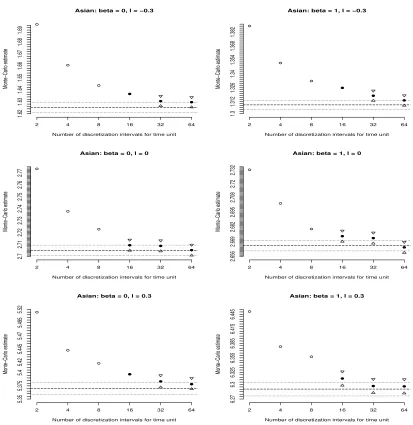
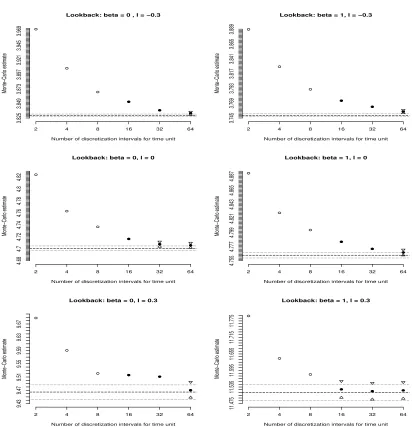
(42) of the Euler scheme. To address our comparison, we require that the Monte Carlo 95%-confidence interval generated byE2 andE3 has non empty intersection with the corresponding interval generated by E1. This seems a very reasonable (although somewhat arbitrary) accuracy. Figures 3-4 and Table 1 summarize the relevant results from a Monte Carlo numerical test for a selection of values of the two parameters l and β affecting the jump component. In order to ensure negligible Monte Carlo error we have chosen a Monte Carlo sample size of 5 105iterations. In Figures 3-4 we have plotted
the Monte Carlo estimates of E1 and E3 Vs the number of discretisation
steps (per time unit)
1,2,4, . . . ,26 . To preserve graphics’ readibility we
interval and the computational time forE1, E2 andE3.
The results of the numeric experiment supports the following important arguments in favour of the JEA estimator.
i E1 is not affected by discretization bias; in fact it turns out to be the limit of discretisation schemes as the length of the discretization interval tends to 0.
ii E1 is not prone to the trade-off between accuracy of the estimator and computational effort. As a consequence, for sufficiently high level of accuracy it is computationally more efficient than estimators based on discretisation schemes.
iii E1 provides a reliable benchmark to evaluate the convergence of com-peting discretisation methods and the accuracy of the related Monte Carlo estimators.
7. Conclusion. We have developed a simple algorithm (JEA) for Monte
Carlo simulation of a wide class of functionals of jump-diffusion processes with (markov) state-dependent intensity. Its core consists of the Exact Al-gorithm for the simulation of the continuous component and on a stochastic thinning algorithm for the simulation of the jump component. In comparison with currently available Monte Carlo estimators, JEA estimator is unbiased, and, for sufficiently high level of accuracy, computationally more efficient.
It is worth to mention at least two research areas related to JEA that deserve further investigation.
1. Extension of C0-C3.The domain of JEA can be extended far bejond
conditionsC0−C3. Trivially, we can weaken conditionsC1−C3 by replacingEA1 with the more recentEA2 orEA3 for the simulation of the diffusion component. More interestingly, we believe we can remove also conditionC0 thus allowing unboundedness of the intensity of the jump component; we are currently working on this.
2. Financial applications.In finance the application of jump-diffusion
a first example of application of the JEA framework to credit risk modeling see (7), Chapter 4.
APPENDIX A: APPENDIX 1: BROWNIAN BRIDGE RESULTS.
We briefly review the Brownian bridge results supporting the Monte Carlo algorithms presented in Section 5. We consider a generic (s1, a) → (s2, b)
Brownian bridge and an interval (l1, l2)⊂Rsuch thata∈(l1, l2). We adopt
the notation:
τ(s1, a;s2, b;l1, l2) := inf{u∈[s1, s2] :BBu(s1, a;s2, b)∈/ (l1, l2)}
where BB(s1, a;s2, b) := {BBu(s1, a;s2, b) :s1 ≤u≤s2} and inf∅ = ∞.
Throughout we will rely on the following representation of the Brownian bridge in terms of Brownian motion:
(43) BB(s1,a;s2,b)
u
d
=a+ u−s1
s2−s1
(b−a) +√s2−u
s2−s1
Wu−s1 s2−u
; s1≤u≤s2
Givenz∈[s1, s2] it follows from (43):
(44)
P r(τ(s1, a;s2, b;l1, l2) > z) =P r
Wu ∈(α1+β1u, α2+ β2u), u∈
0,z−s1 s2−z
with α1 := √ls1−a
2−s1, α2 :=
l2−a
√
s2−s1, β1 :=
l1−b
√
s2−s1 and β2 :=
l2−b
√
s2−s1. Let us consider first the one sided case withl2 > a and l1 =−∞. The theory for
the one sided case is rather standard; references are the classic (24) and (19). Firstly we rewrite (44) in the following way:
(45)
P r(τ(s1, a;s2, b;−∞, l2) > z) =P r
τα2,β2 >
z−s1
s2−z
=P r s1+τα2,β2s2 1 +τα1,β1
> z
!
.
where τα2,β2 := inf{u≥0 :Wu ≥α2+β2u}. It is time to recall the cele-brated Bachelier-Levy formula which gives the density of the hitting time
τα2,β2 of a sloping line α2+β2u for Brownian motion:
(46) fα2,β2(u) =
e−2α2β2IGu;α2
β2, α
2 2
if α2β2 >0
IGu;−α2
β2, α
2 2
where IG(u;k, g) is an inverse gaussian density with parameters k and g. Plugging in z = s2 in (44) and using (46) we find the one sided crossing
probability of the Brownian bridge:
(47) p(s1, a;s2, b;−∞, l2) =
(
1 if b≥l2
expn−s 2
2−s1(l2−a)(l2−b)
o
if b > l2
LetE:={τ(s1, a;s2, b;−∞, l2)∈[s1, s2]}be the crossing event with
proba-bility (47). From (45) and (46), we derive a suitable reprsentation to simulate the hitting times conditionally on the crossing event:
τ(s1, a;s2, b;−∞, l2)|E=d
s1+Z s2
1 +Z : Z∼
IG−l2−a
l2−b,
(l2−a)2
s2−s1
if b≥l2
IGl2−a
l2−b,
(l2−a)2
s2−s1
if b < l2
The simulation of an inverse gaussian random variable is standard (e.g. see (10)). Finally from (47) we derive the distribution function of the maximum of the Brownian bridge:
(48)
P r{M(s1, a;s2, b)≤m}= 1−exp
−2 ((m−s a)(m−b))
2−s1
, m ≥ max(a, b)
so that an immediate application of the inverse transform method (e.g. see (10)) provides the recipe for the simulation ofM:
(49)
M(s1, a, s2, b)
d
= 1
2
q
(a−b)2−2 (s
2−s1) log(U) +a+b
: U ∼Unif[0,1]
We turn the attention now to the double barrier case |l1|,|l2| < ∞, a ∈
(l1, l2) in order to justify the simulation method in Section 5.4.3. This is a
succint excerpt from (8) (Section 2.4.2 and Appendix 1). From (44):
(50)
p(s1, a;s2, b;l1, l2) =
(
1 if b /∈(l1, l2)
where a, b ∈ (l1, l2) implies that α1, β1 < 0 and α2, β2 > 0. We introduce
the two sequences of functions:
Pj(s, x;t, y;l1, l2) := pj(s, x;t, y;l2−l1, l1) +pj(s, x;t, y;l2−l1, l2)
Qj(s, x;t, y;l1, l2) := qj(s, x;t, y;l2−l1, l1) +qj(s, x;t, y;l2−l1, l2); (j= 1,2, . . .)
where
(51)
pj(s, x;t, y;δ, l) =e−
2
t−s[jδ+(l−x1)][jδ+(l−y)]; qj(s, x;t, y;δ, l) =e−
2j t−s[jδ
2−δ(l−x)]
From the representation of the two sided crossing probability (of two sloping lines) for Brownian motion in (11), using (50), for a, b∈(l1, l2):
(52) p(s1, a;s2, b;l1, l2) =
∞ X
j=1
[Pj(s, x;t, y;l1, l2)−Qj(s, x;t, y;l1, l2)]
From (51) we can easily verify the two following crucial facts:
i. for any j = 1,2, . . .:Pj > Qj > Pj+1
ii. forj→ ∞:Pj ↓0 and Qj ↓0
In this context it is immediate that the two sequences:
nk(s, x;t, y;l1, l2) =
k
X
j=1
[Pj(s, x;t, y;l1, l2)−Qj(s, x;t, y;l1, l2)]
(53)
nk(s, x;t, y;l1, l2) = nk−1(s, x;t, y;l1, l2) +Pk(s, x;t, y;l1, l2)
(54)
converge respectively from below and from above to the target probabilityp. Thus we can establish the final result supporting the Monte Carlo algorithm in Section5.4.3: fora, b∈(l1, l2), −∞< l1 < l2 <+∞ ask→ ∞:
(55)
More details on the Doob’s approach to the two-sided crossing probability problem (52) and an alternative proof of (55) based on probabilistic argu-ments can be found in (8).
REFERENCES
[1] Beskos, A., Papaspiliopoulos, O., and Roberts, G. O. (2006a). Retrospective exact simulation of diffusion sample paths with applications. Bernoulli, 12(6):1077–1098. [2] Beskos, A., Papaspiliopoulos, O., and Roberts, G. O. (2007). A new factorisation of
diffusion measure and sample path reconstruction. Submitted.
[3] Beskos, A., Papaspiliopoulos, O., Roberts, G. O., and Fearnhead, P. (2006b). Exact and efficient likelihood based inference for discretely observed diffusions (with discus-sion). J. R. Stat. Soc. Ser. B Stat. Methodol., 68(3):333–382.
[4] Beskos, A. and Roberts, G. O. (2005). Exact simulation of diffusions. Ann. Appl. Probab., 15(4):2422–2444.
[5] Caines, P. E. and Zhang, J. F. (1995). On adaptive control for jump parameter systems via nonlinear filtering. SIAM J. Control Optim., 33:1758–1777.
[6] Cariboni, J. and Schoutens, W. (2004). Pricing credit default swaps under l´evy models. available from www.defaultrisk.com.
[7] Casella, B. (2006). Exact Monte Carlo simulation of Diffusion and Jump-diffusion processes with financial applications. PhD thesis, Universit`a Commerciale L. Bocconi, Istituto Metodi Quantitativi.
[8] Casella, B. and Roberts, G. O. (2008). Exact monte carlo simulation of diffusions with barriers. To appear in Advances in Applied Probability.
[9] Das, S. (2002). The surprise element: Jumps in interest rates.Journal of Econometrics, 106:27–65.
[10] Devroye, L. (1986). Nonuniform random variate generation. Springer-Verlag, New York.
[11] Doob, J. L. (1949). Heuristic approach to the Kolmogorov-Smirnov theorems. Ann. Math. Statistics, 20:393–403.
[12] Giesecke, K. (2004). Credit risk modeling and evaluation: an introduction. InCredit risk: models and management, volume 2 ofRisk Books. D. Shimko.
[13] Giraudo, M. and Sacerdote, L. (1997). Jump-diffusion processes as models for neu-ronal activity. Biosystems, 40:75–82.
[14] Glasserman, P. and Merener, N. (2004). Convergence of a discretization scheme for jump-diffusion processes with state-dependent intensities. Proc. R. Soc. Lond. Ser. A Math. Phys. Eng. Sci., 460(2041):111–127. Stochastic analysis with applications to mathematical finance.
[15] Gobet, E. (2000). Weak approximation of killed diffusion using Euler schemes. Stochastic Process. Appl., 87(2):167–197.
[16] Ikeda, N. and Watanabe, S. (1989). Stochastic differential equations and diffusion processes, volume 24 ofNorth-Holland Mathematical Library. North-Holland Publishing Co., Amsterdam, second edition.
[17] Johannes, M. (2004). The statistical and economic role of jumps in continuous-time interest rate models. The Journal of Finance, 59(1):227–260.
[18] Johannes, M., Kumar, R., and Polson, N. (1999). State dependent jump models: How do us equity indices jump? Working paper. University of Chicago.
volume 113 of Graduate Texts in Mathematics. Springer-Verlag, New York, second edition.
[20] Merton, R. C. (1976). Option pricing when undrlying stock returns are discontinuous. Journal of Financial Economics, 3:125–144.
[21] Metwally, S. and Atiya, A. (2002). Using brownian bridge for fast simulation of jump-diffusion processes and barrier options. Journal of Derivatives, 10:43–54. [22] Pelucchetti, S. (2008). An analysis of the efficiency of the Exact Algorithm. PhD
thesis, Universit`a Commerciale L. Bocconi, Istituto Metodi Quantitativi.
[23] Platen, E. and Rebolledo, R. (1985). Weak convergence of semimartingales and discretisation methods. Stochastic Process. Appl., 20(1):41–58.
[24] Revuz, D. and Yor, M. (1991). Continuous Martingales and Brownian Motion. Springer-Verlag.
[25] Zhou, G. (2001). The term structure of credit spreads with jump risk. Journal of Banking and Finance, 25:504–531.
[26] Zhu, S. C. (1999). Stochastic jump-diffusion process for computing medial axes in markov random fields. IEEE Transactions on Pattern Analysis and Machine Intelli-gence, 21:1158–1169.
Address of the Second author Department of Statistics University of Warwick Coventry CV4 7AL UK
E-mail:[email protected]
Asian: beta = 0, l = −0.3
Number of discretization intervals for time unit
Monte−Carlo estimate
2 4 8 16 32 64
1.62 1.63 1.64 1.65 1.66 1.67 1.68 1.69
Asian: beta = 1, l = −0.3
Number of discretization intervals for time unit
Monte−Carlo estimate
2 4 8 16 32 64
1.3 1.312 1.326 1.34 1.354 1.368 1.382
Asian: beta = 0, l = 0
Number of discretization intervals for time unit
Monte−Carlo estimate
2 4 8 16 32 64
2.7 2.71 2.72 2.73 2.74 2.75 2.76 2.77
Asian: beta = 1, l = 0
Number of discretization intervals for time unit
Monte−Carlo estimate
2 4 8 16 32 64
2.656 2.669 2.682 2.695 2.708 2.72 2.732
Asian: beta = 0, l = 0.3
Number of discretization intervals for time unit
Monte−Carlo estimate
2 4 8 16 32 64
5.35 5.375 5.4 5.42 5.445 5.47 5.495 5.52
Asian: beta = 1, l = 0.3
Number of discretization intervals for time unit
Monte−Carlo estimate
2 4 8 16 32 64
6.27 6.3 6.325 6.355 6.385 6.415 6.445
Fig 3. Plot of the Monte Carlo estimates and95%-confidence intervals ofE1(resp. dashed line and dotted lines) andE3(resp. circle and triangles) Vs the number of discretisation intervals per time unit (2n, n= 0,1, . . . ,6). Functional: ASIAN optionφ=X
1+X2+X3+
X4+X5. Model: X (38) with fixed parameters α=σ=λ0 = 1andx0 = 2and variable
parametersβ andl. Monte Carlo sample size:5×10⁵. Notes: We have reported only the
[image:30.595.92.505.173.598.2]Lookback: beta = 0 , l = −0.3
Number of discretization intervals for time unit
Monte−Carlo estimate
2 4 8 16 32 64
3.825 3.849 3.873 3.897 3.921 3.945 3.969
Lookback: beta = 1, l = −0.3
Number of discretization intervals for time unit
Monte−Carlo estimate
2 4 8 16 32 64
3.745 3.769 3.793 3.817 3.841 3.865 3.889
Lookback: beta = 0, l = 0
Number of discretization intervals for time unit
Monte−Carlo estimate
2 4 8 16 32 64
4.68 4.7 4.72 4.74 4.76 4.78 4.8 4.82
Lookback: beta = 1, l = 0
Number of discretization intervals for time unit
Monte−Carlo estimate
2 4 8 16 32 64
4.755 4.777 4.799 4.821 4.843 4.865 4.887
Lookback: beta = 0, l = 0.3
Number of discretization intervals for time unit
Monte−Carlo estimate
2 4 8 16 32 64
9.43 9.47 9.51 9.55 9.59 9.63 9.67
Lookback: beta = 1, l = 0.3
Number of discretization intervals for time unit
Monte−Carlo estimate
2 4 8 16 32 64
11.475 11.535 11.595 11.655 11.715 11.775
Fig 4. Plot of the Monte Carlo estimates and 95%-confidence intervals of E1 (resp. dashed line and dotted lines) and E3 (resp. circle and triangles) Vs the number of dis-cretisation intervals per time unit (2n, n= 0,1, . . . ,6). Functional: LOOKBACK option
φ= max{0≤t≤5}Xt. Model:X (38) with fixed parameters α=σ =λ0 = 1and x0 = 2
and variable parametersβ and l. Monte Carlo sample size: 5×10⁵. Notes: We have
re-ported only the confidence interval ofE3characterised by non-empty intersection with the corresponding confidence interval ofE1. If no intersection occurs (plot: beta =1, l=-0.3) we have reported the confidence interval corresponding to the smalles discretisation step (1/26). The solid circles represent E3estimates whose computational time is lower than
[image:31.595.93.505.159.586.2]Numerical comparison
Functional β l Method νˆ C.I.(95%) N time
0
-0.3
E1 1.6251 [1.6209,1.6293] 40 E2 1.6323 [1.6281,1.6364] 25 218
E3 1.6305 [1.6264,1.6347] 25 106
0
E1 2.705 [2.7005,2.7094] 35 E2 2.7120 [2.7075,2.7164] 25 216
E3 2.7093 [2.7049,2.7138] 24 58
0.3
E1 5.3703 [5.359,5.3816] 39 E2 5.36 [5.3491,5.3709] 24 110
Asian E3 5.3834 [5.3722,5.3947] 25 107
1
-0.3
E1 1.3088 [1.304,1.3135] 41 E2 1.3134 [1.3095,1.319] 26 312
E3 1.3180 [1.3131,1.3229] 25 107
0
E1 2.6655 [2.6608,2.6702] 37 E2 2.6703 [2.6656,2.675] 25 160
E3 2.6738 [2.6691,2.6785] 24 58
0.3
E1 6.2905 [6.2763,6.3046] 40 E2 6.2851 [6.2708,6.2991] 25 161
E3 6.3124 [6.2981,6.3266] 24 58
0
-0.3
E1 3.8293 [3.8271,3.8316] 44 E2 3.7636 [3.7613,3.7658] 26 280
E3 3.8328 [3.8306,3.8351] 26 244
0
E1 4.7008 [4.6969,4.7048] 39 E2 4.6306 [4.6266,4.6345] 26 281
E3 4.7077 [4.7038,4.7117] 25 130
0.3
E1 9.4646 [9.4429,9.4863] 43 E2 9.3795 [9.3579,9.4011] 26 281
Lookback E3 9.4701 [9.4483,9.4949] 26 247
1
-0.3
E1 3.7494 [3.7471,3.7518] 46 E2 3.6844 [3.6821,3.6867] 26 289
E3 3.7555 [3.7532,3.7578] 26 243
0
E1 4.7636 [4.7593,4.7678] 34 E2 4.7003 [4.6960,4.7043] 26 292
E3 4.7679 [4.7636,4.7721] 26 244
0.3
E1 11.5151 [11.4854,11.5447] 43 E2 11.3992 [11.3699,11.4185] 26 275
E3 11.5264 [11.4966,11.5563] 24 66
Table 1
Monte Carlo estimate, 95%-confidence intervals and computational time of E1(JEA estimator), E2(Euler estimator) andE3(Euler + Thinning) with discretisation step
1/N. Functionals: ASIAN(φ=P5
i=1Xi)and LOOKBACK option
(φ= max{0≤t≤5}Xt). Model:X (38) with fixed parametersα=σ=λ0= 1andx0= 2
and variable parametersβ andl. Monte Carlo sample size: 5×10⁵. Notes: The
discretisation step selected forE2orE3is the largest in the range
{1/2n;n= 0,1, . . . ,6
}generating a confidence interval with non-empty intersection with the corresponding confidence interval ofE1. Alternatively if no intersection occurs, we
setN = 26 and the corresponding values of the estimate, confidence interval and