Feasibility of a novel vermitechnology using
vermicast as substrate for activated sludge
disposal by two epigeic earthworm species
Kui Huang1*, Fusheng Li2, Xiaoyong Fu3, Xuemin Chen3
1
Graduate School of Engineering, Gifu University, Gifu, Japan; *Corresponding Author:[email protected] 2
River Basin Research Center, Gifu University, Gifu, Japan 3
School of Environmental and Municipal Engineering, Lanzhou Jiaotong University, Lanzhou, China
Received 11 July 2013; revised 12 August 2013; accepted 1 September 2013
Copyright © 2013 Kui Huang et al. This is an open access article distributed under the Creative Commons Attribution License, which permits unrestricted use, distribution, and reproduction in any medium, provided the original work is properly cited.
ABSTRACT
This study was conducted to investigate the fea- sibility of vermicomposting by using vermicast as the substrate for the stabilization of municipal activated sludge, called hereafter as direct ver- mistabilization, in which the pre-treatment and bulking materials required in previous practices were all omitted. For this purpose, two epigeic earthworm species, namely Eisenia foetida and
Bimastus parvus, were inoculated into substrate
for composting fresh dewatered activated sludge. Direct vermistabilization resulted in significant reductions in pH, TOC, C/N ratio and the content of heavy metals, as well as increases in EC, total N, total P and total K in the final vermicast. Moreover, both Eisenia foetida and Bimastus
parvus showed faster growth rate and higher co-
coon production. The results of this study sug- gest that the direct vermistabilization has the ad- vantages of being simple, cost-effective and ef- ficient, and can thus be used as a feasible ver- micomposting approach to convert fresh dewa- tered activated sludge into a valuable product for agricultural use. The results also suggest that
Bimastus parvus can be used as a new potential
candidate for vermicomposting of municipal ac- tivated sludge.
Keywords:Activated Sludge; Biology; Earthworms; Heavy Metals; Nutrients; Vermicomposting
1. INTRODUCTION
Large scale urbanization in recent years has resulted in the generation of large amount of municipal sewage slu-
dge, which has become one of emerging environmental issues in the world. Currently, the primary means of sludge treatment include direct application for agricultures, land- fill, incineration, and so on. According to the situations of developing countries, the use of sludge for agricultural pur- poses is probably the most appropriate method for its di- sposal. However, it is well known that municipal sludge is a complex waste that contains not only large amounts of organic matter and nutrient elements, but also many heavy metals and harmful organic pollutants and patho- gens. Direct application of sludge as the fertilizer, with- out undergoing prestabilization treatment, may pollute agricultural lands and cultivated crops. It is thus neces- sary and urgent to seek ecologically sound technologies that enable sustainable recycling of rich nutrients and high organic content in municipal sludge, and at the same time, can ensure a significant reduction in the risk-caus- ing hazardous substances.
reasons, vermicomposting has been considered as an eco- logical and cost effective technology for the treatment and recycling of different organic waste materials, particular- ly for developing countries.
The use of earthworms in sludge management is term- ed as vermistabilization [4]. Recent studies have demon- strated that vermicomposting is highly useful and com- petitive for stabilization of activated sludge generated in sewage treatment plants [5-8]. However, intensive litera- ture review revealed clearly that most previous studies on vermicomposting were conducted using batch sys- tems, in which pre-treatment and/or bulking materials were used for improving the activities of earthworms and microorganisms. This makes the process much compli- cated when activated sludge is dealt with. So far, studies using continuous vermicomposting systems are very li- mited; and experimental approaches using vermicast as the substrate for improving the efficiency of vermicom- posting, which may allow the omission of pre-treatment and the use of bulking materials, can be hardly found. This study was aimed to evaluate the feasibility of direct vermistabilization by using vermicast as the sub- strate for composting of municipal activated sludge in continuous vermicomposting system. For this, Eisenia foetida, a worm species that has been commonly used in vermicomposting, was utilized. Meanwhile, for compari- son and searching for new effective species, Bimastus parvus that has not yet been reported so far in existing literature was also investigated. The analytical items in- cluded the physicochemical properties of the end pro- ducts of vermicast, and the growth and the fecundity of the earthworms during direct vermicomposting.
2. METHODS
2.1. Earthworms and Municipal Activated Sludge
Two species of epigeic earthworms (E. foetida and B. parvus), originally collected from the piles of cow dung in a local cattle farm, were randomly picked out for experimentation from individual stocking bin, respecti- vely. The stock earthworms were cultured in the labora- tory for one year by using biosolids (i.e., food waste, municipal sludge and cow dung) as the feed materials. The municipal activated sludge used in this experiment was obtained from the Lanzhou Wastewater Treatment Plant, Lanzhou, China. The characteristics of the sludge were: water content = 75%, pH = 7.82, electrical con- ductivity (EC) = 0.46 S/cm, total organic carbon (TOC) = 32.32%, total nitrogen (TN) = 36.42 g/kg, total pho- sphorus (TP) = 7.70 g/kg, total potassium (TK) = 11.22 g/kg, C/N ratio = 9.72, copper (Cu) = 210.00 mg/kg, zinc (Zn) = 1557.67 mg/kg, lead (Pb) = 68.42 mg/kg, and chromium (Cr) = 125.68 mg/kg.
2.2. Experimental Design
The experiment was conducted in perforated cylindri- cal plastic containers, each with a capacity of about 10 L (25 cm in diameter and 20 cm in height). The thickness of the substrate bedding was maintained at about 10 cm in all the containers throughout the experiment. The earth- worms of E. foetida and B. parvus were introduced into individual containers, respectively, for acclimatization prior to the addition of sludge. Following one day’s ac- climatization, 700 g of the fresh dewatered sludge was directly added onto the substrate bedding. A control was also operated in parallel for investigation of the perfor- mance of degradation, for which worms were not intro- duced. All containers were kept in dark at the room tem- peratures (22˚C - 28˚C). The moisture content of the feed in each container was maintained at 70% ± 10%. To pre- vent moisture loss and avoid direct sunlight, all contai- ners were covered with shade plastic bags and black bur- lap. For each experiment, three replicate were operated and the running time length was 30 days. Vermicompos- ting samples were collected at different times, i.e., 0, 10, 20 and 30 days, after each experiment was commenced.
2.3. Chemical Analysis
Physicochemical analysis was conducted on the dry weight basis. All chemicals used were of the analytical reagent grade. All samples were analyzed in triplicate and the results were averaged. pH and EC were mea- sured with 1/10 (w/v) suspensions by using digital pH and EC meters (Systronic made), respectively. TOC was measured using the method of [9]. TN was measured us- ing the Kjeldahl method. TP was measured using the mo- lybdenum colorimetric method. The total concentrations of K, Cu, Zn, Pb and Cr were quantified using ICP-AES (IRIS Intrepid Ⅱ XSP, Thermo Elemental, America) after digesting the sample in the mixed acidic solution of HNO3 and HClO4 (HNO3:HClO4 = 4:1, v/v).
2.4. Statistical Analysis
Statistical analysis was conducted using the Statistica Package (Version 8.0). ANOVA was performed to ana- lyze the significance of the differences among the che- mical properties at the significance level of 0.05. For in- dependent samples, t-test was performed between E. fo- etida and B. parvus for their biological differences.
3. RESULT AND DISCUSSION
3.1. Changes in Nutrients Properties during Vermicomposting Process
appearance, and odour free. Table 1 shows variations of pH and EC during vermicomposting. Statistically signi- ficant decreases of pH with the vermicomposting time were observed for treatment with both worms (p < 0.001) as compared to the control; and a significant difference in the decreasing extent of pH between two worm species were also confirmed existent (p < 0.001). For instance, after 30 days of composting, pH with E. foetida was nearly neutral (7.03 ± 0.06), while that with B. parvus was slightly acidic (6.20 ± 0.20). This result supports previous ones obtained by others on vermicomposting of sludge [5,6]. The shift of pH during vermicomposting is probably due to mineralization of nitrogen and phos- phorus into nitrites/nitrates and orthophosphates, respec- tively, and due to bioconversion of organic materials into intermediate species of organic acids [2]. The different decreasing extent of pH between E. foetida and B. parvus observed in the present study may indicate the species- specific differences of worms in their mineralization ef- ficiency, for which further elaborative studies are requir- ed. In regard of the changes of EC during vermicom- posting, the data shown in Table 1 revealed that EC in- creased gradually with time. Compared to the control bed- dings where earthworms were not introduced, the experi- mental beddings introduced with earthworms displayed a significant increasing trend (p < 0.001), with the value of EC being increased by approximately 4 folds. This in- crease was probably due to the loss of organic matter and the release of different mineral salts in available forms such as phosphate, ammonium and potassium [10]. More- over, comparison of the EC values at all treatment times between the tested two earthworm species demonstrated less apparent difference (p > 0.05).
Changes of TOC and TN during vermicomposting are illustrated in Table 2. TOC reduced by about 30% for the treatment with two earthworms as against the control treatment (p < 0.001). Significant differences between the tested two earthworms species were not confirmed (p > 0.05). The reduction in TOC during vermicomposting observed in the present result is consistent with previous reports that earthworms can accelerate decomposition and mineralization of organic matter contained in sludge [5,11,12]. The loss of carbon, in the form of CO2, was probably the result of earthworms’ roles in enhancing the activity of decomposers, e.g. bacteria, fungi, nematode and protozoa, populated in the vermicomposting system, as reported by [7]. The conversion of some organic frac- tions of the waste into the earthworm biomass was also a likely reason leading to the observed carbon reductions [5-7]. In contrary to the decreasing trend of TOC, the content of TN increased by approximately 30% through vermicomposting (p < 0.001); and no significant diffe- rences were found between the tested two earthworm species (p > 0.05). The results of the present study are
supported by the previous ones documented [13,14]. It was postulated that earthworms can enhance nitrogen le- vels by adding their excreta, mucus, body fluid and en- zymes, etc. into the substrate; moreover, the decaying tis- sues of dead worms also add a significant amount of ni- trogen into the vermicomposting system [14].
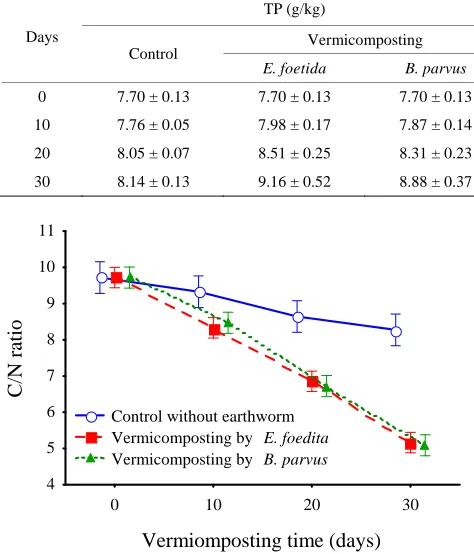
The C/N ratio of organic materials reflects the extent of mineralization and stabilization during the process of composting or vermicomposting. As shown in Figure 1, the C/N ratio decreased by 47.3% in the earthworm treat- ment systems, which is much higher than in the control (p < 0.001); and the differences between the tested two earthworm species were insignificant (p > 0.05). The final C/N ratios of the vermicast, i.e., the vermicast after treatment for 30 days, by E. foetida and B. parvus des- cended to 5.16 and 5.08, respectively. The decrease in C/N is probably a combined effect of the loss of carbon as carbon dioxide due to microbial respiration and of the simultaneous addition of nitrogen by earthrms in the form of mucus and nitrogenous excretory materials during ver- micomposting, as suggested by [8]. Compared to pre- vious studies, in which some bulking materials, such as cow dung, straw and compost, were added into sludge before vermicomposting [5,6,13,14], although the C/N ratio in the material (activated sludge) of the present stu- dy was lower, apparent decreases of its value in the treat- ment systems with earthworms were still observed. This may thus suggest that a greater extent of organic matter stabilization of municipal activated sludge was achieved through vermicomposting even if no bulking materials and pre-treatment were employed.
Table 1. Changes of pH and EC during vermicomposting of activated sludge.
pH EC (S/cm)
Vermicomposting Vermicomposting Days
Control
E. foetida B. parvus Control E. foetida B. parvus
0 7.83 ± 0.06 7.83 ± 0.06 7.83 ± 0.06 0.46 ± 0.04 0.46 ± 0.04 0.46 ± 0.04
10 7.57 ± 0.04 7.43 ± 0.06 7.25 ± 0.05 0.52 ± 0.03 0.78 ± 0.02 0.70 ± 0.02
20 7.50 ± 0.03 7.13 ± 0.05 6.71 ± 0.15 0.58 ± 0.02 1.79 ± 0.06 1.68 ± 0.04
[image:4.595.56.538.234.337.2]30 7.42 ± 0.05 7.03 ± 0.06 6.20 ± 0.20 0.63 ± 0.03 2.23 ± 0.08 2.19 ± 0.03
Table 2. Changes of TOC and TN during vermicomposting of activated sludge.
TOC (%) TN (g/kg)
Vermicomposting Vermicomposting Days
Control
E. foetida B. parvus Control E. foetida B. parvus
0 32.32 ± 2.32 32.32 ± 2.32 32.32 ± 2.32 36.55 ± 1.30 36.55 ± 1.30 36.55 ± 1.30
10 31.27 ± 1.52 29.16 ± 2.31 29.24 ± 0.11 36.87 ± 1.09 38.50 ± 0.25 37.99 ± 0.69
20 29.67 ± 0.91 25.33 ± 0.83 26.26 ± 0.35 36.54 ± 0.64 43.87 ± 0.90 42.99 ± 0.7
[image:4.595.56.293.369.646.2]30 28.33 ± 0.36 23.59 ± 2.22 22.89 ± 0.26 35.37 ± 0.71 50.25 ± 2.10 49.48 ± 0.12
Table 3. Changes of TP and TK during vermicomposting of activated sludge.
TP (g/kg) TK (g/kg)
Vermicomposting Vermicomposting Days
Control
E. foetida B. parvus Control E. foetida B. parvus
0 7.70 ± 0.13 7.70 ± 0.13 7.70 ± 0.13 11.22 ± 0.13 11.22 ± 0.13 11.22 ± 0.13
10 7.76 ± 0.05 7.98 ± 0.17 7.87 ± 0.14 11.56 ± 0.20 12.65 ± 0.14 12.42 ± 0.34
20 8.05 ± 0.07 8.51 ± 0.25 8.31 ± 0.23 11.62 ± 0.40 12.78 ± 0.51 13.36 ± 0.38
30 8.14 ± 0.13 9.16 ± 0.52 8.88 ± 0.37 12.02 ± 0.39 13.48 ± 0.82 14.80 ± 0.59
0 10 20 30
Vermiomposting time (days) 4
5 6 7 8 9 10 11
C/N ratio
Control without earthworm Vermicomposting by E. foedita
Vermicomposting by B. parvus
Figure 1. Change of C/N ratio during vermicomposting.
found statistically insignificant (p > 0.05). The increase of TK during vermicomposting was also reported in existing literatures [5,6]. The enhanced release of K from the sludge due to the production of acids by microor- ganisms and the increased number of micro flora in the
gut of earthworms is a likely reason behind the observed increases of K in the vermicast [10]. However, cautions should be addressed here since some researchers observ- ed decreases in the content of K, as a result of probable leaching of soluble potassium by the excess water con- tent [17].
3.2. Changes in Heavy Metals during Vermicomposting Process
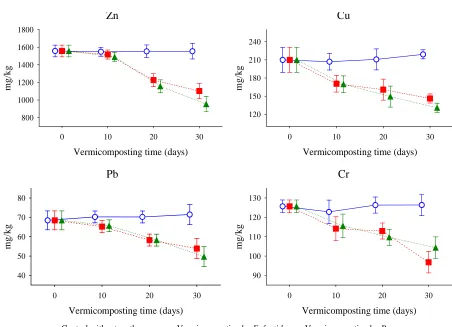
Heavy metals in the sewage sludge may come from a variety of sources like batteries, consumer electronics, ceramics, light bulbs, plastics, house dust and paint etc. If higher concentrations of heavy metals remain in the vermicast, they may cause detrimental effects upon the growth of plants. So, it is essential to trace the behaviour of heavy metals during vermicomposting. As shown in
by 9.8% in the treatment systems with earthworms as against the control (for Cu, p < 0.001; for Zn, p < 0.001; forPb, p < 0.001; for Cr, p < 0.05). The differences in the content of these four metals in the end products of vermicomposting with both tested worm species were found less significant (p > 0.05). The decreases in the content of heavy metals were probably due to accumu- lation of these metals into the bodies of earthworms. In general, as decomposers for organic matters, many soil faunas like earthworms, enchytraeids and mites can in- gest and digest organic compounds for their own meta- bolism. During the metabolic process, the decomposers inevitably accumulate a certain quantity of contaminants into their bodies and skins through direct or indirect ad- sorption and absorption [18,19]. Previous studies have revealed that, during vermicomposting, earthworms re- duced a considerable amount of heavy metals from the substrate through bioaccumulation [11,14]. Earthworms ingest a large quantity of organic materials in order to achieve necessary nutrition and, during the process they can liberate metals into free forms as a result of enzy- matic reaction in their gut [12]. The free forms of metals are then sorbed onto different organs such as chlorago- genous cells, gizzard and connective tissues [20]. On the other hand, the results also suggested that different heavy metals exhibited different reductions during vermicom- posting. The extent of reductions of heavy metals due to bioaccumulation of earthworms was found to be directly related to the availability and the initial levels of heavy metals in the substrate [12].
3.3. Biology of Earthworms in
Vermicomposting of Activated Sludge
Vermicomposting is considered in terms of the bio- mass and the cocoon production of earthworms as well. As summarized in Table 4, earthworms showed a signi- ficant increase in the individual weight (p < 0.05) at the end.
E. foetida and B. parvus reached the mean individual weight of 808.9 ± 45.4 mg and 723.3 ± 35.6 mg after 30 days, respectively. Comparatively, the individual growth rate (mg/day) of B. parvus was slightly higher that of E. foetida; however, the difference between these two worms was statistically insignificant (p > 0.05). In a previous study, Suthar (2010b) [12] reported the growth rate of about 1.13 - 5.51 mg/day and 1.44 - 2.50 mg/day for E. foetida in vermicomposting of cow dung-amended sewage sludge and primary sludge, respectively. Similar to his result, a higher cocoon production (Table 4) with the tested two earthworm species in the present study was also observed; with the total cocoon production after 30 days of vermicomposting with E. foetida being ap-
parently lower than that with B. parvus. The food avai- lability and the stocking density in the vermicompos- ting system are important factors related to the growth rate and the cocoon production of earthworms [6,12]. Our results thus suggest that activated sludge without any pre-treatment and bulking materials remains palata- ble for earthworms in continuous vermicomposting sys- tems. In the systems, the activity of populated micro- organisms may play an important role in earthworms’ diet, which makes organic matter much more palatable. In batch systems, however, as reported in previous stu- dies [12-14], pre-treatment and bulking materials are es- sential to vermicomposting. This difference may be as- cribed to the fact that these two different vermicompos- ting systems are associated with different operation me- thods, which may lead to differences in the patterns of earthworms’ ingestion and organic matter decomposi- tion. In regard of the mortality of E. foetida and B. parvus, an observable difference was existentas could be seen in
Table 4; however, statistical analysis indicated that this difference was not significant (p > 0.05). The lower mor- tality of both earthworms indicates that the continuous vermicomposting systems investigated in the present stu- dy can produce a favourable environment condition for earthworms. In addition, it is also inferable that direct vermicomposting using vermicast as the substrate is a suitable technology for disposal of municipal activated sludge.
4. CONCLUSION
Direct vermistabilization of municipal activated sludge in the continuous system resulted in the drop of pH to 6.20 - 7.03, the increase of EC, total N, total P and total K by about 3.5 folds, 35.4% - 37.5%, 15.4% - 20.0% and 20.1% - 31.9%, and the decrease of TOC, C/N ratio and content of heavy metals for Cu, Zn, Pb and Cr by 27.0% - 29.2%, 47.2% - 47.8%, and 35.2% - 37.7%, 29.3% - 38.8%, 21.2% - 27.4% and 17.0% - 23.0%, respectively, with the earthworm species of B. parvus and E. foetida, as compared to the results of the parallel control expe- riment. Moreover, the growth rate and the reproduction rate of E. foetida and B. parvus were able to reach 4.8 - 5.8 mg/day and 2.3 - 3.7 cocoon/day, respectively. The results obtained from this study indicate that direct ver- mistabilization can enhance the nutritive value and re- duce the phytotoxicity of end products, thus suggesting that direct vermistabilization by using vermicast as the substrate bedding could be a feasible technology for the management of municipal activated sludge.
5. ACKNOWLEDGEMENTS
Zn
0 10 20 30
Vermicomposting time (days) 800
1000 1200 1400 1600 1800
mg/
k
g
Cu
0 10 20 30
Vermicomposting time (days) 120
150 180 210 240
mg/
k
g
Pb
0 10 20 30
Vermicomposting time (days) 40
50 60 70 80
mg
/k
g
Cr
0 10 20 30
Vermicomposting time (days) 90
100 110 120 130
mg
/k
g
[image:6.595.72.524.74.401.2]Control without earthworm Vermicomposting by E. foetida Vermicomposting by B. parvus
Figure 2. Changes of heavy metals contents during vermicomposting.
Table 4. Individual growth, cocoon production and mortality of E. foetida and B. parvus.
Mean individual biomass (mg) Treatment
Start End
Mean growth rate of individual (mg/day)
Total cocoon production after 30 days
Mortality after 30 days (%)
E. foetida 586.8 ± 24.9 808.9 ± 45.4 6.50 ± 2.7 144.3 ± 16.2 4.0 ± 6.9
B. parvus 561.9 ± 15.7 723.3 ± 35.6 4.87 ± 0.8 95.7 ± 6.5 2.7 ± 4.6
tion of China (NSFC, 51168029) and the Program of Gansu Provincial Science and Technology Department (1104FKCA157).
REFERENCES
[1] Dominguez, J. (2004) State-of-the art and new perspec- tives on vermicomposting research. In: Edwards, C.A. Ed., Earthworm Ecology, 2nd Edition, CRC Press, 401- 424. http://dx.doi.org/10.1201/9781420039719.ch20
[2] Ndegwa, P.M. and Thompson, S.A. (2001) Integrating composting and vermicomposting the treatment and bio- conversion of biosolids. Bioresource Technology, 76, 107- 112. http://dx.doi.org/10.1016/S0960-8524(00)00104-8
[3] Hartenstein, R. (1981) Production of earthworms as a po- tentially economic source of protein. Biotechnology and Bioengineering, 23, 1797-1811.
http://dx.doi.org/10.1002/bit.260230808
[4] Neuhauser, E.F., Loehr, R.C. and Malecki, M.R. (1988)
The potential of earthworms for managing sewage sludge. In: Edwards, C.A. and Neuhauser, E.F., Eds., Earthworms in Waste and Environmental Management. SPB Academic Publishing, The Hague, 9-20.
[5] Gupta, R. and Garg, V.K. (2008) Stabilization of primary sewage sludge during vermicomposting. Journal of Haz- ardous Materials, 162, 430-439.
http://dx.doi.org/10.1016/j.jhazmat.2007.09.055
[6] Khwairakpam, M. and Bhargava, R. (2009) Vermitechno- logy for sewage sludge recycling. Journal of Hazardous Materials, 161, 948-954.
http://dx.doi.org/10.1016/j.jhazmat.2008.04.088
[7] Suthar, S. (2010). Pilot scale vermireactors for sewage sludge stabilization and metal remediation process: Com- parison with small-scale vermireactors. Ecological Engi- neering, 36, 703-712.
http://dx.doi.org/10.1016/j.ecoleng.2009.12.016
[image:6.595.58.535.456.511.2]http://dx.doi.org/10.1016/j.biortech.2010.10.031
[9] Nelson, D.W. and Sommers, L.E. (1982) Total carbon and organic carbon and organic matter. In: Page, A.L., Miller, R.H. and Keeney, D.R., Eds., Method of Soil Analysis, American Society of agronomy, Madison, 539-579.
[10] Kaviraj and Sharma, S. (2003) Municipal solid waste ma- nagement through vermicomposting employing exotic and local species of earthworms. Bioresource Technology,
90, 169-173.
http://dx.doi.org/10.1016/S0960-8524(03)00123-8
[11] Suthar, S. and Singh, S. (2008) Feasibility of vermicom- posting in biostabilization of sludge from a distillery in- dustry. Science of the Total Environment, 394, 237-243. http://dx.doi.org/10.1016/j.scitotenv.2008.02.005
[12] Suthar, S. (2010). Recycling of agro-industrial sludge through vermitechnology. Ecological Engineering, 36, 1028-1036.
http://dx.doi.org/10.1016/j.ecoleng.2010.04.015
[13] Garg, P., Gupta, A. and Satya, S. (2006) Vermicomposting of different types of waste using Eisenia foetida: A com- parative study. Bioresource Technology, 97, 391-395. http://dx.doi.org/10.1016/j.biortech.2005.03.009
[14] Suthar, S. (2009) Vermistabilization of municipal sewage sludge amended with sugarcane trash using epigeic Eis- enia fetida (Oligochaeta). Journal of Hazardous Materi- als, 163, 199-206.
http://dx.doi.org/10.1016/j.jhazmat.2008.06.106
[15] Lee, K.E. (1992) Some trends opportunities in earthworm research or: Darwin’s children. The future of our disci- pline. Soil Biology & Biochemistry, 24, 1765-1771. http://dx.doi.org/10.1016/0038-0717(92)90185-Z
[16] Le Bayon, R.C. and Binet, F. (2006) Earthworm changes the distribution and availability of phosphorous in organic substrates. Soil Biology & Biochemistry, 38, 235-246. http://dx.doi.org/10.1016/j.soilbio.2005.05.013
[17] Sangwan, P., Kaushik, C.P. and Garg, V.K. (2008) Vermi- conversion of industrial sludge for recycling the nutrients.
Bioresource Technology, 99, 8699-8704. http://dx.doi.org/10.1016/j.biortech.2008.04.022
[18] Haimi, J. (2000) Decomposer animals and bioremediation of soils. Environmental Pollution, 107, 233-238. http://dx.doi.org/10.1016/S0269-7491(99)00142-6
[19] Curry, J.P. and Schmidt, O. (2007) The feeding ecology of earthworms—A review. Pedobiologia, 50, 463-477. http://dx.doi.org/10.1016/j.pedobi.2006.09.001
[20] Vijver, M.G., Wolterbeek, H.T., Vink, J.P.M. and Van Ge- stel, G.A.M. (2005) Surface adsorption of metals onto the earthworm Lumbricus rubellus and the isopod Porcellio scaber is negligible compared to absorption in the body.