Munich Personal RePEc Archive
Reconstructing the Quantity Theory (I)
Kakarot-Handtke, Egmont
26 July 2011
Online at
https://mpra.ub.uni-muenchen.de/32432/
Reconstructing the Quantity Theory (I)
Egmont Kakarot-Handtke
Abstract
The quantity theory is disjunct to the hard core of general equilibrium theory. It does not relate to the formal foundations of standard economics and, vice versa, from the behavioral axioms of standard economics a rationale for using money cannot be derived. The present paper leaves the standard axioms aside and reconstructs the quantity theory from entirely new structural axiomatic foundations. This gives a coherent view of the interrelations of quantity of money, transaction money, saving–dissaving, liquidity–illiquidity, rates of interest, leverage, allocation, prices, profits, unit of account, and employment.
JELE10, E20, E40
KeywordsNew framework of concepts, Structure-centric, Axiom set,
The point is, . . . that if we believe that the quantity theory of money is true, it is not because we find the theory underlying it so plausible and precisely expressed that we feel impelled to assent to it. It is facts and not analytical rigour that make the quantity theory good economics. (Blaug, 1995, p. 44)
Practitioners were always fond of the quantity theory. In fact, it was the first theory of macroeconomic stabilization (Skidelsky, 1995, p. 80). The theory is intuitively convincing and in broad agreement with facts. The conspicuous drawback of the quantity theory is its disconnectedness from the hard core of standard economics.
The most serious challenge that the existence of money poses to the theorist is this: the best developed model of the economy cannot find room for it. (Hahn, 1982, p. 1)
Keynes gave an almost poetic description of this theoretical double life:
We have all of us become used to finding ourselves sometimes on the one side of the moon and sometimes on the other, without knowing what route or journey connects them, related, apparently, after the fashion of our waking and dreaming lives. (Keynes, 1973, p. 292)
In the strict sense it is misleading to speak ofTHE quantity theory. It is more a blend of tenets with the main ingredients: causal arrow from money to prices, stable demand for nominal money balances, exogeneity of supply, long run neutrality, short run non-neutrality, definition of ‘money’, transmission mechanism, interest elasticity, and the proportionality theorem that holds these elements together. Above all, the quantity theory is immediately relevant for economic policy and therefore cannot escape the distortions of ideologization. Because of its constructive shortcomings it is likewise misleading to speak of the quantityTHEORY.
In short, an almost indescribable analytical sloppiness characterized some 200 years of development in monetary theory. (Blaug, 1995, p. 43)
Hence some extra analytical rigor of a new kind is worthwhile. It has to focus first of all on the foundational propositions. Standard economics rests on specific behavioral assumptions that are formally expressed as axioms. The standard set of behavioral axioms is replaced in the present paper by structural axioms. This approach is meant to yield theobjectivedeterminants of the quantity of money on the one hand and of the price on the other and to establish their mutual relations.
calculus. The case for structural axiomatization has been made at length elsewhere (Kakarot-Handtke, 2011a, 2011c, or 2011b), thus we can proceed without further methodological preliminaries.
The formal ground is prepared in section 1. From the structural axiom set, which represents the pure consumption economy, first the quantity of money and credit is derived in section 2 and then the average stock of transaction money in section 3. All money transactions are carried out by the transaction unit of central bank and this presupposes a reallocation of resources that is dealt with in section 4. The quantity of money is changed, in section 5, by a process of synchronous saving–dissaving that changes the distribution of liquidity–illiquidity among households. The relation between liquidity and credit, leverage and the required reallocation of resources among the the consumption goods producing firm, the transaction unit and the banking unit is established in sections 6 to 8. The banking unit provides the link between the rate of interest on savings and the rate of interest on loans. Ultimately, as shown in section 9, it mediates between the motives of liquidity preference and reduction of illiquity. In section 10 the saving–dissaving process is reversed and the quantity of money is reduced to gold-backed current deposits. The lack of full sovereignty in determining the unit of account is identified in section 11 as the main factor that prevents the full neutrality of money. Finally, in section 12, the relation between employment and the quantity of money is formally established. Section 13 concludes.
1 Axioms
The first three structural axioms relate to income, production, and expenditures in a period of arbitrary length. For the remainder of this inquiry the period length is conveniently assumed to be the calendar year. Simplicity demands that we have for the time being one world economy, one firm, and one product (the consistent differentiation of the axiom set is carried out in Kakarot-Handtke, 2011b).
Total income of the household sectorY is the sum of wage income, i.e. the product of wage rateWand working hoursL, and distributed profit, i.e. the product of dividendDand the number of sharesN.
Y=W L+DN |t (1)
Output of the business sectorOis the product of productivityRand working hours.
O=RL |t (2)
Consumption expendituresCof the household sector is the product of priceP
and quantity boughtX.
The axioms represent the pure consumption economy, that is, no investment expenditures, no foreign trade, and no taxes or any other government activity.
2 Money and credit
The money economy is therealeconomy and buying≡selling is the basal economic fact. The dichotomization of the real and the monetary sphere was a central point of Keynes’s methodological critique of orthodox economics:
The division of economics between the theory of value and distribution on the one hand and the theory of money on the other hand is, I think, a false division. (Keynes, 1973, p. 293)
The first task in a structural setting is to show how money consistently follows from the given axiom set.
If income is higher than consumption expenditures the household sector’s stock of money increases. The change in periodtis defined as:
∆M¯H≡Y−C |t (4)
The stock of money M¯H at the end ¯t of an arbitrary number of periods is
defined as the numerical integral of the previous changes of the stock plus the initial endowment:
¯
MH≡ t
∑
t=1
∆M¯Ht+M¯H0 |¯t (5) The changes in the stock of money as seen from the business sector are symmet-rical to those of the household sector:
∆M¯B≡C−Y |t (6)
The business sector’s stock of money at the end of an arbitrary number of periods is accordingly given by:
¯
MB≡ t
∑
t=1
-30 -20 -10 0 10 20 30
0 60 120 180 240 300 360 420 480 540 600 660 720
O v er d ra ft s D ep o si ts
Day / Period
Transaction Pattern (a)Transactions -30 -20 -10 0 10 20 30
0 60 120 180 240 300 360 420 480 540 600 660 720
D
ep
o
si
ts
Day / Period
Transaction Money
[image:6.595.134.460.135.247.2](b)Average stock of transaction moneyMˆT
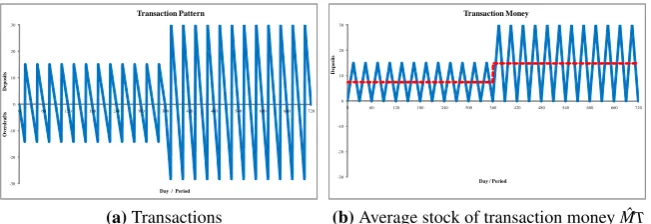
Figure 1:Household sector’s transaction pattern for different nominal incomes in two periods
¯
Mt≡
t
∑
t=1 ∆M¯t
if M¯0=0 |¯t (8) The quantity of money thus follows directly from the axioms and this implies for the time being that the central bank plays anaccommodativerole and simply sup-ports the autonomous market transactions between the household and the business sector.
3 Transaction money
As Hahn rightly put it: ‘In any case: no monetary theory without sequences’ (1982, p. 3). By sequencing the initially given period length of one year into months the idealized transaction pattern that is displayed in Figure 1a results (cf. Schmitt, 1996, p. 134). It is assumed that the monthly incomeY/12is paid out at mid-month. In the first half of the month the daily spending ofY/360increases the current overdrafts of the households. At mid-month the households change to the positive side and have current deposits ofY/24at their disposal. This amount reduces continuously towards the end of the month. This pattern is exactly repeated over the rest of the year. At the end of each subperiod, and therefore also at the end of the year, the stock of money is zero. Money is both, present and absent depending on the time frame of observation.
In period2the wage rate, the dividend and the price is doubled. Since no cash balances are carried forward from one period to the next, there results no real balance effect provided the doubling takes place exactly at the beginning of period2.
ˆ
MT≡κY |t (9)
which resembles Pigou’s Cambridge equation. However, the variableMˆTis not
to be taken as the demand for transaction balances; it is a straightforward period average and entirely unrelated to the ‘demand–and–supply explanation of economic phenomena’ (Blaug, 1995, p. 29).
For the transaction pattern that is here assumed as an idealization the index is
1/48. Different transaction patterns are characterized by different numerical values of the transaction pattern index.
The expenditure ratiorEand the sales ratiorXis defined as:
ρE≡
C
Y ρX≡
X
O |t (10)
Taking (9) and (10) together one gets the explicit transaction equation:
[i]MˆT≡κρX ρE
RLP [ii] MˆT
P ≡κO if ρX =1;ρE=1 |t (11)
We are now in the position to substantiate the notion of accommodation as a money-growth formula. According to [i] the central bank enables the average stock of transaction money to expand or contract with the development of productivity, employment, and price. In other words, the real average stock of transaction money, which is a statistical artifact and no physical stock, is proportional to output [ii] if the transaction index is given and if the ratiosrEandrXare unity. Under these
initialconditions money is endogenous (Desai, 1989, p. 150) and neutral (Patinkin, 1989) in the structural axiomatic context. Money emerges fromautonomousmarket transactions and has three aspects: stock of money, quantity of money (hereM=0¯
at period end, cf. Graziani, 1996, p. 143) and average stock of transaction money (hereMˆT>0).
4 The transaction unit
The business sector consists of a consumption goods producing firm1and the central bank as the second firm. To begin with the central bank handles only the money transactions. Total employment is given by:
L=L1+L2 |t (12)
To focus exclusively on the monetary phenomena variations of total employment are excluded until section 12.
Y = W1
|{z}
W
L1+ W2
|{z}
W
L2+ (D1N1+D2N2)
| {z }
YD=0
|t (13)
The household sector apportions its consumption expenditures between the purchase of consumption goods and the purchase of transaction services. WithX2
the number of transactions per period that are carried out by the central bank on behalf of the households is denoted:
C1=P1X1+P2X2 |t (14)
Consumption expenditures are equal to income over all periods, i.e.rE=1. The
household sectoras a wholedoes neither save nor dissave.
The profit definition is taken from (Kakarot-Handtke, 2011a, pp. 15-17) and differentiated for the two firms:
Qf i1≡P1X1−W L1
Qf i2≡P2X2−W L2 |t
(15)
Under the condition that both markets are cleared, i.e.rX=1, this can be rewritten
as:
Qf i1≡P1R1L1
1− W
P1R1
ρX1=1
Qf i2≡P2R2L2
1− W
P2R2
ρX2=1 |t
(16)
Overall profits are zero because ofC=YandYD=0. The zero profit condition for
a single firm readsW/PR=1. From this conditions follows that relative pricesP1/P2
are inverse to the productivity ratio. In sum: both markets are cleared, the household sector’s budget is balanced and profits are zero for both the consumption goods producing firm and the transaction unit of the central bank. Money transactions consume resources, the less so, the higher the productivity of the transaction unit.
5 Synchronous saving–dissaving
The household sector is segmented into two groups: the saversA and dissavers
B. Each group has its individual expenditure ratio. The expenditure ratio for the household sector as a whole is then defined as weighted average:
ρE ≡ρEA
YA
Y +ρ
B E
YB
Y YA+YB=Y;ρE=1 |t (17)
The conditionrE=1ensures that the business sector is not the least affected by
-55 0 55
0 360 720 1080 1440
O v er d ra ft s+ L o a n s D ep o si t+ S a v in g s
Day / Period
Synchronous Saving-Dissaving
A B M (average) plus loans plus savings accounts
[image:9.595.139.459.126.320.2]1 2 3 4
Figure 2:Saving of householdsAleads in period1to an increase of the quantity of money
sector, i.e. rE<1,is quite a different issue that has to be treated separately. The
condition that the household sector’s budget is balanced in each period entails the
perfect complementarityof time preferences within the household sector. For all households that save there are other households that dissave exactly the same amount and these households take a bigger share of output compared to their real income
YB/P. This, of course, is a convenient idealization. The overall expenditure ratio is
virtually never exactly one, but that is not of interest at the moment. The perfectly synchronous buildup of current deposits by groupAand of current overdrafts by groupBduring period1is visualized in Figure 2.
At the end of period1saving–dissaving and the accumulation of current deposits respectively overdraft stops. During this period current deposits progressively assume the role of a store of value; emerging from the day to day transactions money now becomes ‘a link between the present and the future’ (Keynes, 1973, p. 293). In the next period the expenditure ratios of both groups are again unity. The usual day to day transactions of groupAcontinue now at a higher level of current deposits. Correspondingly the transactions of groupBcontinue at a higher level of overdrafts.
GroupA’saverage quantity of moneyMˆAis composed of the average stock of
transaction moneyMˆTAand the cumulated savings in the form of current deposits
ˆ
MSA. Accordingly this average quantity is defined as:
ˆ
MA≡MˆTA+MˆSA |t (18)
Is follows from (5) that:
ˆ
MSA≡
¯
MHAt+M¯HAt−1
2 −
YA
It follows from (9) that:
ˆ
MTA≡κYA with κ=
1
24 |t (20)
Both groups of households are interchangeable in principle. Therefore we have analogously for groupB:
ˆ
MB≡MˆT B+MˆSB |t (21)
In the case under consideration this quantity consists of overdrafts, i.e. the asset side of the central bank’s balance sheet. However, groupBmay change sides. To arrive at a general relation and to exclude overdraftseitherof groupA orof groupB
the discrete Heaviside function is applied:
HMˆ=
(
0, Mˆ <0 1, Mˆ ≥0
(22)
This gives the general form for the average quantity of moneyMˆ as:
ˆ
M≡HMˆTA
ˆ
MTA+H
ˆ
MSA
ˆ
MSA+H
ˆ
MT B
ˆ
MT B+H
ˆ
MSB
ˆ
MSB |t (23)
Both, the average quantity of ˆmoney for periodtand the quantity of ¯money at period end¯tare consistently derived from the axiom set and develop over time as a consequence of autonomous market transactions.
For the synchronous process we have as a first result that there isno relation
between a rising quantity of ˆmoney/ ¯money and price. The price remains constant over the periods under consideration. The buildup of the quantity of money in period1doesnotlead to a price increase.
6 Liquidity and credit
HouseholdA’s financial assets consist at the moment of current deposits which exhibit, as the means of payment in the given economy, the highest degree of liquidity. Liquidity is not a precisely defined notion. To make it operable a liquidity index❧is assigned to the households’ financial assets, i.e. current deposits, and liabilities, i.e. current overdrafts, at period end as follows:
Λ≡M¯HAλA+M¯HBλB |¯t (24) When the highest index, i.e.❧=1, is assigned to current depositsM¯HAand the
lowest, i.e.❧=-1, to current overdraftsM¯HB, overall household liquidity▲is zero in
period2.
The lowest degree of liquidity or the highest degree of illiquidity is defined by the fact that groupBis obliged to pay off the overdrafts with the central bank on demand. GroupBisde factoilliquid if this event occurs. It therefore has a strong motive to reduce illiquidity. It is assumed that groupB takes up credit with the banking unit of the central bank at the beginning of period3. When we assign to the one-period loan a liquidity index of -0.7, for example, overall household liquidity
increasesby switching from overdrafts to loans:
Λ=0.3 ¯MHA if λA=1;λB=−0.7; ¯MHA=M¯HB (26)
For any combination of current overdraftsM¯HBand one-period loansM¯HB1the
overall liquidity is given by:
Λ≡M¯HAλA+ (M¯HBλB+M¯HB1λB1) (27) In Figure 2 overdrafts are replaced by loans at the beginning of period3. In order to reduce illiquidity groupBhas to pay interest to the banking unit of the central bank.
7 The banking unit
The inclusion of the banking unit entails that the given resources of the business sectorLhave first to be reallocated:
L=L1+L2+L3 |t (28)
As a consequence total income is then given by:
Y = W1
|{z}
W
L1+ W2
|{z}
W
L2+ W3
|{z}
W
L3+ (D1N1+D2N2+D3N3)
| {z }
YD=0
|t (29)
The interest payments to the banking unit have to be subsumed under consump-tion expenditures:
C1=P1X1+P2X2+J3X3 |t (30)
The quantity bought from the banking unit X3 can here be set equal to the
amount of the loanMB1(for the consistent derivation of the rate of interest from the
differentiated axiom set see Kakarot-Handtke, 2011b, pp. 12-14).
The reallocation of labor input is neutral with regard to the price of the con-sumption good. When labor inputL3is taken away from firm1 output falls. At
the same time consumption expenditures are redirected away from purchases of consumption goods to purchases of the illiquidity reducing services of the banking unit, i.e.C1goes down andC3goes up. This leaves the price of the consumption
labor input is reallocated. This effect is related to saving–dissaving but has to be kept analytically apart. Synchronous saving–dissaving is about complementary time preferences and has no allocative effect whatsoever. Saving–dissaving and liquidity–illiquidity are related, but only in a loose way; they are disconnected in time (Keynes, 1973, pp. 166-168).
Profit for each firm is zero, i.e. W/PR=1:
Qf i1≡P1R1L1
1− W
P1R1
ρX1=1 |t
Qf i2≡P2R2L2
1− W
P2R2
ρX2=1 |t
Qf i3≡J3R3L3
1− W
J3R3
ρX3=1 |t
(31)
The zero profit conditions define the relations of commodity price, transaction price and rate of interest. The inclusion of the banking unit and the appearance of a rate of interest on loans results in a reallocation of demand and resources. The loan interest rate is, at first, alone determined by the production conditions of the banking unit.
8 Leverage and banking rules
By directly paying off the overdrafts of groupBthe banking unit contributes to a restructuring of loans on the asset side of the central bank’s balance sheet. There is a switch from zero term to longer term loans on the asset side while the liability side remains unchanged. Measured with criteria analogous to (27) the liquidity of the central bank decreases. However, since the central bank creates liquidity at will these criteria are of no consequence. Things look different when we take the banking unit as a separate entity.
The banking unit consists at the moment of an asset side. This is not a grave problem; the banking unit gets interests and pays wages in equal amount. The situation is reproducible for an indefinite time. The transaction unit, on the other hand, is no longer concerned alone with transactions but has in parts assumed the role of a savings bank. A proper division of labor demands that the savings of the households eventually find their way to the banking unit.
The situation of the banking unit can be characterized by two leverage ratios. The first is the relation of assets to liabilities:
ρA≡
¯
A
¯
L |¯t (32)
The second relation pertains to the time structure of assets and liabilities which are normally of diverse maturity. The term leverage ratio is defined as:
ρT ≡
TA¯
TL¯
|¯t (33)
At the momentTA¯depends on the amounts and the average time until maturity
of the outstanding loans. Since the liabilities are zero the banking unit’s term leveragerTis infinite.
We now impose the minimum rule that both leverage ratios should be finite. This rule exerts a pressure on the banking unit to vie for groupA’scurrent deposits. It is assumed that the banking unit offers at first an overnight account with an interest rate of x percent. It is assumed further that the households react to that offer and move their free deposits at the beginning of period4to the banking unit as shown in Figure 2. Thereby the task of the transaction unit is reduced again to supporting the household and business sector’s autonomous day to day transactions.
GroupAdoes not give up much of its liquidity. Once a household does not renew the overnight accountMHA1it switches back to current depositsMHA. The
overall liquidity of the household sector is given by:
Λ≡(M¯HAλA+M¯HA1λA1) + (M¯HBλB+M¯HB1λB1) (34) When we assign a liquidity index of 0.99 to overnight accounts the overall liquidity falls slightly in period4; the households trade liquidity against interest (Keynes, 1937, p. 216). Liquidity falls further when the households switch to longer term saving accounts. According to the inclination of groupAto part with its current deposits for a certain term both leverage ratios fall. In the case of perfect congruence of the asset and liability side both ratios are unity. When this is made a rule the banking unit has to acquire savingsbeforeit can acquire loans.
Under ideal conditions and with no special worries about the future groupA
should prefer the interest-bearing overnight account, hence free current deposits should be zero. This, though, is an add-on assumption about human behavior that is not required in ageneral structuralanalysis.
When the leverage rule is tightened the banking unit does not face a quantitative problem because current overdrafts and current deposits are equal by construction. The task consists in a more precise matching of both sides of the balance sheet with regard to the term structure. The banking unit can achieve this matching by structuring their savings accounts and offering the appropriate interest rates. Ultimately these interest rates depend on the distribution of liquidity preferences among group A. When an upward shift of the interest rate structure motivates more saving then more dissaving is needed otherwise the conditionrE=1is no
9 The interest rate link
The banking unit pays interests to groupA. Equation (29) therefore changes to:
Y = W1
|{z}
W
L1+ W2
|{z}
W
L2+ W3
|{z}
W
L3+JL¯M¯HA+ (D1N1+D2N2+D3N3)
| {z }
YD=0
|t (35)
Interest payments affect also the profit of the banking unit:
Qf i3≡JA¯M¯HB−JL¯M¯HA−W L3 |t (36) The banking unit gets interests from loans to groupB, i.e. onM¯HBand pays
interests on the savings accounts of groupA, i.e. onM¯HA. It is assumed that wage
costsWL3do not change compared to period3. If profits are again set to zero then the
margin between credit and debit interest rates covers exactly the operating costs and the interest rate on loans depends directly on the interest rate on savings accounts:
JA¯≡JL¯+
W L3 ¯
MHA
if M¯HA=M¯HB |t (37)
Interest rates on both sides of the balance sheet ultimately depend on the liquidity preference of groupA. The higher the interest rate that is necessary to motivate groupAto part with liquidity the higher the interest rate for the loans of group
B. This link holds strictly only under the condition that the leverage ratios of the banking unit are kept constant. The effects of a higher liquidity preference can be buffered by higher leverage ratios. For the functioning of the pure consumption economy the current deposits of groupAare in the strict sense not required. They are required, though, to reduce the leverage risk of the banking unit (Minsky, 2008, pp. 261-265).
One can easily imagine that groupAswitches in subsequent periods between current deposits, overnight and longer term savings accounts and that all these movements are compensated for by the leverage ratios. Thus groupAis perfectly satisfied and there is no further effect on the economy.
A high stock of current deposits hasnoimpact on prices. The market clearing prices can be derived from the zero profit conditions (31) respectively (36) and depend on the wage rate and productivity (i.e. on Keynes’s efficiency wage; see Skidelsky, 1995, p. 92). The stock of current deposits is not among the price determinants. Therefore the structural axiomatic quantity theory is obviouslynot
about the determination of the price level.
Equation (37) implicates that, if wage rate and loans (=savings) are multiplied with the same factor (see section 11) the interest rates on both the asset and the liability side of the banking unit remain unaffected.
interest rate. GroupAgets a higher interest income and increases its consumption expenditures. Changes of liquidity preference lead, in the final analysis, to changes in the distribution of output among households.
Interest rate increases may have feedback effects on saving–dissaving. If perfect synchronicity breaks down and both groups lower their expenditure ratios, i.e. increase saving so that rE<1, then the business sector as a whole makes a loss
that is equal to thenet savingof the household sector as a whole. The adverse impact on employment is obvious and shall not be considered further here (see Kakarot-Handtke, 2011d, pp. 5-9).
In Keynes’s scheme the vagaries of liquidity preference disturb the classical interest rate mechanism thus causing a shortfall of effective demand because of insufficient investment expenditures (Keynes, 1973, p. 173). Hence liquidity preference is one among the explanations of unemployment. Since in the pure consumption economy there is no investment we do not follow this thread of argument further.
10 Saving–dissaving reversal
Period4in Figure 2 suggests a shortcut. Instead of putting their current deposits in a savings account of a certain contract period groupAcould lend the money directly to groupB. While this practically eliminates the banking unit, analytically it does not. As soon and as far as a household enters the lending business it becomes a firm. Analytically the banking unit is replaced by an arbitrary number of small scale banks. If the private bankers pay the same wage rate to themselves and if their aggregated labor input equals that of the banking unit their profits are in sum equal to that of the banking unit. Takenas a wholethe one-man banks are formally identical with the banking unit. This is not to deny that the behavior of these firms would be quite different from that of a bank in the familiar sense but these individual idiosyncrasies are more of historical than analytical interest. Therefore they are passed over here.
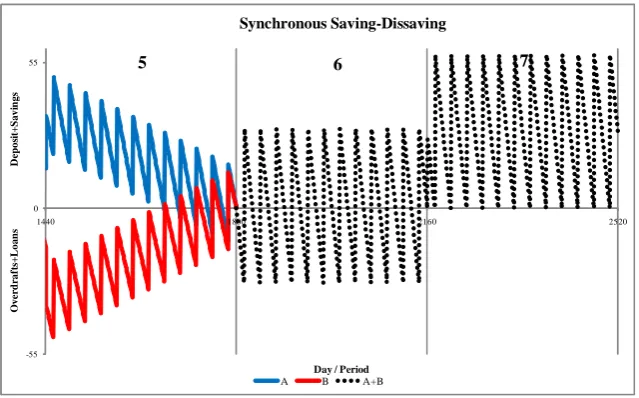
Eventually the saving–dissaving of period1has to be reversed. This takes place in the 5th period which is depicted in Figure 3. GroupAfirst switches its savings ac-counts back to current deposits and then spends more than the period income on the consumption goods. Since the process is assumed to be perfectly synchronous group
Bcurtails its consumption expenditures accordingly. The banking unit vanishes at the beginning of period5.
It is easy to see that the upper parts of period1and period5 put together add up to an overlapping generations model. This presupposes merely that the initial dissaving in period1is not reversed and that the loan is revolved for an indefinite time.
-55 0 55
1440 1800 2160 2520
O v er d ra ft s+ L o a n s D ep o si t+ S a v in g s
Day / Period
Synchronous Saving-Dissaving
A B A+B
[image:16.595.138.458.125.324.2]5 6 7
Figure 3:Reversal of saving–dissaving and elimination of overdrafts
the households with an initial amount of deposits according to (5) and to endow the firms according to (7). This shifts the whole pattern upwards in period7. In practice this can be achieved by a selling of assets, e.g. gold, to the transaction unit. The central bank’s balance sheet then shows the valued stock of gold on the asset side and theconstant sumof households’ and firms’ current deposits on the liability side. In this case transaction money is fully backed by gold. The index for this transaction pattern is❦=1/12. When full or fractional gold backing is made a rule for the central bank money becomes exogenous. With this regime switch the precondition for accommodation vanishes.
11 Unit of account changes
Up to this point the dimension of price, wage rate and other nominal variables has been tacitly taken as given. In the structural axiomatic context it is the task of the central bank to define this dimension. Equation (38) restates pricePinexplicitform as product of the specific unit of accountqand the generic pricep. The generic price has the dimension generic currencyGCUper unit of an arbitrary consumption good. The specific unit of accountqhas the dimension specific currency (EUR,
USD,JPY, etc.) per unit of generic currencyGCU:
P≡χp |W,D,etc.
P EU R U NIT ≡ χ EU R GCU
| {z }
speci f ic unit o f account
generic price
z}|{p GCU
U NIT
| {z }
generic unit o f account
When the explicit form is applied to the nominal variables of the axioms (1) and (3) the specific unit of accountq cancels out. After its elimination one has a simple reformulation of the axiom set in generic currency which describes the money economy before the central bank steps in. It is formally of no consequence to replace the generic unit of account by something tangible, say,GCU=ounce of gold or any other commodity or by something artificial like special drawing rights
GCU=XDR.
Whether fiat or commodity money is taken does not affect the axiom set. It is convenient, though, to obviate parochial realism and to consider money in the abstract. The concrete money form would, to be sure, have practical consequences for everyday money transactions. With the assumption that all transactions are carried out by the central bank the awkwardness of physical money in the form of notes or coins is taken from the structural axiomatic model. As ideal transaction medium money should neither burn up much resources, nor yield a seigniorage, nor cause a wealth transfer between the private sectors and government (cf. Gurley and Shaw, 1960, p. 73). Therefore, the logically first act is to declare current deposits at the central bank as means of payment.
Then it is the task of the central bank to define the unit of account of the means of payment. It is assumed that the monetary values in all contracts are formulated explicitly by applying expression (38), which is to that effect referred to as contract equation (cf. Arrow and Hahn 1991, p. 357). Hence it is sufficient for the central bank to officially declare at the beginning of period1 that the dimension of the specific unit of accountqisEUR,USD,JPY, etc. This declaration has no effect on the generic variables of the money economy which at the moment involves the axiom set andallcontracts. No harm is done, except to those who have to change price tags, when the central bank declares in the next period that the specific unit of accountqis doubled. This simply doubles all nominal magnitudes including the average stock of transaction money (11). Money is a veil with regard to declarative changes of the specific unit of account.
Let us now assume that business and workers form a coalition. They agree to double wage rate, dividend, and price in the next period. For the axiom set this move is of no consequence. All nominal magnitudes double. There is no difference to a declarative change of the unit of account by the central bank. However, there is a real difference for those who are party to a contract and for those with current deposits and current overdrafts at the central bank. These nominal magnitudes are not affected by the coalition game and the purchasing power of deposits, for example, diminishes. Without any direct real gain for itself the coalition spawns random advantages and disadvantages in the rest of the money economy.
Accommodation implies that the average stock of transaction money (11) in-creases. Since output is not affected the real average stock of transaction money remains constant.
consumption expenditures. Yet this problem can be circumvented by shortening the payment interval, i.e. by reducing❦. Hence, if it is part of the coalition game (and technically feasible) to multiply wage payments per period in accordance with the available overdraft facilities the central bank is in principle incapable to stop the game. The central bank has no full sovereignty over the unit of account. This predicament does not depend on the actual level of employment. The coalition game can be played at overemployment or underemployment as long as business and labor stick to their agreement. However, if the central bank accommodates only to the autonomous decisions of the coalition money is no longer neutral. The coalition effects apartialchange of the specific unit of account.
Full accommodation would require that the central bank declares a unit of account change for period2 withq2=2q1. This declarative change applies toall
contracts and, of course, to the existing deposits and overdrafts as depicted in Figure 1a as well as to any imposed overdraft limit. Then no one is made better or worse off by the coalition game. A declarative doubling of the specific unit of accountquno actudoubles price and the average stock of transaction money as given by (11) and shown in Figure 1b. This is the trivial variant of the quantity theory.
It is worth noting that the rate of interest is not affected by declarative changes of the specific unit of account (Kakarot-Handtke, 2011b, p. 13). Interest payments double because the nominal values of loans and savings are doubled. Interest rates are the fixed stars on the monetary firmament.
When the dimension of the specific unit of account in (38) is supplemented by the quotientEURt-1/EURt-1then the contract equation can be rewritten as:
P
EU R U NIT
≡χ
EU R EU Rt−1
p
EU Rt−1
U NIT
(39)
In this form the specific unit of account assumes the role of a perfect infla-tor/deflator. Full accommodation is formally the same thing as a declarative change of the specific unit of account. This in turn means that full accommodation is the same thing as a perfect inflation/deflation with no effect on real variables and contracts. Only in this limiting case is money a veil independently of the rate of price changes. There isnoreal balance effect andnodistinction between real and nominal rates of interest. It goes without saying that the central bank will not resort to overall accommodation. The lack offullsovereignty over the unit of account is the ultimate reason why money is not neutral in the structural axiomatic money economy.
12 Transaction money and employment
accommodative regime. As final step employment variations are now taken into the picture. From the axiom set and the definitions
ρV ≡
D
W ρF≡
W
PR |t (40)
follows the employment equation in its simplest form (cf. Kakarot-Handtke, 2011a, pp. 6-9 or 2011d, pp. 5-9):
L=
DN PR
ρX
ρE
− W
PR
= ρVN
ρX
ρEρF
−1
= (·)
1 ρEρF
−1
if ρX =1 |t (41)
The employment equation is the structural axiomatic counterpart to the Phillips curve and contains the original (Phillips, 1958) as special case.
The average stock of transaction money is given by (11). Taking the employment equation (41) into account, the definition of the average stock of transaction money boils down to what may be referred to as augmented transaction equation:
ˆ
MT ≡κ
(ρVN)
1
W−
ρE
PR
≡ (·)W 1−ρEρF
if ρX=1 |t (42)
From this relation follows – with all other variables fixed in each case:
(i) An increase of the expenditure ratiorEleads according to (41) to higher
employment and exacts a higher average stock of transaction money
ˆ
MTaccording to (42).
(ii) When the rates of change of wage rate and price are identical employ-ment stays where it is andMˆTrises. Both, employment and the average
transaction balance remain unaltered if the rate of change of wage rate and price is zero.
(iii) A wage rate increase is conductive to higher employment and exacts a higherMˆT.
(iv) A price increase leads to a drop of employment and exacts a lower
ˆ
MT. Under the condition of budget balancing, i.e. rE=1, and market
clearing, i.e. rX=1, the varying configuration of W, P, R,i.e. ofrF,
determines the development of the average stock of transaction money.
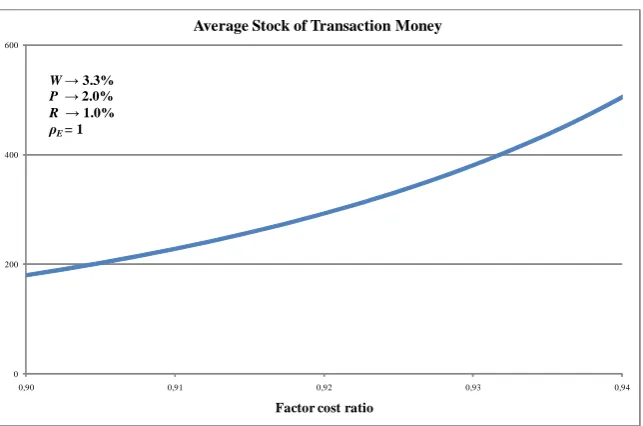
The key variable, then, is the factor cost ratiorF. Figure 4 shows how the average
0 200 400 600
0,90 0,91 0,92 0,93 0,94
Factor cost ratio
Average Stock of Transaction Money
W→ 3.3% P → 2.0% R → 1.0%
[image:20.595.138.460.122.335.2]ρE = 1
Figure 4:The augmented transaction equation
A closer look at the augmented transaction equation (42) reveals that the relation is in factnegativefor price increases, which patently contradicts the basic tenet of the commonplace quantity theory. The paradox resolves itself when the wage increase of 3.3 percent per period is taken into account. The augmented transaction equation asserts that the relation between wage rate and the average stock of transaction money ispositive. The salient point is that this positive relation is stronger and therefore supersedes the negative relation between price and average stock of transaction money. As long as empirical tests do not precisely discriminate between these two countervailing effects the quantity theory in either version will find empirical support. Relying on the structural axiom set the prediction may be ventured that more sophisticated measurements will lead to a refutation of the commonplace quantity theory and establish a positive relation between thewage rateand the average stock of transaction money (all other things equal). More general the structural axiomatic quantity theory asserts that there is a positive correlation between the average stock of transaction money and the factor cost ratiofor any given expenditure ratio (for some empirical support see Brissimis and Magginas, 2008, pp. 4, 7).
commonplace correlation between quantity of ˆmoney and price will emerge from (23). As Laidler put it:
The overwhelming weight of evidence is . . . consistent with the quan-tity theory and inconsistent with certain extreme criticisms of it. To the extent that one comes to this evidence with a prior belief that the quantity theory is a plausible doctrine, that belief is strengthened by it. (Laidler 1991, quoted in Blaug, 1995, p. 44)
The same is even more true for the structural axiomatic quantity theory.
13 Conclusions
Behavioral assumptions, rational or otherwise, are not solid enough to be eligible as first principles of theoretical economics. Hence all endeavors to lay the formal foundation on a new site and at a deeper level actually need no further vindication. The present paper suggests three non-behavioral axioms as groundwork for the formal reconstruction of the evolving money economy and applies these to the quantity theory. The main results of the inquiry are:
• The first step consists in declaring current deposits at the central bank as the
means of payment. Then, under the initial structural axiomatic conditions money is endogenous and neutral. Money emerges from autonomous market transactions and has three aspects: stock of money, quantity of money and average stock of transaction money. Money and credit are symmetrical.
• Money transactions, which are exclusively carried out by the central bank’s
transaction unit, exact a reallocation of resources and of consumption expen-ditures.
• The store of value function emerges from the day to day transactions in the
synchronous process of saving–dissaving with complementary time prefer-ences. In this process there is no relation between a rising quantity of money and prices.
• Interest rates on both sides of the banking unit’s balance sheet depend, given
the credit- and term leverage, on the liquidity preference of the savers.
• The loan interest rate is determined by the interest rate on saving accounts
and on the production conditions of the central bank’s banking unit.
• The market clearing prices depend in the structural axiomatic context in the
most elementary case on wage rate and productivity. The quantity of money is not among the price determinants.
• Changes of liquidity preferences ultimately lead to changes in the distribution
• Full gold-backing of current deposits is a limiting case of the accommodative
regime.
• Full accommodation is formally the same thing as a declarative change of
the specific unit of account. This in turn means that full accommodation is formally the same thing as a perfect inflation/deflation with no effect on real variables and contracts. There is no real balance effect and no distinction between real and nominal rates of interest.
• The rates of interest are the sole variables that are not affected by declarative
changes of the specific unit of account.
• The structural axiomatic quantity of money is composed of two parts:
trans-action money and savings in the form of current deposits. There is, first, no relationship between the money part of savings and the price of the consump-tion goods and, second, given the productivity the augmented transacconsump-tion equation establishes a negative correlation between price and the average stock of transaction money and a positive correlation between wage rate and the average stock of transaction money.
• If a) savings in the form of current deposits are either zero (and earn interest
on savings accounts) or remain fairly stable and b) wage rate and price move in tandem then the commonplace correlation between quantity of money and price emerges from the structural axiomatic formalism.
The structural axiomatic approach fits the quantity theory consistently into a general context.
References
Arrow, K. J., and Hahn, F. H. (1991). General Competive Analysis. Amsterdam, New York, NY, etc.: North-Holland.
Blaug, M. (1995). Why is the Quantity Theory of Money the Oldest Surviving Theory in Economics? InThe Quantity Theory of Money, pages 27–49. Aldershot: Edward Elgar.
Brissimis, S. M., and Magginas, N. S. (2008). Inflation Forecasts and the New Keyenesian Phillips Curve. International Journal of Central Banking, 4(2): 1–22.
Desai, M. (1989). Endogenous and Exogenous Money. In J. Eatwell, M. Milgate, and P. Newman (Eds.), Money, The New Palgrave, pages 146–150. London, Basingstoke: Macmillan.
Gurley, J. G., and Shaw, E. S. (1960). Money in a Theory of Finance. Washington: Brookings Institution.
Hahn, F. (1982). Money and Inflation. Oxford: Blackwell.
Kakarot-Handtke, E. (2011a). Keynes’s Missing Axioms. SSRN Working Paper Series, pages 1–29. URLhttp://ssrn.com/abstract=1841408.
Kakarot-Handtke, E. (2011b). The Pure Logic of Value, Profit, Interest. SSRN Working Paper Series, pages 1–21. URLhttp://ssrn.com/abstract=1838203.
Kakarot-Handtke, E. (2011c). Schumpeter and the Essence of Profit.SSRN Working Paper Series, pages 1–25. URLhttp://ssrn.com/abstract=1845771.
Kakarot-Handtke, E. (2011d). Unemployment Out of Nowhere. SSRN Working Paper Series, pages 1–21. URLhttp://ssrn.com/abstract=1885544.
Keynes (1937). The General Theory of Employment. Quarterly Journal of Eco-nomics, 51(2): 209–223. URLhttp://www.jstor.org/stable/1882087.
Keynes, J. M. (1973). The General Theory of Employment Interest and Money. The Collected Writings of John Maynard Keynes Vol. VII. London, Basingstoke: Macmillan. (1936).
Lavoie, M. (2003). A Primer on Endogenous Credit-Money. In L.-P. Rochon, and S. Rossi (Eds.),Modern Theories of Money, pages 506–543. Cheltenham, Northampton, MA: Edward Elgar.
Minsky, H. P. (2008).Stabilizing an Unstable Economy. New York, NY, Chicago, IL, San Francisco, CA: McGraw Hill, 2nd edition.
Patinkin, D. (1989). Neutrality of Money. In J. Eatwell, M. Milgate, and P. New-man (Eds.),Money, The New Palgrave, pages 273–287. London, Basingstoke: Macmillan.
Phillips, A. W. (1958). The Relation Between Unemployment and the Rate of Change of Money Wage Rates in the United Kingdom, 1861-1957. Economica, 25: 283–299. URLhttp://www.jstor.org/stable/2550759.
Schmitt, B. (1996). A New Paradigm for the Determination of Money Prices. In G. Deleplace, and E. J. Nell (Eds.),Money in Motion, pages 104–138. Houndmills, Basingstoke, London: Macmillan.
Skidelsky, R. (1995). J. M. Keynes and The Quantity Theory of Money. InThe Quantity Theory of Money, pages 80–96. Aldershot: Edward Elgar.
Correspondence address: AXEC
Egmont Kakarot-Handtke Hohenzollernstraße 11 80801 Munich, Germany e-mail: [email protected]
Papers on SSRN:http://ssrn.com/author=1210665