Cloud Streaming on Online Gaming
Puttaswamy M R
1Dr. P Balamurigan
2Sumaiya Said Hamood Al Mahdhori
3Dr. Prakash Kumar
41
Research Scholar
2Professor
2
Department of Computer Science
1
Bharthiyar University, Coimbatore, Tamilnadu
2Govt. Arts Women College, Coimbatore, Tamilnadu
3,4
Middle East College, Muscat Sultanate of Oman
Abstract— Cloud computing in general and cloud gaming in particular have been extensively investigated separately, due to the great attention this technology currently attracts. The specific problem this work addresses is the bandwidth issues, in which it can’t sustain the large number of servers and storages into small data center, redundancy as well as non-backup issues. Further occasional technology failure here or there, no hardware in cloud may limit you to go away with your servers. This may not enable you to get all the features with limited versions, which depends on service provider. You may also lose the control when moving the service to the cloud. One can’t ignore the security issue & data protection in addition to the speed or lack of internet that can affect the application working via internet. Despite the superior benefits that can be maintained by cloud streaming in general and cloud gaming in particular, few drawbacks can affect the end users and games seekers who wish smooth playing of the games with all the operations in cloud server. The results extracted from this study demonstrate the new manner to rectify the defaults or run smoothly streaming of the games. Similar attempts are also tried as a current working solutions by many huge companies such as OnLive, Sony, NIVIDIA etc. Many of these solutions already implemented as an alternative, in case of any of bandwidth or security issue or whatever defaults that could be happened while using these technologies. Besides, this study also demonstrates many of future trends that the cloud streaming providers attempt to implement them for better performance and competency. Key words: Cloud streaming, cloud gaming, gaming cloud by video streaming, gaming cloud by file streaming, cloud future trend
I. INTRODUCTION
Cloud streaming, which is also known as media streaming, is considered as one of the fabulous emerging technologies that appear recently in parallel with the modern world, largely using multimedia and internet technologies. Cloud streaming appears as a brilliant technique to transfer and process data in continuous and steady stream. Its importance appears as highly recommended for the users, who unable to download vast files rapidly via internet. With cloud streaming, the user can display the data quickly and smoothly via application that is converting the data into picture or sound, even before the transmitting of the entire file by using only the browser or plug-in from the client side. In particular, Cloud streaming serve many techniques. Some of these techniques and types are cloud gaming, cloud video, cloud music or audio, cloud movie, cloud download, cloud storage, cloud server, cloud PS4 etc. As this new generation infrastructure gains momentum, more and more applications are applied to this kind of rapid developed technologies.
This study proposes methodologies for cloud streaming in general and cloud gaming in particular and the
ways to enhance this open source for the future outlook. Actually all cloud streaming types are very important for the growth requirements by users and clients, but cloud gaming could be described as the most complicated technique among all of them; in which it cover all of audio, video streaming and file streaming under its gamp. The fact that makes cloud gaming more complicated and facing lot of risks and limitations either directly from the cloud gaming itself or indirectly by the effects that come from its types such as video and file streaming or from the effects that come from cloud streaming in general. In this study, firstly we discuss about cloud streaming overall functionality, its pros and cons and its importance for the average downtime taken for cloud users verses non cloud users. Next, this study describes the functionality of cloud gaming in specific as an important technique of cloud streaming, its types and characteristics, providers, users’ awareness and interest, its benefit and its limitations with critical evaluation and analysis. Finally we provide the recommendation and attempt for future trend outlook and concerns, that should be taken in consideration in order to adhere to the willing level to rally catch up on the users’ requirements either on cloud streaming in general or in cloud gaming in particular.
II. CLOUD STREAMING
A. Cloud Streaming Overall Functionality
Whenever end users requests the content, then content will be drawn on the platform only, based on reverse proxy technology of Distribution Cloud's On Demand Streaming. Hence user can simply host your multimedia files on an HTTP web server, rather than deploying their multimedia files on a streaming server. Whenever any piece of streaming content is requested by the end user, then end user will be directed towards the nearest available edge streaming server. At this point of time, edge server makes a determination on whether or not, it has the content item. If the edge server have the content, the server will immediately begin to stream that content to the end user. In case, edge server does not have the content, then only the edge server will initiate HTTP byte range request. This enables to retrieve the content from the HTTP web server (or Cloud Storage repository). Lossless copy of multimedia files can be steamed via TCP based on the requests. But the streaming of these files to the edge server, depends on type of protocol end user supports. Finally, the multimedia files will be streamed to the end users over UDP or TCP[3].
B. Cloud Streaming’s Pros & Cons
Cloud streaming has lot of benefits and advantages including reducing the time without any need of installing your own streaming server to get the media. It supports large and small events with multiple format and multiple locations without any need of special software or hardware. It is also easy to implement it quickly with less cost for maintenance with in-house IT infrastructure without the need of IT support for any of cloud hosting or applications. Other advantages includes easy for Troubleshooting, installation and configuring, efficient recovery and retrieval of applications with minimum downtime, and the flexibility for scale and growth as per the user requirements.
On the other hand, cloud streaming has some of disadvantages as the same as any of emerging technologies could has some cons which are - bandwidth issues in which it can’t sustain the large amounts of servers and storages into small data canters, redundancy issue as well as non-backed up of data. Further the technology may fail here or there, hardware in cloud may limit you to go away with your servers, less features with limited versions which depends on your provider, you may also lose the control when moving the service to the cloud. The security issue, data protection and the speed or lack of internet can affect the application that works via internet [4].
C. Cloud Streaming’s Importance for the Average
Downtime Taken and Events for Cloud Users Vs. Non Cloud Users
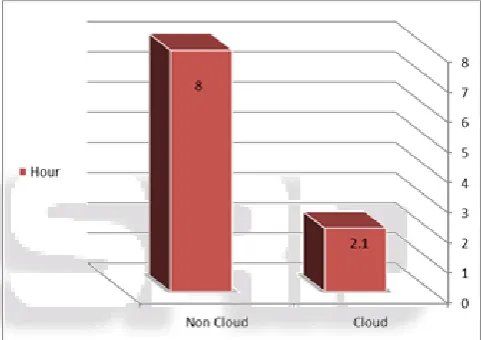
[image:2.595.308.549.51.224.2]As mentioned above, cloud streaming provide live streaming. In other words, streaming support for live events using any major streaming format. Following bar chart illustrates the support of events for cloud’s users and non-cloud’s users.
Fig. 1: Average time taken for events for cloud users vs. non cloud users
Cloud streaming also provides the efficient recovery and retrieval of applications and data with faster delivers, more accurate and less downtime. Therefore it is considered as the most efficient recovery plan[5].
Fig. 2: Average downtime taken for cloud’s users vs. non cloud’s users
D. Improve Cloud Streaming’s limitations
Ideal performance for any bandwidth issue, is that clients must plan and should not create small set of data centers using large servers and storages devices. Besides for limited features issues, the user should know the cloud service provider offers, because some cloud providers are not offering the all needed features. Moreover for losing control issue, the user must ensure the cloud service provider must provide continuous and round the clock live help desk to rectify any problems immediately. This is required especially for the companies that move their services to the cloud for handing large amount of data and information. For companies who have an in-house IT support facilities, they should be able to handle issues on their own by logging onto a server. The above are only temporary practices to avoid some predictable limitations that could occur while using the services. Still willing for more future improvement will be discussed later in this study.
III. CLOUD GAMING
A. Cloud Gaming overall functionality
[image:2.595.307.548.294.464.2]complicated one which is a “cloud gaming” or it can also be called as “gaming on demand”, “online gaming” etc. It is considered as one of the complicated emerging technology that lay under cloud streaming. The fact that makes cloud gaming more complicated because of its two main types the first one is cloud gaming based on video streaming and the second one is cloud gaming based on file streaming. Even its risks and limitations come from both the combination of audio, video streaming and file streaming. However the main purpose of cloud gaming is to facilitate the playing of games for the end user in any device without any interruption and without the need of any heavy and powerful graphics hardware. Cloud gaming can provide intellectual game streaming depending on the input commands, in such cases the computer will receive the streaming videos and audio, while the rest of all heavy file transfers will be carried out by the cloud server itself.
B. Cloud gaming types and the characteristics of each type
Cloud gaming functionality depends on its types’ manner to make the gaming streams online. There are two types of cloud gaming. The first one is cloud gaming based on video streaming and the other one is cloud gaming based on file streaming
First, cloud gaming based on video streaming facilitate game execution and stream the videos of the gameplay to the user. User interactions through controller, mouse, keyboard, for you. All your actions through keyboard, mouse and controller input are sent over to the cloud gaming server via the network[6].
Using cloud gaming based on video streaming, user can get games on demand on any devices such as mobile, consoles or computers. Cloud gaming is similar to video on demand, through the use of a thin client, in which the actual game is stored on the operator's or game company's server and is streamed directly to computers accessing the server through the client [7]. This allows access to games without the need of a console and largely makes the capability of the user's computer unimportant, as the server is the system that is running the processing needs [8][9]. The user press the button and the signal goes directly to the server which is in return will send the response to the input control. Actually many companies and cloud gaming providers using this technique such as OnLive and many others.
The main characteristic of this type that the user has no need to download the game or to store its applications and contents in his/her hard drive but all the game code will execute at the cloud server itself. Even the user can execute the game with the minimum power or powerless computer than what is normally required to play a game. Especially the cloud server is doing the whole operations required to enhance displaying the game with high level of performance that is usually done in the ordinary ways by users. So all the broadband an encryption to get streamed into the subscriber’s device online without any downloading of the game [10][11]. Second one is Cloud gaming based on file streaming. It is also known as “progressive downloading”. This type is little bit different than the first type in which a 5% of the total game size to be downloaded primarily to allow the user to start playing the game while downloading the rest of the game during user’s playing time. As same as video
streaming, this type can be run in any devices such as consoles, computers and mobiles.
The main characteristic of this type is that it allows the user to access the game without any lag with very low bandwidth for internet connects. It is also used to provide scalable streaming for games huge data contents.
On the other hand, the cloud gaming that is based on file streaming require hardware capabilities just to run the game in which all the game’s contents are stored and downloaded on the user’s device. Still many companies are using this type of cloud gaming such as Approxy, SpawnApps and Kalydo.
C. Cloud Gaming Providers
There are many cloud gaming providers such as, OnLive being the most popular one especially it gives you 30 minutes of free trail, just to play the full version of each supported game as well as to check the service of the OnLive. Also there are NVIDIA’s and Sony which are very great names that really works on continues development of cloud gaming in order to meet the future trend and users’ expectations [12]. There are also other cloud gaming providers such as Kalydo, PlaycastMedia Systems, G-Cluster, GFACE.
D. Cloud gaming users’ awarness and interest
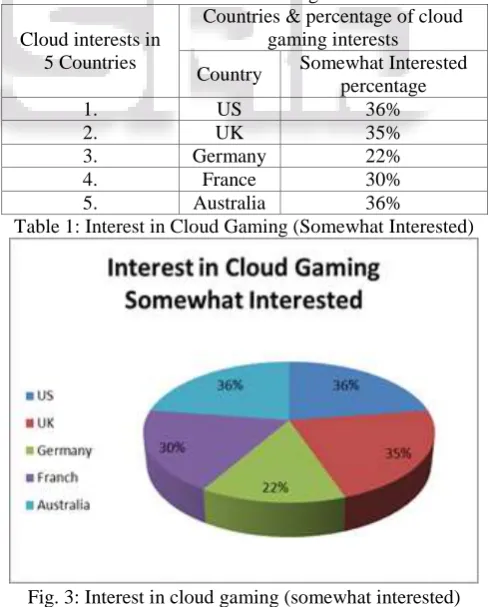
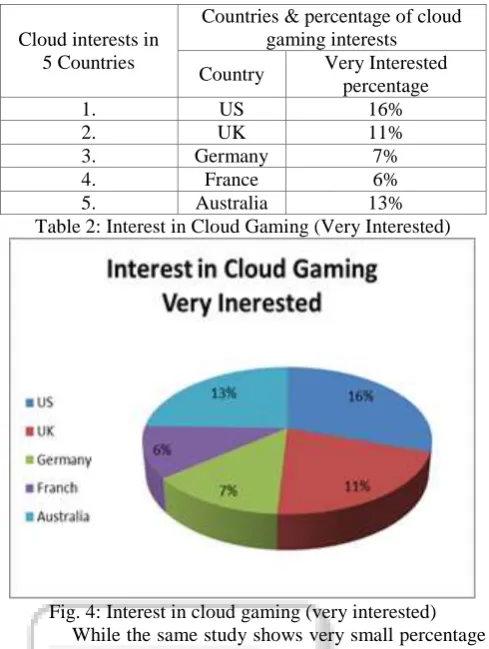
According to the increased awareness & interest toward cloud gaming, Techinitio makes a great survey in 2013 that measures the great interest of cloud gaming in five countries which are Australia, France, Germany, UK, US.
The following table shows the percentage of interest in each of the mentioned countries as following:
Cloud interests in 5 Countries
Countries & percentage of cloud gaming interests
Country Somewhat Interested percentage
1. US 36%
2. UK 35%
3. Germany 22%
4. France 30%
5. Australia 36%
[image:3.595.306.551.392.696.2]Table 1: Interest in Cloud Gaming (Somewhat Interested)
Cloud interests in 5 Countries
Countries & percentage of cloud gaming interests
Country Very Interested percentage
1. US 16%
2. UK 11%
3. Germany 7%
4. France 6%
5. Australia 13%
[image:4.595.45.290.52.377.2]Table 2: Interest in Cloud Gaming (Very Interested)
Fig. 4: Interest in cloud gaming (very interested) While the same study shows very small percentage of 1% or less for the ones who do not care about cloud gaming (Techinitio, 2013)
E. Cloud Gaming Benefits and Limitations
There are many benefits of cloud gaming such as High-quality, low-latency, multi device gaming on any PC, support for Mac, tablet, smartphone or TV. Further it maintain the simplicity representing in anytime accessing to a library of gaming titles and saved games in the cloud. User can Play or continue games from any device, anywhere. Besides, it applies with less hassle, in other words, no new hardware, No complicated setup, No game discs, No digital downloads, No game installations and No game patches[13]. Moreover there are other advantages such as flexible use, saving disk space and protecting your game in which there’s no CD for you to keep track of. Even In case you lost the installation disk, but if you want to re-install the game on a new computer, still can get it through online. User need not have to worry about the disc breaking or the disc getting severely damaged 20 minutes after buy it. All the important data is stored online [14]. On the other hand there are many limitations in
cloud gaming in which some of them are similar with cloud streaming. According to Techinitio, the main downsides are Latency as every user experienced Lagging on LAN gaming and concluded that it would run smoothly on local computer. It’s a common sense that when user input, data has to travel through all the internet to the remote server, which would then send the output. This would obviously will lag behind the other action. In additions, Internet have unlimited space of storage but a server is always limited. The videos or games stored in the Cloud are always compressed, and the same way user get it when play them. This
result is low sharpness and low detailing. Moreover, Bandwidth would require the unlimited plan over user bandwidth, if game is in the cloud. Further continuous play of any online game will eats up players 3 GB of bandwidth per hour. It becomes too expensive. In addition to the continues fairness of hacking, even if the main motivation is to curb piracy used in game market, but still pirates will figure a way around it. In other words, if user look deeper into the technology itself, then can understand that cloud is the ultimate disrupter. According to Webopedia, one can count all the permutations but still new possibilities will soon spring up. The constant growth of the cloud, and its closely related technology named virtualization has led to a new trend i.e. Software Defined. Be it networking, storage or the entire data canter, Software Defined promises fully abstract software from the underlying hardware. In case of cloud abstract data will be computed from their physical location. Start-ups like Simplicity and Pluribus Networks mine is the new sector, which in essence, turns the data centre into a single pooled cloud of resources. As tech analyst Stu Miniman says that the cloud is the ultimate software defined. In other words, cloud could face the out of control risk, in which a single hacker gets lucky and two million people get their passwords exposed. Ultimately, everything is part of one big cloud [18].
IV. FUTURE TREND OUTLOOK FOR APPLICATIONS DEVELOPMENT
Actually there are many great names such as NVIDIA’S, Sony etc, which are working superiorly for cloud gaming development either to rectify its limitations or to invent new manner to enhance its performance or to add additional options and tools in order to meet all users’ satisfaction fulfilment.
About future gaming, will Cloud Gaming be able to redeem itself?. The resultant prospects are bright and it will probably be a welcome boost to the gaming industry by making gaming affordable and more accessible to more players. When and how it will arrive is another matter. In the meantime, we’ll have to make due with buying new gaming consoles and chucking out the old ones.
There are many attempt by Sony in which it aims to establish Playstation4 to be the first video game console from an established industry leader. Sony attempted to make cloud based streaming gaming a central part of its business.
According to Sony CEO Kaz Hirai, The Company hopes to rehabilitate all of Sony’s businesses, by unifying them through all its hardware and cloud services. His reason is that people are moving more and more to the mobile space, the two keywords, and user and the business probably hear this from everybody- smartphones and tablets. According to Hirai, A lot of things to the is happening in the industry. With reference to cloud, one of the things as a strategy is acquisition of a company called Gaikai. That is a company that’s going to propel the movement of the video game business into the cloud space very quickly.”[15].
Earlier Sony announced its committee to gain full ownership of Japanese broadband company “So-Net” so it can advance the chase of cloud services and interactive entertainment experiences in Asia.
Sony is ready for a future when even digital goods aren’t stored on your hardware as the main concept of implementation. Cloud gaming and the PlayStation 4 is a good example of Sony applications that needs to take on a very clear shape as a streaming device.
While other revolutionary big company with big name of cloud gaming provider which is NVIDIA that will provide NVIDIA GRID cloud gaming technology, in which you’ll soon be able to stream video games from the web just like any other streaming media. GRID renders 3D games in cloud servers, encodes each frame instantly and streams the result to any device with a wired or wireless broadband connection [17].
Regardless of the big names of cloud gaming providers, actually cloud gaming itself featured 5 Exciting Emerging Trends of Future Gaming as following:-
A. The Cloud Gaming Rise
In 2009 Game developers conference, OnLive revealed cloud gaming idea over the Web in which it was firstly introduce the technique to the public. OnLive established cloud gaming by streaming the game over the Internet from a server miles away and the user was able to play on a low-end laptop. Users can stream games, which are available in the OnLive storage by using OnLive’s own client. It was a good start that gain the attention of testers, game developers and investors. Despite every attempts tried, even after 3 years later, OnLive was unable to achieve success from cloud gaming. Even though, it had thousands of subscribers, but none of the users are paying, since players just try the game’s demos on the OnLive store for 30 minutes for free and after that they don’t continue.
B. A Diverse Game Plan
During the year 2008, GaiKai Company was founded and which started focusing more on selling their platforms to game manufacturers who wish to provide cloud gaming options to their players. The GaiKai platform is similar to Netflix streaming on Smart TV platform. Basically, GaiKai allows white-label businesses with any manufacturer. In such cases, if Samsung wants to have their own cloud gaming platform on their range of TVs, GaiKai was ready to build it for them. They developed a partnership with Electronic Arts and Ubisoft. The attempt was in the midst of making more mainstream games available on their platform. Sony subsequently showed up and bought them for $380 million[16].
1) Friend or Rival?
There may be many reasons for massive buyover. Adding a new platform to their service amy be one of the reason. The other reasons may be to prepare it for PS4 or their range of Sony smartphones, to stave off the competition from other tech manufacturers like LG or Samsung or even from GaiKai itself before it grows big enough to consume Sony and the rest of the traditional gaming industry[16].
C. Setting Up Cloud Gaming
Despite big players in the mix, cloud gaming was not taken over the world, as anticipated. To acieve success, still a lot
of creases to iron out. Here is a brief walkthrough of the problems faced by companies who are investing in cloud gaming:
1) The cost and charge
In orede to facilitate games to play anywhere and anytime, Cloud gaming service providers have to invest in getting the server technology (more on that later) to ensure smooth gameplay. This is one of the main reason, why companies like OnLive provided three options: rent, purchase or subscribe, from $5 to $50 fees to game on the Cloud. The costs is only for the gaming experience and user need to have own Internet connection. Further one need a minimum of 2Mbps (or the standard recommended speed of 5Mbps) for smooth gaming because with Cloud Gaming, user will be burning up about 1.3GB in an hour. Asking the rest of the household to stop watching online videos during online game play is not justified [16]
2) Absence of Players
New gaming platforms face a big problem during online games, because players like to compete with other players. Since cloud gaming is still relatively new and players didn’t get adapted, accustomed or transformed their top running list of favorite games into cloud platform. The shift-over needs fewer configuration settings also one of the reason why existing players are not keen to shift over to cloud platform[16].
3) Change
One of the other reason is changeover of physical game entity. . If cloud gaming takes over, there will be no more game stores. Player need not pick up physical copies of the games anymore from nearby stores. The actual gaming experience will also change because, instead of being able to invest in users gaming machine, gameplay will now depend more on your internet connection and the servers hosting these games[16].
D. Latency and Hardware
Latency is the reply and reaction normally a player get from a game event when send through the Web. For a fast-paced game same as in the Multiplayer Online Battle Arena or First Player Shooter genre, it needs user or players to have a latency of at least 350 milliseconds and less. Otherwise, players in-game performance may goes down. When it comes to latency issues, many companies are still working to get game performance in tip-top shape [16].
1) Faster Gameplay
CiiNOW is working on improving game comeback response and lowering latency rates. So far, they are claiming that their network latency is 27% faster than GaiKai and 17% faster than the XBox 360. This means that player get better response times under gaming environment during play on mode for CiiNOW platform[16].
E. Hardware Performance
With Nvidia, the latency issue is considered a small one. The standard Xbox performance has around 150 – 200 milliseconds of latency. With cloud gaming, a tweak in the hardware department can easily bring the numbers down to 60 miliseconds’[16].
Hypervisor, the physical graphic card can actually create and run a virtual graphic card within it.
With this technology, the Grid has the equivalent power of 720 XBox 360’s put together, running at only a fifth of the power. If you think thats a lot of firepower, you’d be right. GaiKai is working hand-in-hand with Nvidia to redefine cloud gaming[16].
V. CONCLUSION
In this paper we investigated the issues in cloud streaming in general and cloud gaming in particular. We discuss about their functionalities, their types, their benefits and limitations. We propose some recommendations to rectify the downsides that appear in cloud as the same as any of emerging technology. Also this paper shows some trends for future development with critical evaluation and analysis of each stage during cloud gaming development since started up-to-date and how the improvement can recover the streaming performance in competence manner as well as how can add additional features and tools for more efficiency.
REFERENCES
[1] Akamai Edge Platform & Distribution Cloud (2013)
Cloud streaming. Available at:
http://distributioncloud.com/products/cloud-streaming/ (Accessed: 19 December 2013).
[2] Distribution Cloud (2013) Cloud streaming. Available at: http://distributioncloud.com/products/cloud-streaming/ (Accessed: 19 December 2013).
[3] Akamai Edge Platform & Distribution Cloud (2013) Cloud streaming. Available at:
http://distributioncloud.com/products/cloud-streaming/ (Accessed: 19 December 2013).
[4] Distribution Cloud (2012) Cloud streaming. Available at: http://distributioncloud.com/products/cloud-streaming/ (Accessed: 19 December 2013).
[5] Stratosphere Networks (2012) Advantages and disadvantages of coud. Available at:
http://www.stratospherenetworks.com/advantages-and-disadvantages-of-cloud.html (Accessed: 06 November 2013).
[6] Techinitio (2013) Cloud Gaming: Advantages & Disadvantages. Available at:
http://www.techinitio.com/cloud-gaming-advantages-and-disadvantages/ (Accessed: 15 November 2013). [7] Shea, Ryan; Jiangchuan Liu, Edith C.-H. Ngai, Yong Cui
(July/August 2013). "Cloud Gaming: Architecture and Performance". IEEE Network: 16–21.
[8] "Exclusive: Does cloud gaming spell the end for consoles?". TechRadar. March 24, 2009. Recovered October 7, 2010.
[9] "Taking gaming into the 'cloud'". BBC News. June 9, 2009. Recovered October 7, 2009.
[10] Beaumont, Claudine (June 18, 2010). "OnLive launches cloud-based gaming service". The Daily Telegraph (London). Retrieved October 7, 2010.
[11] Crowther, Joe (June 17, 2010). "OnLive launch cloud gaming platform". Metro. Retrieved October 7, 2010. [12] Techinitio (2013) Cloud Gaming: Advantages &
Disadvantages. Available at:
http://www.techinitio.com/cloud-gaming-advantages-and-disadvantages/ (Accessed: 15 November 2013). [13] NVIDIA Coporation (2014) The Power of Cloud
Gaming. Available at:
http://www.nvidia.com/object/cloud-gaming.html (Accessed: 15 November 2013).
[14] Cloudtweaks (2013) Benefits of Cloud Gaming. Available at:
http://www.cloudtweaks.com/2013/10/benefits-of-cloud-gaming/ (Accessed: 20 November 2013).
[15] Digitaltrends (2012) Sony CEO talks importance of cloud gaming to playstation’s future. Available at: http://www.digitaltrends.com/gaming/sony-ceo-talks- importance-of-cloud-mobile-gaming-to-playstations-future/ (Accessed: 14 January 2014).
[16] Nelz Dzyre filed in web 2.0 (2013) A Look Into: Cloud Gaming. Available at:
http://www.hongkiat.com/blog/cloud-gaming/ (Accessed: 25 November 2013).
[17] NVIDIA Coporation (2014) the Power of Cloud Gaming. Available at:
http://www.nvidia.com/object/cloud-gaming.html (Accessed: 15 November 2013).