Design Automation
Choesnah Idarti, MSc., B.Eng Arch.
Submitted for an MPhil.
Postgraduate Research MPhil Computing and Technology
School of Architecture, Computing and Engineering
University of East London
Abstract
The study of design does not seem to shift from the paradigm that design process is a complex and seems similar to the nature of a black box system. It is a process which can be viewed solely in terms of its input and output, without a detail prescription of the process to produce that output. The complex nature of design process, and architecture design in particular have been explained by experts (Alexander 1964, Anderson 1966 to name a few), but this thesis underlines the work around of the rigid clear box system of computing to get a reliably working non-wired-in process to support the notion of architecture design as a complex system.
The clear box nature of computing process is a fundamental characteristic of computing, so the process to be proposed has to work within this framework. The process would have to be prescribed or otherwise it cannot be executed. Many machines which given the same input and the same process, will all result in the same output. A single machine which given the same input and the same process to execute for many times will all result in the same output each time. However, the development of computing has enabled the processing of multiple inputs. The significant of parallel computing is that it seems to provide a window of epistemic autonomy within a process.
There is a large philosophical and theoretical discussion behind the notion of epistemic autonomy which this thesis tried to introduce a preliminary summary, and sums it into the following
description. A system consists of one single bird and a process of how to fly may result in a bird flying. Given many birds and implementing flying process synchronously to all the birds could result in a swarm of birds. There is not much different to see one bird or many birds flying in the sky, except that in many birds that each are using the same flying process would result in an underlying flying configurations. The underlying flying configuration is not part of the system; it is an emergence of the system. So the emergence structure of flying bird was enabled by a window of epistemic autonomy which comes from the use of many flying birds as opposed to a single flying bird.
A window of epistemic autonomy seems to have been created in the programming experiments with the implementation of a basic Agent-Based Model (ABM) as ABM is inherently an autonomous non-wired in process (Cilliers, 1993). The coding is based on a system introduce by Reynolds (1987) which a program was already built and modified many times in projects within CECA – UEL. To put simply, the inputs are multiple copies of one type of entity placed in using randomizing code, and the process synchronously applied to all these copies are to move towards the closest out of other three neighboring entities.
entity both will eventually within a specific constant distance with each other, and these will stay in a loop of attract and repel, which is perceived as simulation of these being stop moving.
The development of the programming experiment have found that when all entities are identified as occupying entities, eventually all entities will loop in attract and repel, i.e. all eventually will be non-moving. When introduce with non-occupying entities, i.e. those not identified and included in the SPM, then the possibility to have similar characteristic to what is known in the Configurational Theory as the movement space appears.
The specific of architectural production may be seen as an opposite of the dynamics seen in an underlying configuration of bird swarm. Architectural subjects particularly regarding spatial configurations seems to be required to be static; there is not known liquid or ever-changing spatial configurations. Thus instead merely producing a system of moving around entities in space, this then had to be translated into some static versions of events. In this programming experiment, these were built on the basis ofnotations provided by the Configurational Theory (Hillier, 1996). Interestingly, he also stated in his previous work (Hillier, 1978) that there is a production of space where a larger space is being divided into smaller space.
There is a body of research into programming headed by Mitchell, et.al (1976), which stretches for about three decades afterwards. However as far as the literature investigation went, none has seemed to explore the notion of epistemic autonomy in the production of spatial configurations. Following this finding, the programming experiment then added in a program called Voronoi Diagram (version coded in the programming experiment is as prescribed by Akl and Lyons, 1993) which enables several significant developments in producing spatial configurations by way of dividing space.
Firstly, the production of space by way of dividing space is based on an emergence of underlying configuration out of possible social relations between entities occupying the space. Secondly, the division is based on maximum arrangement of occupiable space between all occupying and non occupying entities, because Voronoi Diagram divided space equally in between all of the identified entities. Thirdly; a part from an emergence spatial relations by way of utilization of SPM within the ABM, the employment of Voronoi Diagram also enables the emergence of shapes and dimensions out of the divided space.
Contents
[image:4.595.73.525.115.818.2]Abstract ... 2
Table of Figures ... 6
Table of Codes ... 7
1. Introduction ... 9
2. Literatures ... 11
2.1. Space: a social theory of space ... 11
2.2. Alpha Syntax: methods ... 12
2.2.1. Grid Method: Cellular Automaton ... 12
2.2.2. Non-grid method: Formal Languages ... 13
2.3. Voronoi Diagram: a method to divide space ... 14
2.3.1. Voronoi Diagram as Social Art... 15
2.3.2. Voronoi Diagram as Urban Plan Generator ... 16
2.3.3. Voronoi Diagram as Spatial Configurations generator ... 16
2.4. Agent-based Model: Simulation of Random Movement ... 17
3. Spatial Languaging: The Program ... 18
3.1. Agent-based Model Basic Procedures... 18
3.1.1. Create Agents ... 18
3.1.2. Move Agents ... 18
3.2. Agent-based Model for Spatial Languaging ... 18
3.2.1. Create Visitors and Occupiers ... 19
3.2.2. Create Types of Occupying Agents ... 19
3.2.3. Social Preference Matrix ... 20
3.3 Voronoi Diagram ... 21
3.4. The Main Procedure ... 22
3.5. Program Setup ... 23
3.5.1. Global Setup ... 23
3.5.2. Run the Program ... 24
3.6. Programming Results ... 24
3.6.1. Program Execution ... 24
3.6.2. Graphic Output... 25
3.6.3. Version Development ... 25
4.4. Self-organizing Spatial Configurations ... 26
4.5. Epistemic Autonomy ... 29
4.6. Re-iterating Distributed Representation for Design Process ... 31
4.7. Synthetic Gestalt ... 33
Bibliography ... 35
Appendix 1 Sample Results ... 41
Graphic Set 1. Total Segregation with 30% occupiers ... 41
Graphic Set 2. Segregation according to type with 30% occupiers ... 42
Graphic Set 3. Integrated population with 30% occupiers ... 43
Graphic Set 4. Total segregation with 50% occupiers ... 44
Graphic Set 5. Segregation according to type with 50% occupiers ... 45
Graphic Set 6. Integrated population with 50% occupiers ... 46
Graphic Set 7. Total Segregation with 80% occupiers ... 47
Graphic Set 8. Segregation according to type with 80% occupiers ... 48
Graphic Set 9. Integrated population with 80% occupiers ... 49
Appendix 2 Sample Debugging: Social Preference Matrix ... 50
Appendix 3 Sample Numerical Outputs... 51
Appendix 4 The Code ... 54
Module boundarystuff ... 54
Module brownian ... 60
Module friends ... 69
Module voronoibits ... 74
Table of Figures
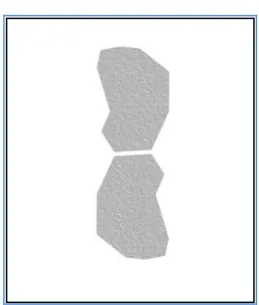
Figure 1 Elementary Space ... 11 Figure 2 (interior-exterior) Spatial Relation ... 12 Figure 3 (exterior-exterior) Spatial Relation ... 12 Figure 4 Leak Method (hover over picture to follow link
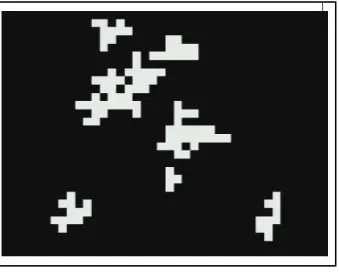
http://www.youtube.com/watch?v=QrJ5gKvjfsk) ... 13 Figure 5 the Alpha Syntax - copyright Paul Coates 2010 ... 13 Figure 6 L-System (hover over picture to follow link http://www.youtube.com/watch?v=wd8rt-dIaks) ... 14 Figure 7 Alpha Syntax 2.0 earlier to recent – copyright Paul Coates 2010 ... 14 Figure 8 Voronoi Diagram (hover over picture to follow link
http://www.youtube.com/watch?v=E9qHEssEWGU) ... 15 Figure 9 Scott Snibbe Interactive Art (hover over picture to follow link
http://www.youtube.com/watch?v=1p96bTARFKc) ... 15 Figure 10 Kaisersrot Voronoi Diagram (hover over picture to follow link
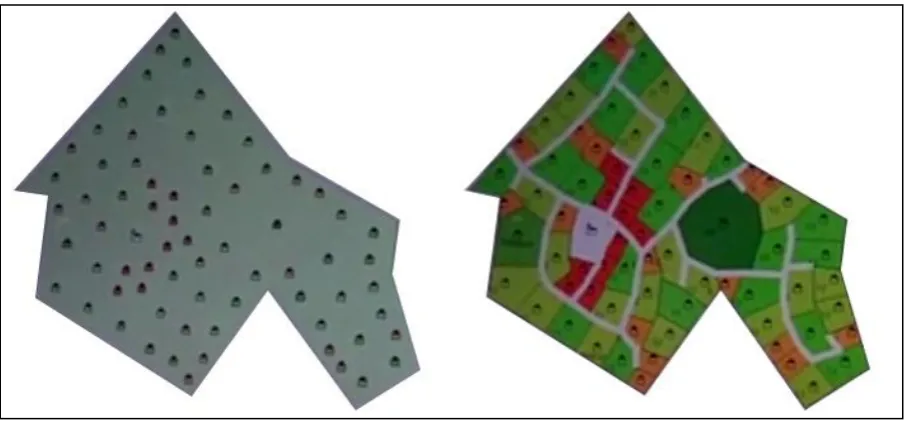
http://www.youtube.com/watch?v=Zw7_JFHi5hk&feature=player_embedded) ... 16 Figure 11 Social Preference Matrix, Text File and the Corresponding Matrix ... 20 Figure 12 Spatial Languaging Main Procedure ... 23 Figure 13 A Set of resulting Spatial Configurations (hover over picture to follow link
http://www.youtube.com/watch?v=ME0Ci5SDMuc) ... 26 Figure 14 the Dog picture by David Marr 1982 (hover over picture to follow link
Table of Codes
code 1 Assigning Visitors and Occupiers ... 19
code 2 Social Preference Array ... 21
code 3 Voronoi Diagram Procedure ... 22
To my family, Erlangga, Haniya, Aleena, my late Mum and my Dad for their reimbursable continuous supports,
And
1.
Introduction
... ARCHITECTURAL RESEARCH SHOULD ALWAYS FALL BETWEEN WHATEVER POLAR OPPOSITES ONE CARES TO DEFINE..(COATES, 2010, P.1)
Ludwig von Bertalanffy (1968) aims for a theory that unifies all explanations with his General System Theory ( GST). GST is not the only field of study that works towards theory of everything, but recent development in agent-based modeling seems to provide sufficient verification for GST visions of universality. The grand aspiration may already been fulfilled when Stephen Wolfram published an empirical and systematic study of simple programs. Wolfram (2002, p.465) concludes that simple programs with different rules can have similar behavior, such as some natural systems which seem very different but behave in similar ways. It is proposed that such scheme is applicable across different fields of sciences. This emphasizes on isomorphism between different systems and might explain similarity in either their internal structures or their external behaviors.
Paul Coates (2010, p.1) suggested that architects and other designers would be interested in this development because it manifests a new epistemology. Form is a complex with many interrelated aspects, creating a simple program based on a particular known aspect of form might lead to a production of interesting forms. A simple program which is parallel to an existing system related to form may demonstrate a similar structure or behavior and pattern of forms. Among these programs are computer models which explore the notion such as how space produces society and how society produces space.
Preliminary works for such production of space has been done by Bill Hillier with “a theory of space with its own descriptive autonomy, i.e. a theory without interpreting other theory” (Hillier &
Hanson, 1984, pp. 5-9). A space of a social theory of space is an elementary cell which is a dichotomy of the outside and the inside. For that space to grow there are two ways; firstly, by subdividing it thereby maintaining the internal permeability, or secondly, by aggregating it thereby maintaining the external continuous permeability (ibid., p.19)
Accompanying Hillier proposal above, the Alpha Syntax program was developed by Paul Coates. Alpha Syntax exclusively an application of the second method of the proposed spatial growth, it aggregates cells which connect throughout with an axiomatic permeable cell. There are two versions of Alpha Syntax program developed; a grow method by orthogonal constrains i.e. within cellular grids (ibid., chapter 2) and the tree branching which is a grow method free from orthogonal constrains (Coates, 2010, pp.153-154). So far, there is no development of a specific computer program in any of Hillier’s publications which applies the growth method of dividing the internal space.
Later on, Hillier proposed a theory of architecture and a social theory of architecture (Hillier, 1996). Theory of architecture stated that architecture is a theory applies to building. It implies that
those changes in spatial configuration might have been caused by the same configuration of people. If a space as defined by the social theory of architecture represents a dichotomy of inside and outside, it might indicate that spatial systems is a dual to a system created by configuration of people.
The proposition would be that an isomorphic mapping of space and social simulation would add to the theory of architecture; it would be that architecture is a physical manifestation of how social system might regulate the elements. The aim of this thesis is to create a simple program that might lead to a production of space using the assumption that if there is a dichotomy between a spatial configuration and a configuration of people, then a simple program simulating configuration of people is isomorphic to a production of spatial configuration.
Simulating configuration of people requires a model of spatially occupying entities which follow simple configurational rules. This can be achieve using agent-based model of spatially occupying entities such as Boids (Reynolds, 1987) which coupled with agent’s preference such as Thomas Schelling Frog Pond scheme (see similar model by Epstein & Axtell, 1996). Thomas Schelling racial dynamics model could be expanded into more categories as it has already contain a very simple social rules; either an agent is a friend or not, to the other agent.
With isomorphic assumption, a simulation of agent-based model of configuration of people would mean simultaneous productions of spatial configurations. However how to map the emergent spatial configurations forming out of the feed provided by the agent-based model simulation? Referencing to a couple of projects related to dividing a space, the possible solution is to represent the emerging spatial configurations as a specific bounded universe consist of many of bounded cells mapped by each spatially occupied agents.
Accordingly, this program can be proposed as the first growth method of a social theory of space by Hillier & Hanson (1984, chapter 2), which is a method of subdividing the space. Using algorithmic geometry planar dividing method called Voronoi Diagram (Boisonnat & Yvinec, 1998, p.405) and a color scheme representation of agents which also use to color the divided cells, spatial
configurations as isomorphic map of Euclidian bounded social interactions can be manifested.
The existing algorithms modified in the program are agent-based simulations already developed at the Centre for Evolutionary Computing in Arcitecture (CECA) and a newly developed computational
geometry method called Voronoi Diagram.The specific small original contribution made in the
program is a social preference module within the agent-based simulation. It is a two dimensional array that feed from a social relationship table. A text document containing a matrix of that table; either a friend or not friend (binary) between agents of different types is prepared by the user and this will feed into the module; it is the basic of social construct of otherwise random localized chances of the forming of configurations of people.
2.
Literatures
2.1.
Space: a social theory of space
Any computer program basically consists of elements and methods processing these elements. A simple program seems to refer to the use of the most basic elements and particular methods that process elements within micro context or local rules however results in observable un-programmed behavior of the whole. For example a simple program consists of random mobile spatial entities with an instruction to follow other entities that is closer to itself. After a while, this set of basic elements and local method would be perceived to give rise to; firstly a flocking configuration, and later on a notion of a leader. These emergent behaviors of both flocking and leadership were not programmed by the programmer. These are simple programs as explained by Stephen Wolfram (2002) and which Paul Coates and students programmed for architecture.
For spatial configuration within a social theory of space, Hillier suggested that the most basic element would be a cell which represents a dichotomy of the inside and the outside. Therefore space could be identified into two categories; the interiors and the (collective) exteriors (1984, p.19).
FIGURE 1 ELEMENTARY SPACE
There were several kinds of notations adopted by Hillier in his publications, therefore a convention is required. The graphical notation as seen on the right above in Fig. 1, and there is also notation which seems to be use for written discussion or in paragraphs, where he uses the letters X and Y. The letter X is used for interior and Y for exterior. The graphical notation will not be use within this document, but diagrammatic notation as seen on the left in Fig. 1 above will be use in diagrams and the use of X and Y in corresponding texts.
This elementary space serves the purpose as (Hillier & Hanson, 1984, p.52):
1. an elemental structure that characteristically is an irreducible objects and relations,
2. independent notation which can be use in discussion or analysis about space,
3. being part of a coherent system where many elementary spaces related to one another,
4. the only element of combinatorial system based on specific syntax which makes up more
complex structures.
Interior
There is no formal mention of local rules for processing the elements given by Hillier, therefore the assumptions are as follows; there is the interior to exterior spatial relation, and the exterior to exterior spatial relation. In Hillier terminology these are the syntaxes.
FIGURE 2 (INTERIOR-EXTERIOR) SPATIAL RELATION FIGURE 3 (EXTERIOR-EXTERIOR) SPATIAL RELATION
Originally, there were 8 different set of syntaxes but only one set of syntax as shown above was developed because the rest were over-constrained, and had been tested and summarized as
incapable to produce varied results as what had been given by the chosen set (Coates, 2010, p.138).
2.2.
Alpha Syntax: methods
The elementary space and the micro spatial relations as explained by Hillier Space Syntax theory provide the ingredient for generations of more complex form. Generative methods such as Diffusion Limited Aggregation (Batty, 1994) and Lindenmayer System (Prusinkiewicz & Lindenmayer, 1990) which uses elementary form and local rules, and both produce similarly complex fractal forms. However they consist of entirely different algorithms and thus different in the way they process the basic elements and use different context in defining local rules.
Although each algorithm is unique, they could produce forms which as a whole can be perceived as similar forms produced by two different methods. There are two ways to process the basic elements which concern with an application of local rules; grid base or non-grid method. The grid method is known as Cellular Automaton, and the non-grid is graph rewriting method, for example the Lindenmayer system. Alpha Syntax features developments which seems to incorporate these methods.
2.2.1. Grid Method: Cellular Automaton
Celullar Automaton (or CA) is a successive addition of patches on grid following a set of state-bound rules, leading to more complex universe of patches than the initial state of that universe. Wolfram (2002) provides the most extensive study of Cellular Automaton. The universe changes from a simple to a complex one step at a time. Parts are added at each step and their assign locations are in
[image:12.595.348.478.121.274.2] [image:12.595.114.249.128.276.2]this method of form where previous forms will dictate the later forms, and form at the next stage is within local of form at the previous stage.
FIGURE 4 LEAK METHOD (HOVER OVER PICTURE TO FOLLOW LINK HTTP://WWW.YOUTUBE.COM/WATCH?V=QRJ5GKVJFSK)
Alpha Syntax was developed by Paul Coates following Space Syntax framework and inspired by Maruyama 1969 flow diagram (Coates, 2010, p.131). It employs CA method known as the leak method. The above figure is the Monte Carlo simulation created using the same method.
FIGURE 5 THE ALPHA SYNTAX - COPYRIGHT PAUL COATES 2010
2.2.2. Non-grid method: Formal Languages
[image:13.595.72.526.334.526.2]FIGURE 6 L-SYSTEM (HOVER OVER PICTURE TO FOLLOW LINK HTTP://WWW.YOUTUBE.COM/WATCH?V=WD8RT-DIAKS)
[image:14.595.73.526.390.627.2]Paul Coates further on to develop the Alpha Syntax program based on Diffusion Limited Aggregation method which result is a resonance to an L-System method known as the Branching structures (2010, pp. 152-157). Branching structures characteristically has a sequence of parts which is known as axis. An axis is essentially a chain which the beginning of form is connected through out by the same elements. From this main structure, the rules will produce branches adding more elements and thus the form becomes more complex. Alpha Syntax has Y spaces creating the continuous axis, and it branches as X spaces are added at each step of the program.
Figure below shows an emerging axis created by simple rule of f f [-f] [-f] using L-System. Later version of Alpha Syntax was created with similar continuous axis.
FIGURE 7 ALPHA SYNTAX 2.0 EARLIER TO RECENT – COPYRIGHT PAUL COATES 2010
2.3.
Voronoi Diagram: a method to divide space
where the nearest (least) three points are on its circumference, and such no other point will be inside the circle (Akl & Lyons, 1993, pp.99-101).
FIGURE 8 VORONOI DIAGRAM (HOVER OVER PICTURE TO FOLLOW LINK HTTP://WWW.YOUTUBE.COM/WATCH?V=E9QHESSEWGU)
The shape of each Voronoi cell is unique because its sides are the manifestation of otherwise invisible exact middle spaces in between the centre of one cell to another point of the opposing cell. These shapes can be altered and such Voronoi Diagram is known as generalized Voronoi Diagram. Because these shapes created entirely based on the positions of the centre of the cells, they would have irregular angles. The generalized Voronoi Diagram contains rules which alter the angles and further on some generalized Voronoi Diagram alter the shape entirely by ruling how many sides there should be out of a cell.
2.3.1. Voronoi Diagram as Social Art
Scott Snibbe used Voronoi Diagram to create an interactive social art installation (Snibbe, 1999). The space is divided synchronously according to people who join in a specific bounded plane. As they walk around, these lines are updated to note the exact boundaries where spaces between people are congruent at each time.
FIGURE 9 SCOTT SNIBBE INTERACTIVE ART (HOVER OVER PICTURE TO FOLLOW LINK HTTP://WWW.YOUTUBE.COM/WATCH?V=1P96BTARFKC)
This project shows significant insight into how space could be synchronously mapped in
[image:15.595.84.524.495.609.2]2.3.2. Voronoi Diagram as Urban Plan Generator
Kaisersrot project use Voronoi Diagram as an urban plan generator (Kaisersrot, 2001 & 2003). It is a generalized Voronoi Diagram which use repels and attracts rules between the points which triggered straight after the points were placed in and thus creates congruent space in between them. Voronoi then divides the plan, and naturalizing the organic shapes of the original Voronoi cells into
[image:16.595.73.526.229.442.2]rectangular shapes. Kaisersrot also programmed in nodal configurations synchronously. For example one can drag a church across and a group of specified buildings will follow and configure all around it following the same process as if it is placed in as in the beginning. A fixed size road is then added up by the user. The road has its starting point, crossroads and ending point placed in manually.
FIGURE 10 KAISERSROT VORONOI DIAGRAM (HOVER OVER PICTURE TO FOLLOW LINK HTTP://WWW.YOUTUBE.COM/WATCH?V=ZW7_JFHI5HK&FEATURE=PLAYER_EMBEDDED)
2.3.3. Voronoi Diagram as Spatial Configurations generator
Snibbe’s art and Kaisersrot projects seems to suggest that Voronoi Diagram is a good medium to enable isomorphic mapping of spatial configurations and configurations of people. In Snibbe’s art, Voronoi Diagram seems to convey a natural sense of structural mapping of space as it is being used by configurations of people. In Kaisersrot, Voronoi Diagram functions directly as configurational generator.
Spatial configurations as explained by Hillier emerged from the relations between one cell to other cells. Similarly, configurations of people must have embedded within them the relations between one individual to the others. Under this assumption, there would be preliminary work into
developing a set of meta-relations between the entities which represents configurations of people.
Therefore, the program should be a manifestation of exploring the randomness of configurations of people, which in part can be made possible by manifesting real-time random movement of people as much as has been shown in Scott Snibbe’s project and thus to capture the emergent spatial
configurations using Voronoi Diagram.
2.4.
Agent-based Model: Simulation of Random Movement
ABM or Agent-based Model is a type of simulation which is developed to observe emergent
behaviors of a dynamic complex system. In Boids (Reynolds, 1987) flocking behavior and a notion of leader are noted to have been emerged out of an initially random movement of spatially occupying movement entities called boids. Each boid were simply programmed to direct its own heading to follow the nearest other moving boids. Once all boids have the same headings, the notion of flocking boids and its leader appear.
Emergent properties within such simulation can be exploited to produce emergent spatial configurations. Un-programmed configurations of people can be manifested through random movement of the agents, and such program already existed on AutoCAD platform in the Centre for Evolutionary Computing in Arcitecture (CECA) research archive. However, there is not a function of class types of agents and how different types of agents relate to each other. Classification of agents will create more structured chances of configuration which some of such behaviors have been demonstrated by Schelling’s frog pond (Epstein & Axtell, 1996).
Thomas Schelling pond model was critical in population dynamic research, because it maps the otherwise unseen configuration of frogs and turtles in space based on each individual preference criteria. The simulation was really simple; there were two groups of turtles and frogs (ibid.) and each frog was programmed to only settle at a locality which has a minimum number of other frogs, and the same rule applies to turtles. The emergent spatial segregation of frogs and turtles was not program into each individual frog or turtle but a result of local interactions between them.
[image:17.595.215.384.549.719.2]The lesson from Schelling frog pond model is that by having different individuals with different preferences can result in interesting spatial configurations.
3.
Spatial Languaging: The Program
3.1.
Agent-based Model Basic Procedures
The Centre of Evolutionary Computing in Architecture (CECA) had several types of ABM applications available in various computing platforms. Some of these are in various programming language such as Visual Basic which can be modified in AutoCAD programming platform from version 2004 onwards. To have the program built in AutoCAD platform or any other drawing platform would enable efficient transition from generations of conceptual spatial configurations into eventual development of spatial designs.
There are basic procedures within these programs which identifies with ABM and they are as follows
3.1.1. Create Agents
This procedure enables manifestation of how an agent should look like on screen. There are programs in CECA that based on ABM platforms such as NetLOGO (Wilensky, 1999). There are also programs which were developed using software such as AutoCAD and these use circles as
manifestation of agents (DRAW CIRCLE is a command available in AutoCAD). This command is coupled with a random placement of the circle.
3.1.2. Move Agents
There are basic geometrical calculations to get the circles moving around the screen, which pull local data of each agent to process the next step. To move forward, there are calculations related to random heading and this will use a constant as the step range. The use of random heading to get the agent on to the next step would enable greater chances of emergent behavior. Besides these
calculations, there are other calculations which involved with situations each agent would be in, such as too close to other agents, or too close to the boundary of the universe. And as the simulation involves many agents, there is a state called limbo world or synthetic synchronicity; a state where each agent’s corresponding parameters are calculated for the next step to get all agents simultaneously into their next positions.
3.2.
Agent-based Model for Spatial Languaging
3.2.1. Create Visitors and Occupiers
The first hierarchy is whether or not an agent is a visitor or an occupier. The early version of SL has shown that all agents within ABM will eventually settle and thus all of them identify with occupiers. This is unfortunate for generations of spatial configurations as these will need “roads” or movement spaces, or Y spaces as known in Hillier’s terminology. To avoid top down entry of such spaces (as shown in Kaisersrot project), it is logical to embed them directly into ABM and thus these spaces would be an emergent property of the overall spatial configurations.
The program has a procedure to control how many percentages of visitors out of the overall agents’ population. This is currently coded within the program as opposed to a user controlled entry, although it is possible to change it into a user entry.
For c = 1 To pts
randpoint(0) = random(-universe * 0.8, universe * 0.8) 'choose random x y z the array is autocads way of holding a point randpoint(1) = random(-universe * 0.8, universe * 0.8)
randpoint(2) = 0
walker.diameter = startdiam 'sizs(Int(random(1, nsize))) walker.steplength = walker.diameter
walker.heading = random(0, 360)
Set acircle = ThisDrawing.ModelSpace.AddCircle(randpoint, walker.diameter / 2) 'walker is represented as circle walker.circleid = acircle.ObjectID
If Rnd > 0.2 Then 'change here to control how many percentage of visitors walker.colour = Int(random(1, CDbl(groups)))
Else
walker.colour = 256 ‘these will be visitors End If
acircle.color = walker.colour 'colour the circle according to the required number of types of agents acircle.Layer = "circle_layer"
acircle.Update
walker.begin.x = randpoint(0) ' set walker's position to be that same as the circle walker.begin.y = randpoint(1) ' (using my preferred way of defining a point walker.begin.z = 0
thecircles(c) = walker Next c
CODE 1 ASSIGNING VISITORS AND OCCUPIERS
The proportion in the code above correspond to 20% of the whole population of circles created on the screen will be assigned as visitors agents. These circles will be assigned different colors, which is specific and not available to assign occupier agents with the same color of visitors (i.e. color 256).
3.2.2. Create Types of Occupying Agents
The next hierarchy of agent relates to creating entities which enables manifestation of different preferences, i.e. different types of agents identify with different preferences and thus would yield to interesting configurations as has been indicated by Schelling’s frog pond simulation.
Different color circles will then assign randomly to agents, but these will not use the specific color has already assigned for visitor agents.
3.2.3. Social Preference Matrix
The Schelling frog pond model (Epstein & Axtell, 1996) uses a proportion of local friend for a type to settle in the locality. This is simplified within SL; for each three closest neighbor, if there is a friend nearby then move towards it and then slow down. Therefore Social Preference Matrix (SPM) relates to procedure about agent’s movement; it controls when agent will change its movement.
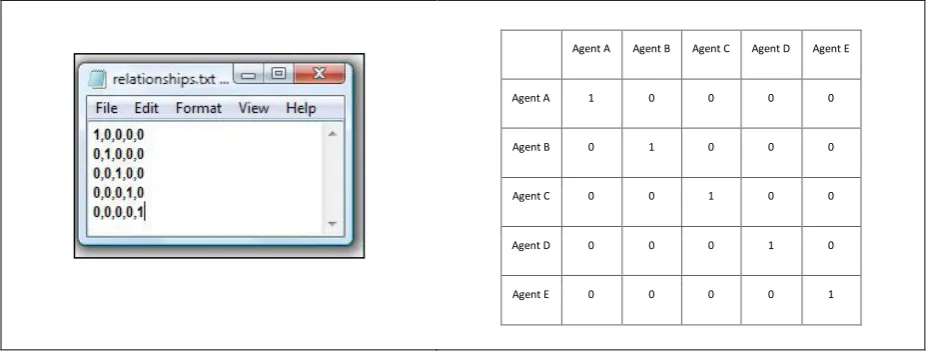
SPM is a user entry in a form of a text file and corresponds to the number of types will be required for the simulation. The user needs to write a preference matrix which has the same size as the number of types of agents that will be in the simulation. For example, 5 different types of agents will need a SPM in a size 5 by 5 as follows.
Agent A Agent B Agent C Agent D Agent E
Agent A 1 0 0 0 0
Agent B 0 1 0 0 0
Agent C 0 0 1 0 0
Agent D 0 0 0 1 0
[image:20.595.66.533.322.504.2]Agent E 0 0 0 0 1
FIGURE 11 SOCIAL PREFERENCE MATRIX, TEXT FILE AND THE CORRESPONDING MATRIX
ReDim originalpoints(1 To pts) As mypoint ReDim thecircles(0 To pts) As agent
'fills in the array thecircles with the randomly scattered circles ReDim limbocircles(1 To pts) As agent
ReDim relations(1 To groups, 1 To groups) As Boolean '2d array of compatible agents
ReDim cols(1 To groups) As Integer Dim rel As Integer
rellies = "c:\stuffs\relationships.txt" Open rellies For Input As 2# For i = 1 To groups For j = 1 To groups Input #2, rel
relations(i, j) = (rel = 1) Next j
Next i Close #2
CODE 2 SOCIAL PREFERENCE ARRAY
3.3
Voronoi Diagram
Voronoi Diagram is coded according to the following steps:
1. Find all voronoi vertices (vv) which are the centre of circles defined through sets of three nearest points (points are supplied by the locations of all agents), as such that there are no other points inside these circles.
2. Draw a line from a vv to the nearest vv, and do this to all vv.
3. At the perimeter, a vv will be connected to an imaginary vv which defined as an extended
line from that vv to the middle of the two points which defined that vv.
4. Then each polygon can be created as voronoi cell, where each will contain one location of
the corresponding agent to that cell.
If counter Mod 60 = 0 Then 'Mod 50 = 0 means every 50-th to get Voronoi Diagram
gestalt counter, ci, cj 'gestalt is the subroutine where Voronoi Diagram procedures contained in it If savestuff Then
ThisDrawing.SendCommand ("_vscurrent" & vbCr & "R" & vbCr) Set allpolys = ThisDrawing.SelectionSets.add("allofit") allpolys.Select acSelectionSetAll
ThisDrawing.Regen acActiveViewport
ThisDrawing.SaveAs (pathname + Str$(counter))
ThisDrawing.Export (pathname + Str$(counter)), "BMP", allpolys allpolys.Delete
End If
thelay.Lock = True boundarylayer.Lock = True
ThisDrawing.SendCommand "_erase" & vbCr & "all" & vbCr ThisDrawing.SendCommand vbCr
thelay.Lock = False boundarylayer.Lock = False ThisDrawing.Regen acActiveViewport End If
CODE 3 VORONOI DIAGRAM PROCEDURE
3.4.
The Main Procedure
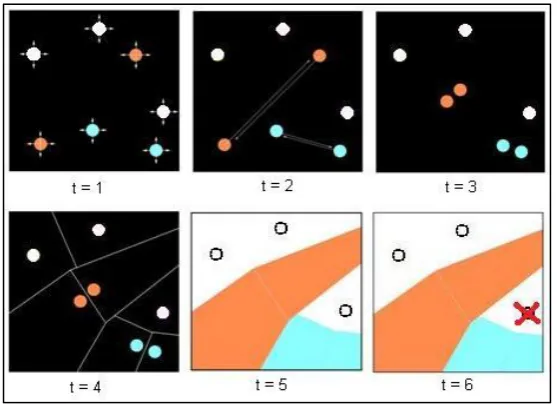
The program in common language can be described as follows.
1. At t = 1 agents created and then move randomly in space.
2. At t = 2 agent’s next step is triggered by predefined conditions such as three nearest neighbors, then agents take action according to SPM
3. At t = 3 if the relations between self and the other agent in SPM = 1 then this agent heads towards, and stays in slow down loop.
4. At t = 4 the Voronoi Diagram is called at a specific step and divides the space.
5. At t = 5 the Voronoi Diagram colours the cells corresponding to the colour of agents.
6. At t = 6 the Voronoi Diagram picks up any trapped Y spaces, then move them randomly back
into the universe.
FIGURE 12 SPATIAL LANGUAGING MAIN PROCEDURE
3.5.
Program Setup
3.5.1. Global Setup
The simulation was built on AutoCAD software, thus it needs to run on AutoCAD version 2004 onwards with Visual Basic programming platform installed.
It needs a new folder to be named “stuff” in the root drive C:/. Otherwise this new folder can be called under different name but one needs to modify the code within the subroutine as shown below.
Set thelay = checkforlayer("circle_layer")
Set boundarylayer = checkforlayer("boundary") 'dont erase boundary as well as circles seed = val(InputBox("seed", "any numbers", 978345210))
ticks = val(InputBox("how may times round the block ", "steps", 500))
'this is how many steps to run program which is proportional to mod n =0, so adjust as necessary Rnd (-1)
Randomize (seed)
savestuff = (InputBox("want to save stuff", "y, folder c:\stuffs") = "y") If savestuff Then
pathname = "c:\stuffs\" + InputBox("type name for saved drawings", "naming the drawings") Open globaldatapathname For Append As #1
Write #1, "counter ¦ number of occupied cells ¦ total area of occupied cells" Close #1
End If
thelay.Lock = False boundarylayer.Lock = False
groups = InputBox("how many groups ?", "different groups represented by different colours", 6) pts = InputBox("how many people?", "size of population", 70)
ReDim originalpoints(1 To pts) As mypoint
ReDim thecircles(0 To pts) As agent 'fills in the array thecircles with the randomly scattered circles ReDim limbocircles(1 To pts) As agent
ReDim relations(1 To groups, 1 To groups) As Boolean '2d array of compatible agents ReDim cols(1 To groups) As Integer
Dim rel As Integer
rellies = "c:\stuffs\relationships.txt" ‘make sure text file called relationships.txt is available in c:\stuff Open rellies For Input As 2#
In the folder stuff there should be 2 text files; relationships.txt and data.txt, and dwg file;
basepoly.dwg. Relationships.txt contains SPM data and data.txt should be a blank file. Basepoly.dwg contains specific drawing layers that make up a bounded universe in a size of 200 x 200 unit of space. The size of 1 agent is unit of space.
Data.txt will be written with statistic information which currently contains three parameter: counter,
totalspacetypes, totalareas. Counter is the step at which the Voronoi Diagram is called,
totalspacetypes is how many agents are currently occupying, and totalareas is the size of occupation.
From these two numbers we can tell if the simulation had finished with all occupiers had occupying the space or not, and if the total occupation match to the percentage set on for the creation of the visitors. If the totalareas shown the number corresponding to 80% of the size of the universe when the set for visitors is 0.2, then it confirms that the program compiled accordingly.
3.5.2. Run the Program
These are the steps to run the program:
1. Open AutoCAD, then open basepoly.dwg
2. Type in AutoCAD command line vbaman and search directory to open the program
spatial_languaging.dvb. Once vb window opens, go back to AutoCAD drawing window.
3. Type in AutoCAD command line vbarun, and choose run macro.
4. Enter all ABM input parameters as required. Choose save file if want to produce spatial
configurations, otherwise SL will run ABM and create Voronoi Diagram without saving image files of spatial configurations. Saved images can be found in C:/stuff
Note: Basepoly.dwg should not be saved at the end of each simulation. Basepoly.dwg should be re-open to run new simulation with different ABM input parameters.
3.6.
Programming Results
3.6.1. Program Execution
3.6.2. Graphic Output
The graphical outputs correspond to the parameters as expected. The proportion of occupier gives results to the colored occupied cells with exactly the same spatial proportion; for example
generation of 80% occupiers will result in 80% colored space (Appendix 3). The integrated society where SPM contains more relations with value of 1 and combine this with larger occupier
percentage will fill the occupational space quicker.
Interestingly the emergent geometry demonstrated forms analog to that of real settlements, where segregated SPM creates small scattered spaces, and the integrated creates dense spatial
configurations. All spatial arrangements of these spaces and their dimensions were entirely an emergent property of the simulation. How space is being used in terms of movement by its inhabitants give results to not only the arrangements of “rooms” but also its dimensions. It is a phenomenon that can be described as self-organizing spatial configurations which produce arrangement of space according to its uses with the corresponding dimensions of each space simultaneously.
The population density coupled with occupier and visitor ratios are fundamental to the kind of space which would emerge. From the observer’s viewpoint, a population which is made of 50% occupier agents and 50% visitor agents seems to generate interesting graphics compared to other settings (see Appendix 1 Graphic set 4, 5, and 6). These graphic sets comparatively produce same effect of perception although different social matrix was applied to each set. This might be explained as the gestalt effect of background and foreground. Furthermore some graphics show the emergent of beady ring phenomenon (Hillier, 1984, p.59)
The underlying gestalt effect computed by the Voronoi diagram follows the theoretical wholeness of a spatial configuration and fully implemented under these principles into each of the graphics. This is done by responding to a non-conforming configuration, such as a trapped Y space (movement space) in the middle of occupied spaces. This step enables a continuation of movement space over the whole space created without having to coded-in a continuous movement space.
3.6.3. Version Development
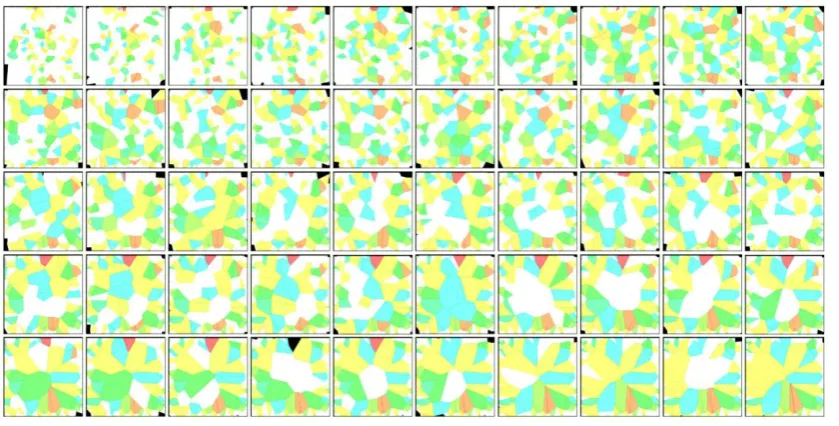
FIGURE 13 A SET OF RESULTING SPATIAL CONFIGURATIONS (HOVER OVER PICTURE TO FOLLOW LINK HTTP://WWW.YOUTUBE.COM/WATCH?V=ME0CI5SDMUC)
The series of images above is a result of simulation based on the second version ABM setup and it is the program submitted for this thesis. At the end of the first row, more agents had grouped together indicating almost all agents found their preferences. The second row and the third row are images which shown emergent beady rings and these configurations are more conforming to syntactic configurations in comparison to the first and the fourth row. Halfway over the third row and the fourth row show that configurations had reached equilibrium and all these had more or less the same syntactic configurations and more or less the same total area where differ only in their cell shapes.
Is this mean Y space or movement space is somehow a form of an axiom? Considering there is no starting point of Y space indicated from the beginning of the simulation, these movement spaces could be considered as indirectly axiomatic. The present of equilibrium configurations seems to suggest that there is a maximum point in time to which all occupier agents would map into X spaces where these occupied spaces. At this point there will only be minimal varieties in geometry (shapes of cells and their dimensions) of a stable topology.
4.
Discussions
4.4.
Self-organizing Spatial Configurations
for good arrangement and relations of the parts using simplified concepts would match the complexity of the real?
Mechanically, design is an act applying a formula, or recipe, to manifest form using known parts via specific arrangements or relationships which believe to give good result. Science as we know it today was brought to such advancement because scientists can explain subjects in a mechanic sense. The specific study which puts forward the possibility to explain anything in terms of its mechanics is known as the field of System Theory and its newest form is known as the field of Dynamical System Theory. Thus, architecture also been subjected to the mechanic frame of thinking, and there would be a mechanic interpretation of the production of architecture through the medium of modelling.
Christopher Alexander showed that eventually design process will result in some degree of fitness of the form to its context. What search method prescribed above which could produce form that is a ‘good fit’ for its complex context? Stanford Anderson (1966) criticized that there is too much oversimplification of the mechanical method that does not regard the fact that a good arrangement of parts varies from time to time, because context (all parameters that should be taken into account in the production of form) is believed to always in states of changes. There is not simply a set that will guarantee a good fit for all times. Thus Anderson argued for the lack of sensitivity of problem-solving method as one as proposed by Alexander. He then suggested that a mechanical method could be used to produce complex objects such as architecture only when it is responsive to the initially undefined problems and equally responsive to the infinite of potential problems that come during, and later on the process.
This means the challenge is to define a mechanic of design that adapts. Throughout such a process, it should be made possible to introduce new parameters of good fit, so that the eventual fitness is an emergence of all possible interactions within the universe until that specified time frame within the formal evolutionary process. If one steps back to the notion of a model, it is intriguing to find out why a formula manifested from deducing a complex, can be expected to produce something quite complex. John Frazer (1995) uses evolutionary methods for the production of architectural form and demonstrated that using nature’s recipe of genetics, the aim to produce an object that is far more complex than its formula can be achieved. Genetics is widely accepted as the mechanical process for the ever increasingly complex forms. But how does this evolutionary process become responsive to the ever changing context?
Such setting means that any form along an infinitely continuous process will need to take information from its context and to use it. The process means invoking new arrangements, new relations between parts; and perhaps even new parts to be defined. The new form itself then will invoke feedback which is then fed again into the process. In this way, the context itself evolves, since it requires information to be processed and action to be taken; just as what was needed for the production of form. Accordingly, it is not simply an evolution of form, but it is a dynamic self-organizing system with interacting systems of form and its context, are changing through times and thus increasingly becoming more complex. This self-organizing system is characteristically infinite, which is guaranteed to continue forever as long as the feedback mechanisms between these they are still going on.
Essentially, the self-organizing system of space and people as an infinite loop functions between form and context. John Holland (1998, pp.125-141) named such a scheme as the Constraint
Generating Procedure (CGP). He presented the concept as the foundation of emergent phenomena in complexity science. Agent-based Model is the significant element in the construction that leads to
emergence behaviour (ibid., pp.116-118 and Ferber, 1999, pp.15-16). ABM structures interaction
between parts locally. It enables synchronous processing of information thus possible to treat changes gradually. However, construction of each ABM will need to find its own mechanics of self-organization. There is no specific recipe or over-arching procedure of self-organizing mechanism.
The work of Ashby, Beer and Pask (Cariani, 1993) suggests that the mechanics of emergence and its underlying self-organization is a paradox. Emergence can only be shown to occur when the
structural outcome is not dependant on the details of the epistemic definition. Once again, there is no definition for specific mechanics at micro level. However, developing a computational method is fundamentally constructing basic or micro elements of a system and applying structural interactions between them. The feedback mechanism between interacting systems is another layer of structural interaction which consists of interactions between different elements of different systems. When
emergence is literally happening, is it then possible then to identify the mechanics underlying it? The clue would be in the interactions at these different levels, and the mechanism of emergence can be identified when one knew how these systems interact.
Space Syntax theory (Hillier & Hanson, 1984) is a true form of deduction, synthesis, and formulation of space hence it provides elements which is truly basic for the construction of Spatial Languaging program. Space Syntax is the structuralist approach to architecture, very close to Nietschzian primordiality of space as described by Lefebvre (1974, p.22) that space can only be defined as either occupied or unoccupied; that is in binary form could be expressed as a 1 and 0 or X and Y. The space syntax theory also provides binary relationships between the occupied and the unoccupied space. It opens a wide combinatorial possibility because rules of relationships only apply locally. As long as there is a way to feed this system where individual space can be defined randomly, the possible combination of cell spaces that creates the overall spatial configuration is always indefinite at the time of initialisation.
Thus, ABM would provide isomorphic feeds for the mapping of spatial configurations using the locations of its agents in space. An agent is characteristically a randomly mobile and thus inherently unpredictable in terms of their location in space. The relations between agents in ABM could only be defined by the types of interactions. For Spatial Languaging program, the type of interaction is as per preference which are either 1 or 0. When an agent is near enough to three other agents it would go towards the one it prefers to be local with. The Space Syntax theory seems to strongly suggest an isomorphic mechanism between spatial configurations and configurations of people. Space can only be defined by those who are currently in that space, and thus creation of space is identified with a being to be in a certain place in space.
This creates a form of ‘fit’. Which specific configuration of people corresponds better to a specific configuration of space? Both Hillier (1996) and Alexander (1964) seems to agree that configuration is a form of combination of binary form of 1 and 0 (i.e. x space and y space). Combinations of these
occupied and unoccupied spaces could result in a complex (of space) which at the same time (when
it interacts with a configuration of people) fit into the context of how it can be use by particular socio-spatial configurations. So thus my understanding is that an experiment to produce complex spatial configuration can be done using principles introduced by Space Syntax with a mutual perturbing framework as the mechanism.
4.5.
Epistemic Autonomy
For many researchers in the field of design computing, the goal would be to develop design generators which as much independent of human as the creator of space (who draw it) and to enlarge the capacity of the processor (which process it)to design. This aim backs up with the realization of the contemporary tools and thoughts about how we could design. The approach implemented in Spatial Languaging program is to achieve this kind of self-organization. It aims to process design in a self-organizing way.
autonomy, epistemic autonomy is suggested to be fundamental to a self-organizing system. This could mean that an epistemic autonomy should not preclude the inherent isomorphic quality of all systems involved. As such, the spatial configurations and the configurations of people would be isomorphic and that epistemic autonomy of these configurations only applied to the emergence of geometry, morphology and topology of the configurations.
Secondly, it would also mean that there is a degree of autonomy in regards to structural emergence. The structure of spatial configurations within this project is a dual of the social structure manifested in the use of space and then mapped so it is visible by the Voronoi Diagram. This type of structural emergence is different to axiomatic structure in at least two aspects; axiomatic structuring uses the structural elements as part of the emerging structure, and self-organizing structure does not. Axiomatic structure starts with one of its own structural element, and grows into larger structure by combining other structural elements with that axiom. This kind of emergence was incorporated in the Alpha Syntax (Coates, 2010, pp.153-157). Contrastingly, self-organization give rise to its own structural elements manifested through the map with underlying mapping conventions involved in it. Spatial Languaging program produces structures which are manifested, as opposed to growing.
Furthermore the other aspect is of the convention itself; the mutual perturbation is a map which relies on its mapping convention, whilst the axiomatic structure uses a convention to emerge. The mapping convention is the key to the main co-morphogenetic process since it enables feedback mechanisms. In agreement with the contemporary philosophy of computer modelling each interacting part has its own formative structure (Cilliers, 1998, p.10). In analogy spatial
configurations are theorized by the spatial sciences, whilst social interactions are similarly theorized by the social sciences.
Specific mapping convention accommodates the emergence of those particular structures recognizable as spatial configurations and as social interactions because by way of feedback both systems will keep changing. Otherwise its structural parts would not comply with what is
recognizable as spatial configurations or social interactions and therefore the development of Social Preference Matrix (SPM) is inevitable because the matrix feeds the system with a would be social structure, it is the mapping convention of who should interact with whom.
Self-organization implies a set where some elements already exist, in which there is some degree of epistemic autonomy of the form. It is not possible, working within a self-organizing framework to get a total autonomy. The epistemic autonomy achieved within the emerging spatial configurations of this project is gained through the isomorphic understanding of spatial structure and social structure, which is made possible by ABM and the spatial configurations is an emerging structure brought out by the Voronoi Diagram.
Post-structuralist view of modelling (Cilliers, 1998, pp.58-88) requires a particular theory to be fundamental to a model. Thus if there are more architectural theories which involves different systems which structurally coupling then is it possible to construct more self-organizing design process? From these experiments there would be new architectural theories as a result of observing these self-organizing simulations.
[image:31.595.170.428.199.405.2]4.6.
Re-iterating Distributed Representation for Design Process
FIGURE 14 THE DOG PICTURE BY DAVID MARR 1982 (HOVER OVER PICTURE TO FOLLOW LINK
HTTP://EN.WIKIPEDIA.ORG/WIKI/GESTALT_PSYCHOLOGY)
Distributed representation is an approach to the problem of representations for building a complex system, where the complex system is built as a tool to learn about that complex system (Cilliers, 1998, pp.12-13). Design process in some way is learning about the environment and the
requirements of the built environment. Considering the availability of ABM and the understanding of self-organizing systems, then it should be possible to represent the environment more thoroughly than ever before. Therefore, it seems this is the right time to embrace systems thinking and to apply new techniques to process design.
Agent-based Model (ABM) is a typical framework for distributed representation because its characteristics are sufficient in enabling emergence phenomena. Self-organization is a process
where a simple system can develop a complex structure from unstructured beginnings (ibid., p.12).
Distributed representation of design process seems feasible only via ABM because it is characteristically parallel processing.
Distributed representation of design requires a strong over-arching design theory. Theory is a form of existing knowledge about complex system, and it precedes the model by providing the elements of the model (ibid., p.130). An observer would learn from the model as they perceived the model and can decide which behaviours already known and which are emergent. There is nothing new if the existing is not identifiable. Distributed representation of design process would use the elements provided by design theory in order to enable the emergence of new kinds of spatial designs.
Distributed representations of design not only have a specific interacting network of ABM – space - observer, but also produce a continuity of evolving results. Designs produce by utilizing distributed representation will result in series of spatial designs and all these results are individual designs. Design is then a complex system which as a whole and as its parts is always undergoing repetitions, reiterations, and transformations because this is the means of design to becoming into being; i.e. when design is actually identified by the observer. These are the specific characteristics of
distributed representation of design process; autonomous, self-organizing, cognitive and observer-related. These are designs which are identified as the second-order characteristics.
Distributed representation of design is also characteristically a continuously co-evolving system because it is based on isomorphic structural coupling. Society and space are isomorphic in the way it will influence each other; anything happened to an individual element in one system will affect element or elements in the other system which will eventually feedback iteratively. The mechanism to describe the relations between the model and the observer is interactive, from which the series of operating procedures can be explained using an autopoietic framework. Autopoietic framework for this kind of interaction is known as syn-referential, i.e. the coordination of coordination of actions, where innate structure of both the model and the observer is coordinating with each other over time(Maturana & Varela, 1980, pp.9-11). This is a structural coupling and thus isomorphic, embodies in autopoietic term languaging.
Spatial Languaging is a program which generates spatial configurations. Spatial Languaging is also proposed as a term to describe a general framework in which the problematic representation and systematic understanding of architecture and design process can be addressed and sufficient simulations of design process as a complex can be developed. Languaging in itself is a specific term in relation to SL program, which points to the corresponding Space Syntax theory that has been
interpreted in the identification of the mechanics of interactionsbetween configuration of space and
configuration of people.
Interactions or languaging in autopoiesis terminology is an infinite recursive coordination of coordination of action. This essentially means that to respond to the received information from outside its own system, it would have to be flexible structurally and capable to re-arrange its parts accordingly in response to that information. The internal changes will be feedback to the outside
system, where there will be more information available for it to respond. The term languaging
4.7.
Synthetic Gestalt
One of the main findings of this study is that feedback mechanism that work for analyzing parts of a system seems to work at a global level. Spatial Languaging program simulates a similar phenomenon of global observation among other observable behaviours it produced. The agents are individuals with simple embedded features to act locally, but Voronoi Diagram process and analyze these agents as a whole entity. This is called a synthetic gestalt phenomenon.
What happened in the program was that where an agent creates a cell of space which does not conform to the local neighbourhood rules, then this agent will be relocated in the next step. This affects agents as a form of feedback perturbing into the system of agents without intervening with the epistemic autonomy of the program to produce permeable configurations. It indicates that a local or bottom-up network could send and receive feedback by employing a global or top-down processor. This is significant when one believes a machine is made of parts and they all connected in such a way with feedback mechanisms that help the machine to restructure its parts over time. If architecture and or design process is such machine, the existence of a top down processor like synthetic gestalt in an evolutionary scheme could be the key to hold all the interacting elements of design process.
Synthetic gestalt could be existed within all self-organizing systems, it could be use to explain the process known as homeostatic state. This is a state where elements of a system that were put together could stabilize and reach equilibrium which then could demonstrate some recognizable function (Cariani, 1993). Distributed representation of design process is a self-organizing set which will always require an element within it which will act as synthetic gestalt.
[image:33.595.115.481.534.670.2]Where elements of design identified by a strong over-arching design theory such as Space Syntax theory, other theories related in the actual construction of built environment would be the one which will be the synthetic gestalt of that model.
FIGURE 15 LAYERS OF DISTRIBUTED REPRESENTATION
Bibliography
Abraham, Matthew, 2000 “The Critical Idiom of Postmodernity and Its Contributions to an Understanding of Complexity. A review of Paul Cilliers, Complexity and Postmodernism: Understanding Complex Systems”. London: Routledge, 1998. in Postmodern Culture Volume 10, Number 2, the Johns Hopkins University Press
Akin, Omer, Dave B and Pithavadian S. 1992 “Heuristic Generation of Layout (HeGeL) based on a paradigm for problem structuring” in Environmental and Planning B 19 pp. 33-59
Akl, S.G., Lyons, K.A., 1993, Parallel Computational Geometry, Prentice Hall: New Jersey
Alexander, C, 1964, Notes on the Synthesis of Form, Harvard University Press: Cambridge, Massachusetts
Alexander, C., Ishikawa, S., Silverstein, M., 1977, the Pattern Language: Towns, Buildings, Construction, Centre for Environmental Structure, University of California: Berkeley, California
Anderson, SO. 1966, Problem-Solving and Problem-Worrying, Unpublished lecture manuscript given at Architectural Association, London, March 1966 and ACSA Teachers Seminar, Cranbrook, June 1966
Axelrod, R, 2005, Agent-based Modelling as a Bridge between Disciplines. In Handbook of Computational Economics Vol. 2: Agent-based Computational Economics, Handbooks in Economic Series. North-Holland Eds Kenneth L. Judd and Leigh Tesfatsion. Forthcoming available online
http://www-personal.umich.edu/~axe/research/ABM_Perspectives.pdf last accessed 15 March 2006
Bayazit, N., 2004, “Investigating Design: a Review of Forty Years of Design Research”, Design Issues Volume 20, Number 1, Winter 2004, MIT Press: Cambridge Massachusetts avalaible online last accessed 6 February 2006
http://mitpress.mit.edu/journals/pdf/desi_20_1_16_0.pdf
Baybars I, 1982, "The generation of floor plans with circulation spaces" Environment and Planning B 9 445-456
Batty, M., Longley, P., 1994, Fractal Cities: a Geometry of Form and Functions, Academic Press Professional :San Diego
Baudrillard, J., 1994, Simulacra and Simulation, trans Sheila Faria Glaser, The University of Michigan Press
Baudrillard, J., 2003, Mass, Identity, Architecture. Architecture Writings of Jean Baudrillard, Francesco Proto (Ed.), Wiley Academy, England
Barney, B., 2006, Introduction to Parallel Computing, for Lawrence Livermore National Laboratory, a website operated by University of California for the Department of Energy’s National Nuclear Security Administration, California, USA. Available at http://www.llnl.gov/computing/tutorials/parallel_comp/#Whatis last accessed 1 September 2006
Bertalanffy, L V, 1962 “General System Theory - A critical review”, General Systems, 7:1-20
Bertalanffy, L V, 1968, General System Theory Foundations Development Applications, Penguin Books, England
Bloch C J, 1979, "Catalogue of small rectangular plans", Environment and Planning B 6 155-190
Boissonnat, J-D., Yvinec, M., 1998, Algorithmic geometry, Cambridge University Press: Cambridge
Bridges A H, 1979, "Analysis in architectural design" architectural design" in PArC 79 Proceedings (Online Publications, Pmner, Middx; AMK, Berlin) PP 175-185
Bryne D., 1999, “Book Review Paul Cilliers Complexity and Postmodernism: Understanding Complex System”, Journal of Artificial Societies and Social Simulation Volume 2 Issue 2 available at
http://jasss.soc.surrey.ac.uk/2/2/review1.html Last accessed 27 August 2006
Cariani, P., 1993, “To Evolve an Ear: Epistemological Implications of Gordon Pask’s Electrochemical Devices”, Systems Research, 10 (3):19-33, available at
http://homepage.mac.com/cariani/CarianiWebsite/PaskPaper.html last accessed 11 August 2006
Chomsky, N., 1957, Syntactic Structures, The Hague, Muton
Cilliers, P., 1998, Complexity and Postmodernism: Understanding Complex Systems, Routledge, London
Coates, P., 2010, Programming.Architecture, Routledge, London
Corbusier, 1923, Towards a New Architecture
Cousin J, 1970, "Topological organization of architectural space" Architectural Design 10, pp. 491-493
Craik, K.J.W., 1943, “The nature of Explanation”
Cullen, P.-A., 2000, “Contracting, Co-operative relations and Extended enterprises”, Technovation, 20 (7), pp. 363-372.
Damski, Jose C. and Gero, John S. 1997, “An Evolutionary Approach to Generating Constraint-Based Space Layout Topologies”, CAAD Futures 1997 [Conference Proceedings / ISBN 0-7923-4726-9] Munchen (Germany), 4-6 August 1997, pp. 855-864
Dawkins, R., 1986, the Blind Watchmaker, Norton and Company Inc
Derrida, J., 1976, Of Grammatology, trans. Gayatri Chakravorty Spivak, Baltimore & London: Johns Hopkins University Press
Eastman C M, 1970, "Representations for space planning" Communications of the ACM 13 242-250 Abstraction as a tool of automated floor-plan design
Eliasmith, C., 2004, Distributed Representation Dictionary of Philosophy of Mind last edited 2004, last accessed 11 August 2006 available at http://philosophy.uwaterloo.ca/MindDict/distributedrepresentation.html
Eastman C M, 1972, "Preliminary report on a system for general space planning" Communications of the ACA 11 15 76-87
Epstein, J. M., & Axtell, R. L., 1996, Growing Artificial Societies: Social Science from the Bottom Up, The MIT Press.
Ferber, J. 1999, Multi-agent Systems an Introduction to Distributed Artificial Intelligence, Addison-Wesley, London
Flemming U, 1978a. "Representation and generation of rectangular dissections" Proceedings of the Fifteenth Design Automation Conference (ACM-SIGDA/IEEE-DATC, New York) pp 138-144
Frazer, JH., 1995, an Evolutionary Architecture, Architectural Association: London
Garson, J., 2002, "Connectionism", The Stanford Encyclopedia of Philosophy (Winter 2002 Edition), Edward N. Zalta (ed.), available at http://plato.stanford.edu/archives/win2002/entries/connectionism/ last accessed 21 August 2006
Galle P, 1981, "An algorithm for exhaustive generation of building floor plans" Communications of the ACM 24 813-825
Gero J S, 1977, "Note on `Synthesis and optimization of small rectangular floor plans' of Mitchell, Steadman, and Liggett" Environment and Planning B 4 81- 88
Gero, JS and Damski, J, 1997, “A symbolic model for shape emergence”, Environment and Planning B: Planning and Design 24: 509-526.
Giddens, A, 1984, The Constitution of Society. Outline of the Theory of Structuration, Polity, Cambridge
Giedion, S., 1948, Mechanization Takes Command, Oxford University Press: Oxford
Gilbert, N., Troitzsch, K.G., 1999, Simulation for the Social Scientist, Open University Press, Buckingham
Gilbert, N., 1995, “Emergence in Social Simulation”, in Artificial Societies the Computer Simulation of Social Life, Editor Nigel Gilbert, Rosaria Conte, UCL Press: London
Gilleard J, 1978, "LAYOUT-a hierarchical computer model for the production of architectural floor plans" Environment and Planning B 5 233-241
Goldspink, C., 2000, “Modeling Social Systems as Complex: Towards a Social Simulation Meta-model”, Journal of Artificial Societies and Social Simulation Vol. 3 No. 2 available at http://jasss.soc.surrey.ac.uk/3/2/1.html last accessed 9 September 2006
Goldspink, C., 2002, “Methodological Implications of Complex System Approaches to Sociality: Simulation as a foundation for knowledge”, Journal of Artificial Societies and Social Simulation Vol. 5 No. 1 available at
http://jasss.soc.surrey.ac.uk/5/1/3.html last accessed 9 September 2006
Grason J., 1968, "A dual linear graph representation for space-filling location problems of the floor plan type" in Emerging Methods in Environmental Design and Planning Ed. G T Moore (MIT Press, Cambridge, MA) pp 17U-178
Hayes, B, 1999, “E-pluribus Unum Simulating Herds. Flocks and Schools”. American Scientist Online January-Volume 87 No. 1, available online http://www.americanscientist.org/amsci/issues/Comsci99/compsci1999-01.html last accessed 3 March 2006
Hejl, P.M., 1984, “Towards a Theory of Social Systems. Self-Organization and Self-Maintenance, Self-Reference and Syn-Reference”. IN H. ULRICH, G. J. B. P. (Ed.) Self-Organization and Management of Social Systems. New York
Heylighen, A, 2000, In Case of Architectural Design: Critique and Praise of Case-based Design in Architecture, Doctoral Thesis, Katholieke Universiteit Leuven: Leuven, last accessed 6 February 2006
Heylighen F., Joslyn, C. 2001, "Cybernetics and Second Order Cybernetics", in: R.A. Meyers (ed.), Encyclopedia of Physical Science & Technology, Vol. 4 (3rd ed.), (Academic Press, New York), p. 155-170
Heylighen, F, 1998, What are Cybernetics and Systems Science? Basic Concepts of the System Approach, Principia Cybernetica Web http://pespmc1.vub.ac.be/SYSAPPR.html last accessed 6 February 2006
Hillier, B, 1996, Space is the Machine, Cambridge University Press: Cambridge
Hillier, B., Leaman, 1978, “Space Syntax”, Environment and Planning B, Vol. 3
Hillier, B., Hanson, J, 1984, The Social Logic of Space, Cambridge University Press: Cambridge
Hofstadter, D.R., 1979, Godel, Escher, Bach: an Eternal Golden Braid a Metaphorical Fugue on Minds and Machines in the Spirit of Lewis Carroll, The Harvester Press Ltd, London