ROAR, the University of East London Institutional Repository:
This paper is made available online in accordance with publisher policies. Please scroll down to view the document itself. Please refer to the repository record for this item and our policy information available from the repository home page for further information.
To see the final version of this paper please visit the publisher’s website. Access to the published version may require a subscription.
Author(s): Steven D. Brown, John Cromby, David J. Harper, Katherine Johnson, and Paula Reavey
Article Title: Researching “experience”: Embodiment, methodology, process. Year of publication: 2011
Citation: Brown, S. D., Cromby, J., Harper, D. J., Johnson, K. and Reavey, P. (2011) 'Researching “experience”: Embodiment, methodology, process'. Theory & Psychology, 21(4), pp. 493-515.
Link to published version:
Publisher statement:
© Sage 2011. DOI: 10.1177/0959354310377543
Information on how to cite items within roar@uel:
Researching ‘experience’: Embodiment, methodology, process
Steven D. Brown, John Cromby, David Harper, Katherine Johnson & Paula Reavey
Professor Steven D. Brown School of Management University of Leicester Leicester
LE1 7RH
Dr. John Cromby
Department of Human Sciences Loughborough University Loughborough, Leicestershire LE11
Dr. David Harper School of Psychology University of East London Stratford
London
Dr. Katherine Johnson
School of Applied Social Sciences University of Brighton
Falmer, Brighton Sussex
Dr. Paula Reavey
Department of Psychology London South Bank University 103 Borough Road
London SE1 OAA
Abstract
In this paper, we explore some of the tensions involved in the process of engaging with embodiment research. Although a significant volume of discursive work on ‘the body’ and its role in social relations now exists, there is little in the way of empirical research that moves the focus away from discourse alone to concentrate on other modalities, such as embodied feelings, sensations and engagements with the world. We begin by briefly reviewing the turn to embodiment across the social sciences and the manner in which this has been taken up in psychology. We then outline our attempts as a research collective to develop methodologies and research activities that can produce meaningful data on
embodied experience. The outcomes of one of these tasks are then described in detail, along with reflections on the difficulties and limitations that emerged. Finally we attempt to conceptualise the challenge of researching embodiment by returning to the late nineteenth century psychology of John Dewey, which, we argue, neatly summarises some of the problems to be addressed by any researchers engaged in the ‘turn to the body’.
When you know in advance where you’re going to end up there’s a whole dimension of experience lacking. (Foucault, 1988 cited in Apperley, 1997 p. 22).
Introduction
Delving into the murky waters of methodological innovation in relation to embodied
experience entails all kinds of risks. If the body is the very grounds of any sort of knowledge, of experience itself, as classical philosophy teaches us, then the very idea that embodiment can be the clear object of a given methodology is problematic, to say the very least. Indeed it might be said that the relationship of embodied experience to method is a foundational one for the human sciences in general, and to psychology in particular. This is particularly so if the relationship is understood in terms of the ability to deliver increasingly accurate and unequivocal knowledge of the body through progressively more refined and calculable methods. But perhaps the relationship needs to be posed the other way round. If embodied
experience serves as the grounds, then it is what shows up through method, without ever
being reducible to it, rather than what is straightforwardly represented or shown by method.
Or as Apperley puts it: ‘Openness towards method, then, is at one and the same time openness towards experience’ (Apperley 1997, p.23).
Our joint interest in the embodied character of experience reflects the recent ‘embodied turn’ that has made the body a central focus in disciplines including (critical) psychology, sociology, social theory, gender studies, queer theory, human and cultural geography and cultural studies. This turn might be crudely summarised in terms of four different emergent traditions of work – 1) Social theories of the body; 2) ‘Histories’ of the body; 3) Analyses of bodily techniques; 4) Studies of embodied experience.
The first tradition was initiated by the realisation that social theory has overlooked the body as the key mechanism through which social order is reproduced. Michel Foucault’s (1977; 1979) studies of how relations of power are mediated through the body in the form of ‘anatomo-politics’ and ‘biopolitics’ are key to this turn. However, Pierre Bourdieu’s (1977; 1986) attempts to cross the borderline between sociology and anthropology by theorising how social distinctions become embodied through the inculcation of tastes and dispositions,
are equally as important. Similarly, Norbert Elias’s The Civilizing Process, which deals with the
moulding of the body and its tastes as a unit of analysis for tracking social and historical transformation is a key source. Notable attempts to restore the place of the body in social theory through synthesising these approaches can be found in Burkitt (1999), Featherstone (1991), Shilling (2003; 2007) and Turner (2008).
The sumptuously designed three volume Fragments for a history of the human body (1989) edited
by Michael Feher, along with Ramona Naddaff and Nadia Tazi, is a high water mark in the second tradition. With contributions from historians, anthropologists, philosophers and cultural theorists, and with topics ranging from ‘hungry ghosts’ and somatic reasoning in Japan to tooth-pulling in seventeenth century Europe, there is little in these collections that is groundbreaking when judged against the standards of the contributing disciplines. But the bringing together of this work in a framework that emphasises the intersection of ‘vital processes’ with ‘figures of thought’ is distinctive (i.e. bodies with discourses). Drawing equally on George Canguilheim’s (1991) constructivist account of vitalism and the late Foucault’s (1984) notion of ‘problematization’, the volumes seek to demonstrate that
most intimate of experiences, such as those around sexuality and gender, can then be shown to be woven into a complex social backdrop which always-already structures our thinking in advance of our attempts to grasp its particular historicity (see Laqueur, 1990).
Explorations of body modification techniques and practices such as tattooing and branding (e.g. Pitts, 2003), along with understandings of disability (Lupton & Seymour, 2000), anorexia (Bordo, 1993) and cosmetic surgery (Heyes, 2007) constitute the third tradition. The seminal, yet fragmentary, writings by the French sociologist Marcel Mauss (2006) on ‘bodily techniques’ or ‘the ways in which, from society to society, men [sic] know how to use their bodies’ (Mauss, 1992: 454), exemplify this tradition. Mauss explores how mundane habitual acts such as walking, swimming or spitting are learned through a kind of cultural apprenticeship. This qualifies them as ‘technical’ in the sense that they are attempts at training and re-organizing the body’s capacities along particular systematic lines. Iris Marion Young (2005) demonstrates that this sort of mundane pedagogical dimension to lived experience can be made central to understanding gender, whilst Paul Connerton (1989) makes similar claims in relation to social memory.
The final tradition is arguably more disparate, and ranges between attempts on the part of cognitive scientists to restore the ‘fleshy’ embodied character of human existence to contemporary understandings of cognitive processes (Lakoff & Johnson, 1999; Rohrer, 2001, 2007) to cultural geographers making the inverse move of seeking to show how space and place becomes incorporated or transduced through emotional experience (Bondi et al, 2005; Thrift, 2007). What is at stake here is the necessity of recognizing the interdependence of subjectivity with a physical body that is simultaneously enrolled within and constitutive of social processes. This interdependence is typically marked by inelegant tautologies such as ‘embodied subjectivity’ (Probyn, 1993), ‘a-subjective experience’ (Massumi, 2002) and our own preferred non sequitur ‘embodied experience’. Philosophically the tradition draws on the phenomenology of Merleau-Ponty (1969; 2002) along with work following its
transplantation to the USA (e.g. Silverman, 1987).
instructive in demonstrating that non-Cartesian accounts of individuality, thinking, memory and emotion can and have been developed and refined for some considerable time in other disciplines. The lessons are being gradually absorbed in psychology, as represented by in the worked collected by Stam (1998); Ussher (1997), Yardley (1997) and overviews provided by Blackman (2008), Harré (1991a), Morgan (2005). The work contained in these collections provides subtle and complex theoretical guidance to loosening some of the apparently intractable conceptual and philosophical issues at stake in developing an ‘embodied
psychology’. In other work we have ourselves contributed to these theoretical debates – see Brown (2001); Cromby (2005); Johnson (2007); Reavey (2009). However our concern in this paper is with the less widely discussed methodological implications of embodied experience. Is it possible to envisage and then enact methods that translate some of the theoretical insights into the empirical realm?
The methodological problem of the body in psychology
Serious attempts to address embodiment in psychology tend to founder upon the problem of the apparent ineffability of embodied experience. There seems to be an enduring sense in which what it is to have a body, to be a body, to be immanent within a body, defies absolute representation. Despite its continual relevance, even despite its sometimes grinding presence, embodied experience remains too slippery, fluid, mobile and variable to be contained
comfortably and completely within any symbolic frame. The lived immediacy of the phenomenological body is nevertheless always paradoxically deferred or partially absent from our analyses, its felt, sensuous, a-symbolic character eliding efforts to fix it definitively within any given analytic frame (Langer, 1967). Consequently, time and again we resort to metaphor, simile, analogy or homology to explain to others, or to capture for ourselves, what we take to be the defining qualities of an experience. And, time and again, we find that the accounts we produce are transparently fictive, explicitly wrought from narrative, metaphor and simile and thoroughly sabotaged by representation; yet simultaneously, we find that the language we use is simply not enough, it misses something out, it is always at best partial, hollow, or clumsy. Moreover, our noticing of this inadequacy is itself subserved by memories of the experience concerned, memories that are, themselves, but pale shadows of the
Ineffability can be managed in psychological research by adopting a reductive model of what the body is and what it is capable of doing. Stam (1998) describes how the body was treated by psychologists in the first half of the last century as an abstract, mechanised entity, which allowed for the generalisation of notions of stimulus, response, reflex, habit and drive at the same time as it ‘managed’ subjectivity by reducing it to issues of detailed psychophysical
measurement. In the second half of the 20th century this behaviourist psychology declined, to
be replaced by a cybernetic systems metaphor where information, signal, noise, difference and feedback predominated. In this new cognitive psychology the body per se largely disappeared, its capacities made subordinate to self-regulating control systems only
occasionally anchored in the biological capacities of sensory and feedback channels. Within this Cartesian conception the body “has evolved into the sexless hull of the robomind” (Stam, 1998 p.4), despite remaining the focus of tensions and conflicts around class, gender, ethnicity and sexuality, and despite being an object of power and governance in new
configurations of subject and politics rendered tractable through the application of biopower (Stephenson & Papadopoulos, 2007).
The link between models of embodiment adopted in psychology and the governance of bodies more generally is also interrogated by Blackman (2005). Taking the ‘dialogical self’ (Hermans, 2002) as her focus, Blackman interrogates the ways in which cultural shifts in notions of self may be aligned with forms of psychopathology. She discusses how features of the dialogical self, despite its progressive multi-voicedness, in fact align themselves neatly with the forms of subjectivity required in our era of neoliberal govermentality, and shows how the emphasis placed on communication in the dialogical self actually reinscribes mind-body dualism through its implicit reiteration of a hierarchy of the senses. In the Western tradition both vision and the aurality emphasised by the dialogical self are explicitly linked to rationality, whilst the ‘contact senses’ (touch, taste, smell) are positioned as more animal and linked to the body, so that by importing this hierarchy: “dialogism makes visible the
dialogical, failures of competence may then become failures of appropriate self-regulation. At this cultural moment this could include failing to be sufficiently autonomous, failing to communicate appropriately or be sufficiently open to change, or failing to regulate activity according to the accelerating treadmill of labour and production. Blackman argues that the dialogical self is disembodied in that it promulgates a flawed and diminished view of embodied experience where “corporeality exists as a primary, foundational origin viewed as non-cognitive, non-intellectual and non-rational” (Blackman, 2005 p.196).
A recent review by Morgan (2005) similarly linked embodiment to domination and power by taking a critical feminist perspective upon attempts to locate subjectivity within discourse. Highlighting the essentialisms and dualisms associated with the ‘empirico-transcendental doublet’ of Cartesian theorising, Morgan provides a close reading of three relevant texts. She shows how Potter & Wetherell (1987) challenge one dualism by locating the self within discourse, whilst simultaneously re-inscribing another by separating human social activity from the biological and physical. Her discussion of Harre (1991b) describes how his positioning theory opens up a socially-obtained multiplicity within the self whilst
simultaneously locating it within a particular embodied vantage point, and she argues that these multiple perspectives challenge the otherwise ocularcentric (cf. Sampson, 1998) notion of the self that emerges. Next, discussing Hollway (1989), Morgan argues that the empirico-transcendental doublet is negated by locating bodies and anatomy within signification, and simultaneously opening up the body to social significance through the reconstitution of desire as an excess of signification. Morgan’s analysis frequently conflates the ‘self’ with the ‘body’ and in so doing may elide, rather than illuminate, some of the problems of the body-subject that it attempts to explicate. Moreover, despite the various possibilities she identifies, Morgan rather unsatisfactorily concludes by “still wondering how we are to re-write the body without reinstating its position as material object and witnessing a reprisal of the empirico-transcendental subject?” (p.367).
participant was [crying] during an interaction by inserting the comment into square brackets, and where relevant have inserted a [sob], a [sniff] or a [blows nose]. Hepburn (2006) argues perceptively that this transcription practice is inadequate in the sense that it omits most of the interactional organisation of crying, the ways in which it is regulated, restrained and released in accord with social cues. In order to engage with these interactional dimensions,
Hepburn proposes the decomposition of [crying] into one of seven kinds of sobbing particles,
elements of transcript precisely timed and denotated to stand for each gasp, sob, snuffle and so on. This transcription procedure then facilitates their analysis as interactionally relevant, situated and occasioned moments readable for their communicative import. Hepburn’s points are valid and the strategy yields interesting analytic insights, but the practice she advocates nevertheless remains a (formalised, methodologically constrained) way of
translating embodied experience into language: as such, it is just as likely to omit something of its ineffable quality as any other such attempt. Since it is precisely a transcriptional strategy, and to this extent purely a refinement of what we do with language in analytic contexts, it leaves the gulf between language and embodied experience intact whilst nevertheless giving the superficial appearance of bridging it. In this instance, then, it can appear as though embodiment has been addressed through the technical accumulation and management of detail.
Related issues inform the deployment of interpretive phenomenological analysis or IPA (Smith & Osborn, 2003), a method dedicated to the explication of individual experience. IPA is explicitly informed by phenomenological theory and method, and frequently focused upon topics in health, clinical or other substantive areas where embodiment is of particular concern. Typically, IPA work involves the analysis of participants’ accounts of their
experience using categories worked up from the data itself (in the manner of grounded theory), with the specific goal of rendering sensible in detailed ways the lifeworlds of
research participants. IPA potentially provides a valuable corrective to the strong tendencies within most branches of psychology to ignore the concrete, lived totality of individual experience (Tolman, 1994) - either by decomposing it into fragments (memory, belief, attitude, cognition, personality), or by reductively conflating it with other analytic frames (as, for example, constructionism’s analysis of discourse tends to do). At the same time, the drive
participants’ accounts as more-or-less naively true, such that analysis can read like a more or less sophisticated re-statement of the data: in this way much IPA is actually insufficiently interpretive. Moreover, the emphasis on participants’ accounts is typically much greater than any discussion of the intentionality, comportment, habits and dispositions that provide the
pre-reflective background to those accounts, and so extensive discussion of the sensuous,
embodied relational engagements that shape, guide and make possible both the accounts and the situations they describe is largely absent: in this sense, much IPA is actually insufficiently phenomenological. To fulfil its promise IPA needs to go beyond its valorisation of individual experience as pristinely self-contained, to quite literally in-corporate our embodied relations with others as co-constitutive conditions of possibility for the accounts we produce and so move towards a view of individuality as thoroughly embodied and societally co-constituted. This need not negate the valuable focus on experience but does seem to demand a thorough re-working of what ‘individual’, and indeed ‘experience’, might actually mean. Whilst some tentative moves are being made in these directions (Larkin, Watts, & Clifton, 2006), there is still a substantial distance to travel.
In summary, despite having moved some considerable distance from the model of the body as the mechanical ‘double’ of an immaterial – or simply irrelevant, in the case of
behaviourism – mind, contemporary psychological research still struggles with how best to give proper empirical standing to embodiment. It seems that that which is closest and most pressing in our mundane lived experience is most remote and unyielding for method.
The methodological process, or, failing to get to grips with embodiment?
experience by delineating key aspects and examining commonalities and differences. Willig (2001) notes that Memory Work has allowed:
researchers to focus on the role of the body in the formation of a sense of self and identity because it works with descriptions of scenes or events that are rich in circumstantial detail. The method is designed to access how a situation was
experienced rather than how it was explained or accounted for by its participants. Such
a focus on ‘being in’ a situation (as opposed to ‘thinking about’ it) implicates both body and mind. It provides a way of studying what is sometimes referred to as embodied subjectivity.
(Willig, 2001, p.133, emphasis in original)
Crawford, Kippax, Onyx, Gault & Benton (1992) and Willig (2001) note a number of key stages in memory work which we followed. They note the importance of choosing a ‘trigger’ which, according to Willig ‘is a word or short phrase which is expected to generate memories that are relevant to the topic under investigation’ (2001, p.128). This technique was applied to investigate the experience of sweating and pain (Gillies et al., 2004). In further work the group turned to visual methods, with the experience of ageing being the theme under investigation (Gillies et al, 2005).
The current project began in the autumn of 2005, following the departure of three of the original group and their replacement by three men – Steve Brown, John Cromby and Dave Harper. The newcomers shared a background in psychology and in qualitative methods, but had no direct experience of the methods used previously by the group. This change in the composition from women only to a mixed group, along with a shift in methodological skills and experiences, had an impact on the direction and progress of the research. This was further compounded by the departure of a further founding member during the course of the work reported here due to work commitments.
we chose the relatively uncontroversial trigger ‘dizziness’ and agreed, following Memory Work principles, to write one ‘positive’ memory and one ‘negative’ memory.
Memories of dizziness
The analysis we conducted based on using dizziness as a trigger produced twelve memories, equally distributed between what we defined as ‘positive’ and ‘negative’ experiences. All of the memories were roughly a paragraph long and written in the third person, and focused on description rather than explication. The example below was a positive memory produced by one group member:
She climbed into the cardboard box and sat down with her legs crossed in front of her, arms clasped around her knees. Her sister closed the flaps down, one by one and clamped them together by tucking them under each other. Inside the box it was dark and stuffy. She shuffled around a little and then called ‘ready’. Thump, over the box went. She rested on her back, knees to her face. Thump, over again – onto her shoulders, neck twisted, knees over her head. Thump. Face down, squished in the corner. Thump, over again, and again, moving down the red, carpeted, landing towards the top of the stairs. ‘Stop, Stop’ she gasped, laughing simultaneously. Thump. ‘Please, stop’ she called, weakly, hitting the side of the box. She could hear the creaking of cardboard as the lid was pulled open. Light shone in. Her sister stood overhead, laughing at the crumpled, distorted heap that was in the bottom of the box. ‘My turn’, she said, pulling her out.
Our analysis proceeded by attempting to identify key themes running through the memories. In this sense our approach was fairly traditional, and followed the basic analytic pathway of most forms of discourse analysis. Indeed to a certain extent we treated the memories as ‘texts’ to be analysed. We set about analysis collectively and tape-recorded the session, which was then transcribed such that the materials for analysis comprised both the original
memories and the text of the subsequent discussion. On the basis of both sets of texts we arrived at a set of themes.
physical isolation, for example a memory of being physically sick whilst alone. The negative memories also had a common thread where the subjects themselves became the object of the gaze of others, typically depicted as critical or judgemental. Safety, by contrast, was associated with notions of youth and confidence - the sense that whatever one does
everything will be alright in the end. Positive memories also focused on containment (e.g. the box), of being held or accepted, others waiting patiently and attentively for normality to return (e.g. ‘my turn’). Control then acted as a hinge or axis around which ‘positive’ and ‘negative’ feelings were distributed. But within this there was some differentiation. We thought there was also an aspect of repetition (the repeated game of rolling in the box, for instance), although across all the memories there was an open question of whether repetition was actively sought or driven by others. Finally, there was an aspect of the pushing of
boundaries, the deliberate placing of oneself in a situation where something might occur in a particular way, in order to have an experience of a new or unusual kind.
This type of analysis seemed to be fairly coherent, and appeared to summarise many common threads running through the memories. However we found ourselves rapidly dissatisfied. In a subsequent discussion we noted that the analysis had mobilised several commonsense notions, which were to some extent predictable in advance. For example, control is a fairly general-purpose notion which can to some extent be used as a descriptor for any form of social interaction, and was indeed noted in a previous paper on sweating and pain (Gillies et al, 2004). Hence, although we felt that we had surfaced the notion
inductively, the notion of control all too readily brings us back to a recognisable grammar of social-psychological descriptions of action (on which see Stam, 1987) that takes us away from the memories themselves. Or to put things another way, we rapidly found ourselves trying to generalise and impose a common framework on the memories, based on
We considered that one of the problems with our task had been that ‘dizziness’ could be interpreted in many ways. We wondered what the result would be if we shared an
experience together. Though our experience and memory of it would vary from person to person we would at least be analysing the ‘same’ experience. Once again we chose an experience which was novel but uncontroversial and settled on a visit to a luminarium
entitled Amozozo --an art installation in Nottingham designed by Architects of Air
(http://www.architects-of-air.com).
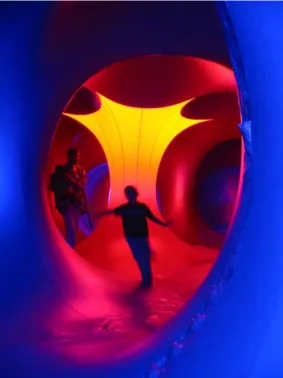
The luminarium
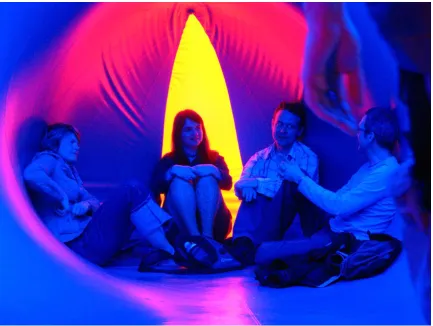
Figure 1 shows the interior of the luminarium. It consists of a series of large inter-connected tent-like chambers. These are made out of a taut, inflated fabric which when seen from the inside and illuminated only by daylight radiated vivid colours of red, blue, green and yellow. Figure 2 shows members of our research group sitting inside one of the many smaller recessed areas in the luminarium.
[Insert figures 1 and 2 about here]
We spent about an hour moving through the space together with other visitors. Several weeks after the experience we wrote memories of the event. However, at a subsequent meeting where we shared and analysed these memories we were intrigued by how, even though we had been in the same place at the same time, our experiences of the event and the generated memories differed considerably. There was some discussion about whether this was a methodological problem to be addressed in some way or whether it was a point of entry into a different set of research questions. Consider, for instance, the following memory:
He is staring through the plastic skin of the luminarium. It is orange. He is trying to get close enough so that the colour fills his eyes. This means sitting at an awkward angle, with his back to the people moving around. He can feel the plastic against his knees and feet. He wonders how long it will take before his eyes have become attuned to the colour. He feels a bit ridiculous and wonders for a moment how he must appear to onlookers. He is also aware of his friends nearby, aware that he is copying their actions of a few minutes ago and wonders, briefly, if they are
told to expect. He keeps looking and wonders how he ought to react. The colours seem to pulse, particularly around the joins in the plastic roof. He says some brief words of confirmation to his friends. The pulsing turns to flickering, like rubbing your eyes. He becomes more aware of other people moving through the dome.
This memory appears to be shot through with concerns about the nature of task itself – ‘has it been enough time yet?’. Whilst there are descriptions of the space itself and the kinds of sensations it afforded, these are mostly couched in terms of how they impinge on the effort to engage with the experience - ‘sitting at an awkward angle …He can feel the plastic against his knees and feet’. This contrasts with a second member’s rich description of the
luminarium’s ‘warm and sexy dome of red’. Here the luminarium appears to afford a less uncomfortable experience. There were also descriptions of being ‘overwhelmed’ by the colours and sensations evoked by their surroundings, whilst one member vividly described how the colours conjured both ‘good, and less good’ impressions until he was able to adjust and enjoy the different light textures. Finally, a group member reported being able to ‘melt into her surroundings’ in such a way that different ‘child-like’ memories of enjoying space freely, and without expectation, were evoked and embraced. The shared space did not then necessarily provoke a shared sense of embodied experience. Rather, many memories
revealed themes relating to expectations about the task and our ability to perform it, and our relationship to other group members in the process of doing so.
others: ‘He isn’t sure how to explore it but he sees the others experimenting and follows their lead’.
This ‘self-conscious’ move results in a less than satisfactory sense of what it was like to ‘be there’ despite references to colour and flickering. Although we had thought that we were clear in research focus, our differing experiences and written accounts of being in the Luminarium led us to wonder whether there had in fact been a lack of clarity over the purpose of the activity. The next set of extracts from the memories suggests that participation in the task/experience was only successfully addressed when situated in the confirmatory (discursive and embodied) actions of others.
Some conversation about party [venue] possibilities affirms my own sense of how the place is being experienced. Begin to play…
Engagement, through play, ensued once a consensus was understood, or loosely perceived. However, cohesion within the group was not simply driven by conversational interaction, it was also established by the embodied and spatial configurations of the activity itself,
especially once removed from the interference of others. The other people in the
luminarium were perceived in some of the memories as a barrier to group cohesion, and a stark reminder that the establishment of the group was extremely important in being able to meet our expectations of the ‘task’, and to be able to perform an active role in the process.
Finding some of the other people there annoying and noisy, wishing the group of us just had the place to ourselves…
He notices the other people in it. He wishes they weren’t there, that the group had the place to themselves so he didn’t feel so self-conscious.
in favour of connecting with others by soaking up the space, moving freely through it. Only once her movement towards the group was achieved could an appreciation of the space and its ability to ‘shift’ feeling and embodiment be achieved:
I felt more de-centred…[and] felt overwhelmed by the need to make a connection. Connection to the rest of the group. These are people I had known a long time, but hardly touched, just spoken to…I felt my body opening up, lying down freely without reservation. The colours in the spaces allowed for a certain anonymity, which provided permission for greater physical intimacy with those around me.
While it might appear that group identity, movement and interaction (recognition, mirroring, repetition) were important factors in the memories of the experience what was also
noticeable across the memories were the diversity in responses to the setting. Simply ‘sharing a space’ with a common purpose did not result in ‘sharing an experience’. Moreover, the range of embodied experiences reported indicates that the space did not hold us together in the way we had anticipated.
Summary
Embodiment and memory work relies upon group cohesion and participation, above all else. If there is uncertainty regarding the actual object (e.g. dizziness) under study, then each member can feel dislocated from the project. Furthermore, if the subject of the research (i.e. the researcher) doubts his or her ability to engage with the task and expresses anxiety in relation to the other members for not fully understanding its nature, group coherency can falter.
research, and doubts emerged about the nature of what it is that was being studied. Although the memories themselves do not describe this process directly, the difficulty or uncertainty over writing the memories was captured in a previous group discussion. For example, a number of us mentioned how difficult it was to remember exactly what occurred, given the gap between the activity and the writing. Of course, writing is itself an embodied activity and we varied in our stance towards it with some of us taking time over the writing of our memories whilst others wrote up to the deadline of the group meeting.
We also varied in what we included in the memories. Willig (2001) notes how memories should aim to be richly descriptive with attention to ‘as much circumstantial detail as possible’, for example ‘sounds, tastes and smells’ and with an openness to ‘contradiction, conflict and ambiguity’ (p.128). However, we found that this invitation could be taken up in different ways with some of us choosing to focus on describing the colours, shapes and texture of the luminarium, based on the shared (although undiscussed) assumption that this was the purpose of the writing task. Thus, this kind of ‘peripheral’ information on the context of the activity, though entirely relevant may not be what captures our embodied experiences most fully. This led us to reflect on whether it would have been more sensible to try to record our experiences directly afterwards, or even during the activity, as well as write memories a short while later. A further issue could be in the treatment of writing itself in a project on embodiment. Perhaps, it was proposed, more discussion was required on the epistemic status of writing experience, on the expectations that we each held, with a view to establishing what may be needed for the project to work more successfully. Or could it be that there was something peculiar about our departure point?
Reflections: Is embodied research impossible?
participate. That is, to engage in the experience properly rather than selectively anticipate which features might be reportable at a later date.
Now in a curious way the surfacing of this problem takes us back to one of the origins of modern psychology. As historians such as Kurt Danziger (1990) have described it, the division of labour in Wundt’s Leipzig laboratory was done precisely to manage problems such as we have encountered. The Wundtian paradigm takes as it object the contents of consciousness which are to be reported by the experimental subject. In stark contrast to the experimental psychology which would follow, the subject is the most important part of the research since the subject is the ‘authority’ on their own consciousness. The experimenter then assumes the role of recorder, in effect acting as the amanuensis of the subject. Finally the writing up of the results is seen as another distinct role altogether. But what is interesting about this set-up, Danziger observes, is that all three roles are seen as complementary and as requiring professional training to be accomplished. Only a trained researcher can act as a suitable experimental subject, for example. Moreover in Wundt’s laboratory researchers would regularly shift between the three roles.
retrospectively is hardly surprisingly, given our substantive, albeit unanticipated reproduction of Wundtian logic.
Thus some of the practical problems we have been describing – such as the difficulty of maintaining group cohesion, the dilemma of separating experiencing from reporting, and the collective problem of knowing what (if anything) to publish and how to accomplish a final written text – might be said to be directly emanate from the ‘primal scene’ of experimental psychology (i.e. the Wundtian Leipzig set-up). But does that also mean that the conceptual problems we have been grappling with are similarly derived from an experimental tradition? This is more questionable, and we would like to conclude with a discussion of why we feel that this is perhaps not the case. To do so we will return to a very different late nineteenth century perspective on the psychological.
Dewey and the puzzle of perspective
In chapter two of The Principles of Psychology, William James constructs an alarming example.
An infant reaches curiously towards the flame of a candle. She feels sudden burning in her fingers and snatches her hand back. What has just happened? The most obvious way to grasp this example is to break it into component parts. There is a candle, emitting warmth and light. The infant’s sensory system picks up these sensations, which attract her conscious attention. She moves her hand forward to explore, but instantly experiences a new sensation – pain – which triggers off an automatic motor response. We might then want to seal this example by adding something in about learning or reflection. Indeed this is what James does in his ‘motor theory of consciousness’, where he has conscious reflection entering into human action only secondarily, as the means of making sense of our acts post-hoc.
into consciousness. The body is interesting in so far as it realises our goals and plans. It is this broadened view of embodiment that we have been seeking to explore.
Our methods may have lead us back to one of the origins of psychology, but our conceptual aspirations have taken us back to another origin – the so-called ‘functional psychology’ of the late nineteenth/early twentieth century (exemplified by James, John Dewey and George Herbert Mead). In historical terms it is traditional to treat this early psychology as merely an interesting precursor to the better established intellectual movements that would follow – in this case either behaviourism or, for the sociological tradition, symbolic interactionism. But what is perhaps more interesting about this work is its systematic attempt to move from
philosophical difficulties around empiricism (see, for instance, James’ The meaning of truth) to
their practical exploration in the context of the experimental vigour of the then nascent North American psychology. The fact that the majority of the major proponents of this approach came eventually to bitterly regret their involvement makes this focus on the specific terms of functional psychology more rather than less interesting, we would argue (James later came to see psychology as a ‘loathsome, distended, tumified, bloated dropsical mass’, whilst Dewey confessed that ‘Psychology got so frightfully off in trying to be scientific (Thorndike et all) I quit – it was a mistake’ – see Brown & Stenner, 2009: 20).
In his classic essay ‘The reflex arc concept in psychology’ (1896) Dewey makes use of the infant-candle example. Dewey’s statements about psychology are in dialogue with James and his vision of cautious psychological experimentation, coupled with a ‘functional’ approach to human action. Dewey is no armchair philosopher, but someone interested in descriptions of human action which explicate its organisation (Dewey speaks of ‘co-ordination’). In this sense Dewey is writing against Kant and the Kantian tradition of restricting knowledge merely to hypothesising general conditions of experience against a backdrop of
things-in-themselves (noumena) which elude any complete knowledge. Like James, Dewey wants to
Dewey’s essay begins by taking aim at the ‘reflex arc’ concept. This is a nineteenth century term which makes sense of the relation between stimulus and response by postulating that environmental objects trigger sensations which give rise to motor responses. The infant touches the candle, feels pain and snatches her hand back. Defined in this way, the body is a vehicle for movement in which stimuli are linked to an array of motor responses. The chaining together of these stimulus-response patterns into complex patterns of ‘behaviour’ would become the basis for operationalism (but crucially Dewey is writing before a general category of ‘behaviour’ was invented as a way of packaging up – and hence neglecting! – all of the problems which are attendant on understanding the chaining of environment with human action – see Danziger, 1997). As Dewey notes:
It is not a question of making the account of the process more complicated, though it is always wise to beware of that false simplicity which is reached by leaving out of account a large part of the problem. It is a question of finding out what stimulus or sensation, what movement and response mean; a question of seeing that they mean distinctions of flexible function only, not of fixed existence; that one and the same occurrence plays either or both parts, according to the shift of interest; and that because of this functional distinction and relationship, the supposed problem of the adjustment of one to the other,
whether by superior force in the stimulus or an agency ad hoc in the center of the soul, is a
purely self-created problem. (Dewey, 1896 p.363-4)
The relationship between stimulus and response outlined in the reflex arc is not sufficient. It is not sufficient because it treats both as entities that are separable in principle and in
flame which singes us as we press close to the fire does not burn in the same way because it is already loaded up into a pattern of planful action).
Dewey then goes on to argue that, in a sense, it is the response that defines the stimulus. Because we only encounter the ‘stimulus’ with reference to possible sensations, and these sensations are themselves only understandable with reference to the possible ‘responses’ we are engaged in, it makes sense to say that the flow of our current and anticipated actions (i.e. response) actually determines or lends value to our perceptual acts of engagement with the world (i.e. stimulus). So psychology has a ‘self-made problem’ based on the conceptual muddle of trying to separate and establish a causal link between a single complex of perception-action-engagement where every term is interdependent.
What is interesting here is that Dewey is developing a language that emphasises
If we take this insight back to our own work, we will be forced to conclude that the separation of reporting/recording from experiencing (i.e. the Wundtian set-up) will always create difficulties because it is literally a shift between two different action-complexes, and hence the relationship between experience (crudely ‘response’) and what experience is about (even more crudely ‘stimulus’) will be completely altered. To coin a crude metaphor, a shift between action-complexes completely re-shuffles the deck of values and significance with respect to experience. For example, our engagement with the luminarium was structured by the shared action-complex of attempting to explore/experience the space. As such, anxieties and pleasures co-existed as potential ways for that complex to be developed in the course of our joint engagement. However the process of writing memories constituted an entirely new action-complex which effectively seized or took hold of the former. From the perspective of this second action-complex, relationships between the group, the physical space and the joint activity become rearranged. What were at the time unfolding relationships, all
interdependent with one another, become somewhat simplified. The activity of experiencing luminarium becomes either ‘pleasurable’ or ‘anxiety provoking’.
For example, this particular infant, left alone in a darkened room with only a candle, was anxious for the return of her mother, who she was seeking, but then feeling the warmth and glow of the candlelight was momentarily distracted, her hand then coming too close, felt a slight pain, as she snatched her hand away she cried both from the sensation and from the rising frustration and fear of abandonment that began to overwhelm her. The concrete conditions of this particular experience would then be expressed by a description of the nexus of family relationships in which it comes to pass that an infant is left in a candlelit room, the particular character of the physical space and organization of the home and the range of potential affects which the baby might experience. To describe such a densely interlinked set of conditions could potentially lead us into wider questions of childhood, family life, domestic space etc. In principle, the range of potential conditions is immense. The task would then be to make an argument for which aspects of the complex arrangement of bodies, spaces and practices are most directly relevant for an understanding of this
particular episode.
Our methodological practice has concentrated on the concrete rather than the abstract. But, in Dewey’s terms, we have done something odd in our analysis. We have tried, in the
dizziness work, to try and hold ‘dizziness’ still as something like either a class of stimuli (a set of sensations) or a set of responses (a set of actions). We did this – admittedly in an arbitrary sense – as the means of comparing the memories. But whatever dizziness is (it can jump places as stimuli or response, depending on where we choose to stop the process we are describing), depends entirely on the action-complexes in which it is embedded and the thresholds between them. For example, the dizziness that was experienced by the sisters as they engaged in the game of rolling boxes is a specific feature of the way in which this relationship is played out in a particular domestic space. Of course aspects of what happens here draw upon wider codes of gendered performance, notions of what beings sisters means, the organization of family space in relation to children and so on. But dizziness constitutes a highly specific way in which this action-complex is experienced. It has a unique tone here.
to look at how these wildly diverse sets of conditions and subsequent experiences might communicate (or not) with each other. To start in this way would be mean beginning with the relations that make up the action complex and then exploring how their combination affords particular kinds of experiences. For instance, the luminarium was a very specific kind of material and social space. Its particular construction facilitated certain kinds of sensory experience (both visual and tactile). The deployment of the luminarium as a piece of ‘public art’ helped to define particular ways in which that space was populated and certain kinds of interactions as either encouraged or discouraged. Our own history and ongoing relationships as a research group engaged in a specific research project was then coupled to this space in a series of complex ways. Together all of this formed an action-complex – or to put it in other terms, an ‘assemblage’ of relations and potential experiences (see Deleuze, 1988).
In methodological terms much of what we have been searching for is already prefigured in what James came to call ‘radical empiricism’ (and what Stenner (2008) has recently termed ‘deep empiricism’). Schematically this consists of 1) treating the phenomenon concerned as an ‘event’ or ‘occasion’ that is irreducible to any other; 2) providing extensive ‘thick’
description of the relations that afford concrete specific experiences; 3) treating subjects and objects, persons and spaces, bodies and their capacities to act on one another, as relationally defined within the given assemblage or action-complex; 4) creating concepts to deduce how particular kinds of experiences may have their place in this complex and as a means of circumscribing limits around potentially relevant conditions.
The contrast between this form of empiricism and that which we initially employed to analyse the dizziness memories can be summed up in the following ways. Radical empiricism
focuses on relations rather than persons. In the luminarium, for instance, the place to begin
ought to be with what goes on between the group members as they interact with the space and with each other rather than with the differences between individuals per se. Relations are
understood with reference to a concrete assemblage or action-complex rather than a broad context.
In this way dizziness is not explained by looking at the different contexts in which it is experienced (i.e. childhood games, adult experiences of social drinking), but instead by describing the particular kind of arrangement of relations which is in play in a given event.
to fix a phenomenon by ensuring that the same ‘stimuli’ are experienced, as we tried to do in the luminarium study, is necessarily doomed because the physical environment is only one aspect of a set of relationships that may be combined to form different sorts of events or occasions, some of which may co-exist alongside one another (e.g. the ‘pleasure of play’
alongside the ‘anxiety of task failure’). Concepts are used to illuminate specific concrete experiences
instead of generalising the matter at hand to a general type of experiences. In the analysis of the
dizziness memories, for example, we rushed too quickly towards the concept of ‘control’ as an attempt to link very different sorts of experiences. As a consequence it failed to illuminate anything specific about the particular memories we were concerned with. It did not, for instance, assist us in drawing out the particular mixture of pleasure and fear threaded through the performance of sibling relationships that was at work in the box-rolling memory. We would have been better off trying to construct a specially made concept that named and elaborated this particular occasion, and used this as a way of sharpening the concrete differences between the other memories.
To conclude, the irony of our return to these early forms of psychology is not lost upon us. This may appear to be a regressive step. Why on earth turn from the apparent precision and efficacy of contemporary qualitative methods such as conversation and discourse analysis towards an apparently anachronistic model of participant-researchers experimenting with the research setting? And why layer such a procedure with such frankly metaphysical
speculation? Our argument is that we have been led to make this turn because there are two important lessons from early psychology whose significance has returned with some force. To research embodiment adequately means recognising the importance of the fleshy, embodied character of psychological thinking and analysis. It means not merely
acknowledging but making central our embodied participation in the process of research. The French expression ‘faire une experience’, meaning both ‘to conduct an experiment’ and ‘to have an experience’ neatly captures this interdependency. At the same time the nature of experience, the complexity and the indeterminacy of unfolding occasions or events, means
that attempts to categorise and classify experiences sui generis will always tend to overlook
private and stopping at the boundaries of our own skin. Radical empiricism is not, as is sometimes argued, an ‘anti-metaphysical’ or ‘a-theoretical’ procedure of focussing on ‘what is there’ (in the experimental data, or in the audio or video recording). It is recognition of the unfinished, relational and emergent character of experience. In order to express that it will be necessary to go beyond what can be taped or recorded in order to describe the conditions of specific experiences. As such we will need to invent concepts ‘along the way’ as tools to assist in this descriptive labour such that at any point we can make visible why we have chose circumscribe an event or occasion in a particular way. The point is neither to search for faux precision nor to engage in theoretical speculation for its own sake but rather to do justice to the complexity of embodied experience, however difficult that proves to be.
References
Apperley, A. (1997) ‘Foucault and the problem of Method’. In M. Lloyd & A. Thacker (Eds.)
The Impact of Foucault on the Social Sciences and Humanities London: Palgrave Macmillan.
Bayer, B. M., & Ror Malone, K. (1996). Feminism, psychology and matters of the body. Theory and Psychology, 6(4), 667-692.
Blackman, L. (2005). The dialogical self, flexibility and the cultural production of
psychopathology. Theory and Psychology, 15(5), 183-206.
Blackman, L. (2008) The body. Oxford: Berg.
Bondi, L., Smith, M. & Davidson, J.D. (eds) (2005) Emotional geographies. London: Ashgate.
Bordo, S. (1993) Unbearable Weight: Feminism, Western Culture and the Body. Berkeley, CA:
University of California Press.
Bourdieu. P. (1977) Outline of a theory of practice. Cambridge: Cambridge University Press.
Bourdieu, P. (1986) Distinction: A social critique of the judgement of taste. London: Routledge.
Boyne, R. (1999) Citation and Subjectivity: Towards a Return of the Embodied Will. Body &
Society, 5(2-3): 209-25.
Brown, S.D. (2001). Psychology and the art of living. Theory & Psychology, 11, 2. 171-192
Brown, S.D. & Stenner, P. (2009) Psychology without foundations: History, philosophy and psychosocial
theory. London: Sage.
Burkitt, I. (1999). Bodies of Thought: embodiment, identity and modernity. London: Sage
Publications.
Connerton, P. (1989) How societies remember. Cambridge: Cambridge University Press.
Crawford, J., Kippax, S., Onyx, J., Gault, U. & Benton, P. (1992). Emotion and Gender:
Constructing Meaning from Memory. London: Sage.
Cromby, J. (2005). Theorising Embodied Subjectivity. International Journal of Critical Psychology
(15), 133-150.
Danziger, K. (1990). Constructing the subject. Cambridge: Cambridge University Press.
Danziger, K. (1997) Naming the mind: How psychology found its language. London: Sage,
Deleuze, G. (1988) Foucault. Minneapolis: Minnesota University Press.
Dewey, J. (1896) The reflex arc concept in psychology, Psychological Review, 3, 357-370.
Featherstone, M., Hepworth, M. & Turner, B.S. (Eds) (1991) The body: Social process and cultural
theory. London: Sage.
Feher, M., Naddaff, R. & Tazi, N. (1989) Fragments for a history of the human body. Parts
One-Three. New York: Zone.
Foucault, M. (1977). Discipline and punish: The birth of the prison. (A. Sheridan, Trans.).
Harmondsworth: Penguin.
Foucault, M. (1979). The history of sexuality Volume 1: The will to know. (R. Hurley, Trans.).
Harmondsworth: Penguin.
Foucault, M. (1984). On the genealogy of ethics: An overview of work in progress. In P.
Rabinow (Ed) The Foucault reader: An introduction to Foucault’s thought. Harmondsworth:
Penguin.
Gillies, V., Harden, A., Johnson, K., Reavey, P., Strange, V. & Willig, C. (2004), Women's collective constructions of embodied practices through memory work: An
exploration of memories of sweating and pain, British Journal of Social Psychology, 43:
99-112.
Gillies, V., Harden, A., Johnson, K., Reavey, P., Strange, V. & Willig, C. (2005), Painting Pictures of Embodied Experience: The Use of Non-Linguistic Data in the Study of
Embodiment. Qualitative Research in Psychology, Vol. 2 (3): 199-212.
Harré, R. (1991a). Physical being: A theory for a corporeal psychology. Oxford: Blackwell.
Harre, R. (1991b). The discursive production of selves. Theory and Psychology, 1, 51-63.
Haug, F. (ed). (1987). Female Sexualisation. London: Verso.
Hepburn, A. (2006). Getting closer at a distance: theory and the contingencies of practice.
Hermans, H. (2002). The dialogical self as a society of mind. Theory and Psychology, 12(2), 147-160.
Heyes, C. (2007). Cosmetic Surgery and the Televisual Makeover. Feminist Media Studies, 7(1):
17-32.
Hollway, W. (1989). Subjectivity and Method in Psychology. London: Sage Publications.
James, W. (1890) Principles of Psychology, New York: Holt.
Johnson, L. (2002). Thinking Beyond the Brain: embodiment and the psycho-somatic. International Journal of Critical Psychology, 5, 51-70.
Johnson, K. (2007) Changing Sex, Changing Self: Transitions in Embodied Subjectivity. Men
& Masculinities, 10 (1): 54-70.
Lakoff, G. & Johnson, M. (1999) Philosophy in the flesh: The embodied mind and its challenge to
Western thought. New York: Basic Books.
Langer, S. (1967). Mind: an essay on human feeling (Vol. 1). Baltimore: The Johns Hopkins
University Press.
Laqueur, T. (1990) Making sex: Body and gender from the Greeks to Freud. Cambridge, Mass:
Harvard University Press.
Larkin, M., Watts, S., & Clifton, E. (2006). Giving Voice and Making Sense in Interpretative
Phenomenological Analysis. Qualitative Research in Psychology, 3, 102-120.
Lupton, D. & Seymour, W. (2000). Technology, selfhood and physical disability. Social Science
and Medicine, 50(12): 1851-1862.
Massumi, B. (2002). Parables for the Virtual: movement, affect, sensation. Durham, N.C.: Duke
University Press.
Mauss, M. (1992) Techniques of the body. In J. Crary & S. Kwinter (Eds) Incorporations. New
York: Zone.
Mauss, M. (2006) Techniques, technology and civilization. Oxford: Berghahn Books.
Merleau-Ponty, M. (1969) The visible and the invisible. Northwestern University Press.
Merleau-Ponty, M (2002) The phenomenology of perception. 2nd ed. London: Routledge.
Morgan, M. (2005). Remembering Embodied Domination: questions of critical/feminist
psy-discourse on the body. Theory and Psychology, 15(3), 357-372.
Pitts, V. (2003). In the Flesh: The Cultural Politics of Body Modification. London: Palgrave. Potter, J., & Wetherell, M. (1987). Discourse and Social Psychology: beyond attitudes and behaviour.
Probyn, E. (1993) Sexing the Self: Gendered Positions in Cultural Studies. London: Routledge. Reavey, P. (2009) The space of memory: rethinking agency through materiality. In J. Haaken
& P. Reavey (eds) Memory matters: Contexts for understanding recollections of child sexual
abuse. London: Routledge.
Rohrer, T. (2001). Pragmatism, Ideology and Embodiment: William James and the Philosophical Foundations of Cognitive Linguistics. In Dirven, R., Hawkins, B. &
Sandikcioglu, E. (Eds) Language and Ideology Volume 1: Theoretical Cognitive Approaches
(pp. 49-81). Amsterdam: John Benjamins.
Rohrer, T. (2007). The Body in Space: Embodiment, Experientalism and Linguistic
Conceptualization. In Zlatev, J., Ziemke, T., Frank, R., & Dirven, R. (Eds.) Body,
Language and Mind, Vol. 2. Berlin: Mouton de Gruyter.
Shilling, C. (2003) The body and social theory. 2nd ed. London: Sage.
Shilling, C. (ed) (2007). Embodying Sociology: Retrospect, Progress,and Prospects. London: Blackwell
Publishing.
Silverman, H.J. (1987) Inscriptions: After phenomenology and structuralism. Northwestern
University Press.
Smith, J. A., & Osborn, M. (2003). Interpretative Phenomenological Analysis. In J. A. Smith (Ed.), Qualitative Psychology: a practical guide to methods (pp. 51-80). London: Sage.
Stam, H. J. (1987). The psychology of control: A textual critique. In H. J. Stam, T. B. Rogers, & K. J.Gergen (Eds.) The analysis of psychological theory: Metapsychological perspectives. Washington: Hemisphere.
Stam, H. (1998). The Body's Psychology and Psychology's Body. In H. Stam (Ed.), The Body
and Psychology (pp. 1-12). London: Sage Publications.
Stenner, P. (2008). A. N. Whitehead and subjectivity. Subjectivity, 22: 90-109.
Stephenson, N., & Papadopoulos, D. (2007). Analysing Everyday Experience: social research and
political change. London: Palgrave Macmillan.
Thrift, N. (2007) Non-representational theory: Space, politics, affect. London: Routledge. Tolman, C. (1994). Psychology, Society, Subjectivity: an introduction to German Critical Psychology.
London: Routledge.
Turner, B.S. (2008) The body and society: Explorations in social theory. 3rd ed. London: Sage. Ussher, J. (ed) (1997) Body talk: Material and discursive regulation of madness, politics and
Willig, C. (2001). Introducing Qualitative Research in Psychology. Buckingham: Open University Press.
Yardley, L. (ed) (1997) Material discourses of health and illness. London: Routledge.
Young, I.M. (2005) On female body experience: Throwing like a girl and other essays. New York:
[image:33.612.90.373.247.625.2]Oxford University Press.